Showing posts sorted by date for query China top destination. Sort by relevance Show all posts

Monday, August 24, 2026

AI on Wheels: My Experience With Tesla Full Self Drive (FSD)

Recently, I saw a news story suggesting that “more and more seniors are using Tesla FSD (full self drive)”. This prompted me to share my own experience with my readers.

Tesla FSD Warning


My wife and I have been regularly using Tesla Full Self Drive (Supervised FSD) software for several months now. It is a subscription costing us $108.16, including tax, per vehicle. Our experience has generally been positive. We set our destination in the navigation system and let FSD drive us. It pulls out of our driveway, takes us wherever we want to go, and parks on the street, in a parking lot, or in a garage. On occasion, though, we have had to take control when we felt it was necessary, often in response to Tesla warning to “take over immediately”.

Tesla Sensors. Source: Car and Driver Magazine


Both of our Tesla Model Y vehicles use hardware version 3 (HW3). In addition to a computer, HW3 includes 7 cameras and four ultrasonic sensors. We get frequent Tesla software updates, downloaded over the air. As of today, we're on software version 2026.21.6, including FSD v14.3.7.  The latest hardware version on new Tesla vehicles is HW4. Tesla recently outlined details on Full Self-Driving (FSD) v15, describing it as a major "step-change" in capability featuring a 10-billion parameter neural network. Tesla confirmed that current Hardware 4 (AI4) computers will natively support v15 and unsupervised features, targeting a late 2026 to early 2027 rollout window. 

Tesla FSD Speed Modes. Source: Jowua


Tesla FSD allows you to choose a driving mode. The choices include Sloth (least aggressive), Chill, Standard, Hurry and Mad Max (most aggressive). Here are more detail on each speed mode:

Sloth: The most cautious setting. It stays strictly at or slightly below the speed limit, favors slow right lanes on highways, and avoids proactive passing. 

Chill: A relaxed, smooth profile. It generally targets the exact speed limit and makes fewer or less urgent lane changes.

Standard: The balanced, default setup. It typically drives roughly 5 to 7 mph over the speed limit (traffic permitting) and maintains an average commuting pace.

Hurry: A faster profile designed for quicker travel times. It allows higher offsets above the speed limit and executes more assertive lane changes to pass slower vehicles.

Mad Max: The most assertive profile, built for heavy gridlock or aggressive urban environments (like dense city traffic). It proactively navigates gaps, moves swiftly around traffic flow, and executes maneuvers with higher urgency.

We drive mostly in Standard or Hurry modes. The best part my wife likes is how smoothly it changes lanes even in high traffic conditions. One particular place where it has eliminated her stress is on Oakland Maze, where her route requires 5 quick lane changes to go from one freeway to another. 

Waymo Robotaxi With LiDAR mounted on top


There have been several instances where we have had to intervene to take control of the vehicle. These include loss of control when the front camera is blinded by direct sun at certain times of the day. This problem would probably not occur if Tesla vehicles were equipped with a LiDAR scanner that uses laser light pulses to measure distances and create accurate, 3D digital models of objects and environments. Robotaxis like Google's Waymo and Amazon's Zoox use LiDAR devices to achieve fully autonomous driving. However, like the rest of Tesla's vehicle lineup and Full Self-Driving stack, the recently announced Cybercab robotaxi also relies entirely on a vision-based camera system and onboard AI to interpret its surroundings. 

In other instances, our Tesla car ran a stop sign that was blocked by a parked truck. It failed to read "STOP" painted on the road surface.  At a local Safeway supermarket, it attempted to park in a shopping cart corral. A couple of times after pulling out of our driveway, it took a wrong turn but found its way back to the correct route after taking a detour. 

Rapid development and deployment of AI applications like Tesla full self drive and various robotaxi services, including Waymo and Zoox, have broad social and economic implications. It is likely to make transportation safer, but it also threatens the livelihoods of tens of millions of taxi and truck drivers around the world.  There have already been protests by drivers' unions in many major cities like London and New York.

Related Links:

Haq's Musings

South Asia Investor Review

My Family's Contribution to Climate Action

Pakistan Joins China in World AI Cooperation Organization

Pakistani-Americans Largest Foreign-Born Muslim Group in Silicon Valley

A Personal Story: When My Heart Stopped in San Francisco

In Memory of My Loving Mother Rafiqa Khatoon

Silicon Valley Pakistani-Americans

Pakistani-American Leads Silicon Valley's Top Incubator

Silicon Valley Pakistanis Enabling 2nd Machine Revolution

Pakistan EV Launches to Accelerate Energy Transition

Pakistani-American Ashar Aziz's Fire-eye Goes Public

Pakistani-American Doctor Honored By President Obama

Pakistani-American's Game-Changing Vision 

Minorities Are Majority in Silicon Valley 

Over A Million Pakistani University Students Enrolled in STEM Fields

Tuesday, July 15, 2025

Pakistani International Students Flocking to European Universities

Recent data shows that there are nearly 10,000 Pakistani students attending colleges and universities in Germany. This figure is second only to the United Kingdom which issued over 35,000 student visas to Pakistanis in 2024. The second most popular destination for Pakistani students is Australia which is hosting nearly 24,000 students from Pakistan as of 2023, according to the ICEF Monitor

Top Countries of Origin For International Students in Germany 2024. Source: Study in Germany


Here's a list of the top 15 countries of origin of foreign students in Germany in 2024: 

India 49,008

China 38,687

Turkey 18,084

Austria 15,379

Iran 15,159

Syria 13,379

Russia 10,593

Italy 10,154

Ukraine 9,914

Pakistan 9,873

Egypt 8,060

Morocco 7,398

Tunisia 6,852

Cameroon 6,789

France 6,759

This year, Pakistani students won 114 Erasmus Mundus EU Scholarships, the highest number in the world. This makes Pakistan the top country receiving these scholarships for the fourth consecutive year. The Erasmus Mundus Scholarship is a prestigious European scholarship program for graduates, funding joint master's degrees at prestigious universities across multiple countries.

Pakistani Students Received the Highest Number of EU Scholarships in 2025. Source: EU


Here's the list of top countries of EU Scholarship Winners in 2025: 

1. 🇵🇰 Pakistan: 114

2. 🇮🇳 India: 96

3. 🇧🇩 Bangladesh: 95

4. 🇲🇽 Mexico: 93

5. 🇳🇬 Nigeria: 75

6. 🇧🇷 Brazil: 73

7.  🇪🇸 Spain: 65

8. 🇺🇸 USA: 62

9. 🇪🇬 Egypt: 61

10. 🇩🇪 Germany: 61

Pakistan is third, after only China and India, in terms of the size of its college-aged population, according to the United Nations. The British Council expects growth in Pakistani outbound mobility to be among highest in the world over the next decade, along with China, India, Nigeria, and Bangladesh.

Acceptance rate in Pakistani universities and degree colleges was just 13.5% in 2022. Only 541,043 students were accepted from 4,085,185 students who applied. The country produced 471,306 university graduates in 2020-21. Of these, 157,102 were in STEM fields, including 43,000 graduates in information technology (IT).  

Pakistan’s gross tertiary enrollment (GER) ratio was only 13% in 2023, according to UNESCO. This is much lower than in India, and lower than in Bangladesh and Sri Lanka as well. Of 109 countries UNESCO profiled in 2021, Pakistan’s tertiary GER was 100th. Given Pakistan’s huge college-aged population, there is serious unmet demand for higher education, according to the ICEF Monitor. 

Recent data on which destinations are hosting the most Pakistani students include:

UK: 34,690 in 2022/23 (+50% y-o-y)

China: 28,000 before the pandemic

UAE: 24,865 in 2020 according to UNESCO

Australia: 23,380 in 2023 (+49%)

US: 10,165 in 2022/23 (+16%)

Germany: 8,210 in 2022/23 (+22%)

Kyrgyzstan: 6,000 in 2020 according to UNESCO

Malaysia: 5,000 in 2023

Canada: 4,750 in 2023 (+101%)

Turkey: 2,385 in 2020 according to UNESCO

Saudi Arabia, South Korea, Sweden, Qatar: At least 4,000 in 2020 according to UNESCO


Tuesday, March 4, 2025

Growing China-Pakistan Space Cooperation

A Pakistani astronaut is scheduled to be the first non-Chinese person to go to Tiangong, the Chinese Space Station, according to media reports. Last year, China put a Pakistani satellite ICUBE-Q aboard its historic Chiang’e 6 mission into the moon’s orbit, designed to retrieve samples from the little explored far side of the moon. Weeks later, Beijing put another Pakistani communication satellite into orbit. The two sides have also announced that China’s Chang’e 8 moon lander mission in 2028 will carry a Pakistani rover to explore the moon's surface. 


Space science is a lot more than rocket science. It goes well beyond building booster rockets for satellite launches. It includes various fields like physics, astronomy, biology, chemistry, and engineering to study phenomena in space and collect and analyze data about activities on earth.  Pakistan-China space cooperation is yet another confirmation of the close and growing scientific ties between the two countries. Tens of thousands of Pakistani students are currently attending Chinese universities which are among the best in the world. Thousands of Pakistani engineers and scientists are closely working with their Chinese counterparts on multiple projects. It is great opportunity for Pakistanis to learn from astounding scientific and technological achievements of their Chinese counterparts. 

Chinese researchers dominate global AI research, according to Marco Polo which tracks global AI talent. China dominates the top 10 science institutions, with the Chinese Academy of Sciences (CAS), the University of Science and Technology of China (USTC) and Tsinghua University taking the top three spots, according to the Science Journal Nature. Only two non-Chinese institutions broke into the top 10 – the Max Planck Society in Germany at No 4 and the French National Center for Scientific Research at No 10. The top three US institutions – the Massachusetts Institute of Technology, Harvard University and Stanford University – were ranked at 13th, 16th and 20th, respectively.

Analysts believe that China's real focus is on industrial applications for Artificial Intelligence (AI) rather than chatbots like ChatGPT or DeepSeek. Chinese are working to use the underlying technology to develop affordable, commercially viable business solutions, according to Jacob Dreyer who recently wrote an article for science journal Nature. "Its applications can then be exported, especially to lower-income countries. In other words, China’s target is not necessarily ‘frontier AI’, but ‘mass-market AI’. Its emerging AI playbook mirrors its approach to other technologies, such as electric vehicles and clean energy: not the first to innovate, but the first to make them affordable for widespread use". 


Sunday, August 18, 2024

Pakistan EV Launches to Accelerate Clean Energy Transition

Pakistani automobile joint ventures with Chinese automakers BYD and Changan have recently launched several all-electric and plug-in hybrid models of automobiles in Pakistan. Earlier, Honda Atlas Cars Pakistan Limited announced plans to build a hybrid electric vehicles plant in the country. Other major brands like Toyota, Haval, and Hyundai are already offering similar models in the country. It all began with the 2019 electric vehicle policy approved by the government of Prime Minister Imran Khan to incentivize the electrification of the auto industry. Pakistan EV policy goal is to achieve 30% of new cars sales, 50% of new 2-wheeler and 3-wheeler sales and 30% of new truck sales by 2030. By 2040, the target is 90% of all new vehicle sales to be electric. The main incentive is the reduction of sales tax from 17% for internal combustion engine (ICE) vehicles to 1% for all-electric (EV) vehicles.


BYD EV. Source: CNBC


BYD Launch:

Chinese electric vehicle giant BYD has announced plans to open an EV production plant in Karachi.  It will start selling three EV models in Pakistan through a partnership with Mega Motors. Mega Motors is a unit of Pakistan's largest private utility Hub Power Co Ltd (HPWR.PSX), known as Hubco. 

"Our entry into the Pakistani market is not just about bringing advanced vehicles to consumers," said Liu Xueliang, BYD's general manager for Asia Pacific, according to Reuters. "It's about driving a broader vision of environmental responsibility and technological innovation." "We will establish Pakistan's first NEV assembly plant... dedicated to producing BYD's cutting-edge new energy vehicles," said Hubco Chief Executive Kamran Kamal, who described the deal as a "landmark investment".

The BYD factory will be built near Karachi’s Port Qasim area that already houses assembly plants for other automobile companies including Toyota, Suzuki Motor Corp. and Kia Corp.’s local units. It will be completed in the first half of 2026, according to Bloomberg. 

Last year, BYD’s total production – comprising battery-only powered cars as well as hybrids – was more than 3 million and surpassed Tesla’s production of 1.84 million cars for a second straight year, according to CNBC

A BYD model comparable to Tesla Model Y is $10,000 cheaper and has more features, according to news reports

Changan Launch: 

Master Changan Motors Limited (MCML), a joint venture between Pakistan's Master Group of Industries and China's Changan International, launched Changan’s electric-first brand, DEEPAL, this month in Karachi, Pakistan.  The joint venture unveiled the brand Deepal with 2 models, L07, the pure electric sports luxury sedan and S07 the pure electric premium SUV. 

Both Changan models offer 250 HP and 320 Nm of instant torque, going from  0-100 km/hr in just 5.9 seconds. The Ternary Lithium battery by CATL has a capacity of 66.8 kWh and provides an exceptional range of up to 540 km in L07 and 485 km in S07. The cars are designed in Italy in Changan’s R&D center and have won the German RedDot design award in 2023 with its futuristic design, according to media reports

Changan has sold 45,000 cars in Pakistan in the last 5 years. 

Honda Atlas:

Last month Honda Atlas Cars Pakistan Limited (HACPL) announced its plan to invest Rs. 5 billion in a cutting-edge hybrid vehicle production facility in Pakistan. This investment will support the local manufacturing and assembly of hybrid electric vehicles (HEVs). 

The company recently reported a 324% jump in sales, totaling Rs. 15.97 billion compared to Rs. 3.77 billion in the same period last year. The company reported a gross profit of Rs. 1.01 billion for the first quarter of FY25.

Two and Three Wheelers:

Prior to the BYD and Changan EV launches, Pakistan granted EV manufacturing licenses to 32 local companies under the EV Policy 2019, according to the Business Recorder newspaper.  Metro Electric Bikes, VLEKTRA and Sazgar Engineering Works are among the key names leading the two and three wheeler EV manufacturing in Pakistan. 

“Motorcycle buyers have started to inquire about electric bikes, scooty, and scooters options. I believe many have postponed buying a normal two-wheeler with expectations that an electric two-wheel model may soon enter the market that is closer to their need,” said Sabir Sheikh, who is also the Chairman, Association of Pakistan Motorcycle Assemblers (APMA), according to media reports. 

Charging Infrastructure: 

A number of investors, including ADM Group, Hashoo Group and Hubco are planning to invest in building a nationwide EV charging stations network. The EV policy provides incentives for it by reducing import duty on charging equipment imports to just 1% and lower power tariffs. It also ensures uninterrupted power supply on feeders fir charging stations. 

Hubco said it will setup fast-charging stations across major cities, motorways and highways to enhance Pakistan's charging infrastructure, according to Reuters.  The EV policy calls for at least one fast DC charging station per 3km by 3km area in all major cities as well as DC fast chargers on all motorways every 15-30 km.

Soaring Imports of Chinese Solar Panels in Pakistan. Source: Bloomberg


Solar Power Boom:

With rapidly falling solar panel prices, Pakistan is experiencing a solar power boom in the country. The country imported some 13 gigawatts of solar modules in the first six months of the year, making it the third-largest destination for Chinese exporters, according to Bloomberg.

Rapid increase in solar power generation complements Pakistan's push to a clean energy economy and EV adoption. This may encourage some of the charging station operators to go solar with batteries to reduce their cost of power purchases from the grid. 

Climate Action:

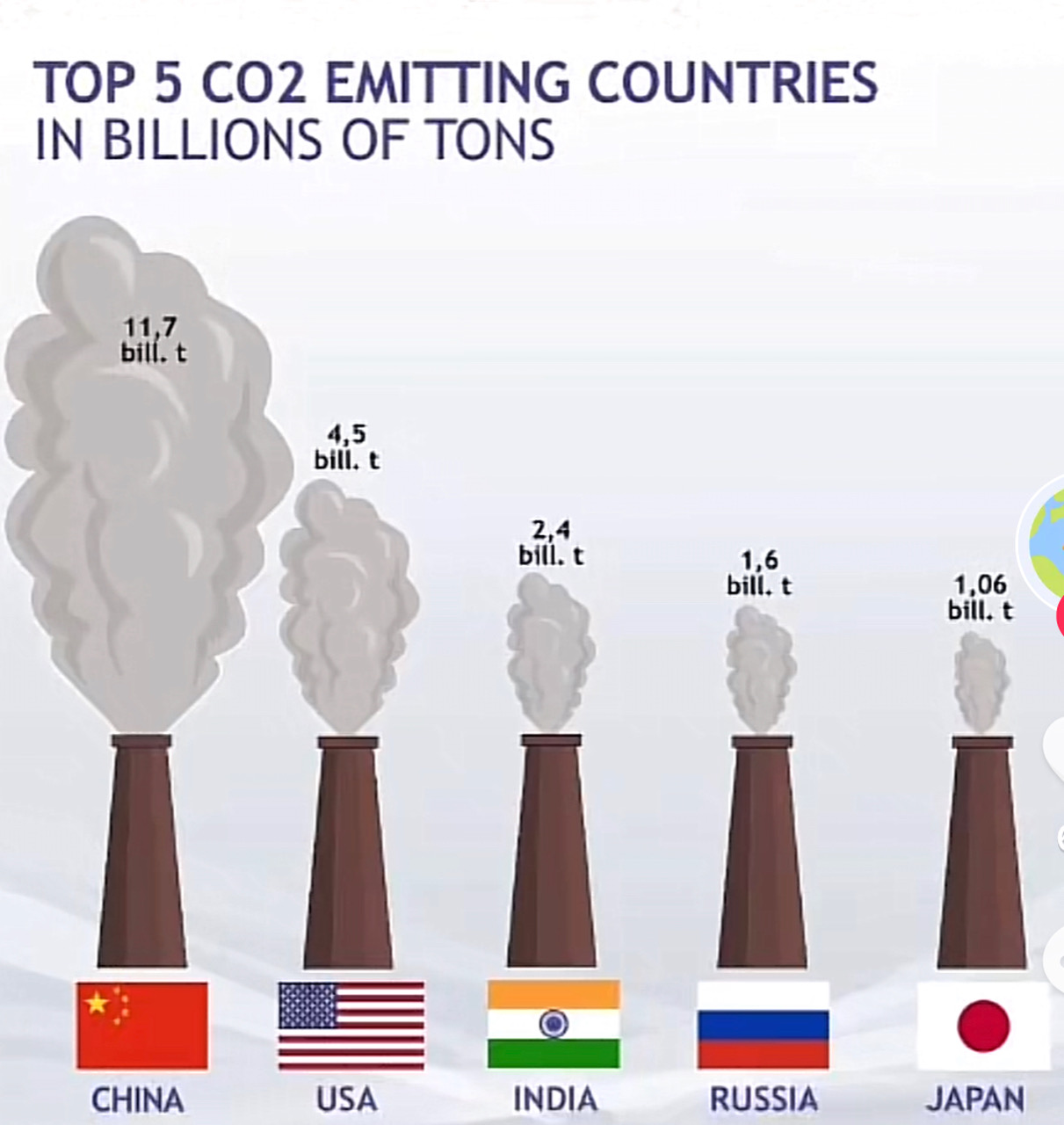
Pakistan has contributed only 0.28% of the CO2 emissions but it is among the biggest victims of climate change. The US, Europe, India, China and Japan, the world's biggest polluters, must accept responsibility for the catastrophic floods in Pakistan and climate disasters elsewhere. A direct link of the disaster in Pakistan to climate change has been confirmed by a team of 26 scientists affiliated with World Weather Attribution, a research initiative that specializes in rapid studies of extreme events, according to the New York Times

Top 5 Current Polluters. Source: Our World in Data


Currently, the biggest annual CO2 emitters are China, the US, India and Russia. Pakistan's annual CO2 emissions add up to just 235 million tons. On the other hand, China contributes 11.7 billion tons, the United States 4.5 billion tons, India 2.4 billion tons, Russia 1.6 billion tons and Japan 1.06 billion tons. 

Pakistan's Annual CO2 Emission. Source: Our World in Data

The United States has contributed 399 billion tons (25%) of CO2 emissions, the highest cumulative carbon emissions since the start of the Industrial Revolution in the late 18th century. The 28 countries of the European Union (EU28), including the United Kingdom, come in second with 353 billion tons of CO2 (22%), followed by China with 200 billion tons (12.7%). 


Monday, April 1, 2024

Pakistani Student Enrollment in US Universities Hits All Time High

Pakistani student enrollment in America's institutions of higher learning rose 16% last year, outpacing the record 12% growth in the number of international students hosted by the country. This puts Pakistan among eight sources in the top 20 countries with the largest increases in US enrollment. India saw the biggest increase at 35%, followed by Ghana 32%, Bangladesh and Nepal at 28% each, Pakistan 16%, Colombia 13%, Italy 10% and Spain 5%. 

Top 8 Source Countries of Foreign Students in US. Source: IIE OpenDoors


"During 2022-2023, there were 10,164 Pakistani students, compared to 8,772 in the previous year, indicating an impressive 16% increase," according to IIE Open Doors Report for 2022-23. There has been an overall 33% increase in enrollment of Pakistani students in US colleges and universities. 

Major Destinations of Pakistanis Studying Abroad. Source: UNESCO

The most recent UNESCO data (2021) counts 71,865 Pakistani students abroad in higher education. More recent statistics published by government sources in various receiving countries show that the outbound student mobility from Pakistan was over 103,190 in 2022. There have been large increases in Pakistani students recorded recently in the UK, Australia, US, Canada, and Germany. The UK is now the top destination with over 23,000 Pakistani students, followed by Australia with nearly 16,000 students from Pakistan  in 2021/22, according to the ICEF Monitor

The most recent UNESCO data (2021) puts the total number of Indians studying abroad at 508,174. 

Pakistani Students in America. Source: IIE OpenDoors

Pakistan is ranked as the 16th biggest source of foreign students in America. China remains the top-sending country in 2022/23, with 289,526 students studying in the U.S. (-0.2% year-over-year). India, the second largest sending country, reached an all-time high of 268,923 international students in 2022/23, an increase of 35% year-over-year, according to the report.

Top 20 Sending Countries of International Students in America. Source: Statista

The United States is hosting over one million (1,057,188) international students in the 2022/2023 academic year, a 12% increase compared to the previous academic year. It is the fastest growth rate in more than 40 years. It is partly attributable to the end of the COVID19 pandemic which dramatically diminished international student mobility. 

Related Links:


Saturday, July 22, 2023

Pakistani Students Account For Largest Share of Increase in Interest in Europe

Interest in studying in Europe  is growing in certain key markets like Pakistan and Bangladesh in particular, according to a recent report on foreign students coming to Europe. Although India generates the largest share of relative demand, this fluctuates drastically and has gradually declined overall in recent years, the report adds.  

Interest in Bachelor's Programs. Source: StudyPortals.com


The chart above shows the top origin countries for interest in Bachelor’s programs in Europe, as well as the evolution of that interest over the last four years. 

Interest in Bachelor's Programs. Source: StudyPortals.com


Bangladesh and Pakistan also show strong demand in Master’s programs, alongside students in Turkey and Iran. The report reveals widening European interest and shift towards STEM

Among 2,835 students from 143 countries selected for the Erasmus Mundus Joint Masters program, Pakistani students rank at the top with 192 scholarships, followed by India 174, Bangladesh 140, Mexico 118, and Nigeria 109, according to an EU tweet. Currently, there are 7.114 Pakistani students studying in Germany. 

The United Kingdom emerged as the top destination for Pakistani students with 28,188 student visas granted in 2022,  up 95% from the previous year. The UK has now surpassed China has the biggest draw for Pakistani students after the COVID19 pandemic.  Of the 486,868 UK student visas granted (to both main applicants and their dependents), 117,965 went to Indian nationals. This is an increase of 80,569 (+215%) compared to 2019, and slightly more than the 115,056 granted to Chinese nationals — but Pakistani nationals saw a bigger increase in approvals for their UK student visas at 377% compared to India’s 215%, according to Study International

Foreign Students in the US. Source: Open Doors


The US also reported a 17.4% increase in the number of Pakistani students studying in the United States during 2021-22. This brought their number to 8,772, according to Open Doors. The Open Doors Report identified China and India as the largest sources of international students to the United States. During 2021-22, China sent 290,086 students, which is 30.6% of the total number of international students in the US, a decline of 8.6% from the previous year. India, which sent 199,183 students this year — 21% of the total — saw a 19% year-over-year increase. Toge­ther, China and India make up more than half of all international students in the United States.

The number of Pakistani students studying in Australia has also increased 21% to 20,935 in 2022.  The number of first-time enrollments of Pakistanis jumped 71% in the year, according to ICEF Monitor

Offsetting a decline in Chinese enrollments in Australia (177,470 in 2022, down 11% y-o-y) and zero momentum from India (128,980, up .03%) were notable enrollment increases from:

Thailand, the 6th largest market, up 61% to 25,792

Nepal, the 3rd largest market, up 21% to 71,805

Colombia, the 4th largest market, up 21% to 28,435

Pakistan, the 9th largest market, up 21% to 20,935

Related Links:


Pakistani Students Biggest Winners of EU Scholarships Among 143 Countries

Pakistan Broadband Subscriptions Pass 100 Million

NED University Ranked Among World's Top 200 For Impact

Over a Million Pakistan University Students Enrolled in STEM Programs

Pakistan Gig Economy Among World's Fastest Growing

NED Alum Sells Silicon Valley Company For $7.5 Billion

Pakistani Student Team Among Top 3 Winners Invited to CERN

Over a Million Pakistani University Students Enrolled in STEM Education

State Bank Targets Fully Digital Economy in Pakistan

NED University Alum Raises $100 Million For His Silicon Valley Fintech Startup

Digital Pakistan: Broadband Penetration Reaches 90% of 15+ Population

Pakistan's Large and Growing Civil Nuclear Program

2021: A Banner Year For Pakistani Tech Startups

NED Alum's AI Startup Startup Named Most Innovative at RSA Conference

Karachi-Born NED Alum Leads Mercedes' Entry into Electric Vehicle Market

AI Research Funded by NED Alum at His Alma Mater

Riaz Haq's Youtube Channel


Monday, June 26, 2023

Pakistani Students Win Highest Number of US and EU Scholarships Among 143 Countries

Pakistani students have received more EU-funded Erasmus scholarships and US-sponsored Fulbright scholarships this year than students from any other country in the world. These are fully-funded scholarships for recipients to study at universities in the European Union and the United States. Pakistan has also seen a post-pandemic surge  of student visas to study in Australia, the US and UK this year. 

EU Scholarships. Source: EU Pakistan

Among 2,835 students from 143 countries selected for the Erasmus Mundus Joint Masters program, Pakistani students rank at the top with 192 scholarships, followed by India 174, Bangladesh 140, Mexico 118, and Nigeria 109, according to an EU tweet

Within the EU, Germany is hosting 7,114 Pakistani students, according to Erudera. Among the major countries of origin of foreign students in Germany are: China 40,055, India 33,753, Syria 16,712,  Iran 11,625, Russia 10,739, Italy 9,887, Cameroon 7,692 and Egypt 7,214.  

The Fulbright scholarship program of the United States Government has awarded 189 scholarships for Pakistanis to study at US universities. Fulbright is the flagship scholarship program of the United States Government, operating in 160 countries.  Pakistan has the largest Fulbright program in the world in terms of U.S. government contribution, with $18.44 million dollars this year to support 189 students, according to the US Embassy in Islamabad, Pakistan. 

The United Kingdom emerged as the top destination for Pakistani students with 28,188 student visas granted in 2022,  up 95% from the previous year. The UK has now surpassed China has the biggest draw for Pakistani students after the COVID19 pandemic.  Of the 486,868 UK student visas granted (to both main applicants and their dependents), 117,965 went to Indian nationals. This is an increase of 80,569 (+215%) compared to 2019, and slightly more than the 115,056 granted to Chinese nationals — but Pakistani nationals saw a bigger increase in approvals for their UK student visas at 377% compared to India’s 215%, according to Study International

Foreign Students in the US. Source: Open Doors

The US also reported a 17.4% increase in the number of Pakistani students studying in the United States during 2021-22. This brought their number to 8,772, according to Open Doors. The Open Doors Report identified China and India as the largest sources of international students to the United States. During 2021-22, China sent 290,086 students, which is 30.6% of the total number of international students in the US, a decline of 8.6% from the previous year. India, which sent 199,183 students this year — 21% of the total — saw a 19% year-over-year increase. Toge­ther, China and India make up more than half of all international students in the United States.

The number of Pakistani students studying in Australia has also increased 21% to 20,935 in 2022.  The number of first-time enrollments of Pakistanis jumped 71% in the year, according to ICEF Monitor

Offsetting a decline in Chinese enrollments in Australia (177,470 in 2022, down 11% y-o-y) and zero momentum from India (128,980, up .03%) were notable enrollment increases from:

Thailand, the 6th largest market, up 61% to 25,792

Nepal, the 3rd largest market, up 21% to 71,805

Colombia, the 4th largest market, up 21% to 28,435

Pakistan, the 9th largest market, up 21% to 20,935

Related Links:


NED Alum Raises $190 Million to Challenge ARM's Dominance

Pakistan Broadband Subscriptions Pass 100 Million

NED University Ranked Among World's Top 200 For Impact

Covid Impact: Pakistani Student Enrollment Declines in US, China

Pakistan Gig Economy Among World's Fastest Growing

NED Alum Sells Silicon Valley Company For $7.5 Billion

Pakistan's Demographic Dividend

Over a Million Pakistani University Students Enrolled in STEM Education

State Bank Targets Fully Digital Economy in Pakistan

NED University Alum Raises $100 Million For His Silicon Valley Fintech Startup

Digital Pakistan: Broadband Penetration Reaches 90% of 15+ Population

E-Commerce in Pakistan

2021: A Banner Year For Pakistani Tech Startups

NED Alum's AI Startup Startup Named Most Innovative at RSA Conference

Karachi-Born NED Alum Leads Mercedes' Entry into Electric Vehicle Market

AI Research Funded by NED Alum at His Alma Mater

Riaz Haq's Youtube Channel


Sunday, July 17, 2022

UN Report: Last Decade Saw 16.5 Million Pakistanis Migrate Overseas

Among 10 countries with the estimated net outflow of migrants exceeding 1 million over the period from 2010 through 2021, Pakistan saw 16.5 million migrants move overseas, the highest in the world, according to a report titled "World Population Prospects 2022" released by the United Nations Department of Economic and Social Affairs (UN DESA). 

Pakistani Workers' Overseas Migration Data (2010-2021). Source: Bureau of Emigration


In many of these countries with more than one million people leaving, the outflows were due to temporary labor movements, such as for Pakistan (net outflow of 16.5 million), India (3.5 million), Bangladesh, (2.9 million), Nepal (1.6 million) and Sri Lanka (1.0 million).  The report also said that India's population will surpass China's in 2023. Over half of the global population increase up to 2050 will be in just 8 countries: Democratic Republic of Congo, Egypt, Ethiopia, India, Nigeria, Pakistan, the Philippines & Tanzania.

Population Sizes of China, India and Pakistan 1950-2099. Source: Our World in Data

The figure of 16.5 million migrants outflow from Pakistan is much higher than the numbers reported by the Bureau of Emigration & Overseas Employment of the Government of Pakistan. A possible source of discrepancy is the uncounted numbers of the family members who accompany workers going abroad for work.  

Between 2010 and 2021, 40 countries or territories have experienced a net inflow of more than 200,000 migrants; in 17 of those, the total net inflow exceeded 1 million people. In 2020, Turkey hosted the largest number of refugees and asylum seekers worldwide (nearly 4 million),followed by Jordan (3 million), the State of Palestine (2 million) and Colombia (1.8 million). Other major destination countries of refugees, asylum seekers or other persons displaced abroad were Germany,  Lebanon, Pakistan, Sudan, Uganda and the United States of America. 

Top Remittance Receiving Countries in 2021. Source: World Bank

Pakistan has received nearly $31 billion in worker remittances in 2021, up a whopping 20% from the prior year, according to the World Bank. This is a new record representing nearly 10% of the country's gross domestic product (GDP). This money helps the nation cope with its perennial current account deficits. It also provides a lifeline for millions of Pakistani families who use the money to pay for food, education, healthcare and housing. This results in an increase in stimulus spending that has a multiplier effect in terms of employment in service industries ranging from retail sales to restaurants and entertainment. 

Remittances from the European Union (EU) to Pakistan soared 49.7% in FY 21 and 28.3% in FY22, according to the State Bank of Pakistan. With $2.5 billion remittances in the first 9 months (July-March) of the current fiscal year, the EU ($2.5 billion) has now surpassed North America ($2.2 billion) to become the third largest source of inflows to Pakistan after the Middle East and the United Kingdom. Remittances from the US have grown 21%, second fastest after the EU (28.3%) in the first 9  months of the current fiscal year. 

Pakistan's share of the working age population (15-64 years) is growing as the country's birth rate declines, a phenomenon called demographic dividend. This dividend is manifesting itself in high levels of worker exports and record remittances pouring into the country. Saudi Arabia and the United Arab Emirates(UAE) are the top two sources of remittances but the biggest increase (58%) in remittances is seen this year from Pakistanis in the next two sources: the United Kingdom and the United States. 

Over 10 million Pakistanis are currently working/living overseas, according to the Bureau of Emigration. Before the COVID19 pandemic hit in 2020,  more than 600,000 Pakistanis left the country to work overseas in 2019. The average yearly outflow of Pakistani workers to OECD countries (mainly UK and US) and the Middle East has been over half a million in the last decade. 

Pakistan ranks 6th among the top worker remittance recipient countries in the world.  India and China rank first and second, followed by Mexico 3rd, the Philippines 4th, Egypt 5th and Pakistan 6th.  

Pakistan Demographics

About two million Pakistanis are entering the workforce every year. The share of the working age population in Pakistan is increasing while the birth rate is declining. This phenomenon, known as demographic dividend, is coinciding with declines in working age populations in developed countries. It is creating an opportunity for over half a million Pakistani workers to migrate and work overseas, and send home record remittances. 

Projected Population Decline in Emerging Economies. Source: Nikkei Asia

common myth about emigration is that it is driven by poverty. But the fact is that the poorest and least developed people tend to stay put where they are; they do not migrate. It's only people who have a certain level of income and skills who are more likely to migrate to other countries for better opportunities. This fact has been well-established by multiple studies conducted in Africa.

Here's an except of African Development Bank report on migration:

"Results show that despite increase in the absolute number of migrants, Africa, particularly SubSaharan Africa has one of the lowest rate of emigration in the world .... Poorer countries generally have lower rate of emigration ......Bad socio-economic conditions generally seem to lead to higher rate of emigration by highly skilled individuals. Generally, migration is driven by motives to improve livelihoods with notable evidence on changes in labor market status. Often, self-employed or unemployed émigré ended up in wage employment. The paper outlines policy issues emerging from the migration trend in Africa."

Migration vs Human Development Source: Hein de Haas


Data shows that increased human and economic development is initially associated with increasing emigration. Any form of development in the poorest countries of the world is therefore likely to lead to accelerating emigration. Such findings contradict conventional thinking and force us to radically change our views on migration. Such rethinking can be achieved by learning to see migration as an intrinsic part of broader development processes rather than as a problem to be solved, or the temporary response to development “disequilibria”, according to The Conversation, a US publication.

Tuesday, June 7, 2022

Islamophobia: Can Modi's India Afford to Alienate the Entire Arab Muslim Middle East?

Last week, two official spokespersons of India's ruling BJP party insulted Prophet Muhammad (PBUH) on an Indian television channel known for promoting Islamophobia. Mohammad Zubair, an Indian Muslim journalist, tweeted a video clip of the TimesNow primetime show featuring BJP's official spokeswoman Nupur Sharma attacking the Prophet (SAW) revered by more than a billion Muslims around the world. As the video clip went viral, a long a growing list of Muslim countries has officially protested to the Indian government. The UAE, Oman, Indonesia, Malaysia, Iraq, the Maldives, Jordan, Libya, Bahrain and Pakistan have now joined Kuwait, Iran and Qatar, calling Indian ambassadors to register their protest, and Saudi Arabia has issued a strongly worded statement. "The Ministry of Foreign Affairs expressed its condemnation and denunciation of the statements made by the spokeswoman of the BJP,"  the Saudi statement said.

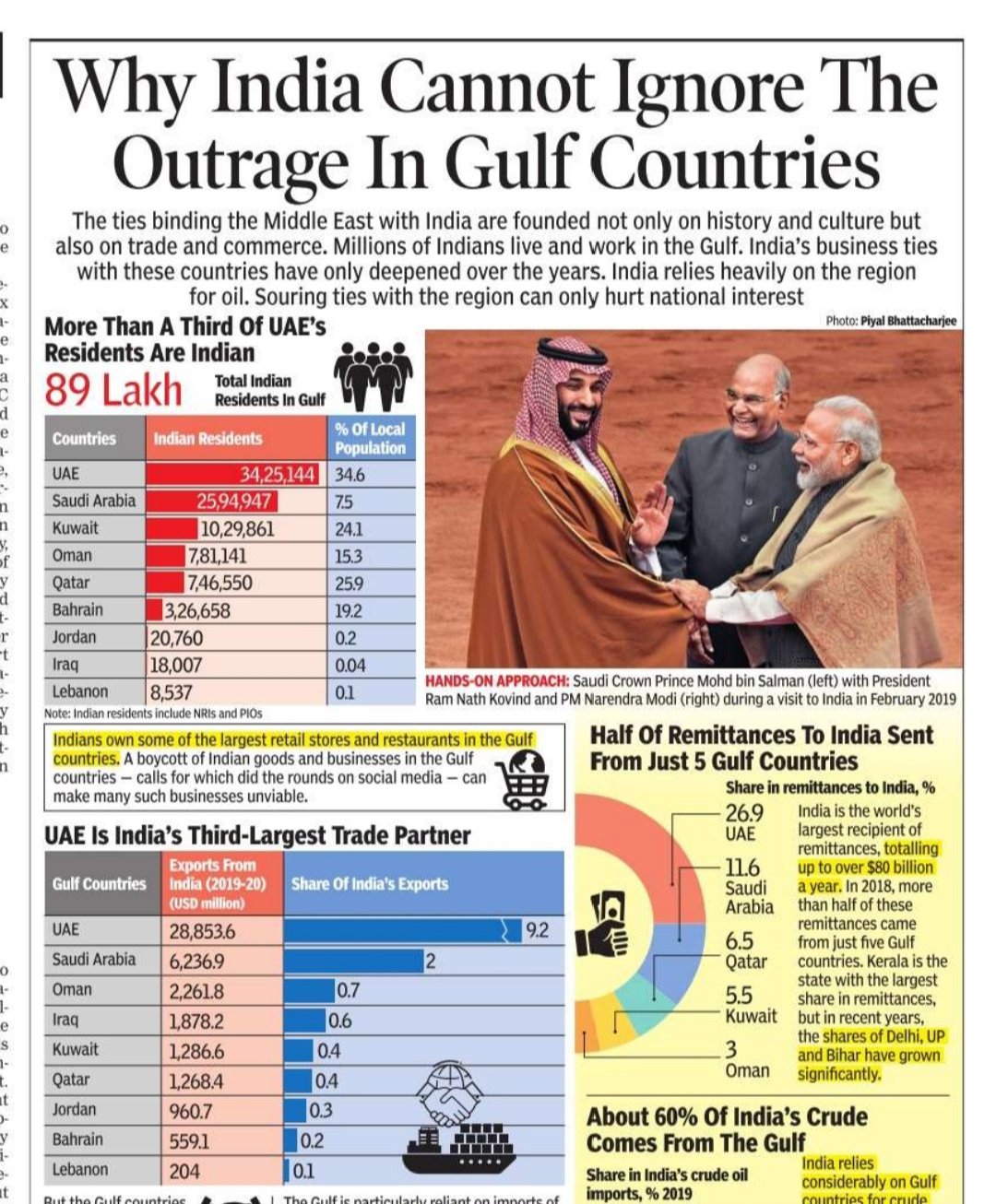
India's Ties to the GCC Nations. Source: Advaid


The BJP's entire domestic politics is built on the hatred of Islam and Muslims. At the same time, Prime Minister Narendra Modi who many hold primarily responsible for promoting Islamophobia in India, wants to have strong economic ties with the Arab Muslim Gulf states. This latest crisis has exposed the built-in contradictions in the BJP's domestic and international agenda.  Indian analyst Aakar Patel calls the ruling BJP party "a party of bigots". Here is his analysis of the situation:

"The (Modi) government has not bulldozed properties of Muslims for resisting rioting; it has conducted civic acts related to unauthorized construction. India is not targeting its Muslims through CAA-NRC pincer; it is only showing solidarity with non-Muslims from neighboring nations. Allowing mobs to prevent congregational prayers in designated spaces is really to ensure traffic flows smoothly. There can not be many who are innocent of what is going on. Certainly, there are none among the votaries of Hindutva. The problem is having democratized violence against Muslims across the country, and having been electorally rewarded for this, Modi must consider what it means for India. He has been given a taste of that this week, and as the sequence of events shows, he has not found it appealing. Trouble on this front will return unless Hindutva retreats and returns India to its normative secular state its Constitution prescribes. This is not going to happen under Modi, of course. The next best thing is to backpedal Hindutva a bit and calibrate Hindutva to a level where it pleases its constituency but doesn't offend the world. This will not be easy as we are about to find out". 


It is important to note that nearly 9 million Indians work in the Arab Gulf nations, 60% India's crude oil comes from the Middle East and the UAE is India'a third largest trading partner. Half of all remittances to India ( nearly $40 billion) come from just 5 Gulf nations of the GCC. 

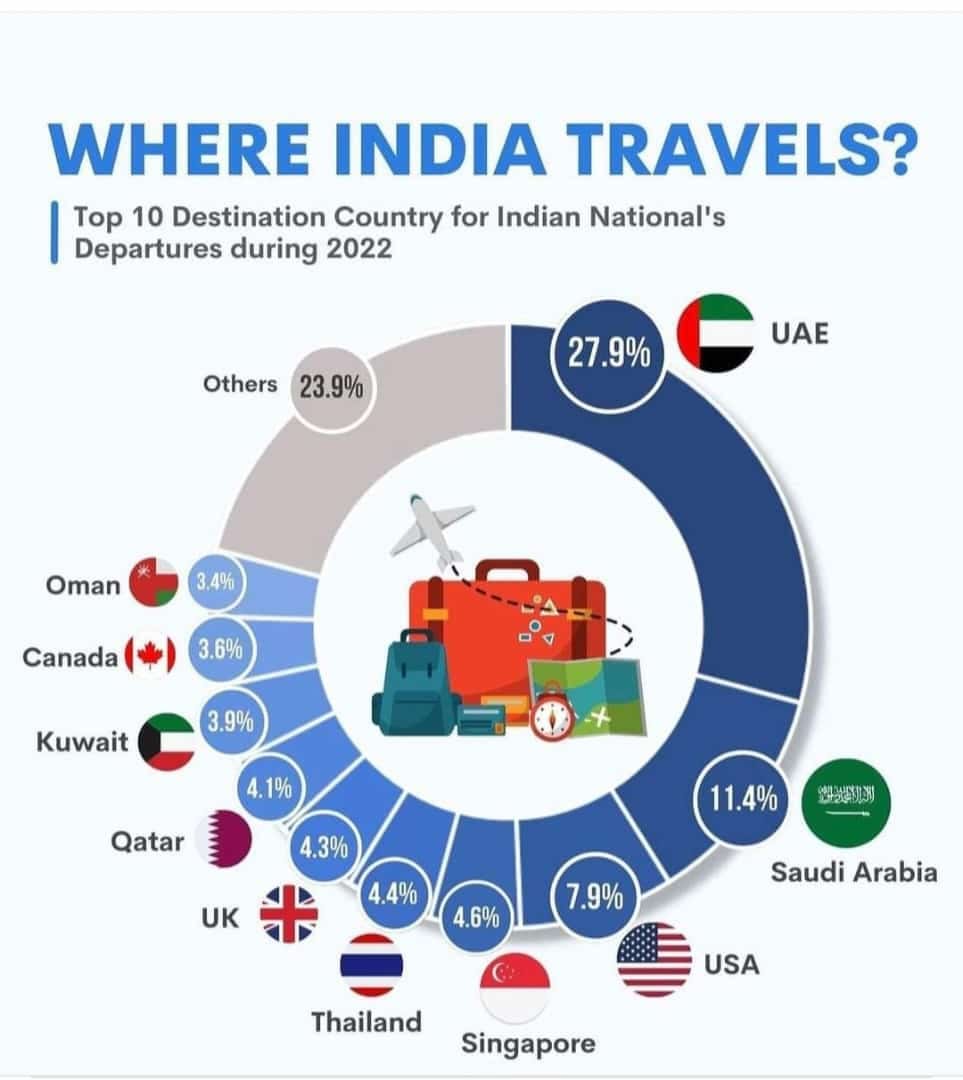
The Hindu Nationalists led by Prime Minister Modi are particularly hostile toward Muslims but also other Abrahamic faiths and the West. American journalist Walter Russell Mead described it in a recent Wall Street Journal Op Ed as follows: "Many BJP supporters want the Indian government to defend India’s Hindu civilization and culture from Islam, Christianity and Western secular liberalism. This form of Hindu nationalism leads to controversial policy initiatives". The fact that the United Arab Emirates has joined to protest is particularly significant. The Arab Muslim UAE, a grouping of  seven Arab Muslim kingdoms, has now become the number one destination for education and employment of people from Hindu India, according to the government data from the two countries. 

India is now ruled by the right-wing Hindu BJP party headed by Prime Minister Narendra Modi whose entire politics is based on extreme hatred of Islam and Muslims. In 2020, Emirati Princess Sheikha Hend bint Faisal al-Qasimi strongly criticized Islamophobia in India. She also expressed solidarity and sympathies with Indian Muslims and Kashmiris.

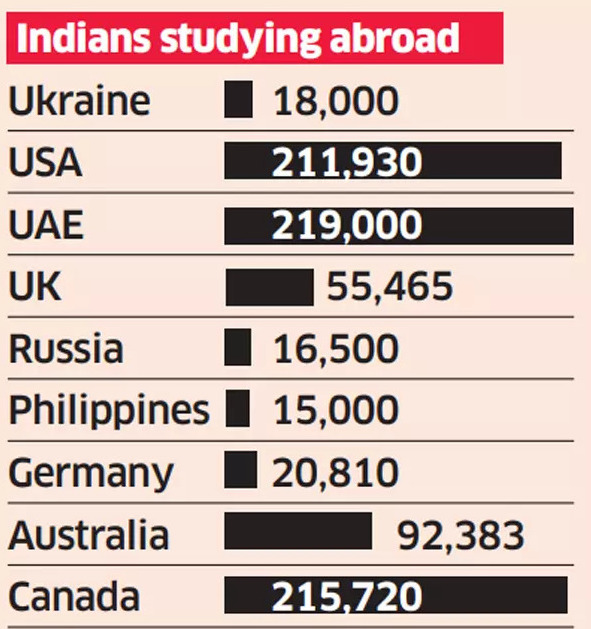
Indians Students Abroad. Source: Economic Times

Over 1.2 million Indian students are now studying overseas, twice more than a decade ago. The UAE has 219,000 Indian students, Canada 215,720, the US 211,930, Australia 92,383, Saudi Arabia 80,800, Britain 55,465, and Oman 43,600, according to the data from India's Ministry of External Affairs


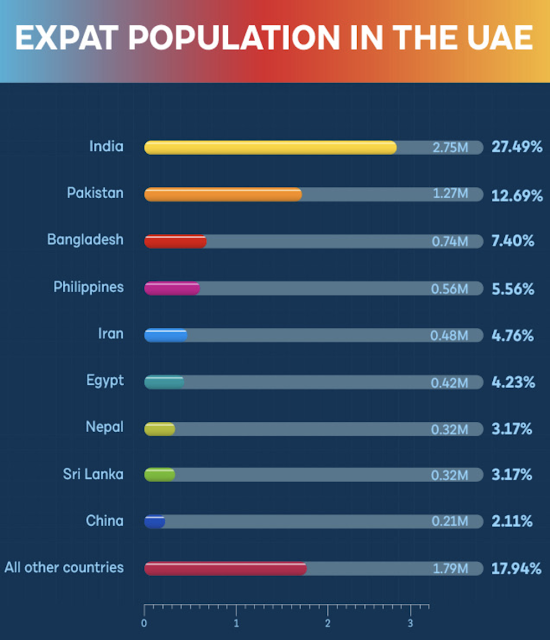
UAE Expat Population. Source: Global Media Insight

In addition to students, there are millions of foreigners working in the UAE. Currently, the Indian population in UAE is the highest with 2.75 million, followed by Pakistanis with 1.27 million. The UAE has around 0.75 million Bangladeshi nationals, 0.56 million Filipinos, and 0.48 million Iranians. There are also people from Egypt (0.42 million), Nepal (0.32 million), Sri Lanka ( 0.32 million), China (0.21 million) and the rest of the world (1.79million).

Last year, India received $43 billion in remittances from the UAE. Total worker remittances to India reached $87 billion last fiscal year, making it the world's largest recipient of these remittances. 

The United States was the second largest destination for Indian students. China maintained its top position among the leading places of origin for international students, with 35% of all international students in the 2020-21 school year hailing from the country, according to the data released by the United States government.  The second most common place of origin was India (18%), followed by South Korea (4%) and Canada (3%). Some of these countries also experienced the largest year-over-year declines in the number of students who enrolled at US institutions. The largest such percentage decreases occurred in South Korea (-21%), China (-15%) and India (-13%).

Related Links: