Showing posts with label Nigeria. Show all posts

Wednesday, February 4, 2026

Can Pakistan's JF-17 Become Developing World's Most Widely Deployed Fighter Jet?

Worldwide demand for the JF-17 fighter jet, jointly developed by Pakistan Aeronautical Complex (PAC) and China’s Chengdu Aircraft Industry Group (CAIG), is surging. It is attracting buyers in Africa, Asia and the Middle East. At just $40 million a piece, it is a combat-proven flying machine with no western political strings attached. It has enormous potential as the lowest-cost 4.5 generation fighter jet featuring AESA radar, enhanced electronics, and superior weapons systems. 

Pakistan PFX Concept Fighter. Source: Raksha Anirveda

In addition to the Pakistan Air Force, it is currently deployed by the air forces of Azerbaijan, Myanmar and Nigeria. Multi-billion dollar orders are in the pipeline from several countries, including Saudi Arabia, Libya and Sudan. Bangladesh is reportedly negotiating to purchase JF-17s in the near future. These orders are not just one-time purchases; they include service and training contracts, as well as spare parts and future upgrades. The US-based business publication Bloomberg recently reported: "After Pakistan said it used the jets to great effect in its brief conflict with India last year, at least five countries have expressed interest in buying them. That sudden demand may put the country’s defense industry in a crunch".  So the question now is: Can Pakistan deliver? 

Currently, Pakistan Aeronautical Complex (PAC) has the capacity to manufacture up to 20 JF-17s per year, sufficient to fill the orders from the Pakistan Air Force. It uses a Pakistani airframe, Chinese-made KLJ-7A AESA radar and Russian Klimov RD-93 turbofan engine. Additional capacity is being added at PAC to meet rapidly growing demand. A Chinese aviation expert told China's Global Times that this could be a "sweet problem" for Pakistan, as backed by strong order demand, the country's aviation industry is expected to develop rapidly, and potential capacity constraints are ultimately not a true concern given China's support for Pakistan in manufacturing this type of fighter jet. 

The JF-17 is opening doors for Pakistan’s defense industry. The country is emerging as a major arms supplier to developing countries in Asia and Africa.  Talks underway with at least 13 countries for JF-17 jets, drones and weapons, with several negotiations at an advanced stage.

Azerbaijan, Myanmar, Nigeria and Sudan have all made significant arms purchases from Pakistan in recent years.  Azerbaijan expanded its order for JF-17 Thunder Block III multi-role fighter jets from Pakistan from 16 to 40 aircraft. The recent order extends a 2024 contract worth $1.6 billion to modernize Baku’s airborne combat fleet to $4.6 billion. This makes Azerbaijan the largest export customer of the Pakistan-made warplane. Bangladesh is negotiating purchase of up to 32 JF-17 Thunder Block III aircraft from Pakistan. 

In the Middle East  Pakistan has orders to supply JF-17s to Libya and Saudi Arabia. In a deal with Libya, Pakistan will sell over two dozen JF-17 fighter jets and 12 Super Mushak trainer aircraft used for basic pilot training.  Pakistan and Saudi Arabia are in negotiations to convert about $2bn of Saudi loans into a deal to buy JF-17 fighter jets, according to Reuters. 

In Africa, Pakistan has recently signed a $1.5 billion contract to supply combat drones and military trainer aircraft to Sudan. The order includes 150 armored vehicles, 220 drones and 10 K-8 Karakorum trainer/light attack aircraft.  Earlier in 2021, Pakistan sold three JF-17 Thunder fighter jets and ten Super Mushshak trainer aircraft to Nigeria in a deal worth nearly $200 million. From 2018 to 2021, Pakistan sold 11 JF-17 Thunder Block I aircraft to Myanmar. 

Air forces of about a dozen developing nations are buying and deploying Pakistani made aircrafts. The reasons for their choice of combat-tested Pakistan manufactured airplanes include advanced BVR (beyond visual range) features, affordability and ease of acquisition, maintenance and training.

Pakistan started developing defense hardware for import substitution to reduce external dependence and to save hard currency. Now the country's defense industry is coming of age to lead the way to high value-added manufactured exports.

Pakistan has unveiled its PFX (Pakistan Fighter Experimental) program as a significant upgrade to its JF-17 joint program with China. The new upgrade will have a number of stealth features ranging from the use of radar-absorbing composite materials and diverterless supersonic inlets (DSI) to internal weapons bay (IWB) which will significantly reduce the aircraft's radar signature. It is targeted for completion by the end of this decade. In addition, the PFX's twin-engine design will improve maneuverability and allow greater payload capacity. 

The program is part of Pakistan's broader strategy to reduce reliance on foreign suppliers and strengthen the domestic defense industry. Currently, 58% of JF-17 components are manufactured locally by PAC, but Pakistan aims to increase this share to achieve full production autonomy for the PFX. It is not just about the PAF modernization but also about positioning Pakistan as an important player in the global military aviation market. 

The PFX is an evolution of a plan that Pakistan announced in 2017 to develop and produce 5th generation fighter planes. It is part of Pakistan Air Force's highly ambitious Project Azm that includes building Kamra Aviation City dedicated to education, research and development and manufacturing of advanced fighter jets, unmanned aerial vehicles (UAVs) and weapon systems.

The PAF has already started replacing its aging fleet with the induction of the Chinese J10C fighter jets which are considered 4.5 Gen. The J10-C has stealth features like diverterless supersonic inlets (DSI).  Its BVR capability is supported by PL-15 missiles, with an engagement range of up to 200 kilometers, facilitating long-range target engagements. 

The PAF has also begun the process of acquiring 5th generation Chinese J35 fighter jets. The delivery of 40 J35 fighters to Pakistan is expected within two years, potentially altering regional dynamics, particularly concerning India. 

Related Links:

Haq's Musings

South Asia Investor Review

US Missile Sanctions: Is Pakistan Really Developing ICBMs?

Pakistan's Cyber Attack and Defense Capability

IDEAS2024: Pakistan Defense Industry Expo

Pakistan's Rising Arms Sales

Pakistan Navy Modernization

West's Technological Edge in Geopolitical Competition

Pakistan Defense Industry

Silicon Valley Book Launch of "Eating Grass"

Ukraine's Lesson For Pakistan: Never Give Up Nukes!

Pakistan Destroyed Indian Rafales, S-400 Air Defense System

Pakistan's Sea-Based Second Strike Capability

Riaz Haq Youtube Channel

VPOS Youtube Channel


Wednesday, October 29, 2025

Pakistan's Rising Arms Sales to Developing Nations

Pakistan is emerging as a major arms supplier to developing countries in Asia and Africa. Azerbaijan, Myanmar, Nigeria and Sudan have all made significant arms purchases from Pakistan in recent years.  Azerbaijan expanded its order for JF-17 Thunder Block III multi-role fighter jets from Pakistan from 16 to 40 aircraft. The recent order extends a 2024 contract worth $1.6 billion to modernize Baku’s airborne combat fleet to $4.6 billion. This makes Azerbaijan the largest export customer of the Pakistan-made warplane. Bangladesh is negotiating purchase of up to 32 JF-17 Thunder Block III aircraft from Pakistan. 

Pakistan PFX Concept Fighter. Source: Raksha Anirveda


In Africa, Pakistan has recently signed a $1.5 billion contract to supply combat drones and military trainer aircraft. The order includes 150 armored vehicles, 220 drones and 10 K-8 Karakorum trainer/light attack aircraft.  Earlier in 2021, Pakistan sold three JF-17 Thunder fighter jets and ten Super Mushshak trainer aircraft to Nigeria in a deal worth nearly $200 million. From 2018 to 2021, Pakistan sold 11 JF-17 Thunder Block I aircraft to Myanmar. 

Air forces of about a dozen developing nations are buying and deploying Pakistani made aircrafts. The reasons for their choice of combat-tested Pakistan manufactured airplanes include advanced BVR (beyond visual range) features, affordability and ease of acquisition, maintenance and training.

Pakistan started developing defense hardware for import substitution to reduce external dependence and to save hard currency. Now the country's defense industry is coming of age to lead the way to high value-added manufactured exports.

Pakistan has unveiled its PFX (Pakistan Fighter Experimental) program as a significant upgrade to its JF-17 joint program with China. The new upgrade will have a number of stealth features ranging from the use of radar-absorbing composite materials and diverterless supersonic inlets (DSI) to internal weapons bay (IWB) which will significantly reduce the aircraft's radar signature. It is targeted for completion by the end of this decade. In addition, the PFX's twin-engine design will improve maneuverability and allow greater payload capacity. 

The program is part of Pakistan's broader strategy to reduce reliance on foreign suppliers and strengthen the domestic defense industry. Currently, 58% of JF-17 components are manufactured locally by PAC, but Pakistan aims to increase this share to achieve full production autonomy for the PFX. It is not just about the PAF modernization but also about positioning Pakistan as an important player in the global military aviation market. 

The PFX is an evolution of a plan that Pakistan announced in 2017 to develop and produce 5th generation fighter planes. It is part of Pakistan Air Force's highly ambitious Project Azm that includes building Kamra Aviation City dedicated to education, research and development and manufacturing of advanced fighter jets, unmanned aerial vehicles (UAVs) and weapon systems.

The PAF has already started replacing its aging fleet with the induction of the Chinese J10C fighter jets which are considered 4.5 Gen. The J10-C has stealth features like diverterless supersonic inlets (DSI).  Its BVR capability is supported by PL-15 missiles, with an engagement range of up to 200 kilometers, facilitating long-range target engagements. 

The PAF has also begun the process of acquiring 5th generation Chinese J35 fighter jets. The delivery of 40 J35 fighters to Pakistan is expected within two years, potentially altering regional dynamics, particularly concerning India. 

Related Links:

Haq's Musings

South Asia Investor Review

US Missile Sanctions: Is Pakistan Really Developing ICBMs?

Pakistan's Cyber Attack and Defense Capability

IDEAS2024: Pakistan Defense Industry Expo

Pakistan's Aircraft Exports

Pakistan Navy Modernization

West's Technological Edge in Geopolitical Competition

Pakistan Defense Industry

Silicon Valley Book Launch of "Eating Grass"

Ukraine's Lesson For Pakistan: Never Give Up Nukes!

Pakistan Destroyed Indian Rafales, S-400 Air Defense System

Pakistan's Sea-Based Second Strike Capability

Riaz Haq Youtube Channel

VPOS Youtube Channel


Tuesday, July 15, 2025

Pakistani International Students Flocking to European Universities

Recent data shows that there are nearly 10,000 Pakistani students attending colleges and universities in Germany. This figure is second only to the United Kingdom which issued over 35,000 student visas to Pakistanis in 2024. The second most popular destination for Pakistani students is Australia which is hosting nearly 24,000 students from Pakistan as of 2023, according to the ICEF Monitor. 

Top Countries of Origin For International Students in Germany 2024. Source: Study in Germany


Here's a list of the top 15 countries of origin of foreign students in Germany in 2024: 

India 49,008

China 38,687

Turkey 18,084

Austria 15,379

Iran 15,159

Syria 13,379

Russia 10,593

Italy 10,154

Ukraine 9,914

Pakistan 9,873

Egypt 8,060

Morocco 7,398

Tunisia 6,852

Cameroon 6,789

France 6,759

This year, Pakistani students won 114 Erasmus Mundus EU Scholarships, the highest number in the world. This makes Pakistan the top country receiving these scholarships for the fourth consecutive year. The Erasmus Mundus Scholarship is a prestigious European scholarship program for graduates, funding joint master's degrees at prestigious universities across multiple countries.

Pakistani Students Received the Highest Number of EU Scholarships in 2025. Source: EU


Here's the list of top countries of EU Scholarship Winners in 2025: 

1. 🇵🇰 Pakistan: 114

2. 🇮🇳 India: 96

3. 🇧🇩 Bangladesh: 95

4. 🇲🇽 Mexico: 93

5. 🇳🇬 Nigeria: 75

6. 🇧🇷 Brazil: 73

7.  🇪🇸 Spain: 65

8. 🇺🇸 USA: 62

9. 🇪🇬 Egypt: 61

10. 🇩🇪 Germany: 61

Pakistan is third, after only China and India, in terms of the size of its college-aged population, according to the United Nations. The British Council expects growth in Pakistani outbound mobility to be among highest in the world over the next decade, along with China, India, Nigeria, and Bangladesh.

Acceptance rate in Pakistani universities and degree colleges was just 13.5% in 2022. Only 541,043 students were accepted from 4,085,185 students who applied. The country produced 471,306 university graduates in 2020-21. Of these, 157,102 were in STEM fields, including 43,000 graduates in information technology (IT).  

Pakistan’s gross tertiary enrollment (GER) ratio was only 13% in 2023, according to UNESCO. This is much lower than in India, and lower than in Bangladesh and Sri Lanka as well. Of 109 countries UNESCO profiled in 2021, Pakistan’s tertiary GER was 100th. Given Pakistan’s huge college-aged population, there is serious unmet demand for higher education, according to the ICEF Monitor. 

Recent data on which destinations are hosting the most Pakistani students include:

UK: 34,690 in 2022/23 (+50% y-o-y)

China: 28,000 before the pandemic

UAE: 24,865 in 2020 according to UNESCO

Australia: 23,380 in 2023 (+49%)

US: 10,165 in 2022/23 (+16%)

Germany: 8,210 in 2022/23 (+22%)

Kyrgyzstan: 6,000 in 2020 according to UNESCO

Malaysia: 5,000 in 2023

Canada: 4,750 in 2023 (+101%)

Turkey: 2,385 in 2020 according to UNESCO

Saudi Arabia, South Korea, Sweden, Qatar: At least 4,000 in 2020 according to UNESCO


Wednesday, February 1, 2023

Pakistanis Remain Hopeful Amid Crises: 69% Think Their Children Will Do Better

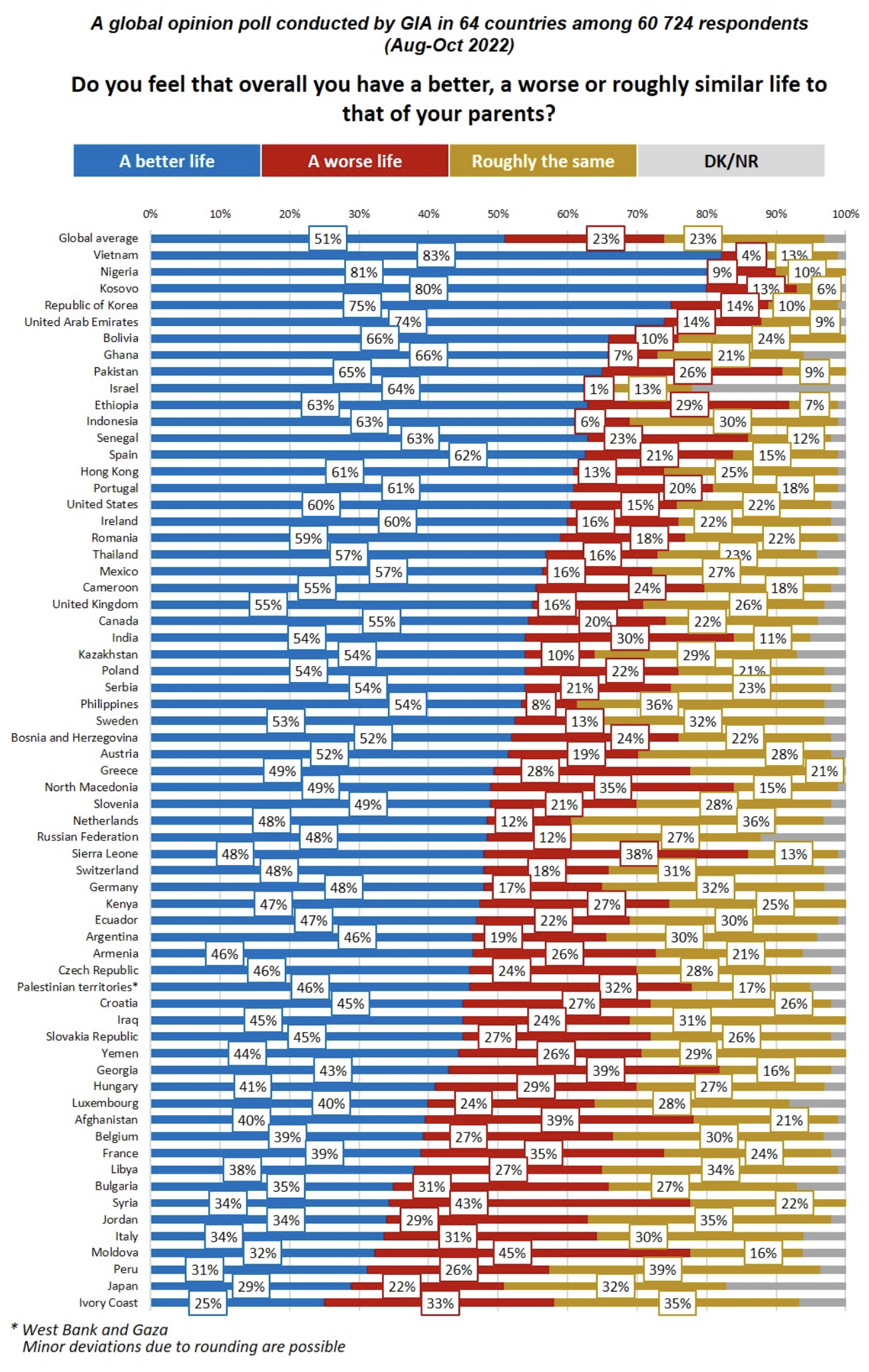
Pakistan is in the middle of multiple serious crises. But the vast majority of Pakistanis feel that they have better lives than their parents did, and they think their children will have even better lives than theirs, according to a Gallup International Poll of 64 countries conducted from August to October last year. The poll asked two questions: 1) Do you feel your life is better, worse or roughly similar to that  of your parents? and 2) Do you think your children will have a better, worse or roughly the same life as you? The answers to these questions reveal that Pakistanis are among the top 5 most positive nations among 64 countries polled by Gallup International. Anecdotal evidence in terms of packed shopping malls and restaurants in Pakistan's major cities confirms it. Such positivity augurs well for Pakistan's prospects of successfully dealing with the current crises. It will drive the nation's recovery. 

Doing Better Than Parents. Source: Gallup International

Pakistanis Among Most Optimistic: 

Nearly two-thirds (65%) of Pakistanis said they live better than their parents did. And 69% of Pakistani parents think their children will have better lives than they do. In neighboring India, 54% of respondents feel their lives are better than their parents' while only 43% say their children will have better lives than theirs'.  The global average for the former is 51% and it is 44% for the latter. The poll results put Pakistanis among the world's five most hopeful nations. 

Optimism For Children. Source: Gallup International


Most of the countries are positive on both questions, but if one looks for instance for countries with both above 50% positive answers, Nigeria stands out with 171 (81% positive for today plus 90% positive for tomorrow), followed by Kosovo (162), the United Arab Emirates (150), Ghana (141) and Pakistan (134), according to Gallup International. 

Sum of Percentages of Positive Answers to Both Questions. Source: Gallup

Pakistan (69% better minus 18% worse) is among the most positive countries. India is much less positive (43% minus 33%). Nigeria (90% minus 6%) tops the list in terms of positivity and the most negative is Slovenia (14% minus 53%). Among the prominent countries where GIA could poll, expectations for their children’s future are highest in Nigeria, followed by Russia (52% minus 10%), Mexico (48% minus 30%) and the USA (43% minus 31%). When combining the two questions, another perspective is added. For instance, Moldova shows a total of 86 (45% saying that their live is worse  than the one of their parents plus 41% expecting a worse life of today’s children), followed in this negative ranking by North Macedonia (82: 35% negative assessments plus 47% negative predictions), Afghanistan (81), Syria and Italy (78), etc.

Economic Mobility in Pakistan: 

Pakistanis' positive responses in the Gallup poll appear to be supported by a World Bank study. Economic mobility across generations, also known as intergenerational mobility (IGM), is a key measure of human progress. It shows that Pakistan is doing relatively well, according to a World Bank sponsored study. The analysis examines whether those born in poverty or in prosperity are destined to remain in the same economic circumstances into which they were born, and looks back over a half a century at whether children’s lives are better or worse than their parents’ in different parts of the world.

Inter-Generational Income Mobility Map of the World 2018. Source: World Bank


Intergenerational Income Mobility Study:

The World Bank study uses a newly created 2018 database—the Global Database of Intergenerational Mobility (GDIM)—that covers more than 95 percent of the global population.  Intergenerational income mobility measures how children's incomes compare with their parents' incomes at similar stages of life over a period of 50 years.

Inter-Generational Income Inequality Scatter Plot of the World 2018. Source: World Bank


The study found that higher intergenerational income mobility is associated with lower income inequality.

Inclusive Development: 

More and more Pakistanis are sharing in their nation's development, according to The World Economic Forum (WEF). Pakistan ranks 47 among 74 emerging economies ranked for inclusive development by the WEF released report at Davos, Switzerland. Inclusive development in the South Asian country has increased 7.56% over the last 5 years. The World Economic Forum assesses inclusive development  based on "living standards, environmental sustainability and protection of future generations from further indebtedness."  

“Man can live about forty days without food, about three days without water, about eight minutes without air...but only for one second without hope.”  American author Hal Lindsey