Saturday, July 6, 2019

Pakistan Ramps Up Nuclear Power to Boost Low-Carbon Electricity

Construction of 1,100 MW nuclear power reactor K2 unit in Karachi has been completed by China National Nuclear Corporation, according to media reports. A similar reactor unit K3 will add another 1,100 MW of nuclear power to the grid, bringing the total nuclear power installed capacity of Pakistan to 3,630 MW (12% of total power) by 2022.  Hualong One reactors being installed in Pakistan are based on improved Westinghouse AP1000 design which is far safer than Chernobyl and Fukushima plants.  In addition, Pakistan is also generating  9,389  MW (about 28% of total power) of low-carbon hydroelectric power in response to rising concerns about climate change.

Karachi Nuclear Power Plant (KANUPP):

With the placement of the outer containment shell, K2 is  now ready for containment and heat tests. It is scheduled to begin operations in 2020. It’s built using the Chinese HPR1000 technology, which features a dual containment design, with the outer containment providing additional protection for the primary containment.

Karachi Nuclear Power Plant K2 Unit Under Construction. Source: CNNC

KANUPP is Pakistan's first nuclear power plant where construction started in 1966 in Karachi. The plant was connected to the national grid on 18 October 1972. KANUPP, a pressurized heavy water reactor of 137 MW gross capacity was constructed by Canadian General Electric under a turnkey contract. In 1976, vendor support for spare parts and fuel was withdrawn. The PAEC undertook the task of indigenously manufacturing the required spare parts and nuclear fuel on an emergency basis and, since 1980, KANUPP has successfully operated using fuel manufactured by the PAEC, according to International Atomic Energy Agency (IAEA). Here is an except of IAEA's 2018 report on nuclear power in Pakistan:

"Despite the keen interest of Pakistan in building additional nuclear plants, it took more than two decades before the second nuclear power plant started construction. This delay was due to Pakistan’s lack of access to international nuclear technology coupled with a lack of indigenous industrial infrastructure. The construction of Pakistan’s second nuclear plant, C-1, a pressurized water reactor (PWR), was made possible in 1993 with the help of the China National Nuclear Corporation (CNNC). The plant was connected to the national grid on 13 June 2000 and has a gross capacity of 325 MW. A third nuclear power plant, C-2, with 325 MW gross capacity started commercial operation on 18 May 2011. The fourth unit, C-3, started commercial operation on 6 December 2016. It has a gross capacity of 340 MW and a similar plant, C-4, sited beside C-3, was connected to the grid on 25 June 2017. The first concrete pours to mark the start of construction of Karachi Coastal Power Project, a project containing two nuclear units, K-2 and K-3 (1100 MW each), based on an improved PWR design, were 20 August 2015 and 31 May 2016, respectively."
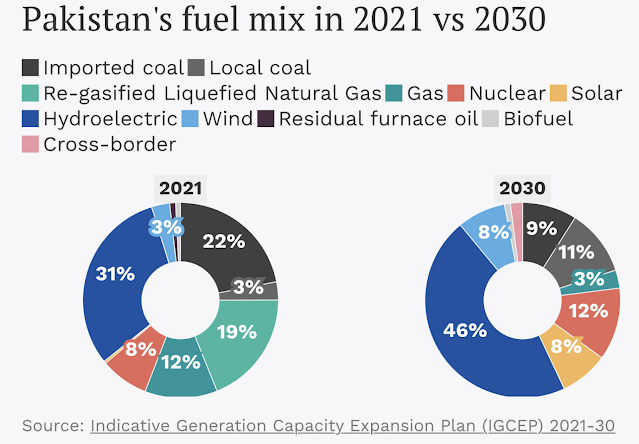

Pakistan Power Generation Fuel Mix. Source: Third Pole


International Energy Agency:

International Energy Agency (IEA) has recently warned that "steep decline in nuclear power would threaten energy security and climate goals". "With nuclear power facing an uncertain future in many countries, the world risks a steep decline in its use in advanced economies that could result in billions of tonnes of additional carbon emissions", the IEA has said.

Pakistan Among 31 Countries Operating Nuclear Power Plants


Nuclear is the second-largest low-carbon power source in the world today, accounting for 10% of global electricity generation. It is second only to hydropower at 16%, according to International Energy Agency (IEA). Pakistan nuclear plants are expected to generate 3,630 MW  (12% of total power vs 10% global average) by 2022.  Pakistan is also generating  9,389  MW (about 28% of total power vs 16% global average) of low-carbon hydroelectric power in response to rising concerns about climate change.

Nuclear Plant Safety Concerns:

Activists in Pakistan have raised serious concerns about potential risks from K2 and K3 plants to the population in Karachi. Are such concerns valid?

The worst nuclear disaster in the history of nuclear power generation was at Chernobyl in present day Ukraine. One of the key reasons was that the Chernobyl plant did not have the fortified containment structure common to most nuclear power plants elsewhere in the world. KANUPP K-2 and K-3 reactors have two containment shells: primary and secondary. It is noteworthy that Bhopal Union Carbide disaster was history's worst industrial disaster, far bigger in terms of human toll than the Chernobyl disaster.

China signed a technology transfer deal with the United States in 2006 that put the Westinghouse AP1000 reactor design at the “core” of its atomic energy program. Chinese reactor manufacturers also resolved to build advanced third-generation technology in their safety review after the 2011 Fukushima nuclear plant disaster.

Unlike Fukushima where underground emergency cooling system failed due to flooding, the Hualong One design stores water above the reactor that can be gravity-fed to keep it cool if the pumps fail in the event of meltdown. The Chinese HPR1000 reactors employ multiple redundant generators and cooling systems to lower meltdown risk.

Hydropower Generation:

The biggest and most important source of low-carbon energy in Pakistan is its hydroelectric power plants. Pakistan ranked third in the world by adding nearly 2,500 MW of hydropower in 2018, according to Hydropower Status Report 2019.  China added the most capacity with the installation of 8,540 megawatts, followed by Brazil (3,866 MW), Pakistan (2,487 MW), Turkey (1,085 MW), Angola (668 MW), Tajikistan (605 MW), Ecuador (556 MW), India (535 MW), Norway (419 MW) and Canada (401 MW).

New Installed Hydroelectric Power Capacity in 2018. Source: Hydroworld.com

Pakistan's Water and Power Development Authority (WAPDA) says commissioning of the 108-MW Golen Gol 2, 1,410-MW Tarbela 4th Extension and 969-MW Neelum Jhelum hydropower projects in 2018 boosted its hydroelectric generating capacity of 9,389 MW, an increase of 36% in just one year, according to Hydro Review. Hydropower now makes up about 28% of the total installed capacity of 33,836 MW as of February, 2019.   WAPDA reports contributing 25.63 billion units of hydroelectricity to the national grid during the year, “despite the fact that water flows in 2018 remained historically low.” This contribution “greatly helped the country in meeting electricity needs and lowering the electricity tariff for the consumers.”

Top 20 Countries by Newly Installed Hydropower Capacity. Source: IHA

Pakistan has the potential to generate 59,000 MW of hydropower, according to studies conducted by the nation's Water and Power Development Authority (WAPDA). Currently, it's generating only 9,389 MW of hydroelectric power, about 16% of the estimated potential. Media reports indicate that China is prepared to finance and build another 40,000MW capacity as part of the development of the Northern Indus Cascade region which begins in Skardu in Gilgit-Baltistan and runs through to Tarbela, the site of Pakistan’s biggest dam, in Khyber-Pakhtunkhwa province.

Pakistan has made only a small contribution to climate change through carbon emissions.  And yet, it counts among the dozen or so nations considered most vulnerable to its damaging effects. These include rising temperatures, recurring cycles of floods and droughts and resulting disruption in food production.

Summary: 

Construction of 1,100 MW nuclear power reactor K2 unit in Karachi has been completed by China National Nuclear Corporation, according to media reports. A similar reactor unit K3 will add another 1,100 MW of nuclear power to the grid, bringing the total nuclear power installed capacity of Pakistan to 3,630 MW (12% of total power) by 2022.  Hualong One reactors being installed in Pakistan are based on improved Westinghouse AP1000 design which is far safer than Chernobyl and Fukushima plants.  In addition, Pakistan is also generating  9,389  MW (about 28% of total power) of low-carbon hydroelectric power in response to rising concerns about climate change. One of the ways Pakistan can help reduce carbon emissions is by realizing its full nuclear and hydroelectric power potential by building more nuclear plants and dams. The development of the Northern Indus Cascade region to generate 40,000MW of hydropower is a significant part of this effort.

Related Links:

Haq's Musings

South Asia Investor Review

Nuclear Power in Pakistan

Recurring Cycles of Drought and Floods in Pakistan

Pakistan's Response to Climate Change

Massive Oil and Gas Discovery in Pakistan: Hype vs Reality

Renewable Energy for Pakistan

Digital BRI: China and Pakistan Building Fiber, 5G Networks

LNG Imports in Pakistan

Growing Water Scarcity in Pakistan

China-Pakistan Economic Corridor

Ownership of Appliances and Vehicles in Pakistan

CPEC Transforming Pakistan

Pakistan's $20 Billion Tourism Industry Boom

Riaz Haq's YouTube Channel

PakAlumni Social Network

Wednesday, July 3, 2019

Pakistani EdTech and FinTech Startups Win Prizes in International Competitions

Two Pakistani technology startups have recently won recognition in international competitions.  Sabaq, an EdTech startup, has been shortlisted for Siemens Foundation’s global award. Another Pakistani startup Tez Financial Services in FinTech space has been selected as one of the winners of $100,000 Prize at 2019’s Inclusive Fintech 50.  Growing availability of smartphones, tablets and mobile broadband is enabling Pakistani technology entrepreneurs to offer technology-based solutions in multiple fields including education and financial services. These young ambitious entrepreneurs are beginning to attract venture investments from overseas. Tez Financial Services has received $1.1 million seed funding led by Omidyar Network.

Sabaq:

Karachi-based Pakistani education technology (EdTech) startup SABAQ has been shortlisted for Siemens Foundation’s global award. The award recognizes and endorses low-cost technologies providing vital services and solutions for daily needs in developing countries. Earlier this year, Sabaq was selected among the Top 6 Global EdTech startups at the Global Education and Skills Forum in Dubai.

Sabaq Tablet
Sabaq is among 11finalists selected from a 800 submissions from 86 countries.  It will be compete with other finalists for the top 3 spots in Cairo, Egypt next month. The award recognizes low-cost technologies providing vital services and solutions for daily needs in developing regions. Projects submitted are judged on their technical functionality, local adaptability, social impact, team structure, and financial and business sustainability.

SABAQ has partnered with the National Rural Support Program and identified communities where it has set up SABAQ Centers, non-formal learning spaces for out of school students who are taught using the meraSABAQ Tab. This is SABAQ’s custom-made android tablet that features the meraSABAQ app for primary level, each containing digital learning resources for Urdu, Science and Math, developed in-house in accordance with the national curriculum.

Sabaq Foundation is a non-profit organization that offers a tablet app and a website. The meraSabaq is a custom-made tablet designed to be used both by  experienced and new teachers across formal and non-formal learning environments.  Sabaq's website offers online video tutorials with free video lectures for Pakistani students. The website provides tutorials for four main science subjects -- Mathematics, Physics, Chemistry and Biology for secondary school students. The tutorials follow the exact syllabus of respective boards of education for Cambridge, Federal, Punjab, Sindh, Khyber Pakhtunkhwa (KPK) and Balochistan.

Tez Financial:

Tez Financial Services is a woman-led financial technology startup in Karachi, Pakistan.  It has Visa Everywhere Initiative Women’s Global Award after Worldwide Search. It is the first fully digital financial institution in the country providing financial services to the unbanked/underbanked population via a smartphone app.

Tez FinTech App
Last year, Tez Financial raised $1.1 million in a seed round led by Omidyar Network, the impact investment firm established by Pierre Omidyar, the founder of eBay. Other investors on this round include Accion Venture Lab, the seed-stage investment initiative of global nonprofit Accion; and Planet N. Funds will help the company build its credit portfolio, enhance its mobile technology platform, and secure the company’s NBMFC (Non-Bank Microfinance Company) license.

The Visa Everywhere FinTech competition measures how competing companies leverage their companies’ unique ability to solve or transform consumer and/or commercial payment experiences locally, regionally or globally.

The founders of Tez were previously involved in the creation of Tameer Bank, Easypaisa, and CheckIn Solutions.

Pakistan Telecom Indicators. Source: PTA

Technology Entrepreneurs:

Growing availability of smartphones, tablets and mobile broadband is enabling Pakistani technology entrepreneurs to offer technology-based solutions in multiple fields including education and financial services. As of May 2019, there are over 70 million broadband subscriptions in Pakistan and more than a million new subscribers are are being added every month, according to data from Pakistan Telecommunication Authority  (PTA). These young ambitious entrepreneurs are beginning to attract venture investments from overseas. Tez Financial Services has received $1.1 million seed funding led by Omidyar Network headed by E-Bay founder Pierre Omidyar.

Summary:

Two Pakistani technology startups have recently won recognition in international competitions.  Sabaq, an EdTech startup, has been shortlisted for Siemens Foundation’s global award. Another Pakistani startup Tez Financial Services in FinTech space has been selected as one of the winners of 2019’s Inclusive Fintech 50. Growing availability of smartphones, tablets and mobile broadband is enabling Pakistani technology entrepreneurs to offer technology-based solutions in multiple fields including education and financial services. These young ambitious entrepreneurs are beginning to attract venture investments from overseas. Tez Financial Services has received $1.1 million seed funding led by Omidyar Network.

Related Links:

Haq's Musings

South Asia Investor Review

Digital BRI: China and Pakistan Building Fiber, 5G Networks

Afiniti and Careem: Tech Unicorns Made in Pakistan

Silicon Valley NEDians Digitizing Pakistan School Lessons

FinTech to Promote Financial Inclusion in Pakistan

AI Research Lab and Startup Incubator at NED University

NED University Ranked Among World's Top 200 For Impact

NED Alum Raghib Husain Sells Silicon Valley Company for $7.5 Billion

Pakistan's Research Output Growth Among World's Fastest

Pakistani Universities Ranked Among Asia's Top 500 Up from 16 to 23 in 2018

Pakistan's Tech Exports Surge Past $1 Billion in FY 2018

NED Alum Naveed Sherwani Raises $50 Million For SiFive Silicon Valley Startup

OPEN Silicon Valley Forum 2017: Pakistani Entrepreneurs Conference

Pakistani-American's Tech Unicorn Files For IPO at $1.6 Billion Valuation

Pakistani-American Cofounders Sell Startup to Cisco for $610 million

Pakistani Brothers Spawned $20 Billion Security Software Industry

Pakistani-American Ashar Aziz's Fireeye Goes Public

Pakistani-American Pioneered 3D Technology in Orthodontics

Pakistani-Americans Enabling 2nd Machine Revolution

Pakistani-American Shahid Khan Richest South Asian in America

Two Pakistani-American Silicon Valley Techs Among Top 5 VC Deals

Pakistani-American's Game-Changing Vision 

Thursday, June 27, 2019

More Pakistanis Migrating to Non-English Speaking Rich Industrialized Nations

Migration data for 2016 released by Organization for Economic Cooperation and Development, the club of rich industrialized nations of Europe, North America and East Asia, shows that a growing number of Pakistanis are migrating to its non-English Speaking member countries. Traditionally, most Pakistanis migrating to rich industrialized nations have preferred to go to English-Speaking nations. The biggest factor driving such migrations appears to be the growing labor shortages caused by aging populations and declining birth rates in OECD member nations.

Migration to Non-English Speaking OECD Nations:

Among the biggest non-English Speaking OECD destinations in 2016 for Pakistani migrants are Italy (14,735)  , Germany (12,215), Spain (6,461), South Korea (2,724), Japan (1,486), France (1,350) and Sweden (1.211). 

Pakistani Migration to Non-English Speaking OECD Nations in 2016. Source: OECD


Among English Speaking OECD nations, the top destination for Pakistani migrants continues to be the United States (19,313) followed by Canada (11,335), United Kingdom (11,000) and Australia (6,958). 

Pakistanis in Italy. Source: Italian Government


OECD Migration Report 2018: 

Over 95,000 Pakistanis migrated to and another 50,000 acquired citizenship of the rich industrialized nations of the Organization of Economic Cooperation and Development (OECD) in 2016, according to International Migration Outlook 2018 released by the Organization.

Nearly 50,000 Pakistani immigrants became citizens of the rich industrialized countries of the Organization of Economic Cooperation and Development (OECD) in 2016, according to International Migration Outlook 2018 recently published by the Organization.


Source: International Migration Outlook 2018


India topped the list with 130,000 Indians acquiring citizenship of OECD nations in 2016, followed by Mexico (112,000) ranked 2nd, the Philippines (94,000) ranked 3rd, Morocco (94,000) ranked 4th, China (78,000) ranked 5th, Albania (52,000) ranked 6th and Pakistan (50,000) ranked 7th.

In addition, Pakistan was the 18th largest source of immigrants with 95,000 Pakistanis migrating to OECD nations in 2016. India is 4th on this list with 271,000 Indians migrating to OECD countries.

Source: International Migration Outlook 2018


Humanitarian migration of refugees, rather than migration for better economic prospects, dominated OECD inflows during 2015. War-torn Syria was the second largest source with 430,000 migrants in 2015, the report said.

Online Labor Market:

The Internet has enabled online labor markets where freelancers sell their services globally. Pakistan (8.5%) ranks 4th in the world for online labor after India (24%), Bangladesh (16%) and the United States (12%), according to Online Labor Index. This Index is based on data collected from four of the largest online labour platforms, also known as online freelancing or online outsourcing platforms: Fiverr, Freelancer, Guru, and PeoplePerHour. Most of the customer base for online platforms is located in OECD nations.

Online Labor. Source: International Labor Organization

Pew Research Data: 

India is the world's largest exporter of labor with 15.8 million Indians working in other countries. Bangladesh ranks 5th with 7.2 million Bangladeshis working overseas while Pakistan ranks 6th with 5.9 million Pakistanis working overseas, according to Pew Research report released ahead of International Migrants Day observance on Sunday, December 18, 2016.

International Migration: 

Countries of Origin of Migrants to the United States Source: Pew Research


Pew Research reports that nearly 3.5 million Indians lived in the UAE, the world’s second-largest migration corridor in 2015. While most of the migration is from low and middle income countries to high-income countries, the top 20 list of migrants' origins also includes rich countries like the United States (ranked 20), United Kingdom (11), Germany (14), Italy (21) and South Korea (25).

Top 25 Sources of Migrants:

Here is the list of top 20 countries of origin for international migrants:


1. India 15.9 million

2. Mexico 12.3 million

3. Russia 10.6 million

4. China 9.5 million

5. Bangladesh 7.2 million

6. Pakistan 5.9 million

7. Ukraine 5.83 million

8.  Philippines 5.32 million

9.  Syria 5.01 million

10. Afghanistan 4.84 million

11. United Kingdom 4.92 million

12. Poland 4.45 million

13. Kazakstan 4.08 million

14. Germany 4.0 million

15. Indonesia 3.88 million

16. Palestine 3.55 million

17. Romania 3.41 million

18. Egypt 3.27 million

19. Turkey 3.11 million

20. United States 3.02 million

21. Italy 2.9 million

22. Burma (Myanmar) 2.88 million

23. Colombia 2.64 million

24. Vietnam 2.56 million

25. South Korea 2.35 million

Declining Labor Pool in Developed Economies: 

The world population is aging with slowing labor force growth. It is particularly true of the more developed nations with aging populations and declining birth rates.  In an recent report titled "Asian Economic Integration Report", the Asian Development argued that migration within Asia can help deal with regional labor imbalances. It said as follows:

"In Asia and the Pacific, many economies could expand their role as the source or host economy for migrant workers.

Labor supply is still growing in developing economies—such as Cambodia, Indonesia, the Lao People’s Democratic Republic, Mongolia, Myanmar, India, Pakistan, and the Philippines—and they could export labor across the region. In contrast, developed but aging economies such as Hong Kong, China; the Republic of Korea; Japan; and Singapore are unable to meet labor demand with their dwindling workforce.

Hence, these economies would benefit from immigrant labor. Kang and Magoncia (2016) further discuss the potential for migration to reallocate labor from surplus to deficit economies and offer a glimpse of how the demographic shift will frame Asia’s future population structure, particularly the future working age population. Among the issues explored is the magnitude of labor force surpluses and deficits within different economies in Asia."

Pakistan's Growing Labor Force:

Pakistan has the world’s sixth largest population, sixth largest diaspora and the ninth largest labor force with growing human capital. With rapidly declining fertility and aging populations in the industrialized world, Pakistan's growing talent pool is likely to play a much bigger role to satisfy global demand for workers in the 21st century and contribute to the well-being of Pakistan as well as other parts of the world.


With half the population below 20 years and 60 per cent below 30 years, Pakistan is well-positioned to reap what is often described as "demographic dividend", with its workforce growing at a faster rate than total population. This trend is estimated to accelerate over several decades. Contrary to the oft-repeated talk of doom and gloom, average Pakistanis are now taking education more seriously than ever. Youth literacy is about 70% and growing, and young people are spending more time in schools and colleges to graduate at higher rates than their Indian counterparts in 15+ age group, according to a report on educational achievement by Harvard University researchers Robert Barro and Jong-Wha Lee. Vocational training is also getting increased focus since 2006 under National Vocational Training Commission (NAVTEC) with help from Germany, Japan, South Korea and the Netherlands.


Pakistan's work force is over 60 million strong, according to the Federal Bureau of Statistics. With increasing female participation, the country's labor pool is rising at a rate of 3.5% a year, according to International Labor Organization.

With rising urban middle class, there is substantial and growing demand in Pakistan from students, parents and employers for private quality higher education along with a willingness and capacity to pay relatively high tuition and fees, according to the findings of Austrade, an Australian government agency promoting trade. Private institutions are seeking affiliations with universities abroad to ensure they offer information and training that is of international standards.


Trans-national education (TNE) is a growing market in Pakistan and recent data shows evidence of over 40 such programs running successfully in affiliation with British universities at undergraduate and graduate level, according to The British Council. Overall, the UK takes about 65 per cent of the TNE market in Pakistan.

It is extremely important for Pakistan's public policy makers and the nation's private sector to fully appreciate the expected demographic dividend as a great opportunity. The best way for them to demonstrate it is to push a pro-youth agenda of education, skills development, health and fitness to take full advantage of this tremendous opportunity. Failure to do so would be a missed opportunity that could be extremely costly for Pakistan and the rest of the world.

Growth Forecast 2014-2050. Source: EIU


In the high fertility countries of Africa and Asia family sizes are continuing to decline. And in low fertility countries family sizes will continue to remain below replacement levels. Why? Because the same juggernaut forces are operating: increasing urbanization, smaller and costly housing, expanding higher education and career opportunities for women, high financial costs and time pressures for childrearing and changing attitudes and life styles.

Source: BBC


Countries With Declining Populations:

115 countries, including China (1.55), Hong Kong (1.17),  Taiwan (1.11) and Singapore (0.8) are well below the replacement level of 2.1 TFR.  Their populations will sharply decline in later part of the 21st century.

 United States is currently at 2.01 TFR, slightly below the replacement rate.  "We don't take a stance one way or the other on whether it's good or bad," said Mark Mather, demographer with the Population Reference Bureau. Small year-to-year changes like those experienced by the United States don't make much difference, he noted. But a sharp or sustained drop over a decade or more "will certainly have long-term consequences for society," he told Utah-based Desert News National.

Japan (1.4 TFR) and Russia (1.6 TFR) are experiencing among the sharpest population declines in the world. One manifestation in Japan is the data on diaper sales: Unicharm Corp., a major diaper maker, has seen sales of adult diapers outpace infant diapers since 2013, according to New York Times.

Median Age Map: Africa in teens, Pakistan in 20s, China, South America and US in 30s, Europe, Canada and Japan in 40s.


The Russian population grew from about 100 million in 1950 to almost149 million by the early 1990s. Since then, the Russian population has declined, and official reports put it at around 144 million, according to Yale Global Online.

Reversing Trends:

Countries, most recently China, are finding that it is far more difficult to raise low fertility than it is reduce high fertility. The countries in the European Union are offering a variety of incentives, including birth starter kits to assist new parents in Finland, cheap childcare centers and liberal parental leave in France and a year of paid maternity leave in Germany, according to Desert News. But the fertility rates in these countries remain below replacement levels.

Summary:

Overzealous Pakistani birth control advocates need to understand what countries with sub-replacement fertility rates are now seeing: Low birth rates lead to diminished economic growth. "Fewer kids mean fewer tax-paying workers to support public pension programs. An "older society", noted the late Nobel laureate economist Gary Becker, is "less dynamic, creative and entrepreneurial." Growing labor force n Pakistan can not only contribute to Pakistan's prosperity but also help alleviate the effects of aging populations and declining labor pools in more developed economies. I believe that Pakistan's growing population and young demographics should be seen as a blessing, not a curse.

Related Links:

Haq's Musings

South Asia Investor Review

Pakistan is the 7th Largest Source of Migrants in OECD Nations

Pakistanis Mini-Invasion of China

Inspirational Story of Karachi Rickshaw Driver's Daughters

Pakistan's Expected Demographic Dividend

Pakistan's Growing Human Capital

Upwardly Mobile Pakistan

Pakistan Most Urbanized in South Asia

Hindu Population Growth Rate in Pakistan

Do South Asian Slums Offer Hope?

Tuesday, June 25, 2019

NYC Gay Pride Parade to Feature Pakistani-American Star of "Queer Eye"

This weekend's Gay Pride Parade in New York City will mark the 50th anniversary of America's Gay Rights Movement. It will feature Tan France, a fashion designer of Pakistani origin who stars in award-winning Netflix series "Queer Eye". Born Tanveer Wasim Safdar in England, Tan France was raised in Doncaster, South Yorkshire in a very strict British Pakistani Muslim household. Tan's partner is Rob France, an illustrator from Salt Lake City, Utah. They have been together for 10 years.

After studying fashion design at Doncaster College, Tan France began working for Zara as a fashion designer. In late 2011, France created a women's clothing line, Kingdom and State, before moving to the United States in 2015. Tan has recently shot to fame as a star of  Emmy Award winning Netflix series "Queer Eye".

Page Six is reporting that  Netflix series "Queer Eye" cast, including Tan France,  Berk, Karamo Brown, Jonathan Van Ness and Antoni Porowski will be joining the parade on June 30 — also known as World Pride — that will also commemorate the 50th anniversary of the Stonewall riots which triggered the Gay Rights Movement in the United States. There were violent protests by members of the gay community against a police raid that began in the early morning hours of June 28, 1969, at the Stonewall Inn in the Greenwich Village in New York City.

In recently published memoir "Naturally Tan", Tan France has talked about his experience with racism and homophobia.  He told Salt Lake Tribune that he has been repeatedly singled out at Immigration And Customs when entering the United States. "At least 24 times in less than five years. And held in a room with other “brown people.” And asked things like: When was the last time he visited Pakistan? (He was 9.) When was the last time his mom visited Pakistan? When was the last time he operated heavy machinery?", he said.

Tan France is not the only high profile openly gay Pakistani-American. Others are Emmy-winning Karachi-born Hollywood producer Riaz Patel and Lahore-born MIT physicist Dr. Nergis Mavalvala.

Related Links:

Haq's Musings

South Asia Investor Review

Pakistani-American Gay Physicist Nergis Mavalvala

Emmy Winning British Pakistani Riz Ahmed

History of South Asians in America

HBO Comedy "Silicon Valley" Stars Pakistani-American

Pakistanis Make Up Largest Foreign-Born Muslim Group in Silicon Valley

Karachi to Hollywood: Triple Oscar Winning Pakistani-American

Burka Avenger: Pakistani Female Superhero 

Dozen British Pakistanis Elected to UK Parliament

Pakistani-American Ashar Aziz's Fireeye Goes Public

Pakistani-American Shahid Khan Richest South Asian in America

Two Pakistani-American Silicon Valley Techs Among Top 5 VC Deals

Pakistani-American's Game-Changing Vision 

Minorities Are Majority in Silicon Valley 

Pakistani-American Population Growth Second Fastest Among Asian-Americans

The Big Sick

Pakistani-American Diaspora Thriving in America

British Pakistani Singer Zayn Malik

Sunday, June 23, 2019

Inspirational Story of University-Going Daughters of Karachi's Rickshaw Driver

Three daughters of a Karachi rickshaw driver named Amjad Ali are attending top universities in Pakistan. All three graduated from The Citizens Foundation's K-12 schools located across Pakistan, including poor districts of Pakistan's megacity of nearly 20 million residents. Amina Amjad, the eldest is studying at Dow University of Health Sciences (DUHS) to become a medical doctor, the second daughter is enrolled in Shaheed Zulfikar Ali Bhutto Institute of Science and Technology (SZBIST) to become an engineer and the third Muskan Amjad is going to the Institute of Business Administration (IBA), Karachi's top business school on a full scholarship.

Girls' Education: 

Muskan Amjad
This would be unusual for a poor man's children attending top universities regardless of gender. What makes it particularly noteworthy is that these are daughters of a poor man in a country where girls' education is often ignored.  “People often mocked and criticized me, saying that girls are bound to get married and move out and to stop wasting my hard-earned money on my daughters,” Amjad Ali told hosts of Samaa TV, a private television channel in Pakistan.  The Citizens Foundation (TCF) making it possible by making K-12 education accessible and affordable for Pakistan's disadvantaged children.  There are many success stories of TCF alumni posted on TCF's Facebook page.


Back in 2013, another TCF alumna Anum Fatima, a resident of Ibrahim Goth slum located near Karachi's Steel Town, made history; she went to Harvard Business School as part of a student exchange program. Anum's father is employed as a driver and her mother works as a maid. The slum school she attended is run by The Citizen's Foundation (TCF), a private foundation.

Karachi Rickshaw Driver Amjad Ali and Family 


The Citizens Foundation: 

The Citizens Foundation (TCF) is a non-profit organization, and operates one of the largest privately owned networks of low-cost formal schools in Pakistan. The Foundation runs 1,567 school units, educating 252,000 students through 12,000 teachers and principals, with over 17,400 employees. It has very low overhead by Pakistani NGO's standards. Approximately 94% of the Foundation's expenditure is allocated to the Education program.

Pakistan Truck Art Message From A Girl: "Let me Study; Let me Advance"

TCF plays a very important role in the lives of its students during school and after they graduate. It runs an Alumni Development Program (ADP) where successful alumni inspire and mentor students and fellow TCF alumni.  Muskan Amjad volunteers for ADP.

If you read Pakistan media headlines and donation-seeking NGOs and activists' reports these days, you'd conclude that the social sector situation is entirely hopeless. However, if you look at children's education and health trend lines based on data from credible international sources, you would feel a sense of optimism. This exercise gives new meaning to what former US President Bill Clinton has said: Follow the trend lines, not the headlines. Unlike the alarming headlines, the trend lines in Pakistan show rising school enrollment rates and declining infant mortality rates.

Key Social Indicators:

The quickest way to assess Pakistan's social sector progress is to look at two key indicators:  School enrollment rates and infant mortality. These basic social indicators capture the state of schooling, nutrition and health care. Pakistan is continuing to make slow but steady progress on both of these indicators. Anything that can be done to accelerate the pace will help Pakistan move up to higher levels as proposed by Dr. Hans Rosling and adopted by the United Nations. 

Rising Primary Enrollment:

Gross enrollment in Pakistani primary schools exceeded 97% in 2016, up from 92% ten years ago. Gross enrollment rate (GER) is different from net enrollment rate (NER). The former refers to primary enrollment of all students of all ages while the latter counts enrolled students as percentage of students in the official primary age bracket. The primary NER in Pakistan is significantly lower but the higher GER indicates many of these kids eventually enroll in primary schools albeit at older ages. 

Source: World Bank Education Statistics


Declining Infant Mortality Rate: 

The infant mortality rate (IMR), defined as the number of deaths in children under 1 year of age per 1000 live births in the same year, is universally regarded as a highly sensitive (proxy) measure of population health.  A declining rate is an indication of improving health. IMR in Pakistan has declined from 86 in 1990-91 to 74 in 2012-13 and 62 in the latest survey in 2017-18.

Pakistan Child Mortality Rates. Source: PDHS 2017-18

During the 5 years immediately preceding the survey, the infant mortality rate (IMR) was 62 deaths per 1,000 live births. The child mortality rate was 13 deaths per 1,000 children surviving to age 12 months, while the overall under-5 mortality rate was 74 deaths per 1,000 live births. Eighty-four percent of all deaths among children under age 5 in Pakistan take place before a child’s first birthday, with 57% occurring during the first month of life (42 deaths per 1,000 live births).

Human Development Ranking:

It appears that improvements in education and health care indicators in Pakistan are slower than other countries in South Asia region. Pakistan's human development ranking plunged to 150 in 2018, down from 149 in 2017. It is worse than Bangladesh at 136, India at 130 and Nepal at 149. The decade of democracy under Pakistan People's Party and Pakistan Muslim League (Nawaz) has produced the slowest annual human development growth rate in the last 30 years. The fastest growth in Pakistan human development was seen in 2000-2010, a decade dominated by President Musharraf's rule, according to the latest Human Development Report 2018.

UNDP’s Human Development Index (HDI) represents human progress in one indicator that combines information on people’s health, education and income.

Pakistan's Human Development Growth Rate By Decades. Source: HDR 2018

Pakistan saw average annual HDI (Human Development Index) growth rate of 1.08% in 1990-2000, 1.57% in 2000-2010 and 0.95% in 2010-2017, according to Human Development Indices and Indicators 2018 Statistical Update.  The fastest growth in Pakistan human development was seen in 2000-2010, a decade dominated by President Musharraf's rule, according to the latest Human Development Report 2018.

Pakistan@100: Shaping the Future:

Pakistani leaders should heed the recommendations of a recent report by the World Bank titled "Pakistan@100: Shaping the Future" regarding investments in the people. Here's a key excerpt of the World Bank report:

"Pakistan’s greatest asset is its people – a young population of 208 million. This large population can transform into a demographic dividend that drives economic growth. To achieve that, Pakistan must act fast and strategically to: i) manage population growth and improve maternal health, ii) improve early childhood development, focusing on nutrition and health, and iii) boost spending on education and skills for all, according to the report".

Summary: 

The story of Muskan Amjad shows that the state of Pakistan's social sector is not as dire as the headlines suggest. There's reason for optimism. Key indicators show that education and health care in Pakistan are improving but such improvements are slower than in other countries in South Asia region. Pakistan's human development ranking plunged to 150 in 2018, down from 149 in 2017. It is worse than Bangladesh at 136, India at 130 and Nepal at 149. The decade of democracy under Pakistan People's Party and Pakistan Muslim League (Nawaz) has produced the slowest annual human development growth rate in the last 30 years. The fastest growth in Pakistan human development was seen in 2000-2010, a decade dominated by President Musharraf's rule, according to the latest Human Development Report 2018. One of the biggest challenges facing the PTI government led by Prime Minister Imran Khan is to significantly accelerate human development rates in Pakistan.

Here's a video clip of Amjad Ali and his family's appearance on Samaa TV's Naya Din show:

https://youtu.be/7qXI93xdOn8


Related Links:


Monday, June 17, 2019

Vehicles in Pakistan: Over Half of All Households Own Motorcycles in 2019

Private vehicle ownership in Pakistan has risen sharply over the last 4 years. More than 9% of households now own cars, up from 6% in 2015. Motorcycle ownership has jumped from 41% of households in 2015 to 53% now, according to data released by Federal Bureau of Statistics (FBS) recently. There are 32.2 million households in Pakistan, according to 2017 Census.

Vehicle Ownership in Pakistan. Source: PBS

Total number of vehicles registered in Pakistan increased 9.6% to 23,588,268 in 2018, up from 21,506,641 vehicles in 2017. Of all the vehicle categories, motorcycles saw the biggest increase of 11.5% reaching 17,465,880. Cars, jeeps and station wagons rose 5.3% reaching 3,043,593. Trucks surged to 277,416 and buses to 236,461, according to Pakistan Today.

Pakistan is now the 5th largest motorcycle market in the world after China, India, Indonesia and Vietnam. With 7,500 new motorcycles being sold everyday, Pakistan is also the among the world's fastest growing two-wheeler markets. Passenger car and motorcycle sales in Pakistan have both been soaring at rates of over 20% a year until recently.


Motorcycle ownership data is yet another confirmation of the fact that the majority of the households in Pakistan now belong to the middle class, a first in Pakistan's history. This was first reported in 2015 research done by Dr. Jawaid Abdul Ghani of Karachi School of Business and Leadership (KSBL).

It's an important tipping point that puts Pakistan among the top 5 countries with fastest growing middle class population in Asia-Pacific region, according to an Asian Development Bank report titled Asia's Emerging Middle Class: Past, Present, And Future. The ADB report put Pakistan's middle class growth from 1990 to 2008 at 36.5%, much faster than India's 12.5% growth in the same period.


Related Links:

Haq's Musings

South Asia Investor Review

The State of Pakistan's Social Sector

Credit Suisse Wealth Report 2016

Pakistan's Trillion Dollar Economy Among World's Fastest Growing

Pakistan: A Majority Middle Class Country

Karachi School of Business and Leadership

State Bank: Pakistan's Actual GDP Higher Than Officially Reported

College Enrollment in Pakistan

Musharraf Accelerated Development of Pakistan's Human and Financial Capital

Thursday, June 13, 2019

Trump's China Tariffs Helping Pakistani Garments Exports to America

Pakistan's garments exports to the United States have jumped 12% in first quarter of 2019 from the same period a year ago, according to USITC Dataweb.  This double digit exports growth is being partly attributed to US President Donald's Trump ongoing trade war with China with the US government imposing 10% to 25% tariffs on certain Chinese goods. Pakistani rupee devaluation has also contributed to the nation's overall competitiveness.

Textile Exports to United States. Source: Bloomberg

American buyers are diversifying their supplier base away from China, the No. 1 exporter of these goods to the U.S. Already, Bangladesh is close to snatching the trousers-to-towel crown, according to Bloomberg News. Pakistan, at No. 6 last year, has grown its own shipments to the U.S. by almost 12% this year. It may overtake India, which has seen virtually no improvement.

Pakistan's Real Effective Exchange Rate (REER). Source:  Bloomberg

Pakistani apparel exports are becoming more competitive in international markets because Pakistani rupee has declined by almost 25% recently. This has wiped out the currency’s overvaluation adjusted for inflation differences with trading partners, as estimated by the IMF.

Textiles industry is just one the export industries seeing exodus of manufactures and buyers from China.  Electronics industry is seeing similar moves. Engadget is reporting that Google is moving production of its US-bound Nest thermostats and motherboards to Taiwan. The Wall Street Journal has reported that Nintendo is shifting at least some production of its Switch console to Southeast Asia.

Last November, Nomura Securities strategists had said they expected Malaysia, Japan and Pakistan  to be the top 3 beneficiaries of import substitution triggered by US-China trade war escalation. Nomura's analysis is based on detailed study of 7,705 items which will be subject to tariffs and counter tariffs by US and China if the stand-off continues. Nomura developed two indices as part of its research on the subject: NISI (Nomura Import Substitution Index) and NPRI (Nomura Production Relocation Index).

Related Links:

Haq's Musings

South Asia Investor Review

Can Pakistan Avoid Recurring Balance of Payment Crisis?

Pakistan Economy Hobbled By Underinvestment

Pakistan's IT Exports Surging

Can Indian Economy Survive Without Western Capital Inflows?

Pakistan-China-Russia Vs India-Japan-US

Chinese Yuan to Replace US $ as Reserve Currency?

Remittances From Overseas Pakistanis

Can Imran Khan Lead Pakistan to the Next Level?

China to Expand Manufacturing in Special Economic Zones

Monday, June 10, 2019

Improved Security and New Infrastructure Boost Pakistan Tourism Industry

Large numbers of Pakistanis headed north for respite from summer heat during Eid ul Fitr holidays last week. Tens of thousands went to Swat using the newly built Swat Expressway while others chose even cooler temperatures in the heights of the Karakoram mountain via the improved Karakoram Highway.

Karakoram Highway


Some of the preferred tourist destinations included Hunza, Astore, Fairy Meadows, Neelum Valley, Swat and Kumrat. In addition to using tents in camping areas, many tourists found accommodations in public rest houses ordered opened by Prime Minister Imran Khan.

Fairy Meadows near Nanga Parbat in Gilgit Baltistan

Swat Expressway:

Over 60,000 vehicles used the expressway to enter Swat Valley over Eid holidays, according to local officials as reported by Pakistani media. It's a far cry from early 2009 when the Taliban appeared to be in control of Pakistan's Swat valley, and the US politicians and international media were deeply concerned about the insurgents closing in on Islamabad.

Then US Secretary of State Hillary Clinton warned in 2009 that Pakistan was “abdicating to the Taliban”. Various western commentators and pundits went further by predicting Pakistan's "imminent collapse", and the usual foreign policy rags chimed in with their shrill talk of Pakistan as a "failed state".  By 2011, Pakistan Army cleared Swat of the militants, brought refugees back home and began to restore tourism.

Swat Expressway

Built by Pakistani military's Frontier Works Organization (FWO) under contract for Khyber Pukhtunkhwa privincial government, the Swat Expressway is a state-of-the-art 81 kilometers (50 miles)  long 4-lane controlled access motorway that is opening up the hidden treasures of Swat, Chitral, Dir Upper, Dir Lower, Kohistan, Shangla, Buner, Mohmand and Bajaur districts to the world. It's been funded by a $50 million grant by the Saudi government. Its southernmost point is Karnal Sher interchange in Swabi District on Peshawar-Islamabad M1 Motorway and goes north to Chakdara Dir Lower district after passing through 21 bridges and 1300 meters twin tunnels on National Highway N-45.

Karakoram Highway (KKH)


Karakoram Highway:

Karakoram Highway (KKH), the highest paved road in the world, is a 1,300 kilometer (810 miles) Pakistani national highway that extends from Hasan Abdal in the Punjab province via Khyber Pukhtunkhwa (KP) prvince to the Khunjerab Pass in Gilgit-Baltistan, where it crosses into China.  KKH upgrade is a $1.3 billion project expected to be completed as part of China-Pakistan Economic Corridor (CPEC) by 2020. After the upgrade, widths of its various sections will be in the range of  12.5 meters to 30 meters. Minimum widths of lanes will generally be between 2.5 to 3.25 meters.

Hazara Motorway in Abbottabad, Pakistan


KKH has opened up a world of unmatched natural beauty and splendor of places like Hunza, Astore and Fairy Meadows for domestic and foreign tourists. It has connected many cities and towns including Haripur, Abbottabad, Mansehra, Battagram, Besham, Pattan, Dasu, Chilas, Gilgit, Aliabad, Gulmit, Sust, Tashkurgan, Upal And Kashgar.

Hazara Motorway M15 Connecting M1 Motorway With Abbottabad & Mansehra in KP

Pakistan's tourism industry, currently estimated at $20 billion (6.9% of GDP in 2016), is booming, according to data available from multiple reliable sources. World Travel and Tourism Council (WTTC) forecasts it to grow to over $36 billion within a decade.

Hazara Motorway M15 Connecting M1 Motorway With Abbottabad & Mansehra in KP

Economic Impact of Tourism:

Pakistan tourism industry generates $20 billion in revenue and supports 3.6 million jobs directly and indirectly, according to the World Travel and Tourism Council. Foreign visitors generate nearly a billion US$ in exports.

Economic Contribution of Pakistan Tourism. Source: WTTC

Tourism Growth: 

Significantly improved security situation has helped boost annual tourist arrivals in Pakistan by 300% since 2013 to 1.75 million in 2016, while domestic travelers increased 30% to 38.3 million, according to the state-owned Pakistan Tourism Development Corp.  Hotel bookings increased 80 percent in 2016, according to Jovago, Pakistan’s biggest hotel booking website.

Courtesy: Nikkei Asian Review

By contrast, foreign tourist arrivals in the country’s larger neighbor, India, jumped from 6.97 million in 2013 to 8.8 million in 2016, according to Indian government figures. 88% of India's and 92% of Pakistan's tourism revenue is domestic. India's tourism industry is worth $209 billion (9.6% of of GDP in 2016), according to WTTC.

Malam Jabba Ski Resort in Swat Valley


A story in the Financial Times, a British newspaper, quotes British tour operator Jonny Bealby as saying,   “While I am sure this will raise some eyebrows, we are starting to see a marked increase in tourism to Pakistan".  Bealby's company arranged 55% more clients to Pakistan in 2017 compared with 2016, and advance bookings are more than 100 per cent up on this point 12 months ago, according to the Financial Times.

Top Adventure Tourism Destination: 

British Backpackers Society has recently ranked Pakistan as its top destination for adventure tourism.  The Society describes Pakistan “one of the friendliest countries on earth, with mountain scenery that is beyond anyone’s wildest imagination”.

Pakistan Tourism Promotion in Jakarata, Indonesia
Pakistan's northern areas are a top destination for adventure-seekers interested in mountain climbing, white water rafting,  extreme kayaking and helicopter skiing.

Pakistan Brand Promotion on London Buses

Pakistan Tourism Promotion: 

Pakistan government's tourism campaign — including covering buses in several major world cities with beautiful pictures of Pakistan's tourist attraction — have helped raise the country’s profile. Increased investments in roads, airports and other infrastructure have helped ease travel.


Pakistan government has announced its decision to provide 30 day tourist visa on arrival for visitors from 24 countries on three continents.

Summary:

Improved security and new infrastructure are boosting Pakistan's domestic and international tourism. The industry in Pakistan is booming with 300% increase in foreign tourist arrivals since 2013.  Tens of thousands of domestic tourists went to Swat using the newly built Swat Expressway while others chose even cooler temperatures in the heights of the Karakoram mountain via the improved Karakoram Highway. Some of the preferred tourist destinations included Hunza, Astore, Fairy Meadows, Neelum Valley, Swat and Kumrat. In addition to using tents in camping areas, many tourists found accommodations in public rest houses ordered opened by Prime Minister Imran Khan. Tourism industry contributed $20 billion (6.9% of GDP in 2016) and supported 3.6 million jobs in Pakistan in 2016.  World Travel and Tourism Council (WTTC) forecasts it to grow to over $36 billion within a decade.


Related Links:

Haq's Musings

South Asia Investor Review

Pakistan Travel and Tourism Boom

Extreme Kayak Adventures in Pakistan

Helicopter Skiing in Karakorams

Climbing K2: The Ultimate Challenge

Indian Visitors Share "Eye-Opening" Stories of Pakistan

American Tourist Picks Pakistan Among Top 10 Best Countries to Visit

Pakistani American to Pakistani Diaspora: Go Back and Visit Pakistan

Riaz Haq's YouTube Channel

PakAlumni Social Network