Sunday, April 30, 2023

Padlocked Grave Story Confirms Yet Again India's Status as the Hub of Fake News

The story of the padlocked grave has gone viral, thanks to the mainstream Indian news media ranging from the Times of India  to NDTV. The story links the image of a padlocked grave to rising necrophilia cases in Pakistan, with the claim that the image is an example of how parents lock their daughters’ graves in Pakistan in order to prevent rape. Alt News, a fact-check site run by Mohammed Zubair and Pratik Sinha, has found that the grave is in fact located in the Indian city of Hyderabad.  

Fake News in Indian Mainstream Media. Source: Alt News 


Indian news agency ANI Digital tweeted the image of the green padlocked grave with the claim. In its article titled ‘Pakistani parents lock daughters’ graves to avoid rape’, it cited a Daily Times article to report that parents in Pakistan protected their dead daughters against rape by putting padlocks on their graves. None made any attempt to verify it.  


Padlocked Grave Fake News Made Top Google Search Results For Pakistan on April 30, 2023

The media are no longer credible and independent. Instead of going after the Indian media for spreading fake news, the Indian government is cracking down on fact-checkers like Mohammad Zubair. Last year, Zubair was arrested and jailed for months for exposing fake news published in the Indian media. “People in power want to shut me up for exposing their propaganda, their lies and their hate campaigns,” ,said in an interview with the New York Times. “They want to scare other journalists and activists by targeting me.”

Here's a fact check on the padlocked grave location in India, not in Pakistan:

https://youtu.be/hZ_YAkagtps


 In 2018, Indian Prime Minister Narendra Modi's right-hand man and home minister Amit Shah told his party's volunteers commonly known as Modi Bhakts: "We can keep making messages go viral, whether they are real or fake, sweet or sour". "Keep making messages go viral. We have already made a WhatsApp group with 32 lakh people in Uttar Pradesh; every morning they are sent a message at 8 am", Shah added, according to a report in Dainik Bhaskar, an Indian Hindi-language daily newspaper.

Indian Fake News Peddlers Rahul Kanwal (L) and Arnab Goswami

Amit Shah's advice has been heeded by not only BJP trolls but also many in the Indian mainstream media, including Times of India, NDTV, India Today and Republic TV.  

After the 2019 aerial battle between Indian Air Force and Pakistan Air Force over Kashmir, India government and media claimed shooting down a Pakistani F-16.  India Today TV anchor Rahul Kanwal invited  Abhijit Aiyar Mitra, an Indian aviation expert, to confirm that the wreckage he was showing as evidence was that of a Pakistani F-16. 

Mr. Mitra embarrassed his host on live TV by debunking the claim and correctly stating that Pakistani F-16s are equipped with Pratt and Whitney engines and what the TV host was calling a Pakistani F-16 engine was made by a different manufacturer. Watch it here:

https://youtu.be/FJ8MmTvRZ8Q


In a recent airing of 'The Debate' on Republic World TV, host Arnab Goswami invited Indian analyst General G.D. Bakshi and PTI spokesperson Abdul Samad Yaqoob — to represent Pakistan.


Goswami to Yaqoob: "You go and check today ... on the fifth floor of the Serena Hotel, I am telling you, please check, fifth floor of the Serena Hotel in Kabul, how many Pakistani army officers are there?"


Yaqoob: " "What I got to know from my sources [is that] Serena has only two floors. There are no third, fourth or fifth floors." Watch it here:

https://youtu.be/9ZQ1NttzbZE


India with its massive disinformation campaign against Pakistan, as recently revealed by EU Disinfo Lab, appears to be following what a US think tank RAND calls "Firehose of Falsehood" propaganda model. It has over 750 fake media outlets covering 119 countries. There are over 750 domain names, some in the name of dead people and others using stolen identities. Pakistani policymakers charged with countering the Indian propaganda should read the RAND report "Firehose of Falsehoods" for its 5 specific recommendations to the US government to effectively respond to the Russian disinformation campaign. In particular they should heed its key advice: "All other things being equal, messages received in greater volume and from more sources will be more persuasive.......Don't expect to counter Russia's firehose of falsehood with the squirt gun of truth. Instead, put raincoats on those at whom the firehose is aimed" 

Friday, April 28, 2023

China-Pakistan: Beijing to "Further Deepen and Expand" Ties, Support Pak "Financial Stability"

Top Chinese officials have committed to “further deepen and expand” ties with Pakistan at meetings at the highest levels between the military and civilian leaderships of the two nations.  Chinese Prime Minister Li Qiang assured  Prime Minister Shehbaz Sharif of his country's support for Pakistan's "financial stability".  Also in the news this week is a Chinese government commission report recommending the construction of a 3,000 kilometer long railway link between China and Pakistan at an estimated cost of $57.7 billion, making it the most expensive infrastructure project in the Chinese-sponsored Belt and Road Initiative (BRI) to date.  The railroad will connect Pakistan's Gwadar Port on the Arabian Sea with the western Chinese city of Kashgar in Xinjiang province. This appears to be a part of the Chinese response to the US-led Indo-Pacific strategy which Beijing sees threatening its interests in the region. Will India allow itself be used as a US proxy against China? Will the US-China rivalry force India and Pakistan to choose sides as it plays out in South Asia? Will China's assistance now push Pakistan further into the Chinese camp? 


US-India Ties:

US President Joseph R. Biden is pursuing close strategic ties with Indian Prime Minister Modi. The false rhetoric of "democracy" and "shared values" is often used to disguise Washington's true intent to use India to counter China's rise as a global superpower. Meanwhile, China with its long land border with India has warned New Delhi that it "will be the biggest victim" of the US proxy war against China.  In a recent Op Ed in Global Times, considered a mouthpiece of the Beijing government, Professor Guo Bingyun  has wrote as follows: 

"Inducing some countries to become US' proxies has been Washington's tactic to maintain its world hegemony since the end of WWII. It does not care about the gains and losses of these proxies. The Russia-Ukraine conflict is a proxy war instigated by the US. The US ignores Ukraine's ultimate fate, but by doing so, the US can realize the expansion of NATO, further control the EU, erode the strategic advantages of Western European countries in climate politics and safeguard the interests of US energy groups. It is killing four birds with one stone......If another armed conflict between China and India over the border issue breaks out, the US and its allies will be the biggest beneficiaries, while India will be the biggest victim. Since the Cold War, proxies have always been the biggest victims in the end". 

US-Pakistan Ties: 

After assuming office as President of the United States, Joe Biden called many world leaders. But he did not bother to call then Pakistani Prime Minister Imran Khan, nor has he made a call to the current Prime Minister Shehbaz Sharif. This has sent a clear signal to Islamabad that Washington doesn't see it as important.  This prompted Brookings' Bruce Reidel and Madiha Afzal to write: "Biden did not call Khan while he was prime minister. Last fall, we argued he should. Khan in turn declined to attend Biden’s Summit for Democracy. The White House should call Shahbaz Sharif". 

Madiha Afzal of Brookings Institution again reminded Biden this year that "Pakistan, the fifth-largest country in the world and a nuclear-armed nation, ought to be seen by the United States on its own terms and not through the prism of its neighbors. A cold shoulder risks pushing Pakistan further toward China — which is neither an inevitable nor desirable outcome for the United States".  

CPEC and BRI

CPEC Transforming Pakistan: 

Back in 2018, former US Ambassador to Pakistan Richard G. Olson wrote in  a New York Times Op Ed titled "How Not to Engage With Pakistan" that "(CPEC's) magnitude and its transformation of parts of Pakistan dwarf anything the United States has ever undertaken".  Olson went on to warn the Trump Administration that "Without Pakistani cooperation, our (US) army in Afghanistan risks becoming a beached whale". Among the parts of Pakistan transformed by China Pakistan Economic Corridor (CPEC) are some of the least developed regions in Balochistan and Sindh, specifically Gwadar and Thar Desert. 

Source: China Daily


Pakistan's Economic Crisis:

Some blame Pakistan's current balance of payments crisis on Chinese debt taken on to fund CPEC projects. The evidence does not support this. The fact is that Pakistan failed to grow its exports while its imports boomed for over 5 years on Prime Minister Nawaz Sharif's watch from 2013-2018. It forced Pakistan to seek an IMF bailout which came with its own tough conditions to compel economic reforms and greater fiscal discipline. Geopolitics has also played a role in it. The Ukraine War pushed the energy and other commodity prices higher, exacerbating Pakistan's trade deficits. At the same time, the Biden administration has shown little support for Pakistan's bailout by the IMF.  China's latest commitment to support "Pakistan's financial stability" will help, pushing Pakistan further into the Chinese camp. 

Here's a Wall Street Journal video on US-China Rivalry and Pakistan:

https://youtu.be/wvw-85CC1t4

Related Links:

Haq's Musings

South Asia Investor Review

India Emerges the Biggest Winner of Ukraine War, US-China Rivalry

Can Washington Trust Modi as a Key Ally Against China?

Ukraine Resists Russia Alone: A Tale of West's Broken Promises

Ukraine's Lesson For Pakistan: Never Give Up Nuclear Weapons

US-China Battle For Influence in Pakistan

Russia Sanction: India Profiting From Selling Russian Oil

Indian Diplomat on Pakistan's "Resilience", "Strategic CPEC"

Vast Majority of Indians Believe Nuclear War Against Pakistan is "Winnable"


Sunday, April 23, 2023

Digital Pakistan 2023: Technology Transforming Women's Lives in Rural Pakistan

Growing access to smartphones and Internet connectivity is transforming the lives of women in rural Pakistan. They are acquiring knowledge, accessing healthcare and finding economic opportunities.  A recent UNDP report  titled "DigitAll: What happens when women of Pakistan get access to digital and tech tools? A lot!" written by Javeria Masood describes the socioeconomic impact of technology in Pakistan in the following words:

"The world as we know it has been and is rapidly changing. Technology has proven to be one of the biggest enablers of change. There has been a significant emphasis on digital trainings, tech education, and freelancing in the last several years especially during the pandemic, through initiatives from the government, private and development sectors. Covid-19 acted as a big disrupter and accelerated the digital uptake many folds. In Pakistan, we saw the highest number of digital wallets, online services, internet-based services and adaptability out of need and demand". 

Pakistani Women in South Punjab. Photo by Shuja Hakim UNDP Pakistan

Digital Transformation:

The report cites the example of Ayesha Abushakoor from Zawar Wala in South Punjab who is a Quran teacher. She is teaching students remotely in and outside Pakistan. She uses digital wallets to receive payments. The same report also cites the case of Samina, from Muzafargharh, who is getting training online to start a livestock business. Another woman Mujahida Perveen from UC Pega in Dera Ghazi Khan is managing her thyroid disease by watching YouTube videos. 

Telehealth is helping more women access healthcare in remote areas of Pakistan. Startups like Sehat Kahani are employing women doctors who work from home to provide healthcare services. Sehat Kahani was founded by Dr. Sara Khurram and Dr. Iffat Zafar who raised seed funding of US$ 500,000 in 2018, followed by a pre-series of $1 million in March 2021. 

Expansion of Digital Services: 

The year 2022 was a very rough year for Pakistan. The nation was hit by devastating floods that badly affected tens of millions of people. Macroeconomic indicators took a nose dive as political instability reached new heights. In the middle of such bad news, Pakistan saw installation of thousands of kilometers of new fiber optic cable, inauguration of a new high bandwidth PEACE submarine cable connecting Karachi with Africa and Europe, and millions of new broadband subscriptions. Broadband penetration among 140 million (59% of 236 million population) Pakistanis in  the 15-64 years age group reached almost 90%. This new digital infrastructure helped grow technology adoption in the country. 

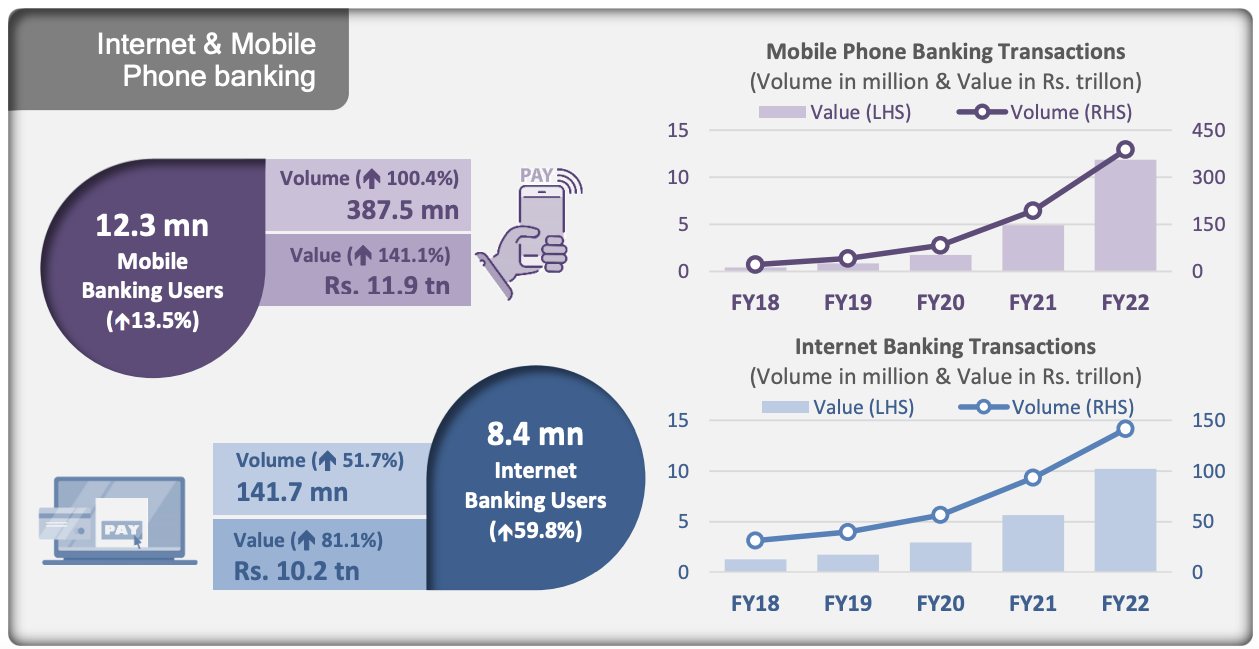
Internet and Mobile Phone Banking Growth in 2021-22. Source: State Bank of Pakistan


Fintech: 

Mobile phone banking and internet banking grew by 141.1% to Rs. 11.9 trillion while Internet banking jumped 81.1% to reach Rs10.2 trillion.  E-commerce transactions also accelerated, witnessing similar trends as the volume grew by 107.4% to 45.5 million and the value by 74.9% to Rs106 billion, according to the State Bank of Pakistan.  

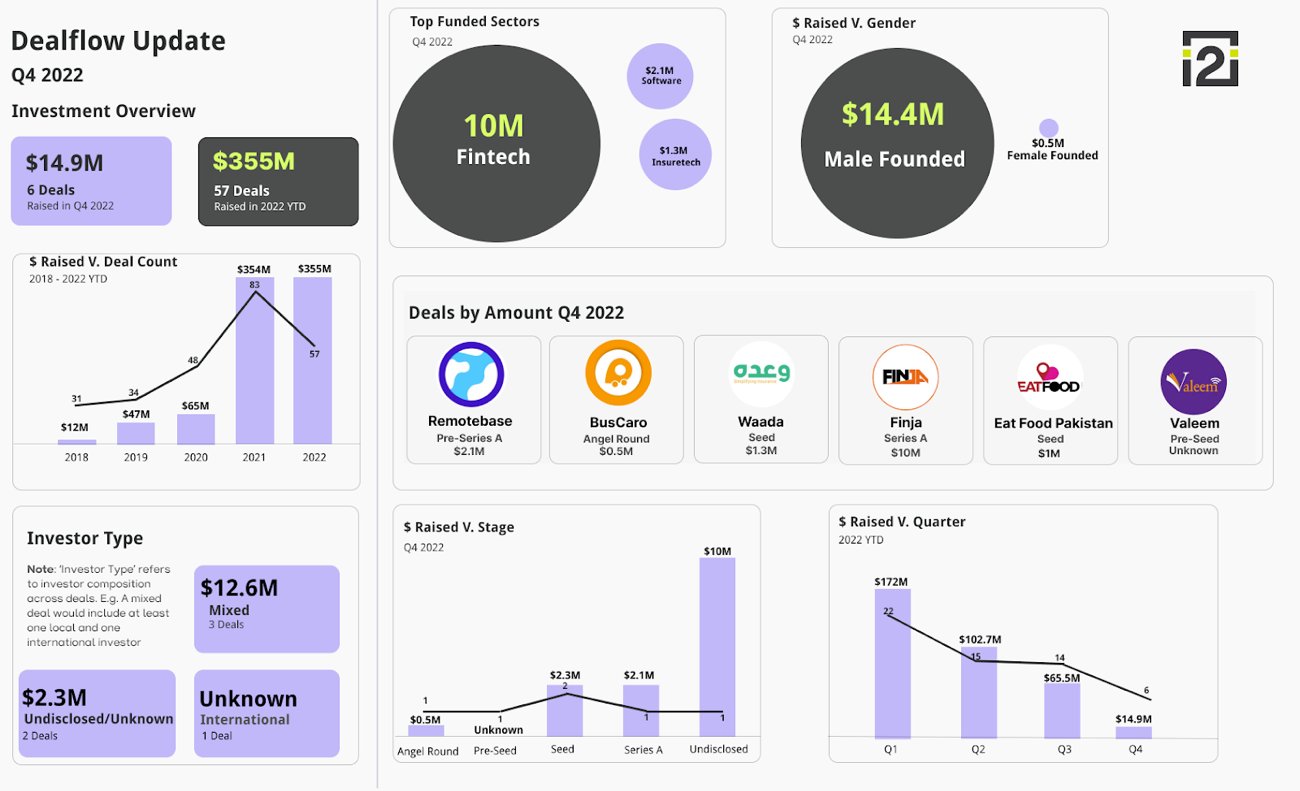
Pakistan Startup Funding in 2022. Source: i2i Investing


Fintech startups continued to draw investments in the midst of a slump in venture funding in Pakistan. Fintech took $10 million from a total of $13.5 million raised by tech startups in the fourth quarter of 2022, according to the data of Invest2Innovate (i2i), a startups consultancy firm. In Q3 of 2022, six out of the 14 deals were fintech startups, compared to two deals of e-commerce startups. Fintech startups raised $38 million which is 58% of total funding ($65 million) in Q3 2022, compared to e-commerce startups that raised 19% of total funding. The i2i data shows that in Q3 2022, fintech raised 37.1% higher than what it raised in Q2 2022 ($27.7 million). Similarly, in Q2 2022, the total investment of fintech was 63% higher compared to what it raised in Q1 2022 ($17 million).

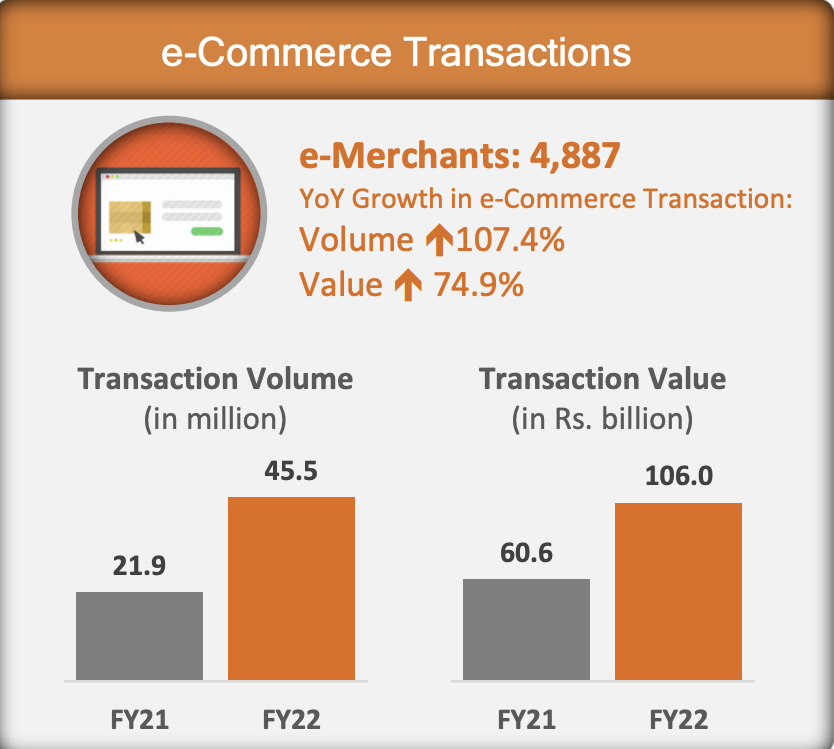
E-Commerce in Pakistan. Source: State Bank of Pakistan


E-Commerce:

E-commerce continued to grow in the country. Transaction volume soared 107.4% to 45.5 million while the value of transactions jumped 75% to Rs. 106 billion over the prior year, according to the State Bank of Pakistan. 

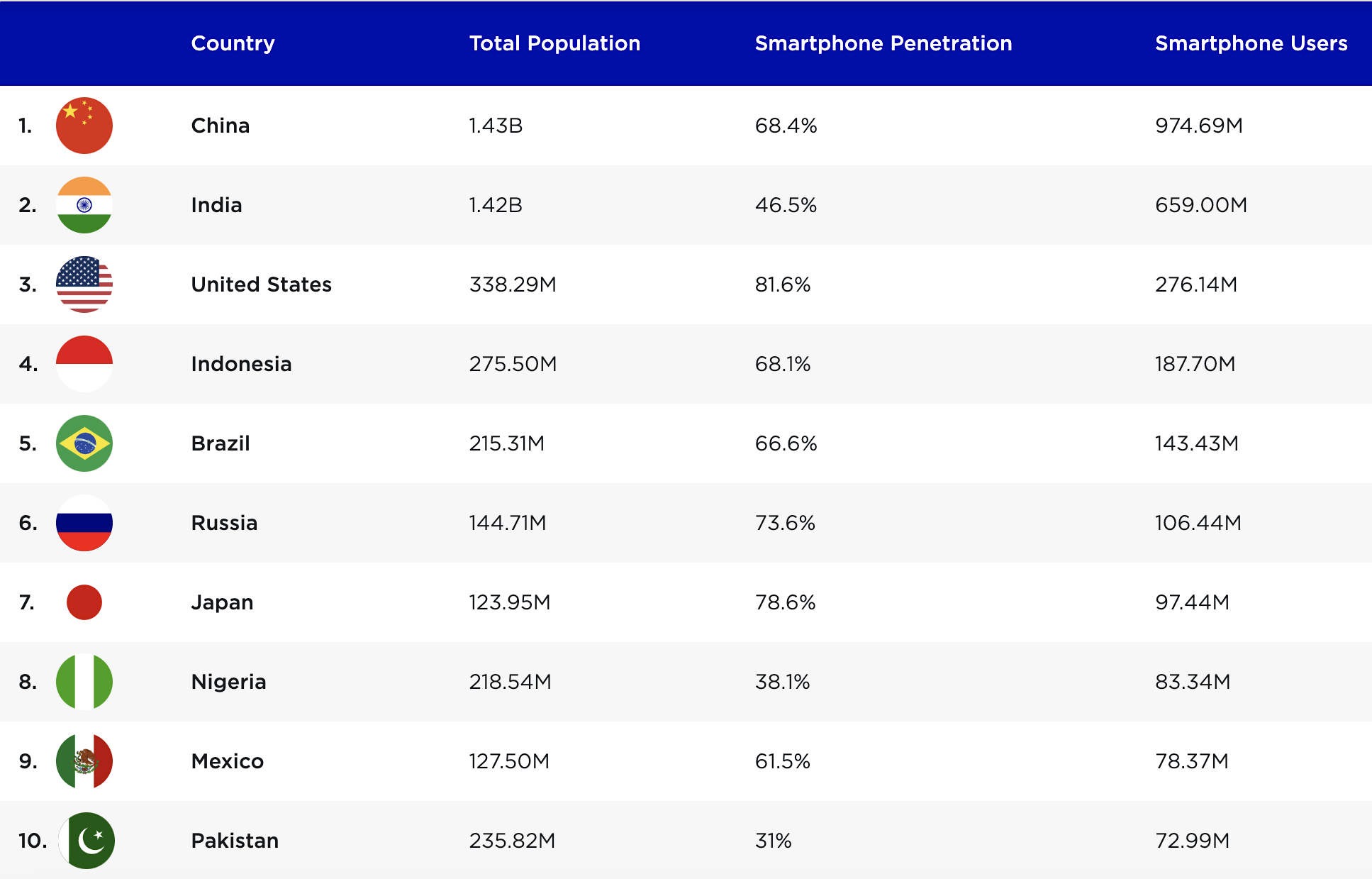
Pakistan Among World's Top 10 Smartphone Markets. Source: NewZoo


PEACE Cable: 

Pakistan and East Africa Connecting Europe (PEACE) cable, a  96 TBPS (terabits per second), 15,000 km long submarine cable, went live in 2022. It brought to 10 the total number of submarine cables currently connecting or planned to connect Pakistan with the world: TransWorld1, Africa1 (2023), 2Africa (2023), AAE1, PEACE,  SeaMeWe3, SeaMeWe4, SeaMeWe5, SeaMeWe6 (2025) and IMEWE. PEACE cable has two landing stations in Pakistan: Karachi and Gwadar. SeaMeWe stands for Southeast Asia Middle East Western Europe, while IMEWE is India Middle East Western Europe and AAE1 Asia Africa Europe 1. 

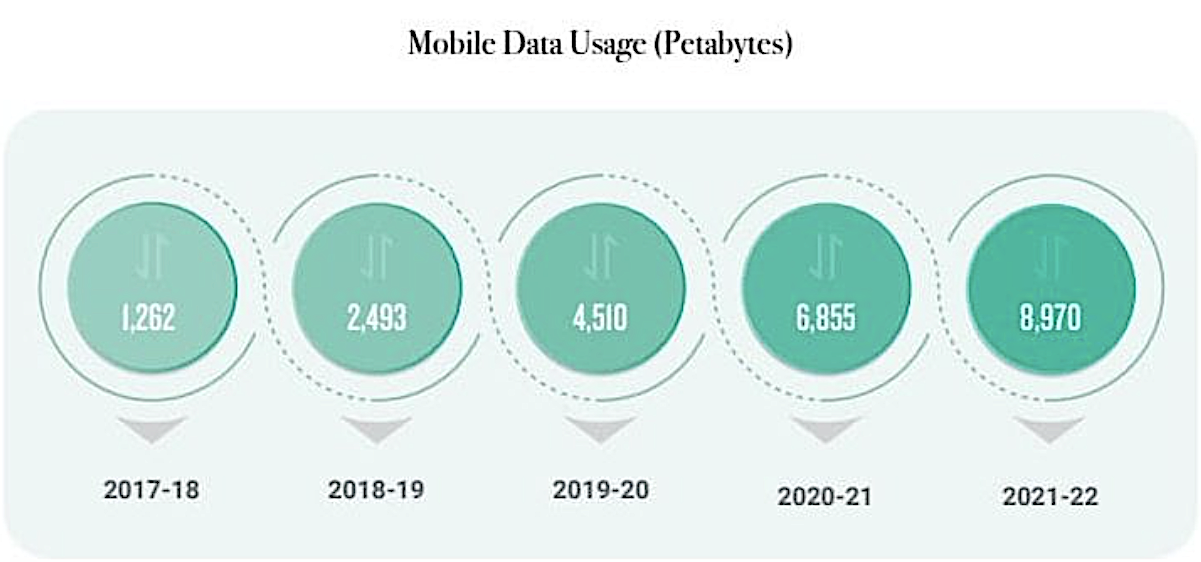
Mobile Data Consumption Growth in Pakistan. Source: ProPakistan


Fiber Optic Cable: 

The first phase of a new high bandwidth long-haul fiber network has been completed jointly by One Network, the largest ICT and Intelligent Traffic and Electronic Tolling System operator in Pakistan, and Cybernet, a leading fiber broadband provider.  The joint venture has deployed 1,800 km of fiber network along motorways and road sections linking Karachi to Hyderabad (M-9 Motorway), Multan to Sukkur (M-5 Motorway), Abdul Hakeem to Lahore (M-3 Motorway), Swat Expressway (M-16), Lahore to Islamabad (M-2 Motorway) and separately from Lahore to Sialkot (M-11 Motorway), Gujranwala, Daska and Wazirabad, according to Business Recorder newspaper.

Mobile telecom service operator Jazz and Chinese equipment manufacturer Huawei have commercially deployed FDD (Frequency Division Duplexing) Massive MIMO (Multiple Input and Output) solution based on 5G technology on a large scale in Pakistan. Jazz and Huawei claim it represents a leap into the 4.9G domain to boost bandwidth. 

Pakistan Telecom Indicators November 2022. Source: PTA


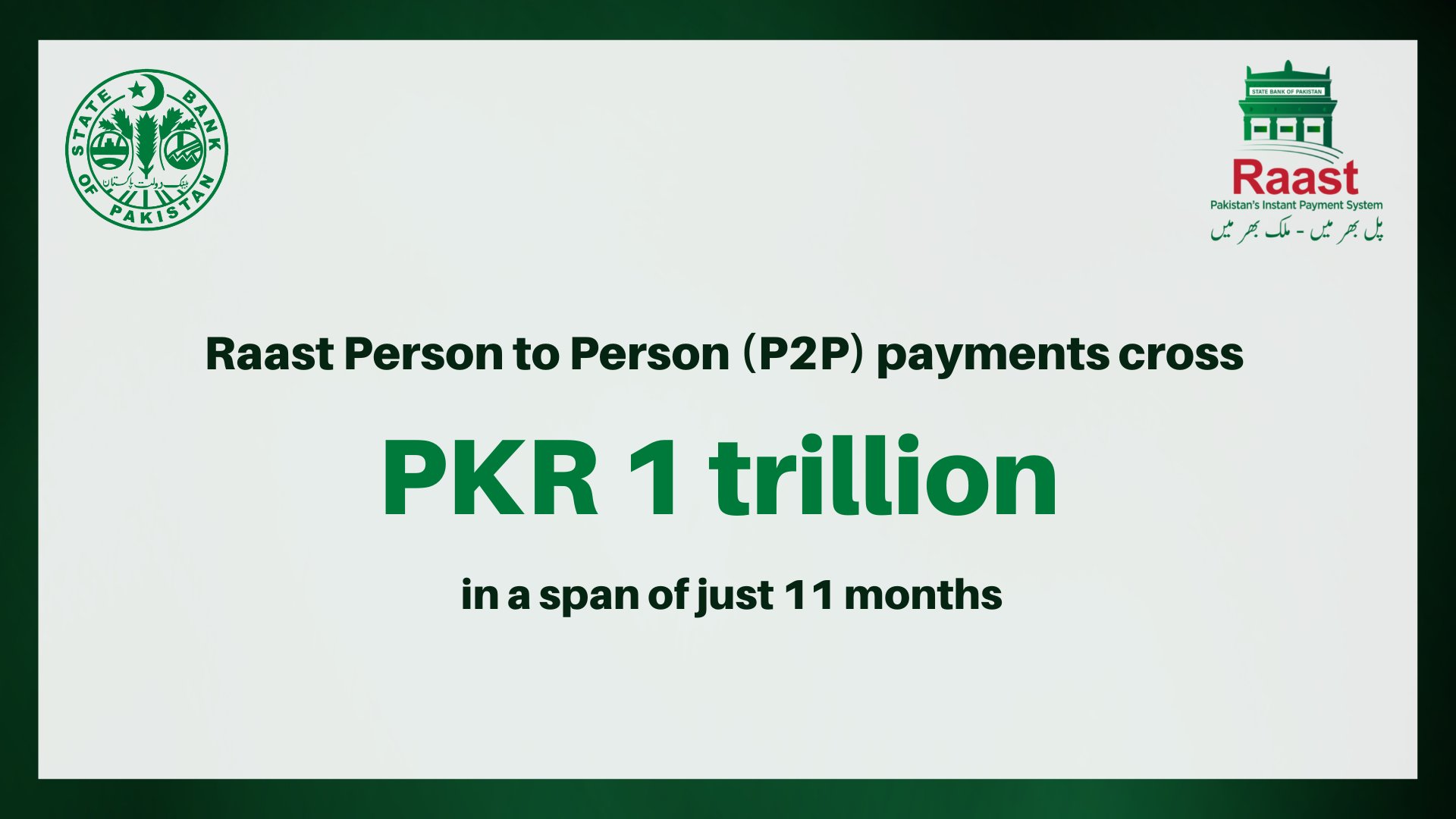
Pakistan's RAAST P2P System Taking Off. Source: State Bank of Pakistan


Broadband Subscriptions:

Pakistan has 124 million broadband subscribers as of November, 2022, according to Pakistan Telecommunications Authority.  Broadband penetration among 140 million (59% of 236 million) Pakistanis in 15-64 years age bracket is 89%.  Over 20 million mobile phones were locally manufactured/assembled in the country in the first 11 months of the year. 

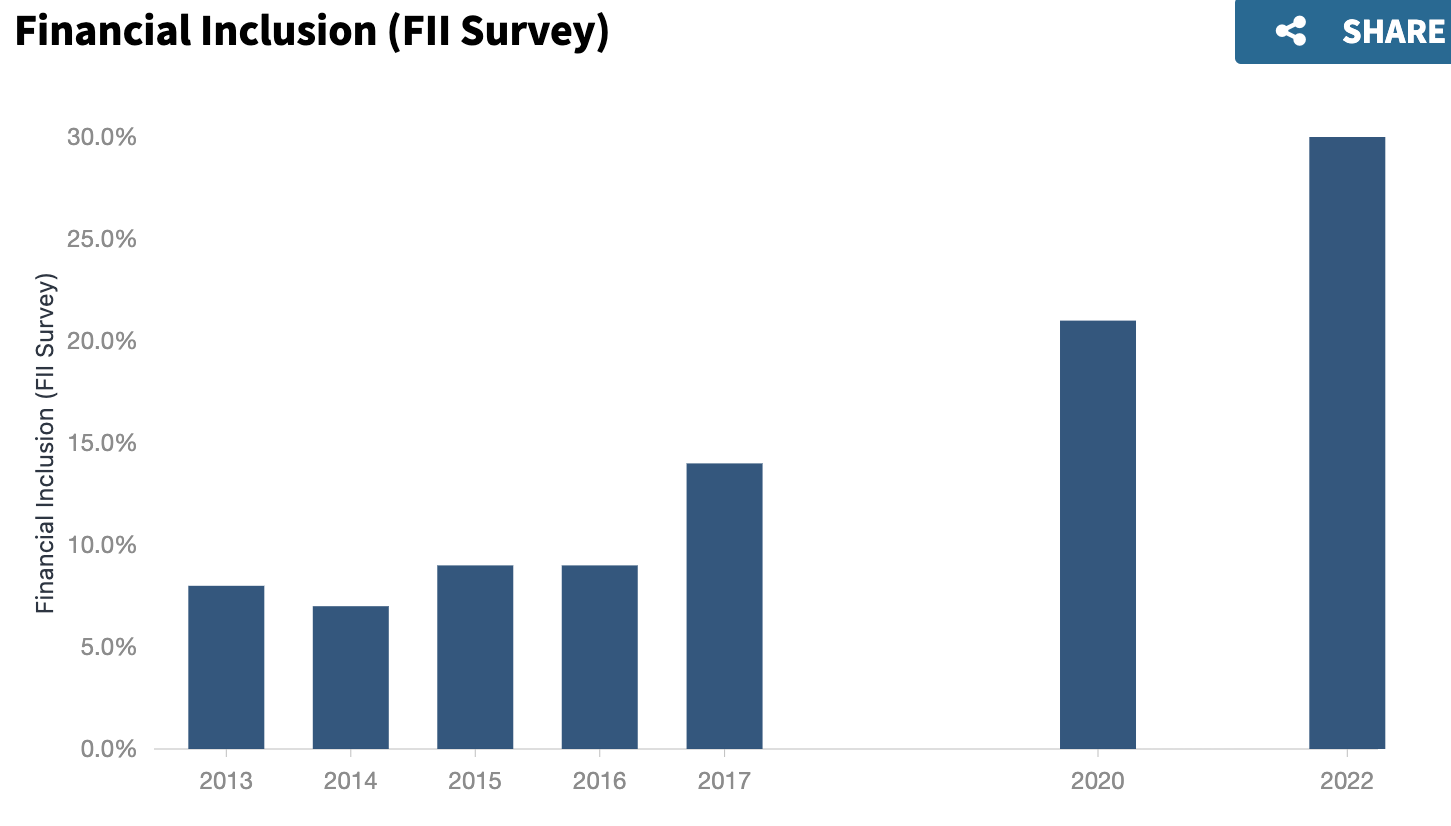
Bank Account Ownership in Pakistan. Source: Karandaaz


Financial Inclusion Doubled In Pakistan in 5 Years. Source: Karandaaz


Documenting Pakistan Economy:

Pakistan's unbanked population is huge, estimated at 100 million adults, mostly women. Its undocumented economy is among the world's largest,  estimated at 35.6% which represents approximately $542 billion at GDP PPP levels, according to World Economics. The nation's tax to GDP ratio (9.2%) and formal savings rates (12.72%) are among the lowest. The process of digitizing the economy could help reduce the undocumented economy and increase tax collection and formal savings and investment in more productive sectors such as export-oriented manufacturing and services. Higher investment in more productive sectors could lead to faster economic growth and larger export earnings. None of this can be achieved without some semblance of political stability. 


Saturday, April 15, 2023

Pakistan is the Second Biggest Source of Foreign Doctors in US and UK

When US Ambassador Richard Holbrooke suffered a massive heart attack in 2010, the doctors who responded to this emergency were both foreign: one from India and the other from Pakistan. Dr. Farzad Najam, a graduate of King Edward Medical College in Lahore, was the chief heart surgeon at George Washington University Hospital at the time. Dr. Monica Mukherjee, a junior cardiologist at the hospital, assisted Dr. Najam in the operating theater. This episode illustrates the high profile presence of South Asian doctors in the United States. 

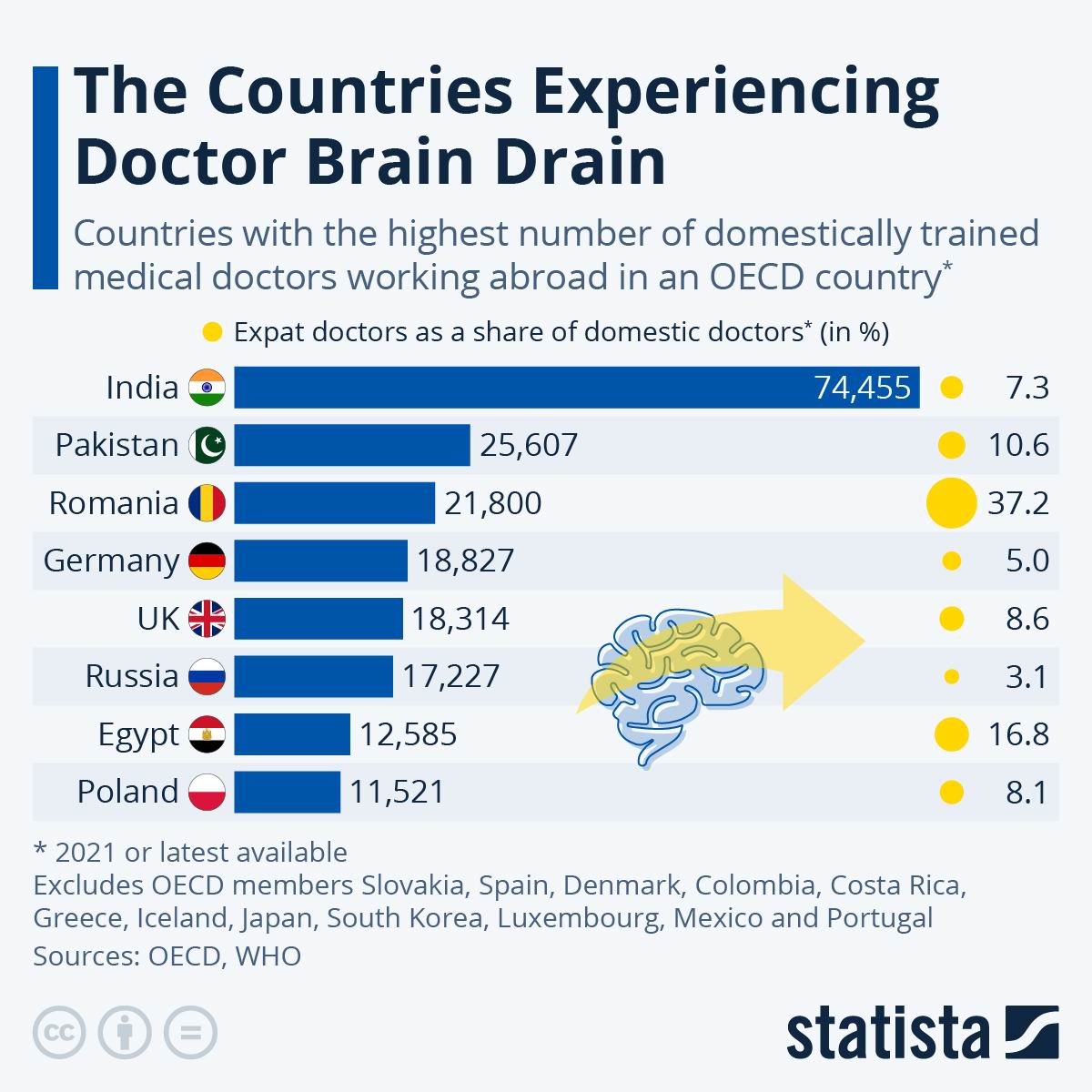
Doctor Brain Drain. Source: Statista

More recently, Dr. Mansoor Mohiuddin, a 1989 graduate of Karachi's Dow Medical College, made global headlines when he implanted a pig heart in a patient at University of Maryland School of Medicine. Considered one of the world’s foremost experts on transplanting animal organs, known as xenotransplantation, Muhammad M. Mohiuddin, MD, Professor of Surgery at UMSOM, joined the UMSOM faculty five years ago and established the Cardiac Xenotransplantation Program with Dr. Griffith. Dr. Mohiuddin serves as the program’s Scientific/Program Director and Dr. Griffith as its Clinical Director.    

Top Countries of Origin of Foreign Doctors in the US. Source: OECD


The pervasive presence of South Asian doctors in the United States is confirmed by OECD (Organization for Cooperation and Development) statistics on foreign doctors in OECD member nations. While India has remained the top source of foreign doctors since 2013, Pakistan has moved up from third to second spot in this period.  As of 2016, there were  45,830 Indian doctors  and 12,454 Pakistani doctors among 215,630 foreign doctors in the United States. India (45,830) and Pakistan (12,454) are followed by Grenada (10,789), Philippines (10,217),  Dominica (9,974), Mexico (9,923), Canada (7,765), Dominican Republic (6,269), China (5,772), UAE (4,635) and Egypt (4,379). 

In percentage terms, 21% of foreign doctors come from India, 6% from Pakistan, 5% each from Grenada, Philippines and Dominica and 4% from Mexico.

Pie Chart of Origins of Foreign Medical Graduates in US. Source: OECD


Many of these "foreign doctors" are US citizens, born and raised in the United States, who travel abroad to study at foreign medical schools. Their reasons vary from ease of admissions to lower costs. This is particularly true of the medical schools  in the Caribbean nations.  

Many Caribbean nations have established medical schools to especially cater to the demand from the United States. In 2007, Pakistan, too, set up Dow International Medical College as part of Dow University of Health Science (DUHS). 

Indians and Pakistanis also make up the top two nationalities among 66,211 foreign doctors in the United Kingdom. There are 18,953 doctors from India, 8,026 from Pakistan, 4.880 from Nigeria and 4,471 from Egypt in the UK.

The list of 25,400 foreign doctors in Canada is topped by South Africans (2,604) followed by Indians (2,127), Irish (1,942), British (1,923), Americans (1,263) and Pakistanis (1,087). 

There are 25,607 Pakistani medical school graduates currently working in all of the OECD member countries which are considered the rich industrialized nations. These Pakistani doctors account for 10.6% of 242,000 Pakistan-trained doctors practicing now. 74,455 Indian doctors working in OECD nations make up 7.3% of about 1,020,000 of all India-trained doctors in practice. 

In spite of losing 10.6% of its doctors to "brain drain" compared to India's 7.3%, Pakistan still has more doctors per capita (1.1 per 1000 population) than India (0.7 doctors per 1000 population), according to the World Bank.  Pakistani medical colleges admit 16,000 students a year compared to 92,000 in India.

As the populations age and demand for medical services grows in the West, more and more of it is being met by recruiting health care workers, including doctors and nurses, from the developing world. 

Related Links:

Haq's Musings

South Asia Investor Review

Pakistani-American Health Professional Featured in Netflix Documentary "Pandemic"

Pakistan is the 3rd Largest Source of Foreign Doctors in America

Pakistani-Americans Largest Foreign-Born Muslim Group in Silicon Valley

Racial Slurs Hurled at Pakistani-American Doctor in St. Louis, Missouri

Islamophobia in America

Silicon Valley Pakistani-Americans

Pakistani-American Leads Silicon Valley's Top Incubator

Silicon Valley Pakistanis Enabling 2nd Machine Revolution

Pakistani-American Surgeon Implants Pig Heart in Human

Pakistani-American Ashar Aziz's Fire-eye Goes Public

Pakistani-American Doctor Honored By President Obama

Pakistani-American's Game-Changing Vision 

Minorities Are Majority in Silicon Valley 

Over A Million Pakistani University Students Enrolled in STEM Fields


Tuesday, April 11, 2023

Silicon Valley NEDians Sponsoring Free Software Bootcamp in Pakistan

Pakistan has seen several boot camps started in recent years to respond to growing demand for practical tech training in the country. Two of my fellow NED University alumni in Silicon Valley - Saeed Kazmi and Idris Kothari - are "helping an initiative in Pakistan with a company xLoop Digital (www.xloopdigital.com), to provide advanced software Bootcamp training to fresh grads in computer science and engineering".  Idris and Saeed are senior NEDians who graduated from our alma mater in early 1970s.  I have personally known them since the early1980s when I first arrived in the San Francisco Bay Area. Both have solid track records as successful tech entrepreneurs in Silicon Valley.  Here are excerpts of their email sent to me on the subject: 

"The training center is located in Karachi . The first batch started in November 22.  Currently, we have about 50 developers under training in two tracks -1. Cloud Native Software Development, 2. Data Sciences/Engineering. The Bootcamp training is provided by www.emeritus.org , a U.S. based company. This is a 16-week program that includes 12 weeks of technical training provided by live on-line, U.S. based instructors, and 4 weeks of soft-skills training. ..... Most of these bootcamps are free of cost however few charge a nominal fee of PKR 10,000 + for every month. In U.S. such Bootcamp costs around $15,000, however we are offering it for free. The only requirement is passing our entry test. We also provide pickup – drop transportation to students...... .The first batch graduated recently, and we are looking to outsource the talent in the U.S. These developers are ready to be interviewed by interested clients". 

Skills Taught at Typical Coding Bootcamp. Source: DICE

Those accepted for the Xloopdigital bootcamp are given a stipend of Rs. 10,000 a month and offered other benefits such as free transport and outpatient medical reimbursements during training.  Upon successful completion of the bootcamp, Xloop offers a 2-year guaranteed employment to all trainees with highly competitive salary and benefits. 

What is coding boot camp?  It is a technical training program designed to teach the programming skills that employers are currently looking for. Technology is constantly changing. It is important for those looking for work in the tech industry to continue to learn and update their skills. Coding boot camps offer short, intensive training courses to help employees and job candidates to meet the needs of employers. They fill the gaps in skillsets of new college graduates to enhance their employability. 

Not all boot camps are alike. It is important to do due diligence before signing up for a boot camp. Some of the questions that come to mind when choosing a boot camp are: 1. How long is the program and how much does it cost? 2. What is its job placement record? 3. Is there a verifiable estimate of the average earnings of its graduates? 4. What is unique about the boot camp you are considering signing up for? How does it compare with other tech bootcamps? 

Let me conclude by quoting Nate Swanner's sound advice on selecting bootcamps: "Remember, there’s no timeline for starting your journey, and nothing saying you must attend a bootcamp to learn tech. What matters is your drive and enthusiasm: two things you just can’t learn in a bootcamp". 

Related Links:


NED Alum Raises $190 Million to Challenge ARM's Dominance

Pakistan Broadband Subscriptions Pass 100 Million

NED University Ranked Among World's Top 200 For Impact

Pakistan's Computer Services Exports Jump 26% Amid Coronavirus Lockdown

Pakistan Gig Economy Among World's Fastest Growing

NED Alum Sells Silicon Valley Company For $7.5 Billion

Pakistan's Demographic Dividend

Over a Million Pakistani University Students Enrolled in STEM Education

State Bank Targets Fully Digital Economy in Pakistan

NED University Alum Raises $100 Million For His Silicon Valley Fintech Startup

Digital Pakistan: Broadband Penetration Reaches 90% of 15+ Population

E-Commerce in Pakistan

2021: A Banner Year For Pakistani Tech Startups

NED Alum's AI Startup Startup Named Most Innovative at RSA Conference

Karachi-Born NED Alum Leads Mercedes' Entry into Electric Vehicle Market

AI Research Funded by NED Alum at His Alma Mater

Riaz Haq's Youtube Channel


Saturday, April 1, 2023

Venture Capital in Pakistan: Startup Funding Rises in Q1 2023 After Hitting Lows in Q4 2022

Pakistani startups raised  $23.1 million in the first quarter of this year after hitting a low of $15.2 million in the last quarter of 2022, according to Data Darbar. The amount of money raised by Pakistani startups increased in each of the first 3 months of 2023, bringing the total funding amount to $945.4 million across 321 deals since 2015. It started out slow with just $1.5 million raised in January, followed by $8.7 million in February and $12.9 million in March. Most of the money went for seed or pre-seed stage companies. 

Pakistan Startup Funding Trend. Source: Data Darbar

Six of the eight deals in Q1/2023 involved seed stage. The pre-seed and accelerator rounds were never disclosed and aren’t, therefore, reflected in the numbers. The lion's share of the investments this year went to logistics ($10.1 million) and fintech ($9 million) startups with the two sectors drawing about $10 million each. Education technology (Edtech) startup Maqsad raised $2.8 million. 

Deal Flow in Q1/2023. Source: I2I Ventures

In terms of gender, a little over 70% of the money raised in Q1/2023 went to male-founded startups and about 30% to female-founded companies.  In Q1 2022, international angels accounted only for 9% (8 investors out of 89) of total investors across disclosed deals. In Q1 2023 they made up 26% (7 investors out of 27), according to Shehryar Hydri, a managing partner at Deosai Ventures. Here are the details of the Q1/2023 deals:  


Pakistan Deal Flow. Source: Data Darbar


There has been a global slowdown in venture funding of startups amid concerns about uncertain economic conditions due to the Ukraine War, high inflation and rising interest rates. Pakistan, too, is heavily impacted. The nation is dealing with political instability and economic uncertainty. 

Related Links:


NED Alum Raises $190 Million to Challenge ARM's Dominance

Pakistan Broadband Subscriptions Pass 100 Million

NED University Ranked Among World's Top 200 For Impact

Pakistan's Computer Services Exports Jump 26% Amid Coronavirus Lockdown

Pakistan Gig Economy Among World's Fastest Growing

NED Alum Sells Silicon Valley Company For $7.5 Billion

Pakistan's Demographic Dividend

Over a Million Pakistani University Students Enrolled in STEM Education

State Bank Targets Fully Digital Economy in Pakistan

NED University Alum Raises $100 Million For His Silicon Valley Fintech Startup

Digital Pakistan: Broadband Penetration Reaches 90% of 15+ Population

E-Commerce in Pakistan

2021: A Banner Year For Pakistani Tech Startups

NED Alum's AI Startup Startup Named Most Innovative at RSA Conference

Karachi-Born NED Alum Leads Mercedes' Entry into Electric Vehicle Market

AI Research Funded by NED Alum at His Alma Mater

Riaz Haq's Youtube Channel


Tuesday, March 28, 2023

Can British Pakistani Humza Yousaf Lead Scotland to Independence?

British Pakistani Humza Yousaf, 37, has made history. He has become the first Muslim to lead Scotland after winning the election of the Scottish National Party (SNP) to succeed Nicola Sturgeon. He is also the youngest person to be elected First Minister of Scotland. Humza's father was born in Pakistan and his mother in Kenya.  "We should all take pride in the fact that today we have sent a clear message, that your color of skin, your faith, is not a barrier to leading the country we all call home", he declared in his victory speech. Back in 2016, he took the oath as a member of the Scottish parliament in Urdu, Pakistan's national language.  Currently, there are 5 members of Pakistani origin serving in the Scottish Parliament and 29 in the British Parliament. 

Scottish Leader Humza Yousaf

Scottish Independence:

He has vowed to lead his nation to independence from Britain, now led by Prime Minister Rishi Sunak, a British Indian. Channel 4 News quoted him as saying: "we will be the next generation that delivers independence of Scotland." The people of Scotland need independence now more than ever", he added.  Here's an excerpt of his victory speech:

"To those in Scotland who don’t yet share the passion I do for independence, I will aim to earn your trust by continuing to govern well, and earn your respect as First Minister by focussing on the priorities that matter to us all, and in doing so using our devolved powers to absolute maximum effect to tackle the challenges of the day. For those of us who do believe in independence, we will only win by making the case on the doorsteps. My solemn commitment to you is that I will kickstart our grassroots, civic-led movement and ensure our drive for independence is in 5th gear". 


60% of Scots Voted Against Brexit. Source: New York Times

Scots Against Brexit:

Recent YouGov poll shows that only 39% of Scottish voters support independence, while 47% wish to remain with the United Kingdom. Can Yousaf persuade more voters to support his goal of independence? He knows that an overwhelming majority of Scots voted against Brexit. This creates an opportunity based on the economic benefits of leaving the UK to join the European Union (EU). Ireland is a good example of a small country enjoying the huge benefits of access to the large European market. Ireland is now significantly wealthier than the UK. Many big American companies have established significant presence in the  Irish Republic to gain access to the EU market. They have created jobs, increased the tax base and brought technology to the Republic of Ireland. 

British Pakistani MPs. Source: Geo News


British Pakistani MPs and Peers:

There are 15 British Pakistani members of the House of Commons, and 14 in the House of Lords, the upper house of the British Parliament, bringing the total strength of British Pakistanis in the UK parliament to 29. Most of them are from very humble backgrounds in rural Pakistan. Majority of Pakistanis in the UK are from Mirpur and its surrounding villages in Azad Kashmir. They or their parents migrated to Britain when they were given compensation by the Pakistani government for their land to make way for the building of the massive Mangla Dam after the signing of the Indus Water Treaty between India and Pakistan in 1960. Five of the twelve British Pakistani MPs in the new parliament are from Azad Kashmir.

London Mayor Sadiq Khan:

In 2016,  Sadiq Khan was elected as mayor of London, making him the first Muslim mayor of a major western capital city. Mayor Sadiq Khan is also of Pakistani-origin. Khan's father migrated to Britain in the 1960s and worked as a London bus driver. Khan comes from a family of two generations of immigrants: His grandparents migrated from what is now India to the newly created state of Pakistan in 1947 and his parents migrated from Karachi to London in 1969. Sadiq Khan was born in London in 1970.

British Pakistanis' Struggles:

While the British Pakistanis have made some headway in the public sector in their new home, they continue to face discrimination, particularly in the private sector.  A 2016 study by the government’s Social Mobility Commission found that the "children of Bangladeshi and Pakistani origin in Britain have outperformed other ethnic groups to achieve rapid improvements at every level of education, but are significantly less likely to be employed in managerial or professional jobs than their white counterparts".

The study said that the "minority ethnic pupils (including Pakistanis) are outperforming white working class children in English tests throughout school, with white British teenagers coming bottom of the pile in the subject at GCSE level".


Pakistani Doctors in the West:

Pakistani doctors make up the third largest source of practicing physicians and surgeons in the United States.  Pakistan is also the second largest source of doctors of foreign origin serving in the United Kingdom, according to OECD. Indians make up 34% of the foreign doctors in Britain, followed by 11% from Pakistan.

Here's a video of Humza Yousaf taking oath as member of Scottish Parliament in Urdu:

https://youtu.be/NE_J8wzo6ko


Related Links:

Haq's Musings

South Asia Investor Review

Upwardly Mobile Pakistani-Americans

Pakistani Diaspora

British Pakistanis

London Mayor Sadiq Khan

British Pakistani Singer Zayn

Pakistan 3rd Largest Source of Foreign Doctors in America

Pakistanis Make Up Largest Foreign-Born Muslim Group in Silicon Valley

Pakistanis in Silicon Valley

Massive Show of Support for Silicon Valley Muslims After Trump Ban

Riaz Haq's Youtube Channel
PakAlumni Social Network


Wednesday, March 22, 2023

World Happiness Report 2023: India Among World's Saddest Nations

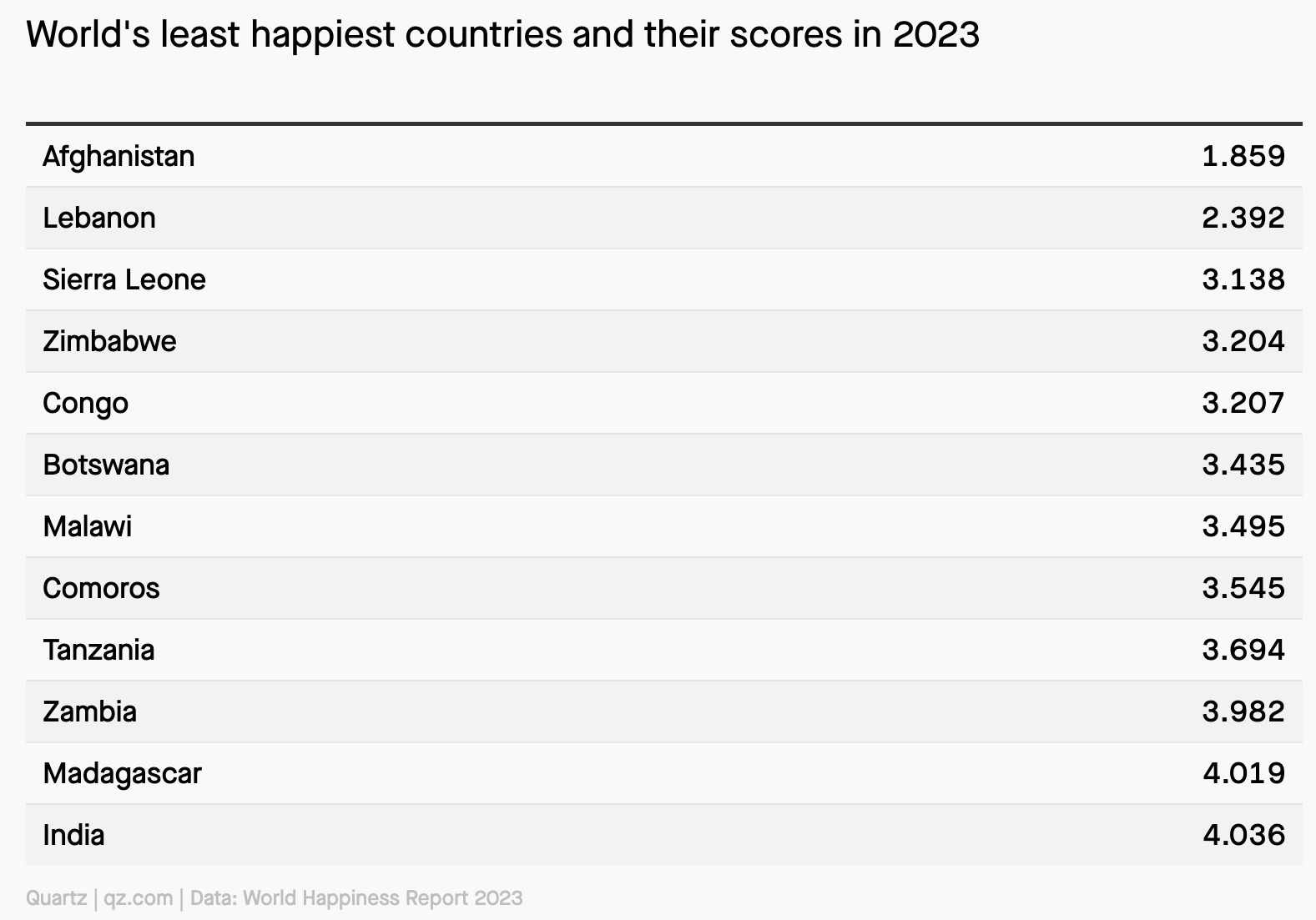
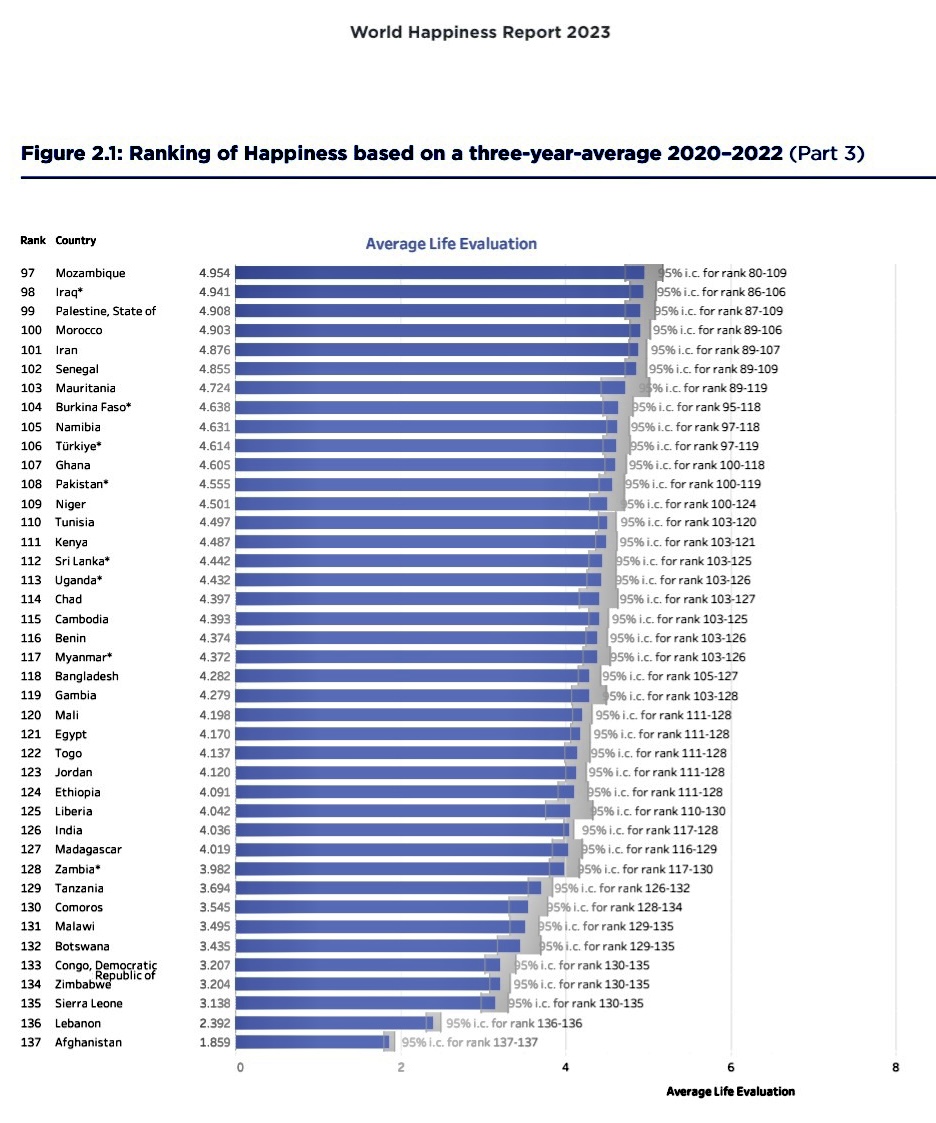
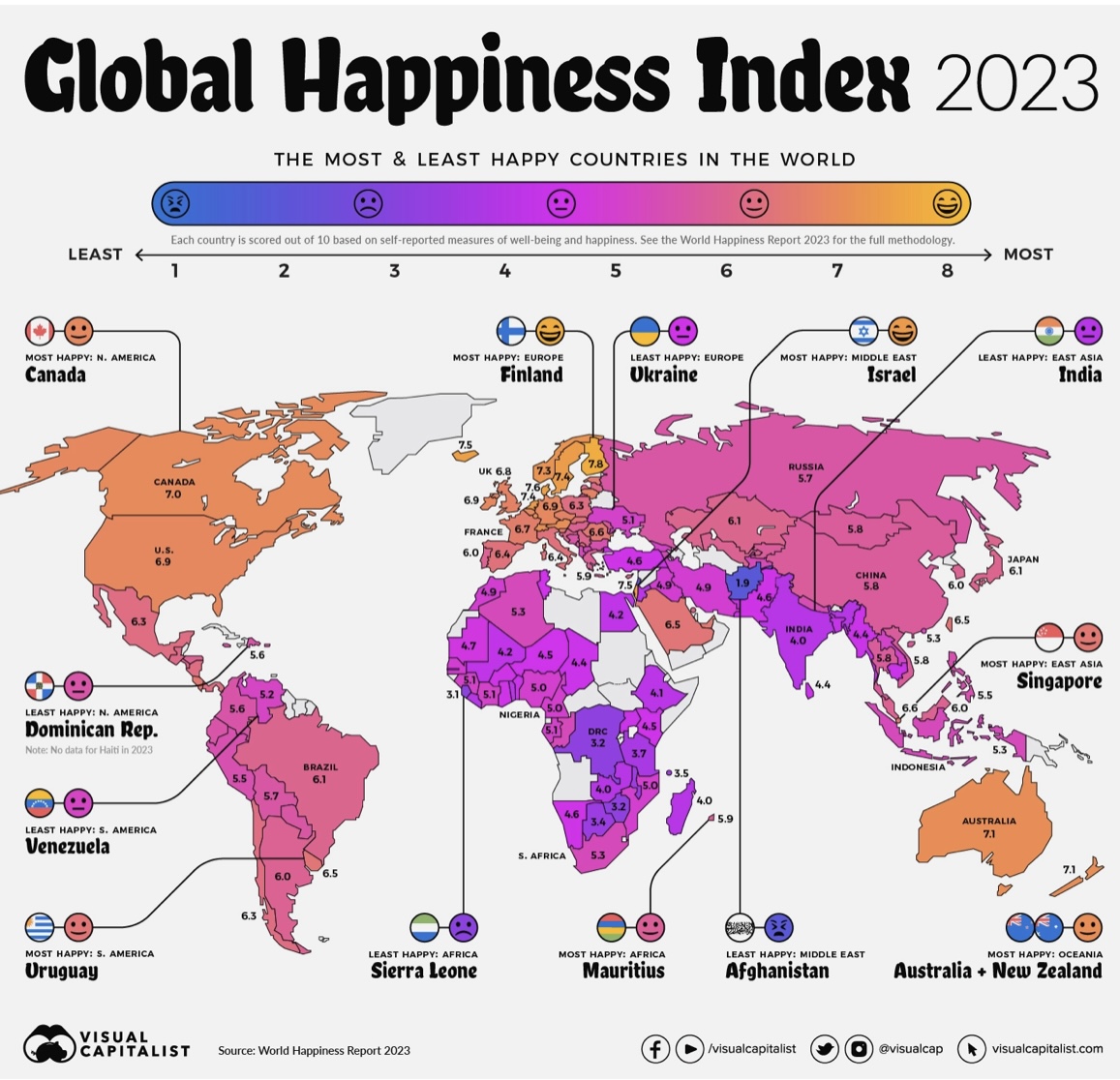
India occupies 126th position among 137 nations ranked in the World Happiness Report 2023 released by the Sustainable Development Solutions Network. In South Asia, Pakistan (score 4.555) ranks 108,  Sri Lanka 112, Bangladesh (4.282) 118 and India 126 (4.036). Only Taliban-ruled Afghanistan ranks worse at 137. Finland is the happiest nation in the world, followed by Denmark and Iceland in 2nd and 3rd place.

Least Happy Countries in 2023. Source: Quartz


Bottom Third Countries in World Happiness Rankings. Source: World Happiness Report


The latest country rankings show life evaluations (answers to the Cantril ladder question) for each country, averaged over a 3 year period from 2020-2022.  The Cantril ladder asks respondents to think of a ladder, with the best possible life for them being a 10 and the worst possible life being a 0. They are then asked to rate their own current lives on that 0 to 10 scale. The rankings are from nationally representative samples for the years 2020-2022.  


World Happiness Map 2023. Source: Visual Capitalist


Happiness Scores Trend:

After climbing to a high of  5.65 in 2019, Pakistan's happiness scores have declined in recent years, reaching a low of 4.52 during the Covid pandemic. The most recent value is 4.555 for 2023. 


Recent Happiness Scores in Pakistan. Source: The Global Economy


India's happiness scores have been declining every year since 2013, reaching a low of 3.78 during the Covid pandemic. The most recent value is 4.036 for 2023. 

Recent Happiness Scores in India. Source: The Global Economy


Causes of Unhappiness: 

Lack of social connections during covid lockdown, along with severe unemployment, high inflation and healthcare worries, took a toll on mental health of Indians, according to the experts quoted by the Indian media. 

Suicide Rates in India and Pakistan. Source: World Bank


Rising Suicides: 

Indian experts' observations are supported by the Indian government data showing a marked increase in suicide rate in India.  India saw the highest suicide rate (of 12 suicides per 100,000 population) since the beginning of this century, according to The Hindu.  Experts say a lot of suicides would have gone unreported and that the numbers and suicide rates could have gone up in 2022 as well. 

Suicide Rate in India. Source: The Hindu


High Unemployment: 

India's unemployment rate rose to 7.45% in February 2023 from 7.14% in the previous month, according to data from the Centre for Monitoring Indian Economy (CMIE).  CMIE’s weekly labor market analysis showed a marginal improvement in India’s labor participation rate to 39.92% in February compared to 39.8% in January 2023 resulting in an increase in the labour force from 440.8 million to 442.9 million.

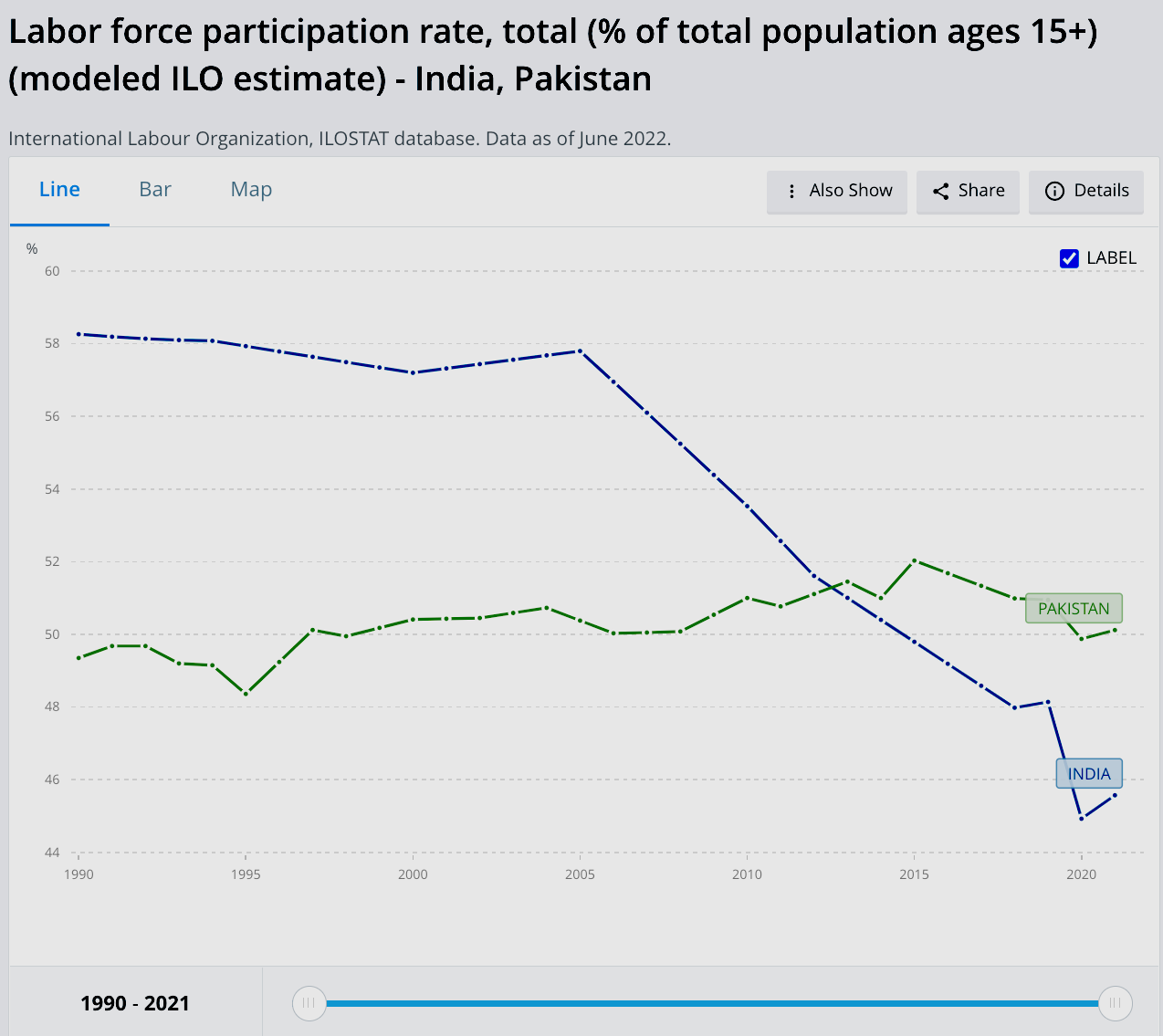
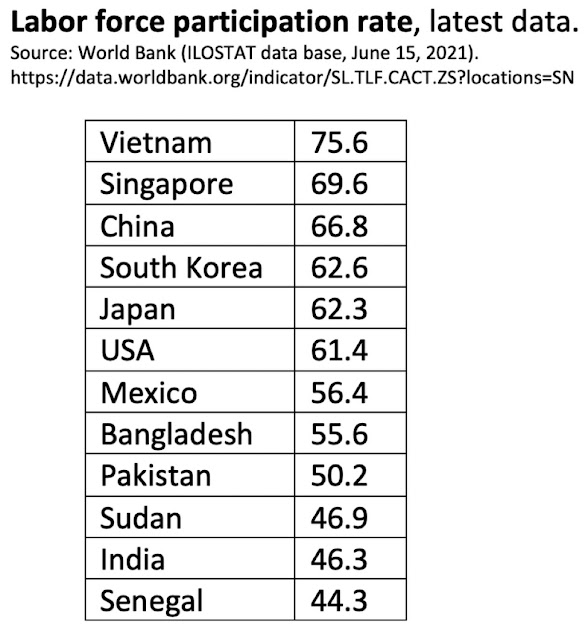
"India’s LPR is much lower than global levels. According to the World Bank, the modeled ILO estimate for the world in 2020 was 58.6 per cent. The same model places India’s LPR at 46 percent. India is a large country and its low LPR drags down the world LPR as well. Implicitly, most other countries have a much higher LPR than the world average. According to the World Bank’s modeled ILO estimates, there are only 17 countries worse than India on LPR. Most of these are middle-eastern countries. These are countries such as Jordan, Yemen, Algeria, Iraq, Iran, Egypt, Syria, Senegal and Lebanon. Some of these countries are oil-rich and others are unfortunately mired in civil strife. India neither has the privileges of oil-rich countries nor the civil disturbances that could keep the LPR low. Yet, it suffers an LPR that is as low as seen in these countries".

Labor Participation Rates in India and Pakistan. Source: World Bank/ILO


Labor Participation Rates for Selected Nations. Source: World Bank/ILO

Youth  unemployment for ages15-24 in India is 24.9%, the highest in South Asia region. It is 14.8% in Bangladesh 14.8% and 9.2% in Pakistan, according to the International Labor Organization and the World Bank.  

Youth Unemployment in Bangladesh, India and Pakistan. Source: ILO, WB


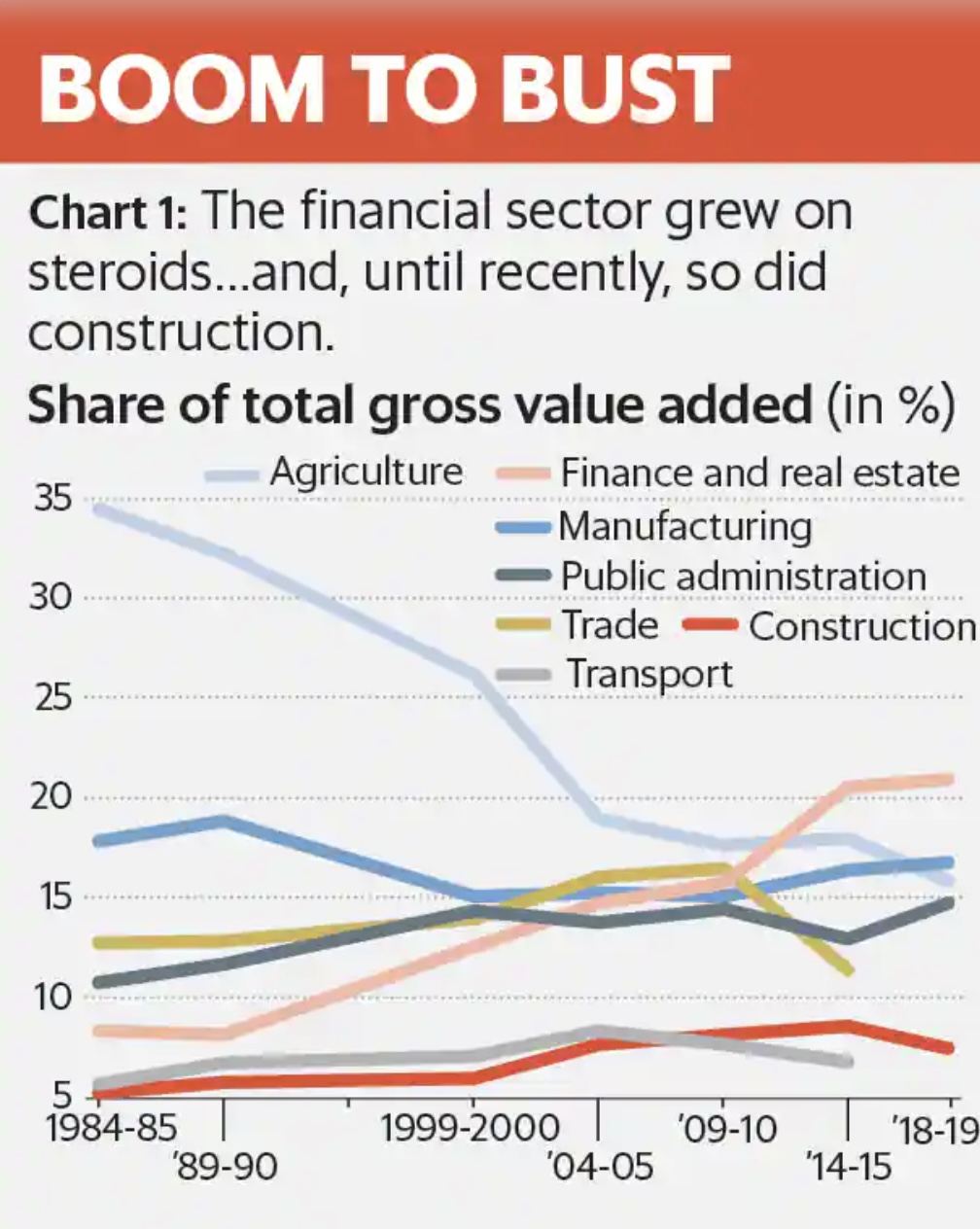
In spite of the headline GDP growth figures highlighted by the Indian and world media, the fact is that it has been jobless growth. The labor participation rate (LPR) in India has been falling for more than a decade. The LPR in India has been below Pakistan's for several years, according to the International Labor Organization (ILO). 

Indian GDP Sectoral Contribution Trend. Source: Ashoka Mody 

Even before the COVID19 pandemic, India's labor participation rate was around 43%, lower than its neighbors'. Now it has slipped further to about 40%. Meanwhile, the Indian government has reported an 8.4% jump in economic growth in the July-to-September period compared with a contraction of 7.4% for the same period a year earlier.  This raises the following questions: Has India had jobless growth? Or its GDP figures are fudged?  If the Indian economy fails to deliver for the common man, will Prime Minister Narendra Modi step up his anti-Pakistan and anti-Muslim rhetoric to maintain his popularity among Hindus?

Indian Employment Trends By Sector. Source: CMIE Via Business Standard


Hunger Crisis:
'
India ranks 94th among 107 nations ranked by World Hunger Index in 2020. Other South Asians have fared better: Pakistan (88), Nepal (73), Bangladesh (75), Sri Lanka (64) and Myanmar (78) – and only Afghanistan has fared worse at 99th place. The COVID19 pandemic has worsened India's hunger and malnutrition. Tens of thousands of Indian children were forced to go to sleep on an empty stomach as the daily wage workers lost their livelihood and Prime Minister Narendra Modi imposed one of the strictest lockdowns in the South Asian nation. Pakistan's Prime Minister Imran Khan opted for "smart lockdown" that reduced the impact on daily wage earners. China, the place where COVID19 virus first emerged, is among 17 countries with the lowest level of hunger. 

World Hunger Rankings 2020. Source: World Hunger Index Report


India Among Worst Hit: 

India has a 17.3% child wasting rate, the worst in the South Asia region. Child stunting is also extremely high across South Asia. “Data from 1991 through 2014 for Bangladesh, India, Nepal, and Pakistan showed that stunting is concentrated among children from households facing multiple forms of deprivation, including poor dietary diversity, low levels of maternal education, and household poverty,” the World Hunger Report said. China, the place where COVID19 virus first emerged, is among 17 countries with the lowest level of hunger. 

Hunger and malnutrition are worsening in parts of sub-Saharan Africa and South Asia because of the coronavirus pandemic, especially in low-income communities or those already stricken by continued conflict. 

India has performed particularly poorly because of one of the world's strictest lockdowns imposed by Prime Minister Modi to contain the spread of the virus. 


Related Links:


Haq's Musings

South Asia Investor Review

Pakistan Among World's Largest Food Producers

Naya Pakistan Housing Program

Food in Pakistan 2nd Cheapest in the World

Indian Economy Grew Just 0.2% Annually in Last Two Years

Pakistan to Become World's 6th Largest Cement Producer by 2030

Pakistan's 2012 GDP Estimated at $401 Billion

Pakistan's Computer Services Exports Jump 26% Amid COVID19 Lockdown

Coronavirus, Lives and Livelihoods in Pakistan

Vast Majority of Pakistanis Support Imran Khan's Handling of Covid19 Crisis

Pakistani-American Woman Featured in Netflix Documentary "Pandemic"

Incomes of Poorest Pakistanis Growing Faster Than Their Richest Counterparts

Can Pakistan Effectively Respond to Coronavirus Outbreak? 

How Grim is Pakistan's Social Sector Progress?

Pakistan Fares Marginally Better Than India On Disease Burdens

Trump Picks Muslim-American to Lead Vaccine Effort

COVID Lockdown Decimates India's Middle Class

Pakistan Child Health Indicators

Pakistan's Balance of Payments Crisis

How Has India Built Large Forex Reserves Despite Perennial Trade Deficits

Conspiracy Theories About Pakistan Elections"

PTI Triumphs Over Corrupt Dynastic Political Parties

Strikingly Similar Narratives of Donald Trump and Nawaz Sharif

Nawaz Sharif's Report Card

Riaz Haq's Youtube Channel