Showing posts sorted by relevance for query hydroelectric. Sort by date Show all posts

Saturday, July 6, 2019

Pakistan Ramps Up Nuclear Power to Boost Low-Carbon Electricity

Construction of 1,100 MW nuclear power reactor K2 unit in Karachi has been completed by China National Nuclear Corporation, according to media reports. A similar reactor unit K3 will add another 1,100 MW of nuclear power to the grid, bringing the total nuclear power installed capacity of Pakistan to 3,630 MW (12% of total power) by 2022.  Hualong One reactors being installed in Pakistan are based on improved Westinghouse AP1000 design which is far safer than Chernobyl and Fukushima plants.  In addition, Pakistan is also generating  9,389  MW (about 28% of total power) of low-carbon hydroelectric power in response to rising concerns about climate change.

Karachi Nuclear Power Plant (KANUPP):

With the placement of the outer containment shell, K2 is  now ready for containment and heat tests. It is scheduled to begin operations in 2020. It’s built using the Chinese HPR1000 technology, which features a dual containment design, with the outer containment providing additional protection for the primary containment.

Karachi Nuclear Power Plant K2 Unit Under Construction. Source: CNNC

KANUPP is Pakistan's first nuclear power plant where construction started in 1966 in Karachi. The plant was connected to the national grid on 18 October 1972. KANUPP, a pressurized heavy water reactor of 137 MW gross capacity was constructed by Canadian General Electric under a turnkey contract. In 1976, vendor support for spare parts and fuel was withdrawn. The PAEC undertook the task of indigenously manufacturing the required spare parts and nuclear fuel on an emergency basis and, since 1980, KANUPP has successfully operated using fuel manufactured by the PAEC, according to International Atomic Energy Agency (IAEA). Here is an except of IAEA's 2018 report on nuclear power in Pakistan:

"Despite the keen interest of Pakistan in building additional nuclear plants, it took more than two decades before the second nuclear power plant started construction. This delay was due to Pakistan’s lack of access to international nuclear technology coupled with a lack of indigenous industrial infrastructure. The construction of Pakistan’s second nuclear plant, C-1, a pressurized water reactor (PWR), was made possible in 1993 with the help of the China National Nuclear Corporation (CNNC). The plant was connected to the national grid on 13 June 2000 and has a gross capacity of 325 MW. A third nuclear power plant, C-2, with 325 MW gross capacity started commercial operation on 18 May 2011. The fourth unit, C-3, started commercial operation on 6 December 2016. It has a gross capacity of 340 MW and a similar plant, C-4, sited beside C-3, was connected to the grid on 25 June 2017. The first concrete pours to mark the start of construction of Karachi Coastal Power Project, a project containing two nuclear units, K-2 and K-3 (1100 MW each), based on an improved PWR design, were 20 August 2015 and 31 May 2016, respectively."

Pakistan Power Generation Fuel Mix. Source: Third Pole


International Energy Agency:

International Energy Agency (IEA) has recently warned that "steep decline in nuclear power would threaten energy security and climate goals". "With nuclear power facing an uncertain future in many countries, the world risks a steep decline in its use in advanced economies that could result in billions of tonnes of additional carbon emissions", the IEA has said.

Pakistan Among 31 Countries Operating Nuclear Power Plants


Nuclear is the second-largest low-carbon power source in the world today, accounting for 10% of global electricity generation. It is second only to hydropower at 16%, according to International Energy Agency (IEA). Pakistan nuclear plants are expected to generate 3,630 MW  (12% of total power vs 10% global average) by 2022.  Pakistan is also generating  9,389  MW (about 28% of total power vs 16% global average) of low-carbon hydroelectric power in response to rising concerns about climate change.

Nuclear Plant Safety Concerns:

Activists in Pakistan have raised serious concerns about potential risks from K2 and K3 plants to the population in Karachi. Are such concerns valid?

The worst nuclear disaster in the history of nuclear power generation was at Chernobyl in present day Ukraine. One of the key reasons was that the Chernobyl plant did not have the fortified containment structure common to most nuclear power plants elsewhere in the world. KANUPP K-2 and K-3 reactors have two containment shells: primary and secondary. It is noteworthy that Bhopal Union Carbide disaster was history's worst industrial disaster, far bigger in terms of human toll than the Chernobyl disaster.

China signed a technology transfer deal with the United States in 2006 that put the Westinghouse AP1000 reactor design at the “core” of its atomic energy program. Chinese reactor manufacturers also resolved to build advanced third-generation technology in their safety review after the 2011 Fukushima nuclear plant disaster.

Unlike Fukushima where underground emergency cooling system failed due to flooding, the Hualong One design stores water above the reactor that can be gravity-fed to keep it cool if the pumps fail in the event of meltdown. The Chinese HPR1000 reactors employ multiple redundant generators and cooling systems to lower meltdown risk.

Hydropower Generation:

The biggest and most important source of low-carbon energy in Pakistan is its hydroelectric power plants. Pakistan ranked third in the world by adding nearly 2,500 MW of hydropower in 2018, according to Hydropower Status Report 2019.  China added the most capacity with the installation of 8,540 megawatts, followed by Brazil (3,866 MW), Pakistan (2,487 MW), Turkey (1,085 MW), Angola (668 MW), Tajikistan (605 MW), Ecuador (556 MW), India (535 MW), Norway (419 MW) and Canada (401 MW).

New Installed Hydroelectric Power Capacity in 2018. Source: Hydroworld.com

Pakistan's Water and Power Development Authority (WAPDA) says commissioning of the 108-MW Golen Gol 2, 1,410-MW Tarbela 4th Extension and 969-MW Neelum Jhelum hydropower projects in 2018 boosted its hydroelectric generating capacity of 9,389 MW, an increase of 36% in just one year, according to Hydro Review. Hydropower now makes up about 28% of the total installed capacity of 33,836 MW as of February, 2019.   WAPDA reports contributing 25.63 billion units of hydroelectricity to the national grid during the year, “despite the fact that water flows in 2018 remained historically low.” This contribution “greatly helped the country in meeting electricity needs and lowering the electricity tariff for the consumers.”

Top 20 Countries by Newly Installed Hydropower Capacity. Source: IHA

Pakistan has the potential to generate 59,000 MW of hydropower, according to studies conducted by the nation's Water and Power Development Authority (WAPDA). Currently, it's generating only 9,389 MW of hydroelectric power, about 16% of the estimated potential. Media reports indicate that China is prepared to finance and build another 40,000MW capacity as part of the development of the Northern Indus Cascade region which begins in Skardu in Gilgit-Baltistan and runs through to Tarbela, the site of Pakistan’s biggest dam, in Khyber-Pakhtunkhwa province.

Pakistan has made only a small contribution to climate change through carbon emissions.  And yet, it counts among the dozen or so nations considered most vulnerable to its damaging effects. These include rising temperatures, recurring cycles of floods and droughts and resulting disruption in food production.

Summary: 

Construction of 1,100 MW nuclear power reactor K2 unit in Karachi has been completed by China National Nuclear Corporation, according to media reports. A similar reactor unit K3 will add another 1,100 MW of nuclear power to the grid, bringing the total nuclear power installed capacity of Pakistan to 3,630 MW (12% of total power) by 2022.  Hualong One reactors being installed in Pakistan are based on improved Westinghouse AP1000 design which is far safer than Chernobyl and Fukushima plants.  In addition, Pakistan is also generating  9,389  MW (about 28% of total power) of low-carbon hydroelectric power in response to rising concerns about climate change. One of the ways Pakistan can help reduce carbon emissions is by realizing its full nuclear and hydroelectric power potential by building more nuclear plants and dams. The development of the Northern Indus Cascade region to generate 40,000MW of hydropower is a significant part of this effort.

Related Links:

Haq's Musings

South Asia Investor Review

Nuclear Power in Pakistan

Recurring Cycles of Drought and Floods in Pakistan

Pakistan's Response to Climate Change

Massive Oil and Gas Discovery in Pakistan: Hype vs Reality

Renewable Energy for Pakistan

Digital BRI: China and Pakistan Building Fiber, 5G Networks

LNG Imports in Pakistan

Growing Water Scarcity in Pakistan

China-Pakistan Economic Corridor

Ownership of Appliances and Vehicles in Pakistan

CPEC Transforming Pakistan

Pakistan's $20 Billion Tourism Industry Boom

Riaz Haq's YouTube Channel

PakAlumni Social Network

Monday, May 13, 2019

Pakistan Among World's Top 3 Countries For New Hydroelectric Power

Pakistan ranked third in the world by adding nearly 2,500 MW of hydropower in 2018, according to Hydropower Status Report 2019.  China added the most capacity with the installation of 8,540 megawatts, followed by Brazil (3,866 MW), Pakistan (2,487 MW), Turkey (1,085 MW), Angola (668 MW), Tajikistan (605 MW), Ecuador (556 MW), India (535 MW), Norway (419 MW) and Canada (401 MW).

New Installed Hydroelectric Power Capacity in 2018. Source: Hydroworld.com

Pakistan's Water and Power Development Authority (WAPDA) says commissioning of the 108-MW Golen Gol 2, 1,410-MW Tarbela 4th Extension and 969-MW Neelum Jhelum hydropower projects in 2018 boosted its hydroelectric generating capacity of 9,389 MW, an increase of 36% in just one year, according to Hydro Review. Hydropower now makes up about 28% of the total installed capacity of 33,836 MW as of February, 2019.   WAPDA reports contributing 25.63 billion units of hydroelectricity to the national grid during the year, “despite the fact that water flows in 2018 remained historically low.” This contribution “greatly helped the country in meeting electricity needs and lowering the electricity tariff for the consumers.”

Top 20 Countries by Newly Installed Hydropower Capacity. Source: IHA

Pakistan has the potential to generate 59,000 MW of hydropower, according to studies conducted by the nation's Water and Power Development Authority (WAPDA). Currently, it's generating only 9,389 MW of hydroelectric power, about 16% of the estimated potential. Media reports indicate that China is prepared to finance and build another 40,000MW capacity as part of the development of the Northern Indus Cascade region which begins in Skardu in Gilgit-Baltistan and runs through to Tarbela, the site of Pakistan’s biggest dam, in Khyber-Pakhtunkhwa province.

Pakistan Power Generation Fuel Mix. Source: Third Pole

Pakistan has made only a small contribution to climate change through carbon emissions.  And yet, it counts among the dozen or so nations considered most vulnerable to its damaging effects. These include rising temperatures, recurring cycles of floods and droughts and resulting disruption in food production.

One of the ways Pakistan can help reduce carbon emissions is by realizing its full hydroelectric potential by building more dams. The development of the Northern Indus Cascade region to generate 40,000MW of hydropower is a significant part of this effort.

Haq's Musings

South Asia Investor Review

Recurring Cycles of Drought and Floods in Pakistan

Pakistan's Response to Climate Change

Massive Oil and Gas Discovery in Pakistan: Hype vs Reality

Renewable Energy for Pakistan

Digital BRI: China and Pakistan Building Fiber, 5G Networks

LNG Imports in Pakistan

Growing Water Scarcity in Pakistan

China-Pakistan Economic Corridor

Ownership of Appliances and Vehicles in Pakistan

CPEC Transforming Pakistan

Pakistan's $20 Billion Tourism Industry Boom

Riaz Haq's YouTube Channel

PakAlumni Social Network

Tuesday, September 16, 2008

Renewable Energy to Tackle Pakistan's Electricity Crisis

In June 2007, the power cuts in Pakistan lasted no more than 3 or 4 hours a day. Today, in extremely hot weather, Pakistanis have to endure without electricity for 8 to 10 hours a day. Industrial production is suffering, exports are down, jobs are being lost, and the national economy is in a downward spiral. By all indications, the power crisis in Pakistan is getting worse than ever.

Extended Load-shedding:
Extended electricity load shedding in Karachi's five major industrial estates is causing losses in billions of rupees as the production activity has fallen by about 50 per cent. KESC, Karachi's power supply utility, is dealing with with a shortfall of around 700MW against a total demand of 2200MW. Almost all forms of power generation from fossil fuel-fired thermal to hydroelectric to nuclear are down from a year ago. As a result of the daily rolling blackouts, the economy, major exports and overall employment are also down and the daily wage earners are suffering. The KESC and PEPCO owe more than Rs. 10b to the independent power producers (IPPs) and paying them will help bring them into full operation and ease the crisis at least partially.

Electricity Demand:
As discussed in an earlier post, Pakistan's current installed capacity is around 19,845 MW, of which around 20% is hydroelectric. Much of the rest is thermal, fueled primarily by gas and oil. Pakistan Electric Power Company PEPCO blames independent power producers (IPPs) for the electricity crisis, as they have been able to give PEPCO only 3,800 MW on average out of 5,800 MW of confirmed capacity. Most of the IPPs are running fuel stocks below the required minimum of 21 days. IPPs complain that they are not being paid on time by PEPCO.

Per capita energy consumption of the country is estimated at 14 million Btu, which is about the same as India's but only a fraction of other industrializing economies in the region such as Thailand and Malaysia, according to the US Dept of Energy 2006 report. To put it in perspective, the world average per capita energy use is about 65 million BTUs and the average American consumes 352 million BTUs. With 40% of the Pakistani households that have yet to receive electricity, and only 18% of the households that have access to pipeline gas, the energy sector is expected to play a critical role in economic and social development. With this growth comes higher energy consumption and stronger pressures on the country’s energy resources. At present, natural gas and oil supply the bulk (80 percent) of Pakistan’s energy needs. However, the consumption of those energy sources vastly exceeds the supply. For instance, Pakistan currently produces only 18.3 percent of the oil it consumes, fostering a dependency on expensive, imported oil that places considerable strain on the country’s financial position, creating growing budget deficits. On the other hand, hydro, coal, wind and solar are perhaps underutilized and underdeveloped today, as Pakistan has ample potential to exploit these resources.

The country's creaky and outdated electricity infrastructure loses over 30 percent of generated power in transit, more than seven times the losses of a well-run system, according to the Asian Development Bank and the World Bank; and a lack of spare high-voltage grid capacity limits the transmission of power from hydroelectric plants in the north to make up for shortfalls in the south.

Gilani Government's Response:
Neelum-Jhelum hydroelectric project, first formally announced by former Minister Omar Ayub on June 10, 2007, is finally starting in earnest under the PPP government of Prime Minister Yousaf Raza Gilani. This hydro project is expected to add 963MW power generating capacity at a cost US $2.2 billion, according to Business Wire. Prior to this project, the new Pakistani Prime Minister signed a deal with a Chinese company, Dong Fong, for setting up 525 MW thermal power plant with an investment of $450 million at Chichoki Mallian (Sheikhupura). Both of these projects are expected help partially close the 3000 MW gap that exists today between supply and demand in Pakistan.

Green Energy Opportunities:
In response to the warnings of energy crisis in Pakistan, President Musharraf's government recognized the need and the potential for renewable alternatives and, in 2006, created Alternative Energy Development Board to pursue renewable energy. In particular, AEDB is focusing on wind and solar as viable alternatives. AEDB is facilitating setting up of small renewable energy projects in line with government’s policy of promoting the use of renewable energy in the country’s power generation mix, says the board’s chief executive officer Mr Arif Alauddin. AEDB has recently issued Makwind Power Private Ltd (MPPL) a Letter of Intent for the setting up of 50MW wind farm at Nooriabad in Sindh, as part of its efforts to facilitate 700 MW wind energy by 2010.


According to data published by Miriam Katz of Environmental Peace Review, Pakistan is fortunate to have something many other countries do not, which are high wind speeds near major centers. Near Islamabad, the wind speed is anywhere from 6.2 to 7.4 meters per second (between 13.8 and 16.5 miles per hour). Near Karachi, the range is between 6.2 and 6.9 (between 13.8 and 15.4 miles per hour). Pakistan is also fortunate that in neighboring India, the company Suzlon manufactures wind turbines, thus decreasing transportation costs. Working with Suzlon, Pakistan can begin to build its own wind-turbine industry and create thousands of new jobs while solving its energy problems. Suzlon turbines start to turn at a speed of 3 meters per second. Vestas, which is one of the world's largest wind turbine manufacturers, has wind turbines that start turning at a speed of 4 meters per second. In addition to Karachi and Islamabad, there are other areas in Pakistan that receive a significant amount of wind.

In only the Balochistan and Sindh provinces, sufficient wind exists to power every coastal village in the country. There also exists a corridor between Gharo and Keti Bandar that alone could produce between 40,000 and 50,000 megawatts of electricity, says Ms. Katz who has studied and written about alternative energy potential in South Asia. Given this surplus potential, Pakistan has much to offer Asia with regards to wind energy. In recent years, the government has completed several projects to demonstrate that wind energy is viable in the country. In Mirpur Sakro, 85 micro turbines have been installed to power 356 homes. In Kund Malir, 40 turbines have been installed, which power 111 homes. The Alternative Energy Development Board (AEDB) has also acquired 18,000 acres for the installation of more wind turbines.

In addition to high wind speeds near major centers as well as the Gharo and Keti Bandar corridor, Pakistan is also very fortunate to have many rivers and lakes. Wind turbines that are situated in or near water enjoy an uninterrupted flow of wind, which virtually guarantees that power will be available all the time. Within towns and cities, wind speeds can often change quickly due to the presence of buildings and other structures, which can damage wind turbines. In addition, many people do not wish for turbines to be sited near cities because of noise, though these problems are often exaggerated. Wind turbines make less noise than an office and people comfortably carry on conversations while standing near them.

As is painfully evident in summers, Pakistan is an exceptionally sunny country. If 0.25% of Balochistan was covered with solar panels with an efficiency of 20%, enough electricity would be generated to cover all of Pakistani demand. In all provinces the AEDB has created 100 solar homes in order to exploit solar energy.

Solar energy makes much sense for Pakistan for several reasons: firstly, 70% of the population lives in 50,000 villages that are very far away from the national grid, according to a report by the Solar Energy Research Center (SERC). Connecting these villages to the national grid would be very costly, thus giving each house a solar panel would be cost efficient and would empower people both economically and socially.

Coal Power and Hydroelectricity
In addition to high winds and abundant solar potential, Pakistan has the fifth largest coal deposits in the world. The negative environmental effects of coal burning can be be mitigated by making use of the latest clean coal technologies that limit noxious gas exhaust into the atmosphere.

Pakistan also has some deposits of natural gas in the Potwar Plateau region and near the border between Balochistan and Sindh, but these are likely to disappear within 20 years.

Because of the presence of many rivers and lakes, it makes sense for Pakistan to build dams to support water management and electricity generation projects. However, it must be done with care to avoid damage to the environment or loss of farmland.

Financial and Policy Incentives
Despite the fact that Pakistan is so well endowed with wind and solar potential, only a few projects such as those mentioned above have been completed. One of the reasons why this has occurred is that Pakistan does not have major financial incentives available for those who want to install wind turbines or solar panels. Let us look at the case of India, Pakistan's neighbor. Despite having less potential for wind, India now has the world's fourth largest number of wind turbines installed at 7,093 MW, according to India: Renewable Energy Market report. Ahead of India are Germany at 21,283 MW, Spain at 13,400 MW and the US at 12,934 MW. In Germany, Spain and India, those who install wind turbines and solar panels are guaranteed a certain rate per kilowatt hour. In India, this varies according to the technology and the area. The Ministry of New and Renewable Energy, India reports that in most areas, between 2500 and 4800 rupees are guaranteed for solar panels, and for wind turbines, between 250,000 and 300,000 rupees are awarded.
Because of the above incentives, the cost of wind in India is between 2 and 2.5 cents per kilowatt hour while in Pakistan, the cost is 7 cents. In December 2006, President Musharraf announced a national renewable energy policy. This policy means that small projects do not need approval and that any person can put up their own project. However, there are no financial incentives for doing so. At the moment, all renewable energy equipment has no sales or income tax and is free of custom duty, but these incentives are not enough to stimulate major growth in the renewable energy market where ROIs and other financial ratios have a long gestation or breakeven period. In certain situations, such as the textiles and other Karachi industrial units losing production and export opportunities due to power cuts, it may make sense for the owners to join hands and build power generation capacity they can rely on.

Conclusion
In addition to coal and hydro electricity generation, Miriam Katz argues that it is clear that Pakistan is a suitable country for the installation of wind and solar: due to high winds near cities; the presence of rivers and lakes as well as the availability of wind turbines from nearby India. There are also other reasons for installing renewable energy. It is quite normal for extended power outages to happen on a daily basis in the country, but this cannot continue if the Pakistani economy is to grow. In March 2007, President Musharraf stated that renewable energy should be part of the push to increase energy supplies by 10 to 12 percent every year. The government also set a target of 10 percent of energy to come from renewables by 2015. If the new PPP-led government follows through with aggressive renewable energy push, Pakistan could be an Asian leader in renewable energy given its natural resources of wind and solar as its strategic endowments.

Related Links:

Renewable Energy Businesses in Pakistan

Pakistan Council of Renewable Energy Technology

Renewable Energy for Pakistan

Pakistan Policy on Renewable Technology

Sugarcane Ethanol Project in Pakistan

Community Based Renewable Energy Project in Pakistan

Thursday, June 28, 2018

Pakistan Water Crisis: Facts and Myths

Pakistan is believed to be in the midst of a water crisis that is said to pose an existential threat to the country. These assertions raise a whole series of questions on the source of the crisis and possible solutions to deal with it. The New Water Policy adopted in April 2018 is a good start but it needs a lot more focus and continuing investments.

Indus Water System. Courtesy: The Friday Times
Questions on Water Crisis: 

How severe is Pakistan's water crisis? Is India contributing to this crisis? How many million acre feet (MAF) of water flows in Pakistan? What are its sources? Glaciers? Rain? Groundwater? How much of it is stored in dams and other reservoirs? What is the trend of per capita water availability in Pakistan? What sectors are the biggest consumers of water in Pakistan? Why does agriculture consume over 95% of all available water? How can Pakistan produce "more crop per drop"? What are Pakistan's options in dealing with the water crisis? Build more dams? Recharge groundwater? Use improved irrigation techniques like sprinklers and drip irrigation? Would metering water at the consumers and charging based on actual use create incentives to be more efficient in water use?

Water Availability: 

Pakistan receives an average of 145 million acre feet (MAF) of water a year, according to the Indus River System Authority (IRSA) report. Water availability at various canal headworks is about 95 million acre feet (MAF).  About 50%-90% comes from the glacial melt while the rest comes from monsoon rains.  Additional 50 MAF of groundwater is extracted annually via tube wells.

Pakistan Water Availability. Source: Water Conference Presentation

The total per capita water availability is about 900 cubic meters per person, putting Pakistan in the water-stressed category.

India Factor: 

What is the impact of India's actions on water flow in Pakistan? Under the Indus Basin Water Treaty, India has the exclusive use of the water from two eastern rivers: Ravi and Sutlej. Pakistan has the right to use all of the water from the three western rivers: Chenab, Jhelum and Indus. However, India can build run of the river hydroelectric power plants with minimal water storage to generate electricity.

Currently, India is not using all of the water from the two eastern rivers. About 4.6 million acre feet (MAF) of water flows into Pakistan via Ravi and Sutlej. Water flow in Pakistan will be reduced if India decides to divert more water from Ravi and Sutlej for its own use.

Secondly, India can store water needed for run-of-the-river hydroelectric plants on the western rivers. When new hydroelectric projects are built on these rivers in India, Pakistan suffers from reduced water flows during the periods when these reservoirs are filled by India. This happened when Baglihar dam was filled by India as reported by Harvard Professor John Briscoe who was assigned by the World Bank to work on IWT compliance by both India and Pakistan.

Pakistan is also likely to suffer when India ensures its hydroelectric reservoirs are filled in periods of low water flow in the three western rivers.

Water Storage Capacity: 

Pakistan's water storage capacity in its various dams and lakes is about 15 million acre feet (MAF), about 10% of all water flow. It's just enough water to cover a little over a month  of water needed. There are several new dams in the works which will double Pakistan's water storage capacity when completed in the future.

Since 1970s, the only significant expansion in water storage capacity occurred on former President Musharraf's watch when Mangla Dam was raised 30 feet to increase its capacity by nearly 3 million acre feet (MAF). Musharraf increased water projects budget to Rs. 70 billion which was reduced to Rs. 51 billion by PPP government and further decreased to Rs. 36 billion by PMLN government.  It was only the very last PMLN budget passed by Shahid Khaqan Abbasi's outgoing government that increased water development allocation to Rs. 65 billion, a far cry from Rs. 70 billion during Musharraf years given the dramatic drop in the value of the Pakistani rupee.

Water Consumption: 

Domestic, business and industrial consumers use about 5 million acre feet while the rest is consumed by the agriculture sector to grow food. Just 5% improvement in irrigation efficiency can save Pakistan about 7.5 million acre feet , the same as the current storage capacity of the country's largest Tarbela dam.

Given the vast amount of water used to grow crops, there is a significant opportunity to save water and increase yields by  modernizing the farm sector.

National Water Policy:

Pakistan's Common Council of Interests (CCI) with the prime minister and the provincial chief ministers recently adopted a National Water Policy (NWP) in April 2018. It is designed to deal with “the looming shortage of water” which poses “a grave threat to (the country’s) food, energy and water security” and constitutes “an existential threat…”as well as “the commitment and intent” of the federal and provincial governments to make efforts “ to avert the water crisis”.

The NWP supports significant increases in the public sector investment for the water sector by the Federal Government from 3.7% of the development budget in 2017-18 to at least 10% in 2018-19 and 20% by 2030; the establishment of an apex body to approve legislation, policies and strategies for water resource development and management, supported by a multi- sectoral Steering Committee of officials at the working level; and the creation of a Groundwater Authority in Islamabad and provincial water authorities in each of the provinces.

More Crop Per Drop:

"More crop per drop" program will focus on improving water use efficiency by promoting drip and sprinkler irrigation in agriculture.

The Punjab government started this effort with the World Bank with $250 million investment.  The World Bank is now providing additional $130 million financing for the Punjab Irrigated Agriculture Productivity Improvement Program Phase-I.

The project is the Punjab Government's initiative called High-Efficiency Irrigation Systems (HEIS) to more than doubles the efficiency of water use. Under the project, drip irrigation systems have been installed on about 26,000 acres, and 5,000 laser leveling units have been provided. The additional financing will ensure completion of 120,000 acres with ponds in saline areas and for rainwater harvesting, and filtration systems for drinking water where possible, according to the World Bank.

Groundwater Depletion: 

 Pakistan, India, and the United States are responsible for two-thirds of the groundwater use globally,  according to a report by University College London researcher Carole Dalin.  Nearly half of this groundwater is used to grow wheat and rice crops for domestic consumption and exports.  This puts Pakistan among the world's largest exporters of its rapidly depleting groundwater.

Pakistan Council of Research in Water Resources is working with  United States' National Air and Space Administration (NASA) to monitor groundwater resources in the country.

Water Stress Satellite Map Source: NASA 
NASA's water stress maps shows extreme water stress across most of Pakistan and northern, western and southern parts of India.

The US space agency uses Gravity Recovery and Climate Experiment (GRACE) to measure earth's groundwater. GRACE’s pair of identical satellites, launched in 2002, map tiny variations in Earth's gravity. Since water has mass, it affects these measurements. Therefore, GRACE data can help scientists monitor where the water is and how it changes over time, according to NASA.

Aquifer Recharge:

Building large dams is only part of the solution to water stress in Pakistan. The other, more important part, is building structures to trap rain water for recharging aquifers across the country.

Typical Aquifer in Thar Desert 

Pakistan's highly water stressed Punjab province is beginning recognize the need for replacing groundwater. Punjab Government is currently in the process of planning a project to recharge aquifers for groundwater management in the Province by developing the economical and sustainable technology and to recharge aquifer naturally and artificially at the available site across the Punjab. It has allocated Rs. 582.249 million to execute this project over four years.

Summary:

Pakistan is in the midst of a severe water crisis that could pose an existential threat if nothing is done to deal with it.  The total per capita water availability is about 900 cubic meters per person, putting the country in the water-stressed category. Agriculture sector uses about 95% of the available water. There are significant opportunities to achieve greater efficiency by using drop irrigation systems being introduced in Punjab. The New Water Policy is a good start but it requires continued attention with greater investments and focus to deal with all aspects of the crisis.

Here's a video discussion on the subject:

https://youtu.be/nrfF3ppBzpo


Related Links:

Haq's Musings

Groundwater Depletion in Pakistan

Water Scarce Pakistan

Cycles of Drought and Floods in Pakistan

Pakistan to Build Massive Dams

Dust Bowl in Thar Desert Region

Dasht River in Balochistan

Hindus in Pakistan

Monday, June 9, 2008

Pakistan Signs Hydropower Deal

MWH, a global provider of environmental engineering, strategic consulting and construction services, today announced that it was selected by the Pakistan Water and Power Development Authority (WAPDA) to provide engineering and construction management services for the Neelum-Jhelum Hydroelectric Project. The project is expected to add 963MW power generating capacity at a cost US $2.2 billion, according to Business Wire. MWH is a US firm based in Broomfield, Colorado.

Hydroelectric Power Potential in South Asia Source: Economist Magazine


This hydroelectric project, first formally announced by former Minister Omar Ayub on June 10, 2007, is finally starting in earnest under the PPP government of Prime Minister Yousaf Raza Gilani. Prior to this project, the new Pakistani Prime Minister signed a deal with a Chinese company, Dong Fong, for setting up 525 MW thermal power plant with an investment of $450 million at Chichoki Mallian (Sheikhupura). Both of these projects are expected help partially close the 3000 MW gap that exists today between supply and demand in Pakistan.

The Joint Venture, Neelum-Jhelum Consultants, lead by MWH and consisting of MWH, Pakistani firms NESPAK, ACE and NDC, and Norwegian firm NORPLAN, will provide design, construction drawing preparation and construction management services for the next eight years.

Located in the Muzaffarabad District in the state of Azad Jammu Kashmir, approximately 85 miles (138 kilometers) from Islamabad, Pakistan, the Neelum-Jhelum project is one of several major projects planned to increase Pakistan's hydroelectric generation capabilities to meet the growing energy needs of the country. The project is part of the Pakistani government's "Vision 2025 Program," envisaged to improve energy development in the country. In addition, Neelum-Jhelum is a priority project in Pakistan's Indus Basic Water Treaty with India. This project has been in the works for eight years but delayed due to various problems including the land acquisition costs in Azad Kashmir. Any further delays would jeopardize Pakistan's right to the water from Neelum river (Called Ganga in India) under the Treaty with India.

In the late 1960s, MWH helped to develop and implement Pakistan's Indus Basin Project. It was the result of a treaty between Pakistan and India, which ended a long and bitter dispute between the two countries over the use of water from the Indus River and its five tributaries. The first large dam built as part of the Indus Basin Project was the Mangla Dam, completed in 1968. An essential part of the project is the MWH -- designed spillway for a 1.1 million cubic feet per second discharge. The company provides water, wastewater, energy, natural resource, program management, consulting and construction services to industrial, municipal and government clients in the Americas, Europe, Middle East, India, Asia and the Pacific Rim.

Both power and water projects are crucial for Pakistan's economy in the intermediate and long term. The challenge for the Pakistani government is to make up for the neglect of several years in the power and water sector. It means that the government must ensure that the water and power projects get started and stay on schedule to begin to address the growing shortage of water and electricity in Pakistan.

Monday, May 11, 2009

Shakti Solar Model For Pakistan

Reliable 24X7 availability of electricity is taken for granted in most of the developed world. Whenever consumers plug their favorite gadgets into the wall socket, it is assumed that the power will be there. Everyone has access to it. Electrical power outages are extremely rare.

Electricity empowers consumers by enhancing their lives through better learning and entertainment, higher productivity and income, greater comfort, increased safety, superior health, and improved economy. People in the developed world live with the benefits of electricity everyday. While most people give little thought to where electricity comes from, there are many different ways to generate electricity - including coal, oil, gas, hydroelectric, nuclear, wind and solar. It is delivered to individual homes by extensive national grid systems.

In most of the developing nations, however, the availability of electricity to majority of the population is either unreliable or non-existent. The lack of such an essential energy source results in low levels of human development, low productivity and widespread poverty in the developing world, as evident from the chart above. The governments of most developing nations, particularly in South Asia, have miserably failed in providing such a basic necessity as electricity to their people. About 40% of the people in both India and Pakistan have no access to electricity, The percentage lacking access in Bangladesh is even higher. Socially-oriented enterprises such as Grameen Shakti and D.light are offering poor communities an affordable alternative to kerosene, which is ubiquitous but hazardous. The quality of the kerosene lamp light isn't good, it emits pollutants, and it's just plain dangerous. "You travel around these villages, and everyone has a story of a child being burned or a house destroyed by fire," says Nedjip Tozun of D.light, speaking to Fortune by phone from his office in Shenzhen, China. "And yet in some places we found that people were spending 15% to 20% of their income on light." The world's poor spend about $38 billion a year on kerosene for lighting, according to the International Finance Corp.

Pakistan's current installed capacity is around 19,845 MW, of which around 20% is hydroelectric. Much of the rest is thermal, fueled primarily by gas and oil. Per capita energy consumption of the country is estimated at 14 million Btu, which is about the same as India's but only a fraction of other industrializing economies in the region such as Thailand and Malaysia, according to the US Dept of Energy 2006 report. To put it in perspective, the world average per capita energy use is about 65 million BTUs and the average American consumes 352 million BTUs.

Extended electricity load shedding in Karachi's five major industrial estates is causing losses in billions of rupees as the production activity has fallen by about 50 per cent. KESC, Karachi's power supply utility, is dealing with with a shortfall of around 700MW against a total demand of 2200MW. Almost all forms of power generation from fossil fuel-fired thermal to hydroelectric to nuclear are down from a year ago. As a result of the daily rolling blackouts, the economy, major exports and overall employment are also down and the daily wage earners are suffering. The KESC and PEPCO owe more than Rs. 10b to the independent power producers (IPPs) and paying them will help bring them into full operation and ease the crisis at least partially.

The electric power situation in India is not much better. The country is suffering its worst electricity crisis. Maharashtra, Uttar Pradesh, West Bengal and Haryana are the worst hit by the ongoing crisis and they are facing power gaps of about 5,000MW, 1,000MW, 2000MW, 1,500MW respectively. Some major cities in India are facing alarming situations; continuous load shedding in Bangalore has led to diesel shortage as people are using diesel generators to deal with the crisis. Times of India has reported student protests against power cuts affecting their studies. Textile and jute mills in West Bengal have been badly hit by unscheduled power cuts. In Tamil Nadu, severe power shortage has hit industrial production, according to MSN India. Companies said production could be down as much as 30 per cent. Sectors like textile, leather and salt appear to be among the worst hit. Industry associations put the loss in production at around Rs 4,000 crore. In Maharashtra, state officials are asking industrial consumers to lower their demand by 10% or be ready to face forced load shedding (rolling blackouts). Last year, IBN reported that New Delhi, the capital, faced 30 percent shortage in power. Maharashtra on an average had 8 to 10 hours of load shedding every day. Madhya Pradesh had 26 percent power deficit. In Gujarat, while the requirement is 5,500 Mega Units, availability is 4,780 Mega Units. Andhra Pradesh, Karnataka and Tamil Nadu are facing 2000 Mega Units of energy deficit and Bihar and Jammu and Kashmir have 1,500 and 1000 Mega Units of power shortages respectively. Cities and towns are facing 7 to 13 hours blackouts.

To empower people and communities in some of the developing nations, social entrepreneurs are stepping in to fill the large gap between supply and demand for electricity. In Bangladesh, for example, Grameen Shakti is a social enterprise selling home solar electricity systems to families that do not have access to electricity otherwise, which includes more than 70% of the country’s population. It is an enterprise that demonstrates the success of a densely networked approach involving mutually reinforcing investments in human, social, ecological and financial capital by a number of organizations.

Solar energy makes much sense for Pakistan for several reasons: firstly, majority of the population lives in 50,000 villages that are far away from the creaking old national grid, according to a report by the Solar Energy Research Center (SERC). Connecting these villages to the national grid would be very costly, thus giving each house a solar panel would be cost efficient and would empower people both economically and socially.

To draw inspiration for empowering Pakistani villagers with solar energy, Pakistanis don't have to look far. In Bangladesh, Grameen Shakti (GS) is demonstrating that it can be done. GS was founded by Bangladeshi Nobel Laureate Mohammad Yunus in 1996 as part of the Grameen Bank’s family of enterprises. Shakti is attempting to rescue the rural people from energy poverty which hampers their social and economic development. Shakti's unique program has taken the first step to break the social and economical divide between those who have energy and those who do not.

The Grameen Bank, based in Dhaka, Bangladesh, was started in 1976 and officially founded in 1983; it operates on a model of providing small loans without collateral to the rural poor in Bangladesh. Grameen Shakti is one of more than two dozen organizations within the Grameen family of enterprises that is dedicated to improving the quality of rural life in Bangladesh. Although registered as a not-for-profit organization, Grameen Shakti is run like a business. In the face of persistent market challenges, the organization achieved profitability in 2000, after only four years of operation. Grameen Shakti has installed more than 40,000 individual solar energy systems that have provided more than 100,000 lower-income individuals with access to reliable electricity.

GS’s solar program mainly targets those areas, which have no access to conventional electricity and little chance of getting connected to the grid within 5 to 10 years. It is one of its most successful programs. Currently, GS is one of the largest and fastest growing rural based renewable energy companies in the world. GS is also promoting Small Solar Home System to reach low income rural households.

Solar Home Systems(SHSs) can be used to light up homes, shops, fishing boats etc. It can also be used to charge cellular phones, run televisions, radios and cassette players. SHSs have become increasingly popular among users because they present an attractive alternative to conventional electricity such as no monthly bills, no fuel cost, very little repair, maintenance costs, easy to install any where etc.

Grameen Shakti has a micro-utility model for some very poor rural consumers who cannot afford a complete solar home system. Under this model, one entrepreneur installs the system at his own premise and share the load with some of his neighbors. Owner of the system is responsible for making installment payments to GS, more than 50% of which is covered by the rents he collects from the users of his system. Micro-utility model has become very popular in the rural market places and has helped to increase business turnover by extending business hours. More than 1000 micro-utility systems are operating in the rural market places.

GS installed SHSs have made a positive impact on the rural people. GS has introduced micro-utility model in order to reach the poorer people who cannot afford a SHS individually. Another successful GS venture is Polli Phone which allows people is off grid areas the facilities of telecommunication through SHS powered mobile phones.

Pakistani blog Pakistaniat has reported practical examples of the use of solar energy as seen in some villages of Pakistan where each house has been provided with a solar panel that’s sufficient to run an electric fan and two energy saving bulbs. Prior to this arrangement, the whole village used to go dark at night. In Narian Khorian, a village about 50 kilometers from Islamabad, 100 solar panels have been installed by a local firm, free of cost, to promote the use of solar energy. With these panels, the residents of 100 households are enjoying light and fan facilities. This would not have happened for decades as the supply of electricity from the national grid would be difficult and costly due to the mountainous terrain.

Dawn newspaper recently reported that the Alternative Energy Development Board is planning electrification of 6968 remote villages through solar photovoltaic (PV) systems in the next 20 years. All the renewable energy projects, being undertaken by AEDB in the country, are financed by federal government through public sector development program (PSDP) allocation and funding from international multi-lateral institutions.

Among private non-government initiatives, a number of community-based micro hydro projects are being executed with the help of the Agha Khan Foundation in Pakistan's Northern Areas and NWFP. Within this region, out of a total of 137 micro-hydro plants, the AKRSP has established 28 micro-hydros with an installed capacity of 619kW. Initially, in 1986, these plants started as research and demonstration units. These projects were extended to Village Organizations (VOs) and became participatory projects. A Village Organization (VO) is a body of villagers who have organized themselves around a common interest.

Shakti Solar offers a very good model for organizing and funding a larger, nation-wide effort to empower Pakistanis with electrical energy to improve their lives.

Last February, I wrote an article "Solar Energy For Sunny Pakistan" suggesting that Pakistanis should seriously pursue the solar energy option. Many of the comments on the post were quite skeptical, some even cynical. But one particular response elated me. It was posted by someone with initials SK, who wrote as follows: "I am a consultant for the World Bank and I work on energy and infrastructure development issues. I am in the process of leaving and starting a non-profit organization to replicate the Grameen Shakti solar pv model in Pakistan because it is the only project I ever reviewed that seemed to make a bit of difference in actually alleviating poverty".

I do hope SK is out there now trying to light up a few homes in Pakistan to empower people. I wish SK, and others like him, great success as social entrepreneurs in Pakistan. It is indeed better to light candles than to curse darkness.

Here is a video on Grameen Shakti Solar:


Related Links:

Energy Shortage

Electric Power Crisis Worsens in Pakistan

Light a Candle, Don't Curse Darkness

Social Entrepreneurs Target India and Pakistan

Solar Energy For Sunny Pakistan

UN Millennium Goals in Pakistani Village

Friday, January 21, 2022

Pakistan Nuclear Power Generation Soared 66% in 2021

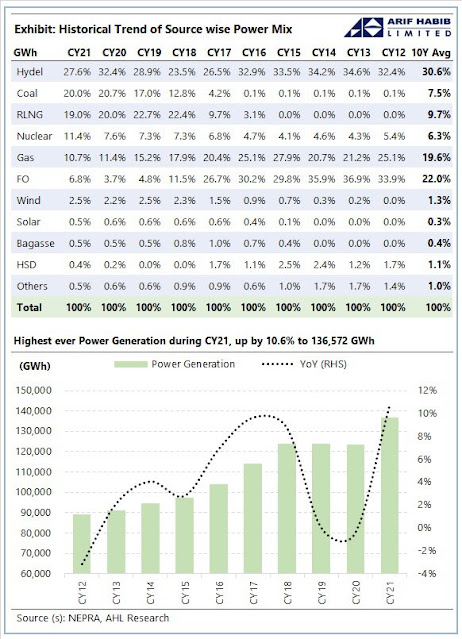
Nuclear power plants in Pakistan generated 15,540 GWH of electricity in 2021, a jump of 66% over 2020. Overall, Pakistan's power plants produced 136,572 GWH of power, an increase of 10.6% over 2020, indicating robust economic recovery amid the COVID19 pandemic. 

Pakistan Electric Power Generation. Source: Arif Habib


Hydroelectric dams contributed 37,689 GWH of electricity or 27.6% of the total power generated, making hydropower the biggest contributor to power generated in the country. It is followed by coal (20%), LNG (19%) and nuclear (11.4%). 


Cost Per Unit of Electricity in Pakistan. Source: Arif Habib

Nuclear offers the lowest cost of fuel for electricity (one rupee per KWH) while furnace oil is the most expensive (Rs. 22.2 per KWH). 
 
Pakistan Electric Power Generation Fuel MiX. Source: Arif Habib

Construction of 1,100 MW nuclear power reactor K2 unit in Karachi was completed by China National Nuclear Corporation in 2019, according to media reports. Fuel is being loaded in a similar reactor unit K3 which will add another 1,100 MW of nuclear power to the grid in 2022. Chinese Hualong One reactors being installed in Pakistan are based on improved Westinghouse AP1000 design which is far safer than Chernobyl and Fukushima plants.  

The biggest and most important source of low-carbon energy in Pakistan is its hydroelectric power plants, followed by nuclear power. Pakistan ranked third in the world by adding nearly 2,500 MW of hydropower in 2018, according to Hydropower Status Report 2019.  China added the most capacity with the installation of 8,540 megawatts, followed by Brazil (3,866 MW), Pakistan (2,487 MW), Turkey (1,085 MW), Angola (668 MW), Tajikistan (605 MW), Ecuador (556 MW), India (535 MW), Norway (419 MW) and Canada (401 MW).

New Installed Hydroelectric Power Capacity in 2018. Source: Hydroworld.com


Hydropower now makes up about 28% of the total installed capacity of 33,836 MW as of February, 2019.   WAPDA reports contributing 25.63 billion units of hydroelectricity to the national grid during the year, “despite the fact that water flows in 2018 remained historically low.” This contribution “greatly helped the country in meeting electricity needs and lowering the electricity tariff for the consumers.”

Pakistan's Current Account Balance vs International Oil Prices. Source: Arif Habib


Recent history shows that Pakistan's current account deficits vary with international oil prices.  Pakistan's trade deficits balloon with rising imported energy prices. One of the keys to managing external account balances lies in reducing the country's dependence on foreign oil and gas. 


Pakistan Power Generation Fuel Mix. Source: Third Pole

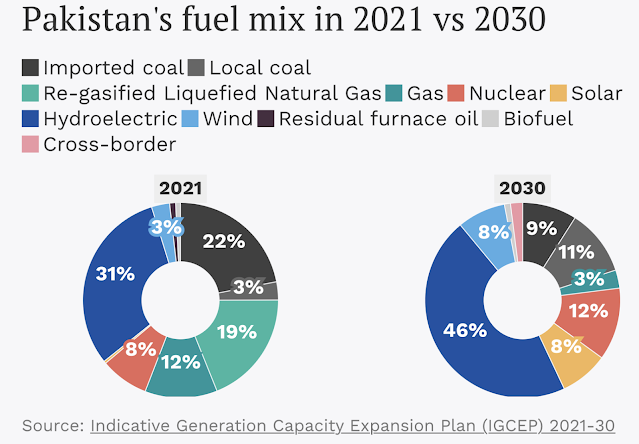
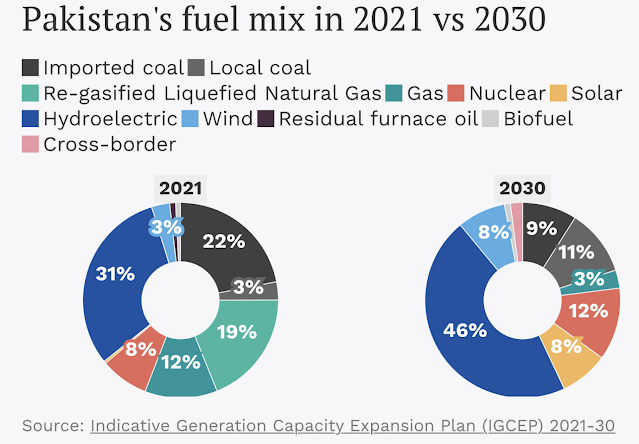
It is true that Pakistan has relied on imported fossil fuels to generate electricity. The cost of these expensive imported fuels like furnace oil mainly used by independent power producers (IPPs) has been and continues to be a major contributor to the "exaggerated external demand driven by its rentier economy" referred to by Atif Mian in a recent tweet. However, Pakistan has recently been adding hydro, nuclear and indigenous coal-fired power plants to gradually reduce dependence on imported fossil fuels. 

Related Links:


Haq's Musings

South Asia Investor Review

Pakistan Among World's Largest Food Producers

Naya Pakistan Housing Program

Food in Pakistan 2nd Cheapest in the World

Indian Economy Grew Just 0.2% Annually in Last Two Years

Pakistan to Become World's 6th Largest Cement Producer by 2030

Has Bangladesh Surged Past India and Pakistan in Per Capita Income?

Pakistan's Computer Services Exports Jump 26% Amid COVID19 Lockdown

Coronavirus, Lives and Livelihoods in Pakistan

Vast Majority of Pakistanis Support Imran Khan's Handling of Covid19 Crisis

Pakistani-American Woman Featured in Netflix Documentary "Pandemic"

Incomes of Poorest Pakistanis Growing Faster Than Their Richest Counterparts

Can Pakistan Effectively Respond to Coronavirus Outbreak? 

How Grim is Pakistan's Social Sector Progress?

Double Digit Growth in Pakistan's Energy Consumption Confirms Economic Recovery


Trump Picks Muslim-American to Lead Vaccine Effort

COVID Lockdown Decimates India's Middle Class

Pakistan to be World's 7th Largest Consumer Market by 2030

Pakistan's Balance of Payments Crisis

How Has India Built Large Forex Reserves Despite Perennial Trade Deficits

Conspiracy Theories About Pakistan Elections"

PTI Triumphs Over Corrupt Dynastic Political Parties

Strikingly Similar Narratives of Donald Trump and Nawaz Sharif

Nawaz Sharif's Report Card

Riaz Haq's Youtube Channel


Sunday, August 7, 2022

Pakistan Plans to Convert Coal-Fired Power Plants to Burn Domestic Thar Lignite

With a new 330 MW mine-mouth coal-fired power plant in Tharparkar, Pakistan has now reached 990 MW of power fueled by the local lignite. Thar coal production is being expanded and plans are in place to convert three more imported anthracite coal fired plants to burn domestic lignite as soon as its production is expanded and a rail link is completed to transport the fuel to the rest of the country. Plans call for using Thar coal in three coal-fired plants currently burning imported coal: Sahiwal Coal Power, China Hub Coal Power and Port Qasim Coal, each of 1,320MW installed capacity. These power plants may require some limited equipment changes to burn domestic lignite. It is worth noting that Pakistan contributes less than 1% of the global greenhouse-gas emissions. Using the higher polluting domestic Thar lignite is crucial to Pakistan's desperate need for cheap energy to spur industrialization for economic growth without running into recurring balance of payments crises. 

Pakistan Electric Power Generation Fuel MiX. Source: Arif Habib

 Last year, hydroelectric dams contributed 37,689 GWH of electricity or 27.6% of the total power generated, making hydropower the biggest contributor to power generated in the country. It was followed by coal (20%), LNG (19%) and nuclear (11.4%).  Nuclear power plants generated 15,540 GWH of electricity in 2021, a jump of 66% over 2020.  Overall, Pakistan's power plants produced 136,572 GWH of power in 2021, an increase of 10.6% over 2020, indicating robust economic recovery amid the COVID19 pandemic. 

Lucky power plant in Karachi has been designed to use Thar Lignite Coal when it is available in sufficient quantity.  Until that time, it will operate on imported lignite coal. Domestic lignite production is being expanded in a bid to replace costly fossil fuel imports that are depleting Pakistan's foreign exchange reserves and exacerbating circular debt in the power sector, according to Nikkei Asia.  

SECMC (Sindh Engro Coal Mining Company) has commissioned a study for converting the China-Pakistan Economic Corridor coal plants in Hub, Jamshoro and Sahiwal to indigenous lignite. A 105km long Thar Rail project is being planned to connect Thar coal fields with Main Line (ML-1) at the New Chhor Halt Station to transport lignite to the power plants in the rest of the country. The transportation of lignite by trucks to Karachi and Kallar Kahar shows its movement by road and rail is feasible and safe despite higher moisture.


Pakistan Electric Power Generation. Source: Arif Habib


Cost Per Unit of Electricity in Pakistan. Source: Arif Habib


Nuclear offers the lowest cost of fuel for electricity (one rupee per KWH) while furnace oil is the most expensive (Rs. 22.2 per KWH). 
 

Construction of 1,100 MW nuclear power reactor K2 unit in Karachi was completed by China National Nuclear Corporation in 2019, according to media reports. Another similar reactor unit K3 is now in operation. It will add another 1,100 MW of nuclear power to the grid in 2022. Chinese Hualong One reactors being installed in Pakistan are based on improved Westinghouse AP1000 design which is far safer than Chernobyl and Fukushima plants.  

The biggest and most important source of low-carbon energy in Pakistan is its hydroelectric power plants, followed by nuclear power. Pakistan ranked third in the world by adding nearly 2,500 MW of hydropower in 2018, according to Hydropower Status Report 2019.  China added the most capacity with the installation of 8,540 megawatts, followed by Brazil (3,866 MW), Pakistan (2,487 MW), Turkey (1,085 MW), Angola (668 MW), Tajikistan (605 MW), Ecuador (556 MW), India (535 MW), Norway (419 MW) and Canada (401 MW).

New Installed Hydroelectric Power Capacity in 2018. Source: Hydroworld.com


Hydropower now makes up about 28% of the total installed capacity of 33,836 MW as of February, 2019.   WAPDA reports contributing 25.63 billion units of hydroelectricity to the national grid during the year, “despite the fact that water flows in 2018 remained historically low.” This contribution “greatly helped the country in meeting electricity needs and lowering the electricity tariff for the consumers.”

Pakistan's Current Account Balance vs International Oil Prices. Source: Arif Habib


Recent history shows that Pakistan's current account deficits vary with international oil prices.  Pakistan's trade deficits balloon with rising imported energy prices. One of the keys to managing external account balances lies in reducing the country's dependence on foreign oil and gas. 


Pakistan Power Generation Fuel Mix. Source: Third Pole

It is true that Pakistan has relied on imported fossil fuels to generate electricity. The cost of these expensive imported fuels like furnace oil mainly used by independent power producers (IPPs) has been and continues to be a major contributor to the "exaggerated external demand driven by its rentier economy" referred to by Atif Mian in a recent tweet. However, Pakistan has recently been adding hydro, nuclear and indigenous coal-fired power plants to gradually reduce dependence on imported fossil fuels. 

Related Links:


Haq's Musings

South Asia Investor Review

Pakistan Among World's Largest Food Producers

Naya Pakistan Housing Program

Food in Pakistan 2nd Cheapest in the World

Indian Economy Grew Just 0.2% Annually in Last Two Years

Pakistan to Become World's 6th Largest Cement Producer by 2030

Has Bangladesh Surged Past India and Pakistan in Per Capita Income?

Pakistan's Computer Services Exports Jump 26% Amid COVID19 Lockdown

Coronavirus, Lives and Livelihoods in Pakistan

Vast Majority of Pakistanis Support Imran Khan's Handling of Covid19 Crisis

Pakistani-American Woman Featured in Netflix Documentary "Pandemic"

Incomes of Poorest Pakistanis Growing Faster Than Their Richest Counterparts

Can Pakistan Effectively Respond to Coronavirus Outbreak? 

How Grim is Pakistan's Social Sector Progress?

Double Digit Growth in Pakistan's Energy Consumption Confirms Economic Recovery


Trump Picks Muslim-American to Lead Vaccine Effort

COVID Lockdown Decimates India's Middle Class

Pakistan to be World's 7th Largest Consumer Market by 2030

Pakistan's Balance of Payments Crisis

How Has India Built Large Forex Reserves Despite Perennial Trade Deficits

Conspiracy Theories About Pakistan Elections"

PTI Triumphs Over Corrupt Dynastic Political Parties

Strikingly Similar Narratives of Donald Trump and Nawaz Sharif

Nawaz Sharif's Report Card

Riaz Haq's Youtube Channel