Saturday, September 3, 2022

Climate Change: Pakistan Requires Massive Assistance to Recover From Catastrophic Floods

Pakistan is dealing with the aftermath of the worst floods in the country's history.  Over a thousand Pakistanis are dead. About 33 million people in two southern provinces are homeless. Sindh is inundated with 784% of normal rainfall so far this year. Balochistan has seen 522% of average rainfall. Both provinces suffered their worst ever heatwave prior to this unprecedented deluge. Nearly a million livestock have been lost, over two million acres of farmland is underwater and 90% of the crops in Sindh and Balochistan have been damaged. This is a massive humanitarian crisis. Pakistan can not deal with it alone.

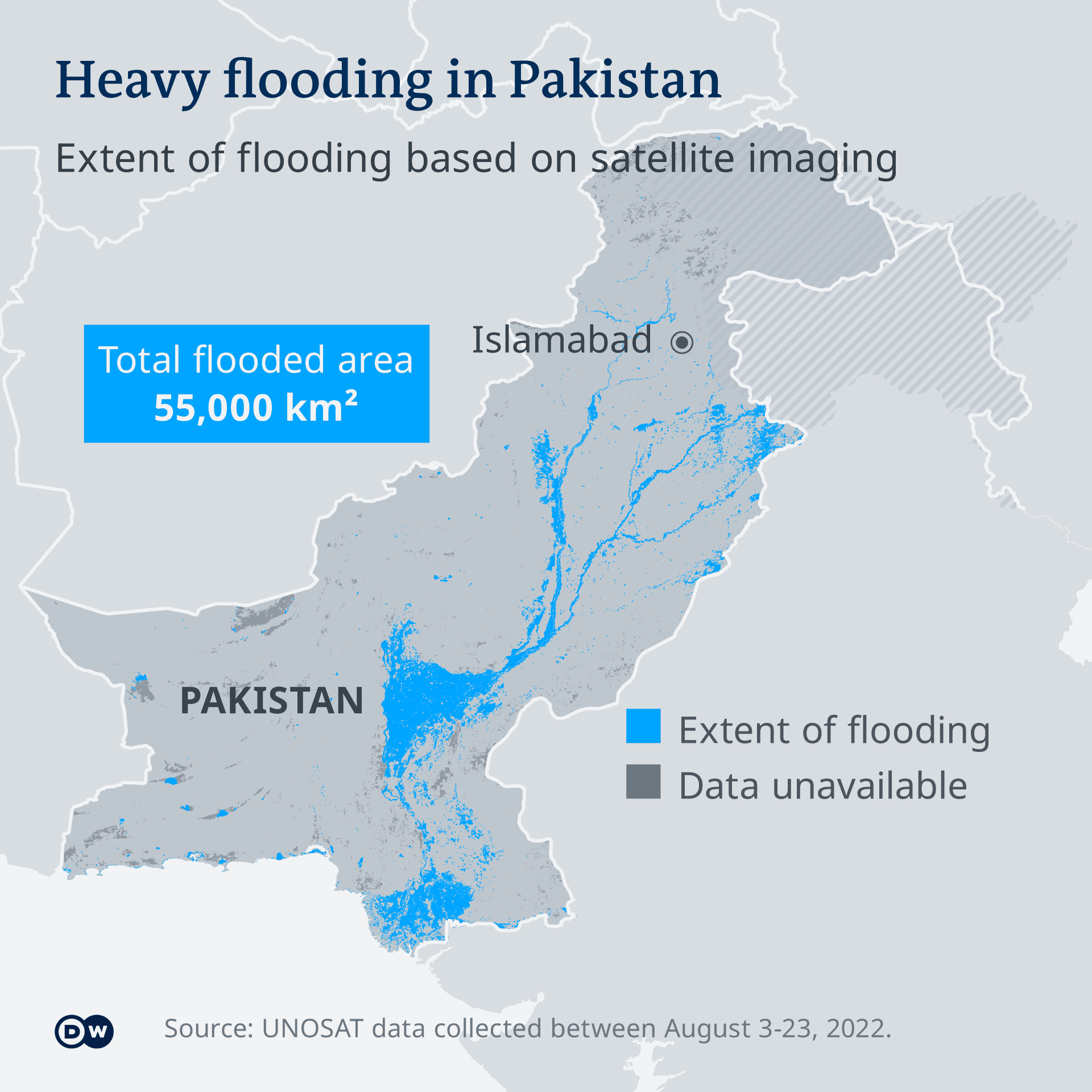
Pakistan Flood 2022 Map. Source: DW

Satellite Image of Qambar, Sindh Before/After Floods 2022. Source: NASA

Satellite Image of Shikarpur, Sindh Before/After Floods 2022. Source: NASA


Balochistan and Sindh Worst Affected by Monsoon22. Source: The Economist

Pakistan's population is about 2.6% of the world population. The nation contributes less than 1% of the global carbon emissions. It lacks the resources needed to deal with the consequences of this man-made disaster. The Industrial Revolution in Europe and the United States was fueled mainly by fossil fuels such as coal and oil believed to be responsible for climate change.  The following map from Professor Jason Hickel shows that the countries in the global north are the biggest polluters while those in the global south are the most vulnerable to the effects of climate change. 

Climate Injustice: Low Emitters Global South vs Big Polluters in Industrial North. Source: Prof J. Hickel
Average Annual Cost of Floods in Vulnerable Countries. Source: Bloomberg


Comparison of 2022 and 2010 Floods in Pakistan. Source: WWF

It will take hundreds of millions of dollars to provide immediate relief to 33 million people, followed by tens of billions of dollars in assistance to rebuild the lives and livelihoods and the infrastructure destroyed by this catastrophe. Pakistan's gross capital formation is only 15% of its GDP. Among the world’s top 20 economies by population, only Egypt has a lower rate of gross capital formation than Pakistan, according to Bloomberg. It is time for the rich industrialized world to help developing nations such as Pakistan to deal with the massive impact of climate change. 

Low Gross Capital Formation in Pakistan. Source: Bloomberg 


All Pakistanis and non-Pakistanis need to pitch in with donations to help finance immediate disaster relief activities. Beyond that, Pakistan will have to be helped by international experts to build disaster preparedness capacity. The new housing and infrastructure will have to be funded and built to ensure its resilience in future climate disasters which are likely to occur more often with greater intensity. There is an urgent  need to prepare western and multilateral financial institutions to deal with such climate catastrophes in developing nations. Mechanisms also need to be put in place to provide and manage funding of these projects in a transparent manner. 

Friday, August 26, 2022

Indian Diplomat Sharat Sabharwal on Pakistan's "Resilience", "Strategic" CPEC, China-Pakistan "Nexus"

Retired Indian diplomat Sharat Sabharwal in his recently published book "India's Pakistan Conundrum"  disabuses his fellow Indians of the notion that Pakistan is about to collapse. He faithfully parrots the familiar Indian tropes about Pakistani Army and accuses it of sponsoring "cross-border terrorism". He also writes that "Pakistan has shown remarkable resilience in the face of adversity".  "Pakistan is neither a failed state nor one about to fail", he adds. He sees "limitations on India’s ability to inflict a decisive blow on Pakistan through military means". The best option for New Delhi, he argues, is to engage with Pakistan diplomatically. In an obvious message to India's hawkish Hindu Nationalist Prime Minister Narendra Modi, he warns: "Absence of dialogue and diplomacy between the two countries carries the risk of an unintended flare-up". Ambassador Sabharwal served as Indian High Commissioner to Pakistan from 2009 to 2013. Prior to that, he was Deputy High Commissioner in Islamabad in the 1990s.
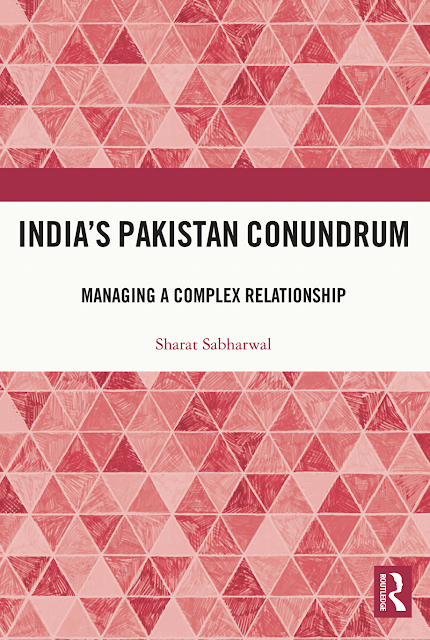
India's Pakistan Conundrum by Sharat Sabhrawal Book Cover


In a 30-minute interview with Karan Thapar for The Wire to discuss his book, Sabharwal said it is not in India’s interests to promote the disintegration of Pakistan. “The resulting chaos will not leave India untouched”. He further argued that Indians must disabuse themselves of the belief that India has the capacity to inflict a decisive military blow on Pakistan in conventional terms. “The nuclear dimension has made it extremely risky, if not impossible, for India to give a decisive military blow to Pakistan to coerce it into changing its behavior.”  He said Indians must disabuse themselves of the belief that they can use trade to punish Pakistan. “Use of trade as an instrument to punish Pakistan is both short-sighted and ineffective because of the relatively small volume of Pakistani exports to India.” 

Below are some key excerpts of "India's Pakistan Conundrum" by Ambassador Sharat Sabhrawal: 

Pakistan Not Failed State: 

"In conclusion, it can be said that Pakistan is neither a failed state nor one about to fail in the foreseeable future. Further, so long as the army remains a largely professional and disciplined force, having at its disposal Pakistan’s rapidly growing arsenal of nuclear weapons, the probability of a change in Pakistan’s external boundaries would remain very low. Therefore, a policy premised on the failure or disintegration of the Pakistani state would hinge on unsound expectations. However, because of the various factors examined in the previous chapters, Pakistan will continue to be a highly dysfunctional state with widespread lawlessness". 

Pakistan's Remarkable Resilience:

"Pakistan has shown remarkable resilience in the face of adversity – evidenced most tellingly by its recovery following the humiliating defeat in 1971. It has recovered significantly from the terror backlash, which followed Musharraf’s U-turn in the wake of 9/11. Fatalities in terror violence that mounted sharply from 2004 onwards, reaching the peak of 11,317 in 2009 (civilians, security forces personnel and terrorists), were down to 365 in 2019. Similarly, fatalities in suicide attacks, which reached the peak of 1,220 in 2010, were down to 76 in 2019".

China Pakistan "Nexus"

"China too reacted adversely to the above Indian move (article 370 abrogation), accusing India of continuing to undermine China’s territorial sovereignty by unilaterally amending its domestic laws and urging it to be cautious in its words and deeds on the border issue. Subsequently, it repeatedly called for peaceful resolution of “Kashmir dispute” left over from colonial history, based on the UN Charter, relevant UN Security Council resolutions and bilateral agreements, thus echoing Pakistan’s position on the subject.  Pakistan’s questioning of the accession of Jammu and Kashmir to India and its policy of cross-border terrorism did not stem from the special status of Jammu and Kashmir under the Indian constitution and have outlasted its abrogation. The Pakistani dimension of India’s Kashmir problem and the Pakistani threat to the security of this sensitive region are still very much alive".

Strategic China-Pakistan Economic Corridor (CPEC):

"China’s reaction to the Indian move and its subsequent aggressive actions in eastern Ladakh have added to that threat. Keen to ensure the safety and security of its strategic CPEC investment, China could in the normal course be expected to encourage a solution based on freezing the existing  territorial reality between India and Pakistan in J&K. However, with the downturn of its own relationship with India, it may be tempted to sustain and bolster Pakistan’s hostility. Equally, India’s strategic planners may be tempted not to give any comfort to China on the CPEC until a degree of stability is restored to the India-China equation, disturbed seriously by China’s aggressive behaviour in eastern Ladakh. Overall, the external environment for the security and stability of Jammu and Kashmir has worsened. This makes it all the more important for India to address the internal dimension of its Kashmir conundrum. India’s challenge is to ensure peace in J&K, not only in the immediate, but durable peace, for the failure to do so would continue to invite external meddling". 

Consequences of Pakistan's Disintegration: 

"Should India work to break up Pakistan? A body of opinion in India recommends that India should be proactive in causing the disintegration of Pakistan. For the reasons mentioned in Chapter 6, a policy premised on disintegration of the Pakistani state would hinge on unsound expectations. However, let us examine, for the sake of argument, the consequences of heightened turmoil in/break up of Pakistan for India. The unwise policies of Pakistan’s rulers have already resulted in considerable turbulence there. Though the Pakistani state uses terror against India, it is calibrated  by its instrumentalities. Heightened chaos in Pakistan leading to collapse of the state authority will not leave India untouched. Let us not forget that Pakistan has continued to pay a heavy price for having caused instability in its neighbour – Afghanistan – something I repeatedly recalled to my Pakistani audiences. Collapse of the state will also present India with a humanitarian crisis of a gigantic proportion, with the terrain between the two countries offering an easy passage to India for those fleeing unrest in Pakistan. At the height of terrorism in the Pakistani Punjab in 2009–10, some of my interlocutors in Lahore were candid enough to say that in the event of a Taliban takeover, they  would have no option but to run towards India. Break up of Pakistan could lead to a civil war amongst the successor states or worse still among various warring groups vying for influence, as was the case after collapse of the state authority in Afghanistan, entailing the undesirable consequences mentioned above and perilous uncertainty concerning the ownership of Pakistan’s nuclear arsenal. Alternatively, India may be faced with a hostile Pakistani Punjab in possession of nuclear weapons. In either case, it will be bad news for India".

Related Links:

Haq's Musings

South Asia Investor Review

India-Pakistan Ties: Who's at Fault For Failing to Resolve Disputes?

India: A Paper Elephant?

Jaswant Singh on Indian Foreign Policy's "Strategic Confinement"

Vast Majority of Indians Believe Nuclear War Against Pakistan is Winnable

Kautilya Doctrine Dominates India's Pakistan Policy

US and China Vying For Influence in Pakistan

Pakistan-China-Russia Vs India-Japan-US

Pakistan Rising or Failing: Reality vs Perception

US DoD 1999 Forecast: "Pakistan Disappears By 2015"

China Pakistan Economic Corridor

Riaz Haq Youtube Channel

VPOS Youtube Channe
Saturday, August 20, 2022

PEACE Cable: Pakistan's Tenth High Bandwidth Submarine Cable Ready to Go Live

Pakistan and East Africa Connecting Europe (PEACE) cable, a  96 TBPS (terabits per second), 15,000 km long submarine cable, is now ready for service. This brings to 10 the total number of submarine cables currently connecting or planned to connect Pakistan with the world: TransWorld1, Africa1 (2023), 2Africa (2023), AAE1, PEACE,  SeaMeWe3, SeaMeWe4, SeaMeWe5, SeaMeWe6 (2025) and IMEWE. PEACE cable has two landing stations in Pakistan: Karachi and Gwadar. SeaMeWe stands for Southeast Asia Middle East Western Europe, while IMEWE is India Middle East Western Europe and AAE1 Asia Africa Europe 1. 

PEACE Cable. Source: Cybernet

PEACE is a privately owned submarine cable that originates in Karachi, Pakistan and runs underwater all the way to Marseilles, France via multiple points in the continent of Africa.  It is being built as part of the Digital Silk Road sponsored by China. Cybernet is the local landing and global connectivity partner of PEACE Cable System in Pakistan. It is designed to enable high-speed access to a variety of content, cloud computing, gaming and video streaming platforms.  


Map of Submarine Cable Connections to Karachi, Pakistan. Source: TeleGeography

The PEACE Pakistan-Egypt segment connects Karachi, Pakistan and Zafarana, Egypt, spanning a total length of 5,800 km. The landings of Karachi and Zafarana were completed in March and December 2021 respectively, according to a press release of PEACE Cable International Network Co., Ltd. In addition, the Mediterranean segment of PEACE linking Marseille, France, to Abu Talat, Egypt, a 3,200km long project, has also achieved RFS in March 2022. Therefore, the route from Pakistan to France of the PEACE cable system is now fully constructed and ready for use.

Telecom Services Subscriptions in Pakistan as of June, 2022. Source: PTA


Number of broadband subscribers and demand for data has seen rapid double digit growth in Pakistan over the last several years. Number of broadband subscriptions has grown to 119 million, representing 53.92% of population. Per user data consumption has nearly tripled from 2.1 gigabytes per month in 2017-18 to 6.1 gigabytes per month in 2020-21. As of June 2022, it exceeds 7 GB per subscriber per month. Telecom service providers are responding to it by increasing the capacity of the Internet by laying more and higher bandwidth fiber cables and adding faster speed equipment. Ookla’s data reveals that the median mobile internet connection speed in Pakistan increased by 3.43 Mbps (+26.5%) in the twelve months to the start of 2022.
Per User Data Demand Growth. Source: Pakistan Telecom Authority 


Pakistan Per Subscriber Per Month Data Use

Worldwide Mobile Data Use Per Subscriber Per Month. Source: Statista

Cybernet, the landing partner of PEACE in Pakistan, claims it has built the country’s state-of-the-art, Cable Landing Station in Karachi, which will allow global carriers, Content Delivery Networks (CDNs), content providers and virtually all IT-enabled firms to tap into the submarine cable capacity at easily accessible interconnect points across Pakistan. 


Thursday, August 18, 2022

Stimson Poll: Vast Majority of Indians Believe Nuclear War Against Pakistan is Winnable

Vast majority of Indians, including those who oppose Prime Minister Narendra Modi, believe that nuclear war is "winnable", according to the results of a Stimson Center poll released recently. They want their country to build a bigger nuclear arsenal than China and Pakistan combined.  Responding to the clamor for more nukes,  Indian Prime Minister Narendra Modi said in 2019 that Indian nuclear weapons were not kept as mere showpieces.  Strong belief about India's ability to win a nuclear war against Pakistan cuts across party lines with 91% of those who support Mr. Modi and 85% of those who don't.  Recently, a group of researchers at Rutgers University considered a hypothetical nuclear conflict between India and Pakistan as they believed such a conflict was the most likely. The group warned that an India-Pakistan nuclear exchange will be catastrophic for the region with tens of millions of immediate fatalities in the war zone, followed by hundreds of millions of starvation deaths around the globe. 

Indians Believe Nuclear War is Winnable. Source: Stimson Center

The poll also finds that the overwhelming majority of Indians are confident their military can defeat both China and Pakistan. They expect that the United States military would come to India's aid in the event of a war with China or Pakistan.  Stimson Center analysts believe that "Indian self-confidence may lead to mistaken popular views of Indian military prowess: India has considerable military capabilities against its most likely regional opponents. Yet Indian confidence that India would likely defeat China or Pakistan may exceed what a careful net assessment might warrant". 

Nuclear Arsenals of India, Pakistan and China. Source: The Economist


The nuclear arsenals of India, Pakistan and China are small but growing faster than those of other nuclear-armed countries, according to a report in The Economist magazine. The combined nuclear stockpiles of China (350 warheads), India (160) and Pakistan (165) now exceed British and French arsenals in Europe (around 500 in total). All three countries are now building their own nuclear “triads”: nukes deliverable from land, air and sea.  

The Stimson survey was conducted by phone with a random sample of 7000 Indians between April 13 and May 14, 2022. Below are its key findings as reported by Christopher Clary, Sameer Lalwani, Niloufer Siddiqui and Neelanjan Sircar:   

1. High levels of support for Prime Minister Narendra Modi, who likely remains among the most popular national leaders in the world today; 

2. Extraordinary nationalist sentiment among Indians, at high levels compared to prior cross-national surveys using identical question wording; 

3. Troubling signs of intolerance toward India’s large Muslim minority, which helps provide context to recent controversies;  

4. Strong confidence in the Indian government’s ability to defend India against potential domestic and foreign threats;  

5. Expectations among a majority of Indian respondents that the U.S. military would support India in the event of a war with China or Pakistan; and 

6. Large majorities in favor of Indian numerical nuclear superiority against its adversaries. 


Tuesday, August 16, 2022

Have Deadly Monsoon Floods Replenished Groundwater to End Long Drought in Pakistan?

Pakistan has seen unprecedented rains followed by massive floods in the current monsoon season. Hundreds of people have lost their lives and tens of thousands have been rendered homeless. After the unfolding of the tragedy, it's now time for renewal. New green shoots are sprouting in Thar desert, indicating the end of the long-running drought in Pakistan. The large Indus Basin aquifer has been significantly recharged. Groundwater has been replenished to a large extent for many years to come, raising hopes for more water for growing crops and raising livestock.  


Sunset in Lush Green Thar Desert After Monsoon 2022. Credit: Emmanuel Guddu

Greening of Thar Desert in Sindh, Pakistan. Source: Emmanuel Guddu


The heavy monsoon rains will help to kick-start the sowing of major Kharif (autumn) crops including rice, cotton, sugarcane and corn after about a month's delay.  “There was 40% less water available for the Kharif season (during May-June 2022),” an official of the Ministry of National Food Security and Research said while talking to The Express Tribune on Saturday. Earlier in March this year, Pakistan's Federal Committee on Agriculture (FCA) had said “for the Kharif year 2022, the water availability in canals head will be 65.84 million acre feet (MAF) against last year’s 65.08 MAF”. Recent rains have helped fill up major water reservoirs across the country.  About 150,000 cubic feet per second of water is being released from Pakistan's largest Tarbela dam which is more than the combined irrigation needs of the two provinces.  It is also generating over 3,000 MW of electricity, media reports.
 

Pakistan Monsoon Rainfall July 2022. Source: PMD

Pakistan Drought Monitor. Source: NDMC, PMD

Pakistan Meteorological Department data shows that Pakistan has seen far more rainfall than normal. About 178 mm of rain has fallen in the country, an increase of 180.5% of normal for the month of July. 

NASA Groundwater Map of August 8, 2022. Source: NASA GRACE

Recent satellite maps from the United States National Aeronautics and Space Administration (NASA) confirm significant groundwater growth in Pakistan. The improvement becomes much more apparent when the latest map is compared with one from 2014.
 
Satellite Groundwater Map of 2014. Source: NASA

Pakistan’s Indus Basin Irrigation System is the world's largest artificial groundwater recharge system, according to the World Bank.  A network of canals dug since the 16th century has recharged the Indus Basin aquifer in Pakistan which now has about 1.2 million tube wells extracting 50 million acre feet of water every year.  NASA satellite maps show that Pakistan is among the places worst affected by rapid depletion of groundwater.  Improved groundwater management is crucial for a healthy, prosperous, and green Pakistan. It appears that the groundwater in the Indus Basin has been replenished to a large extent for many years to come, raising hopes for more water for farmers to grow crops to feed and clothe people and raise livestock. 

Related Links:


Saturday, August 13, 2022

Pakistan At 75: Highlights of Economic and Demographic Progress Since Independence

Pakistan is a young nation with a lot of unrealized potential. As the country turns 75, it is important to recognize that all basic indicators of progress such as income, employment, education, health, nutrition, electricity use, telecommunications and transportation have shown significant improvements over the last seven and a half decades. These improvements can be accelerated if Pakistan can overcome its economic growth constraints from recurring balance of payments crises such as the one it is experiencing now. The only way to do it is through rapid expansion of exports and major reductions in reliance on imports such as fossil fuels and cooking oil. 

Income/GDP Growth:

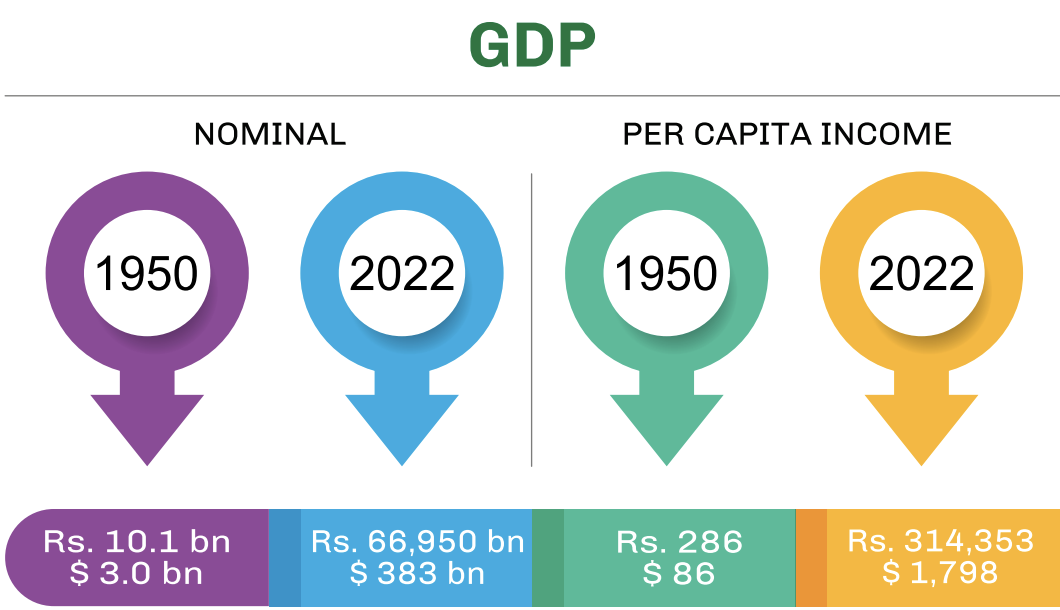
Economic Survey of Pakistan 2021-22 confirms that the nation's GDP grew nearly 6% in fiscal year 2021-22, reaching $1.62 Trillion in terms of purchasing power parity (PPP). It first crossed the trillion dollar mark in 2017. In nominal US$ terms, the size of Pakistan's economy is now $383 billion. The country's per capita income is $1,798 in nominal terms and $7,551 in PPP dollars.  

Pakistan GDP, Per Capita Income Growth. Source: 75 Years Economic Journey

Electricity Consumption:

Pakistan's electricity consumption is an important indicator of economic activity and living standards. It has soared from 40 GWH in 1949 (1 KWH per capita) to 136,572 KWH in 2021 (620 KWH per capita). Last year, hydroelectric dams contributed 37,689 GWH of electricity or 27.6% of the total power generated, making hydropower the biggest contributor to power generated in the country. It was followed by coal (20%), LNG (19%) and nuclear (11.4%).  Nuclear power plants generated 15,540 GWH of electricity in 2021, a jump of 66% over 2020.  Overall, Pakistan's power plants produced 136,572 GWH of power in 2021, an increase of 10.6% over 2020, indicating robust economic recovery amid the COVID19 pandemic. 

Electricity Consumption


Installed Power Generation Capacity Growth. Source: Bilal Gilani of Gallup Pakistan

 Population Growth:

Pakistan's population has grown rapidly over the last 75 years. It is now 227 million, 6.7 times 34 million in 1951. However, the total fertility rate has declined from 6.5 babies  in 1950 to 3.3 babies per woman in 2021.  

Pakistan Population Growth

Pakistan Total Fertility Rate Per Woman of Child-Bearing Age. Source: UN via Macrotrends


Life Expectancy:

Improvements in access to healthcare have helped raise life expectancy in the country. It has increased from just 50 years in 1970 to 67.4 years in 2020. 

Life Expectancy

Employment:

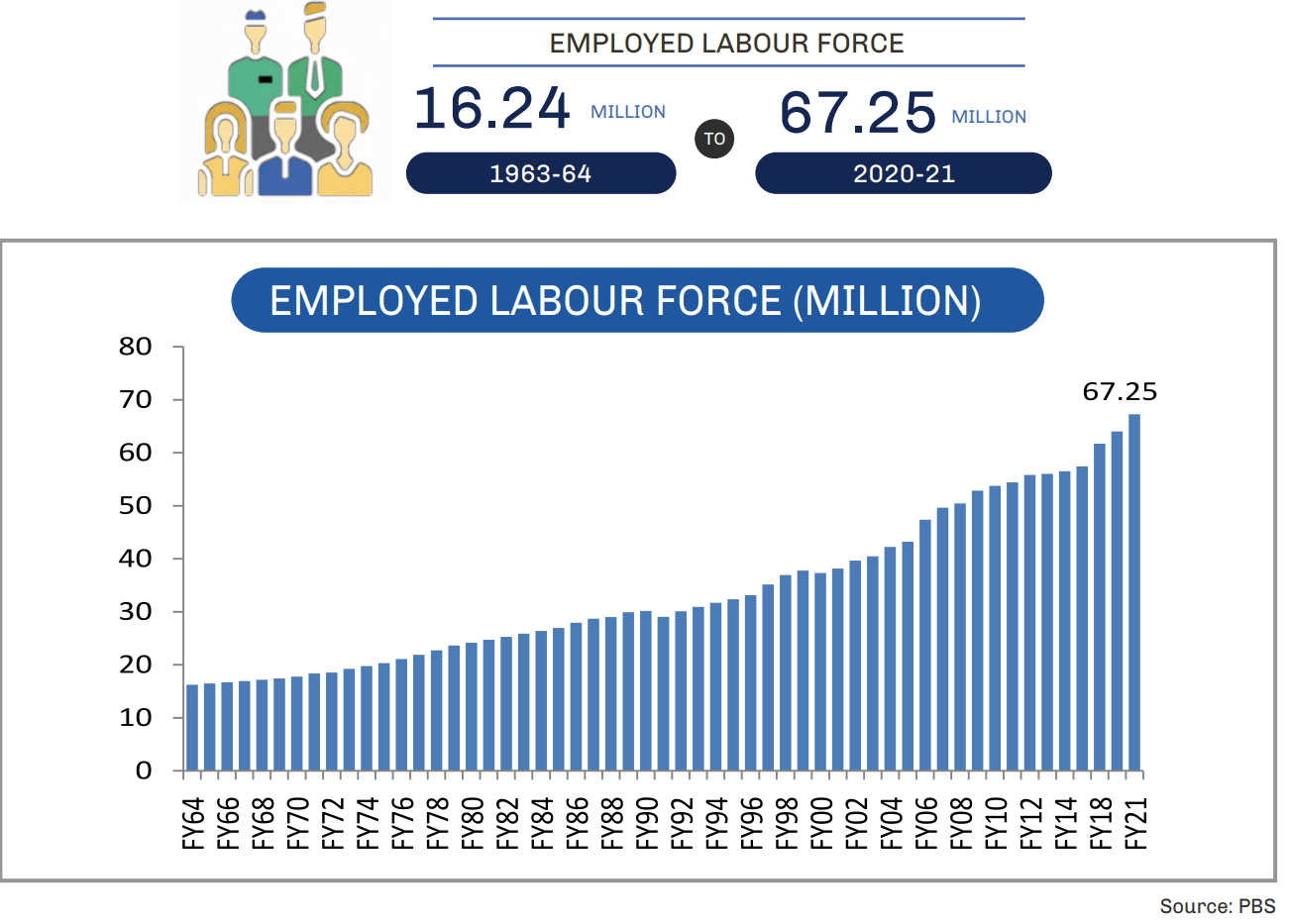
Pakistan's economy has generated tens of millions of jobs since the nation's independence. The employed workforce has grown from 16.24 million in 1963-64 to 67.25 million in 2020-21, according to government sources. Pakistan has created 5.5 million jobs during the past three years – 1.84 million jobs a year, significantly higher than the yearly average of new jobs created during the 2008-18 decade, according to the findings of the Labor Force Survey (LFS) as reported by the Express Tribune paper. The biggest jump in share of employment (1.5%) was in the construction sector, spurred by Naya Pakistan construction incentives offered by the PTI government. 


Pakistan Employment Growth

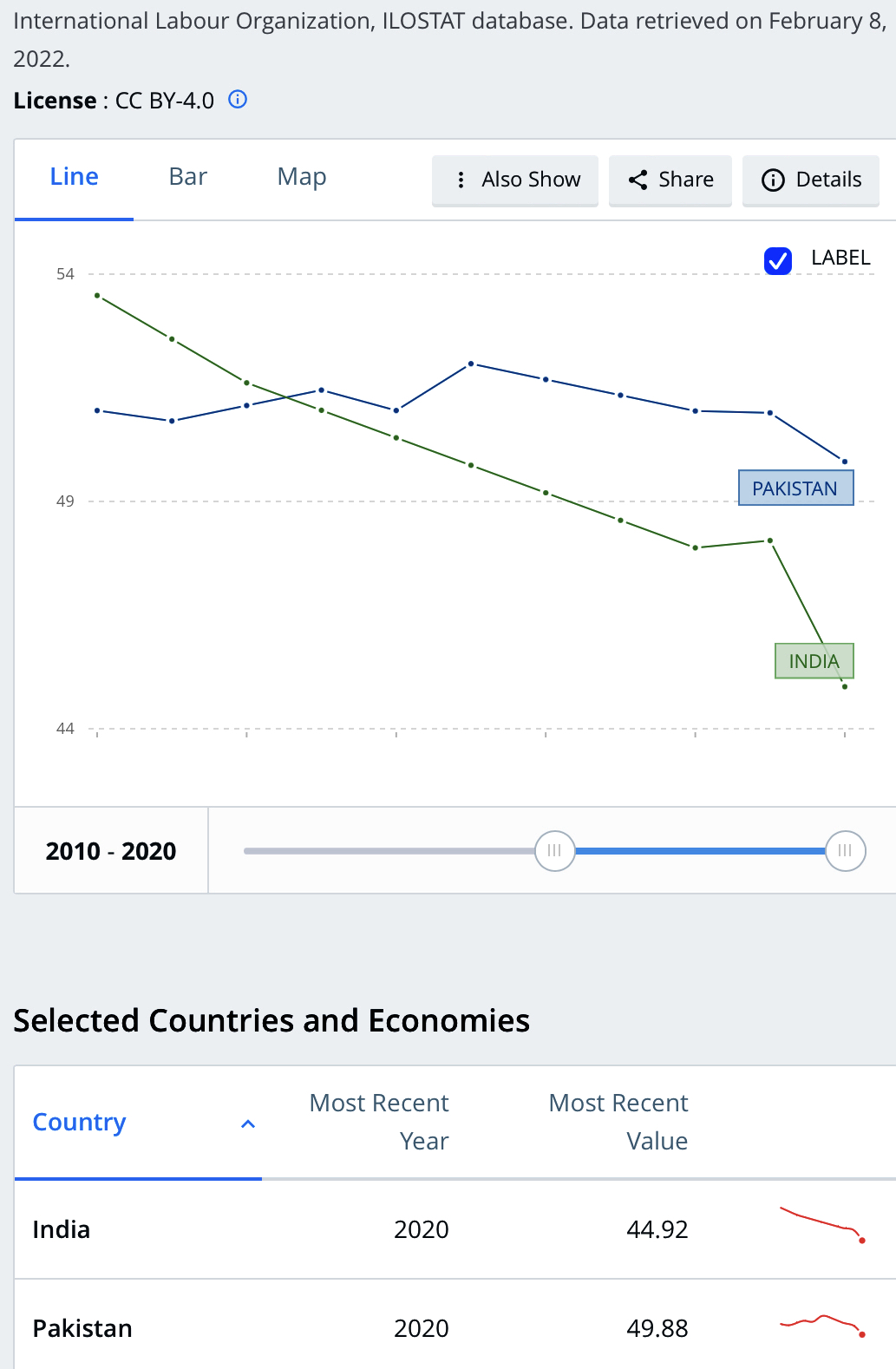
Unlike Pakistan's, India's labor participation rate (LPR) has been falling significantly in the last decade. It fell to 39.5% in March 2022, as reported by the Center for Monitoring Indian Economy (CMIE). It dropped below the 39.9% participation rate recorded in February. It is also lower than during the second wave of Covid-19 in April-June 2021. The lowest the labor participation rate had fallen to in the second wave was in June 2021 when it fell to 39.6%. The average LPR during April-June 2021 was 40%. March 2022, with no Covid-19 wave and with much lesser restrictions on mobility, has reported a worse LPR of 39.5%.

Labor Participation Rates in India and Pakistan. Source: ILO/World Bank


Youth  unemployment for ages 15-24 in India is 24.9%, the highest in the South Asia region. It is 14.8% in Bangladesh and 9.2% in Pakistan, according to the International Labor Organization and the World Bank.  

Poverty Reduction:

Pakistan has managed to significantly reduce poverty since its inception. 

Poverty Decline in Pakistan


Nutrition:

In terms of the impact of economic growth on average Pakistanis, the per capita average daily calorie intake jumped to 2,735 calories in FY 2021-22 from 2,457 calories in 2019-20. It has grown from 2250 calories in 1980 to 2780 calories in 2020. 

Pakistan Per Capita Daily Calorie Consumption. Source: Economic Surveys of Pakistan


Agriculture: 

Pakistan is among the world's largest food producers. It experienced broad-based economic growth across all key sectors in FY 21-22; manufacturing posted 9.8% growth, services 6.2% and agriculture 4.4%. The 4.4% growth in agriculture is particularly welcome; it helps reduce rural poverty.  

Production of Tractors in Pakistan


Wheat Production in Pakistan

Rice Production in Pakistan


Corn Production in Pakistan
Sugarcane Production in Pakistan
Meat Production in Pakistan


Milk Production in Pakistan

Cotton Production in Pakistan


Literacy and Education:

Literacy in Pakistan has increased from just 16.4% in 1950-51 to 62.8% in 2020-21. Male literacy is now at 73.4% but the female literacy lags at only 51.9%. The area of female literacy clearly requires greater attention and focus. 

Literacy Rate in Pakistan

Number of universities in the country has jumped from just 2 in 1947 to 233 in 2021. Enrollment in these colleges has gone up from 644 in 1947 to 1.96 million in 2021. Biggest increases have come since the higher education reform led by Dr. Ata ur Rahman on President Musharraf's watch. 

University Enrollment in Pakistan

Number of degree colleges in the country has jumped from 40 in 1960 to 3,872 in 2021. Enrollment in these colleges has gone up from 4,368 in 1947 to 758,000 in 2021. 

Enrollment in Degree Colleges in Pakistan


Telecommunications:

Telecommunication services and broadband subscriptions in Pakistan have rapidly grown, especially over the last two decades. The number of telephone and mobile users has increased from just 15,200 in 1947 to 194.2 million in 2021. 

Phone Users in Pakistan


Transportation: 

Expansion of road infrastructure and increasing vehicle ownership have contributed to the growth of the road transport sector. Number of registered vehicles in Pakistan has soared from 31,892 in 1947 to 32.4 million in 2021. Road length has grown from 26,300 Km in 1947 to 500,000 Km in 2021. 

Vehicle Ownership and Road Length in Pakistan

Pakistan has seen significant improvements in its population's living standards since independence in 1947. Average Pakistani has much higher income and greater access to food, healthcare, education, housing, transport, electricity and communication services. 

Acknowledgement: Charts and data in this blog post are sourced from 75 Years Economic Journey of Pakistan published by Pakistan's Ministry of Finance. 

Related Links:

Friday, August 12, 2022

Nehru's Secularism Was An Aberration; Modi's Islamophobia is the Norm For India

As India and Pakistan turn 75, there are many secular intellectuals on both sides of the border who question the wisdom of "the Partition" in 1947. They dismiss what is happening in India today under Hindu Nationalist Prime Minister Narendra Modi's leadership as a temporary aberration, not the norm. They long for a return to "Indian liberalism" which according to anthropologist Sanjay Srivastava "did not exist". 

India Pakistan Border Ceremony at Wagah-Attari Crossing


American historian Audrey Truschke who studies India traces the early origins of Hindu Nationalism to the British colonial project to "divide and rule" the South Asian subcontinent. She says colonial-era British historians deliberately distorted the history of Indian Muslim rule to vilify Muslim rulers as part of the British policy to divide and conquer India. These misrepresentations of Muslim rule made during the British Raj appear to have been accepted as fact not just by Islamophobic Hindu Nationalists but also by at least some of the secular Hindus in India and Muslim intellectuals in present day Pakistan, says the author of "Aurangzeb: The Life and Legacy of India's Most Controversial King".  Aurangzeb was neither a saint nor a villain; he was a man of his time who should be judged by the norms of his times and compared with his contemporaries, the author adds.

After nearly a century of direct rule, the British largely succeeded in dividing South Asians along religious and sectarian lines. The majoritarian tyranny of the "secular"  Hindu-dominated Indian National Congress after 1937 elections in India became very apparent to  Quaid-e-Azam Mohammad Ali Jinnah, the leader of All India Muslim League. Speaking in Lucknow in October 1937,  he said the following: 

"The present leadership of the Congress, especially during the last ten years, has been responsible for alienating the Musalmans of lndia more and more, by pursuing a policy which is exclusively Hindu; and since they have formed the Governments in six provinces where they are in a majority they have by their words, deeds, and programme shown more and more that the Musalmans cannot expect any justice or fair play at their hands. Whenever they are in majority and wherever it suited them, they refused to co-operate with the Muslim League Parties and demanded unconditional surrender and signing of their pledges."

Fast forward to 2021, a Pew survey in India found that 64% of Hindus see their religious identity and Indian national identity as closely intertwined. Most Hindus (59%) also link Indian identity with being able to speak Hindi language. The survey was conducted over two years in 2019 and 2020 by Pew Research Center. It included 29,000 Indians.  

Prime Minister Narendra Modi's Hindu Nationalist BJP party's appeal is the greatest among Hindus who closely associate their religious identity and the Hindi language with being “truly Indian.” The Pew survey found that less than half of Indians (46%) favored democracy as best suited to solve the country’s problems. Two percent more (48%) preferred a strong leader. 

Indian anthropologist Sanjay Srivastava sums up the current situation as follows: 

"Our parents practiced bigotry of a quiet sort, one that did not require the loud proclamations that are the norm now. Muslims and the lower castes knew their place and the structures of social and economic authority were not under threat. This does not necessarily translate into a tolerant generation. Rather, it was a generation whose attitudes towards religion and caste was never really tested. The loud bigotry of our times is no great break from the past in terms of a dramatic change in attitudes – is it really possible that such changes can take place in such few years? Rather, it is the crumbling of the veneer of tolerance against those who once knew their place but no longer wish to accept that position. The great problem with all this is that we continue to believe that what is happening today is simply an aberration and that we will, when the nightmare is over, return to the Utopia that was once ours. However, it isn’t possible to return to the past that was never there. It will only lead to an even darker future. And, filial affection is no antidote for it".

Acknowledgement: Charts and data in this blog post are sourced from 75 Years Economic Journey of Pakistan published by Pakistan's Ministry of Finance. 

Related Links:


Thursday, August 11, 2022

Remembering Salam Qureishi (1936-2022): A Pillar of Silicon Valley's Muslim Community

Abdus Salam Qureishi, a successful technology entrepreneur and philanthropist, passed away last Saturday, August 6, 2022. He was 86. Inna lillahi wa inna ilayhi raji’un(‏ إنَّا Ù„ِÙ„َّÙ‡ِ ÙˆَØ¥ِÙ†َّا Ø¥ِÙ„َÙŠْÙ‡ِ رَاجِعُونَ ‏). He was a pillar of the Muslim community in Silicon Valley. Qureishi rose from humble origins in the Indian city of Aligarh and became very successful in the United States. He was very generous with his time and money in supporting the community. He helped build several Muslim community centers in San Francisco Bay Area.  He also invested in companies started by young Muslim entrepreneurs. I had the privilege of meeting him on many occasions while he was still very active in the decades of 1980s and 1990s. He and his wife came to our house for dinner and Yasmeen and I were invited by him for a private dinner with him and his wife at his house in Palo Alto, California.    

Abdus Salam Qureishi (1936-2022)

Qureishi was born in a poor family in Singahi village in the Indian state of Uttar Pradesh. He graduated with a Master's degree in Statistics from Aligarh Muslim University. In the fall of 1959, he arrived in the United States on a teaching fellowship from the Case Institute of Technology in Cleveland. But shortly thereafter, he was recruited by IBM to work for them in the Silicon Valley, California.  He knew little about American football but he quickly learned about it and dramatically improved the performance of the Dallas Cowboys. Computerized sports analytics has now become more common among professional teams. A Pakistani-American Farhan Zaidi has made a name for himself in this field. Farhan is now serving as the general manager of  the San Francisco Giants baseball team. 

In an interview with the Sports Illustrated magazine in 1968, Salam said, “Until I was called to Dallas, I knew nothing about American football. I had learned to enjoy baseball because of its similarity to cricket. Now I think American football is easily the most scientific game ever invented.”  Cowboys President Tex Schramm later said, “We had an Indian who knew absolutely nothing about football and coaches who knew nothing about computers and less about Indians.” Salam's computer analysis helped the Dallas Cowboys pick players who turned the team into a top performer in the 1960s. 

Salam Qureshi went on to found  Sysorex Information Systems (SIS) in 1972. SIS became one of the leading providers of information technology solutions to the U.S. Federal Government customers worldwide. 

Qureishi helped build the first Islamic Center in San Jose and later the Muslim Community Center in Santa Clara, California. He was also active in supporting the Aligarh Muslim University Alumni Association which provided student scholarships and organized popular events like the Sir Syed Day mushairas (poetry recitals) that attracted thousands of people across the United States. Sir Syed was the founder of Aligarh Muslim University. 

Abdus Salam Qureishi was a successful technologist, an early Silicon Valley entrepreneur and an exemplary benefactor of the Muslim community in the San Francisco Bay Area. May his soul rest in eternal peace! Amen!! 

Related Links:

Haq's Musings

Farhan Zaidi: Pakistani-American Computerized Sports Analyst

Pakistanis Make Up Silicon Valley's Largest Foreign Born Muslim Group

Silicon Valley Pakistani-Americans

Pakistani-American Leads Silicon Valley's Top Incubator

Silicon Valley Pakistanis Enabling 2nd Machine Revolution

Karachi-born Triple Oscar Winning Graphics Artist

Pakistani-American Ashar Aziz's Fire-eye Goes Public

Pakistani-American Shahid Khan: First Non-White Owner of an NFL Football Team

Pakistani-American's Game-Changing Vision 

Minorities Are Majority in Silicon Valley