Showing posts with label middle class. Show all posts

Wednesday, June 2, 2021

India's Covid Crisis Decimates Country's Middle Class

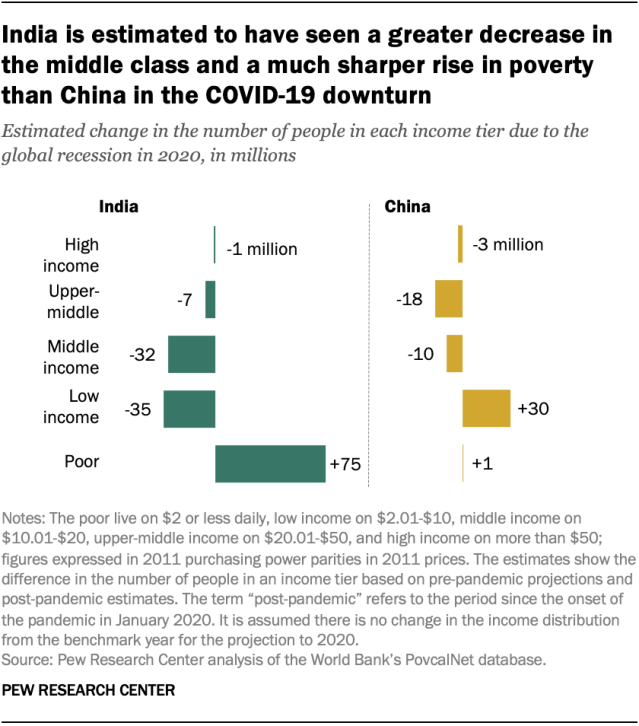
Indian economy shrank 7.3% in fiscal year 1920-21, its worst performance since independence in 1947. Nearly 230 million middle class Indians have slipped below the poverty line, constituting a 15 to 20% increase in poverty since Covid-19 struck last year, according to Pew Research. Middle class consumption has been a key driver of economic growth in India. Erosion of the middle class will likely have a significant long-term impact on the country's economy. “India, at the end of the day, is a consumption story,” says Tanvee Gupta Jain, UBS chief India economist, according to Financial Times. “If you never recovered from the 2020 wave and then you go into the 2021 wave, then it’s a concern.”  

India's Economic Performance Since Independence. Source: Bloomberg


Mainstream Indian media have long been afraid to cover the incompetence and failures of Prime Minister Modi's government. But this is finally changing with the COVID pandemic hitting India's newsrooms. Dozens of Indian reporters and their family members have died after being infected with coronavirus. 

Middle Class Decline in India, China. Source: Pew Research

The disastrous turn in the situation on the ground couple with the change in media coverage have brought focus on Modi government's failed policies in handling the deepening health crisis and its devastating impact. The images of large numbers of people gasping for breath and dying on the streets for lack of oxygen have shocked the world. The covid crisis has exposed the hollowness of India's super-power delusions fed by the country's western boosters who see it as a counterweight to China. An example of such western propaganda is a recent novel by retired US Admiral Janes Stavirides. 

Increase in Debt-to-GDP Ratio During Pandemic. Source: Business Standard

Prime Minister Modi's government has taken on significant debt to cope with the crisis of covid pandemic. As a result, India's debt-to-gp has increased 17% to 89.3%, the third highest among emerging economies. By contrast, Pakistan's debt-to-gdp has risen by a mere 1.6% to 87.2% during the pandemic, according to figures released by the IMF.  

Modi's Hindutva Rate of Growth in India


The authors of "2034: A Novel of the Next World War" portray Indians as heroes whose statesmen-ship de-escalates World War III, negotiates peace and helps India emerge as the new global superpower. Patel, the Indian uncle character of the Indian-American deputy national security advisor Sandeep Chowdhury tells him, "America’s hubris has finally gotten the better of its greatness." The authors imagine the United Nations headquarters moves from New York to Mumbai after the war. Had this book been written after watching thousands of Indian victims of COVID19 gasping for breath and dying daily on the streets of New Delhi, I think Ackerman and Stavridis would have conceived  and developed a completely different plot line for their novel.  

Related Links:

Haq's Musings

South Asia Investor Review

India Tops World Hunger Charts

Is India Superpoor or Superpower?

Rape as a Political Weapon Used By Hindutva

Hindu Nationalism Inspired By Nazism, Fascism

Rise of Islamophobia After Sept 11, 2001 Terrorist Attacks

700,000 Indian Soldiers Versus 7 Million Kashmiris

Modi's Kashmir Blunder and India-Pakistan Nuclear Conflict

Is India a Paper Elephant? 

Howdy Modi Rally Exposes Indian-Americans to Charges of Hypocrisy

Modi's Extended Lockdown in Indian Occupied Kashmir

Hinduization of India

Brievik's Hindutva Rhetoric

Indian Textbooks

India's RAW's Successes in Pakistan

Riaz Haq Youtube Channel

VPOS Youtube Channel

Tuesday, January 14, 2020

Pakistan's Middle Class Consumer Population Among World's Fastest Growing

Although the rate of growth has slowed since 2018, Pakistan's middle class consumer population still remains among the fastest growing in the world. In a report titled "Emerging Markets Transforming As Velocity Markets", Ogilvy and Mather, a global market communications firm, has put Pakistan among what it calls "Velocity 12" group of economies that include Bangladesh, Brazil, China, Egypt, India, Indonesia, Mexico, Myanmar, Nigeria, Pakistan, Philippines and Vietnam.  The term velocity describes both the rate of real change in the size of the middle class as well as a priority for companies as they consider business investment and marketing in V12 countries. These 12 countries will be the biggest contributors to the next billion middle class consumers, according to the report.

The Velocity 12 report says that this next billion middle-class group will:

1. Be increasingly defined by women and youth as the change agents, with purchasing power crossing cultural, religious and demographic divides.

2. Comprise the largest block of newly connected consumers on the internet, globally connected as never before – with global connectivity that is projected to double in the next five years.

3. Rapidly increase its social engagement, and brands discussion, as marketers compete in the digital marketplace for greater share of the new middle-class prize.

4. Urbanize faster than other parts of the world, dominating the future list of megacities, while creating a new “urbangea” that connects large swathes of these countries into a virtual trading zone.

5. Propel cities, more than countries, to become the unit of invention, entrepreneurship and investment.

Growth in Middle Class Consumers 2015-25. Source: Ogilvy and Mather

Velocity 12:

Ogilvy and Mather's report on "Velocity 12" begins with the story of Fahima Sarkar, a Pakistani woman entrepreneur who lives in Lahore. Here is an excerpt:

"If you want to catch a glimpse of the global economic future, then meet Fahima Sarkar. In many ways, Fahima – who lives in Lahore, Pakistan – is typical of her group of friends, and a growing number of women across South Asia. After attending college, Fahima worked in sales for a Karachi-based garment company that was rapidly expanding their business in the region. She eventually left the role because she wanted to start a family. Fahima is a lot different than her own mother – both in her outlook and her lifestyle. Rather than being solely a stay at home mom, Fahima has used her time raising her child to develop a new career as an “Instapreneur,” someone who uses social media to start her own business. Her online venture (headquartered on her kitchen table): selling high-end picture frames via the Web to parents who want an upscale way to display their children’s photos at home. That was her first taste of entrepreneurship – and she turned a profit almost immediately."

"Velocity 12" report forecasts Pakistan's middle class consumer population to reach 122 million by 2025, representing a gain of 59 million members over a 10 year period from 2015 to 2025.

Reality Check:

We are almost half way through Ogilvy's 10 year forecast period. How is Pakistan doing? One indicator is the growth in vehicle ownership, particular the ownership of motorcycles.

Vehicle Ownership in Pakistan. Source: PBS

Private vehicle ownership in Pakistan has risen sharply in 4 year period from 2015 to 2016. More than 9% of households owned cars in 2018, up from 6% in 2015. Motorcycle ownership has jumped from 41% of households in 2015 to 53% in 2018, according to data released by Federal Bureau of Statistics (FBS) recently. There are 32.2 million households in Pakistan, according to 2017 Census.

As of 2015, almost all of South Asia's poor were in two countries: Bangladesh (3% of global poor) and India (24% of global poor). Of the world’s 736 million extreme poor in 2015, 368 million—half of the total—lived in just 5 countries. The 5 countries with the highest number of extreme poor are (in descending order): India, Nigeria, Democratic Republic of Congo, Ethiopia, and Bangladesh, according to the World Bank.

World's Poor Population Distribution. Source: World Bank


Retail Sales in Pakistan. Source: Statista.com

Retail Sales Growth:

Pakistan has seen retail sales climb from $145 billion in 2015 to $210 billion in 2018, according to Statista.com. Over 60 percent of the Pakistani population is between the aged of 15 to 64 years, which is the prime age of consumer spending.

With the introduction of 3G/4G services, internet penetration has risen rapidly. Internet subscriber growth in Pakistan is averaging over 22% per year and total subscribers crossed the 70 million mark in 2019. Cheap smartphones, low cost of 3G/4G services and a consumer-goods obsessed middle class has meant that Pakistan’s e-commerce sector is “mobile first”: some e-commerce start-ups claim that over 75 percent of their total business is online.

E-Commerce:

Online sales are growing much faster than the brick-and-mortar retail sales. Adam Dawood of Yayvo online portal estimates that e-tail sales are doubling every year. He expects them to pass $1 billion in the current fiscal year (2017-18), two years earlier than the previous forecast. This is being enabled by increasing broadband penetration and new online payment options. Ant Financial, an Alibaba subsidiary, has just announced the purchase of 45% stake in Pakistan-based Telenor Microfinance Bank. Bloomberg is reporting that Alibaba is in serious talks to buy Daraz.pk, an online retailer in Pakistan.

Advertising Revenue:

Growing buying power of rapidly expanding middle class in Pakistan drove the nation's media advertising revenue up 14% to a record Rs. 76.2 billion ($727 million), making the country's media market among the world's fastest growing for FY 2015-16, according to Magna Research.  Half of this ad spending (Rs. 38 billion or $362 million) went to television channels while the rest was divided among print, outdoor, radio and digital media. `


Digital media spending rose 27% in 2015-16 over prior year, the fastest of all the media platforms. It was followed by 20% increase in radio, 13% in television, 12% in print and 6% in outdoor advertising, according to data published by Aurora media market research

Mass Media Growth:

Advertising revenue has fueled media boom in Pakistan since early 2000s when Pakistan had just one television channel, according to the UK's Prospect Magazine. Today it has over 100. This boom has transformed the nation. The birth of privately owned commercial media has been enabled by the Musharraf-era deregulation, and funded by the tremendous growth in revenue from advertising targeted at the burgeoning urban middle class consumers.

Sports and Entertainment:

Sports and entertainment sectors are major beneficiaries of increasing advertising budgets. Commercial television channels' shows and serials are supported by advertisers. A quick look at Pakistan Super League 2018 matches reveals that all major consumer brand names are either directly sponsoring or buying advertising from broadcasters.  These ads and sponsorship have turned PSL into a major business producing tens of millions of dollars in revenue to support cricket in Pakistan.  Last year, Pakistan Cricket Board's budget was over $40 million and a big chunk of it came from PSL. This year, the PSL chairman Najam Sethi estimates the PSL franchise valuation is approaching half a billion US dollars with potentially significant revenue upside.

Downsides of Consumer Boom:

There are a couple of downsides of the consumer boom. First,  a dramatic increase in solid waste. Second, rising consumption could further depress Pakistan's already low private savings rate.

FMCG products come with a significant amount of plastic and paper packaging that contribute to larger volume of trash. This will necessitate a more modern approach to solid waste disposal and recycling in Pakistani towns and cities. An absence of these systems will make the garbage situation much worse. It will pose increased environmental hazards.

Pakistan's savings rate is already in teens, making it among the lowest in the world. Further decline could hurt investments necessary for faster economic growth.

Summary: 

Pakistan's $210 billion retail market is among the fastest growing in the world, according to Euromonitor.  In a report titled "Emerging Markets Transforming As Velocity Markets", Ogilvy and Mather, a global market communications firm, has put Pakistan among what it calls "Velocity 12" that include Bangladesh, Brazil, China, Egypt, India, Indonesia, Mexico, Myanmar, Nigeria, Pakistan, Philippines and Vietnam. These 12 countries will be the biggest contributors to the next billion middle class consumers, according to the report. Expanding middle class, particularly millennials with rising disposable incomes, is demanding branded and packaged consumer goods ranging from personal and baby care items to food and beverage products. Strong demand for fast moving consumer goods is drawing large new investments of hundreds of millions of dollars.  Rapid growth in sales of consumer products and services is driving other sectors, including retail, e-commerce, paper and packaging, advertising, media, sports and entertainment. Potential downsides of soaring consumption include increased amount of  solid waste and decline in domestic savings and investment rates.

Related Links:

Haq's Musings

South Asia Investor Review

FMCG Boom in Pakistan

Pakistan Retail Sales Growth

Advertising Revenue in Pakistan

Pakistan FMCG Market

The Other 99% of Pakistan Story

PSL Cricket League Revenue

E-Commerce in Pakistan

Fintech Revolution in Pakistan

Mobile Broadband Speed in Pakistan

Riaz Haq's YouTube Channel

PakAlumni Social Network

Thursday, October 17, 2019

Pakistani Journalist Sohail Warraich in Silicon Valley

I had a chance to meet well-known Pakistani journalist Sohail Warraich recently during his visit to Silicon Valley. He was here to record an interview with successful Pakistani-American entrepreneur Osman Rashid, founder of Chegg and Kno.

Sohail Warraich is a senior journalist and political analyst as well as a popular host of "Ek Din Geo K Sath" aired on Geo TV. Warraich's show features interviews with top politicians, businessmen, entrepreneurs, entertainers, sportsmen and other personalities and celebrities. He often points out contradictions and hypocrisies in the lives of his guests on his show by asking them: "Kia yeh khula tazad naheen" (Is it not an obvious contradiction)?  Warraich is known to be close to former Prime Minister Nawaz Sharif who is currently in jail for owning overseas assets beyond means. He wrote Nawaz Sharif's hagiography  "Ghaddar Kaun". Warraich believes the rise of Imran Khan and his Pakistan Tehreek e Insaf (PTI) party have been enabled by the strong support of the military and Imran Khan's popularity with Pakistan's rising middle class.

L to R: Sohail Warraich, Misbah Azam, Riaz Haq

Osman Rashid is the son of  a Pakistani diplomat. He was born in London and raised in Islamabad. He came to the United States from Pakistan in 1990s to study electrical engineering at University of Minnesota and earned a BSEE there. He is a successful serial entrepreneur in Silicon Valley.

Osman Rashid invited me and a few other Pakistani-American friends to meet Warraich over dinner at his Los Altos home.  In response to my question about about the current state of affairs in Pakistan, Warraich shared his insights below:

1. Pakistan's middle class is rising and increasingly asserting itself in politics.

2. Pakistani military is the most dominant force in the country. It enjoys broad support among the middle class Pakistanis.

3. The rise of Imran Khan and Pakistan Tehreek e Insaf (PTI) have been enabled by the support of the military and the middle class.

4. Middle class support for the military will eventually fade and there will eventually be conflict between the two. It could lead to significant political changes in the country.

5. The situation of the people of Thar is improving with the development of coal mining and construction of power plants.  There are better roads and growing employment opportunities for the locals. Warraich has visited Thar multiple times recently and found that the media reports of hunger and poverty and lack of health care are highly exaggerated. Such reports could be politically motivated to defame Pakistan People's Party (PPP).

Here's a video clip of dinner at Osman Rashid Silicon Valley house that I attended:

https://youtu.be/_0bVSBNLRNo


Related Links:

Haq's Musings

South Asia Investor Review

Pakistani Author-Journalist Raza Rumi in Silicon Valley

Pakistani-American Astrophysicist Dr. Nergis Mavalvala in Silicon Valley

Pakistani-American Moeed Yusuf in Silicon Valley

Islamic Scholar Javed Ahmad Ghamidi in Silicon Valley

Pakistan Civil Society Activist Jibran Nasir in Silicon Valley

Conspiracy Theories Dominate Pakistan Elections Coverage

Rising Middle Class in Pakistan

Can Imran Khan Lead Pakistan to the Next Level?

Pakistani Hindu Women Ride High on Thar Development

Democracy vs Dictatorship in Pakistan


Monday, June 17, 2019

Vehicles in Pakistan: Over Half of All Households Own Motorcycles in 2019

Private vehicle ownership in Pakistan has risen sharply over the last 4 years. More than 9% of households now own cars, up from 6% in 2015. Motorcycle ownership has jumped from 41% of households in 2015 to 53% now, according to data released by Federal Bureau of Statistics (FBS) recently. There are 32.2 million households in Pakistan, according to 2017 Census.

Vehicle Ownership in Pakistan. Source: PBS

Total number of vehicles registered in Pakistan increased 9.6% to 23,588,268 in 2018, up from 21,506,641 vehicles in 2017. Of all the vehicle categories, motorcycles saw the biggest increase of 11.5% reaching 17,465,880. Cars, jeeps and station wagons rose 5.3% reaching 3,043,593. Trucks surged to 277,416 and buses to 236,461, according to Pakistan Today.

Pakistan is now the 5th largest motorcycle market in the world after China, India, Indonesia and Vietnam. With 7,500 new motorcycles being sold everyday, Pakistan is also the among the world's fastest growing two-wheeler markets. Passenger car and motorcycle sales in Pakistan have both been soaring at rates of over 20% a year until recently.


Motorcycle ownership data is yet another confirmation of the fact that the majority of the households in Pakistan now belong to the middle class, a first in Pakistan's history. This was first reported in 2015 research done by Dr. Jawaid Abdul Ghani of Karachi School of Business and Leadership (KSBL).

It's an important tipping point that puts Pakistan among the top 5 countries with fastest growing middle class population in Asia-Pacific region, according to an Asian Development Bank report titled Asia's Emerging Middle Class: Past, Present, And Future. The ADB report put Pakistan's middle class growth from 1990 to 2008 at 36.5%, much faster than India's 12.5% growth in the same period.


Related Links:

Haq's Musings

South Asia Investor Review

The State of Pakistan's Social Sector

Credit Suisse Wealth Report 2016

Pakistan's Trillion Dollar Economy Among World's Fastest Growing

Pakistan: A Majority Middle Class Country

Karachi School of Business and Leadership

State Bank: Pakistan's Actual GDP Higher Than Officially Reported

College Enrollment in Pakistan

Musharraf Accelerated Development of Pakistan's Human and Financial Capital

Tuesday, January 16, 2018

Pakistan is the World's 5th Largest Motorcycles Market

Pakistan is the 5th largest motorcycle market in the world after China, India, Indonesia and Vietnam. With 7,500 new motorcycles being sold everyday, Pakistan is also the among the world's fastest growing two-wheeler markets. Passenger car and motorcycle sales in Pakistan are both soaring at rates of over 20% a year.


Auto Demand Soaring:

Nearly 2.3 million motorcycles have rolled off the factories in Pakistan in the last 10 months. The production of motorcycles jumped 22.34 percent in the first four months of fiscal year 2017-18 (FY18), over the corresponding period of in FY17, according to the latest data from Pakistan Bureau of Statistics (PBS) as reported by the media.

Pakistan automobile market is also expanding along with the motorcycle market. Sales of passenger cars soared 20.4% to 103,432 units in the first half of the current fiscal year of 2017/18, recently released official data shows. Car sales were 85,901 in the same period of last fiscal year, according to Pakistan Automotive Manufacturers Association (PAMA).

Durable Goods Ownership:

Ownership of consumer durables like computers, home appliances and vehicles is often seen as an important indicator of the size and health of the middle classes in emerging economies. Examples of periodic household surveys used by researchers to measure such data include NSS (National Sampling Survey) in India and PSLM (Pakistan Social and Living Standards Measurement) in Pakistan.

Durables Ownership in India and Pakistan. Source: KSBL
Pakistan's Trillion Dollar Economy:

Pakistan is now the world's third fastest growing economy among the world's top 25 economies with PPP GDP of over one trillion US dollars, according to  the International Monetary Fund (IMF). IMF has recently raised the country's 2018 growth forecast to 5.6%.
Courtesy:  Ashraf Hameedi, Highforest Capital
Pakistan 3rd Fastest Among Top 25: 

Spectator Index has ranked India first with 7.3% growth, followed by China (6.5%), Pakistan (5.6%), Indonesia (5.3%) and Turkey (3.7%) among the world's 25 largest economies in terms of PPP GDP.

Earlier in October 2017, the International Monetary Fund (IMF) forecast Pakistan's economy to grow at 6.3% CAGR over 2017-2022.

India-Pakistan Comparison:

Dr. Jawaid Abdul Ghani, a professor at Karachi School of Business Leadership, has recently analyzed household surveys in India and Pakistan to discover the following:

1.  As of 2015, car ownership in both India and Pakistan is about the same at 6% of households owning a car. However, 41% of Pakistani household own motorcycles, several points higher than India's 32%.

2. 12% of Pakistani households own a computer, slightly higher than 11% in India.

3. Higher percentage of Pakistani households own appliances such as refrigerators (Pakistan 47%, India 33%), washing machines (Pakistan 48%, India 15%) and fans (Pakistan 91%, India 83%).

4. 71% of Indian households own televisions versus 62% in Pakistan.

Durables Ownership Growth in Pakistan. Source: KSBL
Growth over Time:

Dr. Abdul Ghani has also analyzed household data to show that the percentage of Pakistani households owning washing machines has doubled while car and refrigerator ownership has tripled and motorcycle ownership jumped 6-fold from 2001 to 2014.

Income/Consumption Growth in Pakistan. Source: KSBL

Rapid Income Growth:

Rising ownership of durables in Pakistan has been driven by significant reduction in poverty and growth of household incomes, according to Dr. Abdul Ghani's research. Percentage of households with per capita income of under $2 per day per person has plummeted from 57% in 2001 to 7% in 2014. At the same time, the percentage of households earning $2 to $10 per day per person has soared from 42% of households in 2001 to 87% of households in 2014.  The percentage of those earning over $10 per day per person has jumped 7-fold from 1% of households in 2001 to 7% of households in 2014.

Pakistani Middle Class:

Only 5% of Pakistanis in $2-$4 per day per person income group have college degrees. But 20% of those in $4-$10 have college degrees, according to the survey results.

Pakistan Middle Class Profile. Source: KSBL

Credit Suisse Income and Wealth Data:

Average Pakistani adult is 20% richer than an average Indian adult and the median wealth of a Pakistani adult is 120% higher than that of his or her Indian counterpart, according to Credit Suisse Wealth Report 2016. Average household wealth in Pakistan has grown 2.1% while it has declined 0.8% in India since the end of last year.

Median wealth data indicates that 50% of Pakistanis own more than $1,180 per adult which is 120% more than the $608 per adult owned by 50% of Indians.

GDP Estimates Using Household Survey Data:

Pakistan's GDP calculated from consumption data in PSLM is significantly higher than the government estimates based on production data. The reverse is true of Indian GDP.

M. Ali Kemal and Ahmed Waqar Qasim, economists at Pakistan Institute of Development Economics (PIDE),  explored several published different approaches for sizing Pakistan's underground economy and settled on a combination of  PSLM (Pakistan Social and Living Standards Measurement) consumption data  and mis-invoicing of exports and imports to conclude that the country's "informal economy was 91% of the formal economy in 2007-08". 

Prominent Indian economists Abhijit V Banerjee, Pranab Bardhan, Rohini Somanathan and TN Srinivasan teaching at MIT, UC Berkeley, Yale University and Delhi School of Economics believe that India's GDP estimate based on household survey (National Sampling Service or NSS) data is about half of what the Indian government officially reports as India's GDP. 

Here's a quote from French economist Thomas Piketty's book "Capital in the Twenty-First Century" explaining his skepticism of production-based official GDP figures of India and China:

"Note, too, that the very high official growth figures for developing countries (especially India and China) over the past few decades are based almost exclusively on production statistics. If one tries to measure income growth by using household survey data, it is often quite difficult to identify the reported rates of macroeconomic growth: Indian and Chinese incomes are certainly increasing rapidly, but not as rapidly as one would infer from official growth statistics. This paradox-sometimes referred to as the "black hole" of growth-is obviously problematic. It may be due to the overestimation of the growth of output (there are many bureaucratic incentives for doing so), or perhaps the underestimation of income growth (household have their own flaws)), or most likely both. In particular, the missing income may be explained by the possibility that a disproportionate share of the growth in output has gone to the most highly remunerated individuals, whose incomes are not always captured in the tax data." 

Who is Dr. Jawaid Abdul Ghani?

The PSLM household data cited in this blog post is taken from a recent presentation made by Dr. Jawaid Abdul Ghani at the Karachi School of Business and Leadership (KSBL) where he teaches. KSBL has been established in collaboration with  Cambridge University's Judge Business School. Prior to his current faculty position, Dr. Abdul Ghani taught at MIT's Sloane School of Management and Lahore University of Management Sciences (LUMS). He has a computer science degree from MIT and an MBA from Wharton Business School.

Summary:

Pakistan is the 5th largest motorcycle market in the world after China, India, Indonesia and Vietnam. With 7,500 new motorcycles being sold everyday, Pakistan is also the among the world's fastest growing two-wheeler markets.  Passenger car and motorcycles sales in Pakistan are both soaring at rates of over 20% a year.  Pakistan has managed to significantly reduce poverty and rapidly grow its middle class since 2001. The country now boasts the world's third fastest growing economy among the world's top 25 economies with PPP GDP of over one trillion US dollars, according to the International Monetary Fund (IMF). IMF has recently raised the country's 2018 growth forecast to 5.6%. spite of major political, security and economic challenges. The foundation for the rise of the middle class was laid on President Musharraf's watch by his government's decisions to invest in education and infrastructure projects that led to the expansion of both human and financial capital. My hope is that the continued improvement in security situation and implementation of China-Pakistan Economic Corridor (CPEC) related projects will bring in higher long-term investments and accelerate Pakistan's progress toward prosperity for all of its citizens.

Related Links:

Haq's Musings

Credit Suisse Wealth Report 2016

Pakistan's Trillion Dollar Economy Among World's Fastest Growing

Pakistan: A Majority Middle Class Country

Karachi School of Business and Leadership

State Bank: Pakistan's Actual GDP Higher Than Officially Reported

College Enrollment in Pakistan

Musharraf Accelerated Development of Pakistan's Human and Financial Capital

China-Pakistan Economic Corridor

Sunday, May 7, 2017

Comparing Ownership of Appliances and Vehicles in India and Pakistan

Ownership of consumer durables like computers, home appliances and vehicles is often seen as an important indicator of the size and health of the middle classes in emerging economies. Examples of periodic household surveys used by researchers to measure such data include NSS (National Sampling Survey) in India and PSLM (Pakistan Social and Living Standards Measurement) in Pakistan.

Durables Ownership in India and Pakistan. Source: KSBL


India-Pakistan Comparison:

Dr. Jawaid Abdul Ghani, a professor at Karachi School of Business Leadership, has recently analyzed household surveys in India and Pakistan to discover the following:

1.  As of 2015, car ownership in both India and Pakistan is about the same at 6% of households owning a car. However, 41% of Pakistani household own motorcycles, several points higher than India's 32%.

Appliance Ownership in South Asia. Source: Seeking Alpha

2. 12% of Pakistani households own a computer, slightly higher than 11% in India.

3. Higher percentage of Pakistani households own appliances such as refrigerators (Pakistan 47%, India 33%), washing machines (Pakistan 48%, India 15%) and fans (Pakistan 91%, India 83%).

4. 71% of Indian households own televisions versus 62% in Pakistan.

Durables Ownership Growth in Pakistan. Source: KSBL
Growth over Time:

Dr. Abdul Ghani has also analyzed household data to show that the percentage of Pakistani households owning washing machines has doubled while car and refrigerator ownership has tripled and motorcycle ownership jumped 6-fold from 2001 to 2014.

Income/Consumption Growth in Pakistan. Source: KSBL

Rapid Income Growth:

Rising ownership of durables in Pakistan has been driven by significant reduction in poverty and growth of household incomes, according to Dr. Abdul Ghani's research. Percentage of households with per capita income of under $2 per day per person has plummeted from 57% in 2001 to 7% in 2014. At the same time, the percentage of households earning $2 to $10 per day per person has soared from 42% of households in 2001 to 87% of households in 2014.  The percentage of those earning over $10 per day per person has jumped 7-fold from 1% of households in 2001 to 7% of households in 2014.

Pakistani Middle Class:

Only 5% of Pakistanis in $2-$4 per day per person income group have college degrees. But 20% of those in $4-$10 have college degrees, according to the survey results.

Pakistan Middle Class Profile. Source: KSBL

Credit Suisse Income and Wealth Data:

Average Pakistani adult is 20% richer than an average Indian adult and the median wealth of a Pakistani adult is 120% higher than that of his or her Indian counterpart, according to Credit Suisse Wealth Report 2016. Average household wealth in Pakistan has grown 2.1% while it has declined 0.8% in India since the end of last year.

Median wealth data indicates that 50% of Pakistanis own more than $1,180 per adult which is 120% more than the $608 per adult owned by 50% of Indians.

GDP Estimates Using Household Survey Data:

Pakistan's GDP calculated from consumption data in PSLM is significantly higher than the government estimates based on production data. The reverse is true of Indian GDP.

M. Ali Kemal and Ahmed Waqar Qasim, economists at Pakistan Institute of Development Economics (PIDE),  explored several published different approaches for sizing Pakistan's underground economy and settled on a combination of  PSLM (Pakistan Social and Living Standards Measurement) consumption data  and mis-invoicing of exports and imports to conclude that the country's "informal economy was 91% of the formal economy in 2007-08". 

Prominent Indian economists Abhijit V Banerjee, Pranab Bardhan, Rohini Somanathan and TN Srinivasan teaching at MIT, UC Berkeley, Yale University and Delhi School of Economics believe that India's GDP estimate based on household survey (National Sampling Service or NSS) data is about half of what the Indian government officially reports as India's GDP. 

Here's a quote from French economist Thomas Piketty's book "Capital in the Twenty-First Century" explaining his skepticism of production-based official GDP figures of India and China:

"Note, too, that the very high official growth figures for developing countries (especially India and China) over the past few decades are based almost exclusively on production statistics. If one tries to measure income growth by using household survey data, it is often quite difficult to identify the reported rates of macroeconomic growth: Indian and Chinese incomes are certainly increasing rapidly, but not as rapidly as one would infer from official growth statistics. This paradox-sometimes referred to as the "black hole" of growth-is obviously problematic. It may be due to the overestimation of the growth of output (there are many bureaucratic incentives for doing so), or perhaps the underestimation of income growth (household have their own flaws)), or most likely both. In particular, the missing income may be explained by the possibility that a disproportionate share of the growth in output has gone to the most highly remunerated individuals, whose incomes are not always captured in the tax data." 


Who is Dr. Jawaid Abdul Ghani?

The PSLM household data cited in this blog post is taken from a recent presentation made by Dr. Jawaid Abdul Ghani at the Karachi School of Business and Leadership (KSBL) where he teaches. KSBL has been established in collaboration with  Cambridge University's Judge Business School. Prior to his current faculty position, Dr. Abdul Ghani taught at MIT's Sloane School of Management and Lahore University of Management Sciences (LUMS). He has a computer science degree from MIT and an MBA from Wharton Business School.

Summary:

Pakistan has managed to significantly reduce poverty and rapidly grow its middle class since 2001 in spite of major political, security and economic challenges. The foundation for the rise of the middle class was laid on President Musharraf's watch by his government's decisions to invest in education and infrastructure projects that led to the expansion of both human and financial capital. My hope is that the continued improvement in security situation and implementation of China-Pakistan Economic Corridor (CPEC) related projects will bring in higher long-term investments and accelerate Pakistan's progress toward prosperity for all of its citizens.

Related Links:

Haq's Musings

Credit Suisse Wealth Report 2016

Pakistan: A Majority Middle Class Country

Karachi School of Business and Leadership

State Bank: Pakistan's Actual GDP Higher Than Officially Reported

College Enrollment in Pakistan

Musharraf Accelerated Development of Pakistan's Human and Financial Capital

China-Pakistan Economic Corridor


Thursday, September 15, 2016

Pakistan's Vibrant Middle Class Driving Motorcycle Sales Boom

Pakistan's fiscal year 2015-16 saw production of motorcycles soar to a new high of over 2 million units. This represents a 16.5% surge from last year.  At the same time, passenger cars and light trucks sales rose to over 200,000 in fiscal 2016, a 20% jump over the same period last year.


Motorcycle Sales:

Rising motorcycle sales in Asia's developing nations like Pakistan are seen as a barometer of expanding middle class. It is, in part, attributed to rising incomes and availability of bank financing at historic low interest rates in the country.

As many as 2,071,123 motorcycles were manufactured during July-June (2015-16) compared to 1,777,251 units during July-June (2014-15), according to the latest data released by Pakistan Bureau of Statistics (PBS) and reported by Pakistani media.

Pakistan is the World's Sixth Largest Motorcycle Market


Car Sales:

In addition to the double digit increase in motorcycle sales, Pakistan also experienced 20% jump in sales of passengers cars, light commercial vehicles (LCVs), vans and jeeps. The total sales of local vehicles increased by 21% to 216,568 as compared to 179,953 units sold in FY15, according to industry data.

Auto Parts Industry:

Rising auto and motorcycle sales are helping boost Pakistan's auto parts industry as well. “We are getting orders and the pace is increasing,” said Sultan and Kamil International CEO Faisal Mahmood speaking to Pakistani media on the sidelines of the 12th Pakistan Auto Show 2016 held at the Lahore International Expo Centre. Mahmood’s company makes more than 350 automotive parts and exports to all major automobile markets in the world.

Other Growth Industries:

Among other industries seeing significant growth are pharmaceuticals (6.54%), cement (17.01%), chemicals (8.13%), non metallic mineral products (10.02%), fertilizers (13.81%), leather products (7.76%) and rubber products (7.16%), according to media reports.

Summary:

Pakistan's economic recovery is in full swing with double digit growth in multiple industries, including auto, pharma, chemicals, cement, fertilizers, minerals, etc.  It is expected to pick up steam over the next several years with new investments on the back of China-Pakistan Economic Corridor related projects.


Related Links:

Haq's Musings

Growing Middle Class in Pakistan

Rising Energy Consumption

China-Pakistan Economic Corridor

Pakistan's Thar Desert Sees Development Boom

Gwadar vs Chabahar Ports

Friday, March 27, 2015

Comparing Median Incomes of Bangladesh, India and Pakistan

Pakistan's per capita median income is $73.26 per month in terms of 2005 PPP (purchasing poverty parity) US dollars as of 2010. It is higher than India's $60.48 and Bangladesh's $51.67 per capita per month, according to the World Bank.

Source: World Bank


Median income is the amount that divides the income distribution into two equal groups, half having income above that amount, and half having income below that amount. Mean income (average) is the amount obtained by dividing the total aggregate income of a country by the number of people in that country.  A country's median income is a better indicator than the average income to gauge how a population is faring economically.

Median income also helps assess the size of the middle class in India, Pakistan and Bangladesh based on the definition used by Asian Development Bank and World Bank. Both of these institutions define middle class as those earning $2 or more per capita per day in terms of 2005 PPP US$.

Pakistan median income of $73.26 per month translates into $2.44 per day, higher than $2 per day income level used by ADB and WB to define middle class. It means that more than 50% of Pakistanis are in middle class. India's $60.48 per month puts 50% of Indians in middle class while Bangladesh's $51.67 means fewer than 50% of Bangladeshis are in middle class.

Source: Asian Development Bank 2010


A 2010 Asian Development Bank's report titled "Asia's Emerging Middle Class: Past,. Present, And Future" reported Pakistan's middle class size as 40.12%  of the country's population as of 2005.  It also estimated Bangladesh's middle class at 20.25% and India's at 25.05% of their total populations.

Source: Institute of Business Administration Karachi Pakistan


More recently, research conducted by Dr. Jawaid Abdul Ghani of Karachi School of Business and Leadership (KSBL) concluded that Pakistan's middle class rose to 55% of the country's population in 2010.

Even though Pakistan's GDP growth has been relatively low compared to India and Bangladesh in recent years, the country's middle class has continued to grow rapidly. It's explained as follows: It's not the overall GDP growth and average per capita income increases but the median per capita income growth that tells you how the GDP gains are shared among the population.

Data shows that economic gains in Pakistan are shared better than India and Bangladesh because of lower inequality. Income poverty rate (those below $1.25 per capita per day) in India is 33% and Bangladesh 43% versus 13% in Pakistan, according to WB data on povcalNet.  Gini Index for India is 33, Pakistan 29 and Bangladesh 32, indicating that Pakistan has lower inequality.

Related Links:

Haq's Musings

Pakistan's Middle Class Estimated at 55% of Population

Comparing Bangladesh and Pakistan in 2012

India-Pakistan Comparison in 2014

Pakistan's Official GDP Figures Ignore Booming FMCG Sector

Musharraf Accelerated Human and Economic Development in Pakistan

Pakistan's Growing Middle Class

Pakistan's GDP Grossly Under-estimated; Shares Highly Undervalued

Fast Moving Consumer Goods Sector in Pakistan

3G-4G Roll-out in Pakistan


Mobile Money Revolution in Pakistan

Friday, March 20, 2015

Major Tipping Point: Pakistan's Middle Class Grows to 55% of Population

Majority of the households in Pakistan now belong to the middle class, a first in Pakistan's history, according to research by Dr. Jawaid Abdul Ghani of Karachi School of Business and Leadership (KSBL).

It's an important tipping point that puts Pakistan among the top 5 countries with fastest growing middle class population in Asia-Pacific region, according to an Asian Development Bank report titled Asia's Emerging Middle Class: Past, Present, And Future. The ADB report put Pakistan's middle class growth from 1990 to 2008 at 36.5%, much faster than India's 12.5% growth in the same period.

Source: Dr. Abdul Ghani


From 2002 to 2011, the country's middle class, defined as households with daily per capita expenditures of $2-$10 in 2005 purchasing power parity dollars, grew from 32% to 55% of the population, according to a paper presented by Dr. Abdul Ghani at Karachi's Institute Business Administration's International Conference on Marketing. Dr. Ghani has cited Pakistan Standards of Living Measurement (PSLM) Surveys as source of his data.

Source: Dr. Abdul Ghani, Karachi School of Business

Growing middle class is a major driver of economic growth, as the income elasticity for durable goods and services for middle class consumers is greater than one, according to a Brookings Institution study titled The Emerging Middle Class in Developing Countries.


Among some of the manifestations of the rising middle class, Dr. Abdul Ghani reports dramatic increase in the ownership of television sets, refrigerators and motorcycles in households in all income deciles in Pakistan.  At the same the total household assets have nearly doubled from $387 billion in 2001-02 to $772.6 billion in 2010-11 in terms of 2005 purchasing power parity dollars.

Consumer spending in Pakistan has increased at a 26 percent average pace the past three years, compared with 7.7 percent for Asia, according to data compiled by Euromonitor International, a consumer research firm. Pakistan's rising middle class consumers  in major cities like Karachi, Lahore and Islamabad are driving sales of international brand name products and services.  Real estate developers and retailers are responding to it by opening new mega shopping malls such as Dolmen in Karachi and Centaurus in Islamabad.

Pakistan's transition to middle-class middle-income country over the last decade mainly during Musharraf years represents a major tipping point for the country's economy. It is likely to accelerate economic growth driven by consumption and draw greater investments in production of products and services demanded by middle class consumers. Some of it is already in evidence in booming sales of durable goods (TV sets, refrigerators, motorcycles) AND non-durables (cosmetics, shampoo, toothpaste, processed foods, etc) in Pakistan's booming FMCG sector.

Related Links:

Haq's Musings

Pakistan's Official GDP Figures Ignore Booming FMCG Sector

Musharraf Accelerated Human and Economic Development in Pakistan

Pakistan's Growing Middle Class

Pakistan's GDP Grossly Under-estimated; Shares Highly Undervalued

Fast Moving Consumer Goods Sector in Pakistan

3G-4G Roll-out in Pakistan


Mobile Money Revolution in Pakistan