Showing posts with label Caste. Show all posts

Friday, March 29, 2024

Agriculture, Caste, Religion and Happiness in South Asia

Pakistan's agriculture sector GDP grew at a rate of 5.2% in the October-December 2023 quarter, according to the government figures. This is a rare bright spot in the overall national economy that showed just 1% growth during the quarter. Strong performance of the farm sector gives the much needed boost for about 37% of Pakistan's workforce engaged in agriculture. It helps the country's rural economy improve their living standards. In the same period, India's agriculture sector that employs 43% of the workforce slowed to 1.2% growth. This could be one possible contributing factor for Pakistan (rank108) significantly outperforming India (rank 126) on the World Happiness Index once again. 

World Happiness Map 2023. Source: Gallup

Pakistan has seen bumper crops of rice, corn, wheat, sugar and cotton this fiscal year after the devastation caused by massive floods in the prior year. During the first six months of the current fiscal year 2023-24, exports of agro and food products from Pakistan have soared by 64% as compared to the same period during 2022-2023. In the month of December alone, there was a growth of 118%, as $882 million of food was exported as compared  to $404 million in the same month in 2022-23. Pakistan's gains in the food export market have come at a time when India has had to limit or ban exports of rice, corn, sugar and other commodities due to crop failures.  

The World Happiness Report attributes India's poor ranking in the Index to widespread caste discrimination in the country. Older Indians belonging to upper castes, and “never experience[d] discrimination or ill-treatment” were “more satisfied with their lives”, according to the report.

Caste discrimination contributed “significantly to the caste-based discrepancies in life satisfaction”, the research showed. Caste backgrounds determined access to education, social services, health care or financial security in India.  Individuals with secondary or higher education, and those of higher social castes reported higher life satisfaction than those without access to formal education and those from Scheduled Castes (SC) and Scheduled Tribes (ST).

Another factor contributing to India's unhappiness is the ruling party's targeting of its minorities, including Christians, Muslims and Sikhs. Here's an excerpts from Rohit Khanna's piece in The Quint describing this issue:

"In recent years, 20 percent of India, our minorities, have been targeted – economically, socially, and physically. We have all seen multiple viral videos calling for the economic boycott of Muslims, of them being mob-lynched on the roads, of their homes being bulldozed, of inter-faith marriages being targeted as ‘love-jihad’ and more. We have seen videos of Christian pastors and congregations being roughed up, and of church buildings being vandalised. We have seen protesting Sikh farmers being vilified on communal lines as ‘Khalistanis’". 

Average MPCE (Monthly Per Capita Consumption Expenditure) for Indian Muslims is only Rs. 2,170.  Average MPCE for upper caste Hindus is Rs. 3,321, the highest of all groups. Lower caste Hindus fare much worse than upper caste Hindus, according to Indian government data

Average Monthly Per Capita Consumption Expenditure by Caste in India. Source: Hindustan Times

India is almost totally dominated by the upper caste Hindus. It is not just the 220 million Dalits (untouchables), or the 190 million Muslims, or the 110 million from “scheduled tribes” (Adivasis)  who are under-represented in positions of power and privilege, but also the 40-50% of Hindus who come from the widest tier of the pyramid, the shudras or laboring castes, known as Other Backwards Classes (OBCs), according to a report in The Economist Magazine.

Some Indians claim without evidence that the Indian Muslims are richer than Pakistani Muslims. The fact is that the average monthly per capita expenditure (MPCE) in Pakistan was PKR 5,959 in 2019-20, the year closest to the 2021-22 for which the Indian MPCE data is available. Using the 2019 average exchange rate of 2.136 PKR to INR, this works out to MPCE of INR 2,789 in Pakistan, higher than for Indian Hindus (INR 2,470) and Muslims (INR 2,170).  As to the cost of living in the two countries, Pakistan is 15.8% cheaper than India without rent and 20.1% cheaper with rent, according to Numbeo

While it is true the Pakistani currency has suffered significant devaluation in the last couple of years, there have been large increases in wages. Pakistan's minimum wage has increased 14 times since 2001, from 14% to 67%. The minimum wage for unskilled workers in 2023 is 32,000 Pakistani rupees per month, up from 25,000 rupees in 2022. The cost of living has been a key factor in determining the new rate. 

Income Poverty in Bangladesh, India and Pakistan. Source: Our World in Data


Over 75% of the world's poor deprived of basic living standards (nutrition, cooking fuel, sanitation and housing) live in India compared to 4.6% in Bangladesh and 4.1% in Pakistan, according to a recently released OPHI/UNDP report on multidimensional poverty.  Here's what the report says: "More than 45.5 million poor people are deprived in only these four indicators (nutrition, cooking fuel, sanitation and housing). Of those people, 34.4 million live in India, 2.1 million in Bangladesh and 1.9 million in Pakistan—making this a predominantly South Asian profile". 

Related Links:

Wednesday, June 21, 2023

Has Silicon Valley Congressman Ro Khanna Abandoned His Principled Stand Against Hindutva?

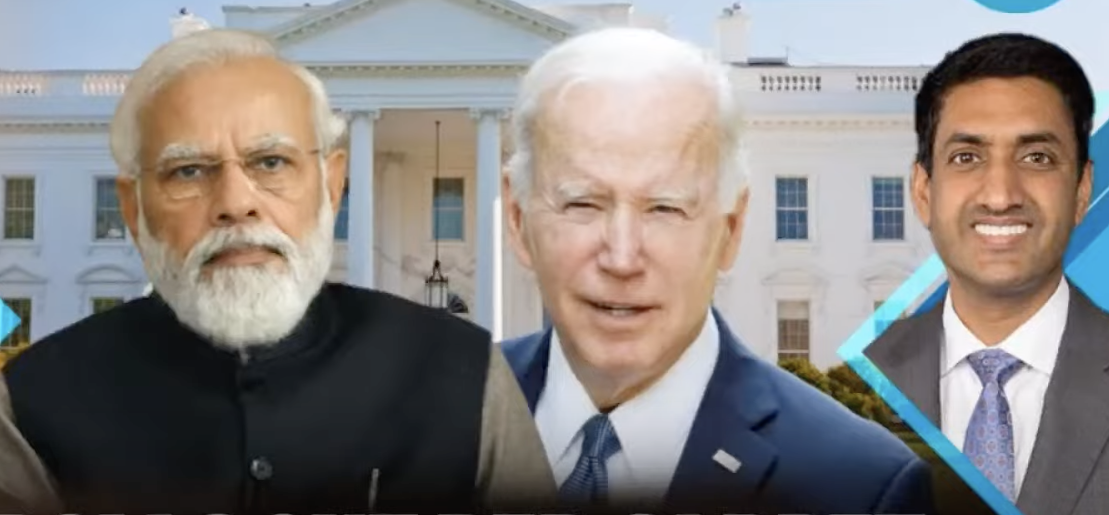
Silicon Valley Congressman Ro Khanna has been instrumental in inviting Indian Prime Minister Narendra Modi to address the joint session of US Congress on June 22, 2023. This came as a surprise to many of his constituents who voted for him after he declared in 2019: “It’s the duty of every American politician of Hindu faith to stand for pluralism, reject Hindutva, and speak for equal rights for Hindus, Muslims, Sikhs, Buddhist & Christians.”  

L to R: Narendra Modi, JOe Biden, Ro Khanna

What caused this change of heart?  Is it the donation of $110,000 to his campaign by Hindu Nationalist donors in the United States, as reported by The Nation?  Fellow Indian-American Congresswoman Pramila Jayapal has also supported Modi's invitation. She will be among members of Congress who will escort Modi to the podium. Ro Khanna and Pramila Jayapal are both supposedly "liberal" Democrats.   

While Khanna says that he “strongly opposes any form of caste discrimination”, he has not endorsed California SB 403, a bill sponsored by Senator Aisha Wahab and supported by Dalit activist Thenmozhi Soundararajan, that outlaws caste discrimination in the state. 

Modi’s US visit comes at a time of rising state persecution of religious minorities, including Muslims and Christians.  Modi's BJP-affiliated politicians have called for genocide against Indian Muslims, attacked mosques and churches, and demolished homes, according to The Nation.  The Biden administration has been silent on these issues, choosing instead to try and strengthen the US-India relationship and deepen the ties between the countries’ military and technology sectors.  For the last four years, the Biden Administration has ignored the USCIRF (US Commission on International Religious Freedom) recommendation to designate India as a “Country of Particular Concern” and impose strategic sanctions on Indian government officials and agencies involved in religious freedom violations. 

On the eve of Prime Minister Modi's visit to Washington, the USCIRF has urged President Biden to discuss with him its concerns about the lack of religious freedom in India. “With India’s upcoming state visit, the Biden administration has a unique opportunity to explicitly incorporate religious freedom concerns into the two countries’ bilateral relationship,” said USCIRF Commissioner David Curry. “It is vital the U.S. government acknowledge the Indian government’s perpetration and toleration of particularly severe violations of religious freedom against its own population and urge the government to uphold its human rights obligations.”

Instead of condemning India for allowing the oppression of minorities and denying media freedom, US officials have applauded the Modi government.  US Commerce Secretary Gina Raimondo has described Modi as “unbelievable, visionary” and “the most popular world leader.” Donald Lu, the assistant secretary of state for South and Central Asia, has praised press freedom in India: “You have India as a democracy in part because you have a free press that really works.”  This is in sharp contrast with the findings of the media watchdog Reporters Without Borders 2023 World Press Freedom Index, which has ranked India 161, out of 180 countries due to its crackdown on the press. India's neighbor Pakistan ranks 150, 11 places above India, on this Index. 

Khanna's recent about-face is seen as a betrayal by many of his constituents who supported him because of his rejection of Hindutva. South Asian social justice activists Anu Mandavilli, Deepa Iyer, Karthikeyan Shanmughan and others have strongly criticized Khanna. 

Related Links:

Haq's Musings

South Asia Investor Review

Pakistan's Bilawal Bhutto Lashes Out at India's Jaishankar

Ro Khanna Rejects Hindutva

India-Pakistan Nuclear Arms Race

Kashmir: 700,000 Indian Soldiers vs 7 Million Kashmiris

US Brackets India's Modi With Murderous Dictators Aristide, Kabila, Mugabe and MBS

Hateful Hindutva Ideology Infects Indian Hindu Diaspora

Caste Discrimination Rampant Among Silicon Valley Indians

Total, Extended Lockdown in Indian Occupied Kashmir

What is India Hiding From the UN Human Rights Team?

Indian JNU Professor on Illegal Indian Occupation of Kashmir, Manipur, Nagaland

Riaz Haq Youtube Channel

Riaz Haq's YouTube Channel


Thursday, February 3, 2022

Upper Caste Hindu-American Professor Acknowledges Internalized Islamophobia

Dr Saiba Varma, Associate Professor of Anthropology at University of California in San Diego (UCSD), has recently been under fire for hiding her familial ties to to a top RAW official while working on her book "The Occupied Clinic: Militarism and Care in Kashmir".  “As an upper-caste and upper-class Indian citizen and subject, I have actively and passively internalized anti-Muslim racism my entire life. I am complicit in the colonization of Kashmir and other regions forcibly incorporated into the Indian nation-state", she acknowledges in her book released last year.  

Dr. Saiba Verma


“Borrowing and extending techniques from British colonial rule, the Indian state enacted the world’s most established, sophisticated, and pervasive systems of emergency rule and legislation and repeatedly criminalized pro-independence demands as ‘conspiracies’ and ‘anti-national.’ The Indian state’s global image as ‘the world’s largest democracy,’ a generous aid donor, and non-interventionist actor have helped disguise its military excesses in Kashmir and other border regions", she adds. 

In her defense, Dr. Saiba has tweeted: “My father (a top official of Indian Indian intelligence RAW posted in Kashmir)  had no direct bearing on the research I’ve done. Recognizing the need to acknowledge this relationship, however, during my fieldwork I disclosed it to Kashmiri scholars and journalists I was close to. My ethical practices and scholarly arguments are accountable to them".  “In my book, I write: "As Stuart Hall once stated, there is no innocent discourse...There is no innocent way for any scholar of Indian origin, including myself, to engage with Kashmir."

American academia has substantial and growing numbers of upper caste Hindu faculty. More than 80 faculty members of the California State University (CSU) have spoken out against a recent decision of CalState University system to include caste in its non-discriminatory policy.  Praveen Sinha, a professor at CSU Long Beach said. "We cannot but oppose the unique risk that CSU's move puts on us as they add a category that is only associated with people of Indian descent such as myself and thousands of other faculty and students in the CSU system. It is going to create divisions where they simply do not exist". 

Devesh Kapur, a professor of political science at the University of Pennsylvania and co-author of The Other One Percent: Indians in America (Oxford University Press, 2017), says that the vast majority of Indian-Americans, including university professors, are upper caste Hindus. He explains the phenomenon of high-achieving Indian-Americans as follows: “What we learned in researching this book is that Indians in America did not resemble any other population anywhere; not the Indian population in India, nor the native population in the United States, nor any other immigrant group from any other nation.” 

Kapur talks about what he calls “a triple selection” process that gave Indian-Americans a boost over typically poor and uneducated immigrants who come to the United States from other countries. The first two selections took place in India. As explained in the book: “The social system created a small pool of persons to receive higher education, who were urban, educated, and from high/dominant castes.” India’s examination system then selected individuals for specialized training in technical fields that also happened to be in demand in the United States. Kapur estimated that the India-American population is nine times more educated than individuals in the home country.

The results of the Indian American Attitudes Survey (IAAS) conducted in 2020 show that India's Hindu Nationalist Prime Minister Narendra Modi's massive popularity among Hindu Americans. The findings of the survey sponsored by Washington-based think tank Carnegie Endowment For International Peace reveal that 69% of Hindu Americans approve of Mr. Modi's performance. 70% of Hindu Americans agree or strongly agree that white supremacy is a threat to minorities in the United States, compared to 79% of non-Hindu Indian American. Regarding Hindu majoritarianism in India, however, the data point to a much sharper divide: only 40% of Hindus agree that Hindu majoritarianism is a threat to minorities, compared to 67% of non-Hindus, according to the 2020 IAAS Survey.

69% of Hindu Americans Support Modi. Source: Indian American Attitudes Survey 2020

The 7 in 10 approval rating of Mr. Modi by Hindu Indian Americans stands in sharp contrast to that of barely one in five Muslim Indian Americans. Indian American Christians are almost evenly divided: 35 percent disapprove, 34 percent approve, and 30 percent did not express an opinion. Twenty-three percent of respondents without a religious affiliation and 38 percent from other faiths approve of Modi’s performance, respectively. The share of “don’t knows” is the smallest for Hindus and Muslims compared to other religious categories, suggesting that views among respondents of these two faiths are the most consolidated.

Related Links:

Haq's Musings

South Asia Investor Review

Pakistani-Americans: Young, Well-educated and Prosperous

Hindus and Muslim Well-educated in America But Least Educated Worldwide

What's Driving Islamophobia in America?

Pakistani-Americans Largest Foreign-Born Muslim Group in Silicon Valley

Caste Discrimination Among Indian-Americans in Silicon Valley

Islamophobia in America

Silicon Valley Pakistani-Americans

Pakistani-American Leads Silicon Valley's Top Incubator

Silicon Valley Pakistanis Enabling 2nd Machine Revolution

Karachi-born Triple Oscar Winning Graphics Artist

Pakistani-American Ashar Aziz's Fire-eye Goes Public

Two Pakistani-American Silicon Valley Techs Among Top 5 VC Deals

Pakistani-American's Game-Changing Vision 

Minorities Are Majority in Silicon Valley 


Sunday, February 14, 2021

The White Tiger: An Incisive Social Commentary on Religion, Caste, Class and Democracy in India

Few films about India offer the kind of incisive social commentary that the recently released "The White Tiger" does. Based on a novel of the same name by Aravind Adiga, it tells  the story of a poor but ambitious young man from a village in the Indian state of Uttar Pradesh. The film touches on religion, caste, class and democracy in India. It is directed by Iranian-American director Ramin Bahrani and now available on Netflix. 

The White Tiger: Adarsh Gourav, Priyanka Chopra and Rajkummar Rao


The movie opens with a scene showing Balram Halwai (Adarsh Gourav) looking back at his life. It follows up with a series of long flashbacks to tell his story. Along the way, Balram sarcastically compares India's democracy with China's sanitation system. “If I were in charge of India, I’d get the sewage pipes first, then the democracy.” Numerous scenes in the film illustrate poor sanitation in India by showing Balram and others squatting and defecating in the open

Raised in an Indian village, Balram is determined to rise above his "halwai" (confectioner) caste in India's rigidly defined caste system which makes any such escape extremely difficult. He persuades a corrupt landlord known as the Stork (Mahesh Manjrekar) and his son Ashok (Rajkummar Rao) to give him a job as a back-up driver.  Ashok is married to Pinky (Priyanka Chopra Jonas), a chiropractor who grew up in the United States.   

Balram soon replaces the primary driver (Girish Pal) by revealing his Muslim identity which he was hiding to work for the Islamophobic Stork. Balram spends most of his time working for Ashok.  Ashok’s older brother, referred to as Mukesh Sir or the Mongoose (Vijay Maurya), doesn't  particularly like Balram. Unlike Ashok who has studied abroad, the Mongoose character accepts India’s culture of corruption and participates in it willingly. The Mongoose visits Delhi regularly to help Ashok distribute bags full of cash to politicians and bureaucrats. He also helps Ashok deal with his sadness when Pinky suddenly leaves him to return to the United States.  

The White Tiger is a well-made film. I recommend it to anyone interested in understanding the real life in India

Related Links:

Haq's Musings

South Asia Investor Review

Peepli Live Debunks Myths About India

Slumdog Millionaire

Upward Mobility in India and Pakistan

Disintegration of India

Dalit Death Shines Light on India's Caste Apartheid

India's Hindu Nationalists Going Global

Rape: A Political Weapon in Modi's India

Trump's Dog Whistle Politics

Funding of Hate Groups, NGOs, Think Tanks: Is Money Free Speech?

Riaz Haq Youtube Channel

VPOS Youtube Channel

Friday, August 14, 2020

After 73 Years of Independence, Caste-Ridden India Remains Dominated by Minority Brahmins

After 73 years of independence, a small upper caste Indian minority retains near monopoly of the highest ranks in both the Indian government and the private sector. A few well-educated Indian Muslims and low-caste Hindus can not escape caste-ism even when they move to work in Silicon Valley.  Over two-thirds of low caste Indian-Americans report being discriminated against by upper caste Indian-Americans in Silicon Valley, according to a report by Equality Labs, an organization of Dalits in America.  Dalits also report hearing derogatory comments about Muslim job applicants at tech companies. These revelations have recently surfaced in a California state lawsuit against Silicon Valley tech giant Cisco Systems.
Upper Caste Domination:

It is not just the 220 million Dalits (untouchables), or the 190 million Muslims, or the 110 million from “scheduled tribes” (Adivasis)  who are under-represented, but also the 40-50% of Hindus who come from the widest tier of the pyramid, the shudras or laboring castes, known as Other Backwards Classes (OBCs), according to a report in The Economist Magazine. Here's an excerpt from The Economist:

"Out of the 89 highest-ranked civil servants in the central government, according to a recent survey, just four are not upper-caste Hindus, and not one is an obc. Two-thirds of the Supreme Court’s 31 judges and more than half of all state governors are high-caste Hindus. When the home ministry recently formed a panel to revise the criminal code, its five experts were all men, all from north India and all from upper castes. The trend is just as stark outside of government. A study published last year of the mainstream Hindi and English press revealed that out of 121 people in senior jobs, such as editors, all but 15 were upper caste. Not a single one was a Dalit."

Indian Caste System


Caste Discrimination in Silicon Valley:

The few well-educated Indian Muslims and low-caste Hindus can not escape the upper caste domination even in Silicon Valley. Over two-thirds of low caste Indian-Americans are discriminated against by upper caste Indian-Americans in Silicon Valley, according to a report by Equality Labs, an organization of Dalits in America. Dalits also report hearing derogatory comments about Muslim job applicants at tech companies. These revelations have recently surfaced in a California state lawsuit against Silicon Valley tech giant Cisco Systems.


Religious Discrimination:

Both caste and religious discrimination are rampant among Indian-Americans in Silicon Valley. Back in 2009,  there was a religious discrimination lawsuit filed  against Vigai, a South Indian restaurant in Silicon Valley. In the lawsuit filed in Santa Clara County Superior Court, Abdul Rahuman, 44, and Nowsath Malik Shaw, 39, both of San Jose, alleged they were harassed for being Muslim by Vaigai's two owners, a manager and a top chef — a violation of the Fair Employment and Housing Act, according to a report in the San Jose Mercury News.

According to the complaint, restaurant personnel regularly used ethnic slurs such as "Thulakkan," a pejorative term for Muslims in Sri Lankan Tamil dialect, to harass the two Muslim cooks. Also according to the complaint, restaurant staff were encouraged to call the plaintiffs by names such as "Rajan" or "Nagraj" under the pretext of not wanting to upset customers who might stop patronizing the restaurant if they heard the men referred to by their Muslim names.


Modi in Silicon Valley

The complaint also stated that the plaintiffs were forced to participate in a religious ceremony despite telling the owners it was against their Islamic beliefs. The complaint alleged that the restaurant owners insisted on their participation and proceeded to smear a powder on their foreheads, making the religious marking known as a "tilak."

Upper Caste Silicon Valley

"Dominant castes who pride themselves as being only of merit have just converted their caste capital into positions of power throughout the Silicon Valley," says Thenmozhi Soundarajan of Equality Labs. Vast majority of Indian-Americans in Silicon Valley support India's Islamophobic Prime MInister Narendra Modi. Modi held a huge rally at a large venue in Silicon Valley where he received a rousing welcome in 2015.

Caste vs Race in America:

Contrary to The International Convention on the Elimination of All Forms of Racial Discrimination (ICERD) that includes discrimination based on caste, most Indian-Americans argue that race is not caste . Dating back to 1969, the ICERD convention has been ratified by 173 countries, including India. California’s lawsuit reinforces that caste is race. It will now make it harder for companies to ignore caste discrimination. While the US has no specific law against the Indian caste system, the California Department of Fair Employment and Housing has filed the lawsuit against Cisco using a section of America’s historic Civil Rights Act which bars race-based discrimination. Here is an excerpt of an article published in TheWire.in on the lawsuit recently:

"In October 2016, two colleagues informed John Doe, a principal engineer at Cisco, that his supervisor, Sundar Iyer, had told them that he (Doe) was from the “Scheduled Castes” and had made it to the Indian Institute of Technology via affirmative action. “Iyer was aware of Doe’s caste because they attended IIT at the same time,” said the case. The suit says that, when confronted by Doe, Iyer denied having disclosed his caste. In November 2016, Doe contacted Cisco’s HR over the matter. Within a week of doing so, Iyer reportedly informed Doe he was taking away Doe’s role as lead on two technologies. Iyer also removed team members from a third technology that Doe was working on and reduced his role to that of an independent contributor and he was isolated from his colleagues, the lawsuit says. In December 2016, Doe filed a written complaint with HR on the matter."

Summary:

Indian society is caste-ridden. A small upper caste Indian minority retains near monopoly of the highest ranks in both the Indian government and the private sector. after 73 years of India's independence. Caste discrimination is also rampant among Indian-Americans and NRIs (Non-resident Indians) in Silicon Valley with 67% of low caste Indians reporting being victims of such discrimination in workplace. Muslims also face employment discrimination in some of the workplaces dominated by Indian managers. California state has filed a lawsuit against Silicon Valley tech giant Cisco Systems alleging caste discrimination.

Related Links:

Haq's Musings

South Asia Investor Review

India Remains Poor Hungry and Illiterate Decades After Independence

Indian Muslims Worse Off Than Dalits

Bigotry Bedevils Silicon Valley Indian Restaurant

India Ranked as Most Racist in the World

Indians Admire Israel and Hitler

Caste Apartheid in India

Mahatma Gandhi and His Struggle With India

Who Killed Karkare?

Procrastinating on Hindutva Terror

India's Guantanamos and Abu Ghraibs

Hindutva Government in Israeli Exile?

Growing US-India Military Ties Worry Pakistan

The 21st Century Challenges For Resurgent India

Riaz Haq's YouTube Channel

PakAlumni Social Network

Saturday, December 16, 2017

India Breakup; Pakistan NGO Expulsions; Alabama Democrat Jones' Upset Win

Does Lord Meghnad Desai's question "A country of many nations, will India break up" raised in his latest book "The Raisina Model" make any sense? Why would India break up? What are the challenges to India's unity? Is there an identity crisis in India? Is it the power imbalance among Indian states? Is it growing income disparity among peoples and states? Is it religious, ethnic, caste and/or regional fault lines running through the length and breadth of India? Is it beef ban?

Growing Income Gap of Indian States. Source: Bloomberg

Why is Pakistan expelling dozens of foreign-funded NGOs? Is it the fall-out from Save The Children NGO's alleged collusion with the CIA in fake polio vaccination scheme to find Osama Bin Laden? Is it a general concern about the NGOs role in subverting and corrupting society as explained by Stephen Kinzer's book "The Brothers" about John Foster and Alan Dulles? Is it the State Department documents describing US-funded international NGOs as "force multipliers", "partners", "agents of change" and "an efficient path to advance our foreign policy goals"?


Map of India(s) on the eve of British conquest in 1764


How did Democrat Doug Jones' pull off a win in the US Senate race in deep red Alabama? Did the allegations of sexual harassment against Republican Roy Moore play a big role? Or was it the heavy turn out of black voters that overwhelmed the vast majority of white voters (65% of white women, 74% of white men) who voted for Roy Moore? Would the result have been different if more women voted for Moore? Does it save considerable embarrassment for the Senate Republicans to see an openly racist, Islamophobic, homophobic, pedophile Judge Rpy Moore lose in a state in the Deep South?


Viewpoint From Overseas host Faraz Darvesh discusses these questions with Misbah Azam and Riaz Haq (www.riazhaq.com)

https://youtu.be/tPzuQrNSW3A


Related Links:

Haq's Musings

Disintegration of India

Dalit Death Shines Light on India's Caste Apartheid

US Hypocrisy in Dr. Afridi Case

Who Killed Sabeen Mahmud?

Trump's Dog Whistle Politics

Funding of Hate Groups, NGOs, Think Tanks: Is Money Free Speech?

Riaz Haq Youtube Channel

VPOS Youtube Channel


Tuesday, August 20, 2013

Harvard Genetics Study Finds Most Indians Are Not Indigenous

"To keep up the purity of the Race and its culture, Germany shocked the world by her purging the country of the Semitic races -- the Jews. Race pride at its highest has been manifested here. Germany has also shown how well-nigh impossible it is for races and cultures, having differences going to the root, to be assimilated into one united whole, a good lesson for us in Hindusthan to learn and profit by."   Madhav Sadashiv Golwalkar,  leader of the Hindu Nationalist RSS (Rashtriya Swayamsevak Sangh)  
Debunking the myth of "the purity of the Race" pushed by  Hindu Nationalist leader Madhav Sadashiv Golwalkar, a Harvard study published in the American Journal of Human Genetics has found that vast majority of Indians today have descended from a mixture of two genetically divergent populations--Ancestral North Indians (ANIs) who migrated from Central Asia, the Middle East, the Caucasus, and Europe,  and Ancestral South Indians (ASI), who are not closely related to groups outside the subcontinent.

Source: World Values Survey and Washington Post

Geographically, Ancestral North Indians (ANIs) tend to be more concentrated in the northern and western parts of India closer to West Asia, while Ancestral South Indians are found mostly in southern and eastern parts of India.

The paper, titled "Genetic Evidence for Recent Population Mixture in India" confirms that North Indians ancestors started migrating to India from outside thousands of years before the advent of Islam. ANIs and ASIs routinely intermarried between 4,200 and 1,900 years ago until the imposition of strict segregation by the Hindu caste system, according to the study.

Lactose Tolerance Map
With segregation strictly in place, the Indian society moved toward endogamy—the practice of avoiding intermarriage or close relationships between ethnic groups—which reached its most extreme form in the creation of the caste system which remains in force to this day. A 2011 report found that in “40 percent of the schools across sample districts in Uttar Pradesh—India’s most populous state, with 199 million people—teachers and students refuse to partake of government-sponsored free midday meals because they are cooked by dalits (untouchables).”

The paper is based on the work of researchers from Harvard, MIT, and the CSIR-Center for Cellular and Molecular Biology in Hyderabad, India. They conducted what they call the “most comprehensive sampling of Indian genetic variation to date,” using samples collected from 571 individuals belonging to 73 “well-defined ethno-linguistic groups.” The data allowed the authors to trace not just the genetic mixture between these groups but how long ago this mixture occurred.

World IQ (Intelligence Quotient) Map (Source: Richard Lynn)


Similar genetic studies of Pakistanis published in the American Journal of Human Genetics have found very diverse ancestral origins of the people in the country. These range from Balochis with origins in Aleppo (modern Syria) to Brahuis who are indigenous Dravidian, and Baltis of Sino-Tibetan ancestry to Pashtuns of Jewish or Central Asian origins.

These genetic studies offer strong rebuttal of Hindu Nationalists' claims of "racial purity" of Hindus. Genetics confirm that most Indians (and Pakistanis) are, in fact, people of mixed or foreign ancestry regardless of their faith.

Related Links:

Haq's Musings

World Values Survey Finds Indians Most Racist

Indians Admire Israel and Hitler

Caste Apartheid in India

Religion, Caste and Politics in India by Christophe Jaffrelot

Mahatma Gandhi and His Struggle With India

Who Killed Karkare?

Procrastinating on Hindutva Terror

India's Guantanamos and Abu Ghraibs

Hindutva Government in Israeli Exile?

Growing US-India Military Ties Worry Pakistan

The 21st Century Challenges For Resurgent India


Thursday, May 16, 2013

World Values Survey Finds Indians Most Racist

43.5% of Indians, the highest percentage in the world, say they do not want to have a neighbor of a different race, according to a Washington Post report based on World's Values Survey.

About Pakistan, the report says that  "although the country has a number of factors that coincide with racial intolerance – sectarian violence, its location in the least-tolerant region of the world, low economic and human development indices – only 6.5 percent of Pakistanis objected to a neighbor of a different race. This would appear to suggest Pakistanis are more racially tolerant than even the Germans or the Dutch".

Housing Discrimination: 

It appears that there is a small but militant minority in Pakistan that is highly intolerant, but the vast majority of people are tolerant. My own experience as a  former Karachi-ite  is that there is little or no race or religion based housing segregation, the kind that is rampant in India where Muslims are not welcome in most Hindu-dominated neighborhoods. There have been many reports of top Muslim Bollywood stars having difficulty finding housing in Mumbai's upscale neighborhoods. A common excuse used to exclude them is the ostensible requirement to be vegetarian to live there.

Source: World Values Survey and Washington Post

Hate Against Indian Muslims:

The idea of racial purity is central to Hindu nationalists in India who have a long history of admiration for Adolf Hitler, the Nazi leader, including his "Final Solution".

In his book "We" (1939), Madhav Sadashiv Golwalkar, the leader of the Hindu Nationalist RSS (Rashtriya Swayamsevak Sangh) wrote, "To keep up the purity of the Race and its culture, Germany shocked the world by her purging the country of the Semitic races -- the Jews. Race pride at its highest has been manifested here. Germany has also shown how well-nigh impossible it is for races and cultures, having differences going to the root, to be assimilated into one united whole, a good lesson for us in Hindusthan to learn and profit by."

Caste-based Apartheid:

While Golwalar's principal target in the above paragraph were Indian Muslims, the treatment of lower caste Hindus in India also falls in the category of racism. The International Convention on the Elimination of All Forms of Racial Discrimination (ICERD) now includes discrimination based on caste. Dating back to 1969, the ICERD convention has been ratified by 173 countries, including India. Despite this, and despite the United Nations Sub-Commission on the Promotion and Protection of Human Rights reiterating that discrimination based on work and descent is a form of racial discrimination, the Indian government's stand on this issue has remained the same: caste is not race.

Over 250 million people are victims of caste-based discrimination and segregation in India. They live miserable lives, shunned by much of society because of their ranks as untouchables or Dalits at the bottom of a rigid caste system in Hindu India. Dalits are discriminated against, denied access to land, forced to work in slave-like conditions, and routinely abused, even killed, at the hands of the police and of higher-caste groups that enjoy the state's protection, according to Human Rights Watch.

Gandhi's Disdain for Black Africans:

It's not just the Hindu Nationalists who are racists. Even Mohandas K. Gandhi, Mahatma or the Great Soul, was not immune to Indians' racist tendencies. In 1908, recording his first experience in a South African prison, Gandhi referred to black South Africans as "kaffirs". According Joseph Lelyveld, the author of "Great Soul: Mahatma Gandhi and His Struggle With India", Gandhi wrote: "We were then marched off to prison intended for kaffirs. ..we could understand not being classed with the whites, but to be placed with the Natives seemed too much to put up with. It is indubitably right that Indians should have separate cells."

Summary:

The findings of World's Values Survey on India are well-supported by other evidence such as the Hindutva ideology as spelled out by RSS leader Golwalkar, the existence of widespread caste-based discrimination classified as racism by the United Nations and lots of other anecdotal evidence. Just this month, Indian racism was on full display at a lavish Indian wedding in South Africa where guests flown in from India refused to be served by black waiters and drivers.

Let me conclude this post with a video interview of Professor Ahmad Hasan Dani who attended Banaras Hindu University (BHU) and studied archaeology, and said that he was ostracized and treated as a pariah by Hindu students and faculty at BHU. He was not allowed to sit and eat with his fellow students, he was asked to keep his plates and dishes separate in his room, and required to stand outside the dining hall to be served his meal and then wash the dishes himself. Later, when he graduated at the top of the archaeology class, he was offered a faculty position, but the University head and former president of India Radhakrishnan told him that he would be paid a salary but he would not be allowed to teach. Here is a video clip of late Prof Dani talking about it with Farah Husain on Morning with Farah TV show:


Related Links:

Haq's Musings

Indians Admire Israel and Hitler

Caste Apartheid in India

Mahatma Gandhi and His Struggle With India

Who Killed Karkare?

Procrastinating on Hindutva Terror

India's Guantanamos and Abu Ghraibs

Hindutva Government in Israeli Exile?

Growing US-India Military Ties Worry Pakistan

The 21st Century Challenges For Resurgent India