Showing posts sorted by date for query Karachi. Sort by relevance Show all posts

Friday, June 26, 2026

Pakistani-American Professor Publishes Landmark Genomic Research on Pakistanis

Dr. Danish Saleheen, a Pakistani-American professor at Columbia University, and his fellow researchers have published a comprehensive analysis of 173,303 genomes from Pakistan, one of the largest genomic studies ever conducted in South Asia. This landmark work is upending how scientists understand human genetics and drug development. "South Asians have been severely underrepresented in genome studies—comprising just 2% of global genomic databases despite representing 25% of the world's population," study leader Dr. Saleheen explained. The study is sponsored by Novartis, Columbia University Irving Medical Center, and the Center for Non-Communicable Diseases, Karachi, Pakistan. Its results could fundamentally transform drug discovery. 


The study, published in the journal Nature, has identified knockouts of nearly 6,500 genes—about one third of all protein-coding genes (exomes)—in 34,000 individuals. Cousin marriages are quite prevalent in Pakistan, with half of all marriages occurring between close relatives. Landmark research, including the Pakistan Genomic Resource, highlights how these genetic traits act as both a medical challenge and a massive opportunity for scientific discovery.  

Study of Knockout Genes in Humans vs Mice

What are "knockout genes"? In Pakistan, the study has identified thousands of individuals with naturally missing or "knocked out" or "deleted" genes. Researchers use mice for studying diseases and "knock out" or delete specific genes to study how the deletions impact health and contribute to disease. The problem is that translation of such findings to humans has been difficult, "because mouse genes often have different functions than their human counterparts," Saleheen says. “What’s unique about our Pakistan study is we can go back to participants and conduct comprehensive medical exams to see what kind of effects the gene deletion may have on the individual,” he adds.

The study reveals that South Asian populations carry genetic ancestry components shared with both European and African populations, suggesting that insights gained from the Pakistan Genome Resource (PGR) have broad applicability across multiple human populations. This genetic overlap means that treatments validated in Pakistani populations are likely to benefit diverse ancestry groups globally.

"What we would prefer to do is identify people who are born without working copies of these genes and see if that has an effect on their health."  These "human knockouts" are rare in genome databases like the UK Biobank and the NIH's All of Us, which predominantly contain genomes of people with European ancestry.  "Consequently, many experimental drugs that seem promising in mice fail in clinical trials," Saleheen says. "That costs billions of dollars in losses every year."

Dr. Saleheen is a physician-scientist working at the intersection of human genetics and drug discovery. He has an MBBS degree from Karachi's Aga Khan University and a Ph.D. in Cardiovascular Genomics from Cambridge University.  He is Professor of Medical Sciences and Director of Global Genomics at Columbia University Irving Medical Center, founding Director of the Center for Non-Communicable Diseases (CNCD) in Pakistan, and founding Principal Investigator of the Pakistan Genome Resource (PGR) — one of the world's largest human "knockout" discovery programs (www.cncd.org). He is the author of more than 250 research papers and a 2018 recipient of the Clinical Research Forum's Top 10 Clinical Research Achievement Award, the national prize recognizing the ten most outstanding clinical research accomplishments in the United States that year.

 Related Links:


Monday, June 8, 2026

Ten Pakistanis Among Unicorn Founders in America

There are ten Pakistani immigrants included among founders or co-founders of unicorns in America, according to  a recent study by the National Foundation for American Policy (NFAP). A unicorn is a startup with a valuation of at least one billion U.S. dollars. Immigrant entrepreneurs of US unicorns are diverse, hailing from 76 different countries. India, with 96 companies, is the leading country of origin for the immigrant founders of U.S. billion-dollar companies. Immigrants from Israel founded the second-most billion-dollar companies with 60, followed by the United Kingdom (47), China (41), Canada (30), Russia (23), France (21), Germany (18), Ukraine (16), Australia (14), Pakistan (10) and Romania (10). Some companies were founded by entrepreneurs from the same country or immigrants from multiple countries.

Four of Ten Pakistani-American Founders Listed Among Unicorns


Why are Indian entrepreneurs leading the pack of unicorn founders/co-founders in America?  The key reason is that “the great Indian brain drain” is accelerating with the country rapidly losing its best and brightest to the West, particularly the United States. Large presence of the Indian immigrant unicorn founders in America is attributed to the fact that most immigrant founders come to the U.S. as students or H1B workers, categories dominated by Indians. Over 80% of the H1B visas go to Indian applicants. India also leads in sending students to study in US universities. 

Unicorns in America. Source: NFAP

Pakistan, too, is suffering brain drain but not on the same scale as India. Most prominent among Pakistan-origin unicorn founders/cofounders are Karachi-born Sualeh Asif, Lala Moosa-born Qasar Younis, Karachi’s NED University alumnus Rehan Jalil and Pakistani-American serial entrepreneur Zia Chishti. 

26 year old Karachi born Sualeh Asif, cofounder of Cursor (Anysphere) recently joined the list of Forbes Billionaires after Cursor reached a $29.3 billion valuation in November 2025, according to Forbes magazine. 

43 year old Qasar Younis, a Lala Moosa born Harvard-educated Pakistani-American, is the CEO of  Applied Intuition, a physical AI and autonomous vehicle software firm valued at $15 billion. Younis's resume includes his role as Chief Operating Officer of Y-Combinator, a spawning ground for tech giants Dropbox, Airbnb, and Stripe in Silicon Valley, according to Fortune Magazine.

Rehan Jalil, a fellow alumnus of NED University in Karachi, founded AI-powered data privacy and governance platform Security.AI. The startup has now been acquired by Veeam for $1.725 billion.

Zia Chishti is a serial entrepreneur from Pakistan. He founded Afiniti.AI which reached a $1.6 billion valuation back in 2017. founded his first company Align Technology in 1997 in Silicon Valley. It creates clear plastic braces for straightening teeth by using advanced 3-D computer imaging. The technology now trademarked as Invisalign has helped millions of people straighten their teeth for a beautiful smile without enduring the pain and unsightly looks of the traditional steel brackets and wires used in orthodontics. Align Technology is now valued at $10 billion.

The NFAP study found that immigrants have founded or co-founded 59% (455 of 775) of America’s privately held startup companies valued at $1 billion or more. That is an increase from 55% in NFAP reports released in 2018 and 2022. 

Approximately two-thirds (66%) of U.S. billion- dollar companies (unicorns) were founded or cofounded by immigrants or the children of immigrants. Nearly 80% of America’s unicorn companies (privately held, billion-dollar companies) have an immigrant founder or an immigrant in a key leadership role, such as CEO or vice president of engineering. Almost one in four U.S. billion- dollar companies, or 24%, have a founder who came to America as an international student. The research shows the importance of immigrants in cutting-edge companies and the U.S. economy at a time when U.S. immigration policies have grown more restrictive.

The collective value of the 455 immigrant-founded billion-dollar companies is $5.0 trillion, which is more than the total market value of companies listed on stock markets in all but 7 countries, including the UK and Germany, and a demonstration of the wealth-creating power of immigrants. The collective value of immigrant-founded billion-dollar companies rises to over $5.8 trillion if one includes unicorn companies that have gone public since 2016.

Related Links: 

Monday, May 25, 2026

Iron Brothers China and Pakistan Celebrate 75 Years of "Unbreakable" Friendship

President Xi Jinping and Prime Minister Shehbaz Sharif have met today in Beijing to reaffirm the "unbreakable" bond between their two "iron brother" countries on the 75th anniversary of the establishment of the China-Pakistan diplomatic ties. "No matter how the international landscape may evolve, China will always place priority on the development of China-Pakistan relations in its diplomacy with neighboring countries," he said. Over 7 decades of friendship witnessed Pakistan help bring about the US-China rapprochement that has enabled the Asian giant to grow from international isolation to what President Donald Trump recently declared part of "G2", the exclusive group of two real superpowers in the world today. Prime Minister Shehbaz Sharif's three-day visit to China has seen the signing of multiple agreements to further strengthened strategic and economic relations between two Asian neighbors. These deals are aimed at developing Pakistan's digital economy and renewable energy sectors. 


Prime Minister Shehbaz Sharif (L) with President Xi Jinping


Digital Economy:

Prime Minister Shehbaz Sharif began his 3-day official visit to China with the city of Hangzhou where he was warmly welcomed by Chinese officials. He led a business-to-business (B2B) investment conference with private business leaders from China and Pakistan.  Hangzhou is known for its huge digital economy, e-commerce dominance, and an aggressive push into "future technologies" like embodied AI, robotics, and drones. It is home to the Chinese tech giant Alibaba. 

Prime Minister Sharif visited Alibaba’s headquarters where he forged a comprehensive strategic agreement with the tech giant's Chairman Tsai "right now" to accelerate Pakistan's digital economy. The deal covers AI infrastructure, cloud computing, digital payments and e-commerce.  

Renewable Energy:

Prime Minister Sharif also received CATL Executive Vice President Oscar Lou in Hangzhou. CATL is a leading manufacturer of advanced batteries used for energy storage and electric vehicles. Sharif invited CATL and other renewable energy equipment makers to invest in Pakistan to respond to the growing needs of the country. 

In a meeting with Sheng Huo Neng Yuan Ke Ji Company CEO Agnes Siu, discussions focused on cooperation in the renewable energy sector, particularly solar power. The prime minister highlighted Pakistan’s growing renewable energy market and government measures aimed at facilitating investment in the sector. He also met with Danwei Shao, the Chairwoman of Starcharge Group, to build electric vehicle charging infrastructure and smart mobility systems in Pakistan. 

Sharif argued that the industries where China was no longer competitive because of expensive labor could come to Pakistan, bring in plant and machinery, enter into joint ventures with Pakistani entrepreneurs, manufacture goods, and export to third countries.

Other Industries:

Sharif pitched for Chinese investments and cooperation in other key sectors, including agriculture, pharmaceuticals, textiles and mining. 

President Xin Yuan of Xiuzheng Pharmaceuticals called on the prime minister and discussed pharmaceutical manufacturing, healthcare cooperation and investment opportunities in Pakistan’s growing medical sector.

Sharif promoted a number of special economic zones (SEZs) created by the Pakistan government, Specifically, he mentioned a special economic zone in Karachi spread over more than 6,000 acres of land, where all basic amenities would be provided so that Chinese investors and Pakistani entrepreneurs together could invest there.


Beijing Visit:

Prime Minister Sharif and his team flew from Hangzhou to Beijing to meet with the top Chinese leaders, including President Xi Jinping, Prime Minister Li Qiang and Foreign Minister Wang Yi. 

President Xi told the visitors that China firmly supports Pakistan in safeguarding its independence, sovereignty, and territorial integrity. "No matter how the international landscape may evolve, China will always place priority on the development of China-Pakistan relations in its diplomacy with neighboring countries," he said.

Foreign Minister Wang, also a member of the Political Bureau of the Communist Party of China Central Committee, held a meeting with Pakistan's Chief of Defense Forces and Chief of Army Staff Syed Asim Munir. No matter how the international and regional situation changes, the friendship between China and Pakistan has always been as solid as a rock and unbreakable, Chinese Foreign Minister Wang Yi said to him on Monday.

Joint Statement:

At the conclusion of Prime Minister Sharif's China visit, a joint China-Pakistan statement said the two nations have reached a “new broad consensus” ⁠on deepening strategic ⁠ties to bolster the development of a joint economic corridor and establish the port of Gwadar as a regional connectivity hub. “The two sides engaged cordially and reached a new broad consensus on further deepening the China-Pakistan All-Weather Strategic Cooperative Partnership,” the statement said. 

Monday, May 18, 2026

Pakistani-American Franchisee Joins Bid to Acquire Papa John's Pizza

A Pakistan-American franchisee has joined a Qatari-backed investor group's bid to buy out the US-based Papa John's Pizza restaurants chain. Nadeem Bajwa started his part-time job in 1991 as a pizza delivery driver for Papa John's while attending college in Indiana. He has since risen to become the largest franchisee with nearly 300 restaurants across the United States. Bajwa's backing could help Irth, which is also backed by Brookfield Asset Management, in its $47 a share pursuit of the pizza chain. Papa John's has been reviewing Irth's offer, though sources told Reuters there is no guarantee a deal gets done.

Papa John's Largest Franchisee Nadeem Bajwa


Bajwa’s journey wasn’t easy. In his early twenties, he was the first in his family to move to the United States, where he encountered many challenges upon arrival. “Coming to the U.S., actually, that was my first flight [ever.] I’d never flown before,” Bajwa told CNBC News. “Just getting into the plane, it was a full flight coming here by myself, [there was] a lot of anxiety ... but I was determined to make it.”

Back in 2020, Pakistani reporter Ahmad Noorani alleged that "(T)he growth of the Bajwa family’s business empire in the United States and later in Pakistan directly matches the rise in power of retired general Asim Saleem Bajwa, who is now chairman of the country’s massive China-financed infrastructure project and a special assistant to the prime minister". “Out of total 99 companies, 66 are main companies, 33 companies are branch companies of some of the main companies, while five companies are dead now,” Ahmad Noorani alleged, adding that the businesses of the Bajwa family have been put under the umbrella called Bajco Group

Eager to allege corruption, Noorani obviously ignored many well-known Pakistani immigrant success stories in US restaurant franchise business while jumping to the conclusion that Nadeem Bajwa's success must be built on his brother's alleged corruption in Pakistan. Noorani does not offer any evidence to back up his allegations.

Bajwa's success as a fast food franchisee is not unique. Other Pakistani-American entrepreneurs own and operate some of the largest fast-food franchises in the United States, managing thousands of locations for major brands like Popeyes, Burger King, and Papa John's. Among the most prominent Pakistani-American franchisees is Shoukat Dhanani (Dhanani Group).  Based in Sugar Land, Texas, the Dhanani family runs one of the largest private businesses in the U.S. They are the largest franchisees of Popeyes and a massive Burger King operator, building an empire that generates well over a billion dollars in revenue.

Tabassum Mumtaz, an NED University alumnus, is a another successful Pakistani-American fast-food franchisees. He began his career as a cook for Long John Silver’s,  eventually rising to own the entire chain and becoming a mega-franchisee of A&W, KFC, and Taco Bell under Ampex Brands, running a restaurant portfolio generating over a billion dollars in annual revenue.


Related Links:

Haq's Musings

South Asia Investor Review

Karachi IBA Alum Appointed CEO of KFC

Pakistani Leaders in London After Panama Leaks

Edible Arrangements: A Pakistani-American Franchisor's Success Story

NED Alumni Convention 2016 in Houston, Texas

Is CPEC Authority Chairman Bajwa Guilty as Alleged?

President Pervez Musharraf's Legacy

We Hang Petty Thieves and Appoint Great Ones to High Offices

Capitalism's Achilles Heel by Raymond Baker

Nawaz Sharif's Report Card

Riaz Haq's Youtube Channel


Monday, May 4, 2026

Pakistan's New Infrastructure Investments and Trade Routes

Pakistan has recently launched 5G wireless service in multiple cities and closed financing on the 306 kilometer 6-lane Sukkur-Hyderabad M6 motorway. In addition, Pakistan is seeing significant increase in the utilization of its Gwadar and Karachi ports after the closure of the Strait of Hormuz due to the US-Iran war. This will help open the trade routes from Pakistan to Central Asia via Iran, bypassing unstable Afghanistan. It has the potential to eventually make Pakistan a major transshipment hub for the region extending to the land-locked Central Asian Republics. Another major news is the Asian Development Bank financing of cross-border connectivity of the power grid and digital networks. These developments are expected to substantially enhance economic activity in the country, in spite of the short-term negative impact of the energy crisis, particularly in oil and gas imports. 


5G Launch:

Wireless carriers Jazz and Zong have launched 5G services across Pakistan in March 2026.  This will further expand and enhance Pakistan's digital public infrastructure. Jazz launched its 5G service across major cities, including in Islamabad, Rawalpindi, Lahore, Karachi, Peshawar, Quetta, Multan, and Faisalabad. Meanwhile, Jazz's competitor Zong is targeting over 16 cities with 5G speeds exceeding 1.4Gbps. 

During the March auction, a total of 480 MHz of spectrum was sold across multiple bands for over $500 million, with Pakistan's main telcos, Jazz, Ufone, and Zong, snapping up the assets. Pakistan Telecommunication Authority (PTA) put a total of 597 MHz of spectrum on the table, with just over 100 MHz of this going unsold.

M6 Motorway:

Pakistan has signed an agreement with the Asian Development Bank (ADB) for $235 million in financing for two sections (120 miles) of the M6 motorway in Sindh province. The Islamic Development Bank (IDB) and the OPEC Fund have already agreed to finance three other sections of this motorway. 

The M-6 motorway is the only missing segment in the north-south motorway route linking Karachi to Peshawar. The 306-kilometer-long, six-lane motorway will have 15 interchanges and 10 service areas.

Cross-Border Grid Connectivity:

Pakistan is joining the Pan-Asia Power Grid Initiative sponsored and financed by the Asian Development Bank which will provide $50 billion for power and $20 billion for digital infrastructure. The project will link grids, boost power trading, improve broadband and develop AI-ready communities across Asia, the Pacific. 

Iran Trade Routes:

Pakistan has opened six land transit routes for goods destined for Iran, creating a road corridor through its territory as thousands of containers remain stranded at Karachi port because of the United States blockade of Iranian ports and ships trying to pass through the Strait of Hormuz.

This development signals a major shift away from the Gulf trade infrastructure Iran had long relied upon, particularly through Jebel Ali Port in the United Arab Emirates. This represents an opportunity for Pakistan to create new trade routes to Central Asian Republics bypassing Afghanistan, eventually making Pakistani ports a major transshipment hub for the entire region. 

Pakistan's newest Gwadar Port has already seen a major surge in activity, handling around 11,000 containers in April 2026 alone, surpassing its entire 2025 volume. The increase comes as shipping companies adjust routes due to disruptions near the Strait of Hormuz, pushing traffic toward safer alternatives.

Space Program:

Pakistan's space agency SUPARCO has achieved a major milestone by launching five indigenous satellites over the last 16 months (early 2025 – April 2026), marking a shift toward rapid space technology expansion. The fleet, aimed at Earth observation and agriculture, includes EO-1, EO-2, AI-powered EO-3, and Pakistan's first hyperspectral satellite, HS-1

HS-1 is Pakistan's first hyper-spectral  satellite which is equipped with advanced hyperspectral imaging sensors capable of capturing data across hundreds of narrow spectral bands.  The satellite lifted off from China’s Jiuquan Satellite Launch Center on a Kinetica-1 rocket. It is expected to boost Pakistan's national capacities in areas such as precision agriculture, environmental monitoring, urban planning, and disaster management. Its high-resolution data will support improved resource management and strengthen Pakistan’s resilience to climate-related challenges. 

Related Links:


Monday, April 27, 2026

A Personal Story: When My Heart Stopped in San Francisco

On the morning of April 13, 2026, a surgeon named Cain, stopped my heart at a San Francisco hospital to graft two bypass veins to restore full blood supply to my heart. It's a procedure called CABG (coronary artery bypass graft pronounced like the vegetable), that seems to have become fairly routine in modern times. Dr. Brian Scott Cain was assisted by Dr. Danielle Holland, a cardiovascular anesthesiologist. Prior to the procedure, Dr. Cain told me he had done nearly 4,000 such operations in his 20 years as a cardiovascular surgeon. In terms of risk, he said, there was a 1% chance of death and 2% chance of stroke during surgery. But the upside after successful surgery is a significant improvement in quality of life. 

In a Chair on 4th Day in Hospital, With Chest Scar Clearly Visible


By the time I woke up in an intensive care unit (ICU) a few hours later, I was told it all went smoothly.There were no surprises. Dr. Cain informed me that my heart is in good shape. I was kept in the ICU for less than 24 hours. In these 24 hours, I sat up in a chair and had breakfast, then walked with the assistance of a walker before being transferred to a regular hospital room. 

The reason I ended up getting CABG surgery has to do with the fact that I started experiencing shortness of breath during long walks and strenuous exercise. When I told my cardiologist Dr. Lucas Christianson about it, he ordered a perfusion stress test, also known as nuclear stress test. The results were abnormal, indicating two blocked coronary arteries. 

I received good care from doctors, nurses and other staff in the regular hospital room. They made sure I was cared for and fed well. In addition to daily visits by Dr. Cain and other doctors, there were multiple daily visits by respiratory therapists (RT) and physiotherapists (PT) designed to ensure full restoration of my lung function and ability to walk on my own. Vital signs (temperature, blood pressure and blood oxygen saturation level) checks every 3 hours and regular blood draws meant I could not sleep much. Pretty soon I was asking to be discharged so I could go home and catch up on my sleep. My doctors assured me it was their goal too but they wanted to make sure that the red blood cells and electrolytic balance were restored and my edema (excess water retention) reduced to nearly pre-surgery levels. In addition to visual checks of my feet, I was weighed everyday to ensure I was losing retained water from surgery. 

I was discharged from the hospital on April 19, exactly 6 days after surgery. I was told that this is fairly normal. There was another CABG patient of Indian origin in the room next door. He was there for 10 days and stayed there when I was discharged. Apparently, the surgeon discovered he had deep vein thrombosis (DVT) during surgery that complicated his situation. 

Dr Cain somehow learned that I am a Pakistani-American. He told me he mentioned it to a fellow cardiovascular surgeon named Dr. Ahmad Sheikh who confirmed to him my national origin. I personally do not know Dr. Sheikh but I am acquainted with his family. In fact, my wife and I were invited to attend his sister's wedding in Fremont, California. 

Looking through the hospital window, the one thing that struck me was how many Waymo robotaxis were ferrying passengers through the streets of San Francisco. Waymo is owned by Google. Its cars are made by Jaguar. They are fitted with LIDARs (Light detection and ranging) which constantly scan the vehicle's surroundings to create 3D scanned images of all objects around it. In addition, there are multiple radars and cameras which provide inputs to a computer that operates the vehicle. My wife drove to the hospital but both of my daughters used Waymo robotaxis. They both felt comfortable riding in the back seat of a vehicle with no human driver. 

Related Links:

Haq's Musings

South Asia Investor Review

Over 1000 Pakistani Medical Graduates Match in US Residency Programs

Eleve Days in Karachi, Pakistan

Pakistani-Americans Largest Foreign-Born Muslim Group in Silicon Valley

Babies Born in USA Swaddled in Pakistan-Made Blankets

In Memory of My Loving Mother Rafiqa Khatoon

Silicon Valley Pakistani-Americans

Pakistani-American Leads Silicon Valley's Top Incubator

Silicon Valley Pakistanis Enabling 2nd Machine Revolution

Pakistani-American Surgeon Implants Pig Heart in Human

Pakistani-American Ashar Aziz's Fire-eye Goes Public

Pakistani-American Doctor Honored By President Obama

Pakistani-American's Game-Changing Vision 

Minorities Are Majority in Silicon Valley 

Over A Million Pakistani University Students Enrolled in STEM Fields


Wednesday, April 1, 2026

Out of School Children: ASER Pakistan Reports Substantial Increase in Enrollment

The Annual Status of Education Report (ASER) Pakistan 2025 national report, officially released on March 26, 2026, shows that the number of "Out of School Children" (OOSC) aged 6-16 years in Pakistan is now 5 million, not 25 million generally reported.  "The findings on access are encouraging. Enrollment levels are high, with 92.2 percent of children aged 6–16 in school and only 7.7 percent out of school", says the ASER Pakistan 2025 report. ASER Pakistan is a citizen-led initiative, primarily led by Idara-e-Taleem-o-Aagahi (ITA) in collaboration with various national and international partners to promote foundational learning. It also works closely with over 10,000 volunteers and numerous local civil society organizations such as the Aga Khan Foundation (AKF), PAL Network (People's Action for Learning),  UNESCO and federal and provincial government departments in Pakistan. 

Enrolling Out of School Children in Pakistan. Source: ASER Via Bilal Gilani 

The latest ASER report contains a table showing that the 6 to 16 age group has around 66 million boys and girls. Based on these numbers, the out of school children's population is now 5.3 million. Of the total number of enrollees, 62% attend government schools and 27% are in private schools. 

Number of Out-of-School Children 6-16 Years is 8% (5 million). Source: ASER Pakistan 2025

The number of out-of-school Pakistani preschoolers in the 3-5 years age group is 41%, according to the ASER Pakistan 2025 Report. It indicates that most Pakistani parents do not send their children to school before age 6.

Number of Out-of-School Children 3-5 Years is 41%. Source: ASER Pakistan 2025


Earlier,  the Household Integrated Economic Survey (HIES) released by the Pakistan Bureau of Statistics (PBS) in December 2025 put the OOSC figure for children 5-16 years at 20 million. One important difference is the age bracket: ASER's figure of 5 million is for 6-16 years while the HIES figure of 20 million is for 5-16 years.  

While the public spending on education remains low in Pakistan, the private sector spending is higher.  Recent data indicates annual education expenditure exceeds Rs. 5 trillion ($18 billion), driven by roughly Rs. 2.8 trillion in household spending (private) and Rs. 2.23 trillion in government (public) funding, highlighting a major shift towards private financing. 

The total (public+private) spending on education has been rising. In 2024-25 it was $18 billion in USD terms, twice the national defense budget of Pakistan. This appears to be driving higher school enrollment. In addition to increasing access, the key challenges for Pakistan include improving learning outcomes and reducing drop-out rates at higher grade levels. 

Related Links:


Saturday, March 28, 2026

Over 1000 Pakistani Medical Grads Matched in US Residency Programs in 2026


Over 1000 Pakistani medical graduates have been matched in the 2026 NRMP (National Residency Matching Program), according to APPNA (The Association of Physicians of Pakistani Descent of North America).  This 2026 program was the largest in history, offering 44,344 positions to 53,373 registered applicants, with over 93% of spots filled. Among Pakistani medical graduates matched, Karachi's Dow Medical University graduates led the pack with 132 matches, followed by 109 from Lahore's King Edwards Medical University and 60 from Karachi's Aga Khan Medical College. 


Top Pakistani Medical Schools in US Residency Programs. Source: APPNA


Nearly 3,000 Indian medical graduates made up the largest group among international medical graduates matched in US residency programs this year. Pakistanis were second with over 1,000 matches.  Over 9,000 International Medical Graduates (IMGs) (including both U.S. citizens and non-U.S. citizens) matched into U.S. residency positions, with non-U.S. IMGs seeing a 56.4% match rate. 


Foreign Medical Residents at Parkview Hospital in Indiana. Source: Mary Bowden MD
 
This year, the presence of a large number of foreign doctors has become a political issue. In some programs, such as Parkview hospital in Indiana, 14 of 15 residents who matched in the internal medicine program are from foreign countries. 12 of them are from Pakistan. Another program at Baptist Hospital of Southern Texas, all 13 residents are foreign medical graduates. Of these 6 are from Pakistan. 

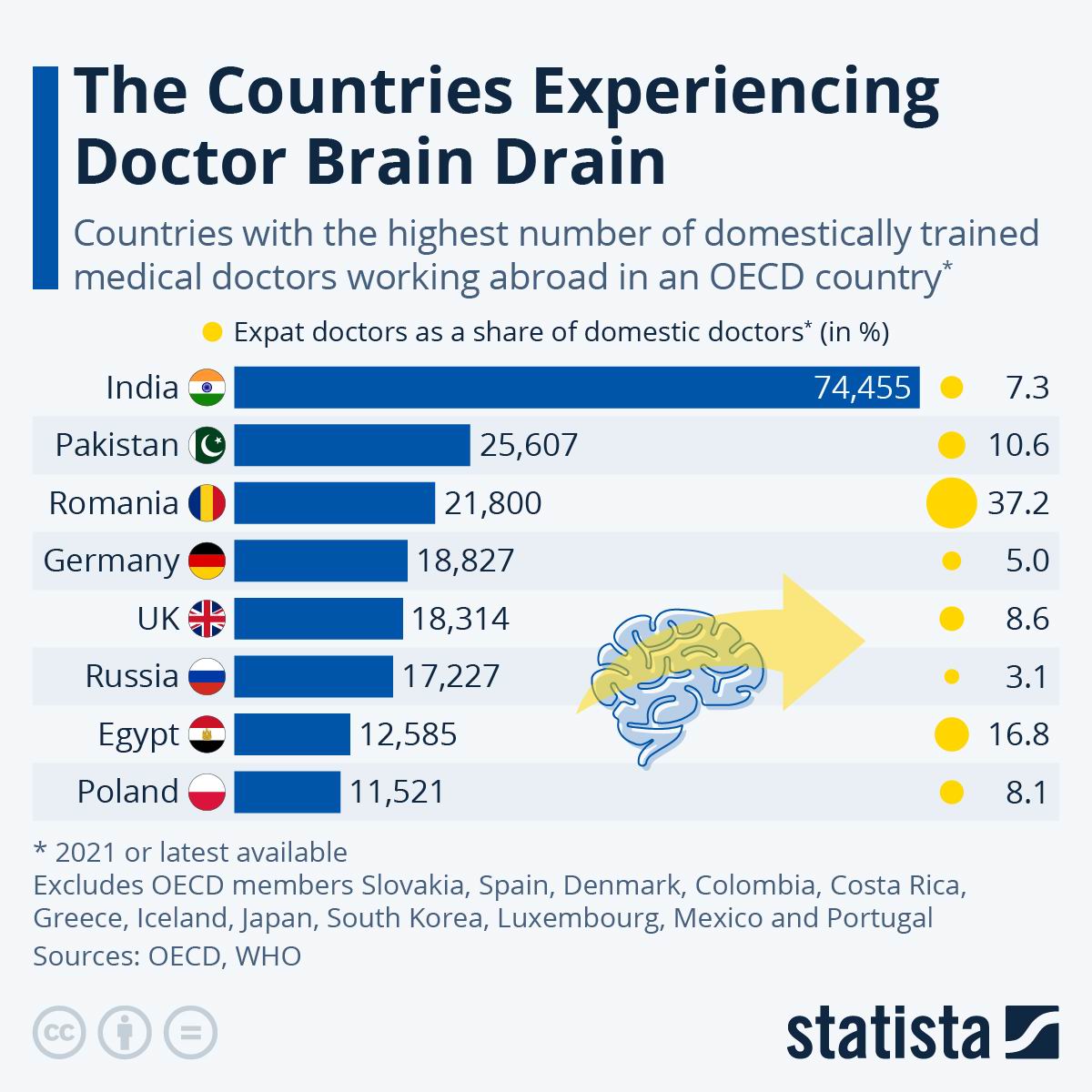
Doctor Brain Drain. Source: Statista

Pakistani-American doctors make up the second largest population of foreign doctors in America. And they are quite successful. For example, Dr. Mansoor Mohiuddin, a 1989 graduate of Karachi's Dow Medical College, made global headlines when he implanted a pig heart in a patient at University of Maryland School of Medicine. Considered one of the world’s foremost experts on transplanting animal organs, known as xenotransplantation, Muhammad M. Mohiuddin, MD, Professor of Surgery at UMSOM, joined the UMSOM faculty five years ago and established the Cardiac Xenotransplantation Program with Dr. Griffith. Dr. Mohiuddin serves as the program’s Scientific/Program Director and Dr. Griffith as its Clinical Director.    

Top Countries of Origin of Foreign Doctors in the US. Source: OECD


The pervasive presence of South Asian doctors in the United States is confirmed by OECD (Organization for Cooperation and Development) statistics on foreign doctors in OECD member nations. While India has remained the top source of foreign doctors since 2013, Pakistan has moved up from third to second spot in this period.  As of 2016, there were  45,830 Indian doctors  and 12,454 Pakistani doctors among 215,630 foreign doctors in the United States. India (45,830) and Pakistan (12,454) are followed by Grenada (10,789), Philippines (10,217),  Dominica (9,974), Mexico (9,923), Canada (7,765), Dominican Republic (6,269), China (5,772), UAE (4,635) and Egypt (4,379). 

In percentage terms, 21% of foreign doctors come from India, 6% from Pakistan, 5% each from Grenada, Philippines and Dominica and 4% from Mexico.

Pie Chart of Origins of Foreign Medical Graduates in US. Source: OECD


Many of these "foreign doctors" are US citizens, born and raised in the United States, who travel abroad to study at foreign medical schools. Their reasons vary from ease of admissions to lower costs. This is particularly true of the medical schools  in the Caribbean nations.  

Many Caribbean nations have established medical schools to especially cater to the demand from the United States. In 2007, Pakistan, too, set up Dow International Medical College as part of Dow University of Health Science (DUHS). 

Indians and Pakistanis also make up the top two nationalities among 66,211 foreign doctors in the United Kingdom. There are 18,953 doctors from India, 8,026 from Pakistan, 4.880 from Nigeria and 4,471 from Egypt in the UK.

The list of 25,400 foreign doctors in Canada is topped by South Africans (2,604) followed by Indians (2,127), Irish (1,942), British (1,923), Americans (1,263) and Pakistanis (1,087). 

There are 25,607 Pakistani medical school graduates currently working in all of the OECD member countries which are considered the rich industrialized nations. These Pakistani doctors account for 10.6% of 242,000 Pakistan-trained doctors practicing now. 74,455 Indian doctors working in OECD nations make up 7.3% of about 1,020,000 of all India-trained doctors in practice. 

In spite of losing 10.6% of its doctors to "brain drain" compared to India's 7.3%, Pakistan still has more doctors per capita (1.1 per 1000 population) than India (0.7 doctors per 1000 population), according to the World Bank.  Pakistani medical colleges admit 16,000 students a year compared to 92,000 in India.

As the populations age and demand for medical services grows in the West, more and more of it is being met by recruiting health care workers, including doctors and nurses, from the developing world. 

Related Links:

Haq's Musings

South Asia Investor Review

Pakistani-American Health Professional Featured in Netflix Documentary "Pandemic"

Pakistan is the 3rd Largest Source of Foreign Doctors in America

Pakistani-Americans Largest Foreign-Born Muslim Group in Silicon Valley

Racial Slurs Hurled at Pakistani-American Doctor in St. Louis, Missouri

Islamophobia in America

Silicon Valley Pakistani-Americans

Pakistani-American Leads Silicon Valley's Top Incubator

Silicon Valley Pakistanis Enabling 2nd Machine Revolution

Pakistani-American Surgeon Implants Pig Heart in Human

Pakistani-American Ashar Aziz's Fire-eye Goes Public

Pakistani-American Doctor Honored By President Obama

Pakistani-American's Game-Changing Vision 

Minorities Are Majority in Silicon Valley 

Over A Million Pakistani University Students Enrolled in STEM Fields


Tuesday, January 6, 2026

Pakistan Household Survey HIES 2024-25 Raises More Questions Than It Answers

Recently released HIES 2024-25 household integrated economic survey by Pakistan Bureau of Statistics (PBS)  raises more questions than it answers. For example, it shows that Pakistani households are buying lower amounts of basic food ingredients like wheat, meat and eggs in the last four years, implying that people are eating less to cover other expenses, like electricity and gas. But it doesn't explain why the households have reported significantly lower purchases of these items than production reported recently by the PBS. What is the source of this discrepancy? Is the data flawed? Or, is it missing a new trend toward less home cooking? Is the young urbanized population buying more  prepared foods? Are they ordering out more often using ubiquitous food delivery services?  Let us try and understand it in more detail. 

21% Pakistanis Buy Tandoori Nan. Source: Gallup Pakistan


Data Discrepancy: 

There is a significant discrepancy in household data for per capita monthly consumption of basic food ingredients like wheat, meat and eggs. For example, the HIES 2024-25 reports 6.59 Kg of wheat consumption per capita per month, which translates into 79 Kg per person per year. The wheat production data from PBS shows 30 million tons or 120 Kg per capita in 2025.  We know that Pakistan did not export wheat last year. So what happened to the 41 Kg per capita difference? It is 30% of the total production reported, too large to be explained away as waste in the system. It was most probably bought by food businesses and eventually consumed by Pakistani households. There are similar discrepancies in meat, eggs and other food data, with reported household consumption being far below production. 

Household Food Items Purchase Data. Source: HIES 2024-25 

Prepared Foods:

A 2025 Gallup survey revealed that 21% of Pakistanis buy tandoori naan. Pakistan's prepared food market is experiencing robust growth, with the Convenience Food sector valued at $6.91 billion in 2025, projected to grow at 5% annually, driven by Ready-to-Eat (RTE) meals and frozen foods, especially RTE/RTC (Ready-to-Cook) products like frozen snacks. Key trends include rising demand for time-saving, convenient options due to urbanization, growing health consciousness (organic/natural), and dominance by flexible packaging, with online delivery also expanding rapidly.

Urbanization in Pakistan. Source: World Bank

Urbanization:

The World Bank researchers have recently concluded that 88% live in urban areas. Their conclusion is based on satellite imagery and the Degree of Urbanization (DoU) methodology. The official Pakistani figures released by the Pakistan Bureau of Statistics (PBS) put the current level of urbanization at 39%. The source of this massive discrepancy is the government's reliance on administrative boundaries rather than population density and settlement patterns, according to the World Bank working research paper titled  "When Does a Village Become a Town?". 

Ultra-Processed Foods:

Ultra-processed foods (UPFs) like biscuits, sugary drinks, chips, and packaged snacks, are a growing concern in Pakistan. Such foods are contributing to rising obesity, diabetes, and heart disease. Obesity causes non-communicable diseases (NCD) which are now among the leading causes of death in Pakistan.

To deal with the obeseity crisis, several Pakistani pharmaceutical companies have started domestic production of generic versions of GLP-1 (Glucagon-Like Peptide-1) drugs Ozempic/Wegovy (Semaglutide) and Mounjaro/Zeptide (Tirzepatide). 

Food Delivery Services:

Pakistan's food delivery market is experiencing rapid growth, projected to hit $2.35 billion in 2025, driven by high smartphone penetration, a young urban population, and increased convenience-seeking, with Foodpanda dominating but facing a growing trend of direct restaurant ordering and a demand for diverse, tech-enabled options despite past economic challenges.

Street Food Growth:

With rising urbanization, the street food sector in Pakistan is vibrant and growing. It is crucial for livelihoods and affordable food. Deeply embedded in culture, choices range from savory samosas and chaat to bun kebabs, pakoras, pani puri, and biryani, popular for convenience and taste.

Fast Food Boom:

Pakistan’s fast food industry is experiencing rapid growth, making it the 8th largest fast food market globally. With a large consumer base, the demand for fast food continues to grow, contributing to the economy in significantly. The industry’s annual growth rate stands at 20%, highlighting its rapid expansion and increasing consumer preference for quick-serve meals.

Summary:

The HIES 2024-25 report recently issued by Pakistan Bureau of Statistics implies that Pakistani households are eating less to save money to pay for rising energy bills. I think this is misleading for two reasons: 1. It does not explain why reported household consumption figures are significantly lower than per capita production of these food items and 2. It completely ignores the impact of rapid urbanization that is causing Pakistanis to change their eating habits, such as consuming increasing amounts of prepared foods. 

Related Links:

Haq's Musings

South Asia Investor Review

Pakistanis Happier Than Neighbors

Tipping Point: Pakistan Middle Class Grows to 55% of the Population

Karachi Safety Ranking Rising

Urbanization in Pakistan Highest in South Asia

Agriculture Sector in Pakistan

Karachi is World's Fastest Growing Megacity

Karachi's Human Development Index

Pakistan Rising or Failing: Reality vs Perception

Pakistan's Trillion Dollar Economy Among top 25

CPEC Myths and Facts

Gwadar Port

Riaz Haq's Youtube Channel

PakAlumni Social Network


Tuesday, December 30, 2025

Happy New Year 2026: Pakistan's Year 2025 in Review

As we enter the year 2026, it is time to review the year 2025 and wish you all Happy New Year 2026! May it bring peace, prosperity and happiness to all!! 

The year 2025 saw Pakistan defeat a brazen Indian attack on its soil, while reviving its economy and fighting increasing terror. Pakistan's successful response to multiple serious challenges in 2025 helped significantly raise its geopolitical profile with improved ties with the United States and stronger relations with its friends in China, Russia and the Middle East. Pakistan’s GDP crossed the $400 billion mark in 2025. The year ended with Pakistani currency stable and the KSE-100, the key Pakistani stock market index,  achieving new record highs with over 50% annual return in US dollar terms for investors. Privatization efforts gained steam with the sale of the PIA, the debt-ridden money-losing state-owned national airline, to private Pakistani investors. The political issues between the rulers and the opposition remained unresolved while PTI chief Imran Khan and his wife were sentenced to long jail terms.  Taliban and Baloch terrorist groups stepped up their attacks on both civilian and military targets in the country. Pakistan has accused the Afghan Taliban of harboring these terrorist groups with India's backing. 


Indian Aggression in May 2025:

On May 7, 2025, the Indian military launched an unprovoked attack on civilian targets in Pakistan after alleging without evidence that the terrorist attack in Pahalgam in the Indian Occupied Kashmir was carried out by groups based in Pakistan. The Indian attack was met with a robust Pakistani response in which multiple Indian fighter jets, including recently acquired Rafales, were shot down, leading to the grounding of the entire Indian Air Force for 48 hours. The fighting was halted within 4 days after mediation by the US President Donald J. Trump.  

India's diplomatic efforts to isolate Pakistan by attempting to persuade the international community that Pakistan bore responsibility for Pahalgam failed miserably as the world demanded evidence which New Delhi could not produce. Azerbaijan, China and Turkey stood firmly with Pakistan, while India stood alone. Neither the US nor Russia came to India’s support. 

High Optimism in Pakistan for 2026. Source: Gallup International


Pakistan's Geopolitical Gains:

Pakistan's success in what India dubbed Operation Sindoor was widely recognized by independent analysts and international media. President Trump talked about India's losses and a US government report referred to Pakistan's military successes against India. 

Pakistan’s arm sales soared as the world learnt how the Pakistani military successfully used its indigenous defense gear, including drones and rockets, in the May conflict with India. 

The Chinese celebrated the combat performance of their J-10C fighter jets and PL-15 air-to-air missiles used by the Pakistan Air Force against Indian military jets.  Saudi Arabia signed a mutual defense pact with Pakistan after the Israeli Air Force struck in Doha, Qatar and the US government did nothing to help the country that hosts the largest US military base in the region. 

Pakistan GDP FY 2008 to FY 2025. Source: PBS and AKD


Pakistan's Economic Revival:

Pakistan's economy stabilized with its currency stability and investor confidence. Pakistan’s gross domestic product (GDP ) reached $411 billion in June, 2025, rising 6.2% in April-June quarter. It slowed to 3.7% as floods hit parts of the country in the July-September quarter. The key stock index KSE-100 closed at record highs with 52% annual gain in US dollar terms. Large scale manufacturing grew with 8.3% in Oct 2025, driven by automobiles, construction, textiles, and petroleum.  About 36,000 new retail trading accounts were opened in the September quarter, compared to 23,600 new registrations just three months ago, according to Topline Securities, a brokerage house in Pakistan. Broad and deep participation in capital markets is essential for economic growth and wealth distribution in any country. 


Pakistan Shares Index Performance in 2025. Source: PSX


Pakistani Rupee Performed Better Than Indian/Sri Lankan Currencies in 2025


Pakistan's arms exports soared with multi-billion dollar orders for its fighter jets, trainer aircraft and drones. Azerbaijan, Sudan, Libya and Turkey purchased Pakistan-made defense equipment. 

The discovery of rare earth metals, particularly large deposits of antimony, a critical mineral, boosted Pakistan's potential in world trade of critical metals. Antimony's main uses are in flame retardants (as antimony trioxide in plastics, textiles), strengthening alloys (especially with lead for batteries, ammunition, bearings, cable sheathing, pewter), and in semiconductors (diodes, infrared detectors). It's crucial for military tech (night vision, explosives), improves battery performance, and is used in glass (clarifying agent) and ceramics, highlighting its role in critical defense and energy technologies. . The price of antimony trioxide has shot up to around $40,000 per ton — off its peak of more than $60,000 as some users seek alternatives but still substantially higher than $26,000 in September 2024 — as fears about China’s control of the supply chains for metals including antimony have sparked a global race to secure supplies.

Pakistan received commitments of billions of dollars in investments in its large copper and gold deposits. Copper's importance has dramatically increased with growth in electric vehicles, data centers and global power demand. 

Pakistan Space Program:

In October 2025, China launched HS-1 satellite for Pakistan, its first hyper-spectral satellite which is equipped with advanced hyper-spectral imaging sensors capable of capturing data across hundreds of narrow spectral bands.  The satellite lifted off from China’s Jiuquan Satellite Launch Center on a Kinetica-1 rocket. It is expected to boost Pakistan's national capacities in areas such as precision agriculture, environmental monitoring, urban planning, and disaster management. Its high-resolution data will support improved resource management and strengthen Pakistan’s resilience to climate-related challenges. 

In addition to the HS-1 satellite, Pakistan has signed a $406 million deal with China’s PIESAT for a constellation of over 20 imaging and communication satellites, a move that signals a profound shift in its strategic posture, according to defense site Quwa.  The deal includes a full transfer-of-technology (ToT) for in-country satellite manufacturing. It is poised to provide the Pakistani military with a sovereign, persistent imaging intelligence (IMINT) capability. 

Pakistan's First AI Data Center:

Data Vault and Telenor Pakistan launched the nation's first dedicated AI data center in Karachi. It is designed to support startups, researchers, and government agencies with high-performance computing and GPU-as-a-service offerings. It is equipped with more than 3,000 Nvidia's highest performance H100 and H200 GPUs for which the Trump Administration issued export licenses. These GPUs cost from $40,000 to $60,000 each, making the Nvidia chips the biggest chunk of the investment made in this AI data center. Other data centers in Pakistan also support AI workloads but this new data center in Karachi is specially designed for AI. It puts the country on a short list of only a handful of nations with locally hosted AI data centers. Pakistanis rank among the world's top five users of Artificial Intelligence (AI) tools, securing the fourth spot among 21 nations surveyed by the Schwartz Reisman Institute.

Pakistan's Challenges in 2026:

Sustained economic recovery is the key challenge for Pakistan in 2026 and beyond. It is a difficult challenge amid unsettled issues with India and unresolved domestic political problems at home. Opposition leader Imran Khan and his wife have been sentenced to long jail terms by Pakistani courts. This situation, if left unresolved,  is likely to continue to be a source of instability and poor economic performance. The other challenge is rising incidents of terror in the country with a 70% increase in terror attacks in 2025. Brute force alone will not resolve these issues. There's a need for talks to reach a political settlement with the Afghan Taliban who are harboring groups like the TTP and BLA that launch cross-border attacks in Pakistan. 

Related Links:

Haq's Musings

South Asia Investor Review

Pakistan Downs India's French Rafale Jets in a Major Aerial Battle

Retail Investors Drive Pakistan Shares Higher

HS-1 Satellite: Pakistan's Eye in the Sky

Pakistan's Rising Arms Exports to Developing Nations

Pakistan Gets its First AI Data Center

West's Technological Edge in Geopolitical Competition

Modi's India: A Paper Elephant?

Pahalgam Attack: Why is the Indian Media Not Asking Hard Questions?

Ukraine's Lesson For Pakistan: Never Give Up Nukes!

Pakistan's Maritime Sector, Blue Economy

Pakistan's Sea-Based Second Strike Capability

Riaz Haq Youtube Channel

VPOS Youtube Channel

Wednesday, December 10, 2025

Pakistan Gets its First AI Data Center

Data Vault and Telenor Pakistan have launched the nation's first dedicated AI data center in Karachi. It is designed to support startups, researchers, and government agencies with high-performance computing and GPU-as-a-service offerings. It is equipped with more than 3,000 Nvidia's highest performance H100 and H200 GPUs for which the Trump Administration issued export licenses. These GPUs cost from $40,000 to $60,000 each, making the Nvidia chips the biggest chunk of the investment made in this AI data center. Other data centers in Pakistan also support AI workloads but this new data center in Karachi is specially designed for AI. It puts the country on a short list of only a handful of nations with locally hosted AI data centers. Pakistanis rank among the world's top five users of Artificial Intelligence (AI) tools, securing the fourth spot among 21 nations surveyed by the Schwartz Reisman Institute.


The local hosting of data in Pakistan ensures data sovereignty to comply with national data protection and security standards. It also achieves faster response times for queries.  The data center runs entirely on solar power, making it a green data center solution. Additionally, the government of Pakistan has allocated 2,000 MW of power from the national grid for AI data centers. 

One of the objectives of locally hosted AI data centers is to support Urdu language models (LLMs) trained to help Pakistani consumers who wish to use AI chatbots in local languages. A number of Urdu LLMs have already been developed in the country, including Alif and UrduLlama, both based on the open-source Llama-3.1-8B-Instruct architecture. Another model named UrduGPT is described as Pakistan's own large language model, UrduGPT is fine-tuned specifically for Urdu and regional languages of Pakistan using local datasets and cultural semantics to ensure relevance for native speakers.

Currently, Pakistan has 27 data centers located in Karachi, Lahore, and Islamabad, operated by PTCL, Multinet, and Cybernet. More are being built. Zong, a local mobile phone service operator owned by China Mobile, is building AI-driven cloud infrastructure in Pakistan. Indus Cloud and Huawei have a strategic partnership that aims to launch a next-generation cloud data center, incorporating energy-efficient Huawei technology. XDS and Al Nahal IT Park are partnering to build a liquid-cooled data center at the Al Nahal IT Park in Sindh province. Mari Petroleum Company Limited (MPCL), the state-owned oil and gas firm, is diversifying by forming a subsidiary, Mari Technologies, to build Tier III and Tier IV data centers in Islamabad and Karachi, with the 5MW Islamabad facility set for completion by early 2026.