Showing posts sorted by date for query Musharraf human capital. Sort by relevance Show all posts

Tuesday, November 19, 2024

Barrick Gold CEO "Super-Excited" About Reko Diq Copper-Gold Mine Development in Pakistan

Barrick Gold CEO Mark Bristow says he’s “super excited” about the company’s Reko Diq copper-gold development in Pakistan. Speaking about the Pakistani mining project at a conference in the US State of Colorado, the South Africa-born Bristow said “This is like the early days in Chile, the Escondida discoveries and so on”, according to Mining.com, a leading industry publication. "It has enormous upside potential". He was referring to Pakistan’s untapped discovery potential. Escondida was the first discovery of copper in Chile which is now the world's largest producer and exporter of copper. Last year, the South American country exported nearly $20 billion worth of copper. 

Barrick Gold CEO Mark Bristow in Balochistan, Pakistan. Source: Quetta Voice


“Copper has no substitutes,” Bristow continued. “It is as strategic as gold is precious, and we’re bringing new copper projects online just as the supply squeeze hits.” Comparing Reko Diq to Escondida, he said "walking across, there's more than one porphyry, significantly more than one, it's a real endowment for the people of Balochistan and greater Pakistan".  "It (Reko Diq) is world class, a gold mine on its own and a copper mine on its own". He expects a peak of 10,000 jobs during construction and 5,500-6,000 direct jobs to operate the Reko Diq mine afterwards. It will also create a lot of indirect job opportunities in the supply chain. "We are going to demonstrate (in Balochistan) that you can do something transformatory,  both socially and economically". 

Interest in developing Pakistan's Reko Diq copper and gold mines has grown with widening gap between demand and supply of the metals. Dennis Mark Bristow, CEO of the Canadian mining giant Barrick Gold Corporation, has said the Reko Diq mining project in Balochistan province is “absolutely on track” and would be able to begin production by 2028, according to news reports. Bristow said Reko Diq is an “enormous project” in which the company would be investing $10 billion.

Growing Copper Supply-Demand Gap 


Clean Energy Driving Global Copper Demand. Source: IEA Via Nikkei


New infrastructure development is underway to connect Reko Diq with the national highway network. Barrick is building a link road to connect the mining project site with N-40 Quetta-Taftan national highway. Barrick chief says the company looks at the project as a “multi-generational investment,” adding that it wants all children under the age of 10 in the Reko Diq region to be in school by the end of 2024.  Similar infrastructure projects to support coal mining in Thar desert have brought socioeconomic improvements and human development for the local villagers. 

Barrick is developing local Balochi human capital trained in modern mining. Dozens of selected candidates, including women, are undergoing an intensive two-year on-the-job training program at Barrick’s mine sites at of Veladero in Argentina and Lumwana in Zambia. This hands-on experience is designed to equip them with practical skills and insights into world-class mining operations. Upon completion of the program, graduates typically return to Barrick operations in their home country, contributing to driving positive change in their communities, according to Barrick Gold

The Reko Diq project is expected to employ thousands of workers during and after completion. Barrick has interviewed over 3,000 applicants from universities across Pakistan and selected 9 Baloch citizens, four women and five men, according to Bristow. “And they are now working on our mines in Argentina and they will go through a program of development and gaining experience from all our different operations around the world,” Bristow said, saying 30 such graduates would be employed in training programs with the company by the end of the year.  By Jan-Feb next year (2025), he said, 1,200 people would be employed, which would increase to 6,000 by 2026. “By the time we peak production, we will have employed 10,000 people,” Bristow told Arab News. 

Canadian mining giant Barrick Gold Corporation and the governments of Pakistan and Balochistan reached a deal to restart the Reko Diq mining project back in March 2022 on former Prime Minister Imran Khan's watch. Reko Diq is the world's 4th largest undeveloped copper-gold porphyry deposit with over 14 million tons of copper (worth $142 billion at $9,464 per ton) and 21 million ounces  (worth $50 billion at $2,367 per ounce) of gold. 

The project was abandoned in 2011 after a Pakistan Supreme Court bench headed by former Chief Justice Iftikhar Chaudhry canceled the mining license granted to Tethyan Copper Company (TCC), a joint venture between Canada's Barrick Gold and Antofagasta Minerals of Chile. TCC challenged the cancellation in the International Centre for Settlement of Investment Dispute (ICSID). On July 12, 2019, the ICSID Tribunal awarded TCC $5.894 billion plus interest of  $700,000 per day in damages against Pakistan. As of 1 March 2022, the award stood at $6.5 billion. The new agreement between Barrick Gold Corporation  and the governments of Pakistan and Balochistan does away with this award. It also increases the share of the project owned by Pakistan from 25% to 50%, brings in $10 billion investment, the largest single investment in the country, and creates 8,000 jobs. Reko Diq is part of the Tethyan metallogenic belt (TMB) that extends from the Balkans in Europe to Pakistan including Serbo-Macedonian, Anatolian, Takab, Kerman and Chagai metallogenic belts. It is believed to be rich in copper and gold deposits.

Related Links:

Haq's Musings

South Asia Investor Review

New Infrastructure Brings Socioeconomic Development to Thar Desert

Pakistan Revives Reko Diq Mining Project

Kachhi Canal and N-70 Projects Boost Pakistan's Balochistan

Iftikhar Chaudhry Scared Away Foreign Investors

Musharraf Earned Legitimacy by Good Governance

Vindictive Judges Pursue Musharraf

Rare Earths at Reko Diq?


Tuesday, February 7, 2023

Remembering Pervez Musharraf (1943-2023): A True Patriot Who Made Pakistan Stronger

President Pervez Musharraf of Pakistan passed away this week. May his soul rest in peace. Amen. He was a true patriot who honestly served his country to the best of his ability. He strengthened his country's economy, society and military. Per capita incomes of Pakistanis doubled on his watch, lifting the country from a low-income to a middle-income country. His government liberalized media and telecommunications, leading to rapid growth in both industries.  President Musharraf dramatically accelerated his people's human development by investing heavily in education and healthcare. After what has transpired in recent years, most Pakistanis will remember his time in office as a golden age for the country. 

President Pervez Musharraf 1943-2023


Higher education reform backed by huge increases in spending led to a large increase in college and university enrollment and graduation rates. He halved Pakistan's debt burden and doubled exports during his 8 years in office. Pakistan built up credible nuclear deterrence by ensuring development of a variety of nuclear-capable missiles of various ranges. Pakistan developed the JF-17, its first indigenous fighter jet aircraft with China, and the Pakistan Air Force started deploying it during the Musharraf years.  He negotiated the upgrade of PAF F-16s and acquisition of dozens of new F-16s. 

Pakistan Debt and Fiscal Deficit Trend 2000-2020

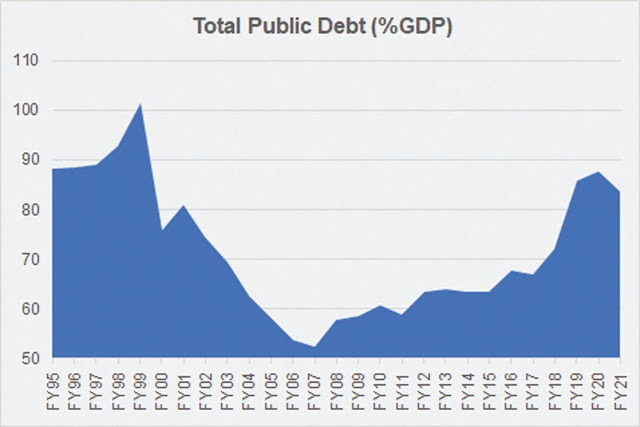
In 1999, President Pervez Musharraf inherited a massive debt of 100% of GDP run up by the Pakistan Peoples Party and the Pakistan Muslim League (Nawaz) governments in the 1990s. Musharraf's policies not only revived the bankrupt economy but also brought down debt to 52% of GDP by 2007. 

Pakistan Debt to GDP 1995-2021. Source: IMF


PPP Government's 2008 Letter to IMF:

In a letter to the International Monetary Fund in 2008, the PPP government hailed Musharraf's economic record without mentioning his name in the following words:

"Pakistan's economy witnessed a major economic transformation in the last decade (2000-2008). The country's real GDP increased from $60 billion to $170 billion, with per capita income rising from under $500 to over $1000 during 2000-07.....the volume of international trade increased from $20 billion to nearly $60 billion. The improved macroeconomic performance enabled Pakistan to re-enter the international capital markets in the mid-2000s. Large capital inflows financed the current account deficit and contributed to an increase in gross official reserves to $14.3 billion at end-June 2007. Buoyant output growth, low inflation, and the government's social policies contributed to a reduction in poverty and improvement in many social indicators". (see MEFP, November 20, 2008, Para 1).

Pakistan Manufacturing Value Added 2000-2021. Source: World Bank


Savings and Investments:

Domestic savings rate reached 18% of the GDP and foreign direct investment (FDI) hit a record level of $5.4 billion in 2007-8. This combination of domestic and foreign investments nearly tripled the size of the economy from $60 billion in 1999 to $170 billion in 2007, according to IMF. Exports nearly tripled from about $7 billion in 1999-2000 to $22 billion in 2007-2008, adding millions of more jobs. Pakistan was lifted from a poor, low-income country with per capita income of just $500 in 1999 to a middle-income country with per capita income exceeding $1000 in 2007.

FDI in the Musharraf years came in many sectors, ranging from telecommunications to manufacturing.
Several mobile phone and Internet service operators built networks worth billions of dollars. Without this telecom infrastructure, there would be no tech industry, no freelancers and no fast-growing tech exports today.

New cement plants met growing demand that more than doubled cement consumption, FMCG (fast moving consumer goods) sector took off to meet demand from growing middle class and production of cars and motorcycles jumped. 


Human Capital Development: 

In addition to the economic revival, Musharraf focused on the social sector as well. Pakistan's Human Development Index (HDI) score grew an average rate of 2.7% per year under President Musharraf from 2000 to 2007, and then its pace slowed to 0.7% per year in 2008 to 2012 under elected politicians, according to the 2013 Human Development Report titled “The Rise of the South: Human Progress in a Diverse World”.


Primary Enrollment Source: Economic Survey of Pakistan

Youth Literacy Rate Source: Economic Survey of Pakistan


Pakistan University Enrollment Jumped in Musharraf Years. Source: World Bank


Overall, Pakistan's human development score rose by 18.9% during the Musharraf years and increased just 3.4% under elected leadership since 2008. The news on the human development front got even worse in the last three years, with HDI growth slowing down as low as 0.59% — a paltry average annual increase of under 0.20 per cent. Going further back to the  decade of 1990s when the civilian leadership of the country alternated between PML (N) and PPP,  the increase in Pakistan's HDI was 9.3% from 1990 to 2000, less than half of the HDI gain of 18.9% on Musharraf's watch from 2000 to 2007.

R&D Spending Jumped 7-fold as % of GDP 1999-2007 Source: World Bank

Acceleration of HDI growth during the Musharraf years was not an accident.  Not only did Musharraf's policies accelerate economic growth, helped create 13 million new jobs, cut poverty in half and halved the country's total debt burden in the period from 2000 to 2007, his government also ensured significant investment and focus on education and health care. The annual budget for higher education increased from only Rs 500 million in 2000 to Rs 28 billion in 2008, to lay the foundations of the development of a strong knowledge economy, according to former education minister Dr. Ata ur Rehman. Student enrollment in universities increased from 270,000 to 900,000 and the number of universities and degree awarding institutions increased from 57 in 2000 to 137 by 2008. Government R&D spending jumped from 0.1% of GDP in 1999 to 0.7% of GDP in 2007. In 2011, a Pakistani government commission on education found that public funding for education has been cut from 2.5% of GDP in 2007 to just 1.5% - less than the annual subsidy given to the various PSUs including Pakistan Steel and PIA, both of which  continue to sustain huge losses due to patronage-based hiring.

Pakistan's High-Tech Exports Tripled as % of Manufactured Exports. Source: World Bank

Pakistan textile exports more than doubled from $5.2 billion to more than $11 billion during the Musharraf years. Exports soared 19.43% in 2001, 20% in 2004, 24.5% in 2005 and 11.23% in 2006, all on President Musharraf's watch, according to "The Rise and Fall of Pakistan's Textile Industry: An Analytical View" published by Javed Memon, Abdul Aziz and Muhammad Qayyum.     


Pakistan Textile Exports Growth. Source: Javed Memon

Pakistan experienced rapid economic and human capital growth in the years 2000 to 2008 on President Pervez Musharraf's watch. Savings, investments and exports hit new records and the rate of increase in human development reached new highs not seen before or since this period.  Without this human capital, there would be no tech industry, no freelancers and no fast-growing tech exports today.

Employment Growth in South Asia. Source: World Bank

Pakistan's employment growth was the highest in the South Asia region in 2000-2010, followed by Nepal, Bangladesh, India, and Sri Lanka in that order, according to a World Bank report titled "More and Better Jobs in South Asia".

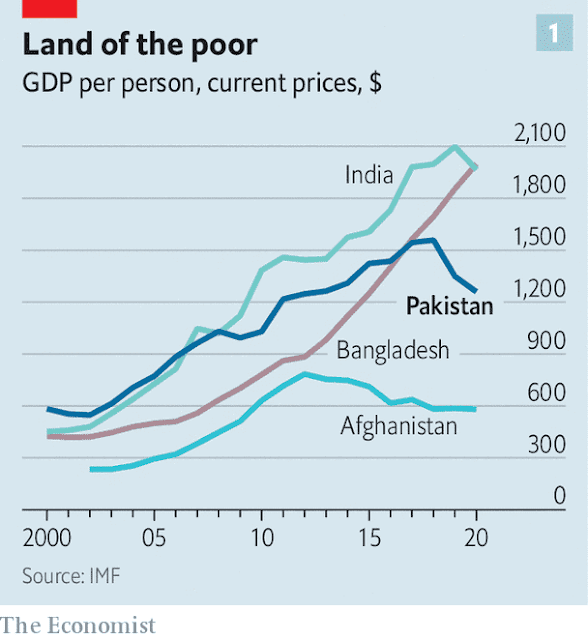
Comparing Per Capita GDP Trajectory in South Asia. Source: The Economist

Until 2010, Bangladesh was a laggard in the South Asia region. Its per capita income was about half of Pakistan's. Now Bangladesh's per capita GDP is higher than both India's and Pakistan's. What changed? The biggest change is Bangladeshi leader Shaikh Hasina's decision to stifle the unruly Opposition and the media to bring political and economic stability to the South Asian nation of 160 million people. It has eliminated a constant sense of crisis and assured investors and businesses of continuity of government policies. With development taking precedence over democracy, Shaikh Hasina followed the example of Asian Tigers  by focusing on export-led economic growth of her country. She incentivized the export-oriented garment industry and invested in human development. Bangladesh now outperforms India and Pakistan in a whole range of socioeconomic indicators: exports, economic growth, infant mortality rate, primary school enrollment, fertility rate and life expectancy.    

Related Links:


Friday, July 29, 2022

Pakistani Tech Startups Attract Record VC Funding in First Half of 2022

Technology startups in Pakistan received record $249 million funding during January-June 2022, up a whopping 171% from the same period last year. A total of 35 deals closed, up 6% from the first half of 2021. July 2022 saw a maiden investment from Sequoia Capital which is considered among the top venture capital firms headquartered in Silicon Valley, California.  Last year was a banner year for Pakistani startups with $310 million venture capital investments. 


Venture Capital Investments in MENAPT Region 1H/22. Source: Magnitt


Sequoia Capital and Kleiner Perkins co-led $17.6 million seed round in Islamabad-based fintech startup DBank this month. DBank has been founded by Tania Aidrus and Khurram Jamali, both of whom have studied the challenges the unbanked population faces closely at their previous stint at Google, where they worked on payments rails for the company’s Next Billion Users initiative, according to Tech Crunch

Soaring VC Investments in Pakistani Startups. Source: Bloomberg


Pakistani startups set a record in 2021 with $310 million venture capital investments, more than the previous six years combined, according to Bloomberg.  The South Asian nation has seen a wave of investments from many global venture capital firms, including Sequoia Capital and Kleiner Perkins -- early investors in Google and Amazon.com Inc.

Venture Capital Investments in MENAPT Region 1H/22. Source: Magnitt


Pakistan's technology sector is in the midst of an unprecedented boom. It is being fueled by the country's growing human capital and rising investments in technology startups. A tweet by Swedish fund manager Mattias Martinsson captured it well when he wrote, "Have followed Pakistan for 15 years. Can't recall any time time when VC activity was anywhere near we've seen in the last few months. Impact of reforms kicking in?".  New laws have made it easier to create startups and offered greater protection to investors.  Digital infrastructure has expanded with over 100 million smartphones and an equal number of broadband subscriptions. 

With expanding Internet infrastructure and rapidly growing user base, Pakistan is now seeing robust growth in venture money pouring into technology startups. Pakistani startups have already attracted more than $310 million in funding in FY 2021-22, more funds than all the money raised by Pakistani startups in their entire history. A recent example is Kleiner Perkins, a top Silicon Valley venture capital investment firm, that led a series A round of $17 million investment into Pakistani start-up Tajir. The startup operates an online marketplace for small store merchants in Pakistan. The announcement came via a tweet by Mamoon Hamid, a Pakistani-American Managing Partner at Kleiner Perkins who led the investment. Last year, Tajir raised a $1.8 million seed round.  The company's revenue has increased by 10x since its seed round. Another example is Sequoia Capital's first investment in Pakistan this month. 

Pakistan Technology Exports. Source: Arif Habib


Pakistan's technology exports are experiencing rapid growth in double digits over the last decade. Total technology exports jumped 22% to $2.6 billion in fiscal year 2021-22, as reported by Arif Habib Securities

Pakistan University Enrollment Growth. Source: Encyclopedia of Higher Education

The foundation for Pakistan's digital transformation was laid with the higher education reform and telecommunications deregulation and investments starting in the year 2001 on President Musharraf's watch. With a huge increase in higher education funding, Higher Education Commission Chairman Dr. Ata ur Rehman succeeded in establishing 51 new universities during 2002-2008. As a result, university enrollment (which had reached only 275,000  from 1947 to 2003) soared to about 800,000 in 2008. This helped build a significant human capital that drove the IT revolution in Pakistan.      

Please watch the following video presentation for more details on Pakistan's technology startup ecosystem:

https://youtu.be/ePApXOM3vkQ


Sunday, May 15, 2022

Karachi Girl Students Win Top Prize at International Science Competition Held in Atlanta, Georgia

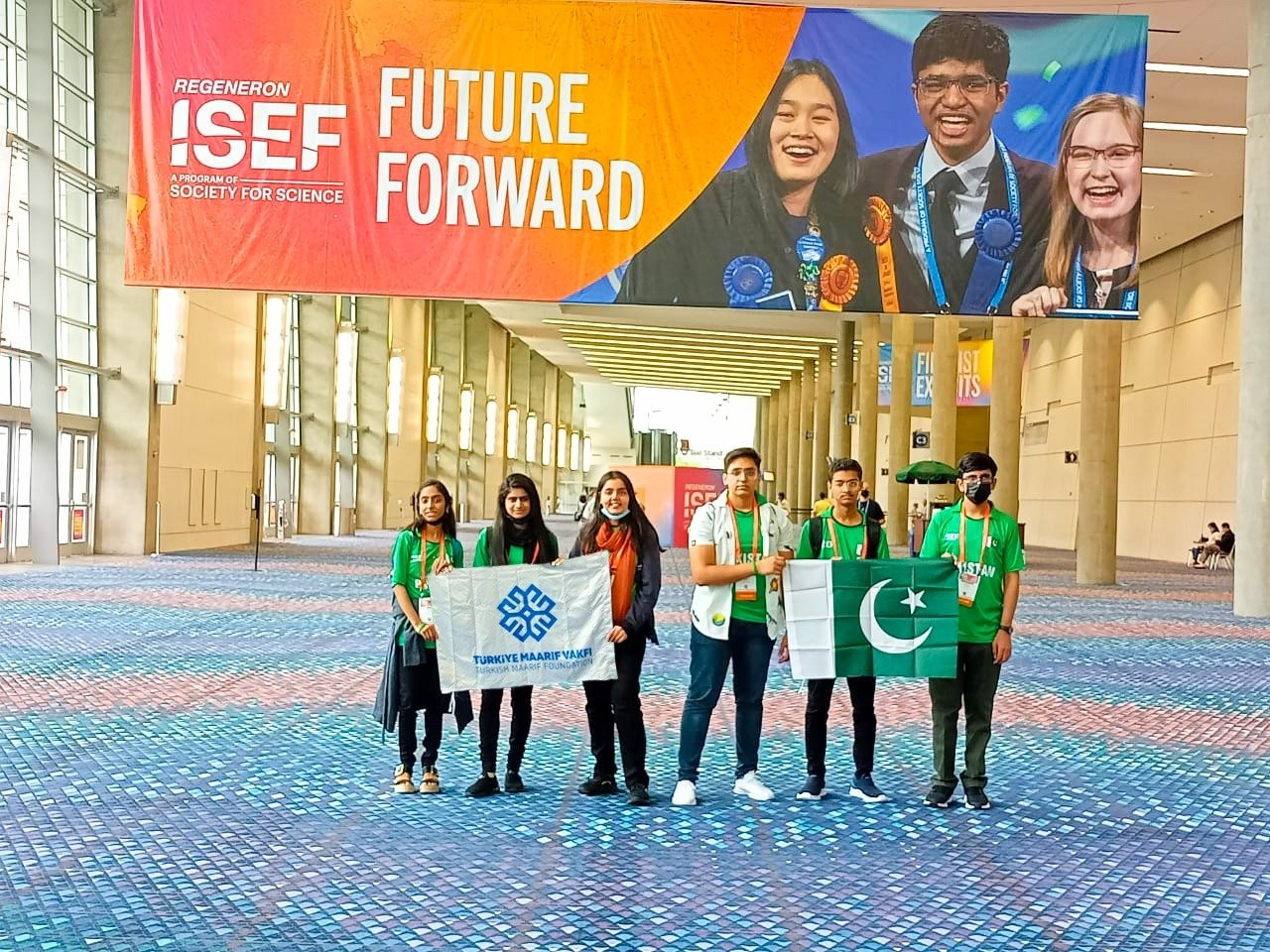
Two Pakistani girl students from Karachi have won the first physical science award of $1,500 each at Regeneron International Science and Engineering Fair (ISEF 2022) held May 7 through 13 in Atlanta, Georgia, United States. Ume Kulsoom and Talia Kusloom, the winners from Pakistan, are 12th grade students at Pak-Turk School in Gulshan-e-Iqbal, Karachi. 

Pakistani Student Participants at ISEF 2022 in Atlanta, Georgia, USA. Source: Maarif Foundation

Ume and Talia Kulsoom topped in the physical science category with their project titled "Vegan Leather Obtained from Cedrus Deodara (deodar tree)", according to an announcement by the Society for Science which organized the event. Regeneron ISEF is the world’s largest international science competition held annually. Each year, nearly 1,800 high school students from more than 63 countries participate to showcase their work.  

The winning project from Pakistan was completed under the supervision of Hira Bashir, a science teacher at the Pakistan-Turkey Maarif International Schools College in Karachi. "Our intelligent students believe in the green world and in the conservation of resources, which encouraged them to come up with this unique idea," the school said.

The ISEF is an annual event organized by the Society for Science and Engineering, a non-profit group headquartered in the US. The organization describes the event as "the world's largest international science competition," bringing together approximately 1,800 high school students from more than 63 countries each year. The Maarif Foundation has 28 schools and colleges across Pakistan that provide quality education to thousands of students in several cities, including Islamabad, Karachi and Lahore. 

Aqsa Ajmal, a graduate of Pakistan's National University of Science and Technology, was among six finalists for Lexus Design Award 2020 for industrial design. She won 3 million Yen (over $25,000) in funding and mentorship in an exclusive program in New York City under the guidance of prominent design leaders from a variety of design fields.

Pursewit Sewing Machine. Source: Lexus


The Mayet Family from Karachi, Pakistan won AI Family Challenge World Championship held in Silicon Valley, California on May 20, 2019.  The family's entry called "Cavity Crusher" uses artificial intelligence algorithm to monitor a child's brush time and determine their oral health habits to notify parents accordingly. It was organized by Iridescent, a global technology education nonprofit organization that empowers underrepresented young people to become self-motivated learners, inventors, and leaders.

In 2018, A team of undergraduate students representing Peshawar won a silver medal in a genetic engineering competition organized by the International Genetically Engineered Machine (iGEM) Foundation in Boston, Massachusetts.

Growing numbers of young Pakistanis are now participating and winning in international science and engineering competitions. Examples include Stanford Design ContestAI Family Challenge World Championship and International Genetically Engineered Machine Competition. These wins offer increasing evidence of Pakistan's expected demographic dividend.


Related Links:

Haq's Musings

South Asia Investor Review

Pakistani Students Win First Place in Stanford Design Contest

Pakistanis Win AI Family Challenge in Silicon Valley

Pakistani Gamer Wins ESPN E-sports Player of the Year Award

Pakistan's Expected Demographic Dividend

Pakistan's Research Output Growing Fastest in the World

AI Research at NED University Funded By Silicon Valley NEDians

Pakistan Hi-Tech Exports Exceed A Billion US Dollars in 2018 

Pakistan Becomes CERN Member

Pakistani Tech Unicorns

Rising College Enrollment in Pakistan

Pakistani Universities Listed Among Asia's Top 500 Jump From 16 to 23 in One Year

Pakistani Students Win Genetic Engineering Competition

Human Capital Growth in Pakistan

Pakistan Joins 3D Print Revolution

Pakistan Human Development in Musharraf Years


Monday, January 24, 2022

Pakistan Cut Public Debt in Half On Musharraf's Watch in 1999-2008

In 1999, President Pervez Musharraf inherited a massive debt of over 100% of GDP run up by the Pakistan Peoples Party and the Pakistan Muslim League (Nawaz) governments in 1990s. Musharraf's policies not only revived the bankrupt economy but also brought down debt to 52% of GDP by 2007. 

Pakistan Debt to GDP 1995-2021. Source: IMF


PPP Government's 2008 Letter to IMF:

In a letter to the International Monetary Fund in 2008, the PPP government hailed Musharraf's economic record without mentioning his name in the following words:

"Pakistan's economy witnessed a major economic transformation in the last decade (2000-2008). The country's real GDP increased from $60 billion to $170 billion, with per capita income rising from under $500 to over $1000 during 2000-07.....the volume of international trade increased from $20 billion to nearly $60 billion. The improved macroeconomic performance enabled Pakistan to re-enter the international capital markets in the mid-2000s. Large capital inflows financed the current account deficit and contributed to an increase in gross official reserves to $14.3 billion at end-June 2007. Buoyant output growth, low inflation, and the government's social policies contributed to a reduction in poverty and improvement in many social indicators". (see MEFP, November 20, 2008, Para 1).

Savings and Investments:

Domestic savings rate reached 18% of the GDP and foreign direct investment (FDI) hit a record level of $5.4 billion in 2007-8. This combination of domestic and foreign investments nearly tripled the size of the economy from $60 billion in 1999 to $170 billion in 2007, according to IMF. Exports nearly tripled from about $7 billion in 1999-2000 to $22 billion in 2007-2008, adding millions of more jobs. Pakistan was lifted from a poor, low-income country with per capita income of just $500 in 1999 to a middle-income country with per capita income exceeding $1000 in 2007.

FDI in Musharraf years came in many sectors, ranging from telecommunications to manufacturing.
Several mobile phone and Internet service operators built networks worth billions of dollars. Without this telecom infrastructure, there would be no tech industry, no freelancers and no fast-growing tech exports today.

New cement plants met growing demand that more than doubled cement consumption, FMCG (fast moving consumer goods) sector took off to meet demand from growing middle class and production of cars and motorcycles jumped. 


Human Capital Development: 

In addition to the economic revival, Musharraf focused on the social sector as well. Pakistan's Human Development Index (HDI) score grew an average rate of 2.7% per year under President Musharraf from 2000 to 2007, and then its pace slowed to 0.7% per year in 2008 to 2012 under elected politicians, according to the 2013 Human Development Report titled “The Rise of the South: Human Progress in a Diverse World”.


Primary Enrollment Source: Economic Survey of Pakistan

Youth Literacy Rate Source: Economic Survey of Pakistan

Overall, Pakistan's human development score rose by 18.9% during the Musharraf years and increased just 3.4% under elected leadership since 2008. The news on the human development front got even worse in the last three years, with HDI growth slowing down as low as 0.59% — a paltry average annual increase of under 0.20 per cent. Going further back to the  decade of 1990s when the civilian leadership of the country alternated between PML (N) and PPP,  the increase in Pakistan's HDI was 9.3% from 1990 to 2000, less than half of the HDI gain of 18.9% on Musharraf's watch from 2000 to 2007.

R&D Spending Jumped 7-fold as % of GDP 1999-2007 Source: World Bank

Acceleration of HDI growth during Musharraf years was not an accident.  Not only did Musharraf's policies accelerate economic growth, helped create 13 million new jobs, cut poverty in half and halved the country's total debt burden in the period from 2000 to 2007, his government also ensured significant investment and focus on education and health care. The annual budget for higher education increased from only Rs 500 million in 2000 to Rs 28 billion in 2008, to lay the foundations of the development of a strong knowledge economy, according to former education minister Dr. Ata ur Rehman. Student enrollment in universities increased from 270,000 to 900,000 and the number of universities and degree awarding institutions increased from 57 in 2000 to 137 by 2008. Government R&D spending jumped from 0.1% of GDP in 1999 to 0.7% of GDP in 2007. In 2011, a Pakistani government commission on education found that public funding for education has been cut from 2.5% of GDP in 2007 to just 1.5% - less than the annual subsidy given to the various PSUs including Pakistan Steel and PIA, both of which  continue to sustain huge losses due to patronage-based hiring.

Pakistan's High-Tech Exports Tripled as % of Manufactured Exports. Source: World Bank

Pakistan textile exports more than doubled from $5.2 billion to more than $11 billion during the Musharraf years. Exports soared 19.43% in 2001, 20% in 2004, 24.5% in 2005 and 11.23% in 2006, all on President Musharraf's watch, according to "The Rise and Fall of Pakistan's Textile Industry: An Analytical View" published by Javed Memon, Abdul Aziz and Muhammad Qayyum.     


Pakistan Textile Exports Growth. Source: Javed Memon

Pakistan experienced rapid economic and human capital growth in years 2000 to 2008 on President Pervez Musharraf's watch. Savings, investments and exports hit new records and the rate of increase in human development reached new highs not seen before or since this period.  Without this human capital, there would be no tech industry, no freelancers and no fast-growing tech exports today.

Employment Growth in South Asia. Source: World Bank

Pakistan's employment growth was the highest in South Asia region in 2000-2010, followed by Nepal, Bangladesh, India, and Sri Lanka in that order, according to a World Bank report titled "More and Better Jobs in South Asia".

Comparing Per Capita GDP Trajectory in South Asia. Source: The Economist

Until 2010, Bangladesh was a laggard in South Asia region. Its per capita income was about half of Pakistan's. Now Bangladesh's per capita GDP is higher than both India's and Pakistan's. What changed? The biggest change is Bangladeshi leader Shaikh Hasina's decision to stifle the unruly Opposition and the media to bring political and economic stability to the South Asian nation of 160 million people. It has eliminated a constant sense of crisis and assured investors and businesses of continuity of government policies. With development taking precedence over democracy, Shaikh Hasina followed the example of Asian Tigers  by focusing on export-led economic growth of her country. She incentivized the export-oriented garment industry and invested in human development. Bangladesh now outperforms India and Pakistan in a whole range of socioeconomic indicators: exports, economic growth, infant mortality rate, primary school enrollment, fertility rate and life expectancy.    

Related Links:


Monday, October 18, 2021

Squid Game: A Dystopian Korean Drama Featuring a Pakistani Migrant Worker

Popular Netflix series Squid Games is a dystopian survival drama about unfortunate people trapped in debt who enter a series of six survival games. The losers die while the single winner takes away 46.5 billion (US$38 million) South Korean won. One US dollar is equal to about 1,200 Korean Won. 

Anupam Tripathi as Ali Abdul in Squid Games

One of the characters in the series is an exploited Pakistani migrant worker named Ali Abdul who just wants to send money home to help his family in Pakistan.  Ali's role is played by Indian actor Anupam Tripathi. Tripathi has previously played other foreign characters in the genre often referred to as K-drama. Squid Games has achieved top ratings around the world in spite of its very violent content. It is the top-rated show among Netflix subscribers in Pakistan. 

Household Debt as Percentage of GDP. Source: IMF

Squid Game is a powerful indictment of capitalism as practiced in many countries, including South Korea. It has brought to light high levels of inequality and household debt in South Korea. The total household debt of $1.5 trillion is about the size of its entire GDP, among the highest in the world. By comparison, formal household debt in Pakistan is just 4% of its GDP, according to the IMF. It can be explained by the fact that the availability of mortgage financing, car loans and credit cards is very limited in Pakistan. 

Sources of Household Debt in Pakistan. Source: SDPI

Only 14.6% of household debt is owed to banks, and the rest to informal sources like family and friends. Researchers Sajid Amin Javed, Wajid Ali and Ifra Baig at SDPI  (Sustainable Development Policy Institute) have analyzed four rounds of the HIES segment of the Pakistan Social and Living Standard Measurement (PSLM) and data from the PPHS (covering the 2005 to 2016 period),  and found that 20% of households in Pakistan are indebted.  

Related Links:

Haq's Musings

South Asia Investor Review

Credit Suisse Wealth Report 2016

Pakistan's Trillion Dollar Economy Among World's Fastest Growing

Pakistan: A Majority Middle Class Country

Karachi School of Business and Leadership

State Bank: Pakistan's Actual GDP Higher Than Officially Reported

College Enrollment in Pakistan

Musharraf Accelerated Development of Pakistan's Human and Financial Capital

China-Pakistan Economic Corridor

Riaz Haq's YouTube Channel

PakAlumni: Pakistani Social Network

Friday, October 1, 2021

2021: A Banner Year For Pakistani Tech Startup Investments

The year 2021 is turning out to be a banner year for Pakistani tech startups. At the end of the third quarter of the current year, technology startups have already raised $278 million, twice the funding raised in the previous 5 years combined. In per capita terms, this is still just over $1 per person, a lot less compared to neighboring India where startups attracted $20 per person

Venture Capital Investment in Pakistan. Source: Kalsoom Lakhani, i2i Ventures


The third quarter (July-Sept 2021) alone has seen startup companies raise $172.6 in 17 deals closed in the three-month period, according to data compiled by Kalsoom Lakhani of i2i ventures. The top deals closed in the third quarter were: 1. Airlift $85 million series B 2. Bazaar $30 million in series A and 3. QisstPay $15 million seed round. 

Source: Kalsoom Lakhani, i2i Ventures

The lion's share of the ,money ($117 million) went to E-commerce startups followed by Fintech ($35 million) and trucking platforms ($13.6 million). Male-founded startups got 46.5% while female-founded companies received 1.7% with the rest of the money going to startups whose founding teams include both male and female founders. 

Venture Funding in Pakistan Lowest Among Most Populous Nations. Source: Crunchbase

In per capita terms, startup investment in Pakistan is still just over $1 per person, a lot less compared to neighboring India where startups attracted $20 per person. As expected, the startups in the United States dwarfed all other countries in both per capita terms ($808) and in total size ($269 billion) of venture capital investments. 
 
Largest Global Market For Venture Funding. Source: Crunchbase

Pakistan's technology sector is in the midst of an unprecedented boom. It is being fueled by the country's growing human capital and rising investments in technology startups. A recent tweet by Swedish fund manager Mattias Martinsson captured it well when he wrote, "Have followed Pakistan for 15 years. Can't recall any time time when VC activity was anywhere near we've seen in the last few months. Impact of reforms kicking in?".  New laws have made it easier to create startups and offered greater protection to investors.  Digital infrastructure has expanded with over 100 million smartphones and an equal number of broadband subscriptions. 

With expanding Internet infrastructure and rapidly growing user base, Pakistan is now seeing robust growth in venture money pouring into technology startups. Pakistani startups have already attracted more than $278 million in funding in 2021, more funds than all the money raised by Pakistani startups in their entire history. A recent example is Kleiner Perkins, a top Silicon Valley venture capital investment firm, that led a series A round of $17 million investment into Pakistani start-up Tajir. The startup operates an online marketplace for small store merchants in Pakistan. The announcement came via a tweet by Mamoon Hamid, a Pakistani-American Managing Partner at Kleiner Perkins who led the investment. Last year, Tajir raised a $1.8 million seed round.  The company's revenue has increased by 10x since its seed round. 

Pakistan Technology Exports Trend 2007-2021. Source: Arif Habib


Pakistan's technology exports are experiencing rapid growth in double digits over the last decade. Total technology exports jumped 47% to $2.1 billion in fiscal year 2020-21. 

Pakistan University Enrollment Growth. Source: Encyclopedia of Higher Education

The foundation for Pakistan's digital transformation was laid with the higher education reform and telecommunications deregulation and investments starting in the year 2001 on President Musharraf's watch. With a huge increase in higher education funding, Higher Education Commission Chairman Dr. Ata ur Rehman succeeded in establishing 51 new universities during 2002-2008. As a result, university enrollment (which had reached only 275,000  from 1947 to 2003) soared to about 800,000 in 2008. This helped build a significant human capital that drove the IT revolution in Pakistan.      

Please watch the following video presentation for more details on Pakistan's technology startup ecosystem:

https://youtu.be/ePApXOM3vkQ