Showing posts with label Startups. Show all posts

Friday, May 12, 2023

Pakistan Now: Darkest Before Dawn?

Pakistan is experiencing one of the darkest periods of its history. Political instability is eroding confidence in the nation's future. Declining economic growth and high inflation are hurting the people of all strata of society, particularly the poor whose numbers are rapidly rising. Is there any hope left for the country? Is it a case of the "darkest before dawn"? How do investors see it? 

Ex PM Imran Khan (R) with President Erdogan

Writing in the Time magazine immediately after the recent arrest of former Prime Minister Imran Khan, American investor, author and commentator Zachary Karabell who has invested in Pakistani startups sees rare hope for Pakistan. He sees Pakistan where Turkey was back in 2001-2003, "when a series of elections brought Recep Erdogan to power even as he was repeatedly disqualified by a military that was determined to retain control". Here's an excerpt of his article titled "The Contrarian Case for Pakistan" published in the current issue of Time Magazine: 

"To some degree, this is an argument of “well, it’s not as bad as they say.” But it’s also a way of highlighting that Pakistan today may be a case of darkest before the dawn. With elections schedule for the fall, and with Imran Khan the most likely victor of said elections unless is his arrest leads to his disqualification as a candidate, Pakistan is in a very similar position to where Turkey was in 2001-2003, when a series of elections brought Recep Erdogan to power even as he was repeatedly disqualified by a military that was determined to retain control. Imran Khan has many of the same strengths and weaknesses of Erdogan, who after championing Turkish democracy and economic reform, then turned into the very type of corrupt autocrat that he had once fought against. But he nonetheless unleashed massive economic potential in Turkey and has left its 80 million people materially better off over the past 20 years, even as hyperinflation and Erdogan’s recent economic ineptitude is now eroding that. Should Imran Khan return to the head the government, he may well usher in a similar period in Pakistan, even as he has his own authoritarian and demagogic tendencies". 

Here are some of the key points Karabell makes in his opinion piece:

1. Pakistan has a real and dynamic private sphere that is not only seeing a start-up and new business ecosystem that has attracted hundreds of millions of dollars a year for the past few years but operates freely in a way that would be inconceivable in many other countries. Compare it to Egypt, for example, which receives far less negative attention and more foreign money yet is almost entirely dominated by a military dictatorship. Or Algeria. And then there are countries which barely function at all, dominating a whole swath of Sub-Saharan Africa but also dot central Asia (Tajikistan anyone?).

2. Pakistan is the fifth most populous country in the world with 230 million souls, a median age of barely 22 and two-thirds of the population under the age of 30. That means unlike most of the world, it has a favorable demographic future.

2. Unlike, say, Nigeria, where the ethnic divisions and decades of corruption mean that it well-nigh impossible to treat the country as one unified market for goods and services, Pakistan is one common market even with its various tribal divisions.
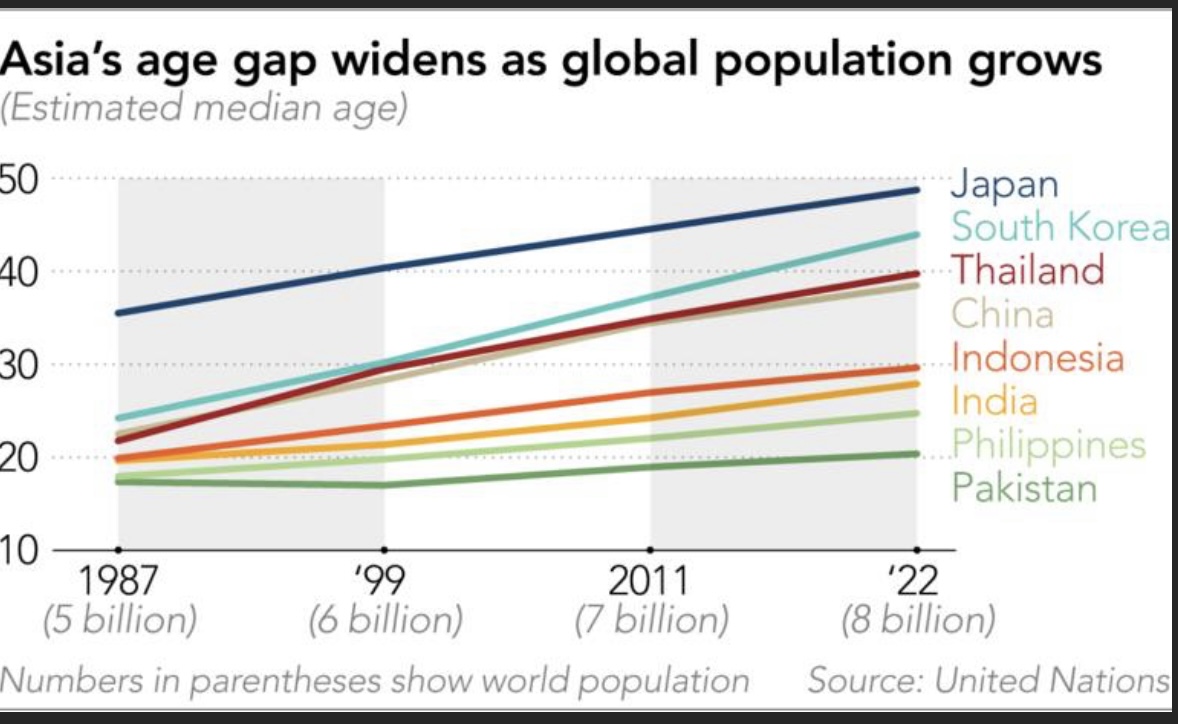
Pakistan Population Youngest Among Major Asian Nations. Source: Nikkei Asia

Karabell concludes with the following: 

Pakistan is on a cusp. We should honor the fact that whichever way the consensus believes it will go, the country is also poised to breakout on the upside. Which path will only be clear in retrospect, but we should pay more attention to the potential of things going right along with the legitimate focus on all that is going wrong.

Saturday, April 1, 2023

Venture Capital in Pakistan: Startup Funding Rises in Q1 2023 After Hitting Lows in Q4 2022

Pakistani startups raised  $23.1 million in the first quarter of this year after hitting a low of $15.2 million in the last quarter of 2022, according to Data Darbar. The amount of money raised by Pakistani startups increased in each of the first 3 months of 2023, bringing the total funding amount to $945.4 million across 321 deals since 2015. It started out slow with just $1.5 million raised in January, followed by $8.7 million in February and $12.9 million in March. Most of the money went for seed or pre-seed stage companies. 

Pakistan Startup Funding Trend. Source: Data Darbar

Six of the eight deals in Q1/2023 involved seed stage. The pre-seed and accelerator rounds were never disclosed and aren’t, therefore, reflected in the numbers. The lion's share of the investments this year went to logistics ($10.1 million) and fintech ($9 million) startups with the two sectors drawing about $10 million each. Education technology (Edtech) startup Maqsad raised $2.8 million. 

Deal Flow in Q1/2023. Source: I2I Ventures

In terms of gender, a little over 70% of the money raised in Q1/2023 went to male-founded startups and about 30% to female-founded companies.  In Q1 2022, international angels accounted only for 9% (8 investors out of 89) of total investors across disclosed deals. In Q1 2023 they made up 26% (7 investors out of 27), according to Shehryar Hydri, a managing partner at Deosai Ventures. Here are the details of the Q1/2023 deals:  


Pakistan Deal Flow. Source: Data Darbar


There has been a global slowdown in venture funding of startups amid concerns about uncertain economic conditions due to the Ukraine War, high inflation and rising interest rates. Pakistan, too, is heavily impacted. The nation is dealing with political instability and economic uncertainty. 

Related Links:


NED Alum Raises $190 Million to Challenge ARM's Dominance

Pakistan Broadband Subscriptions Pass 100 Million

NED University Ranked Among World's Top 200 For Impact

Pakistan's Computer Services Exports Jump 26% Amid Coronavirus Lockdown

Pakistan Gig Economy Among World's Fastest Growing

NED Alum Sells Silicon Valley Company For $7.5 Billion

Pakistan's Demographic Dividend

Over a Million Pakistani University Students Enrolled in STEM Education

State Bank Targets Fully Digital Economy in Pakistan

NED University Alum Raises $100 Million For His Silicon Valley Fintech Startup

Digital Pakistan: Broadband Penetration Reaches 90% of 15+ Population

E-Commerce in Pakistan

2021: A Banner Year For Pakistani Tech Startups

NED Alum's AI Startup Startup Named Most Innovative at RSA Conference

Karachi-Born NED Alum Leads Mercedes' Entry into Electric Vehicle Market

AI Research Funded by NED Alum at His Alma Mater

Riaz Haq's Youtube Channel


Friday, October 1, 2021

2021: A Banner Year For Pakistani Tech Startup Investments

The year 2021 is turning out to be a banner year for Pakistani tech startups. At the end of the third quarter of the current year, technology startups have already raised $278 million, twice the funding raised in the previous 5 years combined. In per capita terms, this is still just over $1 per person, a lot less compared to neighboring India where startups attracted $20 per person. 

Venture Capital Investment in Pakistan. Source: Kalsoom Lakhani, i2i Ventures


The third quarter (July-Sept 2021) alone has seen startup companies raise $172.6 in 17 deals closed in the three-month period, according to data compiled by Kalsoom Lakhani of i2i ventures. The top deals closed in the third quarter were: 1. Airlift $85 million series B 2. Bazaar $30 million in series A and 3. QisstPay $15 million seed round. 

Source: Kalsoom Lakhani, i2i Ventures

The lion's share of the ,money ($117 million) went to E-commerce startups followed by Fintech ($35 million) and trucking platforms ($13.6 million). Male-founded startups got 46.5% while female-founded companies received 1.7% with the rest of the money going to startups whose founding teams include both male and female founders. 

Venture Funding in Pakistan Lowest Among Most Populous Nations. Source: Crunchbase

In per capita terms, startup investment in Pakistan is still just over $1 per person, a lot less compared to neighboring India where startups attracted $20 per person. As expected, the startups in the United States dwarfed all other countries in both per capita terms ($808) and in total size ($269 billion) of venture capital investments. 
 
Largest Global Market For Venture Funding. Source: Crunchbase

Pakistan's technology sector is in the midst of an unprecedented boom. It is being fueled by the country's growing human capital and rising investments in technology startups. A recent tweet by Swedish fund manager Mattias Martinsson captured it well when he wrote, "Have followed Pakistan for 15 years. Can't recall any time time when VC activity was anywhere near we've seen in the last few months. Impact of reforms kicking in?".  New laws have made it easier to create startups and offered greater protection to investors.  Digital infrastructure has expanded with over 100 million smartphones and an equal number of broadband subscriptions. 

With expanding Internet infrastructure and rapidly growing user base, Pakistan is now seeing robust growth in venture money pouring into technology startups. Pakistani startups have already attracted more than $278 million in funding in 2021, more funds than all the money raised by Pakistani startups in their entire history. A recent example is Kleiner Perkins, a top Silicon Valley venture capital investment firm, that led a series A round of $17 million investment into Pakistani start-up Tajir. The startup operates an online marketplace for small store merchants in Pakistan. The announcement came via a tweet by Mamoon Hamid, a Pakistani-American Managing Partner at Kleiner Perkins who led the investment. Last year, Tajir raised a $1.8 million seed round.  The company's revenue has increased by 10x since its seed round. 

Pakistan Technology Exports Trend 2007-2021. Source: Arif Habib


Pakistan's technology exports are experiencing rapid growth in double digits over the last decade. Total technology exports jumped 47% to $2.1 billion in fiscal year 2020-21. 

Pakistan University Enrollment Growth. Source: Encyclopedia of Higher Education

The foundation for Pakistan's digital transformation was laid with the higher education reform and telecommunications deregulation and investments starting in the year 2001 on President Musharraf's watch. With a huge increase in higher education funding, Higher Education Commission Chairman Dr. Ata ur Rehman succeeded in establishing 51 new universities during 2002-2008. As a result, university enrollment (which had reached only 275,000  from 1947 to 2003) soared to about 800,000 in 2008. This helped build a significant human capital that drove the IT revolution in Pakistan.      

Please watch the following video presentation for more details on Pakistan's technology startup ecosystem:

https://youtu.be/ePApXOM3vkQ

Tuesday, August 31, 2021

Unprecedented Boom in Pakistan's Technology Sector

Pakistan's technology sector is in the midst of an unprecedented boom. It is being fueled by the country's growing human capital and rising investments in technology startups. A recent tweet by Swedish fund manager Mattias Martinsson captured it well when he wrote, "Have followed Pakistan for 15 years. Can't recall any time time when VC activity was anywhere near we've seen in the last few months. Impact of reforms kicking in?".  New laws have made it easier to create startups and offered greater protection to investors.  Digital infrastructure has expanded with over 100 million smartphones and an equal number of broadband subscriptions. 

Source: Twitter


Pakistan is churning out more than 30,000 information technology graduates every year. Over three-quarters of Pakistanis in the top three metros of Karachi, Lahore and Islamabad are regularly using the internet. Technology startups are on track to attract more than $230 million in venture capital investments this year, almost 5 times greater than vc investments last year. Technology exports are increasing by double digits every year, reaching $2.1 billion in the fiscal year that ended in June 2021.  Pakistani freelancers' revenue grew 47% last year, the highest growth in Asia and the fourth highest in the world. 

Over Half of All Pakistanis Are Connected to the Internet. Source: Google-Kantar

Pakistan has seen a phenomenal growth of 3500% in broadband subscriptions over the last 8 years . Pakistanis now own more than 103 million smartphones with mobile broadband subscriptions. In a Youtube presentation of the report, Faraz Azhar, Industry Head, Performance, South Asia Frontier Markets, Google said: “With half of its population on the internet - Pakistan is now online!"  

Pakistan's Middle Class Growth Among World's Fastest

Google Search and YouTube are the most popular Internet applications in Pakistan, according to the study. YouTube is used by nearly 90% of all internet users in Pakistan for streaming music and watching video/TV, and 38% of Pakistan's internet users go to YouTube in the research phase of their shopping journey. 


Lancet Population Projection For Top 5 Countries

Pakistan has also experienced an e-commerce boom in the midst of the COVID pandemic. 71% of Pakistani shoppers find purchasing products or services online easy, while 66% find it convenient. Another 54%  find that online shopping websites or apps give personalized product recommendations, which answer common questions. Two-thirds of consumers believe that online shopping is the way forward. They say they will continue to buy products or services online after the COVID-19 pandemic.    

Faraz Azhar, Industry Head, Performance, South Asia Frontier Markets, Google said: “With half of its population on the internet - Pakistan is now online! This is the first time Google and Kantar released a study to understand more about Pakistan’s internet population. But it’s not only about people getting online, this research has uncovered new insights and behaviors that show how COVID is impacting online behaviour and the digital opportunities waiting to be unlocked.” 

Global Investors of Pakistani Startups. Source: Google-Kantar


"More people are coming online in Pakistan, creating a great opportunity for eCommerce businesses - if they are ready to seize it. As we see more exploration of the internet beyond social, e-retailers can capture natural cross-category purchasing on its rise, but only if they have first established themselves and their product offering in an online marketplace," he said.

Pakistan Startup Funding. Source: Google-Kantar


With expanding Internet infrastructure and rapidly growing user base, Pakistan is now seeing robust growth in venture money pouring into technology startups. Pakistani startups are on track to attract more than $230 million in funding in 2021, more funds than all the money raised by Pakistani startups in their entire history. A recent example is Kleiner Perkins, a top Silicon Valley venture capital investment firm, that led a series A round of $17 million investment into Pakistani start-up Tajir. The startup operates an online marketplace for small store merchants in Pakistan. The announcement came via a tweet by Mamoon Hamid, a Pakistani-American Managing Partner at Kleiner Perkins who led the investment. Last year, Tajir raised a $1.8 million seed round.  The company's revenue has increased by 10x since its seed round. 

Pakistan Technology Exports Trend 2007-2021. Source: Arif Habib


Pakistan's technology exports are experiencing rapid growth in double digits over the last decade. Total technology exports jumped 47% to $2.1 billion in fiscal year 2020-21. 

Pakistan University Enrollment Growth. Source: Encyclopedia of Higher Education

The foundation for Pakistan's digital transformation was laid with the higher education reform and telecommunications deregulation and investments starting in the year 2001 on President Musharraf's watch. With a huge increase in higher education funding, Higher Education Commission Chairman Dr. Ata ur Rehman succeeded in establishing 51 new universities during 2002-2008. As a result, university enrollment (which had reached only 275,000  from 1947 to 2003) soared to about 800,000 in 2008. This helped build a significant human capital that drove the IT revolution in Pakistan.      

Please watch the following video presentation for more details on Pakistan's technology startup ecosystem:

https://youtu.be/ePApXOM3vkQ

Wednesday, August 4, 2021

Digital Transformation: Pakistan is Now Online!

Pakistan's digital transformation is in full swing. Over three-quarters of Pakistanis living in the top three metros of Karachi, Lahore and Islamabad are connected to the Internet, according to a report titled "Journey to Digital" produced by global tech giant Google and Kantara consultants. Researchers found that two-thirds of urban and nearly half of rural Pakistanis regularly use the Internet in the South Asian country of 220 million, the 5th most populous nation in the world. It has a young population with the median age of 22.8 years. 46% of Pakistanis access the Internet everyday.  They use the Internet for education, entertainment, shopping and to search for information.

Over Half of All Pakistanis Are Connected to the Internet. Source: Google-Kantar

Pakistan has seen a phenomenal growth of 3500% in broadband subscriptions over the last 8 years . Pakistanis now own more than 103 million smartphones with mobile broadband subscriptions. In a Youtube presentation of the report, Faraz Azhar, Industry Head, Performance, South Asia Frontier Markets, Google said: “With half of its population on the internet - Pakistan is now online!"  

Google Search and YouTube are the most popular Internet applications in Pakistan, according to the study. YouTube is used by nearly 90% of all internet users in Pakistan for streaming music and watching video/TV, and 38% of Pakistan's internet users go to YouTube in the research phase of their shopping journey. 

Pakistan has also experienced an e-commerce boom in the midst of the COVID pandemic. 71% of Pakistani shoppers find purchasing products or services online easy, while 66% find it convenient. Another 54%  find that online shopping websites or apps give personalized product recommendations, which answer common questions. Two-thirds of consumers believe that online shopping is the way forward. They say they will continue to buy products or services online after the COVID-19 pandemic.    

Faraz Azhar, Industry Head, Performance, South Asia Frontier Markets, Google said: “With half of its population on the internet - Pakistan is now online! This is the first time Google and Kantar released a study to understand more about Pakistan’s internet population. But it’s not only about people getting online, this research has uncovered new insights and behaviors that show how COVID is impacting online behaviour and the digital opportunities waiting to be unlocked.” 

Global Investors of Pakistani Startups. Source: Google-Kantar


"More people are coming online in Pakistan, creating a great opportunity for eCommerce businesses - if they are ready to seize it. As we see more exploration of the internet beyond social, e-retailers can capture natural cross-category purchasing on its rise, but only if they have first established themselves and their product offering in an online marketplace," he said.

Pakistan Startup Funding. Source: Google-Kantar


With expanding Internet infrastructure and rapidly growing user base, Pakistan is now seeing robust growth in venture money pouring into technology startups. Pakistani startups are on track to attract more than $230 million in funding in 2021, more funds than all the money raised by Pakistani startups in their entire history. A recent example is Kleiner Perkins, a top Silicon Valley venture capital investment firm, that led series A round of $17 million investment into Pakistani start-up Tajir. The startup operates an online marketplace for small store merchants in Pakistan. The announcement came via a tweet by Mamoon Hamid, a Pakistani-American Managing Partner at Kleiner Perkins who led the investment. Last year, Tajir raised a $1.8 million seed round.  The company's revenue has increased by 10x since its seed round. 

Pakistan Technology Exports Trend 2007-2021. Source: Arif Habib


Pakistan's technology exports are experiencing rapid growth in double digits over the last decade. Total technology exports jumped 47% to $2.1 billion in fiscal year 2020-21. 

Pakistan University Enrollment Growth. Source: Encyclopedia of Higher Education

The foundation for Pakistan's digital transformation was laid with the higher education reform and telecommunications deregulation and investments starting in the year 2001 on President Musharraf's watch. With huge increase in higher education funding, Higher Education Commission Chairman Dr. Ata ur Rehman succeeded in establishing 51 new universities during 2002-2008. As a result, university enrollment (which had reached only 275,000  from 1947 to 2003) soared to about 800,000 in 2008. This helped build a significant human capital that drove the IT revolution in Pakistan.      


Here's a video presentation of Pakistan's "Journey to Digital":


Thursday, February 20, 2020

Pakistan Tech Summit 2020 at Draper University in San Francisco Bay Area

Hundreds of Pakistanis and Pakistani-Americans attended Pakistan Tech Summit 2020 at Draper University in San Mateo, California on February 15, 2020. It was organized by Arzish Azam of Ejad Labs with sponsorships from JS Bank, Netsol, VisionX, Pakistan IT ministry, Pakistan National IT Board and Pakistan Software Exports Board. This event came after a recent report in Germany's Deutsche Welle (DW) by Miriam Partington who wrote in a story titled "Pakistan: The next big Asian market for tech startups?" that "Pakistan's young and tech-savvy population, market of over 220 million people and increasing levels of local capital are creating opportunities for tech entrepreneurs".

Pakistan Tech Summit:

At this conference, I was really encouraged by the presence of many young Pakistan entrepreneurs eager to realize the vision of Digital Pakistan. Enthusiasm is necessary but not sufficient. What is missing is serious attention to attract more risk capital to support these young enthusiastic entrepreneurs.  Unfortunately, I did not see any known Silicon Valley venture capitalists (VC) at the event. Recent McKinsey report on Pakistani startup ecosystem noted that per capita venture capital is just 6 cents, lower than 7 cents in Bangladesh and only a third of 18 cents in Nigeria. What Pakistan needs is a venture capital initiative along with digitization initiative.


Founders or cofounders of several Pakistani startups pitched their companies hoping to attract venture investors. Among the attendees were many young enthusiastic techies.


Najeeb Ghauri, Chairman of Netsol Technologies, made a pitch that focused on the opportunities presented to investors by Pakistan's growing young enthusiastic talent pool and large aspirational middle class population. JS Bank's Noman Azhar talked about his bank's fund that invests in Pakistani startups taking advantage of the government's Digital Pakistan Initiative. An example of their investment is e-challan systems in Islamabad and Peshawar.

Morning keynote speaker was Farrukh Mahboob of VisionX which offers custom-built digital products and mobile applications for businesses. Their digital solutions are tailored to clients’ needs and are powered by emerging technologies including artificial intelligence (AI), augmented and virtual reality (AR, VR).  VisionX clients includes Fortune 500 companies.

A number of startup pitches followed. Founders or co-founders of DontPort, Integry, Kumlaudi, SafePay, JoyCo and Social Pie pitched their ideas.

Examples of VC Funded Startups:

McKinsey report "Starting up: Unlocking entrepreneurship in Pakistan" has cited Daraz, Zameen, PakWheels, Tez Financial, Patari, AugmentCare and Sastaticket.  Monis Rahman, CEO of Rozee.pk, says this is an incomplete list. He personally knows about funds raised by the following companies that are missing from the McKinsey list:

Rozee.pk -- $9 Million across 3 rounds

Finja -- $4.5 Million seed + bridge (working on $15 Million round)

Airlift -- $12 Million Series A (working on $20 Million round)

Examples of VC Funded Pakistani Startups. Source: McKinsey

Lack of Venture Capital:

It was great to see many young Pakistan entrepreneurs eager to realize the vision of Digital Pakistan. Enthusiasm is necessary but not sufficient. What is missing is an enabling environment for startups to attract more risk capital to support these young enthusiastic entrepreneurs.  Unfortunately, I did not see any known Silicon Valley venture capitalists (VC) at the event. Recent McKinsey report on Pakistani startup ecosystem noted that per capita venture capital is just 6 cents, lower than 7 cents in Bangladesh and only a third of 18 cents in Nigeria. India's level of per capita is at $3.72 and UAE's $40 per capita VC investment is more than 10X India's.

Venture Capital Per Capita. Source: McKinsey

Need For Venture Investment Initiative:

Pakistan needs to have a venture capital initiative to ensure that Pakistani startups fully participate in  Digital Pakistan Initiative. Part of the venture capital initiative should create legal and policy framework to protect investors and facilitate their exit strategies. Pakistan government should invite  venture capitalists and offer to participate as a significant investor in professionally VC funds that invest in Pakistani startups. Experienced Pakistani VCs and entrepreneurs like Asad Jamal and Monis Rahman can be used as a resource to establish this venture investment initiative.

Enabling Startup Ecosystem. Source: McKinsey

Summary:

Recent "Pakistan Tech Summit 2020" at Draper University in San Francisco Bay Area attracted dozens of enthusiastic tech savvy young men and women ready with their startup pitches. It confirmed what Deutsche Welle's Miriam Partington recently reported in a story titled "Pakistan: The next big Asian market for tech startups?" in which she wrote: "Pakistan's young and tech-savvy population, market of over 220 million people and increasing levels of local capital are creating opportunities for tech entrepreneurs". Unfortunately, I did not see any known Silicon Valley venture capitalists (VC) at the event. Recent McKinsey report on Pakistani startup ecosystem noted that per capita venture capital is just 6 cents, lower than 7 cents in Bangladesh and only a third of 18 cents in Nigeria. India's level of per capita is at $3.72 and UAE's $40 per capita VC investment is more than 10X India's. Pakistan needs to have a venture capital initiative to ensure that Pakistani startups fully participate in  Digital Pakistan Initiative. Part of the venture capital initiative should create legal and policy framework to protect investors and facilitate their exit strategies. Pakistan government should invite  venture capitalists and offer to participate as a significant investor in professionally managed VC funds that invest in Pakistani startups. Experienced Pakistani VCs and entrepreneurs like Asad Jamal and Monis Rahman can be used as a resource to establish this venture investment initiative.

Related Links:

Haq's Musings

South Asia Investor Review

Pakistani-American VC Asad Jamal Invested Early in Baidu

Pakistani Students Win First Place in Stanford Design Contest

Pakistanis Win AI Family Challenge in Silicon Valley

Pakistani Gamer Wins ESPN E-sports Player of the Year Award

Pakistan's Expected Demographic Dividend

Pakistan's Research Output Growing Fastest in the World

AI Research at NED University Funded By Silicon Valley NEDians

Pakistan Hi-Tech Exports Exceed A Billion US Dollars in 2018 

Pakistan Becomes CERN Member

Pakistani Tech Unicorns

Rising College Enrollment in Pakistan

Pakistani Universities Listed Among Asia's Top 500 Jump From 16 to 23 in One Year

Pakistani Students Win Genetic Engineering Competition

Human Capital Growth in Pakistan

Pakistan Joins 3D Print Revolution

Pakistan Human Development in Musharraf Years

Thursday, December 11, 2014

Pakistani Investors: Invest in Local Technology Startups NOW!

Guest Post by Khurram Zafar

I believe that the technology entrepreneurship ecosystem in Pakistan is at a tipping point! There are a number of factors at play that make Pakistan so ripe for both local and international investors looking to invest in the tech space:
  • Quickly growing internet adoption currently estimated to be 25 million internet users and 15 million mobile internet users;
  • Cheap smart phone devices costing under $50;
  • 3G and 4G rollouts;
  • Massive amounts of marketing and media spend by companies like Rocket Internet, Schibsted, and Naspers that’s targeted to make Pakistani consumers comfortable transacting online;
  • Development of platforms like The Foundation at LUMS Center for Entrepreneurship and Plan9 that are supporting passionate entrepreneurs during their formative years;
  • Slow but steady investments flowing into startups at seed (e.g. Kima Ventures investment into Eyedeus Labs) and early stage (Frontier Digital Venture’s US$3.5 Million investment into PakWheels.com) from local and foreign angels as well as early-stage funds;
  • Tens of millions of dollars being poured into developing pervasive electronic and online payment infrastructure in Pakistan (you have to take my word for it, but telcos and major banks will soon start announcing these plays);
  • Successful entrepreneurs returning from abroad and providing mentoring to startups and building bridges for them outside of Pakistan;
  • Gradual realization by seasoned businessmen and young aspiring entrepreneurs alike that internet has a massive equalizing power and they can tap into a global market of billions through online channels;
  • Low cost of starting a technology business due to easy access to cloud computing platforms; massive distribution channels like the PlayStore, AppStore and Facebook; ability to create very targeted online marketing campaigns; inexpensive outsourcing of development tasks to freelancers; and quick feedback from customers to iterate and improve the products and services;
  • Ease of doing a tech business in Pakistan compared to the red tape and bureaucracy that has to be dealt with while setting up an industry (in fact, software exports still enjoy a complete tax holiday in Pakistan);
  • Excellent leverage on HR that tech (product) businesses provide compared to any other business and we all know that good HR is a constraint anywhere in the world;
  • And lastly, because tech businesses are not as widely impacted by security, electric power shortfalls, gas load-shedding and others infrastructure issues plaguing the rest of the industries in Pakistan.
You inject a bit of capital to catalyze all this further in the 6th most populous (196 Million) country in the world, and we can have a perfect storm that can turn the Pakistani technology startups of today into the giant global businesses of tomorrow!
How long will you keep pumping money in sugar and textile mills? Let me share something that might shed some light on the opportunity that I am ranting about. The following chart compares the annual profit before taxes of a single games company based in Finland, a country with half the population of Lahore, employing only 120 people (which recently took over Nokia’s old R&D facility) with multiple publicly listed companies in Pakistan belonging to various industrial segments. Here are some eye opening inferences in case they are not readily evident:
  • One mobile gaming company in a country with half the population of Lahore makes more profit before taxes than ten of the largest cement companies in Pakistan
  • One mobile gaming company in a country with half the population of Lahore makes more profit before taxes than two companies that distribute natural gas to the entire Pakistan
  • One mobile gaming company in a country with half the population of Lahore makes more profit before taxes than five power generation companies and two oil refineries combined
  • One mobile gaming company in a country with half the population of Lahore makes more profit before taxes than nine of the top textile mills, five automobile companies and 5 sugar mills combined
Mobile Gaming vs Multiple Industries
Comparison of profit before taxes (FY2013) of a single mobile gaming company with various industries in Pakistan
Here is another chart to drive home the point.
  • One mobile gaming company in a country with half the population of Lahore makes more profit before taxes than any one of the largest banks in Pakistan
  • One mobile gaming company in a country with half the population of Lahore makes 6 times more profit before taxes than National Bank of Pakistan
One Mobile Gaming vs Multiple Banks
Comparison of profit before taxes (FY2013) of a single mobile gaming company with various banks in Pakistan
Alright, so I have used one of the most successful games development companies for comparison, but that is besides the point. The point is, the next big games development company could be Mindstorm Studios based right here, in Lahore. The fact that it’s based in Pakistan does not minimize its chances of success. It’s as good an investment opportunity as Supercell of Finland!
One of the incubated companies at the LUMS Center for Entrepreneurship, interaCta, has developed tech to make all TV and radio broadcast interactive without the need of additional hardware, just requiring smart phones. Imagine the implications! It can disrupt the TV, Radio, Advertisement, Ratings industries just to name a few. A potential acquirer wouldn’t care whether the tech was developed at Xerox or LUMS. Eyedeus Labs, another team of LUMS students, recently raised money from Kima Ventures. They are looking to disrupt online video advertisement market by introducing non-intrusive advertisement methods in the videos that do not distract the viewer. Then there is Savaree, BizClout, Burq Solutions, JewelryDesignPro, P for Plan and the list goes on. All of these are great investment opportunities seeking capital. And these are just a few of the seed stage investment opportunities.
I repeat. This is a great time to enter Pakistan. Equity in technology companies is relatively cheap, assets are portable (predominantly intellectual property) in case one gives too much weight to country risk, operations are already on cloud platforms outside of Pakistan for many, and exit opportunities exist globally. The fundamentals of the on-ground businesses are already very strong. The Karachi Stock Market index has been growing north of 40% for the past few years (30%+ in $ terms) and broke the highest ever 32,000 KSE 100 index points barrier a few days ago. Most of that is driven by foreign investment into rock solid businesses by investors who can see past the FOX news propaganda and realize that the nation, that is often deemed to be on the brink of extinction since its founding in 1947, is as resilient as it is resourceful!
It is time local investors join the party as well. Pakistan is a gold mine of opportunities for the truly visionary, local investors with large balls and an appetite for risk looking for big rewards – people who can consider and invest in the opportunities lurking underneath the veil of ‘mostly perception based’ geo-political and security issues. If you are it, sign up as an investor at http://lce.lums.edu.pk/contact-form for starters.
Disclaimer: The author advises, mentors or has some sort of a non-compensatory advisory relationship with almost all the local startups listed in this article. This post reflects the author's assessment of the tech startup scene and the investment opportunities he sees in Pakistan. The owner of this blog does not necessarily agree with the contents of this guest post. 

The author is Executive Director, LUMS Center for Entrepreneurship.
This post was first published on techies.pk

Related Links:

Haq's Musing

Pakistani Brothers Spawned Multi-billion dollar security software industry

Pakistani Technologist Umar Saif in Silicon Valley

Two Pakistani Tech Start-ups in Silicon Valley Immersion Program