Showing posts with label TB. Show all posts

Thursday, April 2, 2020

Can Pakistan's TB Vaccination Program Help Reduce Impact of Coronavirus?

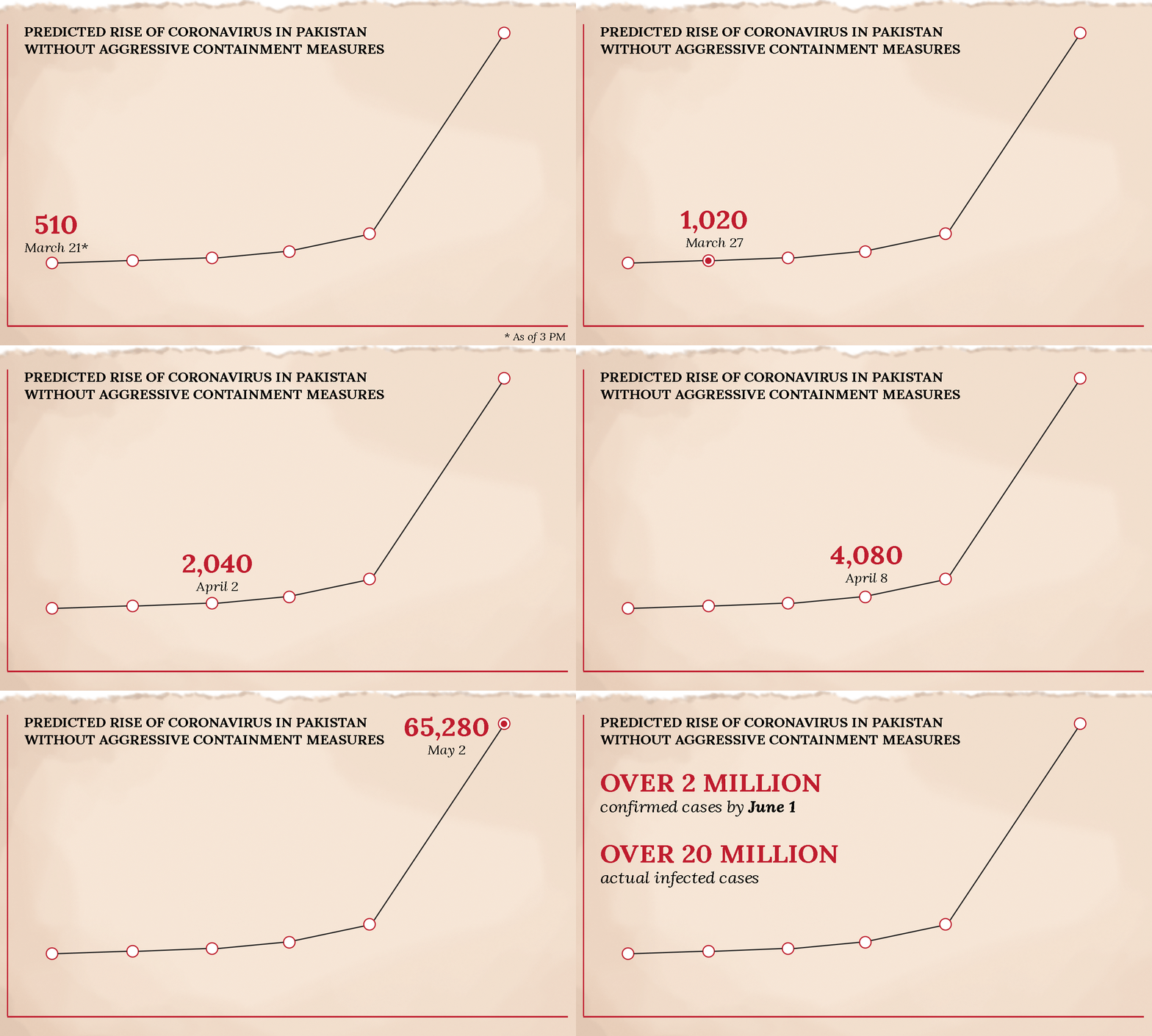
Can Pakistan's 88% BCG vaccination rate against tuberculosis (TB) help reduce the impact of coronavirus? A New York Institute of Technology study using data from 178 countries has concluded that both the incidence and mortality of COVID-19  are significantly lower in countries with BCG vaccination programs against TB. Will this study help prove Dawn News' alarming forecast of over 2 million confirmed cases by June 1 and 20 million actual infections wrong?

Pakistan's Dawn News Coronavirus Forecast


The study has found that the coronavirus has hit US and Italy which do not have universal BCG vaccination programs much harder than countries like Japan which do.  Scientists say it will take several months to get results from ongoing trials testing the BCG vaccine against COVID-19.
TB Vaccine May Lower Death Rates From COVID-19. Source: NYIT College of Osteopathic Medicine  

Scientists have speculated that BCG vaccine may boost the innate immune system not just against TB but also against a variety of other pathogens from invading the body or from establishing an infection. Here are some of the key findings of the study summarized below:

1. Countries that do not have a BCG vaccination policy against TB have seen 10X greater incidence and deaths from Covid-19 than the countries that do, according to a study of  data from 178 countries by New York Institute of Technology researchers.

2. BCG, or Bacillus Calmette-Guérin, is a vaccine for tuberculosis (TB). It is administered at birth in many developing countries that have historically suffered from the disease, such as India and Pakistan. Most of the developed nations, including US, Italy and the Netherlands do not have universal TB vaccination programs. Japan is among the few developed OECD nations that still do. The East Asian nation had some of the earlier cases, but the mortality is low despite not having adopted some the more stringent social distancing rules.

3. The study looked at Covid-19 instances and mortality for 15 days between March 9 and 24 in 178 countries and concluded that incidence of Covid-19 was 38.4 per million in countries with BCG vaccination compared to 358.4 per million in the absence of such a program.

4. The death rate was 4.28 per million in countries with BCG programs compared to 40 per million in countries without such a program. Out of the 178 countries studied, 21 had no vaccination program, while the status was unclear in 26 countries. The latter group was treated as not having a policy for the purpose of this study.

Scientists do not have data yet on the effect of BCG vaccination on coronaviruses in general or SARS-CoV-2 in particular, according to Reuters. There are also many BCG vaccines, with different capacities to protect against various TB strains. Scientists need to determine which BCG vaccines might have the best ability to boost the innate immune system to fight COVID-19.  Scientists say it will take several months to get results from ongoing trials testing the BCG vaccine against COVID-19.

Related Links:

Tuesday, October 11, 2011

WHO Says India Leads the World in TB Cases

India led the world with an estimated one quarter (26%, up from about 20% in previous years) of all TB cases, and China and India combined accounted for 38% of the global cases in 2010, according to the World Health Organization 2011 report titled "Global Tuberculosis Control 2011". The top five countries with the largest number of reported cases in 2010 were India (2.0 million–2.5 million), China (0.9 million–1.2 million), South Africa (0.40 million–0.59 million), Indonesia (0.37 million–0.54 million) and Pakistan (0.33 million–0.48 million).

The good news the WHO report offers is that TB rates are dropping for the first time. The number of TB cases fell from a high of 9 million in 2005 to 8.8 million in 2010. TB deaths dropped from 1.8 million in 2003 to 1.4 million in 2010, and the death rate plummeted 40% from 1990 to 2010. Cure rates are high -- in 2009, 87% of people who had TB were cured, but the report also found that a third of likely TB cases are never notified, so it's not known if those people were diagnosed and treated.

A number of countries have shown that the extra focus on fighting the disease pays off. Kenya, Tanzania and Brazil have all seen TB rates decline in the last 10 to 20 years. China's progress has been substantial, with death rates dropping by almost 80% from 1990 to 2010. The frequency of TB was also cut in half in that time.

Beyond TB, infectious diseases like malaria and dengue fever continue to take a heavy toll in developing nations. Over the past two months, dengue fever has killed 202 people in Pakistan and another 12,000 have been infected, according to Pakistani health officials. India has reported about 28,500 cases of malaria and at least 10 deaths in New Delhi, Andhra Pradesh, Haryana and Mumbai cumulatively this year. In India's Gujarat State 8228 cases have been confirmed in the last few weeks.

Poverty, hunger, unsanitary or unsafe conditions and inadequate health care in South Asia's developing nations are exposing their citizens to high risk of a variety of diseases which may impact their intelligence. Every year, World Health Organization reports what it calls "Environmental Burden of Disease" in each country of the world in terms of disability adjusted life years (DALYs) per 1000 people and total number of deaths from diseases ranging from diarrhea and other infectious diseases to heart disease, road traffic injuries and different forms of cancer.


In the range of DALYs/1000 capita from 13 (lowest) to 289 (highest), WHO's latest data indicates that India is at 65 while Pakistan is slightly better at 58. In terms of total number of deaths per year from disease, India stands at 2.7 million deaths while Pakistani death toll is 318, 400 people. Among other South Asian nations, Afghanistan's DALYs/1000 is 255, Bangladesh 64 and Sri Lanka 61. By contrast, the DALYs/1000 figures are 14 for Singapore and 32 for China.

Recent research shows that there are potentially far reaching negative consequences for nations carrying high levels of disease burdens causing lower average intelligence among their current and future generations.

Published by the University of New Mexico and reported by Newsweek, new research shows that there is a link between lower IQs and prevalence of infectious diseases. Comparing data on national “disease burdens” (life years lost due to infectious diseases or DALYs) with average intelligence scores, the authors found a striking inverse correlation—around 67 percent. They also found that the cognitive ability is rising in some countries than in others, and IQ scores have risen as nations develop—a phenomenon known as the “Flynn effect.”


According to the UNM study's author Christopher Eppig and his colleagues, the human brain is the “most costly organ in the human body.” The Newsweek article adds that the "brainpower gobbles up close to 90 percent of a newborn’s energy. It stands to reason, then, that if something interferes with energy intake while the brain is growing, the impact could be serious and longlasting. And for vast swaths of the globe, the biggest threat to a child’s body—and hence brain—is parasitic infection. These illnesses threaten brain development in several ways. They can directly attack live tissue, which the body must then strain to replace. They can invade the digestive tract and block nutritional uptake. They can hijack the body’s cells for their own reproduction. And then there’s the energy diverted to the immune system to fight the infection. Out of all the parasites, the diarrheal ones may be the gravest threat—they can prevent the body from getting any nutrients at all".

Looking at the situation in South Asia, it appears from the WHO data that Pakistan is doing a bit better than India in 12 out of 14 disease groups ranging from diarrhea to heart disease to intentional injuries, and it is equal for the remaining two (Malaria and Asthma).

A detailed WHO report on World Health Statistics for 2010 assesses and compares its member nations on the basis of nine criteria including mortality and burden of disease, cause-specific mortality, selected infectious diseases, health service coverage, risk factors, health workforce-infrastructure, health expenditures and demographic and socioeconomic statistics. It shows that both India and Pakistan have some serious challenges to overcome to have any chance of meeting health-related Millennium Development Goals (MDGs 4, 5 and 6).

Related Links:

Haq's Musings

India and Pakistan Compared in 2011

Indians and Pakistanis Suffer Heavy Disease Burdens

India Leads the World in Open Defecation

Infectious Diseases Kill Millions in South Asia

Infectious Diseases Cause Low IQ

Malnutrition Challenge in India and Pakistan

Hunger: India's Growth Story

WHO Report 2010 Blogger Analysis

Syeda Hamida of Indian Planning Commission Says India Worse Than Pakistan and Bangladesh

Global Hunger Index Report 2009

Grinding Poverty in Resurgent India

WRI Report on BOP Housing Market

Food, Clothing and Shelter For All

India's Family Health Survey

Is India a Nutritional Weakling?

Asian Gains in World's Top Universities

South Asia Slipping in Human Development