Showing posts with label Optimism. Show all posts

Wednesday, February 1, 2023

Pakistanis Remain Hopeful Amid Crises: 69% Think Their Children Will Do Better

Pakistan is in the middle of multiple serious crises. But the vast majority of Pakistanis feel that they have better lives than their parents did, and they think their children will have even better lives than theirs, according to a Gallup International Poll of 64 countries conducted from August to October last year. The poll asked two questions: 1) Do you feel your life is better, worse or roughly similar to that  of your parents? and 2) Do you think your children will have a better, worse or roughly the same life as you? The answers to these questions reveal that Pakistanis are among the top 5 most positive nations among 64 countries polled by Gallup International. Anecdotal evidence in terms of packed shopping malls and restaurants in Pakistan's major cities confirms it. Such positivity augurs well for Pakistan's prospects of successfully dealing with the current crises. It will drive the nation's recovery. 
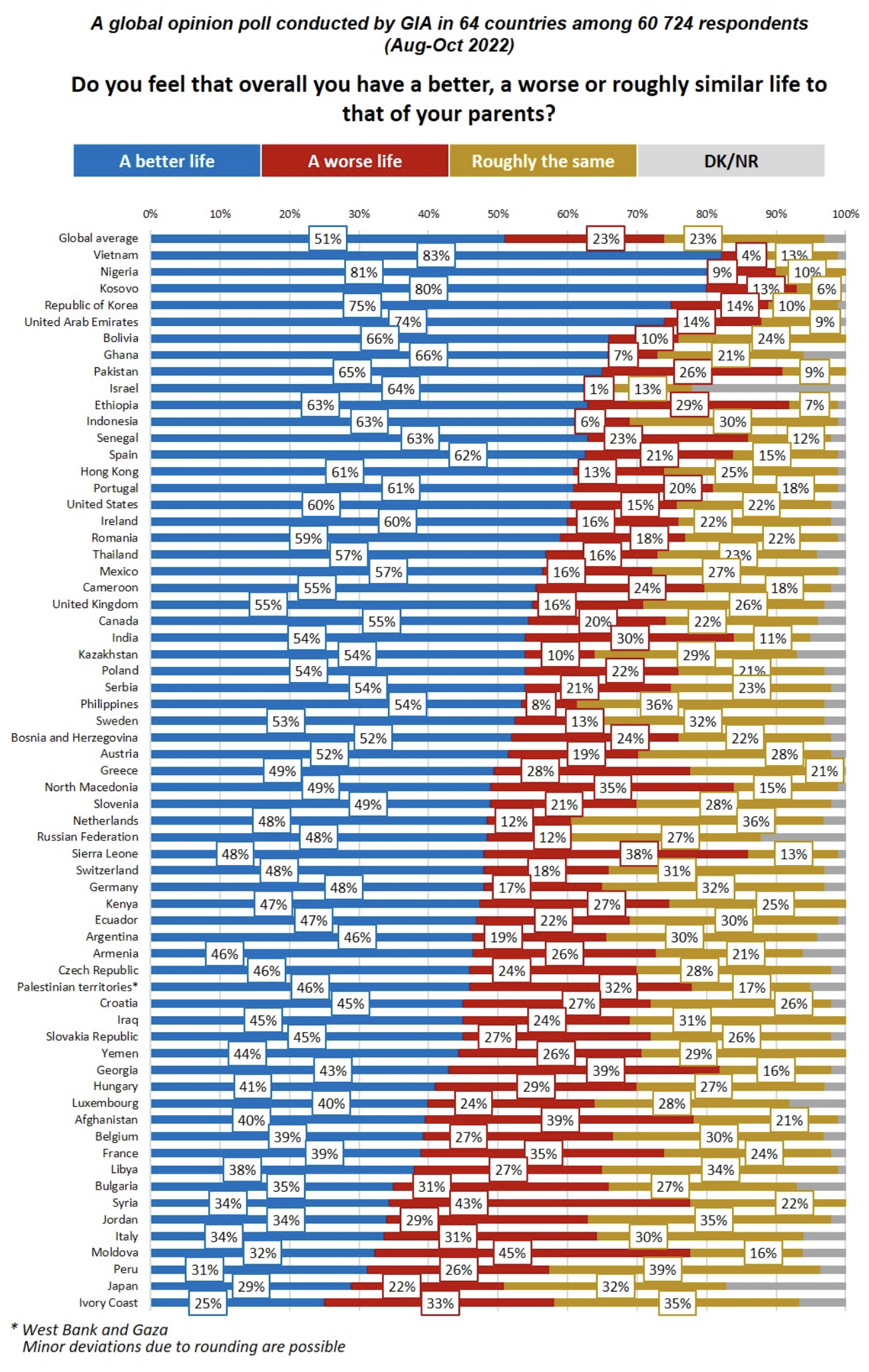
Doing Better Than Parents. Source: Gallup International

Pakistanis Among Most Optimistic: 

Nearly two-thirds (65%) of Pakistanis said they live better than their parents did. And 69% of Pakistani parents think their children will have better lives than they do. In neighboring India, 54% of respondents feel their lives are better than their parents' while only 43% say their children will have better lives than theirs'.  The global average for the former is 51% and it is 44% for the latter. The poll results put Pakistanis among the world's five most hopeful nations. 

Optimism For Children. Source: Gallup International


Most of the countries are positive on both questions, but if one looks for instance for countries with both above 50% positive answers, Nigeria stands out with 171 (81% positive for today plus 90% positive for tomorrow), followed by Kosovo (162), the United Arab Emirates (150), Ghana (141) and Pakistan (134), according to Gallup International. 

Sum of Percentages of Positive Answers to Both Questions. Source: Gallup

Pakistan (69% better minus 18% worse) is among the most positive countries. India is much less positive (43% minus 33%). Nigeria (90% minus 6%) tops the list in terms of positivity and the most negative is Slovenia (14% minus 53%). Among the prominent countries where GIA could poll, expectations for their children’s future are highest in Nigeria, followed by Russia (52% minus 10%), Mexico (48% minus 30%) and the USA (43% minus 31%). When combining the two questions, another perspective is added. For instance, Moldova shows a total of 86 (45% saying that their live is worse  than the one of their parents plus 41% expecting a worse life of today’s children), followed in this negative ranking by North Macedonia (82: 35% negative assessments plus 47% negative predictions), Afghanistan (81), Syria and Italy (78), etc.

Economic Mobility in Pakistan: 

Pakistanis' positive responses in the Gallup poll appear to be supported by a World Bank study. Economic mobility across generations, also known as intergenerational mobility (IGM), is a key measure of human progress. It shows that Pakistan is doing relatively well, according to a World Bank sponsored study. The analysis examines whether those born in poverty or in prosperity are destined to remain in the same economic circumstances into which they were born, and looks back over a half a century at whether children’s lives are better or worse than their parents’ in different parts of the world.

Inter-Generational Income Mobility Map of the World 2018. Source: World Bank


Intergenerational Income Mobility Study:

The World Bank study uses a newly created 2018 database—the Global Database of Intergenerational Mobility (GDIM)—that covers more than 95 percent of the global population.  Intergenerational income mobility measures how children's incomes compare with their parents' incomes at similar stages of life over a period of 50 years.

Inter-Generational Income Inequality Scatter Plot of the World 2018. Source: World Bank


The study found that higher intergenerational income mobility is associated with lower income inequality.

Inclusive Development: 

More and more Pakistanis are sharing in their nation's development, according to The World Economic Forum (WEF). Pakistan ranks 47 among 74 emerging economies ranked for inclusive development by the WEF released report at Davos, Switzerland. Inclusive development in the South Asian country has increased 7.56% over the last 5 years. The World Economic Forum assesses inclusive development  based on "living standards, environmental sustainability and protection of future generations from further indebtedness."  

“Man can live about forty days without food, about three days without water, about eight minutes without air...but only for one second without hope.”  American author Hal Lindsey


Saturday, January 9, 2016

Pakistan Ranked Among World's Top 10 Most Optimistic Nations

The results of the 2015 WIN/Gallup International survey of 68 countries across the globe show Pakistan ranking 5th on economic optimism and 10th on overall optimism.

The World Bank reporting the tailwinds pushing Pakistan's economic growth seems to support the optimism in Pakistan.  Most observers believe that the year 2015 has turned out to be a good year for Pakistan with the return of general optimism among businessmen, investors and consumers. Economic recovery has continued as Pakistan Army's efforts, including its Operation Zarb e Arb and Karachi Operation by Rangers, have started to bear fruit with significant decline in terrorism. There are new signs of a thaw in India-Pakistan ties with Indian Prime Minister Modi's surprise year-end visit to Lahore. Efforts to bring peace in Afghanistan took a new positive turn with the hopeful entry of the Taliban into a quadrilateral process involving Afghanistan, Pakistan, China and the United States.


Source: WIN/Gallup Survey 2015

Overall, 64% of Pakistanis say they happy, slightly below the 66% average for the 68 countries surveyed. Among south Asian nations, 66% of Bangladeshis, 58% of Indians and 42% of Afghans say they are happy, according to WIN/Gallup International Survey for 2015.

Bangladesh (74%), Nigeria (61%) and Columbia (85%) top Hope, Economic Optimism and Happiness Indices respectively. Pakistan scores 42% (rank 10) on hope and 50% (rank 5) on economic optimism indices. India scores 47% (rank 9) on Hope and 44% (rank 6) on Economic Optimism indices.

Jean-Marc Leger, President of WIN/Gallup International Association, said that "2015 has been a tumultuous year for many across the globe, despite that the world remains largely a happy place. 45% of the world is optimistic regarding the economic outlook for 2016, up by 3 per cent compared to last year."

Let's hope the new crises unfolding at the start of the year 2016 such as the China market crash, the Pathankot terrorist attack in India, the new escalation of Iran-Saudi  conflict and the claimed hydrogen bomb test claimed by North Korea do not sour the 2015 year-end  optimism reported by the WIN/Gallup survey.

Related Links:

Haq's Musings

Pakistan's Trillion Dollar Economy

China-Pakistan Industrial Corridor (CPEC)

How Can Pakistan Benefit From Low LNG Prices?

Who's Better For Human Development? Politicians or Musharraf?

Pakistan's Economic Recovery in 2015

SBP: Pakistan's GDP is Underestimated


Sunday, August 19, 2012

Faith in Hard Work: Pakistanis Lead the World

A recent Pew Survey of 21 countries reported that 81% of Pakistanis believe in hard work to achieve material success. Americans are the second most optimistic with 77% sharing this belief followed by Tunisians (73%), Brazilians (69%), Indians (67%) and Mexicans (65%).

 The survey found that "faith in the work ethic is particularly weak in Lebanon, where only 32% of the public anticipates rewards from hard work, and in Russia (35%), Japan (40%), Italy (43%) and Greece (43%), all countries that have suffered greatly from the recent economic downturn. There is also little confidence in hard work in China (45%), despite the fact that it has economically outperformed every country in this Global Attitudes survey".

Reacting to the survey results, former corporate leader Asad Umar who recently left Engro Corporation to join Imran Khan's PTI, said, “Fundamentally, the survey reveals that Pakistanis haven’t lost faith in the country. The Pakistani youth believes that current problems are short-term and can be resolved.”

Fifty-one percent of Pakistani respondents in the survey described their personal economic situation as "good", down from 70% in 2008.  Only 9% of Pakistani participants assessed the national economic situation as "good", down from 41% in 2008.


Another survey titled "Pervasive Gloom About the World Economy" reveals that the vast majority of Pakistanis recognize that their country is facing economic difficulties and most hold the government responsible for it. Only 12% of Pakistanis are satisfied with the current direction of the country. However, 23% believe that Pakistan's economy will get better in the next 12 months. 26% expect it to remain the same and 43% think it will get worse.

Defying the prophets of doom and gloom, Pakistanis remain much more optimistic than the people of any of the 21 countries surveyed, including BRIC countries, that their hard work can bring them material success.It's this perpetual optimism and willingness to work hard that helps Pakistanis maintain their upward social and economic mobility.

Related Links:

Haq's Musings

Upwardly Mobile Pakistan

Educational Attainment in Pakistan

Foreign Visitors to Pakistan Pleasantly Surprised

Pakistan's Infrastructure and M2 Motorway

India Pakistan Comparison 2011

Resilient Pakistan Defies Doomsayers


FMCG Consumption Boom in Rural Pakistan

Pakistan Visits Open  Indian Eyes


Friday, August 13, 2010

Disaster Dampens Spirits on Pakistan's 63rd Independence Day

The devastating floods in Pakistan have dampened the spirits of its people on its 63rd independence day this Aug 14, 2010. All official events marking the day have been canceled as the nation mourns the death of at least 1700 of its citizens and finds itself overwhelmed by the monumental relief and rescue efforts aimed at tens of millions of people across three provinces.

As the scope and scale of the disaster becomes apparent, the response from Pakistani government and the international community has been very slow and inadequate. Coming on the heels of continuing terrorist violence and a slow economy, the floods have further challenged even the greatest optimists in Pakistan.


While it is urgent to cope with the flooding crisis at hand as effectively as humanly possible, it is even more important to keep the faith and remain optimistic about the future of Pakistan in its most difficult hour. And I do see some key trends to be optimistic about Pakistan. Here is the list as I see it:

1. Pakistan is well on its way to becoming an urban middle class society. The country is already more urbanized with a larger middle class than India's as percentage of the population. In 2007, Standard Chartered Bank analysts and State Bank governor Dr. Ishrat Husain estimated there were 30 to 35 million Pakistanis earning an average of $10,000 a year. Of these, about 17 million are in the upper and upper middle class, according to a recent report.

The urban population now contributes about three quarters of Pakistan's gross domestic product and almost all of the government revenue. The industrial sector contributes over 27% of the GDP, higher than the 19% contributed by agriculture, with services accounting for the rest of the GDP.

2. There is an unstoppable mass media revolution sweeping the nation. It began ten years ago when Pakistan had just one television channel, according to the UK's Prospect Magazine. Today it has over 100. Together they have begun to open up a country long shrouded by political, moral and religious censorship—taking on the government, breaking social taboos and, most recently, pushing a new national consensus against the Taliban. The birth of privately owned commercial media has been enabled by the Musharraf-era deregulation, and funded by the tremendous growth in revenue from advertising targeted at the burgeoning urban middle class consumers. Analysts at Standard Charter Bank estimated in 2007 that Pakistan had 30 million people with incomes exceeding $10,000 a year. With television presence in over 16 million households accounting for 68% of the population in 2009, the electronic media have also helped inform and empower many rural Pakistanis, including women.

3. With the popular civil society movement for restoration of democracy and rule-of-law in 2007-2008, political activism by the middle class has been on the rise in Pakistan. The nation has very energetic political talk shows on dozens of TV channels, and a very active blogosphere. With only about 20 million internet users in a population of over 160 million people as of 2010, it is among the most politically active nations online, according to Huma Yousuf, reporter for the Christian Science Monitor in Pakistan.

4. For the first time in the nation's history, President Musharraf's education adviser Dr. Ata ur Rahman succeeded in getting tremendous focus and major funding increases for higher education in Pakistan. The extraordinary increase in funding helped establish 51 new universities and degree awarding institutions during 2002-2008, tripling university enrollment (which had reached only 135,000 from 1947 to 2003) to about 400,000 in 2008, establishment of a powerful digital library which provides free nation-wide access to every student in every public sector university to 45,000 textbooks/research monographs from 220 international publishers as well as to 25,000 international research journals.

According to Sciencewatch, which tracks trends and performance in basic research, citations of Pakistani publications are rising sharply in multiple fields, including computer science, engineering, mathematics, material science and plant and animal sciences. The number of papers published by Pakistani scientists reached 4300 in 2007 (For comparison purposes, India-based authors published 27000 papers in 2007, according to Science Watch). Over two dozen Pakistani scientists are actively working on the Large Hadron Collider; the grandest experiment in the history of Physics. Pakistan now ranks among the top outsourcing destinations, based on its growing talent pool of college graduates. According to Pakistan Software Export Board, Pakistani IT industry has grown at 40% CAGR during the 2001-2007, and it is estimated at $2.8 billion as of last year, with about half of it coming from exports. As evident from the overall results, there has been a significant increase in the numbers of universities and highly-educated faculty and university graduates in Pakistan. There have also been some instances of abuse of incentives, opportunities and resources provided to the academics in good faith. The quality of some of the institutions of higher learning can also be enhanced significantly, with some revisions in the incentive systems.

5. While Pakistanis are poor, they are still better off than than their neighbors, according to a recent Oxford report on multi-dimensional poverty.

OPHI 2010 country briefings on India and Pakistan contain the following comparisons of multi-dimensional (MPI) and income poverty figures:

India
MPI= 55%,Under$1.25=42%,Under$2=76%,India_BPL=29%

Pakistan
MPI=51%,Under$1.25=23%,Under$2=60%,Pakistan_BPL=33%

Lesotho MPI=48%,Under$1.25=43%,Under$2=62%,Lesotho_BPL=68%

China
MPI=12%,Under$1.25=16%,Under$2=36%,China_BPL=3%

Among other South Asian nations, MPI index measures poverty in Bangladesh at 58 per cent and 65 per cent in Nepal.

6. UNDP publishes the Education Index which is measured by the adult literacy rate (with two-thirds weighting) and the combined primary, secondary, and tertiary gross enrollment ratio (with one-third weighting). The adult literacy rate gives an indication of the ability to read and write, while the GER gives an indication of the level of education from kindergarten to postgraduate education.

On this UNDP education index, Pakistan scores low at 0.665 and ranks 137, but it is still ahead of India's score of 0.638 and ranking of 142nd on a list of 176 nations.

7. Pakistan is blessed with many social entrepreneurs who are engaged in activities ranging from microfinancing to enable small entrepreneurs to providing solutions such as clean water, solar lighting, setting up schools, etc. to help fill the vacuum left by the government. These people believe in lighting candles instead of cursing darkness.

Summary:

While I recognize that Pakistan in its current state faces many difficult crises and falls short of the expectations of many in dealing with them, I do believe that Pakistanis have what it takes to move forward as an urban middle class nation capable of dealing with its problems. Its glass is half full, and all it takes to fill it up is the will to do it....and I expect that when the going gets tougher, the tough will get going in Pakistan to meet the challenges. I'll conclude here by leaving you with the following question: If not now, when? If not us, who?

Here's a video clip on Pakistan's middle class:


Related Links:

Haq's Musings

Light a Candle, Do Not Curse Darkness

Decade of Urban Middle Class Growth in Pakistan

Urbanization in Pakistan

Higher Education Reform in Pakistan

High Cost of Failure to Aid Pakistan Flood Victims

Fighting Poverty Through Microfinance in Pakistan

TEDx Karachi Inspires Hope

Monday, May 18, 2009

Mumbai Stocks Fueled by Post-Election Optimism


In a resounding vote of confidence for Prime Minister Manmohan Singh's continuing leadership, Indian and international investors are celebrating with 17% jump in the 30-share BSE index, or 2,110.79 points, to 14,284.21 points, for its highest close since Sept. 11. Trade was finally halted for Monday before noon.

Here are the key headlines from Reuters about strong and positive investor reaction in Mumbai:

* Stocks jump 17 pct, biggest rise in 17 years

* Circuit breakers halt trade twice; markets closed early

* Rupee up 9 percent from low in early March

* Morgan Stanley raises stock, growth projections

* Bond yields drop, stake sales seen to fund deficit

Next door in Pakistan, the investor reaction to news of the day was muted and the KSE-100 remained essentially flat. Karachi Stock Exchange (KSE) was up in the morning but then the sellers came in on Monday and the benchmark KSE-100 Index closed 5 points down to 7,172.

Amidst major counterinsurgency operations in and around Swat Valley and growing refugee crisis, there are signs of optimism by investors and bond holders in Pakistan's economy. The KSE-100, Karachi's stock index, is up 27 percent this year, compared with a 12 percent gain in MSCI’s emerging-market stock index of 26 emerging economies, including Argentina, Brazil, Chile, China, Colombia, Czech Republic, Egypt, Hungary, India, Indonesia, Israel, Jordan, Korea, Malaysia, Mexico, Morocco, Pakistan, Peru, Philippines, Poland, Russia, South Africa, Taiwan, Thailand, Turkey and Venezuela. The Pakistani rupee, which declined 22 percent against the dollar last year, the second-worst performer in Asia, fell 1.8 percent this year.

Currently, KSE-100 companies are trading at a forward price-earnings multiple of about 5 versus Mumbai Sensex PE ratio of over 10. So a lot of the worst case pessimism is already reflected in the share prices of some of the high-quality blue-chip companies trading at Karachi stock exchange. Could it get worse? It's possible but not likely. There appears to be a lot more upside than downside at this time. Between 2001 and 2007, as Western governments fretted about Pakistan's nuclear weapons falling into the hands of militants, the KSE-100 rose risen more than 10-fold. It is capable of repeating the same performance from the lows of this year.

According to Pakistaniat website, Pakistan’s trade deficit narrowed by almost 50% in March, as imports declined faster than exports. In the same month, worker remittances were a record high at US$743 million an increase of 23% over last year. While Japan’s exports plummeted by 50%, China’s by 26% and India’s by 33%, Pakistan’s exports were down by 25%. Even though, the competitive peer group is formidable, Pakistan is the best performer.

On the corporate profitability front, during the worst global down turn in a century, Pakistan’s corporate profitability of listed companies declined by a mere 3% in aggregate in the 3rd quarter of 2009.

At the end of calender year 2008, remittances topped 7 billion dollars, an increase of 17 per cent year over year, led by higher remittances from oil-rich GCC countries, which grew by 30 per cent year on year. Similarly, FDI inflows jumped 100 per cent year on year to 708 million dollars in December, 2008, as the telecom, oil and gas, and financial-services sectors continued to attract foreign inventors, according a report in the Nation newspaper.

Pakistani military's robust response to the rising militancy appears to be backed by a significant majority of the people. If the Pakistani political leadership can deal with its fall-out, such as the humanitarian crisis, and sustain the popular support for the ongoing military action, and the government executes a rational set of economic policies, it is quite reasonable to expect an economic rebound within a year.

Given strong underlying growth dynamics in South Asia, the negative feedback effects of the global financial crisis should be temporary as well. A relatively rapid rebound can be expected in 2010, with a projected revival of GDP growth to 7 per cent, spurring job growth again.

Related Links:

Can Congress Deliver in India?

Is Pakistani Economy Poised For Rebound?

Is Indian Democracy Overrated?

Mumbai's Slumdog Millionaire

Can India Do a Lebanon in Pakistan?

Poor Sanitation in India

Stable, Peaceful, Prosperous India

No Toilet, No Seat in India

Poverty Tours in India, Brazil and South Africa

South Asia's War on Hunger Takes Back Seat

Grinding Poverty in Resurgent India

Pakistani Children's Plight

Poverty in Pakistan