Showing posts with label IT. Show all posts

Friday, February 10, 2023

Over A Million Pakistani University Students Enrolled in STEM Fields

Over a million students, about a third of total 3 million students (1.4 million women, 1.6 million men) enrolled in Pakistani universities and degree colleges, are currently studying science, technology, engineering and mathematics (STEM Education), according to data released by the country's Higher Education Commission (HEC). Of these students, 415,008 are studying natural sciences and mathematics, 276,659 are in information and communication technologies (ICT), 178,260 are in health sciences and 166,457 are in engineering. Pakistan produced 157,102 STEM graduates last year, putting it among the world's top dozen or so countries. About 43,000 of these graduates are in information technology (IT).  
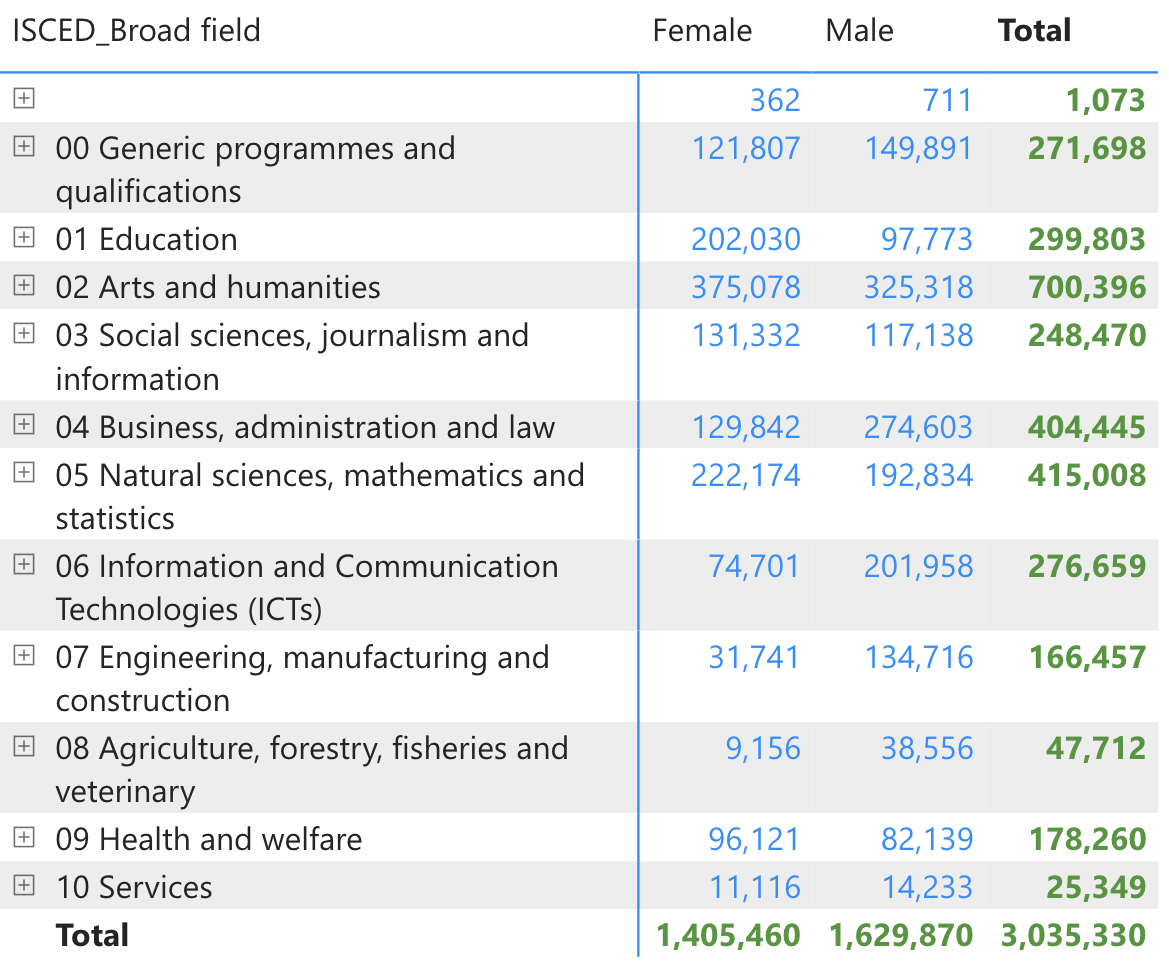
Student Enrollment By Field of Study at Pakistani Higher Education Institutions. Source: HEC


Nearly half a million Pakistani women are currently enrolled in science, technology, engineering and mathematics courses at universities, accounting for nearly 46% of all STEM students in higher education institutions in the country. 

Clockwise From Top Left: Nergis Mavalvala, Maria Abrar, Maheen Adamson, Tasneem Zehra Husain, Sundas Khalid, Asifa Akhtar

Acceptance rate in Pakistani universities and degree colleges was just 13.5% last year. Only 541,043 students were accepted from 4,085,185 students who applied. The country produced 471,306 university graduates in 2020-21. Of these, 157,102 were in STEM fields, including 43,000 graduates in information technology (IT).  


Pakistan Higher Education Admission and Graduation Statistics. Source: HEC


In absolute terms, Pakistan probably ranks among the top dozen or so nations producing university graduates in STEM and IT fields. However, the country lags significantly behind its lower middle income peers in terms of percentage of students enrolled in universities. Only 12% of young people in the 18-25 age group are currently enrolled in higher education institutions. This is about half of the 25% average for South Asia. The data from the World Bank shows that the higher education enrollment rate was extremely low in Pakistan until 2000 when late President Musharraf decided to significantly boost investment in building universities and hire faculty to rapidly increase access to higher education in the country. 


Tertiary Education Enrollment Rates. Source: World Bank


As Pakistan struggles with multiple serious crises,  these young men and women now studying in the nation's universities and colleges offer hope for its bright future. In fact, the vast majority of Pakistanis feel that they have better lives than their parents did, and they think their children will have even better lives than theirs, according to a Gallup International Poll of 64 countries conducted from August to October last year. The poll asked two questions: 1) Do you feel your life is better, worse or roughly similar to that  of your parents? and 2) Do you think your children will have a better, worse or roughly the same life as you? The answers to these questions reveal that Pakistanis are among the top 5 most positive nations among 64 countries polled by Gallup International. Anecdotal evidence in terms of packed shopping malls and restaurants in Pakistan's major cities confirms it. Such positivity augurs well for Pakistan's prospects of successfully dealing with the current crises. It will drive the nation's recovery. 


Related Links:


Wednesday, November 22, 2017

Information Technology Jobs Moving From India to Pakistan?

Outlook India recently ran a story headlined "Noida to Islamabad". It suggests at least anecdotal evidence of information technology jobs beginning to move from India to Pakistan. The number of jobs is only 125 but could it be the tip of a larger iceberg? Are western companies finding Pakistan becoming more competitive with India in terms of cost and skills on offer? Let's try and answer these questions.

Noida to Islamabad:

Outlook India report said 125 employees at a US-based information technology service provider were laid off in Noida in New Delhi, India, and the very next day an equal number of workers started working for the company in Islamabad, Pakistan. Here's an excerpt of Outlook India story:

"On the night of November 1, stretching into early next morning, close to half the workforce at the Noida office of a US-based IT service provider was informed that their services were no longer needed. A former employee says salaries for the staff at the Noida office were declared delayed by a day on October 31. The official explanation was that the servers were not working. “They weren’t clear about how many people were going to be laid off,” he says. The next night, they “axed 125 people in half-an-hour.” They all got a severance package—a cheque for October and another two months of salary—and a termination letter. Rumors of layoffs had started doing the rounds four to five months ago. The talk was that the company was opening offices in a neighboring country. Curiously, the day the workforce in Noida was sacked, almost the same number of employees for the same low-level IT-enabled jobs logged into their systems, 676 kilometers away, in Islamabad, Pakistan. Job cuts have plagued the Indian IT sector for about two years now and have begun to get pretty serious from the start of this year. “Bloodbath in Bangalore” has been the recurring headline. But the trend of these jobs going to techies in Pakistan is more recent. Away from all the noise of ceasefire violations and surgical strikes, where Pakistan could really hurt India is in taking away low-end IT jobs. The neighbor has a budding IT industry, growing in its own space, looking to emulate the Indian IT success story where right now data operators and BPO callers come much cheaper."

The story did not identify the company by name.

Pakistan: The Next Software Hub?

There are tens of thousands of Pakistani IT engineers working in the West, particularly in Silicon Valley, the high-tech capital of the world. The popular entertainment industry recognizes this fact by featuring a Pakistani-American software engineer in lead role played by a real-life Pakistani-American Kumail Nanjiani in HBO's "Silicon Valley" serial.  Articles like the New York Times Op Ed piece in 2015 titled "Pakistan, the Next Software Hub?" have helped raise the profile of Pakistan's information technology industry in the West.

Afiniti and Careem: Tech Unicorns Made in Pakistan:

Afiniti and Careem are two technology unicorns engineered in Pakistan by Pakistanis. AI (artificial intelligence) startup Afiniti software has largely been engineered in Lahore while taxi hailing service Careem's technology has mostly been developed in Karachi.

Careem is a taxi hailing app that is giving its American competitor Uber a run for its money in a region stretching from Pakistan to the Middle East and North Africa. The company cofounded by Mudassir Sheika, a Pakistani national, is headquartered in Dubai in the United Arab Emirates.

Careem's software has been developed by its technology partner VentureDive based in Karachi, Pakistan.  VentureDive was started by serial Pakistani entrepreneur Atif Azim who sold his earlier startup Perfigo to network equipment giant Cisco for $74 million in 2004, according to a report in Tech in Asia.

Washington D.C. based AI technology firm Afiniti, founded by serial Pakistani-American entrepreneur Zia Chishti, has filed for initial public offering (IPO) at $1.6 billion valuation, according to VentureBeat. The company has grown out of the technology used in the Pakistan-based call center business of The Resource Group (TRG) also founded by Zia Chishti.

Bulk of the Afiniti development team is located in Thokar Niaz Baig, Lahore. In addition, the company has development team members in Islamabad and Karachi.

Numbers,  Skills and Cost: 

Pakistani universities are producing over 10,000 IT engineers annually. Many of them have demonstrated their quality and skills by freelancing for American and European companies. Pakistani freelancers consistently rank among the top three year after year.

In terms of cost, Pakistani engineers cost significantly less than engineers in India and elsewhere. The average salary of a software engineer ($110,000) in Silicon Valley is about 20X more than the average salaries in India ($6,875) and Pakistan ($4,770), according to Glassdoor.

Source: Glassdoor

Summary:

Recent move of 125 IT jobs from Noida to Islamabad in an indication that  Pakistan is becoming an attractive destination for software and information technology companies looking for highly skilled talent at significant discounts. It is an emerging center of technology with at least two unicorns, Afiniti and Careem, engineered by Pakistanis in Pakistan.  With growing numbers of young homegrown Pakistani technologists, a highly skilled diaspora and an evolving startup ecosystem with incubators, accelerators and investors, the country is beginning to demonstrate its vast potential as a vibrant technology hub of the future. Provincial governments, particularly those in Punjab and KP, are showing leadership in encouraging this trend. The main ingredients are all coming together to make things happen in Pakistan.

Related Links:

Haq's Musings

OPEN Silicon Valley Forum 2017: Pakistani Entrepreneurs Conference

Pakistani-American's Tech Unicorn Files For IPO at $1.6 Billion Valuation

Pakistani-American Cofounders Sell Startup to Cisco for $610 million

Pakistani Brothers Spawned $20 Billion Security Software Industry

Pakistani-American Ashar Aziz's Fireeye Goes Public

Pakistani-American Pioneered 3D Technology in Orthodontics

Pakistani-Americans Enabling 2nd Machine Revolution

Pakistani-American Shahid Khan Richest South Asian in America

Two Pakistani-American Silicon Valley Techs Among Top 5 VC Deals

Pakistani-American's Game-Changing Vision 


Friday, November 28, 2014

US Government Explains 20X Difference Between US-India BPT Trade Figures


A GAO study showed that U.S. data on offshoring of services to India are more than 20 times smaller than India’s data. What’s the story?
The GAO study showed that U.S. imports from India of business, professional, and technical (BPT) services as published by BEA are substantially lower than India’s data on exports of BPT services to the U.S. (chart 1, left panel).1 However, when adjusted to a similar conceptual basis using information from the GAO report, the difference is actually quite small (chart 1, center panel).

The large gap between the U.S. and Indian data mainly reflects differences in how BEA and India define BPT services. BEA data are consistent with international standards for balance of payments accounting; India’s data, which are based on data from an Indian trade association, do not conform to international standards.  In fact, a 2005 study published by the Reserve Bank of India (RBI) showed that computer services exports (a large component of BPT services) to the U.S. based on international standards are much lower than India’s published data (chart 1, right panel).2 In addition, a 2004 report by the OECD found that 97 percent of India’s exports of computer services to large OECD member countries were unaccounted for in those countries’ data on imports.3

Depending upon how one adjusts for important definitional differences, the gap between the U.S. and Indian estimates either entirely disappears or is substantially reduced.
Chart 1: U.S. and Indian Data on Trade in BPT Services, 2002
Source: GAO; calculations by BEA
1 Government Accountability Office, “U.S. and India Data on Offshoring Show Significant Differences,” October 2005.
2 Reserve Bank of India, “Computer Services Exports from India: 2002-03,” Reserve Bank of India Bulletin, September 2005.
3 Organization for Economic Co-operation and DevelopmentInformation Technology Outlook 2004, October 2004.


What are the reasons for differences between U.S. and Indian data on trade in business, professional, and technical services?

The U.S. and Indian data on trade in business, professional, and technical (BPT) services are not directly comparable because of substantial definitional differences.  When the U.S. and Indian data are adjusted for definitional differences, the difference in estimates either entirely disappears or is substantially reduced.  Some major definitional differences are:
      Indian workers in the United States.  India’s data on trade in BPT services include services provided by Indian nationals who reside in the United States.  BEA follows international standards for balance-of-payments accounting by excluding the compensation paid by U.S. firms to U.S. residents.  Foreign workers who are in the United States for less than one year are considered to be foreign residents, and typically their earnings are included as compensation of employees (under “income” in the balance of payments accounts).  Workers who are in the United States for more than one year are considered to be U.S. residents, and so their earnings are excluded from the balance of payments accounts.  According to the GAO study, Indian officials acknowledged that temporary Indian workers in the U.S. have accounted for about 40 to 50 percent of their data on exports of BPT services.

b)      Sales through affiliated companies.  India’s data on services exports to North America include sales of services to affiliates of U.S. companies located in India or another foreign country, as well as sales by affiliates of Indian companies located in the United States to other U.S. residents.  According to international standards, BEA excludes these sales from U.S. trade in services because the transactions did not occur between a U.S. resident and a non-resident.  A U.S. company’s foreign affiliate that is located in India is an Indian resident, and so its transactions with other Indian residents should not be included in the balance of payments.  Similarly, an Indian company’s affiliate in the United States is a U.S. resident, and so its transactions with other U.S. residents should not be included. According to the GAO study, an Indian official stated that inclusion of sales to affiliates of U.S. companies is “likely a significant factor” accounting for differences between U.S. and Indian data.

c)      Sales of goods.  India’s data on trade in BPT services include some sales of goods, such as prepackaged software and software embedded on computer hardware.  The U.S. data on trade in these products are included in the goods trade data, not in the services trade data.  According to the GAO study, Indian officials stated that embedded and prepackaged software account for about 10-15 percent of India’s estimate of exports of BPT services to the U.S.

d)      Sales of technology-enabled services.  India’s data on trade in BPT services include some technology-enabled services (such as some financial services).  BEA includes these services in other services categories.

e)      Intrafirm trade.  Through 2006, U.S. data for trade in services are collected separately for cross-border trade between unaffiliated companies and for intrafirm (or affiliated) trade.  The surveys that BEA uses to collect data on unaffiliated trade are detailed enough to allow BEA to identify trade in BPT services vis-à-vis India.  Affiliated trade, however, is collected on separate surveys, and data for individual foreign countries that separately identify BPT services are unavailable.  Therefore, reported BEA data for BPT trade with India cannot be directly compared with the Indian data, because BEA’s data for BPT services include only unaffiliated trade and India’s data on BPT services include both affiliated and unaffiliated trade.


How did BEA calculate the adjusted data shown in the chart above?

BEA adjusted both its own estimates and the Indian estimates to eliminate definitional differences between U.S. and Indian data.

BEA adjusted its own data to include an estimate of affiliated transactions, which are collected on surveys that do not allow for BPT services to be separately identified by individual foreign country. In order to estimate affiliated imports of BPT services from India, BEA used a ratio calculated from global affiliated and unaffiliated imports of BPT services. BEA used the same procedure to estimate affiliated imports of computer services (table 1).


Table 1: Adjustments to BEA’s data, 2002
[Millions of dollars]
 
  BPT ServicesComputer Services
    
Published BEA estimates (based on reported data)  
    
a.Global imports33,4884,315
b.   Affiliated imports23,9402,800
c.   Unaffiliated imports9,5481,515
d.Ratio [b/c]2.511.85
    
e.Unaffiliated imports from India 288201
    
Implied estimates (derived from global ratios)  
    
f.Affiliated imports from India [d*e]722371
    
g.Total imports from India [e+f]1,010572

Source: BEA.


Data from India on BPT exports to the U.S. were adjusted to remove the definitional differences with BEA data and international standards as described above. BEA based the adjustments on information provided in the GAO study. Not all differences were quantified in the study, so some differences remain (table 2).


Table 2: Adjustments to India’s BPT services data, 2002
[Millions of dollars]
 
  High estimateLow estimate
    
I.Exports of BPT services (published by India; chart 1, left panel)6,4646,464
    
II.Adjustments for definitional differences (derived from GAO report):  
 a. Indian workers in the U.S.40%50%
 b. Sales through affiliated companies20%30%
 c. Sales of goods10%15%
    
III.Total [a+b+c]70%95%
    
IV.Adjusted Indian estimate of exports of BPT services [I*(1-III)] (chart 1, center panel)1,939323

Source: GAO; calculations by BEA.


The ranges for adjustment factors (a) and (c) were provided by Indian officials and published in the GAO study. The effect of factor (b) was estimated by BEA at 20-30 percent, because the GAO study said that Indian officials thought the effect of this factor was “significant” but that the effect of factor (c) was “insignificant” at 10-15 percent.

The September 2005 RBI study on Indian sales of computer services provided data that corrected for some definitional differences but the estimates still were not directly comparable to U.S. estimates because the Indian estimates were presented based on trade negotiation categories (i.e., GATS rules) that included sales by Indian-owned companies in the United States to U.S. residents, sales by Indian workers in the United States, etc. BEA used data from the RBI study to calculate a ratio of Indian exports of computer services using balance of payments definitions to total (broadly defined) deliveries of Indian computer services using GATS rules at the global level; this ratio was 39%. In addition, the study provided data on the delivery of Indian computer services (broadly defined) to North America. BEA used the global ratio to estimate balance-of-payments basis exports of computer services to North America. BEA then estimated the portion of exports to North America attributable to the U.S. using information from an Indian software trade association (table 3).


Table 3: Adjustments to RBI’s Computer Services Data, 2002
[Millions of dollars]
 
  India's exports of computer services
a.Global delivery of services - broad definition31,133
b.Global exports - balance-of-payments basis12,077
c.Ratio [b/a]0.39
   
d.Delivery of services to North America - broad definition4,046
e.Exports to North America - balance-of-payments basis [c*d]1,569
   
f.Ratio (U.S./North America)0.82
   
g.Exports to United States [e*f] (chart 1, right panel)1,287

Source: RBI; NASSCOM; calculations by BEA. 


Related Links:

Haq's Musings

Does China Seek to Dominate India?

India's IT Exports Wildly Exaggerated

China's Checkbook Diplomacy

Japan to Finance, Build Karachi Mass Transit System

Pak-China Economic Corridor 

Soaring Chinese Imports and Twin Deficits in India

India-Israel Military Relations

Pakistan's Military Production

BRIC, Chindia, and the "Indian Miracle"

India's "Indigenous" Weapons

Pakistan's Telecom Boom

India's Growing Defense Budget