Showing posts sorted by date for query pakistani-americans. Sort by relevance Show all posts

Monday, August 24, 2026

AI on Wheels: My Experience With Tesla Full Self Drive (FSD)

Recently, I saw a news story suggesting that “more and more seniors are using Tesla FSD (full self drive)”. This prompted me to share my own experience with my readers.

Tesla FSD Warning


My wife and I have been regularly using Tesla Full Self Drive (Supervised FSD) software for several months now. It is a subscription costing us $108.16, including tax, per vehicle. Our experience has generally been positive. We set our destination in the navigation system and let FSD drive us. It pulls out of our driveway, takes us wherever we want to go, and parks on the street, in a parking lot, or in a garage. On occasion, though, we have had to take control when we felt it was necessary, often in response to Tesla warning to “take over immediately”.

Tesla Sensors. Source: Car and Driver Magazine


Both of our Tesla Model Y vehicles use hardware version 3 (HW3). In addition to a computer, HW3 includes 7 cameras and four ultrasonic sensors. We get frequent Tesla software updates, downloaded over the air. As of today, we're on software version 2026.21.6, including FSD v14.3.7.  The latest hardware version on new Tesla vehicles is HW4. Tesla recently outlined details on Full Self-Driving (FSD) v15, describing it as a major "step-change" in capability featuring a 10-billion parameter neural network. Tesla confirmed that current Hardware 4 (AI4) computers will natively support v15 and unsupervised features, targeting a late 2026 to early 2027 rollout window. 

Tesla FSD Speed Modes. Source: Jowua


Tesla FSD allows you to choose a driving mode. The choices include Sloth (least aggressive), Chill, Standard, Hurry and Mad Max (most aggressive). Here are more detail on each speed mode:

Sloth: The most cautious setting. It stays strictly at or slightly below the speed limit, favors slow right lanes on highways, and avoids proactive passing. 

Chill: A relaxed, smooth profile. It generally targets the exact speed limit and makes fewer or less urgent lane changes.

Standard: The balanced, default setup. It typically drives roughly 5 to 7 mph over the speed limit (traffic permitting) and maintains an average commuting pace.

Hurry: A faster profile designed for quicker travel times. It allows higher offsets above the speed limit and executes more assertive lane changes to pass slower vehicles.

Mad Max: The most assertive profile, built for heavy gridlock or aggressive urban environments (like dense city traffic). It proactively navigates gaps, moves swiftly around traffic flow, and executes maneuvers with higher urgency.

We drive mostly in Standard or Hurry modes. The best part my wife likes is how smoothly it changes lanes even in high traffic conditions. One particular place where it has eliminated her stress is on Oakland Maze, where her route requires 5 quick lane changes to go from one freeway to another. 

Waymo Robotaxi With LiDAR mounted on top


There have been several instances where we have had to intervene to take control of the vehicle. These include loss of control when the front camera is blinded by direct sun at certain times of the day. This problem would probably not occur if Tesla vehicles were equipped with a LiDAR scanner that uses laser light pulses to measure distances and create accurate, 3D digital models of objects and environments. Robotaxis like Google's Waymo and Amazon's Zoox use LiDAR devices to achieve fully autonomous driving. However, like the rest of Tesla's vehicle lineup and Full Self-Driving stack, the recently announced Cybercab robotaxi also relies entirely on a vision-based camera system and onboard AI to interpret its surroundings. 

In other instances, our Tesla car ran a stop sign that was blocked by a parked truck. It failed to read "STOP" painted on the road surface.  At a local Safeway supermarket, it attempted to park in a shopping cart corral. A couple of times after pulling out of our driveway, it took a wrong turn but found its way back to the correct route after taking a detour. 

Rapid development and deployment of AI applications like Tesla full self drive and various robotaxi services, including Waymo and Zoox, have broad social and economic implications. It is likely to make transportation safer, but it also threatens the livelihoods of tens of millions of taxi and truck drivers around the world.  There have already been protests by drivers' unions in many major cities like London and New York.

Related Links:

Haq's Musings

South Asia Investor Review

My Family's Contribution to Climate Action

Pakistan Joins China in World AI Cooperation Organization

Pakistani-Americans Largest Foreign-Born Muslim Group in Silicon Valley

A Personal Story: When My Heart Stopped in San Francisco

In Memory of My Loving Mother Rafiqa Khatoon

Silicon Valley Pakistani-Americans

Pakistani-American Leads Silicon Valley's Top Incubator

Silicon Valley Pakistanis Enabling 2nd Machine Revolution

Pakistan EV Launches to Accelerate Energy Transition

Pakistani-American Ashar Aziz's Fire-eye Goes Public

Pakistani-American Doctor Honored By President Obama

Pakistani-American's Game-Changing Vision 

Minorities Are Majority in Silicon Valley 

Over A Million Pakistani University Students Enrolled in STEM Fields

Thursday, August 20, 2026

Is the Pakistani Military Ready for Modern Drone Warfare?

The Russia-Ukraine war and the US-Israel-Iran war have recently demonstrated the effectiveness of drone warfare. Is the Pakistani military learning lessons from them to prepare for future conflicts? Let's examine the answer to this question based on recent announcements. 

Pakistan's Long Range Drone D-248

Pakistan has revealed a 3,000-kilometer range one-way drone in July this year. The state-owned Heavy Industries Taxila (HIT) displayed two new long-range loitering munitions – the D-248 and the S-369 – at the 2026 Indus Robotics and Autonomous Systems (RAS) Expo on July 22–23, 2026 in Islamabad.  

The D-248 drone uses a tailless delta configuration – similar to Iran’s Shahed-136 – and carries a maximum take-off weight (MTOW) of 240 kg, a wingspan of 3.3 m, a payload of 30-50 kg, a maximum speed of 225 kph, a cruise speed of 185 kph, an endurance of 12-14 hours, and a flight ceiling of up to 4,500 m.  Iran's Shahed drones have been used in both the Ukraine-Russia war and the US-Iran conflict. Shahed-136 is relatively inexpensive. It has a swarm capability, and a precision-strike capability at extended ranges.

Pakistani Military Official in Ukraine. Source: New York Times

Pakistan is also in talks with Ukraine's Fire Point whose long-range drones have launched spectacular strikes deep inside Russia in recent weeks. Fire Point is promoting its FP-1 Deep Strike, a loitering munition with a range of 2,600 km, as well as FP-2 Front Strike, a loitering munition with a range of up to 200 km.

During a recent exercise, called Combined Resolve, Ukrainian drone units easily spotted and defeated U.S. troops and armored vehicles on rotation from Fort Hood in Texas, according to people familiar with the events, reports the Wall Street Journal. It's not just the Americans who fared badly against Ukrainian drones; the British and the Swedes have also witnessed easy Ukrainian triumphs in military exercises. The U.S. has also struggled to defend against Iran’s long-range Shahed drones, which have killed and injured many American soldiers and destroyed aircraft.

The exercising troops from the United States sent heavy armored vehicles into battle that threw up dust and were easy for Ukrainian reconnaissance drones to spot, according to a participant. Those drones were followed by drones dropping explosives and first-person-view drones, which smash into targets in combat, this person said.

Drones are becoming an important part of modern warfare, as demonstrated by ongoing conflicts in Europe and the Middle East. Gaining military advantage in future conflicts will increasingly depend on how well states conduct technology-driven multi-domain operations by integrating aircraft, drones, electronic warfare, cyber operations, intelligence and AI-assisted analysis. 


Related Links:

Haq's Musings

South Asia Investor Review

US Missile Sanctions: Is Pakistan Really Developing ICBMs?

Pakistan's Cyber Attack and Defense Capability

IDEAS2024: Pakistan Defense Industry Expo

Pakistan's Rising Arms Sales

Pakistan Navy Modernization

Drone Swarms: Saudi Oil Fields Attack Shows Destructive Power

Pakistan Defense Industry

Silicon Valley Book Launch of "Eating Grass"

Turkish and Israeli Drones Enable Azerbaijan's Decisive Victory Over Armenia

Pakistan Destroyed Indian Rafales, S-400 Air Defense System

Pakistan's Sea-Based Second Strike Capability

Riaz Haq Youtube Channel

VPOS Youtube Channel


Saturday, August 1, 2026

Geopolitics: Changing Dynamics of Pakistan's Ties to China and the US

Pakistan has long sought to balance its foreign policy between China and the United States through a pragmatic hedging strategy, gaining economic, military, and diplomatic benefits from both superpowers while maintaining strategic autonomy. But the relationship between Pakistan and China is not the same as the one between Pakistan and the United States. Pakistan's ties with China are strategic while those with the United States remain tactical and transactional. What has changed recently is that Pakistan is no longer waging war to help the United States as it did during the "Cold War" and the "War on Terror". Instead, Pakistan has emerged as a peacemaker between the US and Iran. 

Both China and US Are Courting Pakistan


In a piece titled "Pakistan's Great Game", French political scientist Christophe Jaffrelot has explained what he sees as Pakistan's "tactics and strategy" in dealing with the two superpowers. Here's a quote from Jaffrelot's recent article on the subject:  

"While Pakistan’s relationship with China is rooted in strategic logic, its relationship with the United States is more tactical in nature-and has been since the 1950s, when General Ayub Khan boasted of his ability to play "one lion against another" (referring to the United States and the USSR at the start of the Cold War). In its dealings with the United States, Pakistan has played the role of intermediary, or even "client," within a typical clientelist framework: in exchange for the services Islamabad provided to Washington, the United States provided Pakistan with substantial aid and agreed to sell it sophisticated weapons, and even to train its officers-a privilege greatly appreciated.....  The first major service rendered by the Pakistanis to the Americans was none other than the intermediary role played by General Yahya Khan vis-à-vis Chairman Mao in the early 1970s, which led to the United States’ recognition of the People’s Republic of China. Over the following decade, Pakistan served as an intermediary between Washington and the mujahideen tasked with driving the Soviets out of Afghanistan. And in the 2000s, Pakistan was tasked by Washington with hunting down al-Qaeda-with much more mixed success this time, as evidenced by the discovery of bin Laden’s hideout in Abbottabad in 2011". 

Pakistan PM Sharif (L) with Chinese President Xi


Jaffrelot goes on to say that the United States has repeatedly proved to be an unreliable partner of the South Asia nation.  "Whenever the United States no longer needed Pakistan-or even felt betrayed by it-it abandoned the country or even imposed sanctions on it", he writes. 

More recently, Pakistan's usefulness to the US has once again become obvious,  no longer to wage war against the USSR or terrorism, but to make peace with Iran, Jaffrelot says. 

"In 2026, Pakistan appears useful once again, no longer to wage war against the USSR or terrorism, but to make peace. Each time, these glorious episodes were very short-lived and came to an end due to criticism of the Pakistani regime’s authoritarianism - with the military always remaining in power, even when civilians are in the forefront; its ties to Islamists accused of terrorist activities - particularly in India; or accusations of nuclear proliferation. Will the same be true tomorrow, once the war in Iran is over and the United States no longer needs Pakistan?  Everything will, of course, depend on the outcome of the conflict and the role Pakistan plays in resolving it-for it will be harder to send Islamabad back home if the world owes it something resembling peace". 

Oval Office Photo: L to R: VP JD Vance, President Trump, PM Sharif, FM Munir & Sec of State Rubio

Jaffrelot argues that "Pakistan has reached a turning point through the recognition of its military capabilities, as reflected in the mutual defense agreement it signed with Saudi Arabia...... Last June, Kaja Kallas, the EU Vice President in charge of the Union’s international relations, on the occasion of the 8th Strategic Dialogue between Pakistan and the European Union in Islamabad, thanked Pakistan-"a major regional power"-for its efforts in helping to avert an "all-out war" in the Middle East.  Jaffrelot now sees Pakistan's new role as a "net security provider" in West Asia and the Middle East.

He writes: "A more significant factor entering the equation relates to regional balances of power: Pakistan will continue to serve as a "net security provider" for Middle Eastern countries such as Saudi Arabia if those countries continue to fear the rise of Israel - a potential regional hegemon - and if they doubt Washington’s intentions, or even its mere reliability. There is no doubt that Pakistan itself will do everything in its power to prevent Israel from asserting itself on the regional stage and to gain influence over Iran-which is what the Israeli-American plan for regime change in Iran might have entailed. At the very least, faced with the risk of Israeli hegemony based on force and repeated military interventions, Pakistan could emerge as the architect of a resistance front bringing together not only Saudi Arabia, Turkey, and Egypt, but also Iran".  


Jaffrelot expects India to continue its decade-long campaign to isolate Pakistan internationally. "India’s ability to isolate Pakistan-the strategy Narendra Modi has pursued for more than a decade-is another important variable, though its significance may be undermined by New Delhi’s drift toward authoritarianism and ethnocracy, as well as by the economic and social crisis threatening the country", according to Jaffrelot. 

Related Links:

Haq's Musings

South Asia Investor Review

Pakistan Downs India's French Rafale Jets in a Major Aerial Battle

Has Modi Succeeded Diplomatically or Militarily Against Pakistan After Pahalgam?

Pakistan-Saudi Defense Pact

Pakistan's Key Role in US-Iran Ceasefire

Has Modi Succeeded Militarily or Diplomatically in Isolating Pakistan After "Operation Sindoor"?

China, Pakistan to "Further Deepen and Expand" Ties

Modi's India: A Paper Elephant?

Pahalgam Attack: Why is the Indian Media Not Asking Hard Questions?

Ukraine's Lesson For Pakistan: Never Give Up Nukes!

Pakistan Economy Nears Trillion Dollars

Pakistan's Sea-Based Second Strike Capability

Riaz Haq Youtube Channel

VPOS Youtube Channel


Friday, June 26, 2026

Pakistani-American Professor Publishes Landmark Genomic Research on Pakistanis

Dr. Danish Saleheen, a Pakistani-American professor at Columbia University, and his fellow researchers have published a comprehensive analysis of 173,303 genomes from Pakistan, one of the largest genomic studies ever conducted in South Asia. This landmark work is upending how scientists understand human genetics and drug development. "South Asians have been severely underrepresented in genome studies—comprising just 2% of global genomic databases despite representing 25% of the world's population," study leader Dr. Saleheen explained. The study is sponsored by Novartis, Columbia University Irving Medical Center, and the Center for Non-Communicable Diseases, Karachi, Pakistan. Its results could fundamentally transform drug discovery. 


The study, published in the journal Nature, has identified knockouts of nearly 6,500 genes—about one third of all protein-coding genes (exomes)—in 34,000 individuals. Cousin marriages are quite prevalent in Pakistan, with half of all marriages occurring between close relatives. Landmark research, including the Pakistan Genomic Resource, highlights how these genetic traits act as both a medical challenge and a massive opportunity for scientific discovery.  

Study of Knockout Genes in Humans vs Mice

What are "knockout genes"? In Pakistan, the study has identified thousands of individuals with naturally missing or "knocked out" or "deleted" genes. Researchers use mice for studying diseases and "knock out" or delete specific genes to study how the deletions impact health and contribute to disease. The problem is that translation of such findings to humans has been difficult, "because mouse genes often have different functions than their human counterparts," Saleheen says. “What’s unique about our Pakistan study is we can go back to participants and conduct comprehensive medical exams to see what kind of effects the gene deletion may have on the individual,” he adds.

The study reveals that South Asian populations carry genetic ancestry components shared with both European and African populations, suggesting that insights gained from the Pakistan Genome Resource (PGR) have broad applicability across multiple human populations. This genetic overlap means that treatments validated in Pakistani populations are likely to benefit diverse ancestry groups globally.

"What we would prefer to do is identify people who are born without working copies of these genes and see if that has an effect on their health."  These "human knockouts" are rare in genome databases like the UK Biobank and the NIH's All of Us, which predominantly contain genomes of people with European ancestry.  "Consequently, many experimental drugs that seem promising in mice fail in clinical trials," Saleheen says. "That costs billions of dollars in losses every year."

Dr. Saleheen is a physician-scientist working at the intersection of human genetics and drug discovery. He has an MBBS degree from Karachi's Aga Khan University and a Ph.D. in Cardiovascular Genomics from Cambridge University.  He is Professor of Medical Sciences and Director of Global Genomics at Columbia University Irving Medical Center, founding Director of the Center for Non-Communicable Diseases (CNCD) in Pakistan, and founding Principal Investigator of the Pakistan Genome Resource (PGR) — one of the world's largest human "knockout" discovery programs (www.cncd.org). He is the author of more than 250 research papers and a 2018 recipient of the Clinical Research Forum's Top 10 Clinical Research Achievement Award, the national prize recognizing the ten most outstanding clinical research accomplishments in the United States that year.

 Related Links:


Friday, June 12, 2026

Quantum Computing IPO Makes A British Pakistani Billionaire

Ilyas Khan, the British Pakistan founder of Quantinuum, became a billionaire in the company’s IPO on NASDAQ last week. Khan is a pioneer in the revolutionary field of quantum computing which could speed up computing by orders of magnitude. It will have a huge impact in AI and encryption. Dr. Irfan Siddiqui, a Pakistani-American professor of Physics at University of California at Berkeley, is another top expert in quantum computing. 

Ilyas Khan, British Pakistani Founder of Quantinuum. Source: 2023 BLOOMBERG FINANCE LP


Quantinuum raised $1.68 billion in an initial public offering last week, making its founder Illyas Khan a billionaire, according to Forbes. The listing, which is the largest to date for a quantum startup, valued Quantinuum at over $15.6 billion after it sold 28 million shares at $60 each on June 3. Its shares opened at $58 per share on June 9. Khan, who owns around 15% of the company, is now worth $2.2 billion. Quantinuum uses a new type of quantum computer; rather than running on silicon chips, it instead uses ions trapped in place with lasers to execute computations. 

Ilyas Khan is the founder and former CEO of Cambridge Quantum, which merged with Honeywell's quantum division to form Quantinuum, now regarded as a global leader in quantum technologies valued at over $15 billion. He is involved directly in Pakistan's technology sector, where he provides guidance on integrating high-level quantum technologies into Pakistan's growing tech infrastructure.

Dr. Irfan Siddiqui, Professor at UC Berkeley


In quantum computing, a qubit or quantum bit is the basic unit of quantum information—the quantum version of the classical binary bit physically realized with a two-state device. Here's how Dr. Siddiqui explained quantum computing in an interview with Design News:

"For me, any quantum technology, including quantum computing, is something that takes advantage of entanglement. And entanglement is the idea that if you have different pieces of matter and you put them together, they behave as a single unit. So, for example, each of the bits in a classical computer are independent of each other. If you flip one, it doesn't affect the one next to it. In quantum computers all of these bits have correlation with each other so they're all tied together like one big mass. In fact, the number of states that they can occupy is exponentially larger because of these linkages between neighboring elements. Quantum computing is the science of manipulating this entangled set of bits for some particular problem of interest in either fundamental science and computation or to do a simulation of the natural world."

Four of Ten Pakistani-American Founders of Unicorns


Pakistanis' footprint is growing in the western tech ecosystem. Ten Pakistani immigrants are included among founders or co-founders of unicorns in America, according to  a recent study by the National Foundation for American Policy (NFAP). A unicorn is a startup with a valuation of at least one billion U.S. dollars. Immigrant entrepreneurs of US unicorns are diverse, hailing from 76 different countries. India, with 96 companies, is the leading country of origin for the immigrant founders of U.S. billion-dollar companies. Immigrants from Israel founded the second-most billion-dollar companies with 60, followed by the United Kingdom (47), China (41), Canada (30), Russia (23), France (21), Germany (18), Ukraine (16), Australia (14), Pakistan (10) and Romania (10). Some companies were founded by entrepreneurs from the same country or immigrants from multiple countries.

Related Links: 


Tuesday, June 2, 2026

Growing Fan Base of Cockroach Janata Party in India

"Indians live like cockroaches and die like cockroaches", argued Jayant Bhandari in an X post in April this year. "They vote for bottom of the barrel cockroaches as rulers, who rightly treat them as cockroaches", he added, faulting the people of India for this state of affairs. More recently, Indian Supreme Court Chief Justice Surya Kant said during a hearing that certain unemployed youth were "like cockroaches" who enter professions with fake degrees or become social media and RTI activists attacking the system.  Abhijeet Dipke, a 30-year-old Indian graduate of the public relations program at Boston University, picked up on it. He posted on X on May 16: “What if all cockroaches came together?” Dipke created a political party, named it Cockroach Janata Party (CJP), a parody of the ruling Bhartiya Janata Party (BJP), and established a website that quickly gained tens of millions of followers, according to the New York Times

Cockroach Janata Party Logo. Source: CJP Website


Dipke embraced “cockroach” in the party’s name to reinforce the fact that the insect, which arouses visceral disgust in many people, is also nearly indestructible. “What was thrown at them as an insult, now they are carrying it with pride,” he said. 


The group of Indians described by the Indian Chief Justice as "cockroaches" is made up of over 100 million young people aged 15-29 years who are not in education, employment or training (NEET) as estimated by the World Bank. They make up the world's largest NEET population in any country. Such massive numbers threaten the country’s demographic dividend, risking long-term economic stagnation, widening gender disparities, and severe social instability. They represent a massive reservoir of untapped human potential that drains productivity. 

As a result of failed policies and lack of opportunities at home, India is driving its best and brightest to the West, particularly to the United States, at an increasingly rapid pace. A 2023 study of the 1,000 top scorers in the 2010 entrance exams to the Indian Institutes of Technology (IIT) — a network of prestigious institutions of higher learning based in 23 Indian cities — revealed the scale of the problem. Around 36% migrated abroad, and of the top 100 scorers, 62% left the country, according to a report in the science journal Nature.  Nearly two-thirds of those leaving India are highly educated, having received academic or vocational training. This is the highest for any country, according to the Organization for Economic Co-operation and Development.


Monday, April 27, 2026

A Personal Story: When My Heart Stopped in San Francisco

On the morning of April 13, 2026, a surgeon named Cain, stopped my heart at a San Francisco hospital to graft two bypass veins to restore full blood supply to my heart. It's a procedure called CABG (coronary artery bypass graft pronounced like the vegetable), that seems to have become fairly routine in modern times. Dr. Brian Scott Cain was assisted by Dr. Danielle Holland, a cardiovascular anesthesiologist. Prior to the procedure, Dr. Cain told me he had done nearly 4,000 such operations in his 20 years as a cardiovascular surgeon. In terms of risk, he said, there was a 1% chance of death and 2% chance of stroke during surgery. But the upside after successful surgery is a significant improvement in quality of life. 

In a Chair on 4th Day in Hospital, With Chest Scar Clearly Visible


By the time I woke up in an intensive care unit (ICU) a few hours later, I was told it all went smoothly.There were no surprises. Dr. Cain informed me that my heart is in good shape. I was kept in the ICU for less than 24 hours. In these 24 hours, I sat up in a chair and had breakfast, then walked with the assistance of a walker before being transferred to a regular hospital room. 

The reason I ended up getting CABG surgery has to do with the fact that I started experiencing shortness of breath during long walks and strenuous exercise. When I told my cardiologist Dr. Lucas Christianson about it, he ordered a perfusion stress test, also known as nuclear stress test. The results were abnormal, indicating two blocked coronary arteries. 

I received good care from doctors, nurses and other staff in the regular hospital room. They made sure I was cared for and fed well. In addition to daily visits by Dr. Cain and other doctors, there were multiple daily visits by respiratory therapists (RT) and physiotherapists (PT) designed to ensure full restoration of my lung function and ability to walk on my own. Vital signs (temperature, blood pressure and blood oxygen saturation level) checks every 3 hours and regular blood draws meant I could not sleep much. Pretty soon I was asking to be discharged so I could go home and catch up on my sleep. My doctors assured me it was their goal too but they wanted to make sure that the red blood cells and electrolytic balance were restored and my edema (excess water retention) reduced to nearly pre-surgery levels. In addition to visual checks of my feet, I was weighed everyday to ensure I was losing retained water from surgery. 

I was discharged from the hospital on April 19, exactly 6 days after surgery. I was told that this is fairly normal. There was another CABG patient of Indian origin in the room next door. He was there for 10 days and stayed there when I was discharged. Apparently, the surgeon discovered he had deep vein thrombosis (DVT) during surgery that complicated his situation. 

Dr Cain somehow learned that I am a Pakistani-American. He told me he mentioned it to a fellow cardiovascular surgeon named Dr. Ahmad Sheikh who confirmed to him my national origin. I personally do not know Dr. Sheikh but I am acquainted with his family. In fact, my wife and I were invited to attend his sister's wedding in Fremont, California. 

Looking through the hospital window, the one thing that struck me was how many Waymo robotaxis were ferrying passengers through the streets of San Francisco. Waymo is owned by Google. Its cars are made by Jaguar. They are fitted with LIDARs (Light detection and ranging) which constantly scan the vehicle's surroundings to create 3D scanned images of all objects around it. In addition, there are multiple radars and cameras which provide inputs to a computer that operates the vehicle. My wife drove to the hospital but both of my daughters used Waymo robotaxis. They both felt comfortable riding in the back seat of a vehicle with no human driver. 

Related Links:

Haq's Musings

South Asia Investor Review

Over 1000 Pakistani Medical Graduates Match in US Residency Programs

Eleve Days in Karachi, Pakistan

Pakistani-Americans Largest Foreign-Born Muslim Group in Silicon Valley

Babies Born in USA Swaddled in Pakistan-Made Blankets

In Memory of My Loving Mother Rafiqa Khatoon

Silicon Valley Pakistani-Americans

Pakistani-American Leads Silicon Valley's Top Incubator

Silicon Valley Pakistanis Enabling 2nd Machine Revolution

Pakistani-American Surgeon Implants Pig Heart in Human

Pakistani-American Ashar Aziz's Fire-eye Goes Public

Pakistani-American Doctor Honored By President Obama

Pakistani-American's Game-Changing Vision 

Minorities Are Majority in Silicon Valley 

Over A Million Pakistani University Students Enrolled in STEM Fields


Saturday, March 28, 2026

Over 1000 Pakistani Medical Grads Matched in US Residency Programs in 2026


Over 1000 Pakistani medical graduates have been matched in the 2026 NRMP (National Residency Matching Program), according to APPNA (The Association of Physicians of Pakistani Descent of North America).  This 2026 program was the largest in history, offering 44,344 positions to 53,373 registered applicants, with over 93% of spots filled. Among Pakistani medical graduates matched, Karachi's Dow Medical University graduates led the pack with 132 matches, followed by 109 from Lahore's King Edwards Medical University and 60 from Karachi's Aga Khan Medical College. 


Top Pakistani Medical Schools in US Residency Programs. Source: APPNA


Nearly 3,000 Indian medical graduates made up the largest group among international medical graduates matched in US residency programs this year. Pakistanis were second with over 1,000 matches.  Over 9,000 International Medical Graduates (IMGs) (including both U.S. citizens and non-U.S. citizens) matched into U.S. residency positions, with non-U.S. IMGs seeing a 56.4% match rate. 


Foreign Medical Residents at Parkview Hospital in Indiana. Source: Mary Bowden MD
 
This year, the presence of a large number of foreign doctors has become a political issue. In some programs, such as Parkview hospital in Indiana, 14 of 15 residents who matched in the internal medicine program are from foreign countries. 12 of them are from Pakistan. Another program at Baptist Hospital of Southern Texas, all 13 residents are foreign medical graduates. Of these 6 are from Pakistan. 

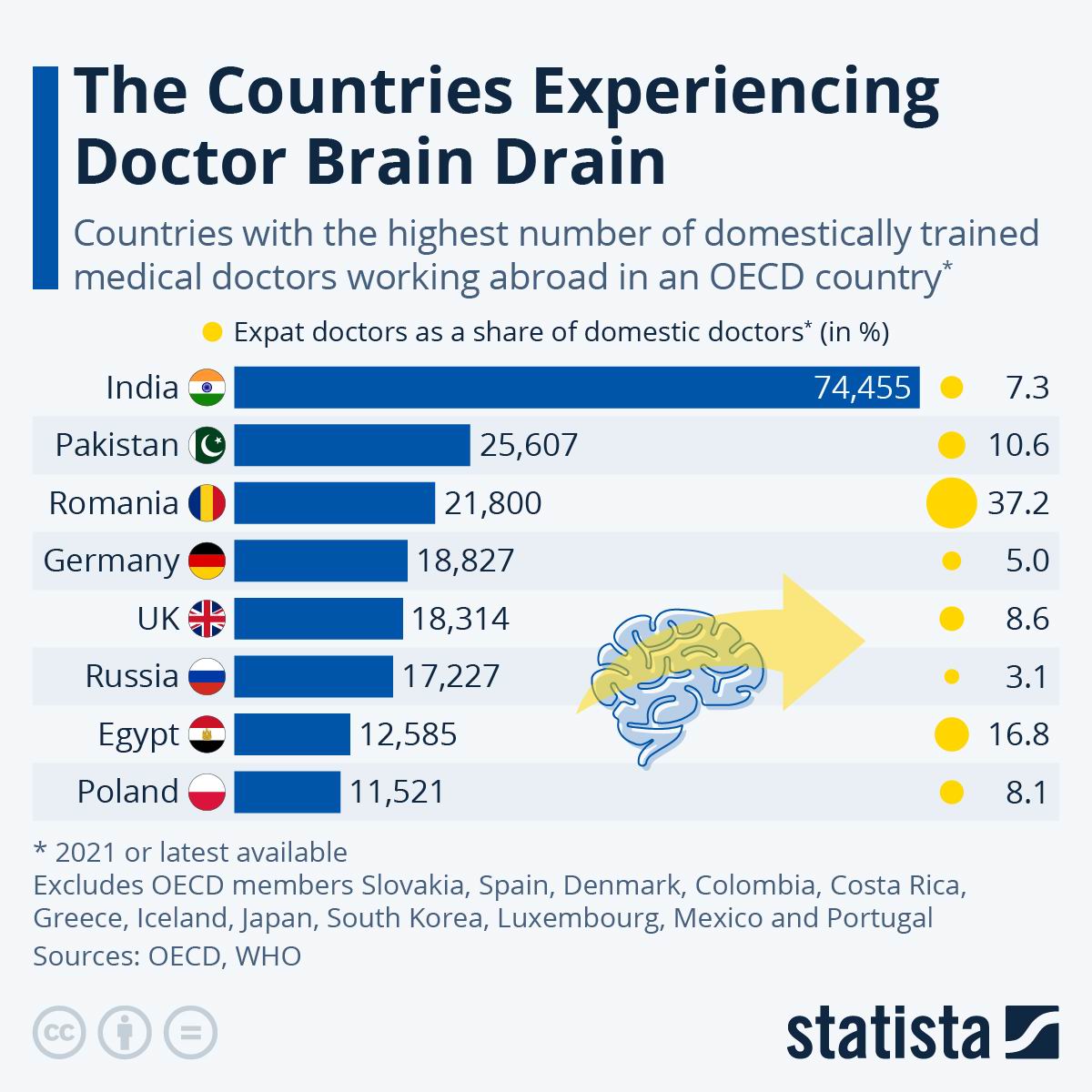
Doctor Brain Drain. Source: Statista

Pakistani-American doctors make up the second largest population of foreign doctors in America. And they are quite successful. For example, Dr. Mansoor Mohiuddin, a 1989 graduate of Karachi's Dow Medical College, made global headlines when he implanted a pig heart in a patient at University of Maryland School of Medicine. Considered one of the world’s foremost experts on transplanting animal organs, known as xenotransplantation, Muhammad M. Mohiuddin, MD, Professor of Surgery at UMSOM, joined the UMSOM faculty five years ago and established the Cardiac Xenotransplantation Program with Dr. Griffith. Dr. Mohiuddin serves as the program’s Scientific/Program Director and Dr. Griffith as its Clinical Director.    

Top Countries of Origin of Foreign Doctors in the US. Source: OECD


The pervasive presence of South Asian doctors in the United States is confirmed by OECD (Organization for Cooperation and Development) statistics on foreign doctors in OECD member nations. While India has remained the top source of foreign doctors since 2013, Pakistan has moved up from third to second spot in this period.  As of 2016, there were  45,830 Indian doctors  and 12,454 Pakistani doctors among 215,630 foreign doctors in the United States. India (45,830) and Pakistan (12,454) are followed by Grenada (10,789), Philippines (10,217),  Dominica (9,974), Mexico (9,923), Canada (7,765), Dominican Republic (6,269), China (5,772), UAE (4,635) and Egypt (4,379). 

In percentage terms, 21% of foreign doctors come from India, 6% from Pakistan, 5% each from Grenada, Philippines and Dominica and 4% from Mexico.

Pie Chart of Origins of Foreign Medical Graduates in US. Source: OECD


Many of these "foreign doctors" are US citizens, born and raised in the United States, who travel abroad to study at foreign medical schools. Their reasons vary from ease of admissions to lower costs. This is particularly true of the medical schools  in the Caribbean nations.  

Many Caribbean nations have established medical schools to especially cater to the demand from the United States. In 2007, Pakistan, too, set up Dow International Medical College as part of Dow University of Health Science (DUHS). 

Indians and Pakistanis also make up the top two nationalities among 66,211 foreign doctors in the United Kingdom. There are 18,953 doctors from India, 8,026 from Pakistan, 4.880 from Nigeria and 4,471 from Egypt in the UK.

The list of 25,400 foreign doctors in Canada is topped by South Africans (2,604) followed by Indians (2,127), Irish (1,942), British (1,923), Americans (1,263) and Pakistanis (1,087). 

There are 25,607 Pakistani medical school graduates currently working in all of the OECD member countries which are considered the rich industrialized nations. These Pakistani doctors account for 10.6% of 242,000 Pakistan-trained doctors practicing now. 74,455 Indian doctors working in OECD nations make up 7.3% of about 1,020,000 of all India-trained doctors in practice. 

In spite of losing 10.6% of its doctors to "brain drain" compared to India's 7.3%, Pakistan still has more doctors per capita (1.1 per 1000 population) than India (0.7 doctors per 1000 population), according to the World Bank.  Pakistani medical colleges admit 16,000 students a year compared to 92,000 in India.

As the populations age and demand for medical services grows in the West, more and more of it is being met by recruiting health care workers, including doctors and nurses, from the developing world. 

Related Links:

Haq's Musings

South Asia Investor Review

Pakistani-American Health Professional Featured in Netflix Documentary "Pandemic"

Pakistan is the 3rd Largest Source of Foreign Doctors in America

Pakistani-Americans Largest Foreign-Born Muslim Group in Silicon Valley

Racial Slurs Hurled at Pakistani-American Doctor in St. Louis, Missouri

Islamophobia in America

Silicon Valley Pakistani-Americans

Pakistani-American Leads Silicon Valley's Top Incubator

Silicon Valley Pakistanis Enabling 2nd Machine Revolution

Pakistani-American Surgeon Implants Pig Heart in Human

Pakistani-American Ashar Aziz's Fire-eye Goes Public

Pakistani-American Doctor Honored By President Obama

Pakistani-American's Game-Changing Vision 

Minorities Are Majority in Silicon Valley 

Over A Million Pakistani University Students Enrolled in STEM Fields


Saturday, March 14, 2026

India Hosts "Proud Islamophobe" Laura Loomer in New Delhi

Self-described "Proud Islamophobe" Laura Loomer was invited to speak this weekend at India Today Conclave, an annual conference sponsored by an Indian publication. Her speech focussed on what she called "Islamic Terrorism". She also apologized for anti-India racists X posts. To further please her Indian audience, she also engaged in Pakistan bashing. "Pakistan's biggest export to the world is Islamic terrorism, and I don't believe the US should be cozying up to the Pakistani government at all," she said. 

Loomer is known to be very close to President Donald Trump. In her social media posts, she is also known for viciously attacking India and Indians almost as much as Muslims. But at the conference in Delhi, she apologized for her anti-India posts. She also deleted most or all such posts prior to showing up in India. 

A Collage of Laura Loomer's anti-India Posts. Source: OpIndia


Loomer has described Indians as “third-world invaders” and questioned their place in the United States, claiming that America was built by “white Europeans.” She also mocked India’s sanitation practices. In one of the widely shared X messages, she questioned why Indians “still [defecate] in the water they bathe and drink from,” while another post mocked Indian immigrants as so-called “high-skilled” workers who supposedly come from a country without basic facilities. In her posts, she has referred to the “rape culture” in India. She asserts that Indians have a low IQ of just 76. 

It was her "proud Islamophobe" label and her views on "Islamic terrorism" that attracted many Indians to find her fit to be given a spotlight in the Indian capital. When X briefly made users’ countries of origin public, several prominent pro-Israel accounts were found to be run from India, according to France24

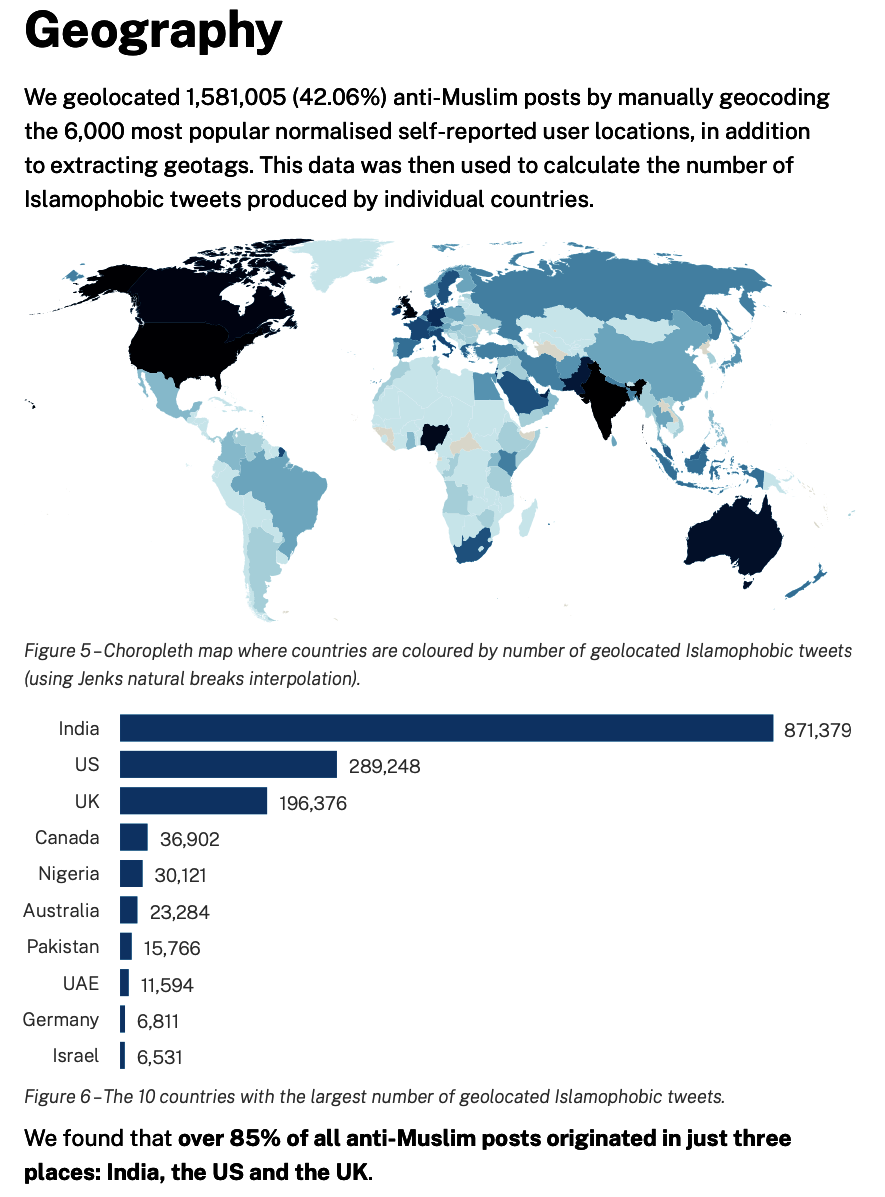
India has just 5.75% of global Twitter users but the country accounts for 55% of all anti-Muslim tweets, according to a report entitled "Islamophobia in the Digital Age" published by the Islamic Council of Victoria (ICV) in 2022. It also found that the US, the UK, and India contributed a staggering 86% of anti-Muslim content on Twitter during a three-year period. It should be noted that both the US and the UK have a sizable  Indian diaspora infected by hateful Hindutva ideology. 

India Accounts For 55% of Islamophobic Tweets. Source: ICV


Individuals and organizations connected to the RSS (Rashtriya Swayamsevak Sangh) are active users of social media. They are working to promote India's divisive Islamophobic politics among the Non Resident Indians (NRIs) and their children. Hundreds of the RSS shakhas (branches) are now found in at least 39 countries around the world. Hindutva is a Hindu supremacist ideology inspired by 20th century Fascism and Nazism in Europe; it is very different from the ancient Hindu faith, according to American history professor Audrey Truschke who teaches Indian history at Rutgers University in the US state of New Jersey. Top Indian economists have raised alarm about it.  

India has only 23 million Twitter users, 5.75% of 400 million Twitter users worldwide, but Indians generate more than half of all Islamophobic tweets in the world.  Numbers published in Twitter’s advertising resources indicate that Twitter had 3.40 million users in Pakistan in early 2022. ICV counted 15,766 Islamophobic tweets geolocated to Pakistan in a three year period.

Executives at Meta, the parent company of Facebook, recently told human rights groups that they wouldn’t release the full India Hate Speech study for their own security. An earlier 2020 company study concluded that Hindutva groups support violence against Muslims and Christians & should be banned from the platform, according to the Wall Street Journal. Here's an excerpt of the Wall Street Journal story:

"Meta has for years faced criticism from rights groups and has been probed by authorities regarding the presence of hate speech on its platforms in India, where more than 300 million people use Facebook and more than 400 million are on its WhatsApp messaging service. Meta has said it invests significantly in technology to find hate speech across languages in India. In 2020, Meta’s safety team concluded that a Hindu nationalist organization in India supported violence against minorities and likely qualified as an organization that should be banned from Facebook, the Journal reported that year. Facebook didn’t remove the group following internal security-team warnings that doing so might endanger both its business prospects and staff in India". 


Tuesday, March 3, 2026

Trump Leads America into an Unpopular War in the Middle East!

President Donald Trump joined Israel in yet another war of choice in the Middle East last week. Polls conducted in the United States immediately after the start of the Iran war show that the majority of Americans do not support it.  A YouGov snap poll fielded Saturday — the day of the strikes — found 34% of Americans approve of the U.S. attacks on Iran, with 44% disapproving and 22% unsure. A CNN poll done soon after found that 59% of Americans disapprove of the war. 

59% of Americans Disapprove of the Iran War. Source: CNN


It appears that President Trump has caved in to pressure from the Israelis to go to war against Iran, a fact confirmed by US Secretary of State Marco Rubio. In answer to a question, Rubio essentially admitted that Israel forced the US into war with Iran. 'There absolutely was an imminent threat,' Rubio said. 'And the imminent threat was that we knew that if Iran was attacked (by Israel), and we believed they would be attacked, that they would immediately come after us, and we were not going to sit there and absorb a blow before we responded.' 

Majority of Americans Disapprove of Iran War. Source: YouGov


Support for prior US wars in the Middle East such as the Iraq war started in the low-mid 70% range in the beginning. Trump is starting at half of that in his attack on Iran — lower than where the average American was in 2013. It's clear that Americans' support for wars in the Middle East has rapidly declined. 

President Trump's MAGA base is particularly incensed by what they see as abandonment of the "America First" promise he made during his presidential campaign in 2024. Many of them now accuse him of pursuing "Israel First" policies at the expense of ordinary Americans.  

"Absolutely disgusting and evil," Tucker Carlson said about the joint US-Israel attack in an interview with ABC News. "This is going to shuffle the deck in a profound way."

"The Trump admin actually asked in a poll how many casualties voters were willing to accept in a war with Iran??? How about ZERO you bunch of sick (expletive) liars. We voted for America First and ZERO wars," said former Rep. Marjorie Taylor Greene, as she blasted the administration on US social media company X.

"We said ‘No More Foreign Wars, No More Regime Change!’ … Trump, (Vice President JD) Vance, basically the entire admin campaigned on it and promised to put America FIRST and Make America Great Again (MAGA)," she added.

Other MAGA figures joined the criticism, with podcaster Tim Pool and influencers Keith and Kevin Hodge writing, "President Trump has completely LIED to his voters, backstabbed our country and has disgraced his legacy beyond repair," reported TRT World

One of the most effects of this war will most likely be on energy prices which have begun to spike already. Energy prices affect all other prices, fueling broader inflation. Rising prices will hurt the entire economy but their negative impact will particularly be felt by middle class households. 

The average price for a gallon of regular gas is just shy of $3 right now, according to AAA, as reported by Marketplace. Tom Kloza, chief analyst at Gulf Oil, told Marketplace that “we’re gonna go in relatively short order to about $3.10 to $3.25,” he said. But if the conflict with Iran continues deeper into March and April, Kloza said prices might peak as high as $3.50 a gallon.

AIPAC, the powerful Israel lobby, is starting to lose its political power and influence in the United States. Several Congressional Democrats have recently refused campaign contributions from AIPAC, the powerful Israel lobby, according to media reports. “Democrats who once counted AIPAC among their top donors have in recent weeks refused to take the group’s donations”, says a New York Times story titled  "Democrats Pull Away From AIPAC, Reflecting a Broader Shift".  “AIPAC is becoming an increasingly toxic brand for some Democrats on Capitol Hill," it says.  It cites the example of Rep. Hakeem Jeffries, D-N.Y., the minority leader, who has long been endorsed by the hardline AIPAC, has now chosen to accept the support of J Street, the competing Israel lobby that advocates a two-state solution. 

Results of Recent Poll of American Jews. Source: Washington Post


A recent poll conducted by the Washington Post has found that  "most (American) Jews (61%) say Israel is committing war crimes — and 39% say genocide — while often distinguishing between the country and its leadership".  American Jews are particularly unhappy with the current right-wing government of Israel.  68% give negative marks to Prime Minister Benjamin Netanyahu’s leadership of Israel, with 48% it “poor” — a 20-percentage-point jump from a Pew Research Center poll five years ago. 

Mamdani's resounding win in New York City, a city that has the world's second largest Jewish population after Tel Aviv, is particularly significant. It sends a clear message to American politicians, particularly Democrats, that they don't have to bow to hardline AIPAC to win elections. 

Although the rebellion against AIPAC is mainly among Democrats, there's also growing anger among Trump's "America First" base who see the Trump Administration's policies as "Israel First". Prominent among Republican critics of Trump's pro-Israel policies are Republican Representatives Thomas Massie and Marjorie Taylor Greene, talk show host Tucker Carlsen and former Trump advisor Steve Bannon. 

Jonathan Greenblatt, the CEO of Anti-Defamation League, has blamed the shift in the US public opinion against Israel on popular social app TikTok.  “We really have a TikTok problem, a Gen Z problem,” he said in a leaked audio recording. “The same brains that gave us Taglit, the same brains that gave us all of these amazing other innovations, need to put our energy towards this, like fast.”  

TikTok is particularly popular among young people. It has carried viral short videos of the Gaza Genocide over the last two years. The pressure from the Israel lobby forced the sale of Chinese-owned TikTok to an American Zionist group led by Oracle's billionaire founder Larry Ellison. Ellison has given tens of millions of dollars to pro-Israel groups. He is reported to be among the six American Zionist billionaires supporting Israel's wartime economy. 


Related Links:


Haq's Musings

South Asia Investor Review

Modi and Netanyahu: Two Sides of the Same Coin

Israel's Gaza Attack is Criminal, Not Defensive

Congressman Massie Exposes Israel Lobby's Bullying Tactics

American College Campuses Rise Up Against Israel's Genocidal War on Gaza

Israeli Settler Colonialism

Islamophobia Driving US Policy in the Middle East and South Asia?

Israeli Scholars Offer Insights into Zionist Psyche

Total, Extended Lockdown in Indian Occupied Kashmir

What is India Hiding From the UN Human Rights Team?

Indian JNU Professor on Illegal Indian Occupation of Kashmir, Manipur, Nagaland

Riaz Haq Youtube Channel

PakAlumni: Pakistani Alumni Social Network