Showing posts with label current account deficit. Show all posts

Tuesday, July 22, 2025

Which Country is a Bigger Beggar? India or Pakistan?

Most countries in the world today borrow money from various sources to finance their budget deficits. So do India and Pakistan. So why is it that only Pakistan's borrowing money gets labeled "begging"? Is it not begging when India borrows a lot more money than does Pakistan? Or is it that only borrowing money from the IMF qualifies as "begging"? Let's look into this double standard.  Currently, India's public debt to GDP ratio is 80% while Pakistan's is about 74%. India's private debt to GDP ratio is 17%, twice that of Pakistan. Do these figures mean that India is a bigger beggar than Pakistan? 


Debt-to-GDP Ratios Around the World. Source: Visual Capitalist


India is consistently among the largest borrowers from International Financial Institutions (IFIs), particularly the World Bank and the Asian Development Bank (ADB). It has been the top debtor to the World Bank for several years and a major borrower from the ADB.  India’s outstanding loan balance with the World Bank is almost double that of the next biggest debtor, Indonesia, which owed the bank $22.2 billion. Pakistan and Bangladesh followed with just short of $20 billion and $19.8 billion, respectively.  India is also the largest borrower from the Asian Development Bank (ADB). Since 1986, when ADB began lending to India, it has approved many loans, grants, and technical assistance totaling $55.3 billion.


Top Debtors to World Bank 2025. Source: Visual Nerd

One key difference between the two South Asian neighbors is the frequency with which Pakistan has been borrowing from the International Monetary Fund, known as the lender of last resort.  Pakistani economic managers have had a poor track record of managing hard currency reserves that the country needs to import what it lacks. Pakistani exports have failed to keep pace with its rising imports. This situation creates a crisis situation every few years and it forces the country to ask the IMF to lend its US dollars.  Currently, Pakistan ($6.3 billion) is IMF's 5th highest debtor after  Argentina ($31.1 billion), Ukraine ($10.19 billion), Egypt ($8.6 billion) and Ecuador ($6.6 billion). The only saving grace is the rapid growth in remittances from the Pakistani diaspora. In the last fiscal year that ended in June, 2025, overseas Pakistanis sent home $38.3 billion, representing 27% growth from the prior fiscal year. It helped Pakistan achieve a current account surplus of $2.1 billion, compared to a current account deficit of $2.1 billion in the previous fiscal year. 


Global Income Levels By Country. Source: Visual Capitalist


Top IMF Debtor Nations. Source: IntelPoint


Pakistan's average economic growth of 5% a year has been faster than the global average since the 1960s, it has been slower than that of its peers in East Asia. It has essentially been constrained by Pakistan's recurring balance of payment (BOP) crises as explained by Thirlwall's Law. Pakistan has been forced to seek IMF bailouts 14 times in the last 75 years to deal with its BOP crises. This has happened in spite of the fact that remittances from overseas Pakistanis have grown 38X since 2000. Every time Pakistan has faced a balance of payments crisis, the result has been massive currency devaluation, high inflation and slower growth for a period of multiple years. The best way for Pakistan to accelerate its growth beyond 5% is to boost its exports by investing in export-oriented industries, and by incentivizing higher savings and investments. 

Related Links:

Haq's Musings

South Asia Investor Review

New Infrastructure Brings Socioeconomic Development to Thar Desert

Pakistan Revives Reko Diq Mining Project

Kachhi Canal and N-70 Projects Boost Pakistan's Balochistan

Iftikhar Chaudhry Scared Away Foreign Investors

Musharraf Earned Legitimacy by Good Governance

Vindictive Judges Pursue Musharraf

Rare Earths at Reko Diq?


Sunday, July 10, 2022

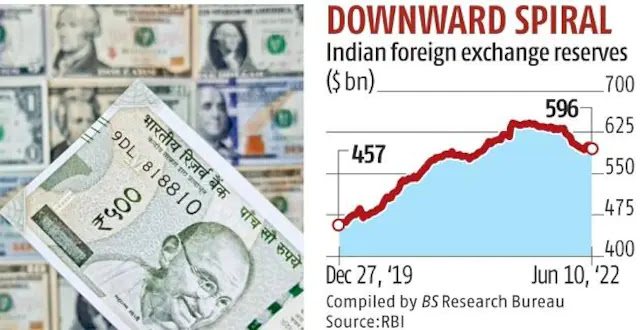
India's Forex Reserves Fall As Foreign Investors Head For The Exits

India's foreign exchange reserves are falling rapidly as foreign investors flee and the country's trade and current account deficits widen. More than $267 billion worth of India's external debt of the total $621 billion is due for repayment in the next nine months. This repayment is equivalent to about 44% of India's foreign exchange reserves. This combination of investors' exodus, widening twin deficits and short-term debt repayments has caused the Indian rupee to hit new lows. Unlike China and other nations that have accumulated large reserves by running trade surpluses, India runs perennial trade and current account deficits. The top contributor to India's forex reserves is debt which accounts for 48%. Portfolio equity investments known as “hot” money or speculative money flows account for 23% of India's forex reserves, according to an analysis published by The Hindu BusinessLine

India's Declining Forex Reserves. Source: Business Standard


Investor Exodus: 

Foreign portfolio investors have pulled out a whopping $33.5 billion from equity and $2.1 billion from debt segments of Indian financial markets, for a total net outflow of $35.6 billion from October 2021 to June 2022,  according to data compiled by the National Securities Depository Limited. In the first half of this calendar year, the total net outflows were $29.7 billion. 

It's not just the FPIs leaving India; a number of multinational companies are also pulling foreign direct investment (FDI) from India. Several big names including German retailer Metro AG, Swiss building-materials firm Holcim, US automaker Ford, UK banking major Royal Bank of Scotland, US motorcycle manufacturer Harley-Davidson and US banking behemoth Citibank have chosen to pull the plug on their operations in India or downsize their presence in recent years. 

Widening Deficits: 

India's finance ministry has warned of a growing twin deficit problem, with higher commodity prices and rising subsidy burden leading to an increase in both the fiscal and current account deficits. India's June trade deficit widened to a record high of $25.63 billion, mainly due to a rise in crude oil and coal imports, from $9.61 billion a year earlier.  India's April-May fiscal deficit was $25.8 billion. 

Summary:

India's current level of forex reserves is enough for less than 10 months of imports projected for 2022-23. But the country has had a structural current account deficit which has been funded by large capital inflows. The accumulation of forex reserves has been due to surplus in the capital account. Since late February, the foreign exchange reserves have declined by $36 billion. India still has large forex reserves but its economy is in the same boat as other emerging markets that run large and worsening trade and current account deficits. With declining forex reserves, India is likely to face headwinds as the US Federal Reserves raises interest rates to fight inflation. 

Related Links:


Haq's Musings

South Asia Investor Review

India in Crisis: Unemployment and Hunger Persist After COVID waves

Naya Pakistan Housing Program

Food in Pakistan 2nd Cheapest in the World

Western Money Keeps Indian Economy Afloat

Pakistan to Become World's 6th Largest Cement Producer by 2030

How Has India Accumulated Large Forex Reserves Despite Perennial Trade Deficits?

Pakistan's Computer Services Exports Jump 26% Amid COVID19 Lockdown

Coronavirus, Lives and Livelihoods in Pakistan

Vast Majority of Pakistanis Support Imran Khan's Handling of Covid19 Crisis

Pakistani-American Woman Featured in Netflix Documentary "Pandemic"

Incomes of Poorest Pakistanis Growing Faster Than Their Richest Counterparts

Can Pakistan Effectively Respond to Coronavirus Outbreak? 

How Grim is Pakistan's Social Sector Progress?

Pakistan Fares Marginally Better Than India On Disease Burdens

Trump Picks Muslim-American to Lead Vaccine Effort

Democracy vs Dictatorship in Pakistan

Pakistan Child Health Indicators

Pakistan's Balance of Payments Crisis

Panama Leaks in Pakistan

Conspiracy Theories About Pakistan Elections"

PTI Triumphs Over Corrupt Dynastic Political Parties

Strikingly Similar Narratives of Donald Trump and Nawaz Sharif

Nawaz Sharif's Report Card

Riaz Haq's Youtube Channel


Saturday, April 13, 2019

Current Debt Crisis Threatens Pakistan's Future

Pakistan is battling massive twin deficits, deteriorating foreign currency reserves, low exports, diminishing tax revenues, a weak currency, unsustainable external debt payments, and soaring sovereign debt. This crisis has forced the country to seek IMF (International Monetary Fund) bailout, the 13th such request in Pakistan's 72 year history.

Pakistan Debt Service: Source SBP
Pakistan's debt repayment costs rose to $5.4 billion for first half of fiscal 2019 ( July 2018-Dec 2018), up from $7.5 billion for the entire fiscal 2018 (July 2017-June 2018), according to the State Bank of Pakistan. At this rate, the total debt service cost for current fiscal 2019 will exceed $11 billion, adding to the nation's debt crisis.

Pakistan's External Debt. Source: Wall Street Journal

This $11 billion debt service cost will add to the projected trade deficit of nearly $40 billion for the current fiscal year. How can Pakistan fund this balance of payments deficit of about $50 billion? Remittances of $21 billion in current FY2019 from Pakistani diaspora are expected to reduce it to $30 billion. PTI government has taken on billions of dollars in loans from Gulf Arabs and China. Given the low rates of foreign investments in the country, a big chunk of the remaining deficit will have to be met by borrowing even more funds which will further increase future debt service costs.

Pakistan's Current Account Deficit. Source: Trading Economics

As a result, Pakistan is now battling massive twin deficits, deteriorating foreign currency reserves, low exports, diminishing tax revenues, a weak currency, onerous external debt payments, and soaring sovereign debt. This crises has forced the country to seek IMF (International Monetary Fund) bailout, the 13th such request in Pakistan's 72 year history.

Pakistan Debt as Percentage of GDP. Source: Trading Economics


In the short term, PTI government's efforts are beginning to pay off. The current account deficit (CAD) in first 8 months of FY2019 (July-Feb 2018) declined to $8.844 billion, down 22.5%, from $11.421 billion in same period last year, according to SBP as reported by Dawn newspaper.

Pakistan's Debt Burden Highest Among 25 Emerging Nations

However, Pakistan's economic woes are far from over. The country's twin deficits are structural. Its exports and tax collections as percentage of its GDP are among the lowest in the world. British civil society organization Jubilee Debt Campaign conducted research in 2017 that showed that Pakistan has received IMF loans in 30 of the last 42 years, making this one of the most sustained periods of lending to any country.

History of Pakistan's IMF Bailouts

Pakistan needs to find a way to build up and manage significant dollar reserves to avoid recurring IMF bailouts. The best way to do it is to focus on increasing the country's exports that have remained essentially flat in absolute dollars and declined as percentage of GDP over the last 5 years. Pakistan's economic attaches posted at the nation's embassies need to focus on all export opportunities in international markets and help educate Pakistani businesses on the best way to take advantage of them. This needs to be concerted effort involving various government ministries and departments working closely with industry groups. At the same time, the new government needs to crack down on illicit outflow of dollars from the country.

Pakistan Debt Service as Percentage (45%) of Budget Among World's Highest 


Azad Labon Ke Sath host Faraz Darvesh discusses Imran Khan's challenges with Misbah Azam and Riaz Haq (www.riazhaq.com)

https://youtu.be/CQ41Qt_2XQM


Related Links:

Haq's Musings

South Asia Investor Review

Pakistan's Debt Crisis

Can Pakistan Avoid Recurring IMF Bailouts?

Pakistan is the 3rd Fastest Growing Trillion Dollar Economy

CPEC Financing: Is China Ripping Off Pakistan?

Information Tech Jobs Moving From India to Pakistan

Pakistan is 5th Largest Motorcycle Market

"Failed State" Pakistan Saw 22% Growth in Per Capita Income in Last 5 Years

CPEC Transforming Pakistan

Pakistan's $20 Billion Tourism Industry Boom

Home Appliance Ownership in Pakistani Households

Riaz Haq's YouTube Channel

PakAlumni Social Network

Thursday, January 31, 2019

Moody's Expects Pakistan's New Mini Budget to Foster Exports and Import Substitution

Pakistan's new government led by Prime Minster Imran Khan has inherited large twin deficits. The new "mini budget" announced by Finance Minister Asad Umar "will support Pakistan’s manufacturing sector, fostering exports and import substitution, and help narrow the current-account deficit",  says a January 31, 2019 report by Moody's investor service.  The report adds that the tax incentives given to manufacturing and exports-oriented industries "will keep Pakistan’s budget deficits wider for longer, potentially eroding the credibility of government efforts to achieve fiscal consolidation."


Pakistan Mini Budget Announced January 23, 2019. Source: Shajar Capital

Here's an excerpt of Moody's report on the immediate downsides of the measures announced by Umar on January 23, 2019: “We expect the deficit to widen to 6% of GDP in fiscal 2019 because revenue growth is likely to be below government projections, given slower economic growth and the new revenue-based incentives, before gradually narrowing to 5% of GDP by fiscal 2021 as the economy picks up. While we believe the government remains committed to fiscal consolidation, a wider for longer deficit could raise questions over the credibility of its fiscal policy."

Remittances from Pakistan diaspora rose by 10% year on year to $10.71 billion in the first half of fiscal 2019, while goods imports slowed sharply to around 3% year on year as non-energy imports contracted.

Moody's expects "the current-account deficit to narrow to 4.7% of GDP in fiscal 2019 and to 4.2% in fiscal 2020 from 6.1% in fiscal 2018, it will remain sizable and wider than in 2013-16, driving Pakistan’s external financing needs. The government has secured $12 billion in financing from Saudi Arabia and the United Arab Emirates – in each case amounting to $6 billion and divided equally between deposits and deferred oil payments – which is likely to largely cover the country’s net financing needs for fiscal 2019".

Beyond fiscal 2019, however, a net financing gap remains large because of the still sizable current-account deficit. Pakistan remains in negotiations with the International Monetary Fund over a new program that would provide a stable additional source of external financing, as well as technical support and assistance on macroeconomic rebalancing and structural reform policies.

On fiscal deficit front, the report warns that “there is a greater risk of fiscal slippage and slower fiscal consolidation in the absence of further revenue-raising measures. Pakistan’s revenue base was a narrow 15.4% of GDP in fiscal 2018, which ended June 2018.”

Related Links:

Tuesday, January 30, 2018

Pakistan's Debt Crisis: Fact or Fiction?

Pakistan is taking on significant amounts of domestic and foreign debt to finance its budget deficits and to support major energy and infrastructure development projects as part of China-Pakistan Economic Corridor (CPEC).  Over one-third of this public debt is external debt denominated in US dollars, Euros and other hard currencies. At the same time, Pakistan's exports have declined over the last several years and the country's current account deficits have grown.

Pakistan's External Debt. Source: Wall Street Journal

Critics Warnings: 

Critics believe that Pakistan is facing a severe debt crisis. They fear that it could get caught in a big debt trap laid by foreign governments. They warn that Pakistan will go broke. It will be unable to repay these mounting debts. Are they right? To answer this question, Dr. Ishrat Husain, a former central banker and governor of the State Bank of Pakistan, has analyzed Pakistan's debt as of June 30, 2017. Here are some of his key findings:
Pakistan Public Debt-to-GDP Trend. Source: Dr. Ishrat Husain
Total Public and Private Debt:

Pakistan’s total debt and liabilities (TDL) consist of public debt and private debt. Total stock of outstanding debt and liabilities on June 30, 2017 stood at 79% of gross domestic product (GDP). Of this, Gross Public Debt accounted for 85% of the total outstanding or 67.2% of GDP. The remaining 15% is the private debt mostly to borrowers outside the country, for which the government has no fiscal obligation, but the SBP has to provide foreign exchange to service this debt. Within the gross public debt, the government’s share was predominant – almost 92% while the balance was owed by the public enterprises but guaranteed by the government. Borrowing from IMF is also included in gross public debt, although it is a liability of the SBP.

As of June, 2017, Pakistan's total public debt-to-gdp ratio is 67.2%, up from 59% in 2008 and 64% in 2013, according to an analysis by Dr. Ishrat Husain, former governor of the State Bank of Pakistan.  The external debt-to-gdp ratio is 20.7%, down from 28.8% in 2008 and 21.3% in 2013.  Pakistan's external debt to foreign exchange earnings ratio has shot up to 161.9% from 123.9% in 2008 and 121.3% in 2013.
Total Debt Service as Percentage of GDP. Source: Dr. Ishrat Husain

Debt to GDP Ratio:

Public External Debt is lower in 2017 i.e. 20.7% of GDP while it was 27.1% in 2008 and 21.4% in 2013. About 93 pct of the public external debt falls under the category of Medium and Long term while 7% under the short term. Therefore the risk appetite for further short term borrowing to tide over payment difficulties cannot be ruled out as the short term public external debt to SBP reserves ratio is 5.5%. Concessional loans still form more than half of the outstanding stock and commercial loans account for only 1.6 percent of the total.

Debt Service Share of Government Revenue. Source: Dr. Ishrat Husain
Debt Servicing as Percent of GDP:

Pakistan's current debt servicing requires 5.9% of GDP. It is down from 6% in 2008 and 6.9% in 2013.  These percentages are by no means alarming. However, the external debt service component to be repaid in US dollars is of concern because of declining foreign currency earnings.

Debt as Percent of GDP. Infographic Source: Bloomberg


External Debt Repayment: 

A major setback has been caused by stagnation in foreign exchange earnings due to a $ 4 billion drop in export receipts since 2013 .This has raised the EDL (external debt and liabilities) to FEE (foreign exchange earnings) ratio from 121 to 162 in 2017 . There has been some growth in exports in last few months but the pace is unspectacular to make a dent. The other element which is picking up is Foreign Direct Investment but that also won’t be able to lower this ratio significantly. On the fiscal side, almost 24% of government revenues were pre-empted by payments of interest and foreign loan repayments . The average interest rate is down to 6.3 percent with domestic debt being relatively expensive at 8.2 percent.
External Debt as Percentage of Foreign Exchange Earnings. Source: Dr. Ishrat Husain

Summary:

As of June, 2017, Pakistan's total debt-to-gdp ratio is 67.2%, up from 59% in 2008 and 64% in 2013, according to an analysis by Dr. Ishrat Husain, former governor of the State Bank of Pakistan.  The external debt-to-gdp ratio is 20.7%, down from 28.8% in 2008 and 21.3% in 2013. Pakistan's current debt servicing requires 5.9% of GDP. It is down from 6% in 2008 and 6.9% in 2013.  These percentages are by no means alarming. However, the external debt service component to be repaid in US dollars is of concern because of declining foreign currency earnings.  Pakistan's external debt to foreign exchange earnings ratio has shot up to 161.9% from 123.9% in 2008 and 121.3% in 2013. Of these, the critics are absolutely right about the last one---the ratio of external debt to foreign exchange earnings. Pakistan has to heed their warnings and urgently address its declining exports and rising current account deficits to avoid the potential external debt trap.

Related Links:

Haq's Musings

Pakistan is the 3rd Fastest Growing Trillion Dollar Economy

CPEC Financing: Is China Ripping Off Pakistan?

Information Tech Jobs Moving From India to Pakistan

Pakistan is 5th Largest Motorcycle Market

"Failed State" Pakistan Saw 22% Growth in Per Capita Income in Last 5 Years

CPEC Transforming Pakistan

Pakistan's $20 Billion Tourism Industry Boom

Home Appliance Ownership in Pakistani Households

Riaz Haq's YouTube Channel

PakAlumni Social Network