Showing posts with label Semiconductors. Show all posts

Wednesday, March 23, 2022

Russia Sanctions: Taiwan's TSMC Joins Western Ban on Technology For Moscow

Taiwan Semiconductor Manufacturing Company (TSMC) will no longer fabricate computer chips for Russia, according to media reports. The ban will particularly affect Russia's Elbrus and Baikal processors, unless China agrees to step in to manufacture these chips, and risk additional US sanctions itself. Both Russian processors use mature 28 nm technology. The world's most advanced TSMC fabrication technology today is 5 nanometers. The best US-based Intel can do today is 7nm technology. China's SMIC (Semiconductor Manufacturing International Corporation) has the capability to produce chips using 14 nm technology.  Semiconductor chips form the core of all modern systems from automobiles to airplanes to smartphones, computers, home appliances, toys, telecommunications and advanced weapons systems.  

Top 10 Semiconductor Chip Producing Countries. Source: Comtrade Database

China is the world's biggest producer of semiconductor chips, according to data from the United Nations. The electronics value chain, which includes consumer electronics and ICT, has been regionalized over the years, and China has become a major global production center for microelectronics, according to a report in Opportimes. Other major producers include South Korea, Singapore, Malaysia, the United States, Japan, Germany, the Philippines, the Netherlands, and Thailand. In particular, the statistics for China add up the production of Hong Kong and Macao. 

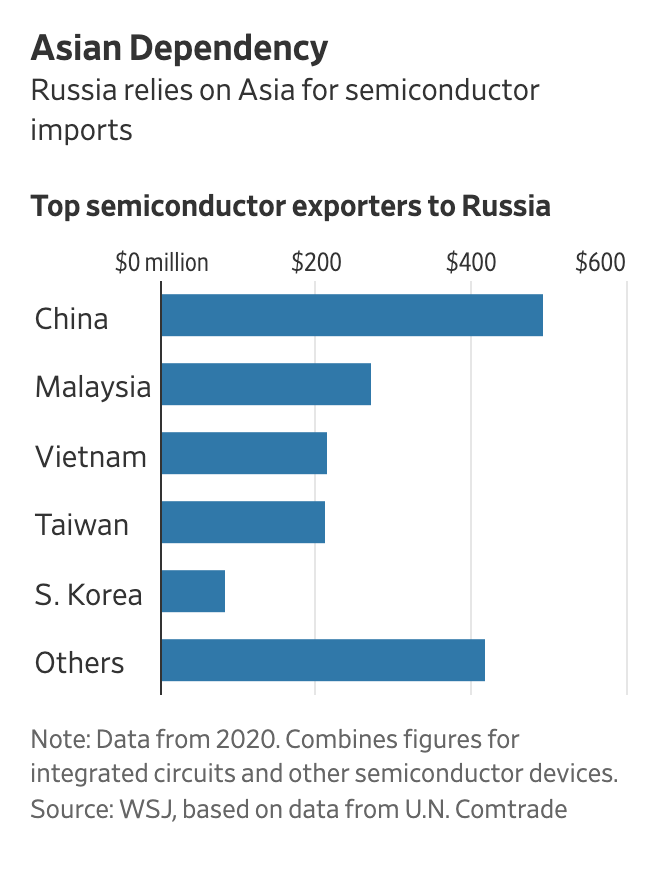
Russia's Semiconductor Imports. Source: WSJ

While China is the  biggest volume producer of semiconductor components in the world,  the Chinese design centers and fabs rely on tools and equipment supplied by the West to deliver products. Western companies dominate all the key steps in this critical and highly complex industry, from chip design (led by U.S.-based Nvidia, Intel, Qualcomm and AMD and Britain’s ARM) to the fabrication of advanced chips (led by Intel, Taiwan’s TSMC and South Korea’s Samsung ) and the sophisticated machines that etch chip designs onto wafers (produced by Applied Materials and Lam Research in the U.S., the Netherlands’ ASML Holding and Japan’s Tokyo Electron ), according to the Wall Street Journal

East vs West Economic Output. Source: Wall Street Journal


There is no question that the current western technology sanctions can seriously squeeze Russia. However, overusing such sanctions could backfire in the long run if the US rivals, particularly China and Russia, decide to invest billions of dollars to build their own capacity. This would seriously erode western technology domination and result in major market share losses for the US tech companies, particularly those in Silicon Valley. 

Related Links:

Haq's Musings

South Asia Investor Review

Pakistani-American Banker Heads SWIFT, the World's Largest Interbank Payment System

Pakistani-Ukrainian Billionaire Zahoor Sees "Ukraine as Russia's Afghanistan"

Ukraine Resists Russia Alone: A Tale of West's Broken Promises

Ukraine's Lesson For Pakistan: Never Give Up Nuclear Weapons

Has Intel's Indian Techie Risked US Lead in Semiconductor Technology?

US-China Tech Competition

Can Pakistan Benefit From US-China Tech War?

Ukraine's Muslims Oppose Russia


Tuesday, August 4, 2020

Global Geopolitics: US-China Technology War; India's Regional Isolation; Pakistan's Ties With China, US

Is US-China technology war heating with Huawei ban? Is it part of the larger geopolitical landscape pitting the US as the established superpower against China as the new rising power? Is the fight over Huawei 5G merely a symptom of it? How will it affect global peace and the economy of the world?

Why has Intel fallen behind TSMC in semiconductor technology which is fundamental to computers, communications and other related technologies?  Is it just the fault of recently fired Indian-American technology executive at Intel? Why is US forcing TSMC to not manufacture chips for Huawei? Is this just an attempt to China's rise in technology?

Are India's regional ties with Bangladesh and Iran fraying? Will Iran-Pakistan ties improve?Why is China building a regional quad with Afghanistan, Nepal and Pakistan? Is it aimed at India and its quad with Australia, Japan and US? Will Pakistan be forced to choose sides between US and China?

Viewpoint From Overseas host Faraz Davesh discusses these questions with Misbah Azam and Riaz Haq (www.riazhaq.com).

https://youtu.be/DLMloNMVwCs


Related Links:

Haq's Musings

South Asia Investor Review

Can Pakistan Benefit From US-China Trade War

US-China Battle For Influence in Pakistan

Digital BRI: China and Pakistan Building Info Highway With 5G, Fiber

Caste Discrimination Among Indian-Americans in Silicon Valley

Has Intel's India-American Techie Jeopardized US Technology Leadership? 

Marvel Pays $7.5 Billion For Cavium Co-Founded by Pakistani-American

OPEN Silicon Valley Forum 2017: Pakistani Entrepreneurs Conference

Pakistani-American's Tech Unicorn Files For IPO at $1.6 Billion Valuation

Pakistani-American Cofounders Sell Startup to Cisco for $610 million

Pakistani Brothers Spawned $20 Billion Security Software Industry

Pakistani-American Ashar Aziz's Fireeye Goes Public

Pakistani-American Pioneered 3D Technology in Orthodontics

Pakistani-Americans Enabling 2nd Machine Revolution

Pakistani-American Shahid Khan Richest South Asian in America

Two Pakistani-American Silicon Valley Techs Among Top 5 VC Deals

Pakistani-American's Game-Changing Vision 

Wednesday, July 29, 2020

Has Intel's Indian-American Techie Risked America's Global Technology Leadership?

Intel has recently fired its Indian-American chief engineer Venkata Murthy Renduchintala, who also served as Group President of the Technology, Systems Architecture and Client Group (TSCG), for failure to deliver 7 nanometer semiconductor technology on schedule, according to Reuters.  The news has knocked the market value of Intel by tens of billions dollars. The American company, the biggest global chip manufacturer with in-house fabrication plants, has also decided to outsource manufacturing. This could deal a serious blow to America's global leadership in chip manufacturing which is fundamental to all other computer and communications related technologies.


Intel's Global Leadership:

Intel Corp. (INTC), founded in 1968 in Silicon Valley, is the world's largest and the most advanced semiconductor company, larger than the second-ranked Samsung Semiconductors, and more than triple the size of the next-largest domestic producer, Qualcomm Inc. (QCOM).

What distinguishes Intel from most other semiconductor companies is that it manufactures its products in-house. The bulk of semiconductor “manufacturers” outsource the actual work of building their products out to foundries in China and Taiwan.

Last week, the company revealed that its smaller, faster 7-nanometer chipmaking technology was at least six months behind schedule and it would have to outsource manufacturing to keep its products competitive.

Taiwan Semiconductor Manufacturing Company (TSMC):

Taiwan-based TSMC has 6 nanometer technology in production already. There is widespread speculation that Intel will turn to it to manufacture its most advanced microprocessors.

TSMC manufactures chips for the vast majority of the leading fabless semiconductor companies including Advanced Micro Devices (AMD), Apple Inc., Broadcom Inc., Marvell, Nvidia, and Qualcomm.

US Technology Leadership Under Threat:

Semiconductor manufacturing technology is fundamental to all other computer and communications technologies. While the U.S. still has most of the leading chip design companies, there are very few leading semiconductor manufacturing facilities in the country. In fact, the US, which invented the chip technology,  has slipped from being first in semiconductor manufacturing at the dawn of the industry to fifth in the world.

Recognizing the issue of foreign sourcing of critical technologies, the US has forced TSMC to start a fab in Arizona.  But TSMC’s proposed fab in Arizona will have relatively small capacity, sufficient to meet only a fraction of the manufacturing demand of top companies like Apple, AMD, Marvell, Nvidia, etc.  The US Congress is in the process of legislation that will provide greater incentives to companies to manufacture chips in the United States.

US-China Tech War:

TSMC is caught in the cross-fire of US-China technology war.  Almost all major semiconductor manufacturers, including TSMC, rely on equipment made by US companies. The US government is attempting to leverage the dominance of US chipmaking equipment industry to shut out the Chinese technology companies.

US Commerce Department has recently announced that henceforth, any semiconductor chips made with equipment built by American companies cannot be sold to Huawei without prior approval and license from the DOC.

Summary:

Silicon Valley tech giant has revealed that its smaller, faster 7-nanometer chipmaking technology is at least six months behind schedule and it would have to outsource manufacturing to keep its products competitive. The company has blamed the failure on its Indian-American chief engineer who has since been fired. What is at stake here is the US technology leadership because semiconductors are fundamental to all computers and communications products. Taiwan-based TSMC appears to be the biggest beneficiary of Intel's failure.

Related Links:

Haq's Musings

South Asia Investor Review

Can Pakistan Benefit From US-China Trade War

Caste Discrimination Among Indian-Americans in Silicon Valley

Marvel Pays $7.5 Billion For Cavium Co-Founded by Pakistani-American

OPEN Silicon Valley Forum 2017: Pakistani Entrepreneurs Conference

Pakistani-American's Tech Unicorn Files For IPO at $1.6 Billion Valuation

Pakistani-American Cofounders Sell Startup to Cisco for $610 million

Pakistani Brothers Spawned $20 Billion Security Software Industry

Pakistani-American Ashar Aziz's Fireeye Goes Public

Pakistani-American Pioneered 3D Technology in Orthodontics

Pakistani-Americans Enabling 2nd Machine Revolution

Pakistani-American Shahid Khan Richest South Asian in America

Two Pakistani-American Silicon Valley Techs Among Top 5 VC Deals

Pakistani-American's Game-Changing Vision 
Friday, October 11, 2019

Invest in Pakistan Summit: Can Pakistan Benefit From US-China Tech War?

About 200 Pakistani-American and other American investors met at Invest in Pakistan Summit in Silicon Valley on October 3, 2019 at San Jose Sheraton. It was hosted by the Pakistan Embassy in Washington DC. One of the sessions I found interesting dealt with the opportunities presented to Pakistan by US-China technology war sparked by US President Trump's actions against Chinese technology giants Huawei and ZTE.  In response to the US threat to restrict access to American core technology, China is aiming to develop and produce 40% of the semiconductors it uses by 2020 and 70% by 2025, according to Washington-based CSIS report. It is estimated that China needs about 500,000 engineers to achieve this goal. Can Pakistan, a reliable Chinese ally, train and provide some of these engineers?


US-China Tech War:

The technology war between the United States and China has been going on with the roll-out of the 5G next generation broadband wireless technology.  China has developed its 5G technology in an attempt to become independent of the technology developed and controlled by companies in the United States and other western nations.  US has been actively trying to stop adoption of Chinese company Huawei's 5G technology in Europe, East Asia, Australia and New Zealand. So far, the US has had limited success while China's Huawei is continuing to win customers around the world.


Tech Supply Chain Bifurcation:

President Trump has also attempted to block Chinese companies' access to semiconductor components and software developed and sold by US companies. Both Huawei and ZTE have been riding a roller coaster with President Trump's daily tweets on this issue. It has affected reliable access to communication chips, Android operating systems and Google apps store.

The net result of it is that the Chinese have lost faith in US companies' reliability. They are now seeking to to create their own supply chain free of companies from US and its close allies in Europe, East Asia and elsewhere.


China's Plans:

China is currently a net importer of technology. The country wants to move “up the value chain” from final product assembly using imported components to creating advanced technology in China itself, but imports of chips and technology will be the norm for many years to come, according to a report by James Lewis of Center for Strategic and International Studies (CSIS) based in Washington DC.

As of now, only 16% of the semiconductors used in China are produced domestically, and only half of these are made by Chinese firms. It is dependent on foreign suppliers for advanced chips. China aims to produce 40% of the semiconductors it uses by 2020 and 70% by 2025, according to the CSIS report.


Opportunity For Pakistan:

China will need 500,000 engineers trained in chip development over the next 5 years to meet its goal of producing 70% of semiconductors within the country, according to Pakistani-American entrepreneur Dr. Naveed Sherwani who presented at the Invest in Pakistan Summit in Silicon Valley.

Naveed and his wife Sabahat Rafiq see this as an opportunity to train a significant number Pakistani engineers in semiconductor chip development to meet China's needs. This will help develop Pakistan's tech-oriented human capital and open up the possibility for Pakistan to build its own chip design and development industry.

Sabahat said she is already training some engineers at an institute in Lahore for this purpose.  She is hoping to expand it to accommodate more trainees in near future.

Naveed currently heads SiFive, a Silicon Valley startup specializing in RISC V microprocessor cores for customized systems on chip (SoC) development.  RISC V is an open source chip architecture developed at UC Berkeley. It is the hardware equivalent of open source Linux OS software.  Naveed is promoting SiFive in both China and Pakistan for "low-power embedded microcontrollers (as small as 13.5k gates) to multi-core applications processors".

Cloud Design:

Naveed talked about the availability of cloud-based advanced chip design tools that Pakistani chip designers can take advantage of. Among the top vendors offering such tools is  Amazon Web Services (AWS).

AWS says it "offers a secure, agile, and scalable platform with a comprehensive set of services and solutions for high performance design, verification, and smart manufacturing, supporting electronic design automation (EDA) and rapid semiconductor innovation in the cloud. Semiconductor companies, including fabless and integrated device manufacturers, and their IP and foundry partners can benefit from the massive scale of AWS infrastructure to design next gen connected products".

Here's how AWS describes its cloud-based chip design tools offering:

"Semiconductor design simulation, verification, lithography, metrology, yield analysis, and many other workloads benefit from the scalability and performance of the AWS Cloud. For example, compute performance for these applications is enhanced by latest generation EC2 instance types, including the z1d. Run more jobs per core with z1d, the fastest single thread performance of any cloud instance delivering 4GHz sustained CPU, 16 GiB RAM per core, and local NVMe storage. Our virtually unlimited cloud storage and high performance computing (HPC) capability enable you to innovate faster, rapidly design and verify new products, and scale seamlessly to meet increasing demand".

Summary:

US-China technology war has recently been triggered by US President Trump's actions against Chinese technology giants Huawei and ZTE.  In response to the US threat to restrict access to American core technology, China is aiming to develop and produce 40% of the semiconductors it uses by 2020 and 70% by 2025, according to the CSIS report. China needs about 500,000 engineers to achieve this goal. Can Pakistan, a reliable ally, train and provide some of these engineers? Pakistani-American entrepreneur Dr. Naveed Sherwani and his wife Sabahat Rafiq believe the answer is an emphatic Yes. This will help develop Pakistan's tech-oriented human capital and open up the possibility for Pakistan to build its own chip design and development industry.


Related Links:

Haq's Musings

South Asia Investor Review

Pakistanis in China

Marvel Pays $7.5 Billion For Cavium Co-Founded by Pakistani-American

OPEN Silicon Valley Forum 2017: Pakistani Entrepreneurs Conference

Pakistani-American's Tech Unicorn Files For IPO at $1.6 Billion Valuation

Pakistani-American Cofounders Sell Startup to Cisco for $610 million

Pakistani Brothers Spawned $20 Billion Security Software Industry

Pakistani-American Ashar Aziz's Fireeye Goes Public

Pakistani-American Pioneered 3D Technology in Orthodontics

Pakistani-Americans Enabling 2nd Machine Revolution

Pakistani-American Shahid Khan Richest South Asian in America

Two Pakistani-American Silicon Valley Techs Among Top 5 VC Deals

Pakistani-American's Game-Changing Vision