Showing posts with label Peace. Show all posts

Tuesday, January 17, 2023

Is Shahzad Chaudhry Right "On India"?

The Pakistan Air Force's Retired Air Vice Marshal Shahzad Chaudhry has recently penned an op-ed for The Express Tribune newspaper calling on his country to make peace with India. He argues that "India is relevant to the world", implying that Pakistan is not. Chaudhry believes that the "gap between Pakistan and India is now unbridgeable".  Chaudhry concludes his piece with the following recommendation: "It is time to recalibrate our policy towards India and be bold enough to create a tri-nation consensus, along with China, focusing on Asia to be the spur for wider economic growth and benefit".

Prime Minister Indian PM Modi Boasts of Having "56 inch Chest"


History of India-Pakistan Peace Talks:

While I completely support Chaudhry's call for Pakistan to make peace with India, I do wonder why India's Hindu Supremacist Prime Minister Narendra Modi would even seriously entertain such a thought if "India is relevant to the world" and Pakistan is not? And if Modi does agree to talks, what kind of peace would come out of such talks?  Would it be similar to Bangladesh-India peace based on client-patron relationship? Retired senior Indian officials like Shyam Saran and AS Dulat have blamed Indian security establishment for past failures to reach a peace deal with Pakistan. 

I also question Chaudhry's idea of creating "a tri-nation consensus" with India and China. Why would China agree to such an arrangement while both Asian giants are seeking to establish regional hegemony? Why wouldn't China pursue its own version of Monroe Doctrine in Asia? 

Let me expand on the above two points about "relevance" of India and Pakistan and "tri-nation consensus" with China. 

Pakistan's Global Relevance:

Chaudhry argues that "India is relevant to the world". So is Pakistan. Indian Prime Minister Narendra Modi's government has pursued a policy of internationally isolating Pakistan for the last 8 years. Indian diplomats and mainstream media have engaged in a concerted campaign to hurt Pakistan diplomatically and economically during this period. Even the sport of cricket has not been spared.  All of the available evidence suggests that this Indian campaign has failed.  
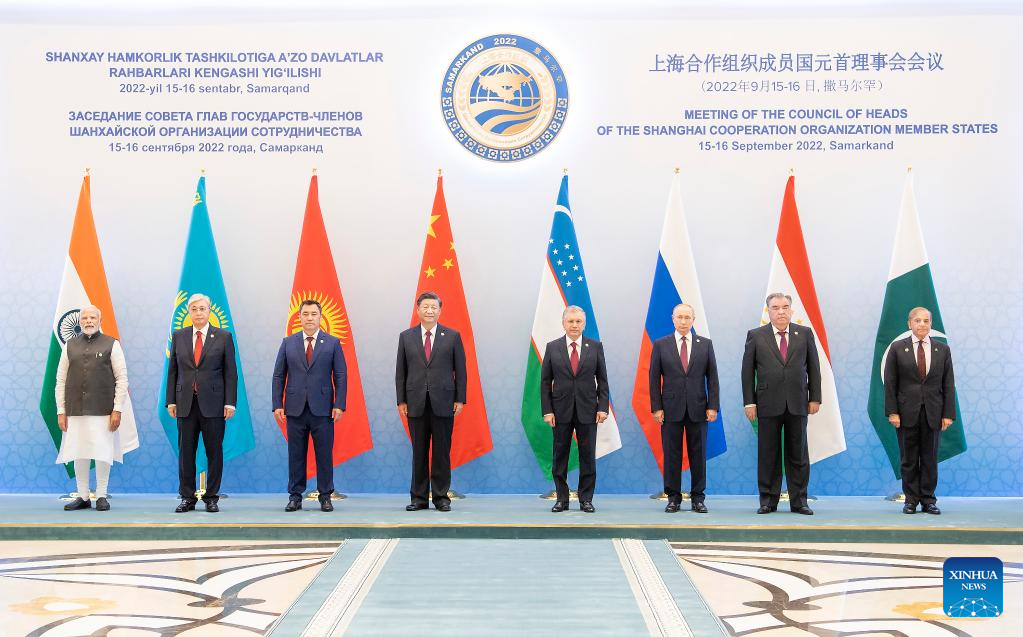
Pakistan PM with Other World Leaders at SCO Summit in Samarkand, Uzbekistan. Source: Xinhua

A prominent Indian journalist Shekhar Gupta has recently summarized the reasons for the Modi government's failure to achieve its objectives relative to Pakistan. Gupta argues that Pakistan is too important to be ignored or isolated by the international community. He says, "Pakistan is too big in terms of population, too powerful militarily, too Muslim, too nuclear and too well located to be isolated". 

Pakistan PM Shahbaz Sharif with President and Mrs. Biden. Source: White House

Here are some of the key points Shekhar Gupta makes in episode 1093 of his show Cut The Clutter : 

1.Pakistan is our most important neighbor. We must focus on Pakistan.

2, We can not ignore Pakistan in India because the world can not ignore Pakistan

3. The Western world has an intrinsic relationship with Pakistan which doesn't go away

4. The West does not see Pakistan as so useful to them today and yet Pakistan can not be isolated.

5. You can see all the indications that Pakistan is not isolated.

6. A lot of (Indian) TV channels say Pakistan is isolated but the evidence doesn't support it.

7. Pakistan FM visited Washington and met his counterpart Tony Blinken. 

8. Pakistan Army Chief has received a warm welcome at the US Defense Dept and met US Defense Secretary Lloyd Austin. Bajwa matters more than the Pakistan Defense Minister. Nobody knows his name.

9. US Ambassador to Pakistan Donald Blome, a career diplomat, has visited "Pakistan Occupied Kashmir" and called it Azad Kashmir...Azad means free.

10. When the chips are down in the region Pakistan is the ally Americans reach out to.

11. The US does not want Pakistan to drift to China.

12. German foreign minister Annalena Baerbock has spoken about Kashmir...the K word. She has asked for the UN to help solve the Kashmir issue.

13. Pakistan Army Chief General Bajwa is not a warmonger. He wants to normalize ties with India. He wants to trade with India. He doesn't want Faiz Hameed to succeed him. He used to be the ISI chief and took credit for the Taliban victory in Afghanistan. Do the Americans have leverage here?

14. Where does Pakistan's unique power come from? Why can't Pakistan be ignored? Why can't Pakistan be isolated?

15. The Indian public needs to understand it.

16. Pakistan is too big in terms of population, too powerful militarily, too Muslim, too nuclear and too well located to be isolated.

17. Pakistan has the 5th largest population and its population is growing fast. It could soon exceed Indonesia to become the largest Muslim nation in the world.

18. Pakistan has the 5th strongest military in the world.

19. In terms of nuclear weapons, Pakistan has the 4th largest nuclear arsenal in the world.

20. Pakistan is too well located to be isolated. It has a geo-strategic location. Pakistan is the western gateway to China. Pakistan opened China's ties with the US. And then helped the US defeat the Soviet Union.

21. The factors that made Pakistan such a strong ally to the US still exist. Don't blame the Pakistanis for it.

22. India is not willing to commit to an alliance with the US.

23. Imran Khan tried to change Pakistan's foreign policy to be more like India's but he failed.

Tri-nation Consensus:

Prime Minister Modi's revocation of Article 370 and annexation of Jammu and Kashmir as Indian union territories have angered not just Pakistan but also China. Modi's actions are not only an affront to the people of Jammu and Kashmir but also in clear violation of India's international and bilateral obligations under United Nations charter and the Simla Accord. China, a permanent member of the United Nations Security Council, lays claim to the Ladakh region. It has objected to India making it a union territory.

Since Modi's annexation of disputed territories of Jammu, Kashmir and Ladakh, China has dramatically stepped up pressure on India in Ladakh. China has increased its troop presence, killed and injured dozens of Indian soldiers and taken at least a thousand kilometers of territory claimed by India. As a result, India has had to move troops from the line of control (LoC) with Pakistan to the Line of Actual Control (LAC) with China. 

Indian Congress Party leader Rahul Gandhi summarized the situation well when he said, "China has taken our land. They are beating out soldiers. The threat of China Is clear. And the government is hiding it, ignoring it. China is preparing for an offensive in Ladakh and Arunachal. And the government of India is sleeping". 


India-Bangladesh Ties:

India's relations with Bangladesh are essentially patron-client relations. This fact became amply clear when Bangladeshi Prime Minister Shaikh Hasina recently visited New Delhi to seek political and economic assistance from the Indian Prime Minister Narendra Modi. 

Modi-Hasina Delhi summit was preceded by Bangladesh Foreign Minister Abdul Momen's trip to India where he said,  "I've requested Modi government to do whatever is necessary to sustain Sheikh Hasina's government".  Upon her return from India, Sheikh Hasina told the news media in Dhaka, "They (India) have shown much sincerity and I have not returned empty handed". It has long been an open secret that Indian intelligence agency RAW helped install Shaikh Hasina as Prime Minister of Bangladesh, and her Awami League party rely on New Delhi's support to stay in power. Bangladesh Foreign Minister Abdul Momen has described India-Bangladesh as one between husband and wife. In an interview with Indian newspaper 'Ajkal,' he said, "Relation between the both countries is very cordial. It's much like the relationship between husband and wife. Though some differences often arise, these are resolved quickly."  Both Bangladeshi and Indian officials have reportedly said that Sheikh Hasina "has built a house of cards". 

India-Pakistan Gap: 

There's no question that Pakistan is in the midst of a major economic crisis. The country's economic performance is dismal right now. At the same time, it must be acknowledged that Pakistan, with its youngest population in Asia, has a bright future ahead if its leaders can resolve the internal political situation. 

Pakistan Population Youngest Among Major Asian Nations. Source: Nikkei Asia

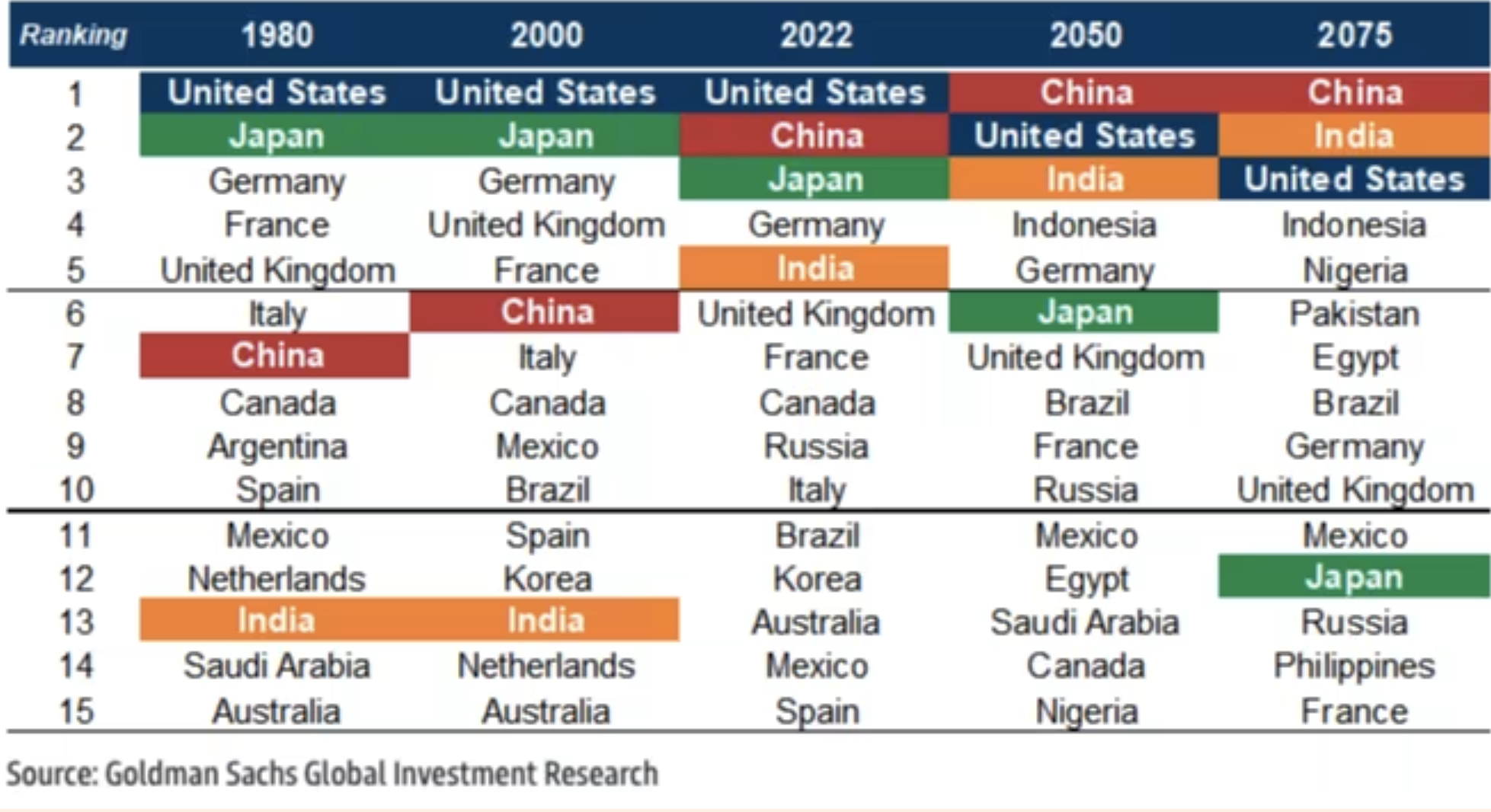
In fact, Goldman Sachs analysts Kevin Daly and  Tadas Gedminas project Pakistan's economy to grow to become the world's sixth largest by 2075.  In a research paper titled "The Path to 2075", the authors forecast Pakistan's GDP to rise to $12.7 trillion with per capita income of $27,100.  India’s GDP in 2075 is projected at $52.5 trillion and per capita GDP at $31,300.  Bangladesh is projected to be a $6.3 trillion economy with per capita income of $31,000.  By 2075, China will be the top global economy, followed by India 2nd, US 3rd, Indonesia 4th, Nigeria 5th and Pakistan 6th. The forecast is based primarily on changes in the size of working age populations over the next 50 years.  

GDP Ranking Changes Till 2075. Source: Goldman Sachs Investment Research 


Economic Growth Rate Till 2075. Source: Goldman Sachs Investment Research 

Economic Impact of Slower Population Growth: 

Daly and Gedminas argue that slowing population growth in the developed world is causing their economic growth to decelerate. At the same time, the economies of the developing countries are driven by their rising populations.  Here are four key points made in the report:

 1) Slower global potential growth, led by weaker population growth. 

2) EM convergence remains intact, led by Asia’s powerhouses. Although real GDP growth has slowed in both developed and emerging economies, in relative terms EM growth continues to outstrip DM growth.

3) A decade of US exceptionalism that is unlikely to be repeated. 

4) Less global inequality, more local inequality. 

Demographic Dividend: 

With rapidly aging populations and declining number of working age people in North America, Europe and East Asia, the demand for workers will increasingly be met by major labor exporting nations like Bangladesh, China, India, Mexico, Pakistan, Russia and Vietnam. Among these nations, Pakistan is the only major labor exporting country where the working age population is still rising faster than the birth rate. 

Over 10 million Pakistanis are currently working/living overseas, according to the Bureau of Emigration. Before the COVID19 pandemic hit in 2020,  more than 600,000 Pakistanis left the country to work overseas in 2019. Nearly 700,000 Pakistanis have already migrated in this calendar year as of October, 2022. The average yearly outflow of Pakistani workers to OECD countries (mainly UK and US) and the Middle East was over half a million in the last decade. 
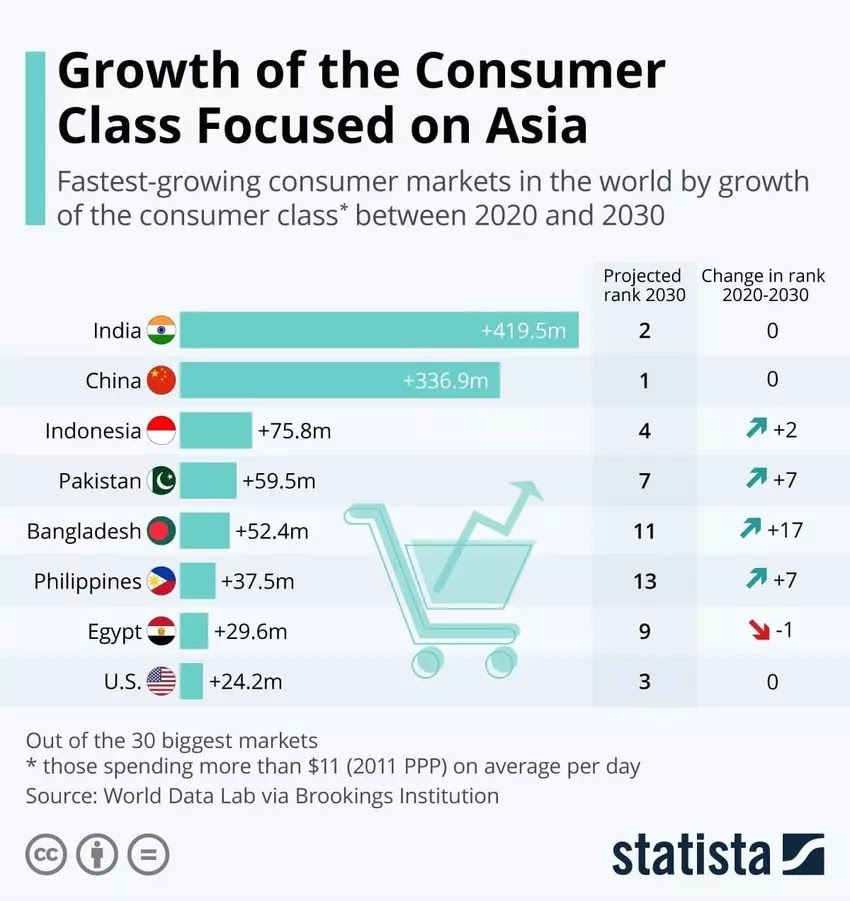
Consumer Markets in 2030. Source: WEF


World's 7th Largest Consumer Market:

Pakistan's share of the working age population (15-64 years) is growing as the country's birth rate declines, a phenomenon called demographic dividend. With its rising population of this working age group, Pakistan is projected by the World Economic Forum to become the world's 7th largest consumer market by 2030. Nearly 60 million Pakistanis will join the consumer class (consumers spending more than $11 per day) to raise the country's consumer market rank from 15 to 7  by 2030. WEF forecasts the world's top 10 consumer markets of 2030 to be as follows: China, India, the United States, Indonesia, Russia, Brazil, Pakistan, Japan, Egypt and Mexico.  Global investors chasing bigger returns will almost certainly shift more of their attention and money to the biggest movers among the top 10 consumer markets, including Pakistan.  Already, the year 2021 has been a banner year for investments in Pakistani technology startups

India's Kautilya Doctrine: 

“Every neighboring state is an enemy and the neighboring state's neighbor is a friend.”
 ― Kautilya, The Arthashastra

The name of Kautilya, meaning crooked, is invoked by former Indian foreign secretary Shyam Saran's book “How India Sees the World: Kautilya to the 21st Century”.  This invocation of Kautilya in the title of the book makes the above quote about "neighboring state is an enemy" particularly relevant to how Indian policymakers like Shyam Saran see Pakistan and Afghanistan. 

Kautilya presented a theory of international relations called the “circle of states,” or Rajamandala. It says hostile states are those that border the ruler’s state, forming a circle around it. In turn, states that surround this set of hostile states form another circle around the circle of hostile states. This second circle of states can be considered the natural allies of the ruler’s state against the hostile states that lie between them. Put more succinctly, “the enemy of my enemy is my friend.”  

Pakistanis like AVM Shahzad Chaudhry must understand that India's foreign policy has always been and continues to be guided by the Kautilya Doctrine. 

Monday, February 1, 2021

PEACE Cable: Pakistan's Highest Bandwidth Undersea Internet Connection to Africa and Europe

Pakistan and East Africa Connecting Europe (PEACE) is  96 Tbps (terabits per second), 15,000 km long, privately owned submarine cable that will originate in Karachi, Pakistan and run underwater all the way to Marseilles, France via multiple points in the continent of Africa.  It is being built as part of Digital Silk Road sponsored by China. Cybernet and Jazz are the local landing and global connectivity partners of PEACE Cable System in Pakistan. It will enable high-speed access to a variety of content, cloud computing, gaming and video streaming platforms.  

PEACE Undersea Cable Route. Source: Submarine Cable Networks


The laying of PEACE undersea cable in Pakistan's territorial waters will begin in March, following government approval this month for Cybernet, a local internet service provider, to construct an Arabian Sea landing station in Karachi, according to Nikkei Asia. The Mediterranean section of the cable is already being laid, and runs from Egypt to France. The 15,000 kilometer-long cable is expected to go into service later this year.   

Mobile Broadband Subscriptions & Data Growth in Pakistan


A 820-kilometer long China-Pakistan fiber optic cable has already been laid between the city of Rawalpindi, Pakistan in the south and the Khunjerab Pass, China in the north  and operational since July, 2018. It is currently being extended to Karachi for connection to PEACE cable. 

Broadband Subscriptions Growth in Pakistan. Source: PTA

When completed, PEACE cable will be Pakistan's 7th highest bandwidth, lowest latency undersea connection to the global Internet system. Currently, there are 6 international submarine cable systems connecting Pakistan, including SMW3, SMW4, SMW5, IMEWE, AAE-1 and TW1. PTCL is the landing party in Pakistan for SMW3, SMW4, AAE-1 and IMEWE cable systems, operates cable landing stations in Karachi. SMW3, SMW4 and IMEWE land at Hawksbay, while AAE-1 lands at Clifton. Transworld Associates Private Limited (Transworld, or TWA) privately owns the TW1 cable system and is a member of the SMW5 consortium. Both TW1 and SMW5 land at Hawksbay and terminate at Transworld's cable landing station in Karachi.  


Pakistan has experienced a huge surge in Internet traffic during the COVID19 pandemic. Cellular Mobile Data usage in the country has soared from 2,545 petabytes in 2019 to 4,498 petabytes in 2020.  Total number of broadband subscriptions in the country has doubled from about 45 million in 2017 to 90 million in 2020,  according to the Pakistan Telecommunications Authority


Tuesday, April 23, 2019

State of Pakistan's Relations With Iran and India

What does Pakistan Prime Minister Imran Khan hope to accomplish during his Iran visit? What are the key issues bedeviling Iran-Pakistan relations? Cross-border terrorism alleged by both? Pakistan's relations with the Gulf Arabs? CPEC? Afghanistan? Gwadar? Chabahar? Indian RAW's use of Iran to launch terror attacks in Pakistani Balochistan? Who calls the shots in Iran? President Rouhani or the hardline Iranian Revolutionary Guard leaders?


Why is Indian Prime Minister Narendra Modi continuing to threaten Pakistan with use of force, including use of nuclear weapons? Is this part of his election campaign to appeal to his base? Or will this intimidation go beyond elections if he wins a second term? Is Pakistan Prime Minister's hope of better ties with India under BJP just a mirage? Are analysts like Moeed Yusuf right about India waiting it out to achieve overwhelming superiority to eventually dictate term to Pakistan?

Viewpoint From Overseas host Faraz Darvesh discusses these questions with Misbah Azam and Riaz Haq (www.riazhaq.com)

https://youtu.be/seNerO7_KsM


Related Links:

Haq's Musings

South Asia Investor Review

Indian Agent Kulbhushan Jadhav Operated From Iran

Modi's India: A Paper Elephant?

Dr. Moeed Yusuf on Future of India-Pakistan Conflict

Iran-Pakistan Ties

Iran-Saudi Conflict

Pakistan's Nuclear Program

Iran Nuclear Deal

1971 India-Pakistan War

Chabahar vs Gwadar Ports

Did America Contribute to the Rise of ISIS?

Sunday, September 30, 2018

Pakistani-American Scholar Dr. Moeed Yusuf in Silicon Valley

Pakistani-American scholar Dr. Moeed Yusuf, Associate Vice President of the Asia Center at the U.S. Institute of Peace in Washington D.C., visited Silicon Valley on September 29, 2018.  Dr. Yusuf  spoke at an event organized by Talk4Pak (talk4pak.com) team to launch his recently published book "Brokering Peace in Nuclear Environments U.S. Crisis Management in South Asia".

Dr. Moeed Yusuf (L) with Faraz Darvesh


The event was moderated by Faraz Darvesh. It started with a brief intro by Riaz Haq to Talk4Pak followed an introduction to  the main speaker by Dr. Misbah Azam.

Riaz Haq (L) with Faraz Darvesh


Riaz Haq introduced Talk4Pak as a media platform intended to connect Pakistani-Americans with Pakistan to stimulate discussion on issues of interest to the diaspora.  Talk4Pak principals include Faraz Darvesh, Misbah Azam, Sabahat Ashraf, Ali Hasan Cemendtaur, and Riaz Haq. Talk4Pak engages with its target audience via social media platforms like YouTube, Facebook and Twitter. Talk4Pak produces two regular shows: Viewpoint From Overseas in English and Azad Labon Kay Sath in Urdu.

Dr. Moeed Yusuf Signing Books


Talk4Pak shows feature discussions with analysts, activists, journalists, intellectuals, writers and thinkers. Guests include a range: Dr. Moeed Yusuf, Dr. Adil Najam, Dr. Ishrat Husain, Brigadier Feroz Khan,  Shuja Nawaz, Raoof Hasan, Munir Malik, Jibran Nasir, Ayesha Siddiqa, Asma Jahangir,  Munizae Jahangir, Monis Rahman, Husain Haqqani, Tarek Fatah, Dr. Nyla Ali Khan (grand-daughter of Shaikh Abdullah), Raza Rumi, Zahid Husain, Mazhar Abbas,  Amir Abbas, Farrukh Pitafi, Zarar Khuro, Jared Taylor and others.

Dr. Misbah Azam (L) Introducing Dr. Moeed Yusf


Misbah introduced Dr. Moeed W. Yusuf as Associate Vice president of the Asia Center at the U.S. Institute of Peace (USIP). Yusuf has been engaged in expanding USIP’s work on Pakistan/South Asia since 2010. His current research focuses on youth and democratic institutions in Pakistan, policy options to mitigate militancy in Pakistan and the South Asian region in general, and U.S. role in South Asian crisis management. His latest book, Brokering Peace in Nuclear Environments: U.S. Crisis Management in South Asia, was released by Stanford University Press in May 2018. The book offers an innovative theory of brokered bargaining to better understand and solve regional nuclear crises.

Dr. Moeed Yusuf Signing Books


In "Brokering Peace in Nuclear Environments U.S. Crisis Management in South Asia" by Dr. Moeed Yusuf published by Stanford University Press, the author analyzes American diplomacy in three critical periods: Kargil conflict in 1999; the stand-off after the Indian Parliament attack in 2001 and the terrorist attack in Mumbai in 2008.

Dr. Moeed Yusuf with Dinner Attendees


Yusuf argues that the US-Soviet Cold War deterrence model does not apply to the India-Pakistan conflict and offers his theory of "brokered bargaining". In chapters that detail the US role during three India-Pakistan crises, it is clear that the US rejected India's insistence on bilateralism in resolving India-Pakistan disputes.  The author says that "in each episode, the concern about the escalation forced the United States to engage, largely unsolicited, and use a mix of rewards (or promises of) and punishments (or threats of) with the regional rivals to achieve de-escalation--ahead of its broader regional or policy interests."

Dt. Moeed Yusuf Speaking at Talk4Pak Silicon Valley Event 


At the talk4pak Silicon Valley event, Dr. Yusuf addressed three areas of focus: 

1. US-Pakistan relations: Yusuf says Washington now sees India, not Pakistan, as its strategic partner in South Asia. Washington's entire relationship with Islamabad today revolves almost exclusively around Afghanistan where American and Pakistani interests do not converge. The only time the United States gets involved in India-Pakistan conflict is when there is a serious crisis that the world fears could escalate into a nuclear confrontation between them. 

2. India-Pakistan Ties: There is no sustained dialogue between New Delhi and Islamabad to resolve issues such as Kashmir between the two neighbors. Yusuf speculates that India wants to wait it out for the time when its economic and military differential with Pakistan becomes so large that Delhi can dictate terms to Islamabad as the unchallenged regional hegemon. 

3. Afghanistan War: Pakistan does not believe that the Afghan Taliban can be militarily defeated and insists that the United States must talk directly with them to reach a political settlement.  Yusuf now believes that the recent start of direct dialogue between the United States and the Taliban may bring an eventual end to America's longest war.

Audience at Talk4Pak Silicon Valley


Dr. Moeed Yusuf's "Brokering Peace in Nuclear Environments U.S. Crisis Management in South Asia" is a thought provoking book as is his presentation at the talk4pak Silicon Valley event. Both should stimulate serious discussion of how regional nuclear powers like India and Pakistan can engage with each other more deeply to maintain peace and stability in their neighborhood. This will require both parties, India and Pakistan, to have sustained dialogue to resolve core issues like Kashmir that underly recurring crises.

Here's a video of the presentation at talk4pak event of September 29, 2018:

https://youtu.be/U5qIWAKviHE


Related Links:

Haq's Musings

South Asia Investor Review

India-Pakistan Conventional Military Balance

Freeing Colonized Minds in Pakistan

America's "We're the Good Guys" Narrative

Funding of Hate Groups, NGOs, Think Tanks: Is Money Free Speech?

US and China Vying For Influence in Pakistan

Pakistan-China-Russia Vs India-Japan-US

Pakistan Rising or Failing: Reality vs Perception

Pakistan's Trillion Dollar Economy Among top 25

MQM-RAW Link

Riaz Haq Youtube Channel

VPOS Youtube Channel

Monday, September 17, 2018

Pakistani-American Scholar on US Role as Peace Broker in South Asia

Pakistani-American scholar Dr. Moeed Yusuf has examined the role of the United States in defusing South Asian crises since the nuclear tests conducted by India and Pakistan in 1998.

In "Brokering Peace in Nuclear Environments U.S. Crisis Management in South Asia" by Dr. Moeed Yusuf published by Stanford University Press, the author analyzes American diplomacy in three critical periods: Kargil conflict in 1999; the stand-off after the Indian Parliament attack in 2001 and the terrorist attack in Mumbai in 2008.

Yusuf argues that the US-Soviet Cold War deterrence model does not apply to the India-Pakistan conflict and offers his theory of "brokered bargaining". In chapters that detail the US role during three India-Pakistan crises, it is clear that the US rejected India's insistence on bilateralism in resolving India-Pakistan disputes.  The author says that "in each episode, the concern about the escalation forced the United States to engage, largely unsolicited, and use a mix of rewards (or promises of) and punishments (or threats of) with the regional rivals to achieve de-escalation--ahead of its broader regional or policy interests."

It seems that Yusuf accepts the widely-held assumption that India enjoys insurmountable conventional military superiority over Pakistan. Many speculate that the difference between the conventional military strengths of the two South Asian rivals is so great that Pakistan would be forced to quickly resort to the use of nuclear weapons in the event of an Indian attack. Such assumptions and speculations are challenged by Professor Walter Ladwig of the War Studies Department at London's Kings College, Meenakshi Sood of Delhi-based Indian Army think tank called The Center for Land Warfare Studies, and other scholars.

Professor Walter Ladwig believes that Pakistan’s conventional deterrence against India in the near to medium term is "much better than the pessimists allege".  Pakistan's  NCWF (New Concept of War Fighting) developed in response to India's CSD (Cold Start Doctrine) is designed to "mount a counter-offensive even before India fires the first shot", according to Indian analyst Meenakshi Sood. Ladwig sums it up well: "Despite a growing technological edge (over Pakistan) in some areas, Indian policymakers cannot be confident that even a limited resort to military force would achieve a rapid result, which is an essential pre-condition for deterrence failure".

One could argue that Yusuf gives too much credit to the US efforts in de-escalating India-Pakistan crises. It creates the impression that brown leaders are less rational than their white counterparts in dealing with existential crises. It perpetuates the stereotype that only a select few nations in the West can be trusted with weapons of mass destruction.  It justifies the nuclear Apartheid being pursued by the United States in the form of nuclear non-proliferation treaty (NPT).  Could it be that the author's research is heavily influenced by the fact that he works for the United States Institute of Peace which is a US government-funded Washington think tank?

Overall, Dr. Moeed Yusuf's "Brokering Peace in Nuclear Environments U.S. Crisis Management in South Asia" is a thought provoking book. It should stimulate serious discussion of how regional nuclear powers like India and Pakistan can engage with each other more deeply to maintain peace and stability in their neighborhood. This will require both parties, India and Pakistan, to have sustained dialog to resolve core issues like Kashmir that underly recurring crises.

Related Links:

Haq's Musings

South Asia Investor Review

India-Pakistan Conventional Military Balance

Freeing Colonized Minds in Pakistan

America's "We're the Good Guys" Narrative

Funding of Hate Groups, NGOs, Think Tanks: Is Money Free Speech?

US and China Vying For Influence in Pakistan

Pakistan-China-Russia Vs India-Japan-US

Pakistan Rising or Failing: Reality vs Perception

Pakistan's Trillion Dollar Economy Among top 25

MQM-RAW Link

Riaz Haq Youtube Channel

VPOS Youtube Channel

Friday, July 13, 2018

Ethiopia's First Muslim Prime Minister Makes Peace With Eritrea

Dr. Abiy Ahmed Ali, a former army officer with a doctorate in conflict resolution,  was elected first Muslim prime minister of Ethiopia by the country's ruling coalition in April 2018. Soon after making history, 41-year-old Prime Minister Ahmed used his conflict resolution skills to make peace with bitter rival Eritrea. The most important immediate benefit of this deal for landlocked Ethiopia is access to Eritrea's Red Sea ports. Both nations can now focus on developing their economies and reducing poverty to improve the lives of their peoples. Their example should inspire many other developing nations, including India and Pakistan, to reach similar peace deals in the best interest of their peoples.

Prime Minister Abiy Ahmed of Ethipia
Who is Abiy Ahmed?

Abiy Ahmed Ali, born 15 August 1976, is chairman of both the ruling EPRDF (Ethiopian Peoples’ Revolutionary Democratic Front) and the OPDO (Oromo Peoples' Democratic Organization). Abiy is also an elected member of the Ethiopian parliament, and a member of the OPDO and EPRDF executive committees.

Abiy has a bachelor's degree in computer engineering, master's in business administration and PhD in conflict resolution. In 1991 as a teenager, he joined the armed opposition against the Marxist–Leninist regime of Mengistu Haile Mariam. He served in Ethiopia's armed forces as an intelligence officer.

Abiy bridged the religious and ethnic divides to build a new alliance between Oromo and the Amhara regions which together make up two thirds of the total population of 100 million Ethiopians.

Ethiopian History:

Ethiopia's ancient name is Abyssinia. Among the first Muslims to arrive in Ethiopia was the first cousin of Prophet Muhammad (SAW) Jafar ibn Abi Taleb, the elder brother of Ali ibn Abi Taleb, who after accepting Islam escaped the persecution of Makkans in 7th century CE. He led a delegation of over 80 Muslim migrants to Habesha (Ethiopia) who were all granted refuge in the African Kingdom by Christian King Nejashi.

About a third of Ethiopia's population is now Muslim with the rest being mostly Christian.

Among the most prominent early Muslims was a slave named Bilal the Abyssinian or Bilal al-Habashi. Prophet Muhammad's close companion Abu Bakr secured Bilal's freedom from his abusive master. Bilal rose to become a close companion of Prophet Muhammad and the first muezzin of Prophet's mosque (Masjid Nabavi) in Madina.  Bilal is now among the world's most popular popular Muslim names.

Eritrean History:

Eritrea was ruled by the Ottomans from 16th to the 19th century. Then it was colonized by Italians. After World War II Eritrea was annexed by Ethiopia. In 1991 the Eritrean People's Liberation Front defeated the Ethiopian government to gain independence. Eritrea's population of about 5 million is equally divided between Christians (Orthodox Church, Roman Catholic and Lutheran protestants) and Muslims.  The population of the high plateau (Asmara) is predominantly Christian, whereas that of the lowlands and the coastal region are predominantly Muslim.

Ethiopia-Eritrea Relations:

The Eritrean People's Liberation Front fought and defeated the Ethiopian military to gain independence in 1991. There was brief period of peace between the two until 1998 when war broke out over disputed territory of Badme.

Conflict between the two neighbors in the Horn of Africa lasted 20 years and claimed 70,000 lives. It was over the  territory of Badme which is still held by Ethiopia. Under the peace deal reached Prime Minister  Abiy Ahmed Ali of Ethiopia and President Isaias Afwerki of Eritrea, Ethiopia accepted Eritrean sovereignty over Badme and agreed to  a plan to withdraw from the region.

Currently, landlocked Ethiopia relies on Djibouti ports for trade. Addis Ababa is connected by a 750 kilometer long railway line with the ports in Djibouti.  The peace deal opens the way for Ethiopia to gain access to Eritrean Red Sea ports which are much closer to Ethiopia.

Summary:

Ethiopia has recently made history by electing its first Muslim leader, Prime Minister Dr. Abiy Ahmed Ali.  Soon after making history, the 41-year-old Prime Minister used his conflict resolution skills to make peace with bitter rival Eritrea. The most important immediate benefit of this deal for landlocked Ethiopia is access to Eritrea's Red Sea ports. Both nations can now focus on developing their economies and reducing poverty to improve the lives of their peoples.  Their example should inspire many other developing nations, including India and Pakistan, to reach similar peace deals in the best interest of their peoples.

Related Links:

Haq's Musings

South Asia Investor Review

Aman Ki Asha (Aspiration For Peace)

Case For Resuming India-Pakistan Talks

Aid, Trade, Investments Remittances in Asia and Africa

Does China Seek to Dominate Africa?

Asian Economic Growth Since 1960

Riaz Haq's Youtube Channel

Saturday, December 9, 2017

Trump on Jerusalem; India Pew Survey; Mattis in Pakistan

Why did President Donald Trump recognize Jerusalem as Israel's capital? Why now? Is it designed to shore up Trump's domestic support with Evangelical Christians and Jewish donors and voters? What will be its impact in the Middle East and the world in the short term and the long term? Will it strengthen anti-US forces? Will there be more violence? Does it make the fight against terror more difficult?

What does the Pew Survey of Indians' on their views of Pakistan show? Why do 64% of Indians, the highest since 2013 when the survey began, say they view Pakistan extremely unfavorably? Is the rise of Prime Minister Modi a cause or consequence of it? Does it make the chances of peace in South Asia even more remote? Why did Indian Congress leader Mani Shankar Ayar call Indian Prime Minister "neech aadmi" (mean person)?

 How did US Def Sec Gen James Mattis' visit to Islamabad go? Why did Stratfor analysts say "Mad Dog (Mattis) Will Bark, But Islamabad Won't Bite"? Did anything change after the visit?  Will Pakistan yield to US pressure? What comes next? Will Pakistan really shoot down any US drones violating Pakistan airspace as the Pakistan Air Force Chief claims? Will US-Pakistan relations further deteriorate?

Viewpoint From Overseas host Faraz Darvesh discusses these questions with Misbah Azam and Riaz Haq (www.riazhaq.com)


https://youtu.be/U2WYeoVBBfU


Related Links:

Haq's Musings

What if Modi Attacks Pakistan?

Do Trump and Modi Have Much in Common?

Will Pakistan Yield to US Pressure? 

Growing Power of Jewish Lobby in Washington

Riaz Haq Youtube Channel

VPOS Youtube Channel

Thursday, February 18, 2010

Aman Ki Asha: South Asians Aspire For Peace

Guest Post By Rakesh Mani

It's one of the most remarkable campaigns the subcontinent has seen: a joint peace initiative run by the Times of India, India's most powerful media empire, and the Jang group, Pakistan's most influential media group. Their joint 'Aman ki Asha' (Hope for Peace) initiative looks to develop a stronger Track II channel in the diplomatic and cultural relations between India and Pakistan.

The Urdu language Jang newspaper's involvement is relevant, and crucial, although the Jang Group's English language The News is also involved. However, it is probably the vernacular Jang reader who needs to be made more open to establishing a rapport with India. The case of the linguistic divide is less pronounced in India. Readers of the English press and vernacular press often share similar opinions on relations with Pakistan.

The criticisms about such civilian initiatives are probably fair: the assortment of cricketers, musicians and matinee idols who are lending their names and faces to the cause have little influence in either country. As long as the politicians and mandarins in India's establishment and the military men and mullahs in Pakistan's power elite are not involved, what difference does it all really make?

Given this reality, it is fair to assume that such a concerted initiative must have the approval of those who matter in Delhi and Islamabad, and possibly in Washington as well. Clearly the intent is to build a strong peace constituency among the masses in both countries for a pact that's being made in the highest echelons. Because war, in its adversity, unifies nations while peace divides them and gives rise to arguments about the price.

Negotiations on Kashmir have never gotten anywhere because neither country has been willing to compromise. For years, we have heard the familiar volley of archaic recriminations; with India refusing to budge from the status quo, and Pakistan looking to significantly alter it. Clearly both countries, at some point, will have to make some compromises to build peace. The gradual process of selling that compromise to their respective electorates has now begun in earnest.

Indians and Pakistanis, raised on animosity and mutual suspicion, now have to be programmed to yearn for peace. At any cost.

There have always been romantics and idealists in both countries who spoke fondly of their neighbor and lobbied for peace. But these constituencies were always relegated to peripheral positions by realist viewpoints that stressed strategic interest. And today, after years of opposing interests, we have a situation where the strategic interests of India and Pakistan seem to coincide.

The galaxy of strategic stars in the subcontinent is now aligned for peace. And things are moving quickly.

A few days ago, the governments of India and Pakistan announced that their foreign secretaries will meet for talks at the end of February to resume the formal dialogue on a number of key issues, including Kashmir. In an apparently unrelated gesture, India's Home Minister P. Chidambaram said that the scores of Indian militants from Kashmir who have crossed into Pakistani territory should be allowed to return to India without punishment.

It is in New Delhi's interest to stabilize the democratic regime in Pakistan, to prevent a nightmare scenario: a million Pakistani refugees, fleeing a theocratic Taliban-dominated country, pounding the gates at Wagah. It's a real threat, with a precedent. The Indian government hasn't forgotten the 1971 crisis, when millions of Bengali refugees flooded into West Bengal from erstwhile East Pakistan. Almost forty years ago, the question was economic and humanitarian.

Today, it's a catch-22: let the Pakistani refugees in, and you run the risk of a phalanx of anti-India militants being camouflaged among them; refuse them entry, and it becomes horrible publicity for a country that fancies itself a responsible, emerging superpower.

Islamabad, on the other hand, feels that the time is ripe to pressure Delhi into a settlement. With Washington leaning on them heavily for support in the war on terror, their approach will be to convince the Americans that they can't fight the battle on their Western border when there are Indian guns being pointed at their back in the East.

One suspects that Manmohan Singh, having seen the nuclear deal through in his first term, is looking to make a settlement on Kashmir his foreign policy priority for the UPA's second term in office. If all goes well, each player in the love triangle has their strategic interests fulfilled and becomes a sure shot for the Nobel Peace Prize.

A fine feather in their caps, but also the possibility of a final and lasting peace in a subcontinent that has been saddled with sorrow and disquiet for decades.


The writer is a 2009 Teach For India fellow, and a writer and columnist for a variety of publications. Email: rakesh.mani@ gmail.com

Related Links:

Case For Resuming India-Pakistan Talks

India's Sane Voice Warns Against Smugness

Hindutva Terror to Spark India-Pakistan War?

Is Pakistan Too Big to Fail?

India and Pakistan Compared in 2010

Why is Democracy Failing in Pakistan?

Middle Class Clout Rising in Pakistan

US Afghan Exit: Trigger For India-Pakistan Talks?

China's Growing Role in Kashmir

Sunday, May 17, 2009

Can Congress Deliver in India?


The convincing victory of Congress party in India has been an embarrassment for the pollsters and the pundits. They predicted a close contest between the Congress-led UPA and BJP-led NDA coalitions. With all but two results declared, the Congress-led alliance is projected to win 260 seats with the BJP on 157. They also said that the Third Front of regional and caste-based parties would determine the ultimate winners in Delhi. In fact, the Third Front has fallen apart, with its main components, the leftists, suffering a huge defeat, according to media reports. The BJP leadership has gracefully conceded defeat and congratulated Prime Minister Manmohan Singh on his party's success in the world's largest democracy.

Congress routed BJP in the major cities of Delhi and Mumbai while the states of Karnataka and Gujarat remained in the BJP column, indicating a split verdict from India's middle class. Unlike Pakistan's ruling PPP whose vote bank is almost entirely rural, it seems that Congress has succeeded in putting together an effective coalition of the urban middle class and rural voters.

Congress made significant gains in the Hindi heartland of Uttar Pradesh, where Nehru dynasty's heir apparent Rahul Gandhi campaigned energetically, winning plaudits and establishing his credentials as the next leader of Congress party. But UP Chief Minister Ms. Mayawati's Bahujan Samaj Party is still ahead of Congress. Her BSP remains a powerful force as it came in a close second for as many as 50 seats in UP.

Voters appear to have backed Congress for pro-farm policies like the $5bn rural work scheme and a waiver of loans for indebted farmers. Five consecutive year of good monsoons, a booming rural market and pay increases for millions of government workers seem to have swung both the urban and rural voters towards the party that led India to its independence. As analysts and Congress party workers point out, there have been no major religious riots in the past five years, and so a vote for the party seemed to be a "vote for peace and harmony".

While Prime Minister Manmohan Singh and his party engaged in angry rhetoric and issued verbal threats to Pakistan after Mumbai attacks, they did not act hastily in spite of the hostile Indian media and the BJP's attempts to take political advantage of the situation. Hopefully, the election results will also mean continuity in India's relations with its neighbors and the US, and early resumption of dialog with Pakistan to ensure peace and stability in South Asia. This is specially important as Pakistani military is in the middle of an offensive against the Taliban.

With a strong mandate in hand, Congress faces a serious challenge in delivering to its urban middle class and rural constituents in the midst of global economic slowdown. According to an OECD report published in 2007, India generated 11.3 million new jobs per year on an average during 2000-2005.

India’s phenomenal growth and job creation of the last five years were fueled in large part by huge inflow of cash and investment. Investment accounted for about 39 percent of the country’s gross domestic product in fiscal year 2008, up from 25 percent five years ago. At its peak, more than a third of investment came from abroad, according to Credit Suisse. But in the last three months of last year, foreign loans and direct investment fell by nearly a third, to their lowest level in more than two years, according to a report in New York Times.

The decline in foreign investment has taken a big toll on sectors like real estate, manufacturing and infrastructure. In the last quarter of 2008, the economy’s growth rate plummeted to about 5.3 percent, the lowest in five years. While consumer demand has kept the economy growing so far, the sudden slowing in the flow of foreign funds and rising unemployment will make it harder for the country to grow fast enough to pull hundreds of millions of people out of grinding poverty. Widespread poverty, chronic hunger, non-existent sanitation facilities, poor infrastructure and lack of opportunity continue to be a cause for serious alarm for India's democracy.

India, often described as peaceful, stable and prosperous in the Western media, remains home to the largest number of poor and hungry people in the world. About one-third of the world's poor people live in India. More than 450 million Indians exist on less than $1.25 a day, according to the World Bank. It also has a higher proportion of its population living on less than $2 per day than even sub-Saharan Africa. India has about 42% of the population living below the new international poverty line of $1.25 per day. The number of Indian poor also constitute 33% of the global poor, which is pegged at 1.4 billion people, according to a Times of India news report. More than 6 million of those desperately poor Indians live in Mumbai alone, representing about half the residents of the nation's financial capital. They live in super-sized slums and improvised housing juxtaposed with the shining new skyscrapers that symbolize India's resurgence. According to the World Bank and the UN Development Program (UNDP), 22% of Pakistan's population is classified as poor.

There is widespread hunger and malnutrition in all parts of India. India ranks 66th on the 2008 Global Hunger Index of 88 countries while Pakistan is slightly better at 61 and Bangladesh slightly worse at 70. The first India State Hunger Index (Ishi) report in 2008 found that Madhya Pradesh had the most severe level of hunger in India, comparable to Chad and Ethiopia. Four states — Punjab, Kerala, Haryana and Assam — fell in the 'serious' category. "Affluent" Gujarat, 13th on the Indian list is below Haiti, ranked 69. The authors said India's poor performance was primarily due to its relatively high levels of child malnutrition and under-nourishment resulting from calorie deficient diets.

India might be an emerging economic power, but it is way behind Pakistan, Bangladesh and even Afghanistan in providing basic sanitation facilities, a key reason behind the death of 2.1 million children under five in the country.

Lizette Burgers, chief of water and environment sanitation of the Unicef, recently said India is making progress in providing sanitation but it lags behind most of the other countries in South Asia. A former Indian minister Mr Raghuvansh Prasad Singh told the BBC that more than 65% of India's rural population defecated in the open, along roadsides, railway tracks and fields, generating huge amounts of excrement every day.

With the economy expected to slow to about 5%, employment generation in India has fallen by 49 percent during January-March this year, largely due to a slow growth of services industries like IT and banking, according to an industry lobby survey.

"The Assocham placement parameter (APP) Index (the body’s index for measuring employment generation) has shown a steep fall of 49 percent and has came down to 509.72 from the base value of 1,000," the Associated Chambers of Commerce and Industry (Assocham) said in a statement.

The APP index Series consist of 26 sectoral indices and a composite index giving an overall picture. The composite index is developed on the principle of weighted average quarterly job creation and has a base value of 1,000.

The study, which tracked employment generation across various sectors throughout metro and non-metro cities, said most of the highest employment generating sectors have curtailed their hiring.

The worst performer in terms of job creation is the IT sector, with its share in the overall index falling to 34 percent from 41 percent, the original allocation for the segment in the base value.

"The IT sector is facing major challenges with contracted demand due to recession in the primary client countries of the US and Europe. The value of the APP IT index has substantially declined by 50.8 percent," the report said.

The sectors that have recorded maximum decline in employment generation include education, hospitality, IT and IT enabled services, real estate, banking, media, textiles, auto, construction, and engineering.

However, some sectors like telecom and fast moving consumer goods (FMCG) have bucked the trend and created more jobs during the same period.

The telecom sector was a leading job generator with its share in the composite index rising from 3 percent to 3.35 percent during the period.

"The pressure on employment, confidence and price levels would be more burdensome than in the past... Moreover, India could be impacted by the return of migrant workers or declining remittances," Citigroup India economist Rohini Malkani said in a recent report.

Citi further said that the Ministry of Labor has indicated that over 5,00,000 jobs were lost during October-December 2008, with export-oriented sectors such as gems and jewelery, autos, and textiles being most impacted.

However, the Citi report stated that this statistic only covers the organized sector, which comprises just 10 per cent of the country's workforce of close to 385 million.

Pakistan, too, has a huge youthful population as India: roughly 105 million out of 170 million Pakistanis are under 25 years old. It will be these people who drive Pakistan's economy in the decades ahead, according Pakistani economist Salman Shah, who talked with the Wall Street Journal recently.

Like India, Pakistan had an economic boom led by construction, manufacturing, telecom, banking and consumers during 2001-2007, under Musharraf-Aziz administration. With annual economic growth approaching 7-8%, it created about 2.5m jobs a year during this period. Talking about foreign direct investment (FDI) in emerging economies, former US Federal Reserve Chief Alan Greenspan said in his book titled "The Age of Turbulence" : “But clearly the Licence Raj (in India) has discouraged foreign direct investment. India received $7 billion in FDI in 2005, a sum dwarfed by China’s $72 billion. India’s cumulative stock of FDI at 6 per cent of GDP at the end of 2005 compares with 9 per cent for Pakistan, 14 per cent for China, and 61 per cent for Vietnam. The reason FDI has lagged badly in India is perhaps no better illustrated than by India’s unwillingness to fully embrace market forces. That is all too evident in India’s often statist response to economic problems. Faced with rising food inflation in early 2007, the response was not to allow rising prices to prompt an increase in supply, but to ban wheat exports for the rest of the year and suspend futures trading to ‘curb speculation’ — the very market forces that the Indian economy needs to break the stranglehold of bureaucracy.” (p. 322 of "The Age of Turbulence" by Alan Greenspan.)

While Indian economy has experienced strong growth during this decade, the majority of its people have not been touched by it. Recently, British Minister Alexander contrasted the rapid growth in China with India's economic success - highlighting government figures that showed the number of poor people had dropped in the one-party communist state by 70% since 1990 but had risen in the world's biggest democracy by 5%.

In spite the recent Congress efforts in rural areas, the rural landscape in India still remains troubled. On its inside pages, the Times of India in 2007 reported Communist Party leader Sitaram Yechury's as saying that "on the one hand, 36 Indian billionaires constituted 25% of India’s GDP while on the other, 70% of Indians had to do with Rs 20 a day". "A farmer commits suicide every 30 minutes. The gap between the two Indias is widening," he said. Over 1500 farmers committed suicide last year in the central state of Chhattisgarh alone.

According to the new UN-HABITAT report on the State of the World's Cities 2008/9: Harmonious Cities, China has the highest level of consumption inequality based on Gini Coefficient in the Asia region, higher than Pakistan (0.298), Bangladesh (0.318), India (0.325), and Indonesia (0.343), among others." Gini coefficient is defined as a ratio with values between 0 and 1: A low Gini coefficient indicates more equal income or wealth distribution, while a high Gini coefficient indicates more unequal distribution. 0 corresponds to perfect equality (everyone having exactly the same income) and 1 corresponds to perfect inequality (where one person has all the income, while everyone else has zero income).

Violence is rising in India because of the growing rich-poor gap. Prime Minister Manmohan Singh himself has called the Maoist insurgency emanating from the state of Chhattisgarh the biggest internal security threat to India since independence. The Maoists, however, are confined to rural areas; their bold tactics haven't rattled Indian middle-class confidence in recent years as much as the bomb attacks in major cities have. These attacks are routinely blamed on Muslim militants. How long will Maoists remain confined to the rural areas will depend on the response of the Indian government to the insurgents who exploit huge and growing economic disparities in Indian society.

With the clear mandate for his Congress Party, Prime Minister Manmohan Singh has huge challenges in front of him. Being a sincere man of intelligence and integrity, I expect him to make a serious effort to confront those challenges. I congratulate him and wish him well. If Mr. Singh succeeds, a prosperous, self-confident India under his leadership can become a positive example in South Asia that India's neighbors can look up to and follow.

Here is a video about Indian democracy:


Related Links:

Is Indian Democracy Overrated?

Mumbai's Slumdog Millionaire

Can India Do a Lebanon in Pakistan?

Poor Sanitation in India

Stable, Peaceful, Prosperous India

No Toilet, No Seat in India

Poverty Tours in India, Brazil and South Africa

South Asia's War on Hunger Takes Back Seat

Grinding Poverty in Resurgent India

Pakistani Children's Plight

Poverty in Pakistan