Showing posts with label Japan. Show all posts

Monday, September 26, 2022

Floods in Pakistan: Biggest Global Polluters US, Europe, China and India Must Accept Responsibility

Pakistan, a country that has contributed only 0.28% of the CO2 emissions, is among the biggest victims of climate change. The US, Europe, India, China and Japan, the world's biggest polluters, must accept responsibility for the catastrophic floods in Pakistan and climate disasters elsewhere. A direct link of the disaster in Pakistan to climate change has been confirmed by a team of 26 scientists affiliated with World Weather Attribution, a research initiative that specializes in rapid studies of extreme events, according to the New York Times

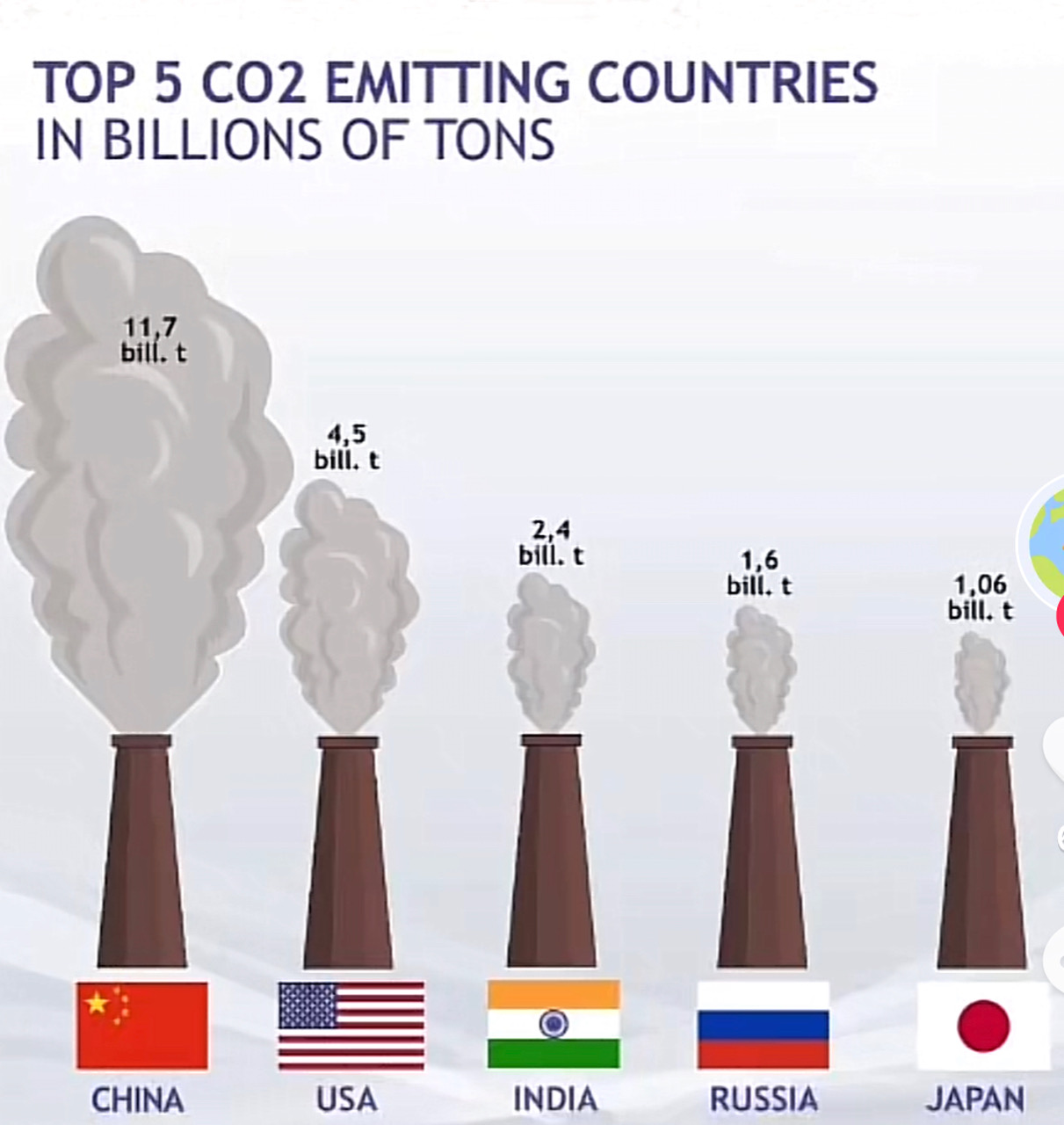
Top 5 Current Polluters. Source: Our World in Data

Currently, the biggest annual CO2 emitters are China, the US, India and Russia. Pakistan's annual CO2 emissions add up to just 235 million tons. On the other hand, China contributes 11.7 billion tons, the United States 4.5 billion tons, India 2.4 billion tons, Russia 1.6 billion tons and Japan 1.06 billion tons. 

Pakistan's Annual CO2 Emission. Source: Our World in Data

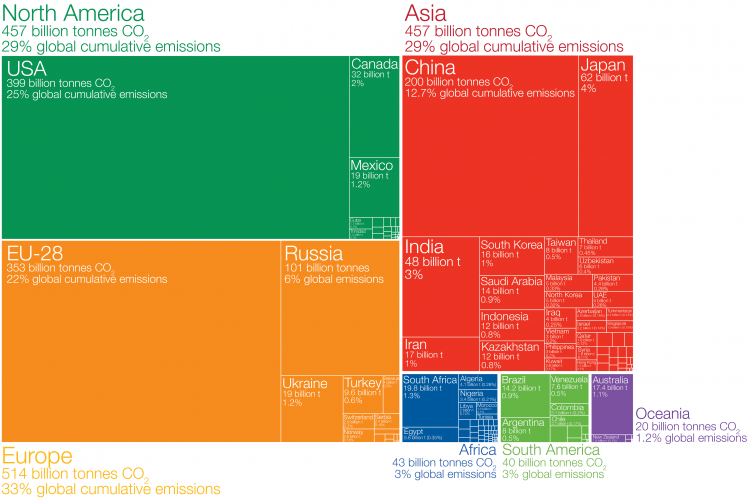
The United States has contributed 399 billion tons (25%) of CO2 emissions, the highest cumulative carbon emissions since the start of the Industrial Revolution in the late 18th century. The 28 countries of the European Union (EU28), including the United Kingdom, come in second with 353 billion tons of CO2 (22%), followed by China with 200 billion tons (12.7%). 

Cumulative CO2 Emissions. Source: Our World in Data

Pakistan's cumulative CO2 contribution in its entire history is just 4.4 billion tons (0.28%). Among Pakistan's neighbors, China's cumulative contribution is 200 billion tons (12.7%),  India's 48 billion tons (3%) and Iran's 17 billion tons (1%).  

Developing Asian Nations' CO2 Emissions. Source: Our World in Data

Pakistan has contributed little to climate change but it has become one of its biggest victims. In the 2015 Paris agreement on climate change, signatories agreed to recognize and “address” the loss and damage caused by those dangerous climate impacts, according to the Washington Post. Last year, at the major U.N. climate conference in Glasgow, Scotland, negotiators from developing countries tried to establish a formal fund to help the countries like Pakistan most affected by climate disasters. It was blocked by rich countries led by the Biden administration. 


Friday, September 16, 2022

Can Washington Trust Modi's India As Key Ally in Asia?

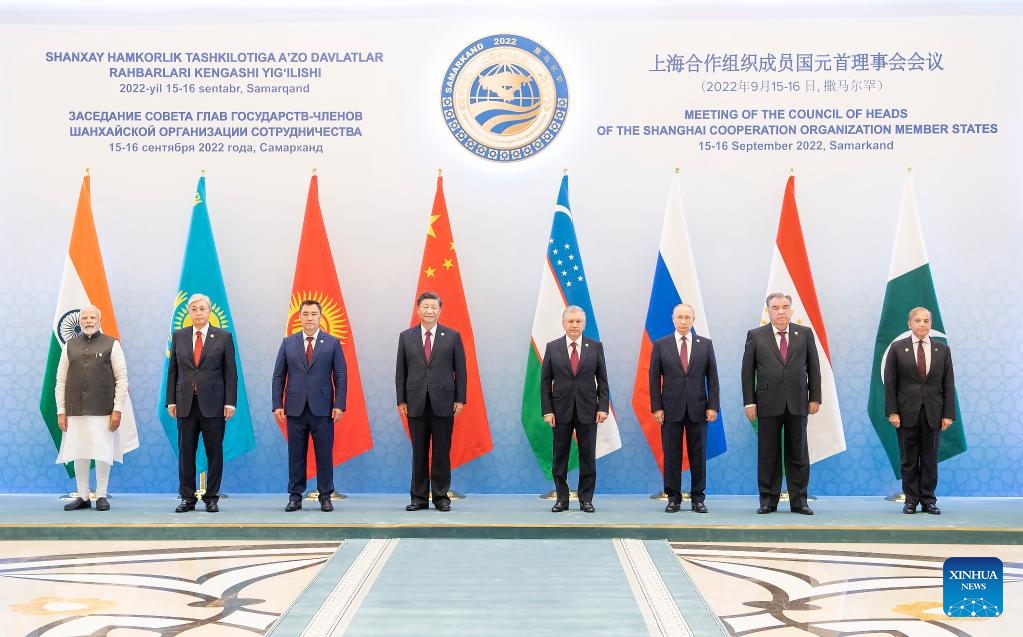
Indian Prime Minister Narendra Modi attended the summit meeting of the China-Russia sponsored Shanghai Cooperation Organization (SCO) held in Samarkand, Uzbekistan this week. India is a full member of this alliance which has been created to counter the US dominance in Asia. At the same time, New Delhi has also joined QUAD, a group of 4 nations (Australia, India, Japan and US) formed by the United States  to counter China's rise. Simultaneous membership of these two competing alliances is raising serious questions about Prime Minister Narendra Modi's real intentions and trustworthiness. Is this Indian policy shift from "non-alignment" to "all-alignment" sustainable? 

2022 SCO Summit in Samarkand, Uzbekistan. Source: Xinhua

Shanghai Cooperation Organization (SCO): 

Shanghai Cooperation Organization (SCO) is a political, economic and security organization designed to counter US dominance. It was founded by Beijing and Moscow in 2001. Currently, it has 8 members: China, Russia, India, Pakistan, Kyrgyzstan, Kazakhstan, Tajikistan and Uzbekistan. Iran has signed a memorandum of commitment this week signaling its intention to join the SCO, underscoring the growing alignment between the U.S.'s top adversaries. India's participation in this alliance seems strange given its simultaneous membership of the Quadrilateral Security Dialogue. 

Quadrilateral Security Dialogue (QUAD): 

The Quadrilateral Security Dialogue (QSD) is a strategic security dialogue between Australia, India, Japan, and the United States that was initiated in 2007 by Japanese Prime Minister Shinzo Abe to counter growing Chinese influence in Asia. India upset Japan recently when it joined the Russia-led Vostok-2022 military exercises held around a group of islands known as the southern Kurils in Russia and the Northern Territories in Japan -- a territorial dispute that dates back to the end of World War II, according to Bloomberg. India scaled back its participation in the war games -- especially staying out of the naval exercises -- in response to the Japanese objections but it left a bad taste. 

Non-Alignment to All-Alignment: 

The contradictions inherent in the membership of both of these competing alliances are already being exposed by Mr. Modi's large and rapidly growing purchases of Russian energy and weapons despite western sanctions.  “India’s neutral public positioning on the invasion has raised difficult questions in Washington DC about our alignment of values and interests,” said Richard Rossow, a senior adviser on India policy at the Center for Strategic and International Studies, told Bloomberg News. “Such engagements -- especially if they trigger new or expanded areas of cooperation that benefit Russia -- will further erode interest among Washington policy makers for providing India a ‘pass’ on tough sanctions decision.”

Monday, December 6, 2021

Esports: Pakistan's Arsalan Ash Wins Tekken7 Championship in Florida

Pakistan's Arsalan Ash defeated the “hometown” American hero Hoa “Anakin” Luu in a thrilling Grand Finals set to win first place in Tekken 7 at CEO 2021 in Florida. Arsalan won every single match without dropping a single game. This came against some of America’s top players, including EVO 2021 Online champion Marquis “Shadow_20z” Jordan. Known for his ability to use several different characters, Arslan Ash stuck with Zafina for the entirety of the CEO 2021, according to a report in EsportsTalk

Arsalan Ash Siddique at CEO 21 Game Competition in Florida. Source: Arsalan Ash

CEO 2021 was the first major fighting game tournament since the start of COVID-19 pandemic in 2020. The victory is Arslan Ash’s first major win in the United States since his memorable performance at EVO 2019 in Japan. It is also the second offline event he has won in 2021 after taking 1st at WePlay Ultimate Fighting League last April. 

Prior to the latest win at CEO 21, Arslan Ash Siddique won three top ESports awards, including Player of the Year award for 2019, according to ESPN.com. In December awards, Aslan Ash won the Best Esports Player award under both the fan and ESPN choice categories. He was also the first-runner for Best Moment of the Year award in the fan poll. The nomination was based on his EVO wins.


Arslan Ash Siddique at EVO Japan 2019


Esports have risen to the level of other major international sports with multiple international tournaments. The total prize money in international tournaments now exceeds a billion US dollars. Esports leagues have sprung up in many countries including Pakistan. Esports Pakistan (ESPK) is a growing E-Gaming organization which organizes national esports competitions at its Gaming Arena at Royal Palm, Lahore.

Arslan put Pakistan on the esports map following his surprise first-place victory in Tekken 7 at EVO Japan 2019 and EVO 2019. Before October 2018, Ash, the Pakistani Tekken 7 phenom, had never competed in a major international tournament. Now, at the end of 2019, he is an international star and the only person to ever win the Evolution Championship Series Japan and its American counterpart in  Las Vegas the same year.

Arslan is not the only successful Pakistani esports competitor on the world stage. Karachi-born Pakistani Syed Sumail Hasan, 19, is the world's youngest video gamer to surpass $1 million in earnings in esports. In fact, he has earned $3.6 million so far as an international Dota 2 player, ranking him the 10th biggest winner in the world, according to esportsearnings.com website which tracks players' earnings. Sumail started playing Dota 2 at the age of 7. He now lives in a Chicago suburb as a permanent resident of the United States.


Syed Sumail Hassan


Arsalan Ash Siddique, 23 years old player from Lahore, Pakistan, caused a stir in Fukuoka Japan when he defeated the world's top players to win EVO championship in February, 2019, according to Asahi Shimbun. In his victory speech, Arslan acknowledged many unknown Pakistani players who are also quite strong but could not join the competition because they could not get the visa to travel to Japan.


It wasn't easy for Arsalan to reach Japan to participate in the contest. He had to jump through many hoops and travel through several transit countries each of which made it difficult for him. When he arrived at Haneda airport in Japan,  he only had Pakistani rupees and no exchange would accept them. Hungry and tired he tried his luck at the food court but no one would accept the Pakistani currency. His next flight was from Narita airport an hour away by public transport. To travel he needed to buy a ticket but did not possess any local currency, according to SBS Urdu.

Arsalan Ash Siddique (Center)


Arsalan was exhausted and ready to give up his dream when he finally got through to his Japanese sponsors who helped him out. Needless to say he got no help from Pakistani diplomats through his challenging journey.

In spite of visa denials and other travel challenges faced by Pakistani players, the country ranks 25th in the world for players' earnings in 2019, according to esportsearnings.com.  Ranked above Pakistan are  mainly rich industrialized nations from North America, Europe and East Asia. All South Asian nations rank below Pakistan. Players from India rank 63rd, Sri Lanka 98th, Afghanistan 108th, Bangladesh 115th and Nepal 123rd.

Here's a video of Arsalan's competition at CEO 2021 Finals in Florida:

https://youtu.be/6rHhR78tbD0


 Related Links:

Haq's Musings

South Asia Investor Review

Pakistani Esports Player Among World's Top Earners 

Mobile Game Industry in Pakistan

Pakistani Investors: Invest in Local Tech Startups

Invest in Pakistan Summit in Silicon Valley

Upwardly Mobile Pakistani-Americans

Upwardly Mobile Pakistan


Sunday, March 28, 2021

Is "Ever Given" Container Ship's Indian Crew At Fault For Blocking the Suez Canal?

Ever Given container ship that ran aground and blocked all shipping traffic through the Suez Canal, the busiest waterway in the world, has just been re-floated.  The mega cargo ship's captain and the entire crew are Indian, the owners and shipbuilders are Japanese, the operator is German, the insurance company is British, the charterer is Taiwanese and the cargo is Chinese, according to media reports. The ship was reported blown aground by strong winds. 

Ever Given Stuck in Suez Canal. Source: Bloomberg

The 200,000-ton, 1,312 ft-long, 175 ft-wide cargo ship got stuck in the Suez Canal last Tuesday. About 30% of global cargo ship traffic remained blocked with 50 ships added to the jam every day the vessel remained stuck, As of yesterday, there were $10 billion worth of goods with nowhere to go with more than 300 ships carrying products across multiple industries now stuck in the gridlock.

This is a major incident that will undoubtedly be investigated to prevent its recurrence. Early reports, however, indicate that there were significant errors made by the crew which might have contributed to the problem. Moments before the ship ran aground, the Ever Given was apparently traveling faster than the speed limit set by the Suez Canal Authority, Bloomberg reported. The ship's last recorded speed was 13.5 knots, logged 12 minutes before it grounded, according to Bloomberg, which cited its own data. The maximum allowed speed through the canal was between 7.6 knots and 8.6 knots, the report said. The Japan Times also reported the ship was traveling 13.5 knots, adding that two canal pilots were onboard when the ship hit land.  

A Wall Street Journal report said that this is not the first time Ever Given has had problems at sea. On Feb. 9, 2019, the container ship ran into the 75-foot Finkenwerder, a pleasure ferry that was moored alongside a pontoon along the Elbe River in a suburb of Hamburg, Germany. It couldn't be learned if the current Indian captain of the ship was its captain when it hit the ferry.   


Monday, August 31, 2020

Have Modi's Misguided Policies Turned India Into A Beggar Nation?

India is set to receive nearly $500 million in emergency aid from Japan to cope with rising covid19 cases and worsening economy, according to Hindustan Times. This is the largest amount of financial assistance announced by any country so far to support India’s response to the Covid-19 crisis, which has had widespread impacts on the Indian economy and health sector. India’s economy in the organized sector shrank nearly 24% last quarter. It is likely a 40% decline in GDP after the government takes the unorganized sector into account, according to the New York Times. Meanwhile, India is seeing record new daily coronavirus cases and becoming the new epicenter of the covid19 pandemic. Have Indian Prime Minister's misguided policies turned India into a beggar nation? The fact is that India was already the world's biggest recipient of foreign aid even before the pandemic. Pakistan is not even among the top 15 recipients of foreign aid.

India in Crisis:

Many in the world, including India's biggest cheerleader Fareed Zakaria, are beginning to see the stark reality of Modi's India as a big failure on multiple fronts. Indian state has failed to contain the deadly COVID19 pandemic. India’s economy in the organized sector shrank nearly 24% last quarter.  It is likely a 40% decline in GDP after the government takes the unorganized sector into account, according to the New York Times. Meanwhile, India is seeing record new daily coronavirus cases and becoming the new epicenter of the covid19 pandemic.  The country's democracy is in decline. India seems like a roadkill for China. This turn of events has created serious problems for Pakistani "liberals" who have long seen and often cited India as a successful example of "secular democracy" at work in South Asia.
Top Aid Recipients and Their Donors in 2017. Source: Wristband Resources

India World's Top Aid Recipient: 

The Japanese emergency aid of $500 million to India is only the latest instance of multi-billion dollar aid Tokyo has provided to New Delhi in recent years. In fact, India is currently the world's largest recipient of official development assistance (ODA) and Japan is its biggest donor. India's $4.21 billion in assistance is followed by Turkey $4.10 billion, Afghanistan $2.95 billion, Syria $2.77 billion, Ethiopia: $1.94 billion, Bangladesh $1.81 billion, Morocco $1.74 billion, Vietnam $1.61 billion, Iraq $1.60 billion and Indonesia $1.48 billion. Pakistan is not even among the top 15 recipients of foreign aid.

India: Epicenter of COVID19:

India is rapidly becoming the world’s new coronavirus epicenter, setting a record for the biggest single-day rise in cases as experts predict that it’ll soon pass Brazil -- and ultimately the U.S. -- as the worst outbreak globally, according to Bloomberg. Over 78,000 new cases were added in a single day taking the total tally to over 3.6 million. This represented the highest ever one-day surge among all major countries. At the current growth rate, India’s virus cases will eclipse Brazil’s in about a week, and the U.S. in about two months. And unlike the U.S. and Brazil, India’s case growth is still accelerating seven months after the reporting of its first coronavirus case on Jan. 30. The pathogen has only just penetrated the vast rural areas where the bulk of its 1.3 billion population lives, after racing through its dense mega-cities.

COVID19 Growth Fastest in India. Source: Bloomberg


Private International Charity to India:

India tops the list of charity recipients from private foundations while Pakistan is ranked as the 12th largest recipient of philanthropic giving in the world, according to a report released by OECD (Organization for Economic Co-operation and Development).

Private Foundation Philanthropy in Asia. Source: OECD 


Global Philanthropic Foundations:

Philanthropic contributions of major international private foundations in Pakistan totaled  $267 million out of the $42 billion global contribution in  2013-2015.  This compares with $1.6 billion in top-ranked India and $498 billion in second-ranked China.  US-based Bill and Melinda Gates Foundation (BMGF) contributed nearly half of the $42 billion in global charity by private foundations.

Private foundations are filling the huge gaps in public funding of health and education sectors in developing nations. . They contributed  $11 billion for the health sector alone in the three year period, ranking third behind the United States and a global fund for fighting disease.

Massive Western Aid to India:

In addition to being the biggest recipient of private foreign charity,  India has been the number one recipient of official US aid since 1947, according to the US government data.   The country India's first Prime Minister turned to for help during the 1962 China-India war was also the United States.


India has received $65.1 billion in US aid since its independence, making it the top recipient of American economic assistance. Pakistan, with its $44.4 billion, is at number 5 on the list.  US data also shows that Pakistan is not among top 10 for military or total economic and military aid.

Local Charity in Pakistan:

Pakistanis donate generously to local charities in the country in the form of religiously mandated donations such as "zakat, sadaqa and fitrana".  One of the key measures of empathy is generosity to others, the kind of generosity demonstrated in Pakistan by the likes of  late Abul Sattar Edhi. The Edhi Foundation set up by the great man is funded mainly by small donations from ordinary people in Pakistan.

 Anatol Lieven, author of "Pakistan: A Hard Country" wrote the following tribute to the Mr. Edhi:

"There is no sight in Pakistan more moving than to visit some dusty, impoverished small town in an arid wasteland, apparently abandoned by God and all sensible men and certainly abandoned by the Pakistani state and its elected representatives - and to see the flag of Edhi Foundation flying over a concrete shack with a telephone, and the only ambulance in town standing in front. Here, if anywhere in Pakistan, lies the truth of human religion and human morality."  

What Professor Anatol Lieven describes as "human religion and human morality" is the very essence of the Huqooq-ul-Ibad (Human Rights) in Islam. Abdus Sattar Edhi understood it well when he said, "there's no religion higher than humanity".

Edhi understood the meaning of what the Quran, the Muslim holy book, says in chapter 2 verse 177:

"Righteousness is not that ye turn your faces towards the east or the west, but righteous is, one who believes in God, and the last day, and the angels, and the Book, and the prophets, and who gives wealth for His love to kindred, and orphans, and the poor, and the son of the road, beggars, and those in captivity; and who is steadfast in prayers, and gives alms."

A recent article written by Shazia M. Amjad and Muhammad Ali and published in Stanford Social Innovation Review said that "Pakistan is a generous country. It contributes more than one percent of its GDP to charity, which pushes it into the ranks of far wealthier countries like the United Kingdom (1.3 percent GDP to charity) and Canada (1.2 percent of GDP), and around twice what India gives relative to GDP."

OECD says corporate donations in Pakistan have increased from  $4.5 million to $56.4 million over the last 15 years. Corporate donations are dwarfed by individual donations made as zakat, sadaqa and fitrana as commanded by the Quran.

In addition to zakat, sadaqa and fitrana, Pakistanis spent about $3.5 billion on Eid ul Azha in 2017, according to analysts. This included sacrifice of $2.8 billion worth of livestock and another $700 million on clothes,  shoes, jewelry and various services. This amount represent a huge transfer of wealth from urban to rural population, including many rural poor, in the country. It also brings philanthropic donations of Rs. 2.5 billion to Rs. 3 billion ($25-30 million) worth of animal hides which are sold to the nation's leather industry.

Empathy Study:

A Michigan State University (MSU) study of 63 countries finds that Pakistanis have higher empathy for others than people in their neighboring countries. It also finds that the United States is among the most empathetic nations in the world.


The MSU researchers, led by William J. Chopik,  analyzed the data from an online survey on empathy completed by more than 104,000 people from around the world.

The survey measured people’s compassion for others and their tendency to imagine others’ point of view. Countries with small sample sizes were excluded (including most nations in Africa). All told, 63 countries were ranked in the study, according to MSUToday, a publication of Michigan State University.

Summary:

India's biggest cheerleaders, including Fareed Zakaria, are beginning to see the stark reality of Modi's India as a big failure on multiple fronts. India is set to receive nearly $500 million in emergency aid from Japan to cope with rising covid19 cases and worsening economy, according to Hindustan Times. This Japanese emergency aid of $500 million to India is only the latest instance of multi-billion dollar aid Tokyo has provided to New Delhi in recent years. In fact, India is currently the world's largest recipient of official development assistance (ODA) and Japan is its biggest donor. India was already the world's biggest recipient of foreign aid even before the pandemic. Pakistan is not even among the top 15 recipients of foreign aid.  This $500 million is the largest amount of financial assistance announced by any country so far to support India’s response to the Covid-19 crisis, which has had widespread impacts on the economy and health sector. India’s economy in the organized sector shrank nearly 24% last quarter. It is likely a 40% decline in GDP after the government takes the unorganized sector into account, according to the New York Times. Meanwhile, India is seeing record new daily coronavirus cases and becoming the new epicenter of the covid19 pandemic. Have Indian Prime Minister's misguided policies turned India into a beggar nation?

Related Links:

Haq's Musings

South Asia Investor Review

Is Fareed Zakaria Souring on India? 

Pakistan Success Against COVID19

Study Says Pakistanis Have Higher Empathy Than Neighbors

Comparing Median Wealth and Income in India and Pakistan

Eid ul Azha Economy

Foreign Aid Pouring in India

Huqooq-ul-Ibad in Islam

Philanthropy in Pakistan

Panama Leaks Scandal

Misaq-e-Madina Guided Quaid-e-Azam's Vision of Pakistan

Interfaith Relations in Islam


Riaz Haq's Youtube Channel
Tuesday, April 28, 2020

International Telecommunications Union Ranks Pakistan Regulator Among Top 5 in Asia Pacific

International Communications Union has ranked Pakistan Telecommunications Authority (PTA) among top 5 regulators in Asia Pacific region.  Pakistan's ICT regulations are 4th generation (G4), more advanced than India's and Bangladesh's 3rd generation (G3) regulations, according to the ITU report titled “Global ICT Regulatory Outlook 2020 (GIRO)”. Only 8% states have managed to achieve G4 status of the 38 economies ranked in Asia-Pacific region. G4 regulations address both economic and social goals.  Among the key policy goals are financial inclusion and digital inclusion.

Telecom Regulators Grouped in 4 Generations. Source: ITU

Pakistan's ICT regulations are ranked 4th in Asia Pacific, ahead of Malaysia's ranked 5 but behind Singapore's ranked 1, Japan's ranked 2 and Australia's ranked 3.  Pakistan scores 88 and ranks 48th in the world among 193 countries. The report uses 50 indicators organized across four pillars: regulatory authority, regulatory mandate, regulatory regime, competition framework. Pakistan scores 20/20 for regulatory authority, 22/30 for regulatory regime and 27/28 for competition framework and 19/22 for regulatory mandate.

ITU's Definition of 4 Generations of ICT Regulatory Regimes. Source: ITU

The Global ICT Regulatory Outlook 2020 benchmarks regulatory progress across no fewer than 193 countries worldwide. In three years, the report claims it has established itself as the go-to reference for regulators and policy-makers seeking to shape meaningful, regulatory change that will benefit all.

Pakistan Telecom Indicators As Of December 31, 2019

Pakistan's designation as G4 country and its high rank is in part due to its efforts to use its regulatory powers to close the digital divide. Pakistan's Universal Service Fund (USF) promotes the development of telecommunication services in un-served and under-served areas and populations throughout across the country. The fund consists of contributions (1.5% of adjusted revenues) by the Telecom Operators with no Government funding involved.

Internet traffic in Pakistan has surged 15% amid COVID-19 lockdown, according to Pakistan Telecommunications Authority (PTA). This spike has occurred in spite the fact that Netflix and YouTube have reduced their bandwidth requirements during the current health crisis. Netflix says it has cut its bandwidth use by 25% without sacrificing quality.  Google's YouTube video platform has decided to temporarily change the quality of all videos on YouTube to standard definition.The increased traffic is mainly due to people working from homes. Pakistan has nearly 80 million 
broadband subscribers as of now.

Related Links:

Haq's Musings

South Asia Investor Review

Pakistan 4G Speed More Than Twice Faster Than India's

Pakistan Digital Advertising Among World's Fastest

Pakistan Internet Traffic Surges Amid Coronavirus Lockdown

Public Sector IT Projects in Pakistan

Pakistan's Gig Economy 4th Largest in the World

Afiniti and Careem: Tech Unicorns Made in Pakistan

Pakistani American Heads Silicon Valley's Top Incubator

Silicon Valley Pakistani-Americans

Digital BRI and 5G in Pakistan

Pakistan's Demographic Dividend

Pakistan EdTech and FinTech Startups

State Bank Targets Fully Digital Economy in Pakistan

Campaign of Fear Against CPEC

Fintech Revolution in Pakistan

E-Commerce in Pakistan

The Other 99% of the Pakistan Story

FMCG Boom in Pakistan

Belt Road Forum 2019

Fiber Network Growth in Pakistan

Riaz Haq's Youtube Channel


Monday, November 13, 2017

Is US Playing the "India Card" Against China With "Indo-Pacific Quad"?

Has Asia-Pacific become Indo-Pacific? Is George W. Bush's Quad back again? Is this Trump's version of Obama's Pivot to Asia? Let's examine what happened during President Donald Trump's recent Asia Trip.

Obama's Pivot to Asia:

President Barack Obama's Pivot to Asia initiative and his efforts to create Trans-Pacific Partnership (TPP) seemed to have been all but abandoned by President Donald Trump after his inauguration in January 2017. This is part of a pattern of Mr. Trump's campaign to erase the Obama legacy and put his own stamp on all things American. However, it now appears that the Obama legacy is being repackaged by the Trump administration under new names such as "Quad" in "Indo-Pacific" region. Its aim remains the same: To check China's rise.

Trump's Quad in Indo-Pacific:

In a speech to business leaders during his visit to Vietnam, President Trump repeatedly called for a “free and open Indo-Pacific,” describing a region where independent nations could “thrive in freedom and peace” and all states “play by the rules.” Without naming China as the target, Trump also used the phrase repeatedly at the start of a meeting Monday in the Philippines with President Rodrigo Duterte, according to Bloomberg.    Trump also met Indian Prime Minister Narendra Modi in Manila and called him a friend and a “great gentleman.”

Trump's Asia trip also saw the revival of a decade-old but short-lived partnership of four maritime nations (Australia, India, Japan and the United States) worried about China’s rising influence in the region now being described as "Indo-Pacific" rather than its usual moniker of Asia-Pacific.  Senior officials from the four countries met in Manila for the first such meeting since the George W. Bush administration, focused on regional issues including North Korea but topped with China-related concerns.

US-India Anti-China Military Alliance?

To some observers, the "Quad" appears to be a throwback to the Cold War era in which the United States wants to use Narendra Modi as a willing ally to check China's rise. They cite lack of confidence in the current American leadership under Trump to follow through on any international or bilateral commitments.

While the US seeks to use India against China, the Indians remain obsessed with Pakistan. They talk about the lack of American concern for India's interests in South Asia and the Middle East. Writing for The Wire, Indian analyst Manoj Joshi complains that "there is no reciprocal US commitment to issues of Indian concern relating to Pakistan and the dangers arising out of the highly volatile environment in the Persian Gulf area which the US has helped create".

India's Pakistan Obsession:

It seems to me that the US policymakers don't fully appreciate the Kautilya doctrine that says "your neighbor is your enemy and your neighbor's neighbor is your friend".

The foreign policy doctrine enunciated by Kautilya, the ancient Indian Machiavelli, continues to guide India's foreign policy vis-a-vis its neighbors, particularly Pakistan. Kautilya's Rajamdala (Circle of States) theory can be seen in action today in India's use of Afghanistan against Pakistan. Unfortunately, the Pakistan phobia in India is so deeply ingrained that the Indian policy vis-a-vis Pakistan is not likely to change in the foreseeable future.

Summary:

President Donald Trump has repeatedly talked about the "Indo-Pacific" region in an obvious attempt to sign up Delhi to counter Beijing in Asia.  However, the Indians remain obsessed with enlisting the Americans to hurt Pakistan. The Trump administration is willing to engage in anti-Pakistan rhetoric but it is not going to act against Pakistan as long as Afghanistan remains important to the US interests. This is where their interest diverge now and likely to remain so at least in the foreseeable future.

Related Links:

Haq's Musings

Why is India Sponsoring Terrorism in Pakistan?

Ex-Indian Spy Documents RAW's Successes in Pakistan

Post Cold War Line-up: Pakistan-Russia-China vs India-Japan-US

Ex RAW Chief AS Dulat Blames Advani For Agra Summit Failure

Pakistan ISI: Afghanistan's Bogeyman

Trump's Anti-Pakistan Rhetoric

Counter-insurgencyOperation ZarbeAzb

India's Abiding Hostility Toward Pakistan 

India's Israel Envy: Will Modi Attack Pakistan?

India's Pakistan Phobia

Thursday, July 27, 2017

5 Pakistani Companies Among Forbes 200 Best Under $1 Billion in Asia

Five Pakistani companies are featured in the Forbes magazine’s latest annual ranking of the 200 best companies with under $1 billion in revenue in the Asia-Pacific  region. Pakistan's representation of 5 on the list is down from 7 last year. The number of Indian companies on the list is down to 3, less than half of the seven companies that made it in 2016.

Among Pakistan's five companies on the list is Ferozsons Laboratories which is making its debut this year. The company's revenue jumped 93% last year.

The list highlights 200 Asia-Pacific public companies with less than $1 billion in revenue and consistent top- and bottom-line growth. This year’s candidates come from 13 countries and averaged 55% growth in sales, a 24% profit margin, and 113% growth in earnings per share.

China tops the Forbes 200 list with 71 companies followed by Japan 41, Taiwan 30, South Korea 22,  Vietnam 10, Singapore 7, Australia 6, Pakistan and Malaysia 5 each, Thailand 4, and Hong Kong and India 3 each.

The Pakistani companies on the list are Agriauto Industries, Cherat Packaging, Ferozsons Labs, Gandhara Industries and Searle Companies. There are 3 Indian companies on this list: 8k Mile Software Services, Kellton Tech Solutions and Manpasand Beverages.

Of the 5 Pakistani companies on the list, two are in auto industry, two in pharmaceuticals and one in package manufacturing. Here are brief descriptions of the companies as published by Forbes:

Agriauto Industries Ltd. manufactures and sells components for automotive vehicles, motorcycles, and agricultural tractors. Its products includes shock absorbers and struts; motorcycle shock absorber and parts; sheet metal press parts; and other parts such as manual type window regulator and door/door hinges. The company was founded on June 25, 1981 and is headquartered in Karachi, Pakistan.

Cherat Packaging Ltd. is engaged in manufacturing, marketing and selling of paper sacks and polypropylene bags to the cement industry in Pakistan. It provides cement bags made from kraft paper and polypropylene granules. The company was founded in 1991 and is headquartered in Karachi, Pakistan.

Ferozsons Laboratories Ltd. engages in the manufacturing and trading of pharmaceutical products. It produces tablets, capsules, syrups, suspension, creams, and ointments. The company was founded on January 28, 1954 and is headquartered in Lahore, Pakistan.

Ghandhara Industries Ltd. engages in the manufacture and market of vehicles. Its products include pickup, trucks, and buses. The company was founded by M. Habibullah Khan Khattak on February 23, 1963 and is headquartered in Karachi, Pakistan.

Searle Co. Ltd. engages in the manufacturing of pharmaceutical products and a low calorie sweetener. It also engages in selling of food and consumer items and manufacturing of pharmaceutical items for other companies. The company operates through the following segments: Pharma, Consumer and Investment Property. Searle was founded on October 5, 1965 and is headquartered in Karachi, Pakistan.

Pakistani companies are riding the rising tide of the nations's middle class consumption. They are benefiting from increasing consumer confidence and growing demand for cement, branded food products, pharmaceuticals and vehicles. Overall consumer products and services companies have been on the rise on Forbes Asia list, an indication of Asia’s success in moving towards a consumer economy.

Related Links:

Haq's Musings

Credit Suisse Wealth Report 2016

Pakistan: A Majority Middle Class Country

Karachi School of Business and Leadership

State Bank: Pakistan's Actual GDP Higher Than Officially Reported

College Enrollment in Pakistan

Musharraf Accelerated Development of Pakistan's Human and Financial Capital

China-Pakistan Economic Corridor


Monday, July 27, 2015

Pakistan Judicial Commission Report; Recurring Floods; ISIS Threat; Japan Re-Militarization

How will judicial commission report impact Pakistan Tehreek e Insaf (PTI)? Will there be a split in PTI? Will it hurt Imran Khan’s and his party’s popularity? Will Nawaz Sharif and his PMLN colleagues behave badly after the report?

Is a new political party emerging in Pakistan with many disgruntled members of existing parties? Is the Pak military behind it? What will such a party look like?

Why are there recurring floods in Pakistan almost every year? Meting glaciers? Heavier monsoons rising from increasing fresh water layer in Bay of Bengal? What can or should be done about it?

Monsoon Movement Across South Asia Source: BBC


Who will fill the vacuum left in Afghanistan by US troop withdrawal? Taliban? ISIS? Al Qaeda? Afghan government?

Why is Japan militarizing? Is it to counter rising China? How will it impact Asia? Viewpoint From Overseas host Faraz Darvesh discusses these questions with Misbah Azam (www.politicsinpakistan.com) and Riaz Haq (www.riazhaq.com).

https://vimeo.com/134619588


Pakistan Judicial Commission Report; Recurring Floods; ISIS Threat; Japan Re-Militarization from WBT TV on Vimeo.


https://www.youtube.com/watch?t=435&v=iszq1jxxNfM


http://www.dailymotion.com/video/x2zhwvp_pakistan-judicial-commission-report-recurring-floods-isis-threat-japan-re-militarization_news


Pakistan Judicial Commission Report; Recurring... by ViewpointFromOverseas

Related Links:

Haq's Musings

PTI Dharna

Musharraf Treason Trial

Pakistani Glaciers Growing, Not Melting Away

Afghan-China-Pakistan Trilateral Initiative For Afghanistan

Post Cold War Lineup: Pakistan-China-Russia Vs India-US-Japan

Talk4Pak Think Tank

VPOS Youtube Channel

VPOS Vimeo Channel

VPOS Dailymotion Channel

Tuesday, February 11, 2014

Japan to Finance and Build Modern Mass Transit System in Karachi

Pakistan's federal government and Sindh provincial government are close to a deal with Japan International Cooperation Agency (JICA) to finance a modern mass transit system befitting the megacity of Karachi with a population of nearly 20 million, according to a Pakistani TV Channel.

KUTC Trains Source: KUTC

The mass transit project will feature modern trains with automatic signalling and telecommunication system. An automatic train control (ATC) system will be set up. The train stations will feature computerized ticketing and vending machines, automated ticket gates and elevators. It will be run by Karachi Urban Transport Corporation (KUTC).

Project History:

The $2.5 billion project will revitalize and modernize the Karachi Circular Railway (KCR). Opened in 1964, the old KCR ran from Drigh Road in the outskirts to the center of the city of Karachi. It ceased operations in 1999 after it suffered huge losses.

Efforts to revive it began in 2005 with a feasibility study conducted by Japan External Trade Organisation (JETRO) completed in 2006. UK-based Scott Wilson Railways was appointed to validate the report prepared by JETRO. Japan International Co-operation Agency (JICA), which is funding the project, sponsored a final study prepared by Special Assistance for Project Formulation (SAPROF). US-based consultants Louis Berger validated the final report. The progress has so far been slow and halting but it now appears that the new government of Prime Minister Nawaz Sharif is pushing to make it happen.

Project Scope:

The JETRO study has recommended that the project be done in two phases.

Phase I of the project will include a 28.3 km circular section from Karachi Cantonment to a proposed station at Gulistan-e-Johar. About 9 km of this section will be elevated.


Phase II will consist of the 14.8km circular section from Gulistan-e-Johar to the proposed station at Liaquatabad. This section will have two dedicated tracks along the main line. Phase II also includes a 5.9 km airport line from Drigh Road to Jinnah International Airport. This extension will either have an elevated or underground track. Other bridges, culverts and underpasses, wherever necessary, will be constructed for the project.

Project Funding:

Japan International Co-operation Agency (JICA) is providing the entire funding for the project through a soft loan. The loan is payable in 40 years by the stakeholders of the City District Government Karachi, Pakistan Railways and Government of Sindh. The Karachi Urban Transport Corporation (KUTC) is planning an international tendering process for the project, which will be awarded on a turnkey basis. The winning contractors will operate it for the first two years of operation.

Rolling Stock:

The new KCR will be served by electric multiple units (EMU) with a capacity to carry 1,400 passengers. The maximum speed of the EMUs will be 100 km/h. About 290 trains are expected to operate daily at six-minute intervals.

Infrastructure Construction:

Proposed Station Design 
The project will include the construction of 19 underpasses and three overhead bridges. About 23 stations are planned for the project. The stations will feature computerized ticketing and vending machines, automated ticket gates and elevators.

The existing KCR has about 22 level crossings. Since the railway line passes through the major commercial areas of the city, these level crossings need to be removed to ensure that trains can operate every 6 minutes. The level crossings are expected to be removed and replaced by underpasses or overpasses.

Economic Impact:

There will be significant positive economic impact of this megaproject. In addition to its obvious benefits for the businesses owned by Prime Minister Nawaz Sharif's family, there will be thousands of new jobs created for ordinary Pakistanis during construction and later to operate the system. It will help stimulate Pakistan's stalling economy.

Japan's Interest:

Japan's commercial interest in Pakistan has recently been validated by JETRO survey of Japanese companies doing business in the country. It indicated that Japanese companies have "strong intentions to expand their business for the reasons of “sales increase” and “high growth potential.” in Pakistan. Clearly, the Japanese see significant future potential in Pakistan to increase their economic footprint in the emerging growth market.

Current Status:

The city and the provincial governments have already begun to remove squatters in and around the existing KCR track to begin new construction. Each of the estimated 5,000 affected families is being promised an 80-square-yard newly built home. The Japan International Cooperation Agency (JICA) is providing financial assistance for the resettlement project, while the KUTC will give an additional Rs 50,000 in financial aid to each affected family, according to a news report.

Future Concerns:

One of the key concerns is how will the system be managed after the first two years of operation by the turn-key contractors? Will it suffer the same horrible fate as the previous public transport systems have in Karachi? Will it be used to hire political cronies of the ruling politicians? Will it be headed by incompetent and corrupt managers hand-picked by politicians? If the politicians are serious about ensuring a well-run mass transit system in Karachi, they will need to take a page from the Delhi Metro Rail Corp (DMRC) system in India.  It is being run very well by an independent professional management team without political interference in its day to day hiring, firing and other management decisions.

Summary:

It is certainly welcome news that Karachi, the world's fastest growing megacity, will finally have a mass transit system that its residents need and deserve. Let's hope this time it's for real.

Related Links:

Haq's Musings

Saving PIA, Railway and Education

Politics of Patronage in Pakistan

Incompetence Worse Than Corruption in Pakistan

JETRO 2013 Survey of Pakistan

Pakistan on Goldman's Growth Map

Karachi is World's Fastest Growing Megacity


Friday, January 31, 2014

Japan Multinationals Rank Pakistan Among Top Growth Markets

Japanese companies have "strong intentions to expand their business for the reasons of “sales increase” and “high growth potential.” in Pakistan.  JETRO 2013 Report

Japanese companies doing business in Pakistan have ranked the country second in the world in terms of business growth, according to a survey conducted by the Japan External Trade Organization (JETRO).

Japanese Companies Reporting Profits (Source: JETRO)


JETRO surveyed 9,371 Japanese multinational companies operating around the world and reported that Pakistan is ranked number 2 in terms of current profitability and expected sales growth. Taiwan leads with 81.8% reporting profits, followed by Pakistan with 74.1% being profitable in 2013.

Japanese Companies' Sales Growth Forecast (Source: JETRO)

Pakistan also ranks at number 2 with 81.5% forecasting future sales growth, just behind Myanmar where  84.6% see growth in the next one to two years. Other South Asian nations, including Bangladesh, India and Sri Lanka, rank much lower for both profits and sales growth.

Japan to Supply Karachi Circular Railway Trains

JETRO has been conducting such surveys for many years. Pakistan’s data is based on responses of 27 Japanese firms doing business in the country. The percentage of Japanese firms expecting improved operating profits remained the same level as last year, while varying by country and region. 64.6% of respondents expect an operating profit in 2013, remaining almost the same level as the previous year (63.9%). Looking at the results by country, the percentage for Taiwan is the highest (81.8%), followed by Pakistan (74.1%), South Korea (73.8%), Hong Kong and Macau (72.6%) and Thailand (72.4%), among others. On the other hand, the percentage is relatively low for Sri Lanka (38.7%), Cambodia (38.5%) and Laos (25.0%). Looking at the results by business scale, 69.4% of large-scale companies expect an operating profit, 13.2 points above the percentage for small and medium-sized enterprises (SMEs) (56.2%).

The percentage of respondents planning to expand business operations in the next one or two years was 59.8% overall, a 2.0 point rise from the 57.8% in the previous year. Firms in emerging countries such as Myanmar (84.6%), Pakistan (81.5%) and Cambodia (80.0%) have particularly strong intentions to expand their business for the reasons of “sales increase” and “high growth potential.” The percentage for China increased to 54.2%, a 1.9 point rise from 2012 when it had decreased by 14.5 points from 2011. On the other hand, the percentage for Indonesia decreased 10.9 points from the previous year, the largest decrease among the surveyed countries. While the percentages for the Philippines (58.1%) and Sri Lanka (51.5%) are below overall average, they showed significant increase (9.9 points and 14.0 points, respectively) compared to the previous year.

JETRO survey is the latest ray hope on the heels of  impressive share market performance in 2013. Karachi's KSE-100 Stock Market Index was up 49.4% (37% in US$ terms) in 2013, beating all but four stock indices in the world. It handily beat Morgan Stanley's MSCI emerging market index which remained essentially flat. By comparison, India's main stock index rose just 8.89% in the same period. The remaining three BRIC countries--Brazil, Russia and China-- all saw their key stock indices decline in 2013.

KSE-100 vs MSCI Emerging Markets Index Source: Wall Street Journal

This is a continuation of the bullish trend seen in 2012 when KSE-100 also rose nearly 50% to top all Asian market indices. As of December 31, 2013, KSE-100 is up 329% since the end of 2008. It is being driven mainly by rapid growth in revenue and profits of the listed companies. Even after the strong run-up, the market still remains cheapcurrently trading at over nine times trailing 12 month earnings—a common valuation measure used by stock analysts, according to Wall Street Journal.

World Stock Indices Performance 2013 Source: Seeking Alpha
Dubai finished up the most in 2013 with a gain of 107.69%. Japan was up the fourth most with a gain of 56.72%, making it the best performing G7 country. The US ended up in 9th place globally with a gain of 29.6%. Of the other G7 countries, Germany finished third with a YTD gain of 25.48%, followed by France (17.99%), Italy (16.56%), the UK (14.43%) and Canada (9.55%), according to Seeking Alpha.

The fresh investor optimism in 2013 was triggered by the election of Prime Minister Nawaz Sharif whose government is seen to be business-friendly by investors and businessmen. His finance minister Ishaq Dar claimed that Pakistan's gdp growth accelerated to 5% in July-Sept quarter in 2013. It was driven by large-scale manufacturing (LSM) which grew 12.76 per cent in September 2013 from a year ago.

"Pakistan has a fairly diverse economy with a large and young population that needs to be fed and supplied basic infrastructure such as electricity," Wall Street Journal quoted Caglar Somek, global portfolio manager at Caravel Management in New York, as saying. He manages around $650 million of investments. "If you find the companies that supply those basic needs, growing at double digit with high profitability, you can buy them at valuations that are on average 30% to 40% cheaper than their emerging market peers," said Mr. Somek.

Since the general elections of May, 2013, Pakistan has seen smooth power transfer from one civilian government to another. Other major transitions include the change of President, Army Chief and the nation's powerful Chief Justice of the Supreme Court.

Power cuts are now less frequent after payment of power generation companies overdue bills by the federal government. Financing has been closed on several power projects, including ADB financing of a major coal-fired plant in Jamshoro and Chinese loans for the nation's largest nuclear power plant planned for Karachi.

The good news for Pakistan in the JETRO report is that the Japanese companies have "strong intentions to expand their business for the reasons of “sales increase” and “high growth potential.”" Let's hope this results in a significant increase in foreign direct investment (FDI) in the country.

Progress on economic front, however, needs to be matched by similar progress on the security front which remains the biggest concern for the future of the country and its economy. What is needed is a comprehensive anti-terrorism strategy and plan of action soon.

Related Links:

Haq's Musings

Pakistan Stock Market Among World's Top 5 Performers in 2013

Foreign Investment Up, Load-shedding Down in Nawaz Sharif's First 100 Days

Pakistan to Beg and Borrow Billions More in 2013-14

Power Companies Profits Soar at Taxpayer's Expense

Does Nawaz Sharif Have a Counter-terrorism Strategy?

Pakistan's Tax Evasion Fosters Aid Dependence

Pakistan's Vast Shale Oil and Gas Reserves

Pak IPPs Make Record Profits Amid Worst Ever Load Shedding 

Global Power Shift Since Industrial Revolution

Massive Growth in Electrical Connections in Pakistan

Finance Minister Ishaq Dar's Budget 2013-14 Speech