Showing posts sorted by relevance for query remittances. Sort by date Show all posts

Thursday, April 14, 2016

Pakistan Received $19.3 Billion in Remittances in 2015 Amid Falling Oil Prices

Pakistani diaspora sent home $19.3 billion in remittances in 2015, representing 12.8 % increase over 2014, according to a World Bank Report titled "Migration and Development Brief" released today.

Pakistan's $19.3 billion in remittance make up 6.9% of 2014 GDP, essentially closing the rising trade deficit amid the nation's falling exports.

The 12.8% increase over 2015 is substantial but it is down from 16.7% jump seen in 2014 over 2013. The report attributes the slower remittance growth from Gulf Cooperation Council (GCC) countries like Saudi Arabia and United Arab Emirates to falling oil prices.

This report comes soon after the Panama Leaks that show how Pakistan's corrupt elite, including Prime Minister Nawaz Sharif's family, are moving and hiding in offshore tax havens the hard-earned dollars sent home by overseas Pakistanis to keep Pakistan's economy afloat.

Overseas Remittances in South Asia Source: World Bank 


In Q4 of 2015, year-on-year growth of remittances to Pakistan from Saudi Arabia and the UAE were 11.7 percent and 11.6 percent, respectively, a significant deceleration from 17.5 percent and 42.0 percent in the first quarter, said the report.

Global remittances, which include those to high-income countries, contracted by 1.7% to $581.6 billion in 2015, from $592 billion in 2014, the World Bank said.

India was the top recipient with $68.9 billion in remittances in 2015, a decline from $70 billion in 2014. This marks the first decline in remittances since 2009,  according to the report.

The growth of remittances in 2015 slowed from 8% in 2014 to 2.5% for Bangladesh, from 16.7% to 12.8% for Pakistan, and from 9.6% to 0.5% for Sri Lanka. “Slower growth may reflect the impact of falling oil prices on remittances from GCC countries,” the report said.

The only country in South Asia to see dramatic growth in remittances was Nepal. The overseas Nepalese workers sent home $7 billion in 2015, an increase of 20.9 percent in 2015 versus 3.2 percent growth in 2014. After the devastating earthquake that hit the Himalayan nation, many Nepalese migrant workers returned home to take care of their families, as the average number of returns at the airport jumped five times to around 4,000 per day.

“Remittances are an important and fairly stable source of income for millions of families and of foreign exchange to many developing countries,” said Augusto Lopez-Claros, director of the World Bank’s Global Indicators Group.

“However, if remittances continue to slow, and dramatically as in the case of Central Asian countries, poor families in many parts of the world would face serious challenges including nutrition, access to health care and education,” Lopez-Claros said.


Related Links:

Haq's Musings

Remittances to Pakistan

Pakistani Names in Panama Leaks

Pakistan Diaspora is Among the World's Largest

Pakistan's Corrupt Elite

Remittances Offer a Lifeline to Pakistan's Poor

Aid, Investment, Trade and Remittances to Pakistan

Saturday, October 8, 2016

Diaspora's 2016 Remittances to Pakistan Rise 5.1% to $20.5 Billion

Overseas Pakistanis sent home $20.5 billion in remittances in 2016, an increase of 5.1% over 2015, according to the World Bank. Pakistan's remittances are 7.5% of its 2015 GDP of $270 billion.

Pakistan's Declining Exports:

The increase in remittances from the diaspora is welcome news in Pakistan suffering from precipitous 12% decline of export earnings and gaping 35-year high trade deficit of $24 billion in 2016.

The World Bank report said 2016 remittances to India declined by 5% to $65.5 billion while Bangladesh received $14.9 billion, a decrease of 3.5% from the previous year.

Declining Remittances to South Asia: 

Remittances to  South Asia region as a whole declined by 2.3 percent in 2016, following a 1.6 percent decline in 2015. Remittances from the oil-rich GCC countries continued to decline due to lower oil prices and labor market ‘nationalization’ policies in Saudi Arabia, according to the report.


Top Recipients of Remittances: 

The top recipients of remittances in 2016 are, India ($65.%b), China ($65.2b), the Philippines ($29.1b), Mexico ($28.1b) and Pakistan ($20.3b) and, in terms of remittances as a share of GDP, Nepal (32.2%), Liberia (31.%), Tajikistan (28.8%), Kyrgyz Republic (25.7%) and Haiti (24.7%).

Pakistan is not alone in seeing its exports decline amid weakness in world demand, particularly in Europe with its slowing economy. However, India's 2016 exports decline is much lower at 5.5% and India's trade deficit actually shrank.

Summary: 

Increase in remittances to Pakistan is good news, especially amid declining worldwide remittances. However, Pakistan can not continue to count on remittances from overseas workers in the midst of low oil prices affecting the GCC nations where millions of Pakistanis work. It must take urgent steps to boost exports and lower its trade deficit to avoid yet another bill-of-payments crisis requiring yet another IMF bailout.

Related Links:

Haq's Musings

Pakistani Diaspora

CPEC to Add Over 2 Million New Jobs in Pakistan

ADB Raises Pakistan GDP Growth Forecast

Is Pakistan Ready For War With India?

India's Israel Envy: Surgical Strikes in Pakistan?

Growing Middle Class in Pakistan

Rising Energy Consumption

China-Pakistan Economic Corridor

Pakistan's Thar Desert Sees Development Boom


Friday, September 2, 2011

Pakistani Diaspora is the World's 7th Largest

Nearly 5 million Pakistani emigrants make up the world's 7th largest disapora, according to the World Bank Factbook 2011. Adding the foreign-born children of these Pakistani emigres to the tally pushes the total figure up to about 7 million. The top five nations that the Pakistani diaspora calls home include the United Kingdom (1.2 million), The Kingdom of Saudi Arabia (1.2 million), the United Arab Emirates (1.1 million), the United States (700,000) and Canada (300,000), according to Pakistan's Dawn newspaper.

The nations ranking ahead of Pakistan are Mexico at #1, India at #2, Russia at #3, China at #4, Ukraine at #5 and Bangladesh at #6. Both the UK and Pakistan are tied at #7 with 4.7 million emigres, according to the World Bank.

World's Top 10 Diasporas:

Here are the top 10 national diasporas:

1. Mexico 11.9 million

2. India 11.4 million

3. Russia 11.1 million

4. China 8.3 million

5. Ukraine 6.6 million

6. Bangladesh 5.4 million

7. Pakistan 4.7 million

7. United Kingdom 4.7 million

8. Philippines 4.3 million

8. Turkey 4.3 million

9. Egypt 3.7 million

9. Kazakhstan 3.7 million

10. Germany 3.5 million

10. Italy 3.5 million

Diaspora Remittances:

The World Bank's Migration and Remittances Factbook 2011 ranks Pakistan at #11 in 2010 for remittances of $9.4 billion sent home by its diaspora. The State Bank of Pakistan reported that overseas Pakistanis sent home $5.291 billion during six months from July to Dec, 2010, an increase of $761 million or 17 per cent year over year, according to Pakistan's Dawn newspaper.

India tops this list with remittances of $55 billion sent home in 2010, followed by China ($51 billion), Mexico ($22.6 billion), Philippines ($21.3 billion), France ($15.9 billion), Germany ($11.6 billion), Bangladesh ($11.1 billion), Belgium ($10.4 billion), Spain ($10.2 billion), Nigeria ($10 billion) and Pakistan ($9.4 billion).

Per Capita Remittances:

In terms of per capita remittances based the World Bank data, China leads the world with an average of $6,100 sent home by each member of the Chinese diaspora, followed by the Philippines ($4,953), India ($4,824), Bangladesh ($2055), Pakistan ($2000), Mexico ($1904), UK ($1,574), Ukraine ($803) and Russia ($504). These per capita figures are an indication of the wealth of each diaspora and the extent of the brain drain experienced by these nations.

Top Immigration Countries:

With 42.8 million immigrants, the United States is home to the world's largest immigrant population. India and Pakistan also have the distinction of being on the list with 5.4 million immigrants in India at #10 and Pakistan with 4.2 million immigrants at #13. Other nations on this list include Russia at #2 (12.3 million immigrants), Germany at #3 (10.8 million), Saudi Arabia at #4 (7.3 million), Canada at #5 (7.2 million), the UK at #6 (7 million), Spain at #7 (6.9 million), France at #8 (6.7 million) and Australia at #9 (5.5 million).

Examples of Diaspora's Role:

Diasporas of various nations are mutually beneficial to both the sending and the receiving countries. They send home the money to help their families and friends financially. And they often acquire advanced education and technical, professional and managerial skills and contribute to solving problems in their host nations in the West. And given the right political and policy context, the members of the diaspora can also help their countries of origin by using their deep knowledge of their home countries and by offering advanced skills, experience and knowledge acquired in more developed nations.

In terms of development help with the skills and capital of the diaspora for their home nations, there are three examples of fairly old and mature diasporas: China, India and Armenia. While China and India have benefited greatly from their diasporas, Armenia has lagged badly, according to a World Bank report titled "Work Globally, Develop Locally: Diaspora Networks as Springboards of Knowledge-Based Development".

Pakistani Diaspora's Role:

In Pakistan's case, growing remittances amounting to 5% of its gdp in 2010 from the nation's diaspora provided an important lifeline for the state of Pakistan in funding its large current account deficit and in helping the individuals and families receiving the funds to supplement their incomes.

Remittances are a source of income for households in Khyber Pakhtunkhwa (KP) and other provinces in Pakistan, according to a 2010 World Bank report titled "Poverty fell in Pakistan in 2001-08 partly because of remittances". A recent Asian Development Bank study found that foreign remittances constituted 9.4 percent of household income in KP, compared to 5.1% for Punjab, 1.5% for Baluchistan, and 0.7% for Sindh.

Beyond the remittances, can Pakistan also benefit from its growing diaspora like India and China have from theirs? With millions of Pakistanis in Europe and America, many of them highly skilled entrepreneurs and business and technology professionals, Pakistani diaspora can be very helpful to their home country in its business, economic, social, political, educational and technological development. The realization of such great potential will only be possible if Pakistani government's public policy, public-private partnerships and state-to-state relations with the West create the necessary conditions for it to happen. Existing organizations of Pakistanis, such as OPEN Silicon Valley, APPNA, and PakAlumni Worldwide, can be helpful in such an endeavor.


Among the emerging diaspora networks, the effort of South African Network of Skills Abroad (SANSA), established by the University of Cape Town’s Science and Technology Policy Research Center, is worth watching. SANSA aims to promote collaboration between highly skilled expatriate scientists and technologists and their counterparts in South Africa. The target group is alumni of all major South African universities working in the West.

Related Links:

Haq's Musings

PakAlumni Worldwide

Pakistani-American's Game-Changing Vision

OPEN Forum 2010

Pakistani-American in $500 Million NFL Deal

Is Pakistan Too Big to Fail?

Pakistani-American Elected Mayor

Fighting Poverty Through Microfinance in Pakistan

Silicon Valley Summit of Pakistani Entrepreneurs

Pakistan's Multi-Billion Dollar IT Industry

Media and Telecom Sectors Growing in Pakistan

Pakistan's Middle Class Growth in 1999-2009

Social Entrepreneurs Target India, Pakistan

Sunday, December 9, 2018

Remittances From Pakistani Diaspora Soared 21X Since Year 2000

Remittance inflows from Pakistani diaspora have jumped 21-fold from about $1 billion in year 2000 to $21 billion in 2018, according to the World Bank. In terms of GDP, these inflows have soared nearly 7X from about 1% in year 2000 to 6.9% of GDP in 2018.

Meanwhile, Pakistan's exports have declined from 13.5% of GDP in year 2000 to 8.24% of GDP in 2017.  At the same time, the country's import bill has increased from 14.69% in year 2000 to 17.55% of GDP in 2017.  This growing trade imbalance has forced Pakistan to seek IMF bailouts four times since the year 2000.  It is further complicated by external debt service cost of over $6 billion (about 2% of GDP) in 2017. Foreign investment in the country has declined from a peak of $5.59 billion (about 4% of GDP) in 2007 to a mere $2.82 billion (less than 1% of GDP) in 2017. While the current account imbalance situation is bad, it would be far worse if Pakistani diaspora did not come to the rescue.

Diaspora Remittances:

Estimated inflows of $20.9 billion make Pakistan the world's 7th largest recipient of remittances for 2018, according data released by the World Bank in its latest "Migration and Remittances" report of December 2018.  In South Asia region, Pakistan is the second largest recipient of remittances of $20.9 billion after top-ranked India's $79.5 billion.

Pakistan Remittances in Millions of US Dollars. Source: World Bank

Remittances from Pakistani diaspora have grown nearly 21-fold since the year 2000.  Pakistanis sent home remittances adding up to 6.9% of the country's GDP in 2018, up from 1% back in year 2000.

Pakistan's Trade:

In 2017, Pakistan exported goods and services worth $22 billion while it imports amounted to $57 billion, a trade deficit of $35 billion for the year. This is a dramatic deterioration from about $2 billion trade deficit (2% of GDP) in year 2000 to $35 billion trade deficit (about 12 % of GDP) in year 2017.

Pakistan Trade Deficit in Billions of US$. Source: World Bank


Pakistan's exports have declined from 13.5% of GDP in year 2000 to 8.24% of GDP in 2017.  At the same time, the country's import bill has increased from 14.69% in year 2000 to 17.55% of GDP in 2017.

Pakistan FDI. Source: The Global Economy

Foreign Direct Investment:

Foreign direct investment (FDI) in Pakistan was a mere $2.82 billion (less than 1% of GDP) in 2017, down from a peak of $5.59 billion (4% of GDP) in 2007.  The lack of foreign investment has contributed to the country's dwindling reserves and balance of payments difficulties requiring it to seek yet another IMF bailout.

Pakistan's External Debt. Source: State Bank of Pakistan via Dr. Ishrat Husain

Pakistan's Debt:

Significant growth in remittances from Pakistani diaspora has clearly helped but the external accounts gap is too big for it. This has forced Pakistan to borrow heavily in recent years. It has raised debt service costs and put pressure on Pakistan's reserves.

Summary:

Remittances from Pakistani diaspora have jumped 21-fold from about $1 billion in year 2000 to $21 billion in 2018, according to the World Bank. In terms of GDP, these inflows have soared nearly 7X from about 1% in year 2000 to 6.9% of GDP in 2018.  Meanwhile, Pakistan's exports have declined from 13.5% of GDP in year 2000 to 8.24% of GDP in 2017.  Foreign investment in the country has declined from a peak of $5.59 billion (about 4% of GDP) in 2007 to a mere $2.82 billion (less than 1% of GDP) in 2017. At the same time, the country's import bill has increased from 14.69% in year 2000 to 17.55% of GDP in 2017. This growing trade imbalance has forced Pakistan to seek IMF bailouts four times since the year 2000.  It is further complicated by external debt service cost of over $6 billion (about 2% of GDP) in 2017. While the current account imbalance situation is bad, it would be far worse if Pakistani diaspora did not come to the rescue.

Related Links:

Haq's Musings

South Asia Investor Review

Can Pakistan Avoid Recurring Balance of Payment Crisis?

Pakistan Economy Hobbled By Underinvestment

Pakistan's IT Exports Surging

Can Indian Economy Survive Without Western Capital Inflows?

Pakistan-China-Russia Vs India-Japan-US

Chinese Yuan to Replace US $ as Reserve Currency?

Remittances From Overseas Pakistanis

Can Imran Khan Lead Pakistan to the Next Level?

China to Expand Manufacturing in Special Economic Zones

Monday, April 24, 2017

Pakistani Diaspora Bucks Global Trend With 2.8% Higher Remittances in 2016

Pakistani diaspora bucked the 2016 global decline in remittances with a modest 2.8% increase over 2015, according to a recently released World Bank report. An estimated $19.8 billion remitted to Pakistan amounted to 6.9% of the country's GDP. This is a welcome relief coming on the heels of the State Bank of Pakistan report indicating the country's current account deficit widened to $6.13 billion or 2.6% of GDP in the first 9 months of fiscal 2017.

2016 Remittances to South Asia. Source: World Bank

Global Decline:

Meanwhile, global remittance flows to developing countries registered a decline for two successive years, said the report.  Remittances declined by an estimated 2.4 percent, to $429 billion, in 2016, after a decline of 1 percent in 2015. India, the largest remittance-receiving country worldwide, led the fall with a decrease of 8.9 percent in remittance inflows.

South Asia Region:

Remittances to India declined by 8.9 percent in 2016, to $62.7 billion, ranking the country as the top recipient of such inflows.  In Bangladesh, remittances declined by an estimated 11.1 percent in 2016. In Pakistan, the 12 percent growth witnessed in 2015 moderated to an estimated 2.8 percent in 2016. Nepal experienced unusually high growth in remittances, at 14.3 percent in 2015, due to emigrants sending financial assistance after the earthquake. In 2016, remittance flows to Nepal declined by an estimated 6.7 percent from the previous year’s high level. In Sri Lanka, remittance growth was estimated at 3.9 percent in 2016.

Next Year Forecast:

The World Bank says the remittance growth in the region is projected to remain muted, because of low growth and fiscal consolidation in GCC countries with low energy prices. An increase of only 2.0 percent is expected in 2017. Bangladesh’s remittance growth in 2017 is forecast at 2.4 percent, India’s at 1.9 percent, Pakistan’s at 1.4 percent, and Sri Lanka’s at 1.3 percent.

Summary:

World Bank report says Pakistani diaspora bucked the 2016 global decline in remittances with a modest 2.8% increase over 2015. An estimated $19.8 billion remitted to Pakistan amounted to 6.9% of the country's GDP. This is a welcome relief coming on the heels of the State Bank of Pakistan report indicating the country's current account deficit widened to $6.13 billion or 2.6% of GDP in the first 9 months of fiscal 2017. Future growth in remittances is likely to remain muted. Slowing growth in such inflows will further increase pressure on Pakistan to work on enhancing exports and attracting more foreign direct investment.

Related Links:

Haq's Musings

CPEC and FDI

Pakistan Remittances Rise Amid Falling Oil Prices

Pakistani Diaspora Among World's Largest

China-Pakistan Economic Corridor (CPEC) to Add 2 Million Jobs

ADB Raises Pakistan GDP Growth Forecast

Gwadar as Hong Kong West

China-Pakistan Industrial Corridor

Wednesday, November 16, 2022

World at 8 Billion: Pakistan is Fourth Largest Contributor to Last Billion

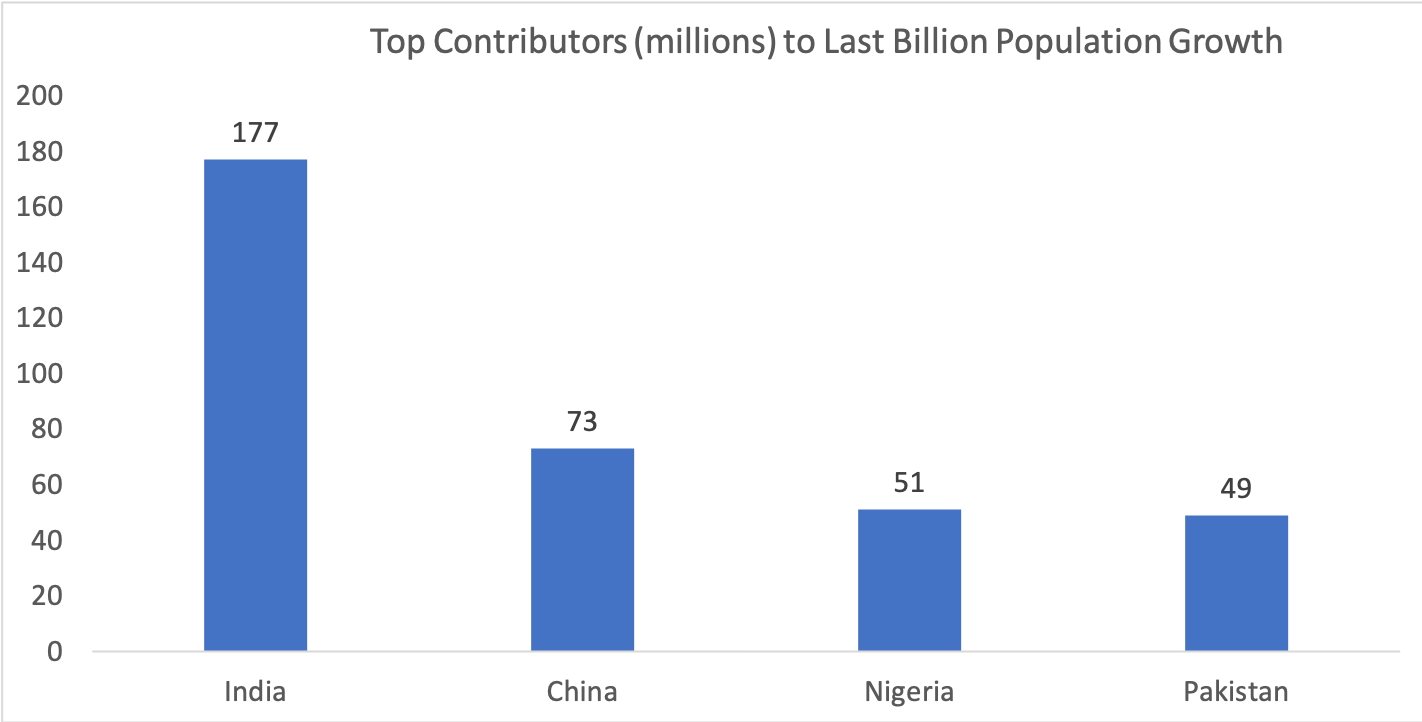
The global population increased by one billion over the last 12 years to reach 8 billion this year, according to the United Nations. Pakistan contributed 49 million people to the last billion, making it the fourth largest contributor after India (177 million), China (73 million) and Nigeria (51 million). Nigeria is expected to soon overtake Indonesia and Pakistan to become the world's 4th most populous nation. More than half of the projected increase in the global population up to 2050 will be concentrated in eight countries: the Democratic Republic of the Congo, Egypt, Ethiopia, India, Nigeria, Pakistan, the Philippines and the United Republic of Tanzania. Rising working age population is turning Pakistan into a major global consumer market. It is also fueling Pakistan's growing surplus labor exports and record overseas worker remittances. 

Pakistan Among Top 4 Contributors to Last Billion Population. Source: UN/Worldometers


World Population Visualization in 2022. Source: Visual Capitalist

World's 7th Largest Consumer Market:

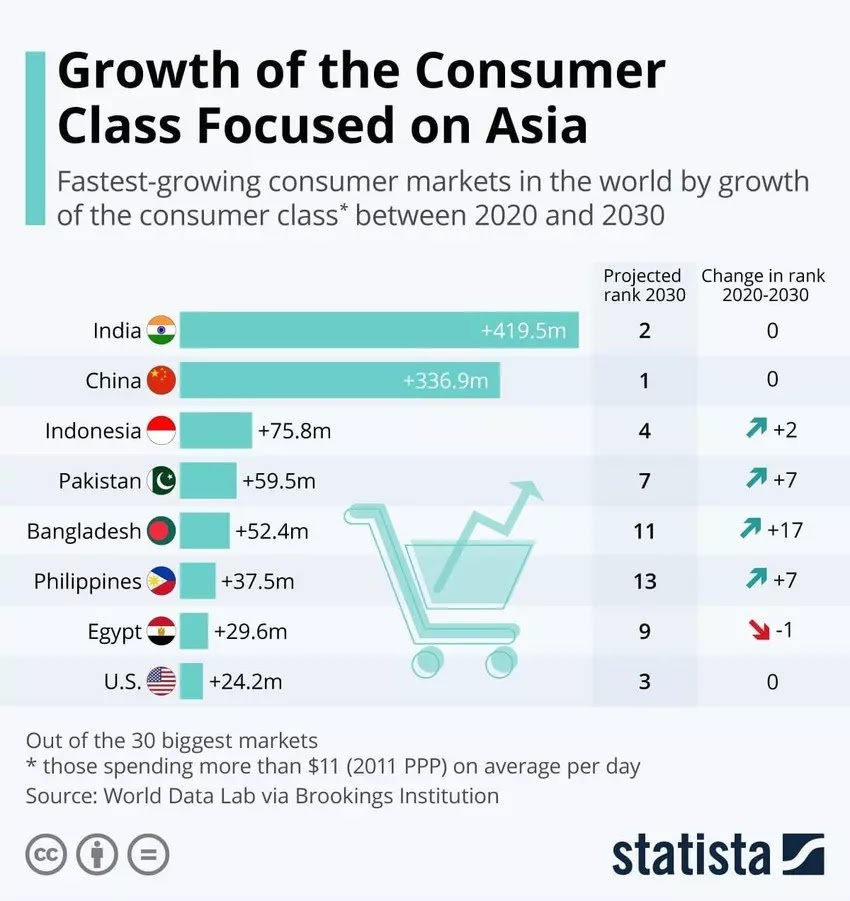
Pakistan's share of the working age population (15-64 years) is growing as the country's birth rate declines, a phenomenon called demographic dividend. With its rising population of this working age group, Pakistan is projected by the World Economic Forum to become the world's 7th largest consumer market by 2030. Nearly 60 million Pakistanis will join the consumer class (consumers spending more than $11 per day) to raise the country's consumer market rank from 15 to 7  by 2030. WEF forecasts the world's top 10 consumer markets of 2030 to be as follows: China, India, the United States, Indonesia, Russia, Brazil, Pakistan, Japan, Egypt and Mexico.  Global investors chasing bigger returns will almost certainly shift more of their attention and money to the biggest movers among the top 10 consumer markets, including Pakistan.  Already, the year 2021 has been a banner year for investments in Pakistani technology startups. 

Consumer Markets in 2030. Source: WEF


World Population in 2050. Source: Visual Capitalist

Labor Exports: 

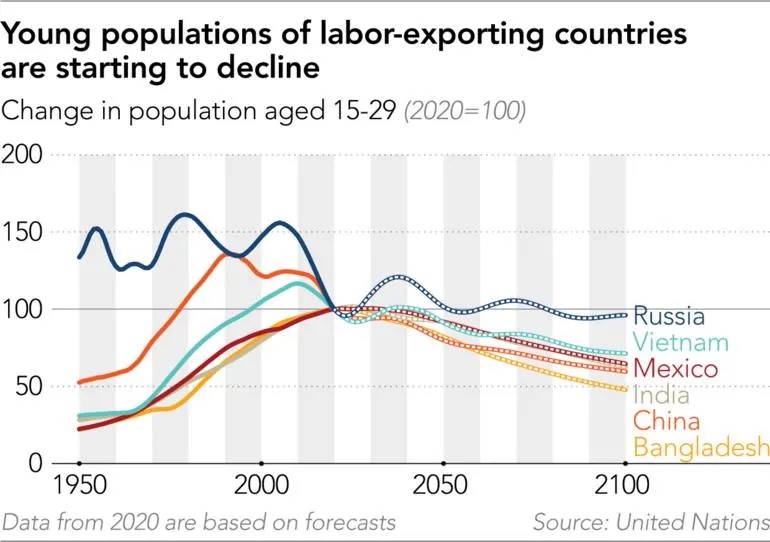
With rapidly aging populations and declining number of working age people in North America, Europe and East Asia, the demand for workers will increasingly be met by major labor exporting nations like Bangladesh, China, India, Mexico, Pakistan, Russia and Vietnam. Among these nations, Pakistan is the only major labor exporting country where the working age population is still rising. 

Working Age Population Declining Among Major Labor Exporters. Source: Nikkei Asia

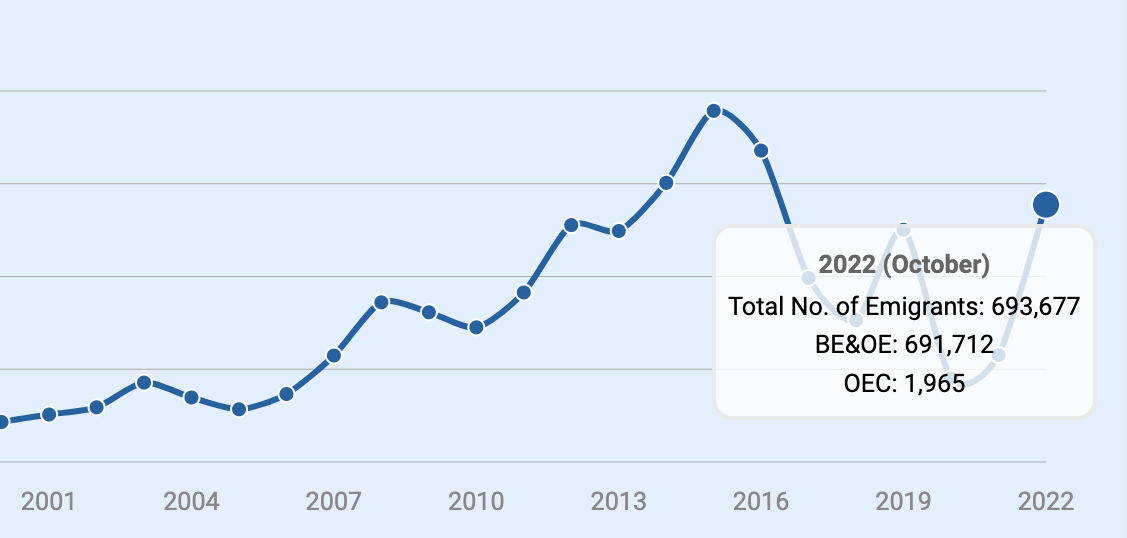
Over 10 million Pakistanis are currently working/living overseas, according to the Bureau of Emigration. Before the COVID19 pandemic hit in 2020,  more than 600,000 Pakistanis left the country to work overseas in 2019. Nearly 700,000 Pakistanis have already migrated in this calendar year as of October, 2022. The average yearly outflow of Pakistani workers to OECD countries (mainly UK and US) and the Middle East was over half a million in the last decade. 

Pakistani Workers Going Overseas. Source: Bureau of Emigration


Record Remittances From Overseas Pakistanis:

Pakistan is already seeing high levels of labor export and record remittances of over $30 billion pouring into the country. Saudi Arabia and the United Arab Emirates(UAE) are the top two sources of remittances but the biggest increase (58%) in remittances is seen this year from Pakistanis in the next two sources: the United Kingdom and the United States.

Remittances from the European Union (EU) to Pakistan soared 49.7% in FY 21 and 28.3% in FY22, according to the State Bank of Pakistan. With $2.5 billion remittances in the first 9 months (July-March) of the current fiscal year, the EU ($2.5 billion) has now surpassed North America ($2.2 billion) to become the third largest source of inflows to Pakistan after the Middle East and the United Kingdom. Remittances from the US have grown 21%, second fastest after the EU (28.3%) in the first 9  months of the current fiscal year. 

Pakistan ranks 6th among the top worker remittance recipient countries in the world.  India and China rank first and second, followed by Mexico 3rd, the Philippines 4th, Egypt 5th and Pakistan 6th.  

Pakistan Demographics

About two million Pakistanis are entering the workforce every year. The share of the working age population in Pakistan is increasing while the birth rate is declining. This phenomenon, known as demographic dividend, is coinciding with declines in working age populations in developed countries. It is creating an opportunity for over half a million Pakistani workers to migrate and work overseas, and send home record remittances. 

Wednesday, November 23, 2022

Nearly 700,000 Pakistani Workers Have Migrated Overseas So Far in Year 2022

Nearly 700,000 Pakistanis have left to work overseas in the first 10 months of the current calendar year, according to Pakistan's Bureau of Emigration Overseas Employment (BEOE). The worker migration from Pakistan had dipped to 225,000 in 2020 and 280,000 in 2021 due to Covid restrictions around the world. The yearly average for the last decade was over half a million Pakistanis migrating to other countries for work.  In August this year, the State Bank of Pakistan said in its "Half Year Report 2021-22" that “(t)he monthly flow of Pakistani workers (overseas) has reverted to pre-Covid levels (of 65,000 per month).” The data from International Organization for Migration (IOM) shows that a lot more of the Pakistan migrants are now skilled labor while the share of unskilled migrants is declining: "Pakistani migrant workers were skilled (42%) and involved in semi-skilled jobs such as welders, secretaries, masons, carpenters, plumbers and so on. Another proportion of the labour migration was composed of unskilled laborers (39%) such as agriculturists, laborers or farmers. Projections about future trends indicate that the number of Pakistani labour migrants will continue rising to reach 15.5 million in 2020 (Government of Pakistan, 2018". Larger and increasingly higher skilled diaspora is expected to sustain double-digit annual growth in overseas worker remittances to Pakistan. 

Pakistani Workers Going Overseas. Source: Bureau of Emigration

Demographic Dividend: 

With rapidly aging populations and declining number of working age people in North America, Europe and East Asia, the demand for workers will increasingly be met by major labor exporting nations like Bangladesh, China, India, Mexico, Pakistan, Russia and Vietnam. Among these nations, Pakistan is the only major labor exporting country where the working age population is still rising faster than the birth rate. 

Over 10 million Pakistanis are currently working/living overseas, according to the Bureau of Emigration. Before the COVID19 pandemic hit in 2020,  more than 600,000 Pakistanis left the country to work overseas in 2019. Nearly 700,000 Pakistanis have already migrated in this calendar year as of October, 2022. The average yearly outflow of Pakistani workers to OECD countries (mainly UK and US) and the Middle East was over half a million in the last decade. 

Consumer Markets in 2030. Source: WEF


World's 7th Largest Consumer Market:

Pakistan's share of the working age population (15-64 years) is growing as the country's birth rate declines, a phenomenon called demographic dividend. With its rising population of this working age group, Pakistan is projected by the World Economic Forum to become the world's 7th largest consumer market by 2030. Nearly 60 million Pakistanis will join the consumer class (consumers spending more than $11 per day) to raise the country's consumer market rank from 15 to 7  by 2030. WEF forecasts the world's top 10 consumer markets of 2030 to be as follows: China, India, the United States, Indonesia, Russia, Brazil, Pakistan, Japan, Egypt and Mexico.  Global investors chasing bigger returns will almost certainly shift more of their attention and money to the biggest movers among the top 10 consumer markets, including Pakistan.  Already, the year 2021 has been a banner year for investments in Pakistani technology startups. 

Record Remittances From Overseas Pakistanis:

Pakistan is already seeing high levels of labor export and record remittances of over $30 billion pouring into the country. Saudi Arabia and the United Arab Emirates(UAE) are the top two sources of remittances but the biggest increase (58%) in remittances is seen this year from Pakistanis in the next two sources: the United Kingdom and the United States.

Remittances from the European Union (EU) to Pakistan soared 49.7% in FY 21 and 28.3% in FY22, according to the State Bank of Pakistan. With $2.5 billion remittances in the first 9 months (July-March) of the current fiscal year, the EU ($2.5 billion) has now surpassed North America ($2.2 billion) to become the third largest source of inflows to Pakistan after the Middle East and the United Kingdom. Remittances from the US have grown 21%, second fastest after the EU (28.3%) in the first 9  months of the current fiscal year. 

Pakistan ranks 6th among the top worker remittance recipient countries in the world.  India and China rank first and second, followed by Mexico 3rd, the Philippines 4th, Egypt 5th and Pakistan 6th.  

Pakistan Demographics

About two million Pakistanis are entering the workforce every year. The share of the working age population in Pakistan is increasing while the birth rate is declining. This phenomenon, known as demographic dividend, is coinciding with declines in working age populations in developed countries. It is creating an opportunity for over half a million Pakistani workers to migrate and work overseas, and send home record remittances. 

Thursday, December 3, 2009

Remittances Offer Lifeline to Pakistanis

Remittances from overseas Pakistanis rose 32 per cent year-over-year to $3.1 billion for the first four months of fiscal 2009/10, according to the State Bank of Pakistan. The central bank expects over $8.5 billion this year in remittances in documented remittances from about 7 million Pakistanis abroad, equivalent to about 5 per cent of Pakistan's gross domestic product. “It is important. That is the size of our current account gap,” State Bank of Pakistan Governor Salim Raza told the News. Pakistan is among the top ten destination countries receiving foreign remittances. Some estimates indicate the formal remittances account for less than half of the actual amount sent to Pakistan.

Finance Minister Shaukat Tarin has said that increasing remittances from Pakistani diaspora is the best way to "get rid of dependence" on international lenders. "International financial institutions lend us with strings attached. We can say goodbye to them."

The government has launched Pakistan Remittance Initiative (PRI) to bring about a fundamental change in the remittance regime and double the volume of transfers in five years. The effort is aimed at encouraging remitters to use the country’s banking channel by streamlining this process to overshadow the illegal hawala system commonly preferred for being cheap and speedy. Now five banks will transfer wired amounts in the account of the receiver within 24 hours.


In March this year, Dr. Farooq Sattar, Federal Minister for Overseas Pakistanis talked about an ambitious target of $15 billion in remittances in 2009-10 while speaking to the media at the launch of a Western Union book titled "Marhaba Musafir". The book contains the basic information about the various countries where Western Union's has operations.

The remittance dollars pouring in to the nation's economy offer the much needed lifeline to the poor in the midst of multiple and serious crises confronting the people of Pakistan. Not only do these remittances dwarf the foreign loans and aid received by Pakistan, the money remitted is far more effective in helping the national economy in the following important ways:

1. Unlike foreign aid, the remittance money from overseas Pakistanis comes with no strings attached. These dollars do not serve the geopolitical interests of any foreign power. Nor are the funds used to pay for unnecessary imports or to pay expensive foreign consultants and contractors from donor countries.

2. While foreign assistance dollars are funneled through the government, the bulk of the remittance money goes directly to the people and it does not feed graft which siphons money into foreign bank accounts of corrupt politicians and bureaucrats.

3. The remittance money has a significant stimulus effect on Pakistan's economy. It invigorates the local economy because it is spent by the people to buy mostly domestic products and services that create more jobs which support more local consumption, and create even more employment opportunities.

In the United States for example, most of the food aid, including the additional $770m food aid last year, for the poor countries requires the aid recipients to purchase food from the US agribusiness. These funds do not help the farmers in the poor nations grow food for the countries to become less dependent on foreign help. The US farm lobby continues to flex its muscle and enrich itself, without regard for the severity of the hunger crisis in the poor nations resulting from sharp increase in food prices. Three years ago, farmers and their allies in Congress effectively destroyed an effort by the Bush administration to begin the switch to untied food aid. The current composition of US Congress is no different, as far as the overwhelming power of the farm lobby is concerned.

European governments switched to giving all-cash donations for food in the mid-1990s, arguing that cash allows more flexibility in responding to crises and that the U.S. uses its food aid as a form of farm subsidy. But the Europeans also continue to erect various barriers to food imports from poor nations that could improve the viability of agriculture in many Asian and African countries.

Private donations abroad by Americans, including pledges to charities and churches and disbursements from corporate foundations, now are three times as large as America's official development assistance of $20 billion, and there is every indication this trend will continue. Washington's contribution looks even more miserly when the ODA data are broken down. Here are some basic facts about US foreign assistance:

1. Less than half of aid from the United States goes to the poorest countries.

2. The largest recipients are strategic allies such as Egypt, Israel, Russia, Pakistan, Afghanistan and Iraq.

3. Israel is the richest country to receive the highest per capita U.S. assistance ($77 per Israeli compared to $3 per person in poor countries).

4. Even after the tripling of the US aid to $1.5 billion a year to Pakistan under Kerry-Lugar bill, it still amounts to about $8 per Pakistani.

According to Asia Times, last year only five of the 22 countries considered industrialized - Norway, Denmark, the Netherlands, Luxembourg and Sweden - achieved the donor benchmark of allocating 0.7% of GNP to ODA. The benchmark was adopted at the Earth Summit in Rio de Janeiro in 1992 under the UN Agenda 21 program for eradicating poverty through development assistance. No other countries have even come close to meeting the target.

France managed 0.41% of GNP last year, the United Kingdom 0.34%, Germany 0.28%, Canada 0.26%, Spain 0.25% and Australia 0.25%. Japan, the only Asian participant, came in a lowly 19th with a paltry 0.2%, maintaining a reduced ODA commitment that dates back to 2001.

Dambisa Moyo, a former economist at Goldman Sachs, and the author of "Dead Aid: Why Aid Is Not Working and How There Is a Better Way for Africa.", recently argued in a Wall Street Journal OpEd that "money from rich countries has trapped many African nations in a cycle of corruption, slower economic growth and poverty. Cutting off the flow would be far more beneficial."

She goes on to say, "Giving alms to Africa remains one of the biggest ideas of our time -- millions march for it, governments are judged by it, celebrities proselytize the need for it. Calls for more aid to Africa are growing louder, with advocates pushing for doubling the roughly $50 billion of international assistance that already goes to Africa each year.

Yet evidence overwhelmingly demonstrates that aid to Africa has made the poor poorer, and the growth slower. The insidious aid culture has left African countries more debt-laden, more inflation-prone, more vulnerable to the vagaries of the currency markets and more unattractive to higher-quality investment. It's increased the risk of civil conflict and unrest (the fact that over 60% of sub-Saharan Africa's population is under the age of 24 with few economic prospects is a cause for worry). Aid is an unmitigated political, economic and humanitarian disaster."

Last year, remittances to various other Asian countries were as follows: $8.9 billion for Bangladesh, $27 billion for China, $30 billion for India, $6.5 billion for Indonesia, $2.2 billion for Nepal, $1.8 billion for Malaysia, $16.4 billion for the Philippines, $2.7 billion for Sri Lanka, $5.5 billion for Vietnam and $1.8 billion for Thailand, according to International Labor Organization estimates.

While recognizing that there is no one silver bullet to alleviate poverty, microfinancing, along with social entrepreneurship, is becoming an essential component of non-government efforts in Pakistan and other developing nations to empower ordinary people toward self-reliance by lifting them out of poverty and teaching them the right skills to help themselves. “Give a man a fish and you feed him for a day. Teach a man to fish and you feed him for a lifetime.” This proverb has guided the efforts of late Dr. Akhtar Hameed Khan, acclaimed Pakistani social scientist and founder of Orangi Pilot Project. Supported by private foundations working in Pakistan, all efforts at alleviating poverty should be guided by this proverb that captures the essence of self-reliance.

The foreign remittances from overseas Pakistanis and private efforts are clearly helpful to the poor in the short to medium term. However, it is extremely important to recognize that the remittances alone are not sufficient for long-term economic progress based on the much needed human development that translates into a highly productive work force contributing to a vibrant national economy. It is absolutely necessary for the Pakistani state to make significant public investments in education, healthcare, infrastructure development and pursuit of good policies and competent governance in the country.


Related Links:

NRO Corruption and Democracy in South Asia

Opposition to Kerry-Lugar in Pakistan

Aid, Trade, Remittances and Microfinance

Zardari Corruption Probe

Rampant Corruption in Construction Industry

Pakistan Remittance Profile

Human Development Slipping in South Asia

Governance in Pakistan

The State, Religion and Ethnic Politics: Afghanistan, Iran and Pakistan

Friday, September 10, 2010

Can Global Pakistanis Invest $10 Billion in Post-Floods Reconstruction?

Members of Pakistani diaspora must remember their compatriots in distress as we celebrate Eid today.

While there have been high-profile recent efforts by overseas Pakistanis to raise millions of dollars to fund rescue and relief efforts after the recent devastating floods, it is now time to begin to shift focus on to the much longer term and significantly more expensive reconstruction phase that will requires billions, not millions, of dollars.

World Bank economist Sanket Mohapatra has said in a recent post that remittances by overseas Pakistanis have played a significant role in Pakistan's economic improvement. Not only have such remittances contributed to significant poverty reduction in Pakistan "by an impressive 17.3 percentage points between 2001 and 2008 (from 34.5 percent in 2001-02 to 17.2 percent in 2007-08)", but "continued strong growth in worker’s remittances in the past few years has also contributed to improvements in the external current account balance” and “have facilitated improvement in the country’s external position”, according to a World Bank report released on July 30, 2010.

World Bank's Mohaptra adds that "there is now a risk that devastating floods that have hit Pakistan, killing more than 1,200 people and leaving 2 million people homeless, could reverse some of the gains in poverty achieved in the last few years, which were already believed to have been weakened in the wake of the recent financial crisis and rise in food prices. During past natural disasters, migrants have sent additional remittances to help their families and friends in need – for example, during the Pakistan earthquake in 2005, in Philippines after typhoons Ondoy and Pepeng in 2009, after an earthquake in Haiti in early 2010, and in other countries in Asia, Africa and Latin America. It is likely that the Pakistani diaspora will send additional financial resources to help their family, friends and even larger communities. These person-to-person transfers could complement official aid efforts".

The cost and the task of post-flood reconstruction may appear to be monumental, but I feel confident that global Pakistani community is equal to it. Already, non-resident Pakistanis have been sending home nearly ten billion US dollars a year in remittances to their home country. And their invested assets are estimated to be in hundreds of billions of US dollars in different parts of the world. I believe Pakistani diaspora can double their remittances in the next twelve months, thereby boosting Pakistan's overall economy by a $10 billion stimulus for reconstruction.

If a significant part of this additional $10 billion in remittances goes into special, professionally managed, investment funds specifically for post-floods reconstruction and rehabilitation, it will be an even greater boost to Pakistan's overall economy. To put it in perspective, the $10 billion in a year would be 5 times the annual foreign aid, and twice the peak FDI Pakistan received in 2007, the last year of healthy economic growth in 2007-2008.

Here's a video clip of Pakistan's billionaire real estate developer Malik Riaz Husain pledging $2 billion of his own wealth to help the flood victims rebuild:


Related Links:

Haq's Musings

Pakistani-Americans Extend Help to Flood Victims

World Bank Report on Pakistan released on July 30, 2010

Pakistan's Economic Performance 2008-2010

Aid, Trade, Investments and Remittances in Pakistan

World Bank Blog on Impact of Remittances in Pakistan

Sunday, July 17, 2022

UN Report: Last Decade Saw 16.5 Million Pakistanis Migrate Overseas

Among 10 countries with the estimated net outflow of migrants exceeding 1 million over the period from 2010 through 2021, Pakistan saw 16.5 million migrants move overseas, the highest in the world, according to a report titled "World Population Prospects 2022" released by the United Nations Department of Economic and Social Affairs (UN DESA). 

Pakistani Workers' Overseas Migration Data (2010-2021). Source: Bureau of Emigration


In many of these countries with more than one million people leaving, the outflows were due to temporary labor movements, such as for Pakistan (net outflow of 16.5 million), India (3.5 million), Bangladesh, (2.9 million), Nepal (1.6 million) and Sri Lanka (1.0 million).  The report also said that India's population will surpass China's in 2023. Over half of the global population increase up to 2050 will be in just 8 countries: Democratic Republic of Congo, Egypt, Ethiopia, India, Nigeria, Pakistan, the Philippines & Tanzania.

Population Sizes of China, India and Pakistan 1950-2099. Source: Our World in Data

The figure of 16.5 million migrants outflow from Pakistan is much higher than the numbers reported by the Bureau of Emigration & Overseas Employment of the Government of Pakistan. A possible source of discrepancy is the uncounted numbers of the family members who accompany workers going abroad for work.  

Between 2010 and 2021, 40 countries or territories have experienced a net inflow of more than 200,000 migrants; in 17 of those, the total net inflow exceeded 1 million people. In 2020, Turkey hosted the largest number of refugees and asylum seekers worldwide (nearly 4 million),followed by Jordan (3 million), the State of Palestine (2 million) and Colombia (1.8 million). Other major destination countries of refugees, asylum seekers or other persons displaced abroad were Germany,  Lebanon, Pakistan, Sudan, Uganda and the United States of America. 

Top Remittance Receiving Countries in 2021. Source: World Bank

Pakistan has received nearly $31 billion in worker remittances in 2021, up a whopping 20% from the prior year, according to the World Bank. This is a new record representing nearly 10% of the country's gross domestic product (GDP). This money helps the nation cope with its perennial current account deficits. It also provides a lifeline for millions of Pakistani families who use the money to pay for food, education, healthcare and housing. This results in an increase in stimulus spending that has a multiplier effect in terms of employment in service industries ranging from retail sales to restaurants and entertainment. 

Remittances from the European Union (EU) to Pakistan soared 49.7% in FY 21 and 28.3% in FY22, according to the State Bank of Pakistan. With $2.5 billion remittances in the first 9 months (July-March) of the current fiscal year, the EU ($2.5 billion) has now surpassed North America ($2.2 billion) to become the third largest source of inflows to Pakistan after the Middle East and the United Kingdom. Remittances from the US have grown 21%, second fastest after the EU (28.3%) in the first 9  months of the current fiscal year. 

Pakistan's share of the working age population (15-64 years) is growing as the country's birth rate declines, a phenomenon called demographic dividend. This dividend is manifesting itself in high levels of worker exports and record remittances pouring into the country. Saudi Arabia and the United Arab Emirates(UAE) are the top two sources of remittances but the biggest increase (58%) in remittances is seen this year from Pakistanis in the next two sources: the United Kingdom and the United States. 

Over 10 million Pakistanis are currently working/living overseas, according to the Bureau of Emigration. Before the COVID19 pandemic hit in 2020,  more than 600,000 Pakistanis left the country to work overseas in 2019. The average yearly outflow of Pakistani workers to OECD countries (mainly UK and US) and the Middle East has been over half a million in the last decade. 

Pakistan ranks 6th among the top worker remittance recipient countries in the world.  India and China rank first and second, followed by Mexico 3rd, the Philippines 4th, Egypt 5th and Pakistan 6th.  

Pakistan Demographics

About two million Pakistanis are entering the workforce every year. The share of the working age population in Pakistan is increasing while the birth rate is declining. This phenomenon, known as demographic dividend, is coinciding with declines in working age populations in developed countries. It is creating an opportunity for over half a million Pakistani workers to migrate and work overseas, and send home record remittances. 

Projected Population Decline in Emerging Economies. Source: Nikkei Asia

A common myth about emigration is that it is driven by poverty. But the fact is that the poorest and least developed people tend to stay put where they are; they do not migrate. It's only people who have a certain level of income and skills who are more likely to migrate to other countries for better opportunities. This fact has been well-established by multiple studies conducted in Africa.

Here's an except of African Development Bank report on migration:

"Results show that despite increase in the absolute number of migrants, Africa, particularly SubSaharan Africa has one of the lowest rate of emigration in the world .... Poorer countries generally have lower rate of emigration ......Bad socio-economic conditions generally seem to lead to higher rate of emigration by highly skilled individuals. Generally, migration is driven by motives to improve livelihoods with notable evidence on changes in labor market status. Often, self-employed or unemployed émigré ended up in wage employment. The paper outlines policy issues emerging from the migration trend in Africa."

Migration vs Human Development Source: Hein de Haas


Data shows that increased human and economic development is initially associated with increasing emigration. Any form of development in the poorest countries of the world is therefore likely to lead to accelerating emigration. Such findings contradict conventional thinking and force us to radically change our views on migration. Such rethinking can be achieved by learning to see migration as an intrinsic part of broader development processes rather than as a problem to be solved, or the temporary response to development “disequilibria”, according to The Conversation, a US publication.