Showing posts with label South Korea. Show all posts

Wednesday, April 13, 2022

The West's Technological Edge in Geopolitical Competition

The US and its allies enjoy a significant technological advantage over China and Russia.  The Chinese are working hard to catch up but the West is not standing still. It is making huge investments in research and development to maintain this edge as it becomes increasingly clear that the outcome of the ongoing international geopolitical competition will largely be determined by technology. 
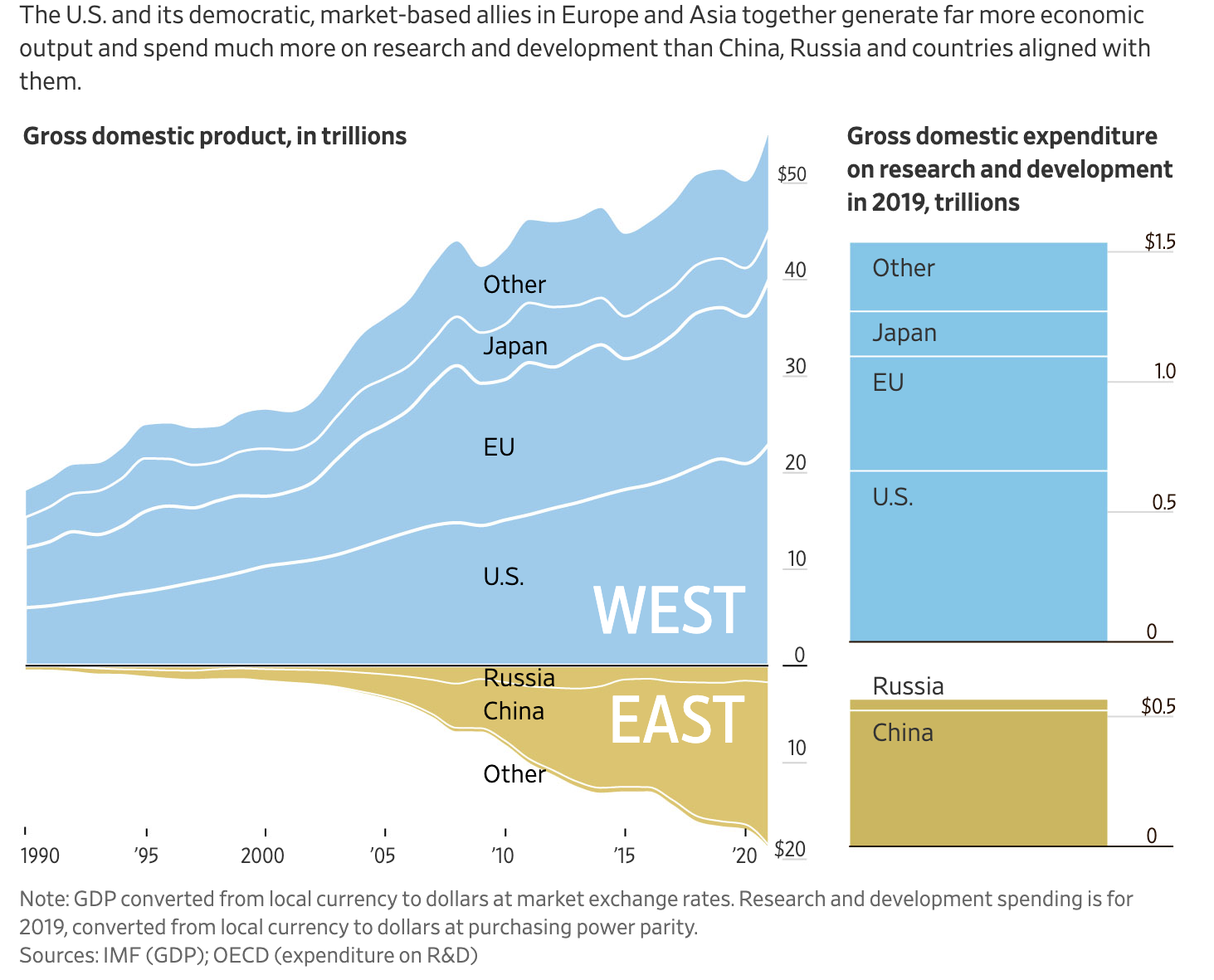
East-West Comparison of GDP, R&D. Source: IMF (GDP), OECD (R&D) via WSJ

In 2019, the United States and its allies invested $1.5 trillion in research and development, far outpacing the combined Chinese and Russian R&D investment of half a trillion USD.  This gap will likely narrow if the East's GDP continues to grow faster than the West's, allowing for higher investment in technology. 

After the Russian invasion of Ukraine, the US, EU, Japan, South Korea and Taiwan have made it clear that the Western allies can and will use technology sanctions to control the behavior of China and Russia. 

Taiwan Semiconductor Manufacturing Company (TSMC) will no longer fabricate computer chips for Russia, according to media reports. The ban will particularly affect Russia's Elbrus and Baikal processors, unless China agrees to step in to manufacture these chips, and risk additional US sanctions itself. Both Russian processors use mature 28 nm technology. The world's most advanced TSMC fabrication technology today is 5 nanometers. The best US-based Intel can do today is 7nm technology. China's SMIC (Semiconductor Manufacturing International Corporation) has the capability to produce chips using 14 nm technology.  Semiconductor chips form the core of all modern systems from automobiles to airplanes to smartphones, computers, home appliances, toys, telecommunications and advanced weapons systems.  

While China is the  biggest volume producer of semiconductor components in the world,  the Chinese design centers and fabs rely on tools and equipment supplied by the West to deliver products. Western companies dominate all the key steps in this critical and highly complex industry, from chip design (led by U.S.-based Nvidia, Intel, Qualcomm and AMD and Britain’s ARM) to the fabrication of advanced chips (led by Intel, Taiwan’s TSMC and South Korea’s Samsung ) and the sophisticated machines that etch chip designs onto wafers (produced by Applied Materials and Lam Research in the U.S., the Netherlands’ ASML Holding and Japan’s Tokyo Electron ), according to the Wall Street Journal. 

There is no question that the current western technology sanctions can seriously squeeze Russia. However, overusing such sanctions could backfire in the long run if the US rivals, particularly China and Russia, decide to invest billions of dollars to build their own capacity. This would seriously erode western technology domination and result in major market share losses for the US tech companies, particularly those in Silicon Valley. 

Related Links:

Haq's Musings

South Asia Investor Review

Pakistani-American Banker Heads SWIFT, the World's Largest Interbank Payment System

Pakistani-Ukrainian Billionaire Zahoor Sees "Ukraine as Russia's Afghanistan"

Ukraine Resists Russia Alone: A Tale of West's Broken Promises

Ukraine's Lesson For Pakistan: Never Give Up Nuclear Weapons

Has Intel's Indian Techie Risked US Lead in Semiconductor Technology?

US-China Tech Competition

Can Pakistan Benefit From US-China Tech War?

Ukraine's Muslims Oppose Russia


Monday, October 18, 2021

Squid Game: A Dystopian Korean Drama Featuring a Pakistani Migrant Worker

Popular Netflix series Squid Games is a dystopian survival drama about unfortunate people trapped in debt who enter a series of six survival games. The losers die while the single winner takes away 46.5 billion (US$38 million) South Korean won. One US dollar is equal to about 1,200 Korean Won. 

Anupam Tripathi as Ali Abdul in Squid Games

One of the characters in the series is an exploited Pakistani migrant worker named Ali Abdul who just wants to send money home to help his family in Pakistan.  Ali's role is played by Indian actor Anupam Tripathi. Tripathi has previously played other foreign characters in the genre often referred to as K-drama. Squid Games has achieved top ratings around the world in spite of its very violent content. It is the top-rated show among Netflix subscribers in Pakistan. 

Household Debt as Percentage of GDP. Source: IMF

Squid Game is a powerful indictment of capitalism as practiced in many countries, including South Korea. It has brought to light high levels of inequality and household debt in South Korea. The total household debt of $1.5 trillion is about the size of its entire GDP, among the highest in the world. By comparison, formal household debt in Pakistan is just 4% of its GDP, according to the IMF. It can be explained by the fact that the availability of mortgage financing, car loans and credit cards is very limited in Pakistan. 

Sources of Household Debt in Pakistan. Source: SDPI

Only 14.6% of household debt is owed to banks, and the rest to informal sources like family and friends. Researchers Sajid Amin Javed, Wajid Ali and Ifra Baig at SDPI  (Sustainable Development Policy Institute) have analyzed four rounds of the HIES segment of the Pakistan Social and Living Standard Measurement (PSLM) and data from the PPHS (covering the 2005 to 2016 period),  and found that 20% of households in Pakistan are indebted.  

Related Links:

Haq's Musings

South Asia Investor Review

Credit Suisse Wealth Report 2016

Pakistan's Trillion Dollar Economy Among World's Fastest Growing

Pakistan: A Majority Middle Class Country

Karachi School of Business and Leadership

State Bank: Pakistan's Actual GDP Higher Than Officially Reported

College Enrollment in Pakistan

Musharraf Accelerated Development of Pakistan's Human and Financial Capital

China-Pakistan Economic Corridor

Riaz Haq's YouTube Channel

PakAlumni: Pakistani Social Network

Wednesday, July 11, 2018

Pakistan GDP Growth 1960-2017: How Does Pakistan Compare With China and India?

The latest GDP figures in terms of current US dollars released by the World Bank for 2017 put Pakistan's GDP at $305 billion, India's at $2,597 billion and China's at $12,237 billion.  The World Bank also lists where the gross domestic products of each country in current US dollars stood in 1960.

GDP Growth in Current US$ 1960-2017. Source: World Bank

Economic Growth Since 1960: 

The World Bank report released in June, 2018 shows that Pakistan's GDP has grown from $3.7 billion in 1960 to $305 billion in 2017, or 82.4 times. In the same period,  India's GDP grew from $37 billion in 1960 to $2,597 billion in 2017 or 71.15 times. Both South Asian nations have outpaced the world GDP growth of 60 times from 1960 to 2017.

While Pakistan's GDP growth of 82X from 1960 to 2017 is faster than India's 71X and it appears impressive, it pales in comparison to Malaysia's 157X, China's 205X and South Korea's 382X during the same period.

India-Pakistan GDP Growth Compared to the World 1960-2017. Source: World Bank


Economic Growth Since 1998:

In spite of all of the multiple challenges on several fronts that Pakistan continues to face, the country's 5X GDP growth over the last two decades is not too shabby when compared with India's 6.5X jump in the same period. Here are the figures for several countries from Spectator Index:

China:  13X growth in  GDP from $1 trillion in 1998 to $13.1 trillion in 2018

India: 6.5X growth in GDP from $400 billion in 1998 to $2.6 trillion in 2018

Pakistan: 5X growth in GDP from $62 billion in 1998 to $310 billion in 2018

United States: 2.2X growth in GDP from $9 trillion in 1998 to $20 trillion in 2018

Japan: 1.25X growth in GDP from $4 trillion in 1998 to $5 trillion in 2018

Per Capita Incomes:

Pakistan has not done as well in terms of per capita income growth for several reasons including poor governance and corruption since 2008 and faster population growth than in China, India and other countries. Per Capita income in Pakistan grew 22% since 2012, half of the 43% growth in India during the same period. China topped with 48% in per capita income since 2012.

Here are per capita income growth figures for selected countries since 2012:

China: 48%, India: 43%, Turkey: 32%, Indonesia: 29%, Pakistan: 22%, UK: 15%, US: 15%, Japan: 15%, Germany: 13%, Canada: 13%, France: 11%, Saudi Arabia: 10%, Greece: 9.5%, Russia: 8%, Italy: 8%, Nigeria: 7.5% and Brazil: 0%.

Per Capita GDP Comparison. Source: Hindustan Times


Pakistan has lagged its peers in per capita income growth over the last 5 decades. Pakistan's economic performance is especially disappointing relative to Asian Tigers like Malaysia and South Korea.  Pakistan was on a similar trajectory as the Asian Tigers during 1960s under Gen Ayub Khan's rule. GDP growth in this decade jumped to an average annual rate of 6 percent from 3 percent in the 1950s, according to Pakistani economist Dr. Ishrat Husain. Dr. Husain says: "The manufacturing sector expanded by 9 percent annually and various new industries were set up. Agriculture grew at a respectable rate of 4 percent with the introduction of Green Revolution technology. Governance improved with a major expansion in the government’s capacity for policy analysis, design and implementation, as well as the far-reaching process of institution building.7 The Pakistani polity evolved from what political scientists called a “soft state” to a “developmental” one that had acquired the semblance of political legitimacy. By 1969, Pakistan’s manufactured exports were higher than the exports of Thailand, Malaysia and Indonesia combined."


Pakistan Growth By Decades. Source: National Trade and Transport Facility

Since 1947, Pakistan has seen three periods of military rule: 1960s, 1980s and 2000s. In each of these decades, Pakistan's economy has performed significantly better than in decades under political governments. The worst decade for Pakistan's economy was 1990s, also known as the lost decade, when the GDP grew just 4% as Benazir Bhutto and Nawaz Sharif took turns to mismanage it.

Pakistan's GDP growth in decades under military rule has been 1.5-2.5% faster on average than under civilian rule. Though the difference of 1.5% in GDP growth appears small, it would have made a huge difference when compounded over multiple decades and put Pakistan in the ranks of Asian Tigers.

Summary:

Pakistan has defied repeated dire forecasts of doom and gloom since its independence.  According to the report released in June, 2018 shows that Pakistan's GDP has grown from $3.7 billion in 1960 to $305 billion in 2017, or 82.4 times. In the same period,  India's GDP grew from $37 billion in 1960 to $2,597 billion in 2017 or 71.15 times. Both South Asian nations have outpaced the world GDP growth of 60 times from 1960 to 2017.  Pakistan's economy has grown 500% over the last two decades in spite of political corruption and serious security challenges and instability created by the Afghan war next door and Indian sponsored proxy war against it.  Pakistan's GDP growth in decades under military rule has been 1.5-2% faster on average than under civilian rule. Though the difference of 1.5% in GDP growth appears small, it would have made a huge difference when compounded over multiple decades and put Pakistan in the ranks of Asian Tigers.

Related Links:


Thursday, July 27, 2017

5 Pakistani Companies Among Forbes 200 Best Under $1 Billion in Asia

Five Pakistani companies are featured in the Forbes magazine’s latest annual ranking of the 200 best companies with under $1 billion in revenue in the Asia-Pacific  region. Pakistan's representation of 5 on the list is down from 7 last year. The number of Indian companies on the list is down to 3, less than half of the seven companies that made it in 2016.

Among Pakistan's five companies on the list is Ferozsons Laboratories which is making its debut this year. The company's revenue jumped 93% last year.

The list highlights 200 Asia-Pacific public companies with less than $1 billion in revenue and consistent top- and bottom-line growth. This year’s candidates come from 13 countries and averaged 55% growth in sales, a 24% profit margin, and 113% growth in earnings per share.

China tops the Forbes 200 list with 71 companies followed by Japan 41, Taiwan 30, South Korea 22,  Vietnam 10, Singapore 7, Australia 6, Pakistan and Malaysia 5 each, Thailand 4, and Hong Kong and India 3 each.

The Pakistani companies on the list are Agriauto Industries, Cherat Packaging, Ferozsons Labs, Gandhara Industries and Searle Companies. There are 3 Indian companies on this list: 8k Mile Software Services, Kellton Tech Solutions and Manpasand Beverages.

Of the 5 Pakistani companies on the list, two are in auto industry, two in pharmaceuticals and one in package manufacturing. Here are brief descriptions of the companies as published by Forbes:

Agriauto Industries Ltd. manufactures and sells components for automotive vehicles, motorcycles, and agricultural tractors. Its products includes shock absorbers and struts; motorcycle shock absorber and parts; sheet metal press parts; and other parts such as manual type window regulator and door/door hinges. The company was founded on June 25, 1981 and is headquartered in Karachi, Pakistan.

Cherat Packaging Ltd. is engaged in manufacturing, marketing and selling of paper sacks and polypropylene bags to the cement industry in Pakistan. It provides cement bags made from kraft paper and polypropylene granules. The company was founded in 1991 and is headquartered in Karachi, Pakistan.

Ferozsons Laboratories Ltd. engages in the manufacturing and trading of pharmaceutical products. It produces tablets, capsules, syrups, suspension, creams, and ointments. The company was founded on January 28, 1954 and is headquartered in Lahore, Pakistan.

Ghandhara Industries Ltd. engages in the manufacture and market of vehicles. Its products include pickup, trucks, and buses. The company was founded by M. Habibullah Khan Khattak on February 23, 1963 and is headquartered in Karachi, Pakistan.

Searle Co. Ltd. engages in the manufacturing of pharmaceutical products and a low calorie sweetener. It also engages in selling of food and consumer items and manufacturing of pharmaceutical items for other companies. The company operates through the following segments: Pharma, Consumer and Investment Property. Searle was founded on October 5, 1965 and is headquartered in Karachi, Pakistan.

Pakistani companies are riding the rising tide of the nations's middle class consumption. They are benefiting from increasing consumer confidence and growing demand for cement, branded food products, pharmaceuticals and vehicles. Overall consumer products and services companies have been on the rise on Forbes Asia list, an indication of Asia’s success in moving towards a consumer economy.

Related Links:

Haq's Musings

Credit Suisse Wealth Report 2016

Pakistan: A Majority Middle Class Country

Karachi School of Business and Leadership

State Bank: Pakistan's Actual GDP Higher Than Officially Reported

College Enrollment in Pakistan

Musharraf Accelerated Development of Pakistan's Human and Financial Capital

China-Pakistan Economic Corridor


Tuesday, March 6, 2012

Should Pakistan Ignore "Washington Consensus" on Free Trade?

East Asian experience has some important lessons for Pakistan as the country embraces the western prescriptions of democracy and free trade. It's particularly important to recall these lessons now in view Pakistan's decision to open unrestricted trade with India whose major industrialists like Tata and Birla have greatly benefited from protectionist policies to scale up and gain experience.

The East Asian nation of South Korea has become a great model of economic success for the developing world. Back in 1960s, its annual per capita income was around $80, less than half of Ghana's at the time. Today, it stands at $30,000, comparable to that of some wealthy European nations. For most of this period, the people of South Korea have ignored the Washington consensus, the western prescription on economy and politics, to achieve this miraculous progress.


In 1960s and 1970s, Korea was led by military ruler General Park Chung-Hee who put in place the policies which helped Koreans realize their great potential. President Park made huge investment in infrastructure, health and education. In addition, South Korean analyst Ha-Joon Chang says that the Korean government "practiced many policies that are now supposed to be bad for economic development: extensive use of selective industrial policy, combining protectionism with export subsidies; tough regulations on foreign direct investment; active, if not particularly extensive, use of state-owned enterprises; lax protection of patents and other intellectual property rights; heavy regulation of both domestic and international finance."

Pakistan, too, was ruled by a military dictator General Ayub Khan in a period labeled by Pakistani economist Dr. Ishrat Husain as "the Golden Sixties". General Ayub Khan pushed central planning with a state-driven national industrial policy. In fact, South Korea sought to emulate Pakistan's development strategy and copied Pakistan's second "Five-Year Plan".


Here's how Dr. Husain recalls Pakistan of 1960s:

"The manufacturing sector expanded by 9 percent annually and various new industries were set up. Agriculture grew at a respectable rate of 4 percent with the introduction of Green Revolution technology. Governance improved with a major expansion in the government’s capacity for policy analysis, design and implementation, as well as the far-reaching process of institution building. The Pakistani polity evolved from what political scientists called a “soft state” to a “developmental” one that had acquired the semblance of political legitimacy. By 1969, Pakistan’s manufactured exports were higher than the exports of Thailand, Malaysia and Indonesia combined. Though speculative, it is possible that, had the economic policies and programs of the Ayub regime continued over the next two decades, Pakistan would have emerged as another miracle economy."

South Korea's Chang has exposed the hypocrisy of the West by explaining that the "G7 was always remarkably reluctant to recommend these (South Korea's) "heterodox" policies and insisted that the "Washington consensus" package of opening up, deregulation and privatization was the right recipe for everyone. When confronted with the Korean case, Washington consensus supporters tried to brush it off as an exception. However, the history of take-offs in most of the G7 countries – especially Britain, the US, Germany, France and Japan – is far closer to the Korean model than is commonly thought. The "unorthodox" policies used by Korea and almost all of today's rich countries need to be seriously considered in any discussion on development options."

Since the great success achieved by South Korea and other Asian Tigers in the latter part of the 20th century, China has become the latest example to have followed the East Asian development model with great results for what is now being dubbed the Asian century. Each of these nations has done it by ignoring the Washington Consensus about democracy, free markets and free trade.

As Pakistan embarks on a new course in trade, it's important for its leadership to recognize the wide gap between the theory and practice of the "Washington Consensus" to effectively safeguard its economy, domestic industries and jobs for Pakistanis to develop and prosper in the 21st century.

Related Links:

Haq's Musings

Ishrat Husain: Structural Reforms in Pakistan's Economy

Pakistan's Bilateral Trade Agreements

Role of Politics in Pakistan Economy

History of Pakistan Economy 1947-2010

Pakistan's Economic Performance 2008-2010

Incompetence Worse Than Corruption in Pakistan

Pakistan's Circular Debt and Load Shedding

US Fears Aid Will Feed Graft in Pakistan

Pakistan Swallows IMF's Bitter Medicine

Shaukat Aziz's Economic Legacy

Pakistan's Energy Crisis

Karachi Tops Mumbai in Stock Performance

India Pakistan Contrasted 2010

Pakistan's Foreign Visitors Pleasantly Surprised

After Partition: India, Pakistan and Bangladesh

The "Poor" Neighbor by William Dalrymple

Pakistan's Modern Infrastructure

Video: Who Says Pakistan Is a Failed State?

India Worse Than Pakistan, Bangladesh on Nutrition

UNDP Reports Pakistan Poverty Declined to 17 Percent

Pakistan's Choice: Talibanization or Globalization

Pakistan's Financial Services Sector

Pakistan's Decade 1999-2009

South Asia Slipping in Human Development

Asia Gains in Top Asian Universities

BSE-Key Statistics

Pakistan's Multi-Billion Dollar IT Industry

India-Pakistan Military Comparison

Food, Clothing and Shelter in India and Pakistan

Pakistan Energy Crisis

IMF-Pakistan Memorandum of Economic and Financial Policies