Riaz Haq writes this data-driven blog to provide information, express his opinions and make comments on many topics. Subjects include personal activities, education, South Asia, South Asian community, regional and international affairs and US politics to financial markets. For investors interested in South Asia, Riaz has another blog called South Asia Investor at http://www.southasiainvestor.com and a YouTube video channel https://www.youtube.com/channel/UCkrIDyFbC9N9evXYb9cA_gQ
Yogi Adityanath, the radical Hindu Chief Minister of the Indian state of Uttar Pradesh, canceled his plans to lead a delegation to the 2023 World Economic Forum at Davos, Switzerland. The cancellation came after a criminal complaint was filed against the Hindu Nationalist leader who is widely seen as Prime Minister Modi's successor.
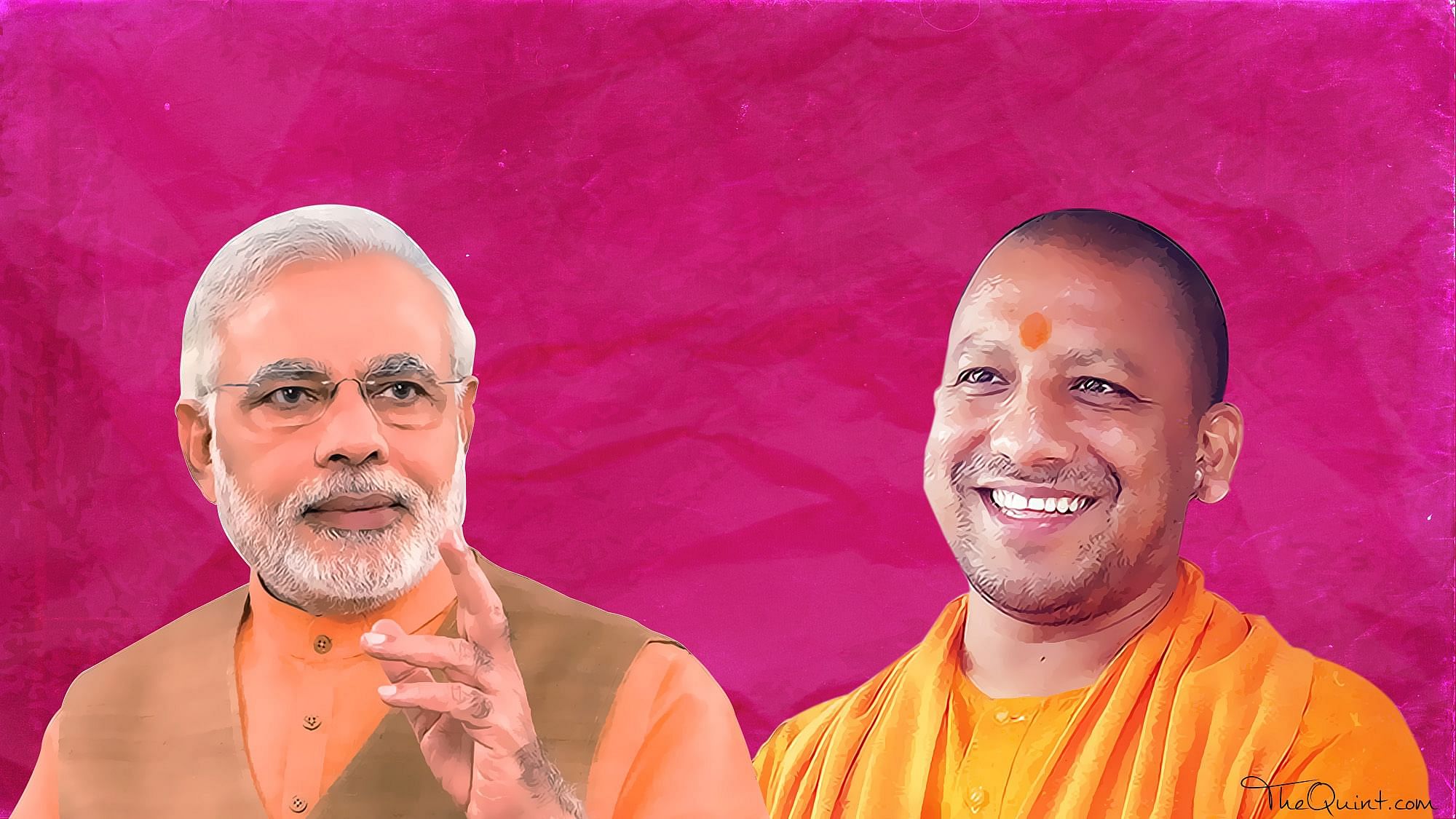
Indian Prime Minister Narendra Modi (L), UP Chief Minister Yogi Adityanath (R)
Adityanath was planning to lead a delegation to the World Economic Forum-2023 meeting at Davos, Switzerland, according to reports in the Indian news media. The state government put up a pavilion to showcase Uttar Pradesh as “the best investment destination”.
The complaint was filed under the principle of “universal jurisdiction” by law firm Guernica 37. It alleges that Adityanath ( real name Ajay Singh Bisht) “ordered the false imprisonment, torture and murder of civilians between December 2019 and 2020” and that “these acts may amount to crimes against humanity.”
Guernica 37 (G37) describes itself as a "Specialist Group of International Criminal and Human Rights Lawyers with a Socially Committed and Multi-Disciplinary Outlook". It claimed that the chief minister does not enjoy diplomatic immunity, and hopes the filing will have a cooling effect on WEF attendance in the future by any political or business figures alleged to have committed criminal acts.
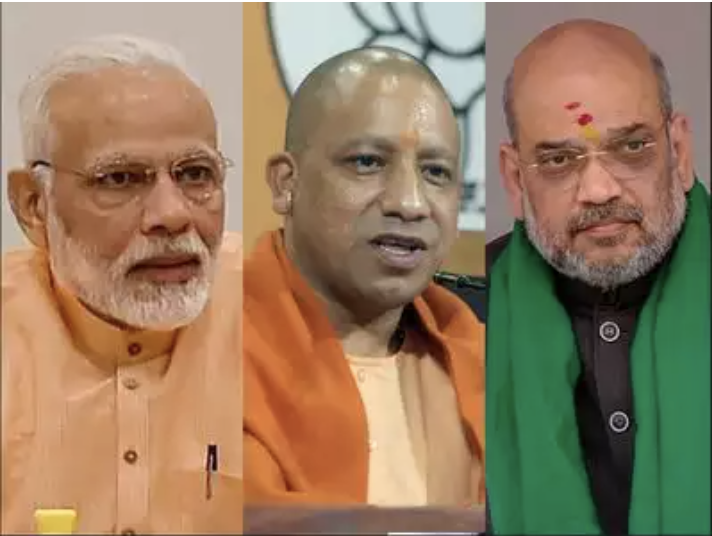
Top Radical Hindu Leaders: Modi (Left), Yogi (Middle) and Shah (Right)
Prior to being elected Prime Minister of India, Modi was barred from visiting the United States and the United Kingdom for his role in the anti-Muslim pogrom in Gujarat in 2002. Speaking about the US decision to grant immunity to Saudi Crown Prince Mohammad Bin Salman, State Department spokesperson Vedant Patel said that it was “not the first time” that the US government has designated immunity to foreign leaders and listed four cases. “Some examples: President Aristide in Haiti in 1993; President Mugabe in Zimbabwe in 2001; Prime Minister Modi in India in 2014; and President Kabila in the DRC in 2018. This is a consistent practice that we have afforded to heads of state, heads of government, and foreign ministers,” he said.
Like his leader Modi, Yogi is a highly divisive Indian Hindu politician. His incendiary anti-Muslim rhetoric and bulldozing of Muslim homes have won him popular Hindu support in India. He is also very popular among the Hindu Indian diaspora.
"We are all with you Modiji and Yogiji", shouted an Indian American man who tweeted a video clip of a a 2022 car rally in Silicon Valley, California. Rally participants can be seen carrying pictures of Prime Minister Narendra Modi and Uttar Pradesh Chief Minister Yogi Adityanath. Some also carried BJP's lotus flags. Hindu Americans enjoy the freedom to practice their faith and culture in the United States while at the same time they support Hindutva fascist rule in their country of origin.
China's Belt and Road Initiative (BRI) and its flagship China-Pakistan Economic Corridor (CPEC) were the stars at Davos, not US President Donald Trump, according to a New York Times report. The geopolitical momentum lay with Beijing, not Washington, the report said. The sessions on BRI and CPEC were among the best attended events at the World Economic Forum 2018.
CPEC Session:
New York Times said "a senior Chinese diplomat helped introduce the prime minister of Pakistan at a breakfast meeting. Prime Minister Shahid Khaqan Abbasi used his talk to praise the rapidly expanding Chinese investments in his country, including to build power stations and a large port".
Inclusive Development Report:
More and more Pakistanis are sharing in their nation's development, according to World Economic Forum (WEF) report released in Davos. Pakistan ranks 47 among 74 emerging economies ranked for inclusive development by WEF released recently at Davos, Switzerland. Inclusive development in the South Asian country has increased 7.56% over the last 5 years. World Economic Forum assesses inclusive development based on "living standards, environmental sustainability and protection of future generations from further indebtedness."
BMI Research Report:
In another report posted on the World Economic Forum website, BMI Research said Pakistan is among the 10 emerging countries it expects to contribute the most to global growth over the next decade. It said Pakistan is one of the "10 emerging markets of the future" — the countries that are set to become new drivers of economic growth over the next 10 years. BMI estimates that these countries will cumulatively add $4.3 trillion to global GDP by 2025 — roughly the equivalent of Japan's current economy.
Here's an excerpt of the BMI Research report:
"Pakistan will develop as a manufacturing hub over the coming years, with the textile and automotive sectors posting the fastest growth at the beginning of our forecast period. Domestic manufacturing investment will be boosted by the windfall from lower energy prices compared to the last decade, and improved domestic energy supply."
Other Engagements:
Pakistan Prime Minister Shahid Khaqan Abbasi met a number of business leaders including WEF Chairman Klaus Schwab, Microsoft founder Bill Gates and CEOs of several energy and telecom companies on the sidelines of the conference.
In addition to Prime Minister Abbasi, several other prominent Pakistanis including Pakistan Peoples Party leader Bilawal Bhutto, youngest Nobel Laureate Malala Yousufzai and Heartfile CEO Dr. Sania Nishtar also spoke at a number of panel discussions at the World Economic Forum in Davos, Switzerland.
Summary:
China's Belt and Road Initiative (BRI) and its flagship China-Pakistan Economic Corridor (CPEC) were the stars at Davos, not US President Donald Trump, according to a New York Times report. Pakistan Prime Minister Shahid Khaqan Abbasi's attendance at the World Economic Forum in Davos, Switzerland helped generate positive vibes about Pakistan among the government and business leaders attending the conference. Abbasi's presentation on CPEC drew a lot of attendees making it among the best attended sessions at Davos 2018.
Indian Prime Minister Narendra Modi spoke today at the World Economic Forum in Davos, Switzerland in support of globalization and talked of his commitment to diversity in his country.
Modi's Rhetoric:
Prime Minister Modi warned that "forces of protectionism are raising their heads" against international trade and commerce.
"Bilateral and multilateral trade negotiations have come to a kind of standstill," he said.
He also praised his country's commitment to democracy and diversity.
"For a society with diverse religions, cultures, languages, attires and cuisines, democracy is not just a political system but a way of living," he said, adding that inclusion is the "main principle" of his government.
Is Modi living up to the ideals of globalization and diversity that he spoke of in his Davos speech? Let's compare these words to his government's actions.
Globalization:
In December 2017, Modi's government imposed stiff tariffs on imports of cellphones, video cameras and televisions, according to a report in New York Times.
The Indian government is also seriously considering a recommendation by Indian Directorate General of Safeguards, Customs and Central Excise that the country impose 70 percent tariffs on imported solar panels.
Diversity:
Mr. Modi has pursued Hindutva politics and policies in spite of warnings by leading economists, including Ragu Rajan, Arun Shourie and analysts at Moody's. These have created a lot of fear among religious minorities and Dalits.
But Mr. Modi has built his entire political career on the intense hatred of Muslims. US President Donald Trump built his successful presidential campaign on Islamophobia and xenophobia. That's what the two men have in common.
India's largest state of Uttar Pradesh elected rabidly anti-Muslim chief minister Yogi Adiyanath who was hand-picked by Muslim-hating Prime Minister Narendra Modi in 2017.
Just as white racists form the core of Trump's support base in America, the Modi phenomenon in India has been fueled by Hindu Nationalists whose leaders have praised Adolph Hitler for his hatred of Jews.
"Ever since that evil day, when Moslems first landed in Hindustan, right up to the present moment, the Hindu Nation has been gallantly fighting on to take on these despoilers. The Race Spirit has been awakening.”
"To keep up the purity of the Race and its culture, Germany shocked the world by her purging the country of the Semitic races -- the Jews. Race pride at its highest has been manifested here. Germany has also shown how well-nigh impossible it is for races and cultures, having differences going to the root, to be assimilated into one united whole, a good lesson for us in Hindusthan to learn and profit by."
Summary:
Indian Prime Minister Narendra Modi's actions do not match his rhetoric on globalization and commitment to diversity. His government's protectionist trade policies and treatment of minorities speak far louder than his words at the World Economic Forum Davos, Switzerland.
What tone did President Donald J. Trump set in his inauguration speech on Jan 20, 2017? Can Trump simultaneously take on the US establishment, friends and foes all at the same time? How will he browbeat US businesses to stop offshoring of manufacturing and jobs? How will he "eradicate radical Islamic terrorism" without the help of allies whose armies he says will not be "subsidized" by the United States? How's Trump's rise seen in Pakistan? Will he start trade wars with China and other countries running trade surpluses with the United States? Will he change Washington or will Washington change him?
Why is the World Economic Forum 2017 in Davos so concerned about growing economic inequality? Is globalization alone responsible for it? Why is India so unequal with 58.4% of the wealth owned by the top 1% of Indians? Why have the Brexit vote and Trump victory sent shockwaves through the ranks of the owners/investors of global businesses and industries? How will they respond to the powerful backlash against globalization? How is automation affecting the jobs situation? Is it equally responsible for loss of jobs?
Why was the new Laskar e Jhangvi chief Asif Chhotu, like his predecessor Malik Ishaq, killed in a police encounter in Punjab? Was this just another fake encounter? Will it help reduce sectarian carnage in Pakistan?
Viewpoint From Overseas host Misbah Azam discusses these questions with leading Pakistani journalist Zahid Husain and regular panelists Ali H. Cemendtaur and Riaz Haq (www.riazhaq.com)
Poor governance and corruption are endemic in India, and have been the talk of the town at Davos this year, tarnishing the meticulously crafted image of "Shining India" at the World Economic Forum since 2006. The immediate effect is that that India's foreign direct investment (FDI) is already down by a whopping 36% in 2010 from 2009, and there is no recovery in sight yet. Meanwhile India's current account deficit is exploding, accounting for about 3.5% of GDP.
In 2006, the "India Everywhere" campaign orchestrated by Indian planning commission officials and the Confederation of Indian Industry (CII) dominated the ambiance of the World Economic Forum at Davos, Switzerland. They spent two years and more than $4 million and put together an elaborate marketing and PR campaign to ensure that the "India story" got prominent play and did not get drowned in the noise at Davos. The success of the initiative was apparent by the dramatic increase in FDI inflow to India which doubled from less than 1% of GDP to nearly 2% of the expanded GDP in 2008.
Here is how Times of India reported the scene from Switzerland in 2006:
For once, India is really everywhere at Davos. With the 35th World Economic Forum (WEF) opening at the Swiss mountain resort, one cannot help but notice India Everywhere.
Right from the moment you step off the aircraft at Zurich airport, big hoardings proclaiming India greet you. Upon reaching Davos, located about 150 km from Zurich, the Indian colours are just about everywhere.
In fact, you see more of India than Switzerland in Davos this year.
The buses wear Indian colours, the bus shelters have Indian advertisements, and key bars, pubs and hotels in the city where the economic meet began Wednesday evening are serving up Indian snacks and Indian wines and beer.
Reports from the World Economic Forum at Davos in 2011 offer a very different narrative.
Summing up the sentiment at Davos, an Indian journalist opined as follows: "..such a forthright disregard for the so-called "India story" may understandably offend nationalist sentiments and bring on the "west versus rest" polarization that keeps many public intellectuals in business. But the harsh truth is that India has been sold, resold and re-re-sold in so many samosa and Sula evenings that it has lost novelty."
Here's a video clip on India's massive corruption:
The economic growth numbers and the rising stock markets during 2004-2007 persuaded many investors to buy into the Bollywood style "Shining India" hype made in Mumbai. However, now that the growth has slowed and the Mumbai stock market is returning back down to earth, the passive consumer of India's well-cultivated image as "peaceful, stable and prospering" investment destination is beginning to scrutinize the reality behind the hype.
Many are surprised to learn from the National Counter-terrorism Center (NCTC) in Washington that the death toll from terrorist attacks in India between January 2004 and March 2007 was 3,674, second only to that in Iraq. (In the same period, 1,000 died as a result of such attacks in Pakistan, the "most dangerous place on earth" according to the Economist, Newsweek and other vendors of geopolitical insight.) The recent Hong Kong-based Political & Economic Risk Consultancy Ltd. has rated India as the riskiest of 14 Asian countries, not including Pakistan and Afghanistan, it analyzed for 2009. Add to that the abject poverty, the continuing and multiple large-scale insurgencies and the lax corporate governance, and you have reasons to worry about the "emerging superpower" called India.
As part of its well orchestrated hype with the assistance of friendly western media, India has effectively used the annual World Economic Forum in Davos, Switzerland as a showcase for its new image as an exciting and dynamic place in the throes of change, a must destination for international investment. In Davos, the Indians have thrown the best parties, laid on the most stimulating discussions and, generally, they have been impossible to overlook. That has added to a flood of international publicity, most of it flattering.
But this year, the shine's off, according to Time magazine. The worldwide economic crisis has refocused the attention of the 2,000 plus delegates in Davos on critical issues of financial stability and governance, in which India is only a peripheral player. India's growth is still relatively strong, but no longer stellar. Exports are down, as is the rupee. Outsourcing and foreign direct investment are out of fashion. Security is suddenly a pressing issue after the Nov. terrorist attacks in Mumbai. And worst of all, the country is now plagued by a huge corporate scandal, at outsourcing firm Satyam, that has fairly or not put a dent in the reputation of India Inc.
According to various media reports, the lavish parties and the elaborate sessions put on by Indians have attracted sparse attendance. Here's an excerpt from Time magazine describing Indian presence at Davos 2009:
There are two obvious signs of this change in Davos. First is the social scene, which the Indians dominated ever since 2006, when several companies bandied together to launch a marketing assault that included handing out iPods to all delegates, flying in the country's best chefs and plastering "India Everywhere" posters around the Swiss mountain town. This year, the Indian parties so far have been conspicuously empty. I went to a Wipro cocktail at the Hotel Europe last night hosted by chairman Azim Premji that attracted no more than 20 people in the hour I spent there. Premji was a charming host, although he moved on quickly after I asked him whether the Satyam scandal was affecting Wipro. Another party thrown by the auto firm Bajaj didn't pull a big crowd either, I was told by a couple who dropped by.
More seriously, this morning, Deutsche Bank hosted a breakfast about India that featured an all-star cast of speakers, including Montek Singh Ahluwalia, a key government planning official, and industry titans Anand Mahindra, who runs an industrial empire and telecoms magnate Sunil Bharti Mittal. Instead of the self-confident message of the past three years -"We are the new global force to be reckoned with" - the tone was a lot more muted. India's still a great place with a great future, they said, but it has some important issues to work through in the short term. Anshu Jain, the London-based head of Deutsche Bank's global markets division who chaired the meeting, summed it up aptly when he said, "It felt like India was all the rage. The question now is whether the pendulum has now swung the other way."
As for India's neighbor Pakistan, there is even more focus on "terror" and continuing talk of doom and gloom. “I assure you and I assure the house that I will never ever allow my soil, Pakistani soil to be used for terror activities,” Pakistan’s Prime Minister Yousuf Raza Gilani said at the World Economic Forum. In spite of the negative attention, Mr. Gilani did try and court foreign businesses and investors to come to Pakistan.
“Investing in Pakistan is investing in future,” the Prime Minister said while addressing a lunch he hosted for the leading businessmen here on the sidelines of the World Economic Forum. Gilani said Pakistan’s sound fundamentals offered the investors an opportunity to explore the country’s economic potential in diverse fields. He emphasized the need for more foreign investment coming into Pakistan and benefit from its investor-friendly economic policies. He said Pakistan’s liberal economic regime with zero import duty on raw material provided equal opportunities for the local and foreign businessmen. He said Pakistan was though confronting with a number of challenges including economic crisis, however the democratic government was struggling to improve the situation.
“Despite all the challenges, economy continues to be buoyant and vibrant in Pakistan,” the Prime Minister said, adding the country’s mineral and work-force resources had the great potential to be fully tapped.
Gilani said the government had converged its focus upon the development of agriculture sector to utilize it particularly during the recession phase. “It will be just a matter of time that Pakistan will become a regional hub of economic activity,” the Prime Minister told his audience. He said the improved economic plan for civil aviation, customs and logistics would substantially enhance the country’s trade activities. The Prime Minister said Pakistan had the capacity to join hands with partners in food security, being a major food producer and the fourth largest milk producer in the world.
Gilani said the government was taking a number of strategic measures, and mentioned increased trade with Afghanistan and improved regional mechanism with the SAARC countries. He said a deep seaport at Gwadar had been established for greater economic activity among the Central Asian and Asian states.
He said the government was using the trade policy prudently by pursuing growth. “Our economic strategy rests on strengthening the trade dividends and ensuring a business-friendly environment in the country,” he said.
Prime Minister Gilani said in WTO context, Pakistan would support substantial reduction on tariffs in the developing countries.
There are reports that the Pakistani prime minister's lunch was not particularly well attended. Prime Minister's critics are of the view that Gilani's visit was an expensive public relations exercise during which he met very few international leaders or spoke to the international media that was willing to talk to him. It's not clear how much planning and preparation was made prior to the prime minister's arrival in Switzerland. The lack of Pakistan's private sector participation at the forum is also troubling.
Regardless of the results of this year's Davos forum, it is important for both India and Pakistan to continue to participate and project their nations in the best possible light. With their large populations and significant growth potential, the South Asian nations must not let up in their efforts to bring peace and prosperity to their impoverished people.
Here's a video of Prime Minister Gilani at the Davos 2009 Summit:
Here's a video of Montek Singh Ahluwalia at Davos 2009:
“When it comes to killing, you know well how to kill,” Turkish Prime Minister Erdogan told Shimon Peres, the President of Israel at a panel discussion at the World Economic Forum in Davos, Switzerland today. “Mr. Peres, you are older than me,” he said. “Your voice comes out in a very high tone. And the high tone of your voice has to do with a guilty conscience. My voice, however, will not come out in the same tone', Erdogan added before walking out of the stage. Leaving the conference, Mr. Erdogan said, “And so Davos is over for me from now on.”
Mr. Erdogan was dismayed at the applause for Mr. Peres by the Israeli supporters at Davos. "I find it very sad that people applaud what you said," Erdogan said. "You killed people. And I think that it is very wrong."
"You kill people," Erdogan told the 85-year-old Israeli leader. "I remember the children who died on beaches. I remember two former prime ministers who said they felt very happy when they were able to enter Palestine on tanks."
"I did not target at all in any way the Israeli people, President Peres, or the Jewish people," Erdogan told a news conference afterward.
"I am a prime minister, a leader who has specifically expressly stated that anti-Semitism is a crime against humanity," he said.
In a news conference immediately after the panel discussion, Mr. Erdogan said he was particularly upset with the Washington Post's David Ignatius, the Jewish-American moderator, who he said had failed to direct a balanced and impartial panel, according to the New York Times.
Other panelists included UN Secretary General Ban Ki-moon and Amr Moussa, the Arab League’s secretary general, joining Mr. Peres and Mr. Erdogan. Participants said Mr. Peres was mostly alone in defending Israel’s role in Gaza, and for that reason he was given the final 25 minutes to speak.
Upon his return to his home country, the Turkish leader was greeted by a jubilant crowd of more than 5,000 supporters, many waving Turkish and Palestinian flags, who flooded Istanbul's airport when his plane touched down about 2 a.m. Friday, Istanbul time.
This incident should be a wake-up call to the Israelis. After all, secular and "moderate" Turkey has been one of the few countries in its neighborhood having friendly relations with Israel.
Israel has been on the defensive as the reports of alleged war crimes have been trickling out of Israel since its recent Gaza offensive.
In one reported incident in Zeitoun, Gaza on January 4, where the frightened members of an extended family were hiding from Israeli bombardment and ground assault as Attiyah, 46, (husband) and Zinad Samouni, 35, (wife) mother of eight children opened the door, the Israeli soldiers in cold blood shot Attiyah dead and then went on a rampage to massacre the other members of the Samouni clan in this small hiding place.
“So far dozens of bodies, mostly women, children and elderly, have been recovered, almost all from the same extended family. The 48th corpse – horribly decomposed – was found on Monday but there are fears others lie under the rubble and soil churned up by Israeli armoured vehicles,” reported Tim Butcher of The Daily Telegraph of London. Navi Pillay, the UN Commissioner for Human Rights has already called for war crimes investigations against Israel for the massacre that took place in Zeitoun on January 4th and 5th.
Doctors at Al-Shifa hospital reported seeing unusual burns on their victims that most likely came from the use of white phosphorus against civilian targets in Gaza. The phosphorus burns get worse when water is poured on them, something the Palestinian doctors observed. Israel denies using phosphorous shells against people in Gaza, but at the same time Israel says it is investigating the allegations. Israeli government has announced the formation of a special legal team to defend Israeli soldiers against potential war crimes charges stemming from the recent three-week offensive in the Gaza Strip.
MSNBC cable channel is reporting that the Israeli move reflects growing concerns in Israel that officers could be subject to international prosecution for the large number of civilian deaths in Gaza, despite the army's claims that Hamas militants caused the casualties by staging attacks from residential areas.
The reported war crimes allegations against Israel must not be allowed to go un-investigated. Any attempt by Israel and its allies to resist independent investigations will be seen as cover up. If the investigations show evidence that war crimes have been committed, the Israeli soldiers and those who ordered this war must be brought to justice in an international criminal court. The US, UN and Europeans must pursue this process honestly with the same vigor as they did with the perpetrators in Germany, Yugoslavia and Rwanda.
Here's a video of Prime Minister Erdogan speaking at Davos:
Here's a video about Israeli behavior in Zeitun, Gaza:
"Judge economic performance, the welfare of people and political stability," President Musharraf told business and political leaders at the World Economic Forum in Switzerland. "Please don't judge (us) on maybe unrealistic Western perceptions of democracy and human rights." According to Reuters, he went on say, "The elections must be free, fair and transparent. And I've added another word -- peaceful, we will make sure that they are peaceful." President Musharraf, Bangladeshi Prime Minister Fakhruddin Ahmed, Iraq's Deputy Prime Minister Barham Salih and Afghanistan's President Hamid Karzai together appeared at a panel discussion in Davos Thursday to discuss 'The Quest for Peace and Stability.' Earlier, Mr. Musharraf met with US Secretary of State Condoleeza Rice on the sidelines at Davos. After this meeting, Rice praised him as a steadfast ally in the war on terror whose country would continue to receive substantial U.S. support. But she stressed that he must uphold his stated commitment to democracy. Musharraf's meeting with Rice was part of a European tour aimed at reassuring Western leaders about his ability to restore democracy and prevail in the escalating combat between government troops and Taliban rebels along Pakistan's mountainous border with Afghanistan.