Showing posts with label Brazil. Show all posts

Sunday, December 7, 2025

World Bank: Pakistan is 88% Urbanized

The World Bank researchers have recently concluded that 88 per cent live in urban areas. Their conclusion is based on satellite imagery and the Degree of Urbanization (DoU) methodology. The official Pakistani figures released by the Pakistan Bureau of Statistics (PBS) put the current level of urbanization at 39%. The source of this massive discrepancy is the government's reliance on administrative boundaries rather than population density and settlement patterns, according to the World Bank working research paper titled  "When Does a Village Become a Town?". 

Urbanization in Pakistan. Source: World Bank

Urban areas are characterized by high population density, while rural areas are sparsely populated with more open space. Major differences include urban areas having more commercial development, diverse job opportunities, and a faster pace of life, while rural areas often focus on agriculture and have a slower pace of life with closer-knit communities but may face challenges with limited access to services. 

The World Bank’s Paper suggests that secondary cities and peri-urban areas — rather than megacities — are the primary drivers of recent urban expansion which are systematically overlooked in official Pakistani classifications. This discrepancy between functional and administrative classifications has significant fiscal and planning implications.

Pakistan's official data grossly underestimates urbanization, with Islamabad showing only 47% urban population compared to 90% under the DoU, while figures in Balochistan, Punjab, and Sindh are more closely aligned. In Khyber Pakhtunkhwa, the DoU estimates the urban population at nearly three times the official 15%, while Islamabad is mostly dense urban, and other provinces show mixed suburban and peri-urban growth. The report finds that Pakistan’s urban landscape has transformed dramatically over the past two decades. Since the early 2000s, a growing share of the rural population has left agriculture, transforming previously rural settlements into new and vibrant urban centers. Unlike Afghanistan, India and sub-Saharan Africa, the agriculture sector is no longer the top employer in Pakistan. Services sector is now the top employment sector in the country.

Top Employment Sector in Each Country. Source: Visual Capitalist

The policy research paper finds that misclassified areas reduce property tax revenues and undermine the planning and provision of critical public services. It also distorts spatial socioeconomic indicators, masking the true extent of urban-rural disparities and complicating the design of effective, evidence-based public policy.


Urbanization Comparison of Developing Nations Based on DoU Method

The DoU method facilitates cross-national comparisons, as it provides a consistent criteria. Application of the DoU reveals that, despite variation across urban typologies, the proportion of the population residing in urban areas exceeds 70 percent in all examined countries. The list (fig 2) includes Brazil and Pakistan (98% each). Bangladesh (79%), Egypt (83%), India (77%) and Mexico (82%).

The paper finds that Pakistan is among only a minority of countries that use purely administrative definitions to identify urban areas. Changing how the country determines urban areas to include population density, service access, and other urban characteristics will allow it, as the DoU shows, to account for a varied urban landscape. Recognizing the existence of areas between dense cities and rural villages can help to establish a staggered expansion of the areas subject to property taxes. Updating the urban classification could increase property taxes sevenfold, and new technologies can help modernize cadaster systems. Besides supporting the reclassification of what areas are urban, satellite data offers additional possibilities to identify properties and update the cadasters.

Related Links:

Haq's Musings

South Asia Investor Review

Pakistanis Happier Than Neighbors

Tipping Point: Pakistan Middle Class Grows to 55% of the Population

Karachi Safety Ranking Rising

Urbanization in Pakistan Highest in South Asia

Agriculture Sector in Pakistan

Karachi is World's Fastest Growing Megacity

Karachi's Human Development Index

Pakistan Rising or Failing: Reality vs Perception

Pakistan's Trillion Dollar Economy Among top 25

CPEC Myths and Facts

Gwadar Port

Riaz Haq's Youtube Channel

PakAlumni Social Network


Saturday, December 11, 2021

Pakistan Forecast to Become World's 7th Largest Consumer Market By 2030

The World Economic Forum forecasts that Pakistan will rise to become the world's 7th largest consumer market by 2030. Nearly 60 million Pakistanis will join the consumer class (consumers spending more than $11 per day) to raise the country's consumer market rank from 15 to 7 in the next 10 years. WEF forecasts the world's top 10 consumer markets of 2030 to be as follows: China, India, the United States, Indonesia, Russia, Brazil, Pakistan, Japan, Egypt and Mexico.  Global investors chasing bigger returns will almost certainly shift more of their attention and money to the biggest movers among the top 10 consumer markets, including Pakistan.  Already, the year 2021 has been a banner year for investments in Pakistani technology startups

Consumer Markets in 2030. Source: WEF


Here's Brookings Institution overview of the top 5 movers in the next 10 years:

1. Bangladesh (+17 positions), from place 28 to 11; future consumer class: 85 million (+50 million) Global share of consumer class: 0.8 percent (2020), 1.6 percent (2030). Bangladesh’s consumer class is projected to more than double by 2030: Today, 35 million people in Bangladesh spend more than $11 a day. By 2030, it will be 85 million! 

2. Pakistan (+8 positions), from place 15 to 7; future consumer class: 121 million (+56 million) Global share of consumer class: 6 percent (2020), 2.3 percent (2030). Pakistan will add 56 million new consumers by 2030, for a total of 121 million. This means that in 2030, for the first time, every other Pakistani will be able to spend more than $11 per day. 

3. Vietnam (+7 positions), from place 26 to 19; future consumer class: 56 million (+21 million) Global share of consumer class: 9 percent (2020), 1.1 percent (2030). Vietnam’s consumer class will grow from 35 million to 56 million within this decade, which is a success story particularly of the middle-aged generation: Consumers between 45 and 65 years of age will contribute nearly 25 percent of Vietnam’s spending, as opposed to 20 percent today. 

4. Philippines (+6 positions), from place 20 to 14; future consumer class: 79 million (+38 million) Global share of consumer class: 1 percent (2020), 1.5 percent (2030). The Filipino consumer class is projected to grow steadily, from 41 million today to 79 million in 2030. By then, more than two-thirds of the Filipino population will spend more than $11 per day. 

5. Indonesia (+2 positions), from place 6 to 4; future consumer class: 199 million (+76 million) Global share of consumer class: 2 percent (2020), 3.8 percent (2030). While Indonesia is only moving up two places, it is experiencing a large gain of consumer class growth. Starting from an already large base of 123 million, Indonesia will have almost 200 million consumers in 2030, making it the fourth-largest consumer market in the world.

Countries in Asia are expected to show the biggest growth of the consumer class among the world's 30 biggest consumer markets. The consumer class is defined as a group of people who spend more than $11 per day. Currently, 55% of the global consumer class live in Asia. 

World's Top 30 Consumer Markets. Source: World Data Lab's Market Pro 


Global investors chasing bigger returns will almost certainly shift more of their attention and money to the top 10 consumer markets, including Pakistan.  Already, the year 2021 has been a banner year for investments in Pakistani technology startups

Pakistan Population in 2030: 274 Million. Source: Our World in Data


Vehicles and home appliance ownership data analyzed by Dr. Jawaid Abdul Ghani of Karachi School of Business Leadership suggests that the officially reported GDP significantly understates Pakistan's actual GDP.  Indeed, many economists believe that Pakistan’s economy is at least double the size that is officially reported in the government's Economic Surveys. The GDP has not been rebased in more than a decade. It was last rebased in 2005-6 while India’s was rebased in 2011 and Bangladesh’s in 2013. Just rebasing the Pakistani economy will result in at least 50% increase in official GDP.  A research paper by economists Ali Kemal and Ahmad Waqar Qasim of PIDE (Pakistan Institute of Development Economics) estimated in 2012 that the Pakistani economy’s size then was around $400 billion. All they did was look at the consumption data to reach their conclusion. They used the data reported in regular PSLM (Pakistan Social and Living Standard Measurements) surveys on actual living standards. They found that a huge chunk of the country's economy is undocumented. 

Pakistan's service sector which contributes more than 50% of the country's GDP is mostly cash-based and least documented. There is a lot of currency in circulation. According to the State Bank of Pakistan (SBP), the currency in circulation has increased to Rs. 7.4 trillion by the end of the financial year 2020-21, up from Rs 6.7 trillion in the last financial year,  a double-digit growth of 10.4% year-on-year.   Currency in circulation (CIC), as percent of M2 money supply and currency-to-deposit ratio, has been increasing over the last few years.  The CIC/M2 ratio is now close to 30%. The average CIC/M2 ratio in FY18-21 was measured at 28%, up from 22% in FY10-15. This 1.2 trillion rupee increase could have generated undocumented GDP of Rs 3.1 trillion at the historic velocity of 2.6, according to a report in The Business Recorder. In comparison to Bangladesh (CIC/M2 at 13%), Pakistan’s cash economy is double the size. Even a casual observer can see that the living standards in Pakistan are higher than those in Bangladesh and India. 

Related Links:


Sunday, June 15, 2014

Science of FIFA's Pakistan-made Brazuca Ball for Brazil World Cup 2014

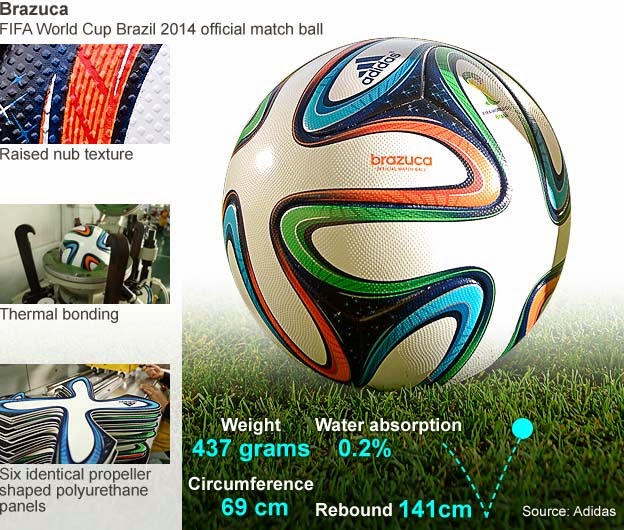
Pakistan is manufacturing and supplying footballs for use in all 64 matches of the World Cup 2014 in Brazil. In addition, most European football leagues have place huge orders to buy Brazuca balls designed by Adidas and made in Pakistan.

Brazuca Ball Source: BBC 
Brazuca football is made from six identical propeller shaped polyurethane pieces glued to a rubber bladder and thermally bonded together. It weighs 437 grams and measures 69 cm in circumference. Pakistan produces the high-quality polyurethane used in manufacturing Brazuca football panels. Brazuca is quite different from the traditional soccer balls which have historically been made of leather pieces stitched together in Sialkot, Pakistan. Polyurethane balls are water-resistant and maintain their shape much better than the leather balls under a variety of conditions in terms of temperature, pressure and humidity. Leather balls have a problem specially  if they soak up the water when it rains during play. Pakistan was chosen to supply the ball after China, the supplier of Jabulani for 2010 World Cup, was unable to meet FIFA's requirements.

Pakistan has not only earned the honor of manufacturing the ball that will be used in FIFA 2014 matches but also outdone both India and China in supplying tens of millions of footballs to European nations that place bulk orders for promotional purposes, according to India's Economic Times.

The Brazuca design is an improvement on the Jabulani ball used in 2010 World Cup in South Africa. Jabulani was too smooth with shallow seams, a problem that has been fixed in the Brazuca by adding raise nub texture and creating deeper seams making its flight more predictable.

The 2010 Jabulani ball had eight panels. The 2006 ball had 14. Before that, the balls were made of 32 internally-stitched panels. By decreasing the number of panels, they decreased the seams, creating a smoother surface. This smoother surface allows it to travel at higher speeds before it started knuckling. Knuckling is when the ball wobbles in the air, following an unpredictable flight path. It's a tool for strikers, a menace for goalkeepers. Researchers at the Center for Sports Engineering Research at Sheffield Hallam University in the UK measured the seams of the Jabulani and the Brazuca, and found that the Jabulani's seams are about .48 mm deep compared to 1.56 mm for the Brazuca. The seams on the Brazuca stretch to 327 cm, compared to 203 cm on the Jabulani.

The Brazuca ball went through a range of scientific tests to assure that it would complement the players' skills on the field, rather than adding a skill set all its own. "We do extensive flight path analysis and the results have shown constant and predictable paths, with deviations hardly recognizable," Matthias Mecking told the BBC. Mecking is Adidas's football director. "We've come full circle," NASA Ames Research Center scientist Ravi Mehta told the CBS News. "It's back to knuckling at about 30mph."  He was not involved in the design but has tested the ball. Another important factor, he says, is the amount of friction between the ball and the player's boot. Dr Mehta explained that when a relatively smooth ball with seams flies through the air without much spin, the air close to the surface is affected by the seams, producing an asymmetric flow. This asymmetry creates forces that can suddenly knock the ball, causing volatile swoops.

Those who are familiar with the cricket ball know that seams and rough surfaces play a crucial role in how the bowler can make it swing in flight, a technique pioneered by Pakistan's Waqar Younis.  Knuckle ball technique used by some Baseball pitchers is similar. The use of seams and roughness of the ball are tools for the bowler or pitcher but a menace for the batsman or batter at the other end.

Here's a video about Sialkot factory manufacturing Brazuca:


Adidas Brazuca being made in Pakistan by Lahorevideos
Related Links:

Haq's Musings

Johnson-Ali Model of Success in Olympics

Commonwealth Games 2010

Geo Sports Ban 

IPL Mixes Business, Sports and Entertainment

Pak Cricket Needs Top Batting Coach and Sports Psychologist

Wednesday, May 14, 2008

Entrepreneurs See Opportunity In Food Crisis


Richard Spinks, a 41-year-old British entrepreneur, is going door-to-door, leasing small plots of land from hundreds of thousands of poor farmers in western Ukraine. His company, Landkom International PLC, has planted wheat, barley and rapeseed (aka Canola) on a combined 25,000 acres. Landkom expects to reap its first big harvest this fall, according to the Wall Street Journal.

As the world food crisis becomes acute, entrepreneurs see opportunities to tackle it and make big money. Such efforts could give a much-needed boost to feed the growing population of the world. For years, big agribusiness companies have used new seed and fertilizer varieties to push yields higher. But as technology gains have slowed, the search for additional arable land has intensified. That's created an opening for entrepreneurs with visions of re-collectivizing the land in former communist countries and boosting production.

The total combined arable land in Russia, Ukraine and Kazakhstan that fed the former Soviet Union adds up to about 437m acres, almost the same as the total arable land in the United States. Among other nations with large arable acreage, India has 400m acres, China has about 350m acres and Brazil 146m acres. Of these countries, only China and Brazil have increased total arable land by about 10% over the last decade while others have shrunk. Compared to these nation, Pakistan has about 50m acres of arable land. And, given appropriate investments, Pakistan can increase its arable land by 10-20% over the next decade.

The current food crisis presents an opportunity for entrepreneurs and investors to invest in Pakistan's farm sector and reap big benefits. The new government in Pakistan should seize this opportunity by formulating a new policy of investment in the agriculture sector to bring prosperity to rural areas in Pakistan and help feed the nation and the world.

Friday, May 9, 2008

Can Pakistan Enhance World's Food Security?

While the term "energy security" has been in vogue for many years, the term "food security" seems to be competing with it for an equal or higher ranking on the world agenda. Food Security is particularly high on the list for countries such as China with the world's largest population to feed and the Middle East nations such as Saudi Arabia and Libya who depend on imported food.

So what are these countries doing? They are acquiring farmland in the nations considered world's breadbaskets. Countries in Africa, Latin America, and Eastern Europe who have plenty of farmland but not a lot of money. While these efforts will help increase food production, a downside of an aggressive policy for more farmland is that it will accelerate deforestation and hurt the environment.

The Chinese agriculture ministry has drafted a proposal to support the acquisition of farmland, especially in Africa and South America, to help guarantee China's food security, the Financial Times reports. Beijing already promotes aggressive foreign acquisition by Chinese oil, banking and manufacturing firms -- to mixed receptions abroad at a time of heightened suspicion surrounding sovereign-wealth investments. A Chinese official tells the FT that there shouldn't be any problem getting the policy approved, but that Beijing worries that foreign governments may be "unwilling to give up large areas of land."

And at a time of relative food shortages and soaring prices for cereals and other nutritive commodities, China will already have some competition, says the Wall Street Journal. In the Middle East, the region most dependent on imported food, Saudi Arabia has said it plans to invest in farm and livestock projects overseas to get a handle on its commodity prices and ensure supply, while Libya has been talking to Ukraine about the possibility of growing its own wheat there. Any shift of economic power from the Middle East to the likes of poorer Ukraine, one of the world's biggest wheat producers, could revive the Heartland Theory of 19th-century and 20th-century geographer Sir Halford John Mackinder, who argued control of the natural resources of the East European breadbasket region was key to controlling the "World Island" of Europe and Asia, and thus the world.

This developing new dynamic creates an opportunity for Pakistan to form partnerships with the Chinese and the Saudis aimed at dramatic improvement in the productivity of its farmland in Sind and Punjab without actually selling the land to foreigners. Farm modernization to realize the full potential of its farmland is a goal Pakistan must set for itself for this decade. If pursued with a clear plan and strategy, Pakistan can not only feed its own population well but it could also become the breadbasket for the world and improve the living standards of Pakistan's rural population.

Prior efforts beginning in 2000 toward corporate farming have met significant opposition. For example, an official of Pakistan's Ministry of Food and Agriculture said in July 2000, "We are working to finalize a policy for introducing corporate agriculture in the country where large farm holdings will be allowed to companies which would seek listing in the stock exchange."

Under the proposal, foreign companies were to be granted a 30-year lease on government-owned land that could be extended for another 20 years. However, food rights campaigners expressed the fear that profit-driven agribusiness transnational companies (TNCs) would use Pakistan as a base for exporting cash crops which would replace staple cereals on the country's farms.

Since the failure of the effort in 2000, Pakistan has again initiated efforts in 2007 to build serious agribusiness using modern techniques as part of a mega project sponsored by the Ministry of Food, Agriculture and Livestock, with the technical and financial assistance of Asian Development Bank. The executing agencies include Ministry of Food, Agriculture and Livestock (MINFAL), Department of Agricultural & Livestock Products Marketing & Grading, State Bank of Pakistan, Provincial Agriculture, Livestock and marketing Departments, and the Agriculture and Livestock Departments of FATA, FANA and AJK. The Project has its headquarters in Islamabad and implementation offices in Punjab, Sindh, NWFP, Balochistan, Federally Administered Tribal & Northern Areas and Azad Jammu and Kashmir.

To the dismay of biodiversity advocates and environmentalists, Brazil has become a dramatic success in food production by making use of the Cerrado (literally meaning Closed), a region of grassland near the equator that was considered not cultivable. The large scale American agribusiness investments have transformed the region into a major producer of soybean and made Brazil a food exporter rivaling the United States. Soybean is a major source of protein for livestock. Livestock farming is in big demand as the world consumes more meat and dairy products. Brazil is also the largest producer and consumer of biofuels and self-sufficient in energy.


The world food and energy crises clearly present opportunities for investors to invest in countries such as Pakistan with plenty of fertile farmland but very low farm productivity. By bringing the farm expertise and enhancing crop yields, agribusiness companies such as Archer-Daniel, Cargill, Bunge, Dow and Monsanto and their international competitors have tremendous opportunities in South Asia. So do companies like Caterpillar, John Deere, Kubota, Hyundai, Mahindra and others in the farm machinery and construction business. While many South Asians may be concerned about the negative impact of big agribusiness on the society and the environment, the over-riding need for efficiency to feed the growing population and international export opportunities will likely trump these concerns.

Tuesday, January 29, 2008

Merchant of Death Eyes Pakistan Market

Philip Morris International, the international unit of the US tobacco giant Philip Morris often described as a merchant of death, is building a new massive cigarette plant in Pakistan.
Philip Morris is expected to spin off PMI as an independent company to be unconstrained by the U.S. tobacco regulations and out of reach of American litigators. Importantly, its practices would no longer be limited by American public opinion, paving the way for trying out new products.

As the smoking rates in developed countries have slowly declined, they have risen dramatically in some developing counties, where PMI is a major player. These include Pakistan (up 42% since 2001), Ukraine (up 36%) and Argentina (up 18%), according to the Wall Street Journal.

The World Health Organization's Framework Convention on Tobacco Control, an international public-health treaty, has 152 participating countries, including China, Brazil and Pakistan. While it has led to greater regulation in many of the world's markets, countries such as Indonesia and Russia haven't signed on. It should be noted that Pakistan was derisively named as "The Winner of Marlboro Man of The Year Award" by anti-tobacco activists for stalling these negotiations but ultimately signed the treaty.

In addition to targeting Pakistan, India, Brazil and Russia, one of PMI's immediate goals is to harness the huge potential of China's smoking population, as well as some of that country's own brands, reports the Wall Street Journal.

After negotiating for three years, PMI is expected this year to begin marketing three Chinese brands. The smokes -- selected from hundreds of varieties produced by state-run China National Tobacco Corp. -- will be sold in Central Europe, Eastern Europe and Latin America, according to PMI.

The launch is planned for sometime in the next six months. It is part of a December 2005 deal in which Philip Morris agreed to market Chinese brands internationally in exchange for the right to produce its own Marlboro brand at state-owned factories. At the moment, Philip Morris is limited to importing its cigarettes for sale in China and is restricted by stringent quotas.

While Philip Morris investments in Pakistan, Brazil, Russia, India and China are expected to bring in much-needed capital and create thousands of new jobs, the proven health risks posed by smoking will also cause widespread disease and death in future years. This does not appear to be a good bargain for these emerging economies with young populations.

Friday, January 25, 2008

New Private Equity Fund Targets Pakistan

A private-equity fund solely dedicated to investing in Pakistan was closed December,2007, capping a year in which the country was one of the hottest emerging markets despite its political turmoil.
JS Group, a Pakistani financial services group, is the sponsor and a large investor in the new JS Private Equity Fund, which was closed on Dec. 31 at $158 million.
The fund, launched in 2006, is likely the third or fourth private-equity fund to invest solely in Pakistan. There are also several regional funds with a mandate to invest in Pakistan. Compared with neighboring India, however, Pakistan has a virtually virgin private-equity market.
In Karachi, the benchmark KSE-100 stock index rallied 47% in 2007 through Dec. 27, making it one of the best-performing emerging markets and nearly matching the gains of India's Sensex index. In comparison, Indonesian shares gained 52% and Brazil 40% in 2007.
"I could understand why a lot of foreign investors are a little spooked by what is happening in Pakistan," said Stephen Smith, partner at JS Private Equity. "Those less experienced in emerging markets will become very nervous."
After Bhutto's killing, the stock exchange was closed for several days and when it reopened on Dec. 31, the market tumbled 4.5%. Subsequently, however, the market has slowly pared its losses. The KSE-100 index is virtually unchanged on the year as of late Thursday.
Smith, however, believes that the political premium is likely overstated and that Pakistan's economic growth and unpenetrated private-equity market offer big opportunities for investors willing to take the risk.
Pakistan has a population of $160 million and its GDP growth has averaged 7% over the past five years. According to a recent United Nations report, Pakistan's GDP is expected to grow 6.2% or more in 2008.
Pakistan is one of the so-called "Next 11" countries singled out by Goldman Sachs as having the potential to offer tremendous investment opportunities, akin to those of leading emerging markets.
"The real thrust of the fund is to provide expansion capital to businesses that are domestic-demand driven," Smith said. "Things have really changed in Pakistan over the last five years. You have the emergence of a fledgling middle class."
The fund sees opportunities in both export-related industries, such as textiles, leather and medical supplies, as well as domestic-demand related industries, such as consumer goods, media and advertising. Smith also sees opportunities in inefficiencies in infrastructure, transportation and logistics, as well as agriculture and horticulture.
"[About] 25% of its economy is agricultural and horticultural and yet the amount of wastage of those products is extraordinarily high, because the infrastructure points are not very efficient," Smith said.
The JS Private Equity Fund has already made two investments. The first is a control investment in Optimus, the Hertz franchise in Pakistan, which specializes in long-term vehicle contract-leasing to businesses. The second is a minority investment in Engro Asahi Polymer & Chemicals, the only Pakistani producer of PVC resin.
Focus on institutional investors
JS Group has been doing private-equity style deals in Pakistan for a long time, but it was only in 2006 that it decided to create a formal fund, targeting professional institutional investors.
With a $40-million investment, CDC Group, a British government-owned fund of funds that invests in emerging markets, is the largest investor in the JS fund. Other investors include the International Finance Corporation; Samba, one of Saudi Arabia's leading financial groups; the Asian Development Bank; the Swiss Investment Fund for Emerging Markets; and PROPARCO, a subsidiary of the French Development Agency dedicated to financing the private sector.
"We're essentially betting on the long term, putting aside short-term volatility. Long-term the economy will win," said Brian Lim, portfolio director at CDC Group.
"We're essentially betting on the long term, putting aside short-term volatility. Long-term the economy will win."
— Brian Lim, CDC Group
"What we did look at was the history of the economy over successive generations of rulers," Lim said. "There did seem to be an economic will for liberalization, for FDI [foreign direct investment]. The one certainty is the economy has worked very well over the recent past. We're hopeful that things will resolve themselves on the political front."
Another reason to enter the Pakistani market is that there is very little competition among private-equity players, Lim said.
"In many sectors there were companies that could grow even faster, but the capital wasn't there," he said.
While neighboring India is experiencing a private-equity boom, Pakistan remains largely overlooked by the industry. There are only a handful of other private-equity funds solely dedicated to Pakistan. Among them are the $100-million TMT-SEAF Pakistan Growth Fund and the $300-million Abraaj BMA Pakistan Buyout Fund L.P. Several regional funds also have a mandate to invest in Pakistan.
In comparison, there are approximately 110 to 120 funds focused primarily on India, according to estimates from the Emerging Markets Private Equity Association.
That estimate looks conservative compared with that of Evalueserve, a global research and analytics firm, which estimates that approximately 200 funds are actively investing or fundraising in India.
"It's a very, very different market from India and China," Smith said. "We like to think we're helping to develop the market. We're a long away from what I'd call a competitive market for private equity. It means that we have to do a lot of patient education."

Source: MarketWatch, January, 2008