Pakistani automobile joint ventures with Chinese automakers BYD and Changan have recently launched several all-electric and plug-in hybrid models of automobiles in Pakistan. Earlier, Honda Atlas Cars Pakistan Limited announced plans to build a hybrid electric vehicles plant in the country. Other major brands like Toyota, Haval, and Hyundai are already offering similar models in the country. It all began with the 2019 electric vehicle policy approved by the government of Prime Minister Imran Khan to incentivize the electrification of the auto industry. Pakistan EV policy goal is to achieve 30% of new cars sales, 50% of new 2-wheeler and 3-wheeler sales and 30% of new truck sales by 2030. By 2040, the target is 90% of all new vehicle sales to be electric. The main incentive is the reduction of sales tax from 17% for internal combustion engine (ICE) vehicles to 1% for all-electric (EV) vehicles.
BYD Launch:
Chinese electric vehicle giant BYD has announced plans to open an EV production plant in Karachi. It will start selling three EV models in Pakistan through a partnership with Mega Motors. Mega Motors is a unit of Pakistan's largest private utility Hub Power Co Ltd (HPWR.PSX), known as Hubco.
"Our entry into the Pakistani market is not just about bringing advanced vehicles to consumers," said Liu Xueliang, BYD's general manager for Asia Pacific, according to
Reuters. "It's about driving a broader vision of environmental responsibility and technological innovation." "We will establish Pakistan's first NEV assembly plant... dedicated to producing BYD's cutting-edge new energy vehicles," said Hubco Chief Executive Kamran Kamal, who described the deal as a "landmark investment".
The BYD factory will be built near Karachi’s Port Qasim area that already houses assembly plants for other automobile companies including Toyota, Suzuki Motor Corp. and Kia Corp.’s local units. It will be completed in the first half of 2026, according to Bloomberg.
Last year, BYD’s total production – comprising battery-only powered cars as well as hybrids – was more than 3 million and surpassed Tesla’s production of 1.84 million cars for a second straight year, according to
CNBC.
A BYD model comparable to Tesla Model Y is $10,000 cheaper and has more features, according to
news reports.
Changan Launch:
Master Changan Motors Limited (MCML), a joint venture between Pakistan's Master Group of Industries and China's Changan International, launched Changan’s electric-first brand, DEEPAL, this month in Karachi, Pakistan. The joint venture unveiled the brand Deepal with 2 models, L07, the pure electric sports luxury sedan and S07 the pure electric premium SUV.
Both Changan models offer 250 HP and 320 Nm of instant torque, going from 0-100 km/hr in just 5.9 seconds. The Ternary Lithium battery by CATL has a capacity of 66.8 kWh and provides an exceptional range of up to 540 km in L07 and 485 km in S07. The cars are designed in Italy in Changan’s R&D center and have won the German RedDot design award in 2023 with its futuristic design, according to
media reports.
Changan has sold 45,000 cars in Pakistan in the last 5 years.
Honda Atlas:
Last month Honda Atlas Cars Pakistan Limited (HACPL) announced its plan to invest
Rs. 5 billion in a cutting-edge hybrid vehicle production facility in Pakistan. This investment will support the local manufacturing and assembly of hybrid electric vehicles (HEVs).
The company recently reported a 324% jump in sales, totaling Rs. 15.97 billion compared to Rs. 3.77 billion in the same period last year. The company reported a gross profit of Rs. 1.01 billion for the first quarter of FY25.
Two and Three Wheelers:
Prior to the BYD and Changan EV launches, Pakistan granted EV manufacturing licenses to 32 local companies under the EV Policy 2019, according to the
Business Recorder newspaper. Metro Electric Bikes, VLEKTRA and Sazgar Engineering Works are among the key names leading the two and three wheeler EV manufacturing in Pakistan.
“Motorcycle buyers have started to inquire about electric bikes, scooty, and scooters options. I believe many have postponed buying a normal two-wheeler with expectations that an electric two-wheel model may soon enter the market that is closer to their need,” said Sabir Sheikh, who is also the Chairman, Association of Pakistan Motorcycle Assemblers (APMA), according to media reports.
Charging Infrastructure:
A number of investors, including ADM Group, Hashoo Group and Hubco are planning to invest in building a nationwide EV charging stations network. The EV policy provides incentives for it by reducing import duty on charging equipment imports to just 1% and lower power tariffs. It also ensures uninterrupted power supply on feeders fir charging stations.
Hubco said it will setup fast-charging stations across major cities, motorways and highways to enhance Pakistan's charging infrastructure, according to Reuters. The EV policy calls for at least one fast DC charging station per 3km by 3km area in all major cities as well as DC fast chargers on all motorways every 15-30 km.
Solar Power Boom:
With rapidly falling solar panel prices, Pakistan is experiencing a
solar power boom in the country. The country imported some 13 gigawatts of solar modules in the first six months of the year, making it the third-largest destination for Chinese exporters, according to
Bloomberg.
Rapid increase in solar power generation complements Pakistan's push to a
clean energy economy and EV adoption. This may encourage some of the charging station operators to go solar with batteries to reduce their cost of power purchases from the grid.
Climate Action:
Pakistan has contributed only 0.28% of the CO2 emissions but it is among the biggest victims of climate change. The US, Europe, India, China and Japan, the world's biggest polluters, must accept responsibility for the catastrophic floods in Pakistan and climate disasters elsewhere. A direct link of the disaster in Pakistan to climate change has been confirmed by a team of 26 scientists affiliated with World Weather Attribution, a research initiative that specializes in rapid studies of extreme events, according to the New York Times.
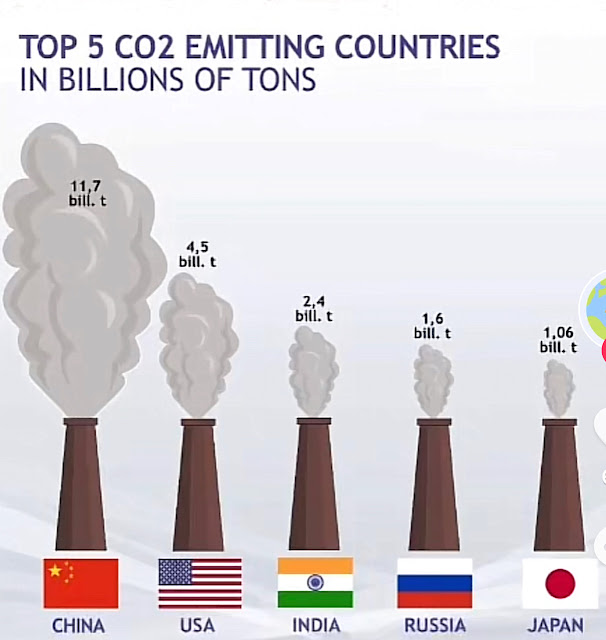 |
| Top 5 Current Polluters. Source: Our World in Data |
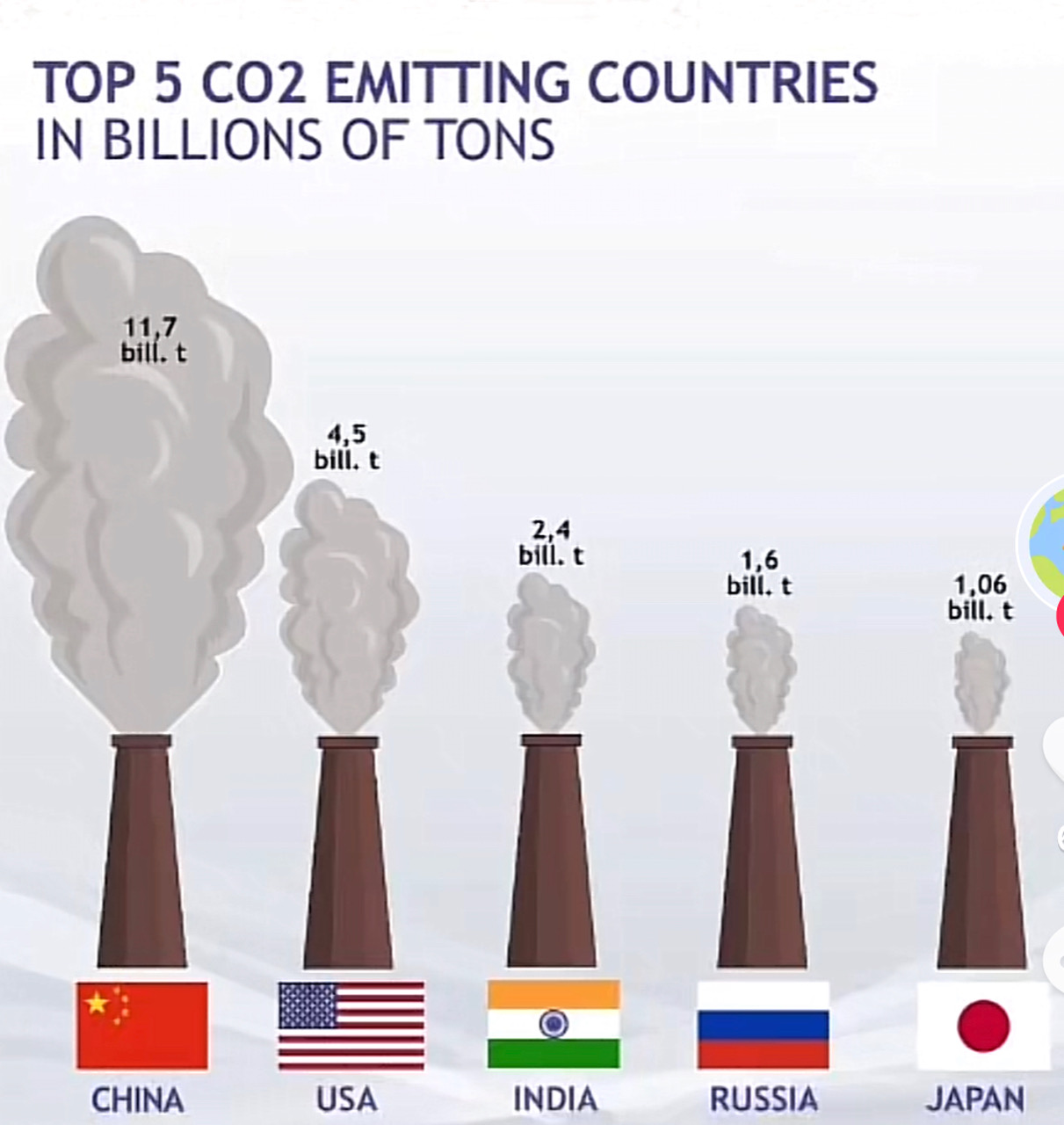
Currently, the biggest annual CO2 emitters are China, the US, India and Russia. Pakistan's annual CO2 emissions add up to just 235 million tons. On the other hand, China contributes 11.7 billion tons, the United States 4.5 billion tons, India 2.4 billion tons, Russia 1.6 billion tons and Japan 1.06 billion tons.
The United States has contributed 399 billion tons (25%) of CO2 emissions, the highest cumulative carbon emissions since the start of the Industrial Revolution in the late 18th century. The 28 countries of the European Union (EU28), including the United Kingdom, come in second with 353 billion tons of CO2 (22%), followed by China with 200 billion tons (12.7%).