Showing posts sorted by date for query farmland. Sort by relevance Show all posts

Friday, September 6, 2024

Shifting Monsoon Pattern: Is Arid Pakistan Turning Wet?

Semi-arid Pakistan, with its farmlands predominantly irrigated by the world's largest contiguous canal system, has experienced an increasing amount of annual rains and floods for several years. Even the desert regions of the country, like the vast Thar desert straddling India-Pakistan border, have recently been turning green. Now a study has found that  "the mean rainfall over the semi-arid northwest parts of India and Pakistan has increased by 10%–50% during 1901–2015 and is expected to increase by 50%–200%" by the end of the current century. The authors of this study published by Advanced Earth and Space Science conclude as follows: "While an adaptation strategy to increased hydrological disasters is a must, harnessing the augmented rainfall would lead to a substantial boost in food productivity, bringing transformative changes in the socio-economic condition of people in the region". 

Annual Summer Monsoon Rainfall in Millimeters For 1979-2015. Source: AGU

Already, the satellite images shared by the US National Aeronautics and Space Administration (NASA) show that greenery in Pakistan has been growing at double digit rates over the last few decades. All of this rapid greening of the country is the result of intensive agriculture in Punjab and Sindh provinces.

Greening Trends in Asia. Source: NASA Earth Observatory

Recent economic data from Pakistan lends credence to the findings of the latest study that the region will see  "substantial boost in food productivity, bringing transformative changes in the socio-economic condition of people". Pakistan's agriculture sector grew 6.3% in 2023-24, far outpacing the overall economy that grew just 2.38%, according to the Economic Survey of Pakistan 2023-24. Pakistan’s agricultural exports reached a record $8 billion in FY 2023-24. This is good news for about 40% of the country's population working in the agriculture sector. By contrast, India's agriculture growth slowed to 1.2% in recent quarters. Studies have shown that strong growth in agriculture helps reduce poverty in developing nations like India and Pakistan. 

Projected Percentage Change in South Asia Rainfall By End of 21st Century. Source: AGU

The study highlights shifting monsoon patterns bringing more rainfall in northwestern India and Pakistan which is explained as follows: "The warming of the western Indian Ocean and Arabian Sea strengthens winds that cross the equator, which increases evaporation and the amount of moisture carried from the ocean to the land. This leads to increased monsoon rainfall."  "On the other hand, the oceanic rain belt between the equator and 10°S shows weakening, with a decrease in mean rainfall from the eastern IO (Indian Ocean) extending up to the maritime continent", it adds. 

A major downside of the increased rainfall from shifting monsoon patterns is frequent flooding in both rural and urban Pakistan. The country experienced the worst floods in its history in 2022.  Over a thousand Pakistanis died. About 33 million people in two southern provinces became homeless. Sindh was inundated with 784% of normal rainfall. Balochistan saw 522% of average rainfall. Both provinces suffered their worst ever heatwave prior to this unprecedented deluge. Nearly a million livestock were lost, over two million acres of farmland went underwater and 90% of the crops in Sindh and Balochistan were damaged. It was a massive humanitarian crisis. 

Such extreme weather events like the floods of 2022 are likely to recur and cause widespread devastation unless measures are taken to build back better. Part of the new infrastructure needed to deal with it includes better rainwater harvesting and improved drainage systems. This is what the authors of the study refer to when they say that "harnessing the augmented rainfall would lead to a substantial boost in food productivity, bringing transformative changes in the socio-economic condition of people in the region". 

Related Links:

Wednesday, December 6, 2023

COP28: Pakistan Planting World's Largest Mangrove Forest

Pakistan, which contributes less than 1% of global carbon emissions, is among the countries considered most vulnerable to climate change. About a third of the country was devastated by massive floods in 2022. The nation committed continued pursuit of nature-based solutions to the problem at COP26 in Glasgow in 2021. As part of this commitment, the country is planting one of the world's largest mangrove forests in the Indus River Delta, a key component of its Ten Billion Tree Tsunami campaign launched by former Prime Minister Imran Khan. 

Pakistan Mangroves Plantation Project. Source: Delta Blue Carbon


Mangrove Forest:

Also known as Delta Blue Carbon Project, the mangroves plantation will eventually cover 350,000 hectares of Tidal Wetlands on the south-east coast of Sindh. Currently, Pakistan is estimated to have 600,000 hectares of mangrove forest. Mangroves absorb hundreds of millions of tons of atmospheric carbon, reduce the impact of storms on human lives and economic assets, and provide a habitat for fish, birds and other plants supporting biodiversity. It is funded by sales of carbon credits to global polluting industries such as those involved in fossil fuels trade. 

Pakistan NDCs (Nationally Determined Contributions) For Climate Goals. Source: UN


Massive Floods of 2022:

More than a year after the unprecedented floods of 2022, Pakistan is still dealing with the havoc they wreaked.  Over a thousand Pakistanis died. About 33 million people in two southern provinces became homeless. Sindh was inundated with 784% of normal rainfall in the year. Balochistan saw 522% of average rainfall. Both provinces suffered their worst ever heatwave prior to this unprecedented deluge. Nearly a million livestock were lost, over two million acres of farmland came underwater and 90% of the crops in Sindh and Balochistan were damaged. This was a massive humanitarian crisis. 

Nature Based Solutions:

How are nature based solutions different from man made solutions? Here's how the World Bank explains the difference: 

"Nature-based solutions are actions to protect, sustainably manage, or restore natural ecosystems, that address societal challenges such as climate change, human health, food and water security, and disaster risk reduction effectively and adaptively, simultaneously providing human well-being and biodiversity benefits. For example, a common problem is the flooding in coastal areas that occurs as a result of storm surges and coastal erosion. This challenge, traditionally tackled with manmade (grey) infrastructure such as sea walls or dikes, coastal flooding, can also be addressed by actions that take advantage of ecosystem services such as tree planting. Planting trees that thrive in coastal areas – known as mangroves -- reduces the impact of storms on human lives and economic assets, and provides a habitat for fish, birds and other plants supporting biodiversity" 

Karachi Mangroves Exhibit. Source: Magnifiscience Center


Saving Karachi:

One of the objectives of restoring mangroves is to prevent a climate disaster in Karachi, Pakistan's largest city and the country's economic hub. Mangroves in Karachi are a unique marine ecosystem fringing the coast, and they provide both a vital spawning area for ocean fish and protection from periodic tsunamis and storm surges. 

Karachi's Magnifiscience Center has a special exhibit to help teach citizens the importance of restoring this marine ecosystem. Here's an excerpt of a recent Time Magazine report on the subject:

"On a recent Tuesday morning, several dozen Pakistani schoolchildren barreled down a wooden walkway into a thicket of mangroves. They jostled for space at a small viewing platform and eagerly pointed out fish darting between the exposed tree roots. As the rising tide inched ever closer to the crabs and mudskippers resting on shore, the children’s guide launched into a detailed explanation of the unique marine ecosystem fringing the coast, and how it provided both a vital nursery for ocean fish and protection from tsunamis and storm surges. If mangroves are so important, wondered one child out loud, “Why are they in here, and not out there?” By in here, she meant the soaring glass atrium of Karachi’s newly opened MagnifiScience Centre, where the high-tech centerpiece is the living mangrove exhibit—complete with real trees, live fish, plastic crabs, and an accelerated tidal ebb and flow maintained by underground water pumps. Out there is the crowded coastal megacity of Karachi, where all but a few of the mangrove forests that once defined this Indus Delta port town have been chopped down, paved over, and developed into ocean-view high-rises, golf courses, and container ports". 


Thursday, September 22, 2022

Angelina Jolie Using Her Star Power to Help Pakistan Flood Victims

Beautiful Hollywood star Angelina Jolie is known for her international humanitarian work as the United Nations Goodwill Ambassador. A winner of multiple awards including one Oscar and three Golden Globes, she is among the highest paid actors in the world. Jolie is currently visiting Pakistan to bring global attention to the immense suffering caused by devastating floods in the country, particularly in its southern Sindh province.  

Angelina Jolie

Pakistan is dealing with the aftermath of the worst floods in the country's history. Over 1500 Pakistanis are dead. About 33 million people in two southern provinces are homeless. Sindh is inundated with 784% of normal rainfall so far this year. Balochistan has seen 522% of average rainfall. Both provinces suffered their worst ever heatwave prior to this unprecedented deluge. Nearly a million livestock have been lost, over two million acres of farmland is underwater and 90% of the crops in Sindh and Balochistan have been damaged. 

UN Sec Gen Antonio Guterres

The United Nations Secretary General Antonio Guterres has described the unprecedented flooding in Pakistan as “a monsoon on steroids" that has created a massive humanitarian crisis. The country can not deal with it alone. He said Pakistan "is drowning not only in floodwater, but in debt.” Mr. Guterres has called for debt relief for developing nations such as Pakistan. “The Debt Service Suspen­sion Initiative should be ex­tended – and enhanced. We also need an effective mechanism of debt relief for developing coun­tries – including middle income countries – in debt distress. Creditors should consider debt reduction mechanisms such as debt-climate adaptation swaps.

It will take hundreds of millions of dollars to provide immediate relief to 33 million people, followed by tens of billions of dollars in assistance to rebuild the lives and livelihoods and the infrastructure destroyed by this catastrophe. Pakistan's gross capital formation is only 15% of its GDP. Among the world’s top 20 economies by population, only Egypt has a lower rate of gross capital formation than Pakistan, according to Bloomberg. It is time for the rich industrialized world to help developing nations such as Pakistan to deal with the massive impact of climate change. 

Low Gross Capital Formation in Pakistan. Source: Bloomberg 

Pakistan's population is about 2.6% of the world population. The nation has contributed just 0.28% of the cumulative global carbon emissions since 1750. It lacks the resources needed to deal with the consequences of this man-made disaster. The Industrial Revolution in Europe and the United States was fueled mainly by fossil fuels such as coal and oil believed to be responsible for climate change. 

Cumulative CO2 Emissions Since 1750. Source: Our World in Data

Below is a map from Professor Jason Hickel showing that the countries in the global north are the biggest polluters while those in the global south are the most vulnerable to the effects of climate change.  

Climate Injustice: Low Emitters Global South vs Big Polluters in Industrial North. Source: Prof J. Hickel

After viewing the flood disaster in Pakistan Jolie said: "I have never seen anything like this. I have been to Pakistan many times. I came because of the generosity that Pakistani people have shown to the people of Afghanistan. Oftentimes those who have less give more than so many other countries. The climate change is not only real but it's here.  This is a wakeup call to the world about where we are. The countries that have not done as much damage to climate are the ones that are bearing the brunt. The needs in Pakistan are now so great. I appeal to the world to help. Many of the victims here will not make it without a lot of help."

Here are some more excerpts from her press conference in Pakistan: 

"I feel overwhelmed but I feel it is not fair to say that since I am not living this." 

"I've never seen anything like this and I have been to Pakistan many times"

"I came  because of  the generosity that Pakistani people have shown to the people of Afghanistan over the years...My heart is very very much with people at this time.”

"It is often seen that the countries that don't have as much give more than so many other countries"

"I am absolutely with you in pushing the international community to do more. I feel that we say that often... we speak of aid appeals, relief and support but this is something very, very different"

"Climate change is not only real and it is not only coming, it is here,"

"I've seen the lives that were saved but I've also seen... I've been speaking to people and thinking that if enough aid doesn't come they won't be here in next few weeks... they won't make it"

"Even if they make it next few months with the winter coming and the destruction of the crops and the hard reality ... I am overwhelmed but I feel it is not fair to say that because I am not living this so I simply try to speak out for help. I can't even imagine what it feels like to be there"

"I will return and continue to return and my heart is very, very much with the people at this time"

https://youtu.be/tsHpbzF_Olg


Saturday, September 3, 2022

Climate Change: Pakistan Requires Massive Assistance to Recover From Catastrophic Floods

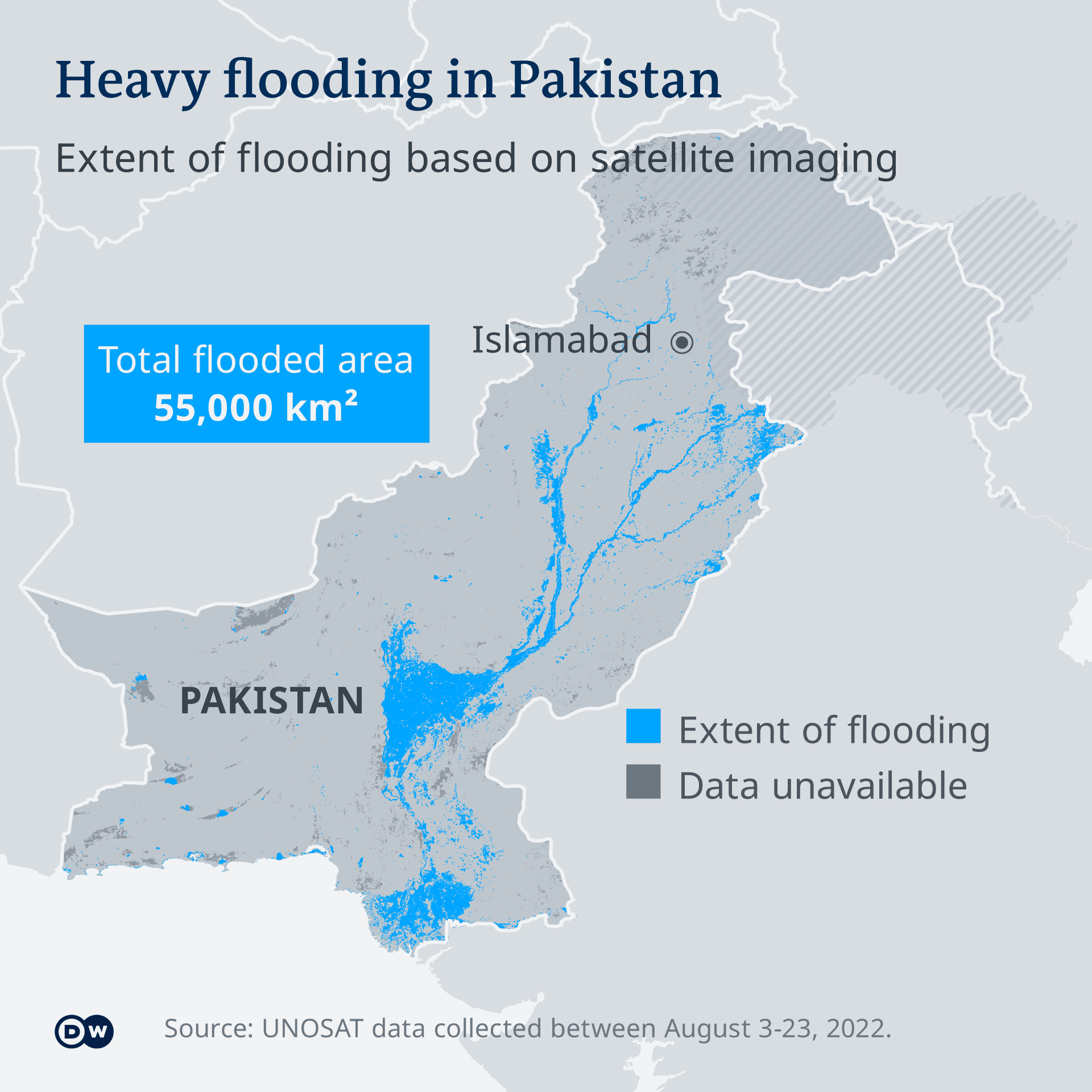
Pakistan is dealing with the aftermath of the worst floods in the country's history.  Over a thousand Pakistanis are dead. About 33 million people in two southern provinces are homeless. Sindh is inundated with 784% of normal rainfall so far this year. Balochistan has seen 522% of average rainfall. Both provinces suffered their worst ever heatwave prior to this unprecedented deluge. Nearly a million livestock have been lost, over two million acres of farmland is underwater and 90% of the crops in Sindh and Balochistan have been damaged. This is a massive humanitarian crisis. Pakistan can not deal with it alone.

Pakistan Flood 2022 Map. Source: DW

Satellite Image of Qambar, Sindh Before/After Floods 2022. Source: NASA

Satellite Image of Shikarpur, Sindh Before/After Floods 2022. Source: NASA


Balochistan and Sindh Worst Affected by Monsoon22. Source: The Economist

Pakistan's population is about 2.6% of the world population. The nation contributes less than 1% of the global carbon emissions. It lacks the resources needed to deal with the consequences of this man-made disaster. The Industrial Revolution in Europe and the United States was fueled mainly by fossil fuels such as coal and oil believed to be responsible for climate change.  The following map from Professor Jason Hickel shows that the countries in the global north are the biggest polluters while those in the global south are the most vulnerable to the effects of climate change. 

Climate Injustice: Low Emitters Global South vs Big Polluters in Industrial North. Source: Prof J. Hickel
Average Annual Cost of Floods in Vulnerable Countries. Source: Bloomberg


Comparison of 2022 and 2010 Floods in Pakistan. Source: WWF

It will take hundreds of millions of dollars to provide immediate relief to 33 million people, followed by tens of billions of dollars in assistance to rebuild the lives and livelihoods and the infrastructure destroyed by this catastrophe. Pakistan's gross capital formation is only 15% of its GDP. Among the world’s top 20 economies by population, only Egypt has a lower rate of gross capital formation than Pakistan, according to Bloomberg. It is time for the rich industrialized world to help developing nations such as Pakistan to deal with the massive impact of climate change. 

Low Gross Capital Formation in Pakistan. Source: Bloomberg 


All Pakistanis and non-Pakistanis need to pitch in with donations to help finance immediate disaster relief activities. Beyond that, Pakistan will have to be helped by international experts to build disaster preparedness capacity. The new housing and infrastructure will have to be funded and built to ensure its resilience in future climate disasters which are likely to occur more often with greater intensity. There is an urgent  need to prepare western and multilateral financial institutions to deal with such climate catastrophes in developing nations. Mechanisms also need to be put in place to provide and manage funding of these projects in a transparent manner. 

Monday, April 19, 2021

Income Inequality: Elite Capture in Pakistan

A recent United Nations report on inequality reveals that the richest 1% in Pakistan take 9% of the national income.  A quick comparison with other South Asian nations shows that 9% income share for the top 1% in Pakistan is lower than 15.8% in Bangladesh and 21.4% in India. These inequalities result mainly from a phenomenon known as "elite capture" that allows a privileged few to take away a disproportionately large slice of public resources such as public funds and land for their benefit. 

Share of Income of Richest 1% in South Asia


Elite Capture:

Elite capture, a global phenomenon,  is a form of corruption. It describes how public resources are exploited by a few privileged individuals and groups to the detriment of the larger population. 

A recently published report by the United Nations Development Program (UNDP) has found that the elite capture in Pakistan adds up to an estimated $17.4 billion - roughly 6% of the country's economy. 

Pakistan's most privileged groups include the corporate sector, feudal landlords, politicians and the  military. UN Development Program's NHDR for Pakistan, released last week, focused on issues of inequality in the country of 220 million people. 

Ms. Kanni Wignaraja, assistant secretary-general and regional chief of the UNDP, told Aljazeera that Pakistani leaders have taken the findings of the report “right on” and pledged to focus on prescriptive action. “My hope is that there is strong intent to review things like the current tax and subsidy policies, to look at land and capital access", she added. 

Inequality in Pakistan. Source: UNDP

Income Inequality:

The richest 1% of Pakistanis take 9% of the national income, according to the UNDP report titled "The three Ps of inequality: Power, People, and Policy". It was released on April 6, 2021. Comparison of income inequality in South Asia reveals that the richest 1% in Bangladesh and India claim 15.8% and 21.4% of national income respectively.

In addition to income inequality, the UNDP report describes the inequality of opportunity in terms of access to services, work with dignity and accessibility. It is based on exhaustive statistical analysis at national and provincial levels, and includes new inequality indices for child development, youth, labor and gender. Qualitative research, through focus groups with marginalized communities, has also been undertaken, and the NHDR 2020 Inequality Perception Survey conducted. The NHDR 2020 has been guided by a diverse panel of Advisory Council members, including policy makers, development practitioners, academics, and UN representatives.

Savings, Investments and Exports:

It is generally accepted that the rich save a much bigger portion of income than the middle class and the poor. The effect is strongest among those in the top quintile of the lifetime earnings distribution—they have substantially greater wealth relative to their earnings than those in the bottom 80% of the distribution, according to published research. 

Lower inequality in Pakistan is reflected in its abysmal domestic savings and investment rate of around 10% of GDP. It shows in Pakistan's lower economic growth rate compared to Bangladesh and India. The distribution of national income in a country is a key socioeconomic variable with broad economic and societal implications. Income inequality and wealth inequality are related because the flow of income determines savings and investments, which in turn determine GDP growth and accumulation of wealth. An economic model offered by Galor and Zeira finds that the effect of rising inequality on GDP per capita is negative in relatively rich countries but positive in poor countries like Pakistan.

Investment as Percentage of GDP Source: State Bank of Pakistan 


While Pakistan's per capita income more than doubled from $500 to $1,000 in the ten years 2000 to 2010, the growth has slowed to less than 30% from 2010 to 2020. Faster GDP growth in the decade of 2000-2010 was partly the result of significant increase in Pakistan's savings and investment rates. Meanwhile, rising worker remittances from overseas Pakistanis have been boosting Pakistan national savings rate and helping reduce current account deficits. 
 
Savings Rate in Pakistan. Source: Dawn


Pakistan's exports doubled from $10 billion to $20 billion in years 2000-2010. In the last decade 2010-2020, the nation's exports have grown only about 25% to $25 billion. Exports have declined in terms of percentage of the country's GDP from 13% to 10% in the most recent decade. 

Pakistan FDI inflows have significantly lagged behind those of the rest of South Asia.

FDI Inflows in Pakistan. Source: World Bank

Pakistan saw rapid economic growth in the 1960s in spite of low domestic savings rate. This can be explained by foreign development aid of as much as 10% of GDP that Pakistan received in that decade. . 

Foreign Aid to Pakistan as Percent of GDP Source: World Bank

Summary:

The richest 1% of Pakistanis take away 9% of the national income. Inequality in Pakistan has many dimensions beyond income. The rich enjoy greater access to education, healthcare, financial services, employment and business opportunities. Corporations, feudal landowners, politicians and the military are the most privileged groups with the best opportunities to own businesses, financial assets, farmland and real estate. They capture an estimated $17.4 billion - roughly 6% of the country's economy. Ms. Kanni Wignaraja, assistant secretary-general and regional chief of the UNDP, told Aljazeera that Pakistani leaders have taken the findings of the report “right on” and pledged to focus on prescriptive action. “My hope is that there is strong intent to review things like the current tax and subsidy policies, to look at land and capital access", she added. The policymakers in Pakistan should consider the negative economic implications of any such moves, particularly on savings and investments in the country.  


Friday, October 29, 2010

Agriculture and Textiles Employ Most Indians and Pakistanis

About 60% of India's workforce is in agriculture. Textile industry is the second biggest employer, accounting for a fifth of India’s exports, and employs almost 10 percent of India’s workforce, or some 35 million people, and has the potential to add another 12 million new jobs --dwarfing the 1-2 million jobs created by the much-heralded IT and BPO sector, according to a World Bank report.

The largest number of people in other South Asian nations are also employed in the agriculture sector, followed by textile manufacturing as the second largest employer.

About 60% of India's workforce is engaged in agriculture, contributing about 16% of GDP, according to published data. Textile manufacturing claims the second largest employment and comprises 26% of manufacturing output. It accounts for a fifth of India’s exports, and employs almost 10 percent of India’s workforce, or some 35 million people, and has the potential to add another 12 million new jobs --dwarfing the 1-2 million jobs created by the much-heralded IT and BPO sector, according to a World Bank report. Even the most optimistic estimates by NASSCOM put the total direct and indirect employment in IT and ITES sectors at 10 million jobs.

The textile sector is crucial to India's economy. The textile industry contributed 4% of India's gross domestic product in the year that ended March 31, and accounted for 13.5% of Indian exports, bringing in $17.6 billion, according to the Wall Street Journal.

With the Indian rupee soaring — up 9 percent against the dollar in the last 16 months, textile exports are down 6.4 percent from a year earlier in the $10 billion Indian clothing industry, according to a recent report in the New York Times.

About 23% of the India's workforce is part of the services sector which accounted for 55% of the GDP in 2007. Within the service sector, the fastest growing segment is business services, contributing about 7% of GDP. It includes information technology enabled services (ITES), information technology (IT), business process outsourcing (BPO) etc. In 2000, it was one third of the total output of services.

Agriculture in Pakistan accounts for 19.4% of GDP and 42% of labor force, followed by services providing 53.4% of GDP and 38% employment, with the remainder 27.2% of GDP and 20% workers in manufacturing sector. Over half of Pakistan's manufacturing jobs are in the textile sector, making it the second biggest employer after agriculture.

The dire situation in India's agriculture sector has been epitomized by over 200,000 farmers' suicides in the last decade. And the rising Indian rupee is now hurting India's textile sector by making its exports more expensive in the world market.

Pakistan's agriculture and textile sectors have also suffered in the last two years. Reduced water flows from India followed by recent floods have adversely affected large swathes of Pakistan's farmland. And the current energy crisis combined with the economic slowdown have hit the textile industry particularly hard. The European Commission, the EU's executive, has recently approved tariff waivers on 75 categories of imports from Pakistan for up to three years, according to a report in the Wall Street Journal. The gesture followed an order by EU leaders wanting to demonstrate they're helping some 10 million Pakistanis left without shelter in the wake of floods.

Pakistan shipped about $4.2 billion of exports to EU last year. About 75% of Pakistani exports to EU are textiles, clothing, leather or related products, and those goods will make up a majority of the roughly $140 million in total extra trade the EU says the deal will generate from eliminating the EU tariffs.

Here is a quick comparison of different sectors of the economy in India and Pakistan in terms of employment and GDP contribution:

Country....Agri(emp/GDP)..Textiles..Other Mfg..Service(incl IT)

India........60%/16% ...........10%/4%.....7%/25%...........23%/55%

Pakistan......42%/20%...........12%/8%......8%/18%...........38%/54%

Assuming India's PPP GDP of $3.75 trillion (population 1.2 billion, nominal gdp $1.3 trillion) and Pakistan's $450 billion (population 175 million, nominal gdp $167 billion)), here is what I calculated in terms of per capita GDP in different sectors of the economy:

India vs. Pakistan: Per Capita GDP $3,125 PPP ($1,083 nom) vs. $2,570 ($955 nom)

Agriculture: $833 PPP ($288 nom) vs. $1,225 PPP ($454 nom)

Textiles: $1,242 ($433) vs. $1,714 ($636)

Non-Textile Mfg: $11,155 ($3,870) vs $5,785 ($2,142)

Services $7,246 ($2,590) vs $3,654 ($1356)

Data shows that the majority of Indians who work in agriculture and textiles are on average 50% poorer than their Pakistani counterparts, as also reflected in the under-$2 a day per capita income figures for 60% of Pakistanis and 76% of Indians.

Agriculture Value Added Per Worker in Constant 2000 US$ (Source: World Bank) 


It also shows that Indians in manufacturing and services sectors add almost twice as much value as Pakistanis, and produce significantly higher value goods and services than their Pakistani counterparts.

The income range in India is much wider from $883 to $11,155 accounting for the much bigger rich-poor gap relative to Pakistan's relatively narrower range from $1225 to $5,785.

The challenge for India is to improve its farmers' productivity and move some of them into higher value added sectors of the economy.

The challenge for Pakistan is to have its manufacturing and services sectors produce more goods and services of higher value, and continue to migrate more of its farmers into other sectors of the economy.

It's clear that farming and textiles continue to be the most important economic sectors with the biggest impact on the lives of the majority of ordinary citizens of India and Pakistan. And just as the US and EU look after their farmers, it is very important for South Asian governments to protect their farming and textile sectors even as they promote diversification of their economies.

Related Links:

Haq's Musings

Pakistan Textile Industry Report

Pakistan's Farmland Controversy
Peepli Live and India's Farmers' Suicides

Floods in Pakistan
Pakistan's Textile Woes

Agricultural Growth in India, Pakistan and Bangladesh

KPMG Report on Pakistan Economy 2010

India and Pakistan Contrasted
Pakistan's Major Business Sectors
Labor Laws: To Create Good Jobs, Reform Labor Regulations

Foreign Investors Buying Pakistani Farm Land
Is Leasing Agricultural Land to Foreigners a Good Idea?

Pakistan's Sugar Crisis and Dietary Habits

Wheat Research and Development in Pakistan

Pakistan's Water Crisis

Wheat Productivity, Efficiency and Sustainability

Agrarian Reform in Pakistan
Urbanization in Pakistan

Water Scarcity in Pakistan

Pakistan Agribusiness Report 2009

Pakistan to Lease 700,000 Acres to Arab States

Pakistan's Total Arable Land

Sunday, June 20, 2010

Smartphones For India and Pakistan

“The times they are a-changin’,” said Steve Jobs in a recent e-mail exchange on Apple's iPhone, “and some traditional PC folks feel like their world is slipping away. It is.”

Google CEO Eric Schmidt has started talking up his company's new motto "Mobile First", urging its developers to start creating versions of new services for smartphones before converting to run on PCs.

"There is a huge thirst for smartphones in emerging markets," Microsoft said in a statement. "For many people, the phone rather than the PC is the main entry point to the Internet, resulting in a high demand for rich communication devices. In order to meet this demand, we have teamed up with MediaTek to facilitate the provision of affordable smartphones," the company added.


As the smart phones prepare to take center stage among computing and Internet access devices, there seems to be a rare consensus emerging among the American technology titans at Apple, Google and Microsoft that the smart phone will be the primary device used to access the Internet...particularly as it relates to demand in the developing world where mobile phones have much higher levels of affordability and market penetration than the personal computers. A logical outcome of such a consensus is the increasingly fierce competition which will significantly drive down the cost and dramatically increase availability of smart phones globally, particularly the developing nations like India and Pakistan where the telecom companies are already building mobile broadband networks. PTCL currently offers 3G service in Pakistan, and a 3G license auction is planned for this year to add more service providers. In addition, the growth of Wi-Fi in South Asia will be an added low-cost data option for smartphones.

BlackBerry service is offered by a number of telecom service providers and widely available in Pakistan's cities, towns and villages. Last year, Time magazine reported from Faridkot, a Pakistani village, that "straddles a paved road about 2 1⁄2 hours' drive from Lahore, and two new gas stations mark the village boundaries. Beyond those are factories and fertile farmland. There is even BlackBerry service". However, the high cost of Blackberry device and mobile Internet service limits it to only about 60,000 elite subscribers in a nation of over 100 million subscribers, about 64% of the population. India, with about 50% cell phone penetration, has nearly 400,000 Blackberry user. The number of Internet users can be expected to rise exponentially as affordability significantly increases to satisfy what Microsoft calls "a huge thirst for smartphones in emerging markets".

The key cost reduction drivers are likely to be similar to the ones seen in the earlier PC battle in 1990s between Wintel (Windows on Intel) and Apple Mac platforms which I personally observed and enabled as a CPU pioneer at Intel. While Macintosh represented a major advance in ease of use with Apple controlling it, the Wintel platform opened up hardware competition with multiple vendors leading to lower prices and tremendous growth in terms of applications and hardware availability. In this new era, the two biggest entries are expected to be Apple iPhone and Google Android, with each trying to outdo the other in terms of ease of use, number of applications and prices.

While Apple currently enjoys dramatic iPhone growth, it's future market share is likely to suffer from the cost barriers it is building into its pricing model which designed to maximize its profits with ongoing revenue stream from third-party content. According to Newsweek, there’s only one place where anyone can buy iPhone apps: Apple’s online App Store. And Jobs keeps a 30 percent cut of the revenue. As for ads, Jobs will sell those, too, and he’ll keep 40 percent. Of course, Jobs also sells music, movies, and books via his iTunes Store, keeping 30 percent. So instead of a one-time sale of a Mac, each iPhone and iPad becomes an ongoing revenue stream.


Currently, Q1/2010 market data shows that Apple iPhone and Google Android are running neck and neck, each selling at an yearly rate of 36 million phones each, while RIM's Blackberry is slightly ahead with about 40 million phones a year. Nokia (Symbian OS) still leads the pack with sales of 86 million smartphones a year. The overall smartphone shipments of about 230 million units still lag the 275 million PCs sold annually. However, a number of forecasters expect smartphones annual sales to equal or exceed PC unit sales by 2011.


Currently, only 7% of Indians and 11% of Pakistanis have the Internet access, according to ITU. Growth in the Internet access anticipated via smartphones can open up a vast new world to a larger number of South Asians. Smartphones have the potential to spur mass literacy, significantly improve health, enable wider access to financial services, help enhance human productivity and afford new opportunities for e-learning for human development to reduce poverty. Growth of Mobile Internet with availability of a new wave of smartphone applications in India and Pakistan has the potential to revolutionize South Asia.

Related Links:

Haq's Musings

Wireless Broadband in Pakistan

ITU Internet Access Data by Countries

Phone Fight

Mobile Internet in Pakistan

Media and Telecom Growth in Pakistan

Poverty Reduction Through Telecom Access

Pakistan's Telecom Boom

Pakistan Tops Text Message Growth

WiMax Rollout in Pakistan

Mobile Internet in Pakistan

Low Literacy Threatens Pakistan's Future

Gender Gap in South Asia

Mobile Financial Services in Pakistan

Financial Services in Pakistan

Distance Learning in Pakistan

Top 5 ICT4D Trends in 2010

ICT4D in Pakistani Hospital

ITCN Asia 2010 Conference in Karachi

State of Telecom Industry in Pakistan

Tuesday, January 5, 2010

Challenges of the Decade 2010-2020 in South Asia and Beyond

Making predictions is hazardous business. After all, who would have forecast with any accuracy the Soviet defeat in Afghanistan and the fall of the Berlin wall in late 1980s, or the terrorists attacks of September 11, 2001, or the near-collapse of the US financial markets in 2008, the kind of events that fundamentally changed the world. This new decade of 2010-2020 could also bring long-lasting but hard to predict events that are described by Nassim Taleb as rare but high-impact Black Swan Events. However, I do think this new decade is likely to be defined by the fundamental issues of access to food and water, in addition to the continuing concerns about terrorism and security. Each of these challenges has the potential to precipitate major events that could bring about fundamental yet unpredictable changes in the world order.

Food:

A combination of population explosion, water scarcity, and climate change are causing serious concerns about access to affordable and reliable food supply in many nations. Climate change in parts of India has resulted in multiple crop failures after seven or eight bad years in a row, putting local people deeper and deeper in debt. An estimated 200,000 Indian farmers have ended their lives since 1997.

There has been a rush by some of the rich but food-poor nations to buy up farmland to grow food in poor nations, raising concerns about the potential for food riots. New ideas and technologies are required to bring about a new "Green Revolution" to feed the growing population of the world.

In June, news agency Reuters reported that the government of Pakistan had offered 404,700 hectares (ha) of farmland for sale or lease to foreign investors. It is the usual suspects of the Gulf states and South Korea who are the likely targets of the government's drive for investment. Oil rich, food poor states from the Middle East and food deficit prone South Korea have been spurred by the high food prices of 2007 and 2008 to increase their food security by investing in agricultural land abroad.

Also in June 2009, Swedish multi-national food company Tetra Pak announced the signing of an memorandum of understanding with local company Engro Foods to create a dairy hub in the Sahiwal district of the Punjab. The hub will serve 15 villages in the district and aims to promote more efficient production and bring smallholders into the formal dairy market chain.

In July, the Pakistani minister for investment said that the country would be happy to provide land for Korean companies to build food and dairy processing facilities, according to Pakistan Agribusiness Report. Also in July, the chief minister of the Punjab said that there was a large amount of interest in investing in the province's agriculture from Qatar.

Water:

The year began with an ominous warning by Sardar Aseff Ali, Deputy Chairman of the Planning Commission, about the potential for a water war between India and Pakistan. Such warnings clearly reinforce the gravity of the water situation, requiring creative solutions.

Water is becoming more scarce, and water wars are likely to erupt in several regions of the world. Among the 25 most populous countries in 2009, South Africa, Egypt and Pakistan are the most water-limited nations. India and China, however, are not far behind with per capita renewable water resources of only 1600 and 2100 cubic meters per person per year. Major European countries have up to twice as much renewable water resources per capita, ranging from 2300 (Germany) to 3000 (France) cubic meters per person per year. The United States of America, on the other hand, has far greater renewable water resources than China, India or major European countries: 9800 cubic meters per person per year. By far the largest renewable water resources are reported from Brazil and the Russian Federation - with 31900 and 42500 cubic meters per person per year.

According to the United Nations' World Water Development Report, the total actual renewable water resources in Pakistan decreased from 2,961 cubic meters per capita in 2000 to 1,420 cubic meters in 2005. A more recent study indicates an available supply of water of little more than 1,000 cubic meters per person, which puts Pakistan in the category of a high stress country. Using data from the Pakistan's federal government's Planning and Development Division, the overall water availability has decreased from 1,299 cubic meters per capita in 1996-97 to 1,101 cubic meters in 2004-05. In view of growing population, urbanization and increased industrialization, the situation is likely to get worse. If the current trends continue, it could go as lows as 550-cubic meters by 2025. Nevertheless, excessive mining of groundwater goes on. Despite a lowering water table, the annual growth rate of electric tubewells has been indicated to 6.7% and for diesel tubewells to about 7.4%. In addition, increasing pollution and saltwater intrusion threaten the country's water resources. About 36% of the groundwater is classified as highly saline.

The solution to the water crisis lies in better management of water resources to conserve water and new technologies to economically recycle or produce fresh water from sea water. For example, about 98% of the water in Pakistan is used in farming through a very inefficient flood irrigation method, leaving only two percent for other consumers and commercial-industrial users. A California study recently found that water use efficiency ranged from 60%-85% for surface irrigation to 70%-90% for sprinkler irrigation and 88%-90% for drip irrigation. Potential savings would be even higher if the technology switch were combined with more precise irrigation scheduling and a partial shift from lower-value, water-intensive crops to higher-value, more water-efficient crops. Rather than flood irrigation used in Pakistani agriculture, there is a need to explore the use of drip or spray irrigation to make better use of nation's scarce water resources before it is too late. As a first step toward improving efficiency, Pakistan government has launched a 1.3 billion U.S. dollar drip irrigation program that could help reduce water waste over the next five years. Early results are encouraging. "We installed a model drip irrigation system here that was used to irrigate cotton and the experiment was highly successful. The cotton yield with drip irrigation ranged 1,520 kg to 1,680 kg per acre compared to 960 kg from the traditional flood irrigation method," according to Wajid Ishaq, a junior scientist at the Nuclear Institute for Agriculture and Biology (NIAB).

Low-Cost Housing:

Housing construction by traditional methods has failed to keep pace with the rising demand, particularly in the developing countries like India and Pakistan experiencing rapid urbanization. New, cheaper and faster construction methods are needed to address the basic shelter needs of the people. There are a number of modular, pre-fabrication and rapid on-site assembly methods are being explored in developing nations.

Mass Literacy:

Literacy has become as fundamental a need as food and water in this day and age. And yet, UNESCO data indicates that 770 million adults around the world remain illiterate, over 35% of them in India. New focus and methods are needed to reach out to the illiterate masses of the world as part of a worldwide mass literacy campaigns.

Low levels of literacy continue to hobble many developing nations, limiting the productivity and economic opportunities for the growing young populations, and causing concerns about social and political instability and growth of international terrorism.

Health Care:

Access to healhcare in South Asia, particularly due to the wide gender gap, presents a huge challenge, and it requires greater focus to ensure improvement in human resources. Though the life expectancy has increased to 66 years in Pakistan and 63 years in India, it is still very low relative to the rest of the world. The infant rate remains stubbornly high, particular in Pakistan, though it has come down down from 76 per 1000 live births in 2003 to 65 in 2009. With 320 mothers dying per 100,000 live births in Pakistan and 450 in India, the maternal mortality rate in South Asia is very high, according to UNICEF.

International Terrorism:

The threat of global terrorism is likely to gain strength and spread with new bases in new geographies. A new and more creative and comprehensive strategy will be necessary to counter this growing threat in the realm of ideas and policies. Any new strategy must take into account the following facts to be effective:

1. Al Qaeda was an organization with central leadership, command and control located in Afghanistan prior to 911. But that is no longer true. According to former State Department official Mathew Hoh who served in Afghanistan, al Qaeda is an elastic, amorphous entity, one based not on geography but ideology. “Al Qaeda is a collection of ideas, of independent, autonomous cells,” Hoh says. “They don’t need a lot of funding. They need an apartment with an Internet connection.”

2. Even the 911 hijackers were not all recruited and trained in any one country. They came from different nations and were educated and trained mostly in the United States and Western Europe. What they shared in common was an ideology rather than a geography.

3. Hundreds of al Qaeda members, including many top leaders, have been captured or killed by Pakistani and US military in the region since 911. And yet, the violence is worse than ever before.

4. There have been multiple reports of al Qaeda popping up in several countries around the world such as Yemen and Somalia, confirming Mathew Hoh's arguments that al Qaeda is not confined to a particular geography in central or south Asia.


Security:

With increasing carnage in several countries, including Pakistan, and growing fears of terrorism, there is an urgent need to develop and use new tools, technologies and methodologies to anticipate and prevent acts of terror resulting in mass casualties.

Counter-insurgency:

There are many insurgencies growing around the world, including South Asia, in response to real or perceived injustices. In addition to the Afghan Taliban insurgency against foreign forces, other examples include Taliban and Baloch insurgencies in Pakistan, and Maoists and Kashmir insurgencies in India.

In addition to the political dialog to understand and address genuine grievances of the insurgents, there is a great need to develop techniques and training for counterinsurgency.

Green Energy:

Clearly, conservation alone will not suffice when it comes to the world's growing energy needs. There will continue to be significant research and development into exploiting energy from water, wind and sun, as well as innovation in safer and greener nuclear technology such as thorium nuclear reactors.

Extreme Affordability:

The incredible success of relatively inexpensive mobile telephones in poor nations, such as Bangladesh, India and Pakistan, has created the awareness among the big corporations and the entrepreneurs that the poor can be a very lucrative market.

Understanding the need to design for extreme affordability with scarce resources is giving birth to a new generation of entrepreneurs. These are entrepreneurs with a social conscience who are motivated by the desire to do good and do well at the same time. They are finding new ways to empower the poor by satisfying their basic needs, such as water, electricity and telephones.

Conclusion:

Regardless of any forecasts of the future, it is extremely important for all nations of the world, particularly the United States, China, the United Kingdom, Israel, Iran, India, North Korea and Pakistan to learn from the mistakes of the last decade to try and make the new decade a better stretch of ten years for the entire humanity. This will require sincere efforts and creative energies of the people from the aforementioned countries and the help of the rest of the world.

Related Links:

Water Crisis

Pakistan's Farmland Controversy

United Nations Literacy Decade

UNICF Country Data

Facts and Myths of Obama's Afghan Surge

Can Energy from Thorium Save Planet Earth?

Social Entrepreneurs Target India and Pakistan

Housing Construction and Economic Growth

Climate Change Worsens Poverty in India

Pakistan's Decade of 1999-2009

Godfather's Vito Corleone: Metaphor for Uncle Sam Today?

Marching Toward Hell by Michael Scheuer

Pakistan's Choice: Globalization or Talibanization

Soviet Defeat in Afghanistan

Karachi Stock Exchange Presentation