Showing posts sorted by date for query Eid. Sort by relevance Show all posts

Saturday, August 2, 2025

Pakistan Ranked Among Top Donors to UN's World Food Program

The United Nations World Food Program has ranked Pakistan fourth among donor countries and sixth overall in 2024.  Among the largest 15 donors worldwide, the United States topped the list with $4.45 billion, followed by Germany ($995 million), the United Kingdom ($610 million), European Union ($593 million), private donors ($335 million), Pakistan ($228 million), South Korea ($203 million), France ($196 million), Sweden ($183 million), Canada ($166 million), Norway ($158 million), Japan ($155 million), UN Central Emergency Fund ($135 million), other UN agencies ($120 million) and Switzerland ($88 million), according to the World Food Program

Top Donors to World Food Program in 2024. Source: WFP

The World Food Program says that 319 million people in 67 countries are facing acute hunger, and the scale of the current global hunger and malnutrition crisis is massive. "A total of 1.9 million people are in the grips of catastrophic hunger – primarily in Gaza and Sudan but also in pockets of South Sudan, Haiti and Mali. They are teetering on the brink of famine. In Zamzam camp in northern Sudan, famine has been confirmed. Many food crises involve multiple overlapping issues that are building year on year". 

Pakistan, being a generous nation and ranked among the top 10 food producing countries, feels a special responsibility to step up and feed as many hungry people as possible. Pakistan is a major global food producer, particularly in several key areas. It ranks among the top ten countries in the world for the production of wheat, rice, cotton, sugarcane, mangoes, dates, and kinnow oranges. It also produces large quantities of cereals, meat, milk, fruits, and vegetables. Specifically, Pakistan is the 8th largest producer of wheat and 10th largest producer of rice globally. 

World Giving Index has ranked Pakistan among the most generous generations in the past. A Michigan State University (MSU) study of 63 countries found that Pakistanis have higher empathy for others than people in their neighboring countries.  Philanthropy is part of the faith for most Pakistanis:

"Righteousness is not that ye turn your faces towards the east or the west, but righteousness is, one who believes in God, and the last day, and the angels, and the Book, and the prophets, and who gives wealth for His love to kindred, and orphans, and the poor, and the son of the road, beggars, and those in captivity; and who is steadfast in prayers, and gives alms." Quran 2:177

Related Links:

Friday, September 6, 2024

Shifting Monsoon Pattern: Is Arid Pakistan Turning Wet?

Semi-arid Pakistan, with its farmlands predominantly irrigated by the world's largest contiguous canal system, has experienced an increasing amount of annual rains and floods for several years. Even the desert regions of the country, like the vast Thar desert straddling India-Pakistan border, have recently been turning green. Now a study has found that  "the mean rainfall over the semi-arid northwest parts of India and Pakistan has increased by 10%–50% during 1901–2015 and is expected to increase by 50%–200%" by the end of the current century. The authors of this study published by Advanced Earth and Space Science conclude as follows: "While an adaptation strategy to increased hydrological disasters is a must, harnessing the augmented rainfall would lead to a substantial boost in food productivity, bringing transformative changes in the socio-economic condition of people in the region". 

Annual Summer Monsoon Rainfall in Millimeters For 1979-2015. Source: AGU

Already, the satellite images shared by the US National Aeronautics and Space Administration (NASA) show that greenery in Pakistan has been growing at double digit rates over the last few decades. All of this rapid greening of the country is the result of intensive agriculture in Punjab and Sindh provinces.

Greening Trends in Asia. Source: NASA Earth Observatory

Recent economic data from Pakistan lends credence to the findings of the latest study that the region will see  "substantial boost in food productivity, bringing transformative changes in the socio-economic condition of people". Pakistan's agriculture sector grew 6.3% in 2023-24, far outpacing the overall economy that grew just 2.38%, according to the Economic Survey of Pakistan 2023-24. Pakistan’s agricultural exports reached a record $8 billion in FY 2023-24. This is good news for about 40% of the country's population working in the agriculture sector. By contrast, India's agriculture growth slowed to 1.2% in recent quarters. Studies have shown that strong growth in agriculture helps reduce poverty in developing nations like India and Pakistan. 

Projected Percentage Change in South Asia Rainfall By End of 21st Century. Source: AGU

The study highlights shifting monsoon patterns bringing more rainfall in northwestern India and Pakistan which is explained as follows: "The warming of the western Indian Ocean and Arabian Sea strengthens winds that cross the equator, which increases evaporation and the amount of moisture carried from the ocean to the land. This leads to increased monsoon rainfall."  "On the other hand, the oceanic rain belt between the equator and 10°S shows weakening, with a decrease in mean rainfall from the eastern IO (Indian Ocean) extending up to the maritime continent", it adds. 

A major downside of the increased rainfall from shifting monsoon patterns is frequent flooding in both rural and urban Pakistan. The country experienced the worst floods in its history in 2022.  Over a thousand Pakistanis died. About 33 million people in two southern provinces became homeless. Sindh was inundated with 784% of normal rainfall. Balochistan saw 522% of average rainfall. Both provinces suffered their worst ever heatwave prior to this unprecedented deluge. Nearly a million livestock were lost, over two million acres of farmland went underwater and 90% of the crops in Sindh and Balochistan were damaged. It was a massive humanitarian crisis. 

Such extreme weather events like the floods of 2022 are likely to recur and cause widespread devastation unless measures are taken to build back better. Part of the new infrastructure needed to deal with it includes better rainwater harvesting and improved drainage systems. This is what the authors of the study refer to when they say that "harnessing the augmented rainfall would lead to a substantial boost in food productivity, bringing transformative changes in the socio-economic condition of people in the region". 

Related Links:

Thursday, July 4, 2024

Pakistani Stock Market is the World's Best Performing Market in 2024

Pakistan's KSE-100 shares index topped 80,000 points on Wednesday as stocks climbed more than 600 points, making it the world's best performing stock market. The benchmark KSE-100 index has posted an annual return of 89% during FY24 (July 2023-June 2024) in PKR terms while in US dollar terms, the return was 94%, as the Pakistani rupee appreciated against the US dollar, according to Pakistani media reports.  This outstanding market performance is generally being seen as a consequence of a series of unpopular decisions  by the military-backed government of Prime Minister Shahbaz Sharif to carry out economic reforms to win the IMF support. 

Pakistani Stock Market Outperforms Asian Peers. Source: Bloomberg

Specifically, some analysts attribute the record increase in Pakistani share prices to multiple factors, ranging from the government's investor-friendly budget to the expectation of closing a longer term IMF deal. Others believe the relatively low price-earnings (P/E) multiples of Pakistani stocks make them attractive to investors. 

Awais Ashraf, director of research at AKD securities, attributed the stocks upward momentum to “expected entry into the larger IMF program and expected monetary easing boosting investor confidence in equities”, according to Dawn newspaper

“The majority increase in return is attributed to re-rating of Price to Earning (PE) from 2.2-2.4x in June 30, 2023 to 3.94x in Jun 28, 2024,” said a Pakistani investment firm Topline Securities in its report. It attributed the PE multiple re-rating to “improving economic indicators, i.e. increase in exports and remittances by 11% and 9%, respectively in 11MFY24, decline in inflation from peak of 38.0% in May-23 to 11.8% in May 2024.”

Foreign portfolio investors are coming back to Pakistan’s debt and equity markets after a prolonged absence, marking a significant shift in market sentiment, according to a report in The Express Tribune newspaper. The short-term external investment has surged by a remarkable 84%, catapulting to a 30-month high, now standing at Rs 501.30 billion (US$ 1.8 billion) .

There is a distinct difference in how the new budget, compliant with the IMF requirements, has been received by the ordinary public compared to the investor class. Higher taxes on consumption in the new budget have angered most consumers but the prospects of  lower fiscal deficits and significant macro-economic improvements are generally being welcomed by investors. The government, backed by the Pakistani military, sees the need to improve the macro-economic indicators as essential to improving the long-term health of the national economy

Related Links:

Thursday, June 13, 2024

Agriculture: A Rare Bright Spot in Pakistan's Economy

Pakistan's agriculture sector grew 6.3% in 2023-24, far outpacing the overall economy that grew just 2.38%, according to the Economic Survey of Pakistan 2023-24.  This is good news for about 40% of the country's population working in the agriculture sector. By contrast, India's agriculture growth slowed to 1.2% in recent quarters. Studies have shown that strong growth in agriculture helps reduce poverty in developing nations like India and Pakistan. 

Snapshot of Pakistan's Economy. Source: Economic Survey of Pakistan 2023-24


The agriculture growth in Pakistan was the highest in 19 years. All major crops saw significant increases. Wheat output jumped 11.6% from 28.2 million tons last year to 31.4 million tons this year, the economic survey said. Cotton, severely damaged by floods and rains last year, reached 10.2 million bales compared to 4.9 million bales last year, growing by 108.2%. Rice output also saw a significant increase — up by 34.8% — reaching 9.9 million tons compared to 7.3 million tons. 

Strong crop output is in part the result of higher yields from increased water and fertilizer availability to farmers, according to the economic survey. 

The survey said the water availability during Kharif 2023 increased to 61.9 million acre-feet (MAF) from 43.3 MAF in Kharif 2022 (when the floods hit). For Rabi 2023-24, the water availability was 30.6 MAF, showing an increase of 4.1% over Rabi 2022-23.

Domestic fertilizer production during FY24 (July-March) rose by 17.3% to 3.25 million tons compared to 2.77 million tons in the same period of FY23. Fertilizer imports also increased by 23.7%, reaching 524,000 ton­s. The availability of fertilizer increased by 18.1% to 3.77 million tons. 

Pakistan's Rice Exports Soared 80% in Current Fiscal Year. Source: FT

The value of Pakistan’s rice exports soared to $3.6 billion over the last 11 months, up from $2 billion in July to May 2022-23. Its previous record for was 4.8 million metric tons of rice exports, valued at about $2.5 billion in 2021-22, according to the Financial Times

Pakistan is among the world's largest food producing countries. It produces large and growing quantities of cereals, meat, milk, fruits and vegetables. Currently, Pakistan produces about 38 million tons of cereals (mainly wheat, rice and corn), 17 million tons of fruits and vegetables, 70 million tons of sugarcane, 60 million tons of milk and 4.5 million tons of meat.  Total value of the nation's agricultural output exceeds $70 billion.  Improving agriculture inputs and modernizing value chains can help the farm sector become much more productive to serve both domestic and export markets.  

Agriculture is considered a key tool for reducing poverty in developing countries like Pakistan. It employs almost half of the rural workforce, contributes around 20% to the country's GDP, and provides raw materials for agro-based industries, according to a study by Yaping Liu, Asad Amin, Samma Faiz Rasool, and Qamar Uz Zaman.  However, some studies suggest that agriculture may only help mitigate rural poverty in the long term, while other sources say that sustainable agriculture practices can significantly improve agricultural production and reduce poverty.

Related Links:

Saturday, January 13, 2024

Pakistan to Set New Record For Rice Exports in 2023-24

The United States Department of Agriculture is forecasting that Pakistan's rice exports will set a new record of 5 million metric tons in 2023-24.  This is nearly 30% more than the 3.9 million tons Pakistan exported last year. It is being attributed to a bumper rice crop in the country and strong global demand after India imposed restrictions on its exports. A large exportable surplus has helped Pakistani exporters to offer competitive prices in the international market, but prices are likely to remain high due to an increase in demand, according to S&P Global Commodity Insights. European Union and Middle East are the main export markets for Pakistani Basmati rice while Africa and the Far East have emerged as the key export destinations for non-Basmati rice from Pakistan. 

Top Rice Exporting Countries. Source: Aljazeera

Pakistan is the world's fourth largest exporter of rice after India, Thailand and Vietnam. Last year (2022-23), India exported an estimated 20.5 million tons of rice, almost 2.5 times that of the second largest exporter, Thailand with 8.5 million tons. Thailand was followed by Vietnam (7.9 million tons), Pakistan (3.6 million tons) and the United States (2.1 million tons).

Pakistan Rice Exports. Source: S&P Global


Pakistan is among the world's largest food producing countries. It produces large and growing quantities of cereals, meat, milk, fruits and vegetables. Currently, Pakistan produces about 38 million tons of cereals (mainly wheat, rice and corn), 17 million tons of fruits and vegetables, 70 million tons of sugarcane, 60 million tons of milk and 4.5 million tons of meat.  Total value of the nation's agricultural output exceeds $50 billion.  Improving agriculture inputs and modernizing value chains can help the farm sector become much more productive to serve both domestic and export markets.  

One of the objectives of Pakistan government's Special Investment Facilitation Council (SIFC) is to bring in new investments to modernize farming.  Already, Pakistan has signed a memorandum of understanding with Kuwait for $10 billion worth of projects, including some focused on food security. The government is also collaborating with China Machinery Engineering Corp., an engineering and construction heavyweight, and China’s Famsun, an agriculture equipment company, according to a presentation about the initiative in November seen by Bloomberg

The initial focus of the Green Pakistan program is on transforming parts of the Cholistan desert to farms and fruit orchards As much as 4.8 million acres of the desert may be allocated fir this purpose.  Many parcels of land available for lease are in arid and underdeveloped regions, supporting irrigation initiatives. Some farmers are already working on their own to implement drip irrigation in Cholistan. Back in 2019, Zofeen Ibrahim of The Third Pole publication met one such farmer named Hasan Abdullah. He uses a measured amount of water mixed with fertilizer via drip irrigation to precisely irrigate his 50 acre citrus farm located on the sand dunes. As much as 60% of the cost of installing drip irrigation system has come from the provincial government. 

Related Links:

Haq's Musings

South Asia Investor Review

Chicken Cheaper Than Daal

Meat Industry in Pakistan

Bumper Crops and Soaring Tractor Sales in Pakistan

Meat and Dairy Revolution in Pakistan

Pakistanis Consuming More Calories, Fruits and Vegetables

Eid ul Azha: Multi-Billion Dollar Urban-to-Rural Transfer

Pakistan's Rural Economy

Pakistan Among World's Largest Food Producing Countries

Median Incomes in India and Pakistan

Tuesday, August 8, 2023

USDA Forecasts Bumper Harvest of Major Crops in Pakistan For 2023/24

The United States Department of Agriculture (USDA) is forecasting bumper harvest of all major crops in Pakistan for 2023/24. Major crops in the country include wheat, rice, sugarcane, corn and cotton. These offer welcome relief for Pakistani farmers who suffered devastating losses in the epic floods of 2022.   

Major Crops Produced in Pakistan. Source: USDA

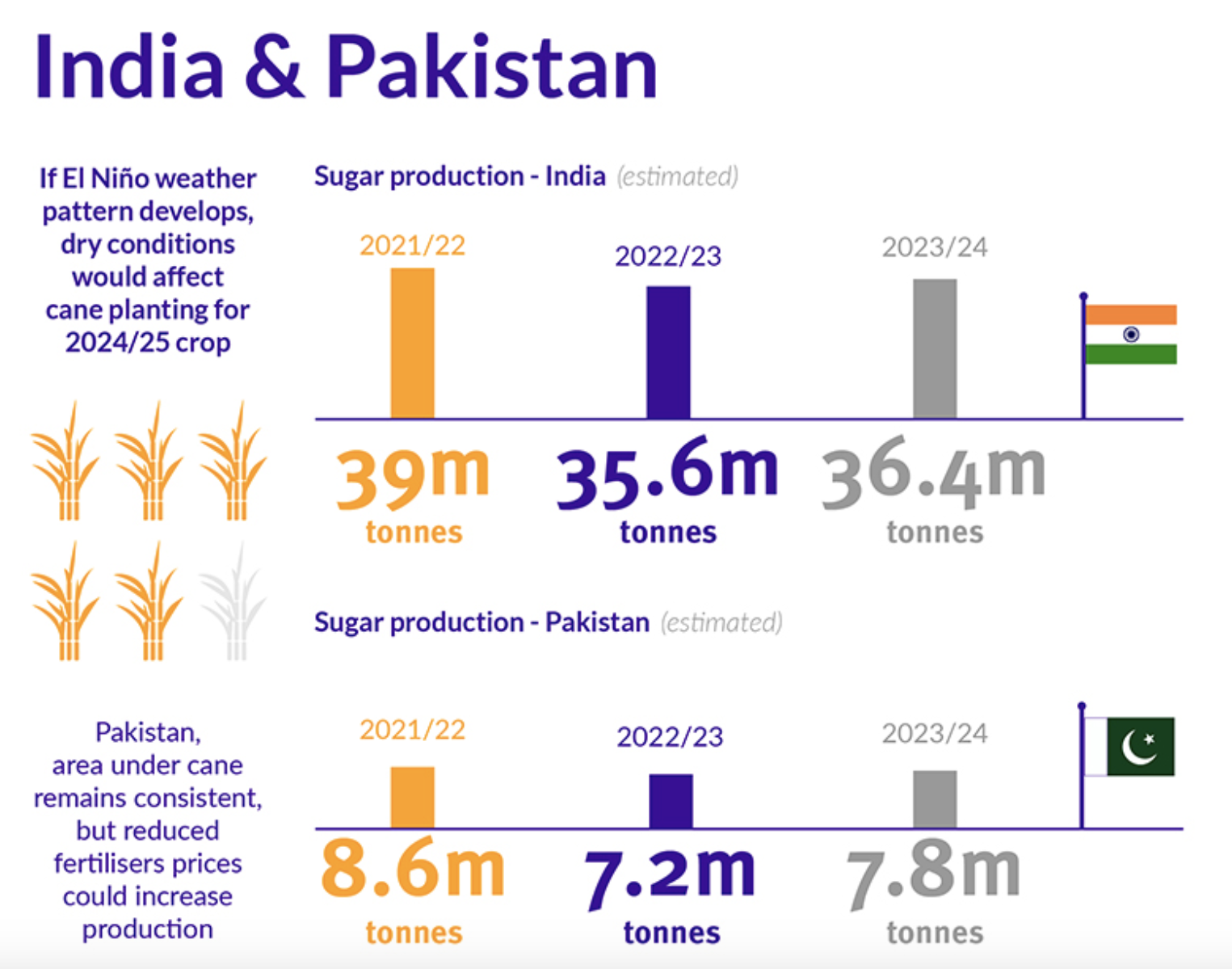
Pakistan is projected to produce 28 million tons of wheat,  10.5 million tons of corn (maize), 9 million tons of rice, 6.5 million bales of cotton, 7.8 million tons of sugar and 540,000 tons of rapeseed (canola) in 2023/24. Each of these production figures is significantly higher than last year's, and higher than the last 5-year average (2018-22) for the country. Potato production jumped 50% to 7.74 million tons in 2022, according to PotatoBusiness.  

Sugar Production in India and Pakistan. Source: Ragus


Pakistan will still need to import wheat but a lower amount than last year, according to a Global Agricultural Information Network report from the Foreign Agricultural Service (FAS) of the US Department of Agriculture. The record harvest will help lower the country’s forecasted import needs from 3 million to 2 million tons in 2023-24 even as total consumption grows to 30.2 million tonnes from 29.2 million tons. Pakistan imported 2.6 million tons last marketing year.

Higher cotton production in Pakistan will result in 2.3 million tons of cottonseed oil in 2023/24, a 34% increase over the 2022/23 output. This increase reflects expectations for a recovery in yield following the flood-damaged 2022/23 output. This will help reduce cooking oil imports, the country's largest food import, this year. Last year, Pakistan imported $4.5 billion worth of edible oil

Pakistan expects to export 5 million tons of rice worth $3 billion this year. India's ban on non-basmati rice exports will likely help Pakistani exporters fetch higher prices on the world market. 

Global Rice Market 2023. Source: Reuters


Pakistan's agriculture output is the 10th largest in the world. The country produces large and growing quantities of cereals, meat, milk, fruits and vegetables. Currently, Pakistan produces over 40 million tons of cereals (mainly wheat, rice and corn), 17 million tons of fruits and vegetables, 70 million tons of sugarcane, 60 million tons of milk and 4.5 million tons of meat.  Total value of the nation's agricultural output exceeds $50 billion. Improving agriculture inputs and modernizing value chains can help the farm sector become much more productive to serve both domestic and export markets.  

Related Links:


Haq's Musings

South Asia Investor Review

Chicken Cheaper Than Daal

Meat Industry in Pakistan

Pakistan Among World's Largest Food Producers

Meat and Dairy Revolution in Pakistan

Pakistan Floods of 2022

Eid ul Azha: Multi-Billion Dollar Urban-to-Rural Transfer

Pakistan's Rural Economy

Pakistan Leads South Asia in Agriculture Value Addition

Median Incomes in India and Pakistan

Tuesday, July 26, 2022

Pakistan Agriculture: Record Harvests Forecast After Heavy Monsoon Rains

In the first few months of 2022,  Pakistan has exported more rice to China than Vietnam, the historic top supplier, according to the United States Department of Agriculture (USDA).  Pakistan's total rice exports are forecast to jump by 450,000 tons to 4.8 million tons, almost 30% higher than the prior year. 

Women Farmers Planting Rice in Pakistan. Source: Reuters


Pakistan experienced broad-based economic growth across all key sectors in FY 21-22; manufacturing posted 9.8% growth, services 6.2% and agriculture 4.4%. The 4.4% growth in agriculture is particularly welcome; it helps reduce rural poverty.  The country is expected to have yet another record year for agriculture in 2022-23 after heavy monsoon rains. Rice is an important food crop in Pakistan  but wheat is the principal grain consumed domestically. Unfortunately, the same hot and dry planting conditions that delayed planting of the 2022 rice crop in Punjab and Sindh provinces have adversely affected Pakistan’s wheat production. This has forced the government to import wheat at a time of high prices amid the war in Ukraine, a major wheat exporter. 

A Cotton Field in Pakistan


The recent monsoon rains will help to kick-start the sowing of major Kharif (autumn) crops including rice, cotton, sugarcane and corn after about a month's delay.  “There was 40% less water available for the Kharif season (during May-June 2022),” an official of the Ministry of National Food Security and Research said while talking to The Express Tribune on Saturday. Earlier in March this year, Pakistan's Federal Committee on Agriculture (FCA) had said “for the Kharif year 2022, the water availability in canals head will be 65.84 million acre feet (MAF) against last year’s 65.08 MAF”. Recent rains have helped fill up major water reservoirs across the country.  About 150,000 cubic feet per second of water is being released from Pakistan's largest Tarbela dam which is more than the combined irrigation needs of the two provinces.  It is also generating over 3,000 MW of electricity, according to media reports

Heavy 2022 Monsoon Rainfall. Source: Pakistan Met Office 


“Cotton production is expected to improve to 9.5-10 million bales (one bale weighs 170 kg) in the wake of ongoing rainfall in cotton belts in Punjab and Sindh,” said Pakistan Central Cotton Committee Vice President Dr Muhammad Ali Talpur. “Cotton production will remain high, as farmers have improved crop management in the backdrop of higher prices in the domestic (and international) market.”

Drought Map of Pakistan. Source: Relief Web

Pakistan's agriculture output is the 10th largest in the world. The country produces large and growing quantities of cereals, meat, milk, fruits and vegetables. Currently, Pakistan produces about 38 million tons of cereals (mainly wheat, rice and corn), 17 million tons of fruits and vegetables, 70 million tons of sugarcane, 60 million tons of milk and 4.5 million tons of meat.  Total value of the nation's agricultural output exceeds $50 billion.  Improving agriculture inputs and modernizing value chains can help the farm sector become much more productive to serve both domestic and export markets.  

Pakistan's Thar Desert After Monsoon 2022. Source: Emmanuel Guddu 


Pakistanis are eating more and healthier foods, according to the Economic Survey of Pakistan 2021-22. Per capita average daily calorie intake in Pakistan has jumped to 2,735 calories in FY 2021-22 from 2,457 calories in 2019-20. The biggest contributor to it is the per capita consumption of fresh fruits and vegetables which soared from 53.6 Kg to 68.3 Kg, less than half of the 144 Kg (400 grams/day) recommended by the World Health Organization. Healthy food helps cut disease burdens and reduces demand on the healthcare system. Under former Prime Minister Imran Khan's leadership, Pakistan succeeded in achieving these nutritional improvements in spite of surging global food prices amid the Covid19 pandemic

Investments in modernization of the agriculture production process and farm-to-market value chain will require major reforms to ensure growers get a bigger share of the value. The extraordinary power of the middlemen (arthis) as financiers needs to be regulated. This can not happen without legislation in close consultation with the growers. Improving agriculture inputs and modernizing value chains can help raise the productivity of the farm sector for it to serve both domestic and export markets better.  

Related Links:


Haq's Musings

South Asia Investor Review

Chicken Cheaper Than Daal

Meat Industry in Pakistan

Bumper Crops and Soaring Tractor Sales in Pakistan

Meat and Dairy Revolution in Pakistan

Pakistanis Consuming More Calories, Fruits and Vegetables

Eid ul Azha: Multi-Billion Dollar Urban-to-Rural Transfer

Pakistan's Rural Economy

Pakistan Among World's Largest Food Producing Countries

Median Incomes in India and Pakistan

Saturday, May 7, 2022

Olive Revolution: Pakistan Joins International Olive Council

Pakistan's Ten Billion Tree Tsunami project launched in 2014 by the PTI government has sparked a silent olive revolution in the country.  Pakistan, now the 19th member of the International Olive Council, is producing about 1,500 tons of olive oil per year and 830 tons of table olives,  according to Juan Vilar Strategic Consultants. It is also helping tackle some of the effects of climate change such as soil erosion and desertification and bringing new opportunities to farmers. Olive cultivation was started as a pilot project in Potohar region by Punjab Chief Minister Shahbaz Sharif's government in 2014. The PTI government promoted it nationwide as a part of Prime Minister Imran Khan's Ten Billion Tree Tsunami initiative to bring about the olive revolution in the country.  

Olive Valley, Pakistan

Pakistan is the world's third largest importer of cooking oil. In 2020, Pakistan imported $2.1 billion worth of palm oil, behind only India's $5.1 billion and China's $4.1 billion in palm oil imports. Increasing olive oil production will help the country reduce its dependence on palm oil imports. Substituting imported palm oil with domestic olive oil may also help improve the heath of Pakistani consumers. 

The International Olive Council (IOC) has 18 members, mostly European and Middle Eastern nations located in the Mediterranean region. Pakistan has joined as its 19th member. The IOC members account for more than 98% of global olive production. The IOC has been headquartered in the Spanish capital Madrid since it was founded in 1959.  The organization specifies acceptable quality control testing methods and assures consumer transparency information, for example: hygiene standards along the supply chain, suitable packing materials and filling tolerances product labelling standards, identification of any food additives or allowable contaminants, recommendations for environmental protection in the use and disposal of olive products.  


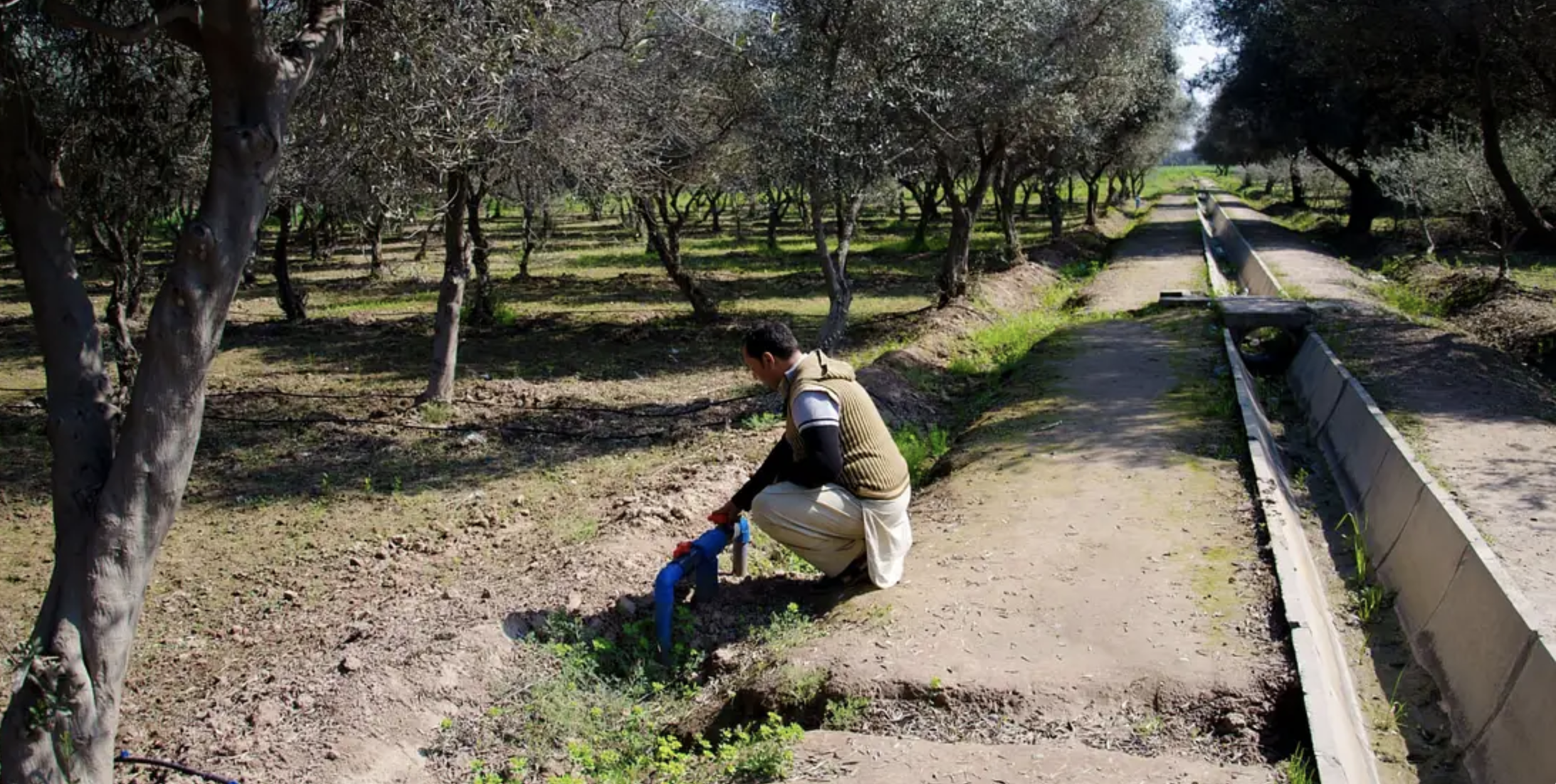
Olive Plantation in Peshawar, Pakistan. Source: Olive  Oil Times

Welcoming Pakistan into the organization, Mr. Abdellatif Ghedira, the IOC’s executive director, told Olive Oil Times: “In Pakistan, olive oil culture is making inroads, and so are the opportunities related to that .....The council is a decisive player in contributing to the sustainable and responsible development of olive growing, and it serves as a world forum for discussing policymaking issues and tackling present and future challenges".  

Olive trees thrive in dry arid regions with rocky soils that are more challenging for traditional crops. Pakistan government officials believe that olive farming is an efficient answer both to reforestation needs and economic development. “A special focus in this phase will be given to underprivileged areas of the country, such as Southern Balochistan, Southern Punjab, the tribal areas of Khyber Pakhtunkhwa (KPK) and some parts of Sindh province,” Muhammad Tariq, national project director at the Ministry of National Food Security and Research, told Olive Oil Times. 

It is expected that traditional farming and modern techniques would make large tracts of barren land productive, creating new jobs and growing the economy. Drip irrigation systems are being deployed over 16,000 hectares and 3.6 million olive trees. The Pakistani public and private sectors currently maintain 26 olive oil extraction plants of different capacities, from 80 kilograms per hour to 600, according to Olive Times.

Pakistan has the potential to be a world leader in olive production. In the last decade,  PTI's Ten Billion Tree Tsunami initiative has spurred rapid olive cultivation in Pakistan with the import of 100,000 olive seedlings from top olive producing countries like Spain, Italy and Turkey. Pakistan’s climate is conducive for olive production, as the olive trees grow fast in regions with moderate winters following long hot summers.

Related Links:


Haq's Musings

South Asia Investor Review

Chicken Cheaper Than Daal

Meat Industry in Pakistan

Bumper Crops and Soaring Tractor Sales in Pakistan

Meat and Dairy Revolution in Pakistan

Pakistanis Are Among the Most Carnivorous

Eid ul Azha: Multi-Billion Dollar Urban-to-Rural Transfer

Pakistan Among World's Largest Food Producing Countries

Drip Irrigation: Can Pakistan Make its Deserts Bloom?

Pakistan's Agenda at COP26 Climate Conference

Thursday, February 10, 2022

World Pulses Day 2022: Pakistan's Daal Consumption in Sharp Decline

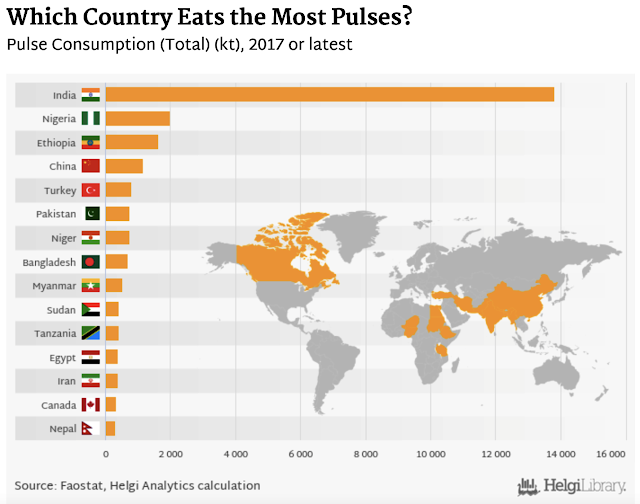
The United Nations has declared February 10 as World Pulses Day to recognize the importance of pulses or daal as global food. This recognition is driven as part of the effort to feed the global population in an environmentally sustainable way. Pulse crops have a lower carbon footprint than most foods because they require a small amount of fertilizer to grow, according to the United Nations. Pulses are protein and fiber rich food grown with a low carbon and water footprint as they are adapted to semi-arid conditions and can tolerate drought stress. Daal (pulses) global consumption is currently rising at a rate of about 9% annually.

Global Daal Consumption. Source: FAO, Helgi

While the global daal consumption has significantly risen in recent years,  Pakistan's per capita daal (pulse) consumption has sharply declined to about 7 kg/person from about 15 Kg/person in the 1960s, according to data released by Food and Agriculture Organization and reported in Pakistani media. Meat has replaced it as the main source of protein with per capita meat consumption rising from 11.7 kg in 2000 to 32 kg in 2016. It is projected to rise to 47 kg by 2020, according to a paper published in the Korean Journal of Food Science of Animal Resources.

Rising Incomes:

FAO report titled "State of Food and Agriculture in Asia and the Pacific Region" said rising incomes in developing nations are causing a shift from plant proteins — such as those found in pulses (daal) and beans — to more expensive animal proteins such as those found in meat and dairy.

Food Consumption By Quintiles in Pakistan


Pulses Consumption:

Per capita consumption of pulses in Pakistan has sharply declined from about 15 kg per person a year to about 7 kg per person a year, found a new report of the Food and Agriculture Organization (FAO) of the United Nations. In spite of decline in consumption, Pakistan is still the second largest importer of pulses in the world. India is both the largest producer and the largest importer of pulses.  

Chana (chickpeas), masoor, mung bean and mash are 4 important pulse crops in Pakistan. Last year, the combined production of all four crops was around 0.7 million tons with dominant share of 80 per cent of gram. The Pakistan Agricultural Research Council (PARC) says the total area under major pulse crops in Pakistan is about 1.3 million hectares.

Pakistan is now producing enough mung beans to meet its domestic needs. The first estimate of the crop for 2021-22 puts the legume output at 253,000 tons, more than enough to meet domestic demand for about 180,000 tons, according to Pakistani media reports. 

Pakistan’s domestic production of chickpeas (chana) is estimated to be about 225,000 – 250,000 tons and it imports about 420,000 tons which adds to about 670,000 tons. 

The first-ever production of kidney bean varieties at commercial level will begin soon as the Pakistan Agricultural Research Council (Parc) will release six new varieties of common bean varieties in the country, according to a Dawn newspaper report. 


Daal (Pulse) Consumption Trend in South Asia. Source: FAO


In neighboring India, too, the consumption of pulse declined from about 22kg per person per year to about 15kg per person per year. In Sri Lanka, however, pulse consumption seemed to have fluctuated between 5kg and 10kg per person per year since 1960, except for a sharp drop from 1970 to 1985, the report said.

Dairy Consumption: 

Economic Survey of Pakistan reported that Pakistanis consumed over 45 million tons of milk in fiscal year 2016-17, translating to about 220 Kg/person.

FAO's "State of Food and Agriculture in Asia and the Pacific Region" says that Mongolia and Pakistan are the only two among the 26 countries in Asia Pacific region where per capita milk consumption exceeded 370 grams/day.

Meat Consumption:

Pakistan's per capita meat consumption has nearly tripled from 11.7 kg in 2000 to 32 kg in 2016. It is projected to rise to 47 kg by 2020, according to a paper published by the United States National Library of Medicines at the National Institutes of Health (NIH). The Organization for Economic Development (OECD) explains that meat demand increases with higher incomes and a shift - often due to growing urbanization - to food preferences that favor increased proteins from animal sources in diets.


Meat Production in Pakistan. Source: FAO


The NIH paper authors Mohammad Shoaib and Faraz Jamil point out that Pakistan's meat consumption of 32 Kg per person is only a third of the meat capita meat consumption in rich countries like Australia and the United States.

A study published in Proceedings of the National Academy of Sciences and Nature magazine reports that Pakistanis are among the most carnivorous people in the world.  After studying the eating habits of 176 countries, the authors found that average human being is at 2.21 trophic level. It put Pakistanis at 2.4, the same trophic level as Europeans and Americans. China and India are at 2.1 and 2.2 respectively.

Chicken Vs Daal:

In 2016, Pakistan's then finance minister Ishaq Dar suggested to his countrymen to eat chicken instead of daal (pulses or legumes). To some, the minister sounded like Queen Marie-Antoinette (wife of France's King Louis XVI) who reportedly said to hungry rioters during the French Revolution:  “Qu'ils mangent de la brioche”—“Let them eat cake”?

It was indeed true that some varieties of daal were priced higher than chicken. For example, maash was selling at Rs. 260 per kilo, higher than chicken meat at Rs. 200 per kilo. But other daals such as mung, masur and chana were cheaper than chicken.

The reason for higher daal prices and relatively lower chicken prices can be found in the fact that Pakistan's livestock industry, particularly poultry farming, has seen significant growth that the nation's pulse crop harvests have not. Pakistan is among the world's largest importers of pulses. 

Pakistan Among World's Largest Food Producers:

Pakistan's agriculture output is the 10th largest in the world. The country produces large and growing quantities of cereals, meat, milk, fruits and vegetables. Currently, Pakistan produces about 38 million tons of cereals (mainly wheat, rice and corn), 17 million tons of fruits and vegetables, 70 million tons of sugarcane, 60 million tons of milk and 4.5 million tons of meat.  Total value of the nation's agricultural output exceeds $50 billion.  Improving agriculture inputs and modernizing value chains can help the farm sector become much more productive to serve both domestic and export markets.  

Summary:

Driven by sustainability concerns, the global daal consumption is rising at a rate of about 9% a year. However, per capita daal consumption in Pakistan is falling while meat and milk consumption is rising rising household incomes. Pulse consumption has sharply declined to about 7 kg/person from about 15 Kg/person in 2000, according to data released by the Food and Agriculture Organization and reported in Pakistani media. Meat has replaced it as the main source of protein with per capita meat consumption rising from 11.7 kg in 2000 to 32 kg in 2016. It is projected to rise to 47 kg by 2020, according to a paper published in the Korean Journal of Food Science of Animal Resources.


Tuesday, January 5, 2021

Pakistan Among World's Largest Food Producing Countries

Pakistan's agriculture output is the 10th largest in the world. The country produces large and growing quantities of cereals, meat, milk, fruits and vegetables. Currently, Pakistan produces about 38 million tons of cereals (mainly wheat, rice and corn), 17 million tons of fruits and vegetables, 70 million tons of sugarcane, 60 million tons of milk and 4.5 million tons of meat.  Total value of the nation's agricultural output exceeds $50 billion.  Improving agriculture inputs and modernizing value chains can help the farm sector become much more productive to serve both domestic and export markets.  

Top 10 Countries by Agriculture Output. Source: FAO


Pakistan has about 36 million hectares of land under cultivation. Wheat and rice are grown on more than half of it. Fruits and vegetables each account for only about 3% of the cultivable land.  Since year 2001, the country's cereal production, mainly wheat, corn and rice, has grown about 45% to 38 million tons. Pakistan produced 6.64 million tons of vegetables and 5.89 million tons of fruits in 2001. 

Pakistan is the world’s 4th largest exporter of rice. The country's domestic production is estimated to surge 13.6% to an all-time high of 8.4 million tons in the year end June 2021, according to Bloomberg.  

Vegetable production rose to about 10 million tons and fruit production increased to nearly 7 million tons in 2015.  A little over 60% of Pakistan's agriculture consists of livestock. Pakistan produces 60 million tons of milk and 4.5 million tons of meat.  Fish production adds up to about 575,000 tons. 


Pakistan's Rising Rice Exports. Source: Bloomberg


Share of Land For Various Crops in Pakistan

Crop yields in Pakistan are low, mainly due to poor quality inputs like seeds. In addition to fertilizer and water, seed is the basic input for agriculture sector and has a major role in enhancing agriculture productivity. This needs to be a key area of focus for Pakistani policymakers working on agriculture. 


Other critical area is post-harvest handling, particularly storage and transportation that is in desperate need of improvement. Post-harvest losses in fruits and vegetables due to mishandling of the perishable product, poor transportation, and inadequate storage facilities and market infrastructure account for about 30%–40% of total production, according to experts at Asian Development Bank.  


World's 5th Largest Population of Chicken in Pakistan 


Improvements in agriculture inputs and modernization of post-harvest process require significant financing and investment. Growers get only a small fraction of value of what they produce, making it difficult for them to make these investments. Middlemen finance farmers and take the lion's share of profits in the value chain.  

Source: FAO via Kleffmann Group

Most of the farmers sell their produce to wholesalers via middlemen called arthis, according to an ADB report. Farmers contract out fruit orchards during the flowering stage to the middlemen (arthis), commission agent, and/or wholesalers who provide loans to the farmers over the course of production. Vegetables and fruits are transported by the same cart or truck from farms to the main markets in the absence of specialized vehicles for specific products. The same vehicle is used for many other purposes including animal transportation. Recently however, reefer (refrigerated) trucks have been introduced on a limited scale in some parts of Pakistan. In the absence of direct access of carrier vehicles to the farms, farmers gather their products in a convenient spot along the roadside for pickup. When middlemen or contractors are involved, it is their responsibility to collect and transport the produce. The unsold produce in one market is sent to other markets in the same locality. 

Date Palms in Sindh, Pakistan. Photo: Emmanuel Guddu


Investments in modernization of the agriculture production process and farm-to-market value chain will require major reforms to ensure growers get a bigger share of the value. The extraordinary power of the middlemen (arthis) as financiers needs to be regulated. This can not happen without legislation in close consultation with the growers. Improving agriculture inputs and modernizing value chains can help raise the productivity of the farm sector for it to serve both domestic and export markets better.  

Related Links:


Haq's Musings

South Asia Investor Review

Chicken Cheaper Than Daal

Meat Industry in Pakistan

Bumper Crops and Soaring Tractor Sales in Pakistan

Meat and Dairy Revolution in Pakistan

Pakistanis Are Among the Most Carnivorous

Eid ul Azha: Multi-Billion Dollar Urban-to-Rural Transfer

Pakistan's Rural Economy

Pakistan Leads South Asia in Agriculture Value Addition

Median Incomes in India and Pakistan

Thursday, October 22, 2020

Pakistan's Per Capita Milk Consumption Reaches 231 Liters

Per capita milk consumption in Pakistan reached 231 liters (231 Kg) in 2019, according to a new research report entitled ‘Asia – Whole Fresh Milk – Market Analysis, Forecast, Size, Trends and Insights’. It has almost doubled from 119 liters per person in 2011. Milk production in Pakistan is the second highest in Asia and the third highest in the world.  Per capita milk consumption of 231 kg in Pakistan is the third highest in Asia, behind Uzbekistan's 339 Kg and Turkey's 281 Kg, according to the IndexBox report

Top Milk Producing Countries. Source: FAO

Milk Production:

Pakistan produced 47 million tons of milk in 2019, the third largest in the world after top-ranked India's 198 million tons and the United States' 100 million tons. Pakistan’s milk production is projected to increase by an average of 3% a year due to an increase in the herd population. According to FAO projections, Asian production is expected to increase by 2% in 2020 due to expected growth in India, Pakistan, and China, while Turkey may experience a decline.

In value terms, India ($146.8B) led the market, alone. The second position in the ranking was occupied by Pakistan ($37.3B). It was followed by China.

Milk Production Growth in Pakistan


Milk Consumption: 

Milk consumption in Pakistan in 2019 was 231 Kg per capita. It has grown an average of 3.2% a year in the last decade. From 2009 to 2019, the average annual rate of growth in terms of volume in India totaled +5.4%. The remaining consuming countries recorded the following average annual rates of consumption growth: Pakistan (+3.2% per year) and China (-1.2% per year).  

Pakistan Dairy Sector:

Vast majority of milk producers in Pakistan are small farmers who own a few cows or buffaloes and sell unprocessed milk. However, commercial scale dairy farming is starting to grow in the country.  Since the year 2000, corporate sector has seen the potential and jumped in with brand names like Dawood's Engro and Nestle's MilkPak.  This has led to the enlargement of herds with imports of high-quality milk germ plasm, the productivity per animal, milk collection, processing and marketing, the supply of dairy inputs (machinery, equipment, feeds, semen, and elite dairy animals), and farmers knowledge, and skills on modern management practices.   

The size of the opportunity for selling dairy products in Pakistan has attracted significant investments from European giants like Nestle, FrieslandCampina and Unilever. Commercial dairy farms like JK Dairy.  

Pakistan Agriculture Output: 

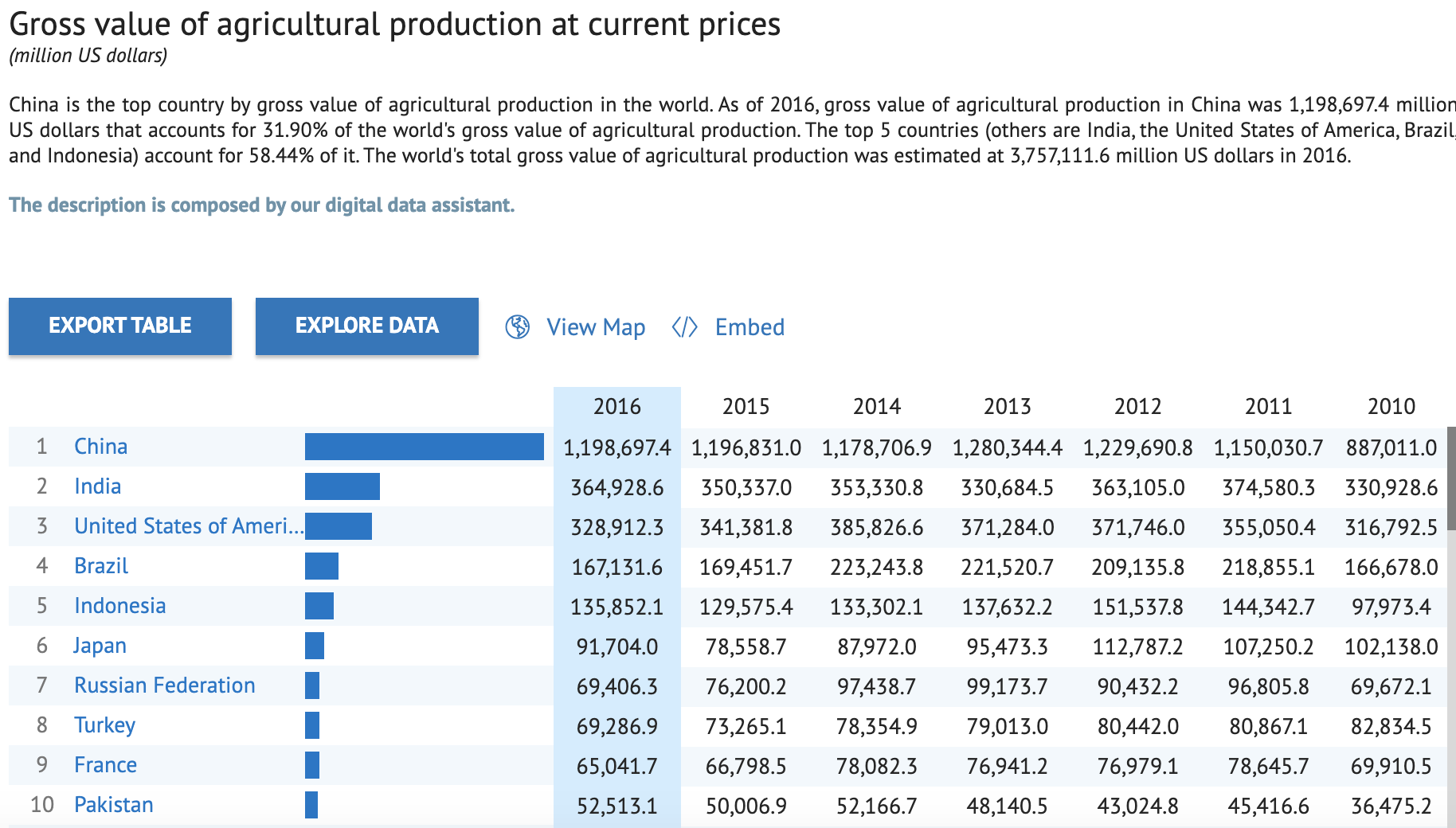
As of 2016, Pakistan's agriculture output is $52.5 billion, the 10th largest in the world in terms of gross value of agricultural production at current prices, according to Food and Agriculture Organization (FAO). China leads with $1.2 trillion in agricultural output, followed by India's $365 billion, United States with $329 billion, Brazil's $167 billion, Indonesia $135 billion, Japan's $91 billion, Russia's $69 billion, Turkey's $69 billion, France's $65 billion and Pakistan's $52 billion.  

Top 10 Countries by Agriculture Output. Source: FAO


Summary:

Pakistan is among the world's largest dairy producing and consuming nations. Pakistan produced 47 million tons of milk in 2019, the third largest in the world after top-ranked India's 198 million tons and the United States' 100 million tons. Per capita milk consumption in Pakistan reached 231 Kg in 2019. Pakistan’s milk production is projected to increase by an average of 3% a year due to an increase in the herd population. Vast majority of milk producers in Pakistan are small farmers who own a few cows or buffaloes and sell unprocessed milk. However, commercial scale dairy farming is starting to grow in the country. Overall, Pakistan's agriculture output is the 10th largest in the world.

Related Links:

Haq's Musings

South Asia Investor Review

Chicken Cheaper Than Daal

Meat Industry in Pakistan

Bumper Crops and Soaring Tractor Sales in Pakistan

Meat and Dairy Revolution in Pakistan

Pakistanis Are Among the Most Carnivorous

Eid ul Azha: Multi-Billion Dollar Urban-to-Rural Transfer

Pakistan's Rural Economy

Pakistan Leads South Asia in Agriculture Value Addition

Median Incomes in India and Pakistan