Showing posts with label Wheat. Show all posts

Tuesday, January 6, 2026

Pakistan Household Survey HIES 2024-25 Raises More Questions Than It Answers

Recently released HIES 2024-25 household integrated economic survey by Pakistan Bureau of Statistics (PBS)  raises more questions than it answers. For example, it shows that Pakistani households are buying lower amounts of basic food ingredients like wheat, meat and eggs in the last four years, implying that people are eating less to cover other expenses, like electricity and gas. But it doesn't explain why the households have reported significantly lower purchases of these items than production reported recently by the PBS. What is the source of this discrepancy? Is the data flawed? Or, is it missing a new trend toward less home cooking? Is the young urbanized population buying more  prepared foods? Are they ordering out more often using ubiquitous food delivery services?  Let us try and understand it in more detail. 

21% Pakistanis Buy Tandoori Nan. Source: Gallup Pakistan


Data Discrepancy: 

There is a significant discrepancy in household data for per capita monthly consumption of basic food ingredients like wheat, meat and eggs. For example, the HIES 2024-25 reports 6.59 Kg of wheat consumption per capita per month, which translates into 79 Kg per person per year. The wheat production data from PBS shows 30 million tons or 120 Kg per capita in 2025.  We know that Pakistan did not export wheat last year. So what happened to the 41 Kg per capita difference? It is 30% of the total production reported, too large to be explained away as waste in the system. It was most probably bought by food businesses and eventually consumed by Pakistani households. There are similar discrepancies in meat, eggs and other food data, with reported household consumption being far below production. 

Household Food Items Purchase Data. Source: HIES 2024-25 

Prepared Foods:

A 2025 Gallup survey revealed that 21% of Pakistanis buy tandoori naan. Pakistan's prepared food market is experiencing robust growth, with the Convenience Food sector valued at $6.91 billion in 2025, projected to grow at 5% annually, driven by Ready-to-Eat (RTE) meals and frozen foods, especially RTE/RTC (Ready-to-Cook) products like frozen snacks. Key trends include rising demand for time-saving, convenient options due to urbanization, growing health consciousness (organic/natural), and dominance by flexible packaging, with online delivery also expanding rapidly.

Urbanization in Pakistan. Source: World Bank

Urbanization:

The World Bank researchers have recently concluded that 88% live in urban areas. Their conclusion is based on satellite imagery and the Degree of Urbanization (DoU) methodology. The official Pakistani figures released by the Pakistan Bureau of Statistics (PBS) put the current level of urbanization at 39%. The source of this massive discrepancy is the government's reliance on administrative boundaries rather than population density and settlement patterns, according to the World Bank working research paper titled  "When Does a Village Become a Town?". 

Ultra-Processed Foods:

Ultra-processed foods (UPFs) like biscuits, sugary drinks, chips, and packaged snacks, are a growing concern in Pakistan. Such foods are contributing to rising obesity, diabetes, and heart disease. Obesity causes non-communicable diseases (NCD) which are now among the leading causes of death in Pakistan.

To deal with the obeseity crisis, several Pakistani pharmaceutical companies have started domestic production of generic versions of GLP-1 (Glucagon-Like Peptide-1) drugs Ozempic/Wegovy (Semaglutide) and Mounjaro/Zeptide (Tirzepatide). 

Food Delivery Services:

Pakistan's food delivery market is experiencing rapid growth, projected to hit $2.35 billion in 2025, driven by high smartphone penetration, a young urban population, and increased convenience-seeking, with Foodpanda dominating but facing a growing trend of direct restaurant ordering and a demand for diverse, tech-enabled options despite past economic challenges.

Street Food Growth:

With rising urbanization, the street food sector in Pakistan is vibrant and growing. It is crucial for livelihoods and affordable food. Deeply embedded in culture, choices range from savory samosas and chaat to bun kebabs, pakoras, pani puri, and biryani, popular for convenience and taste.

Fast Food Boom:

Pakistan’s fast food industry is experiencing rapid growth, making it the 8th largest fast food market globally. With a large consumer base, the demand for fast food continues to grow, contributing to the economy in significantly. The industry’s annual growth rate stands at 20%, highlighting its rapid expansion and increasing consumer preference for quick-serve meals.

Summary:

The HIES 2024-25 report recently issued by Pakistan Bureau of Statistics implies that Pakistani households are eating less to save money to pay for rising energy bills. I think this is misleading for two reasons: 1. It does not explain why reported household consumption figures are significantly lower than per capita production of these food items and 2. It completely ignores the impact of rapid urbanization that is causing Pakistanis to change their eating habits, such as consuming increasing amounts of prepared foods. 

Related Links:

Haq's Musings

South Asia Investor Review

Pakistanis Happier Than Neighbors

Tipping Point: Pakistan Middle Class Grows to 55% of the Population

Karachi Safety Ranking Rising

Urbanization in Pakistan Highest in South Asia

Agriculture Sector in Pakistan

Karachi is World's Fastest Growing Megacity

Karachi's Human Development Index

Pakistan Rising or Failing: Reality vs Perception

Pakistan's Trillion Dollar Economy Among top 25

CPEC Myths and Facts

Gwadar Port

Riaz Haq's Youtube Channel

PakAlumni Social Network


Tuesday, August 8, 2023

USDA Forecasts Bumper Harvest of Major Crops in Pakistan For 2023/24

The United States Department of Agriculture (USDA) is forecasting bumper harvest of all major crops in Pakistan for 2023/24. Major crops in the country include wheat, rice, sugarcane, corn and cotton. These offer welcome relief for Pakistani farmers who suffered devastating losses in the epic floods of 2022.   

Major Crops Produced in Pakistan. Source: USDA

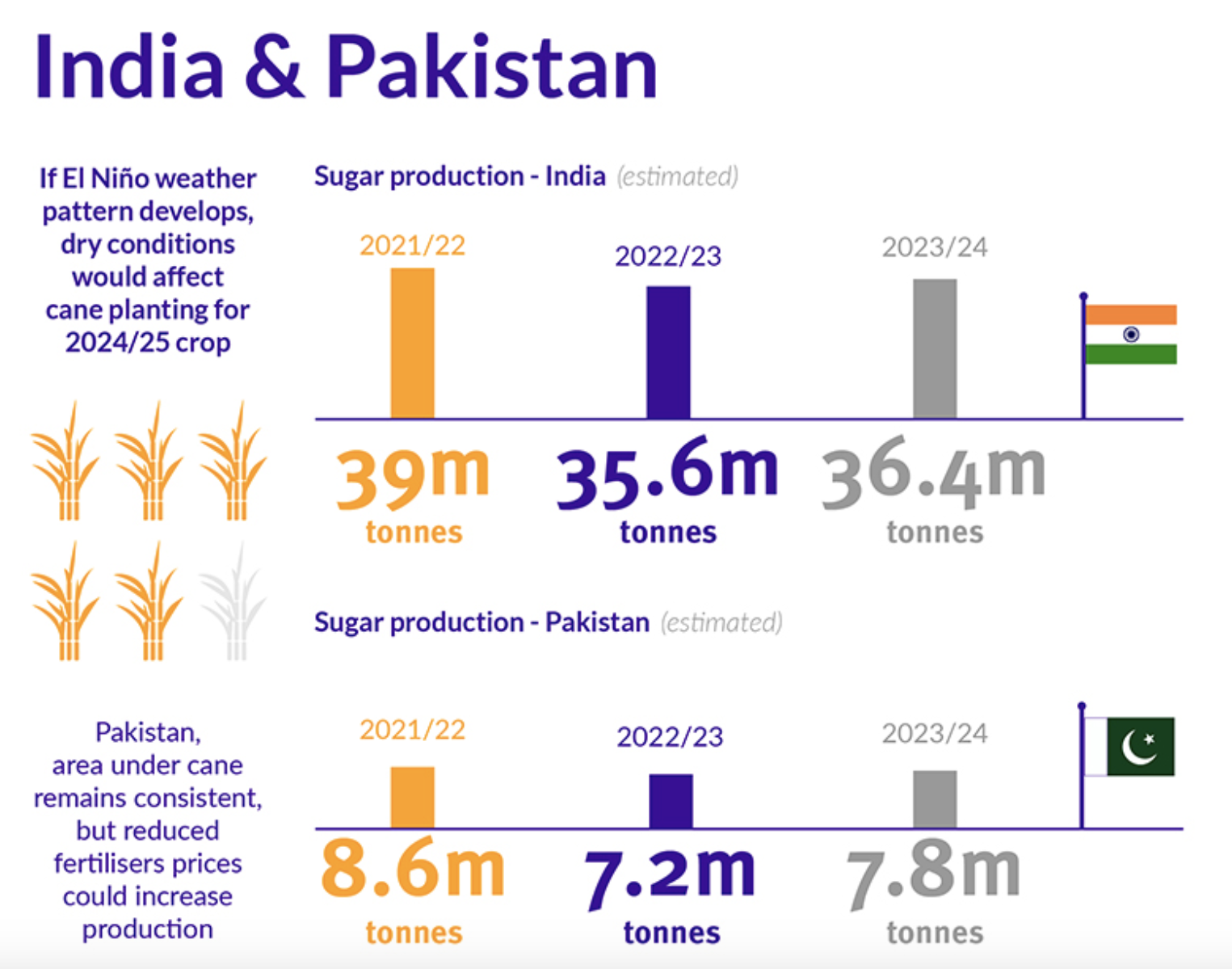
Pakistan is projected to produce 28 million tons of wheat,  10.5 million tons of corn (maize), 9 million tons of rice, 6.5 million bales of cotton, 7.8 million tons of sugar and 540,000 tons of rapeseed (canola) in 2023/24. Each of these production figures is significantly higher than last year's, and higher than the last 5-year average (2018-22) for the country. Potato production jumped 50% to 7.74 million tons in 2022, according to PotatoBusiness.  

Sugar Production in India and Pakistan. Source: Ragus


Pakistan will still need to import wheat but a lower amount than last year, according to a Global Agricultural Information Network report from the Foreign Agricultural Service (FAS) of the US Department of Agriculture. The record harvest will help lower the country’s forecasted import needs from 3 million to 2 million tons in 2023-24 even as total consumption grows to 30.2 million tonnes from 29.2 million tons. Pakistan imported 2.6 million tons last marketing year.

Higher cotton production in Pakistan will result in 2.3 million tons of cottonseed oil in 2023/24, a 34% increase over the 2022/23 output. This increase reflects expectations for a recovery in yield following the flood-damaged 2022/23 output. This will help reduce cooking oil imports, the country's largest food import, this year. Last year, Pakistan imported $4.5 billion worth of edible oil

Pakistan expects to export 5 million tons of rice worth $3 billion this year. India's ban on non-basmati rice exports will likely help Pakistani exporters fetch higher prices on the world market. 

Global Rice Market 2023. Source: Reuters


Pakistan's agriculture output is the 10th largest in the world. The country produces large and growing quantities of cereals, meat, milk, fruits and vegetables. Currently, Pakistan produces over 40 million tons of cereals (mainly wheat, rice and corn), 17 million tons of fruits and vegetables, 70 million tons of sugarcane, 60 million tons of milk and 4.5 million tons of meat.  Total value of the nation's agricultural output exceeds $50 billion. Improving agriculture inputs and modernizing value chains can help the farm sector become much more productive to serve both domestic and export markets.  

Related Links:


Haq's Musings

South Asia Investor Review

Chicken Cheaper Than Daal

Meat Industry in Pakistan

Pakistan Among World's Largest Food Producers

Meat and Dairy Revolution in Pakistan

Pakistan Floods of 2022

Eid ul Azha: Multi-Billion Dollar Urban-to-Rural Transfer

Pakistan's Rural Economy

Pakistan Leads South Asia in Agriculture Value Addition

Median Incomes in India and Pakistan

Tuesday, July 26, 2022

Pakistan Agriculture: Record Harvests Forecast After Heavy Monsoon Rains

In the first few months of 2022,  Pakistan has exported more rice to China than Vietnam, the historic top supplier, according to the United States Department of Agriculture (USDA).  Pakistan's total rice exports are forecast to jump by 450,000 tons to 4.8 million tons, almost 30% higher than the prior year. 

Women Farmers Planting Rice in Pakistan. Source: Reuters


Pakistan experienced broad-based economic growth across all key sectors in FY 21-22; manufacturing posted 9.8% growth, services 6.2% and agriculture 4.4%. The 4.4% growth in agriculture is particularly welcome; it helps reduce rural poverty.  The country is expected to have yet another record year for agriculture in 2022-23 after heavy monsoon rains. Rice is an important food crop in Pakistan  but wheat is the principal grain consumed domestically. Unfortunately, the same hot and dry planting conditions that delayed planting of the 2022 rice crop in Punjab and Sindh provinces have adversely affected Pakistan’s wheat production. This has forced the government to import wheat at a time of high prices amid the war in Ukraine, a major wheat exporter. 

A Cotton Field in Pakistan


The recent monsoon rains will help to kick-start the sowing of major Kharif (autumn) crops including rice, cotton, sugarcane and corn after about a month's delay.  “There was 40% less water available for the Kharif season (during May-June 2022),” an official of the Ministry of National Food Security and Research said while talking to The Express Tribune on Saturday. Earlier in March this year, Pakistan's Federal Committee on Agriculture (FCA) had said “for the Kharif year 2022, the water availability in canals head will be 65.84 million acre feet (MAF) against last year’s 65.08 MAF”. Recent rains have helped fill up major water reservoirs across the country.  About 150,000 cubic feet per second of water is being released from Pakistan's largest Tarbela dam which is more than the combined irrigation needs of the two provinces.  It is also generating over 3,000 MW of electricity, according to media reports

Heavy 2022 Monsoon Rainfall. Source: Pakistan Met Office 


“Cotton production is expected to improve to 9.5-10 million bales (one bale weighs 170 kg) in the wake of ongoing rainfall in cotton belts in Punjab and Sindh,” said Pakistan Central Cotton Committee Vice President Dr Muhammad Ali Talpur. “Cotton production will remain high, as farmers have improved crop management in the backdrop of higher prices in the domestic (and international) market.”

Drought Map of Pakistan. Source: Relief Web

Pakistan's agriculture output is the 10th largest in the world. The country produces large and growing quantities of cereals, meat, milk, fruits and vegetables. Currently, Pakistan produces about 38 million tons of cereals (mainly wheat, rice and corn), 17 million tons of fruits and vegetables, 70 million tons of sugarcane, 60 million tons of milk and 4.5 million tons of meat.  Total value of the nation's agricultural output exceeds $50 billion.  Improving agriculture inputs and modernizing value chains can help the farm sector become much more productive to serve both domestic and export markets.  

Pakistan's Thar Desert After Monsoon 2022. Source: Emmanuel Guddu 


Pakistanis are eating more and healthier foods, according to the Economic Survey of Pakistan 2021-22. Per capita average daily calorie intake in Pakistan has jumped to 2,735 calories in FY 2021-22 from 2,457 calories in 2019-20. The biggest contributor to it is the per capita consumption of fresh fruits and vegetables which soared from 53.6 Kg to 68.3 Kg, less than half of the 144 Kg (400 grams/day) recommended by the World Health Organization. Healthy food helps cut disease burdens and reduces demand on the healthcare system. Under former Prime Minister Imran Khan's leadership, Pakistan succeeded in achieving these nutritional improvements in spite of surging global food prices amid the Covid19 pandemic

Investments in modernization of the agriculture production process and farm-to-market value chain will require major reforms to ensure growers get a bigger share of the value. The extraordinary power of the middlemen (arthis) as financiers needs to be regulated. This can not happen without legislation in close consultation with the growers. Improving agriculture inputs and modernizing value chains can help raise the productivity of the farm sector for it to serve both domestic and export markets better.  

Related Links:


Haq's Musings

South Asia Investor Review

Chicken Cheaper Than Daal

Meat Industry in Pakistan

Bumper Crops and Soaring Tractor Sales in Pakistan

Meat and Dairy Revolution in Pakistan

Pakistanis Consuming More Calories, Fruits and Vegetables

Eid ul Azha: Multi-Billion Dollar Urban-to-Rural Transfer

Pakistan's Rural Economy

Pakistan Among World's Largest Food Producing Countries

Median Incomes in India and Pakistan