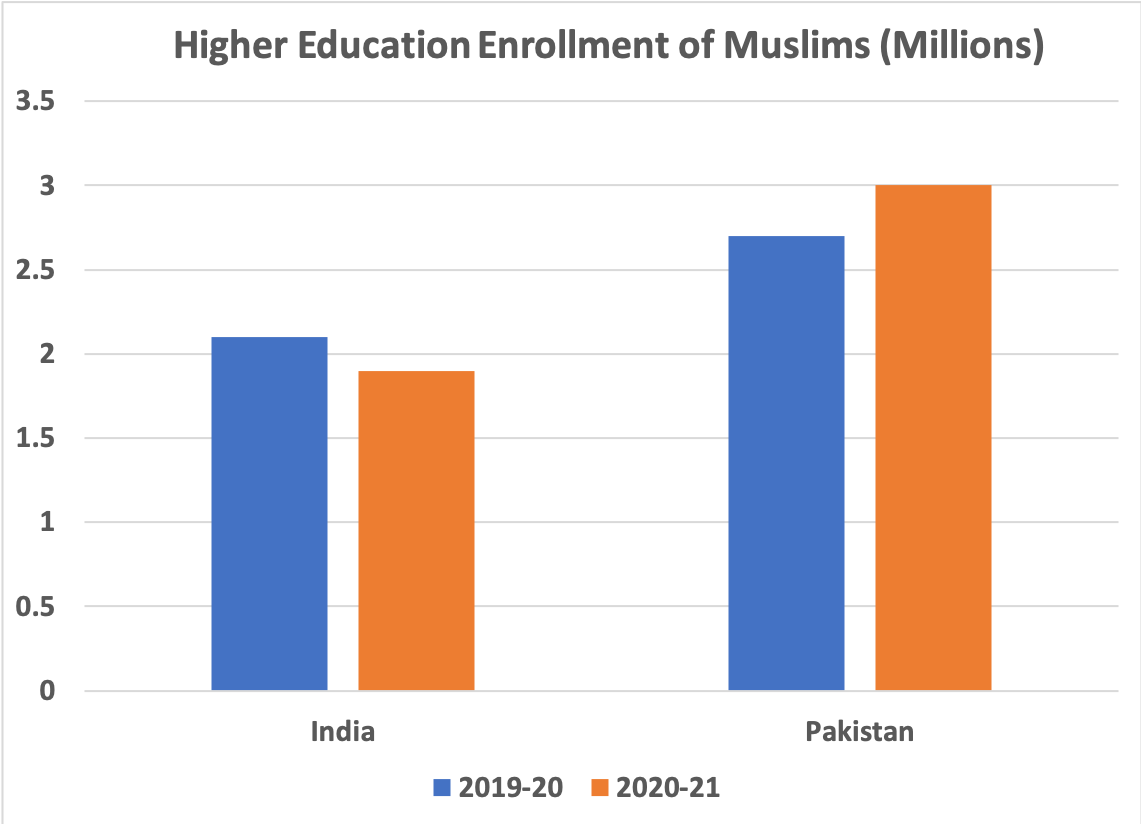
Number of Indian Muslims attending colleges and universities has declined by 8% to 1.9 million in 2020-21, from 2.1 million in 2019-20, according to Indian government data. In the same period, the higher education enrollment in Pakistan has risen about 12%, from 2.7 million to over 3 million. Both India and Pakistan have about the same population of Muslims.
 | |
|
While enrollment of Indian Muslims has fallen by 8%, the enrollment of Dalits, Adivasis and OBCs in higher education has increased by 4.2%, 11.9% and 4% respectively compared to 2019-20. The upper caste Hindus have seen the highest jump of 13.6% in enrollment in colleges and universities.
 |
| Labor Force Education Status of Indian Muslims Worst of all Groups. Source: HT |
These results are consistent with a 2018 study by three researchers which reported that "Muslims (in India) now have considerably worse upward mobility (29) today than both Scheduled Castes (37.4–37.8) and Scheduled Tribes (32.5–32.7). The comparable figure for African Americans is 34."
The research paper titled "Intergenerational Mobility in India: Estimates from New Methods and Administrative Data" says that "higher caste groups (in India) have experienced constant and high upward mobility over time, a result that contradicts a popular notion that it is increasingly difficult for higher caste Hindus to get ahead".
Dartmouth researchers' analysis focuses on two mobility measures: (i) the expected outcome of a child born into the bottom half of the parent outcome distribution (upward interval mobility, henceforth referred to as upward mobility); and (ii) the expected outcome of a child born into the top half of the parent distribution (downward interval mobility).
 |
| Indian Muslims at Bottom in Social Mobility. Source: Dartmouth College |
Panel A in the above figure presents bounds on trends in upward interval mobility, or the average rank among sons born to fathers in the bottom half of the father education distribution. Panel B presents bounds on trends in downward interval mobility, or the average education rank among sons born to fathers in the top half of the father education distribution. Panel C presents bounds on trends in the proportion of sons completing primary school, conditional on being born to a father in the bottom half of the education distribution. Panel D presents bounds on trends in the proportion of sons attaining a high school degree, conditional on being born to a father in the bottom half of the education distribution.
The Dartmouth paper by Sam Asher, Paul Novosad and Charlie Rafkin confirms what an Indian government commission headed by Justice Rajendar Sachar found back in 2006 by saying that "Muslim disadvantage has been widely noted, including by the well-publicized federal Sachar Report (2006)". Here's an excerpt of the paper:
"India’s Muslims constitute a similar population share as the Scheduled Castes and Scheduled Tribes (14% for Muslims vs. 16.6% for SCs and 14% for STs). Muslims have worse socioeconomic outcomes than the general population (Sachar Committee Report, 2006). While Muslim disadvantage has been widely noted, including by the well-publicized federal Sachar Report (2006), there are few policies in place to protect them and there has not been an effective political mobilization in their interest. Muslims have also been frequent targets of discrimination and even violence."
The discrimination and violence against Muslims that the paper refers to has only gotten worse since the election of Hindu Nationalist leader Narendra Modi to India's highest office in India in 2014.
Related Links:
Silicon Valley's Indian-American Congressman Rejects Hindutva
Silicon Valley Hindu Americans Rally in Support of Yogi, Modi
Rape of 8-year-old Asifa Bano in Kashmir
Vast Majority of Hindu Americans Support Modi
Modi's Extended Lockdown in Indian Occupied Kashmir
Hinduization of India
Brievik's Hindutva Rhetoric
Indian Textbooks
Brahmins Continue to Dominate India
Riaz Haq Youtube Channel
PakAlumni Social Network


