Showing posts with label UNICEF. Show all posts

Wednesday, September 27, 2023

WB Poverty Update: India is the Biggest Contributor to Increased Global Poverty in 2023

At the $3.65 poverty line, India accounts for 40% of the slight upward revision of the global poverty rate from 23.6% to 24.1%, according to the World Bank September 2023 Global Poverty Update. It is the same update that made the following recent headline in the Indian and Pakistani media about Pakistan: "Pakistan's 40% Population Lives Below Poverty Line, Says World Bank". Fact: 45.9% of Indians and 39.4% of Pakistanis live below the $3.65 a day poverty line as of September, 2023, according to the the latest World Bank global poverty update that takes into account the impact of inflation on poverty rates. But neither the Pakistani media nor India's compliant "Godi Media" reported it. Nor did they question why poverty in India is growing despite the Modi government's claim to be "the world's fastest growing economy". 

Global Child Poverty Rate. Source: UNICEF


Another recent report by UNICEF that went unnoticed by the media is that the child poverty rate in India far exceeds the rate in Bangladesh and Pakistan: At $2.15 poverty level, India has 11.5% children under poverty, Pakistan 5.6% and Bangladesh 5.1%.  At $3.65 poverty level, India has 49.8% children under poverty, Pakistan 45% and Bangladesh 35.2%. 

Child Poverty Rate By Year By Region From 2013 to 2022. Source: UNICEF

The UNICEF data shows that the South Asia region's child poverty rate at $2.15 for any year since 2013 drops to about a half when India is excluded. 

The latest World Bank and UNICEF reports remind me of the famous Indian writer and poet Javed Akhtar who told his audience at a conference in Mumbai earlier this year that he saw "no visible poverty" in Lahore during his multiple visits to Pakistan over the last three decades. Responding to Indian novelist Chetan Bhagat's query about Pakistan's economic crisis at ABP's "Ideas of India Summit 2023" in Mumbai, Akhtar said: "Unlike what you see in Delhi and 

Mumbai, I did not see any visible poverty in Lahore".  This was Akhtar's first interview upon his return to India after attending "Faiz Festival" in Lahore, Pakistan. 
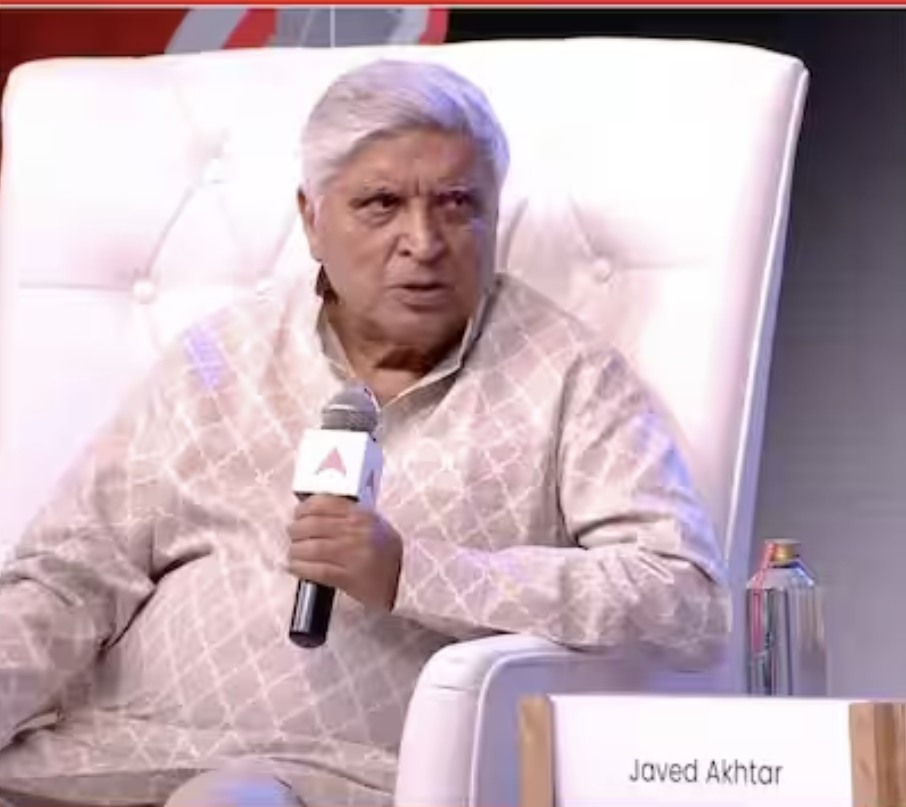
Javed Akhtar at ABP Ideas Summit in Mumbai

Chetan Bhagat began by talking about high inflation, low forex reserves and major economic crisis in Pakistan and followed it up by asking Javed Akhtar about its effects he saw on the people in Pakistan. In response, Akhtar said, "Bilkul Nahin (Not at all). In India you see poverty right in front of you, next door to a billionaire. Maybe it is kept back of the beyond. Only some people are allowed to enter certain areas. But you don't see it (poverty) on the streets. In India, it is right in front of you...amiri bhi or gharibi bhi (wealth and poverty). Sare kam apke samne hain (It's all in front of you). Wahan yeh dekhai nahin deta (you don't see it in Pakistan)". 

Alhamra Arts Center, Lahore, Pakistan

Disappointed by the response, Bhagat suggested that the Indian visitor could have been guided by his hosts through certain routes where he couldn't see any poverty. Javed Akhtar then said "it's not possible to hide poverty. I would have seen at least a "jhalak" (glimpse) of it as I always do in Delhi and Mumbai....I have been to Pakistan many times but I have not seen it". 

What Javed Akhtar saw and reported recently is obviously anecdotal evidence. But it is also supported by hard data. Over 75% of the world's poor deprived of basic living standards (nutrition, cooking fuel, sanitation and housing) live in India compared to 4.6% in Bangladesh and 4.1% in Pakistan, according to a recently released OPHI/UNDP report on multidimensional poverty.  Here's what the report says: "More than 45.5 million poor people are deprived in only these four indicators (nutrition, cooking fuel, sanitation and housing). Of those people, 34.4 million live in India, 2.1 million in Bangladesh and 1.9 million in Pakistan—making this a predominantly South Asian profile". 

Global Multidimensional Poverty Index 2022. Source: OPHI/UNDP

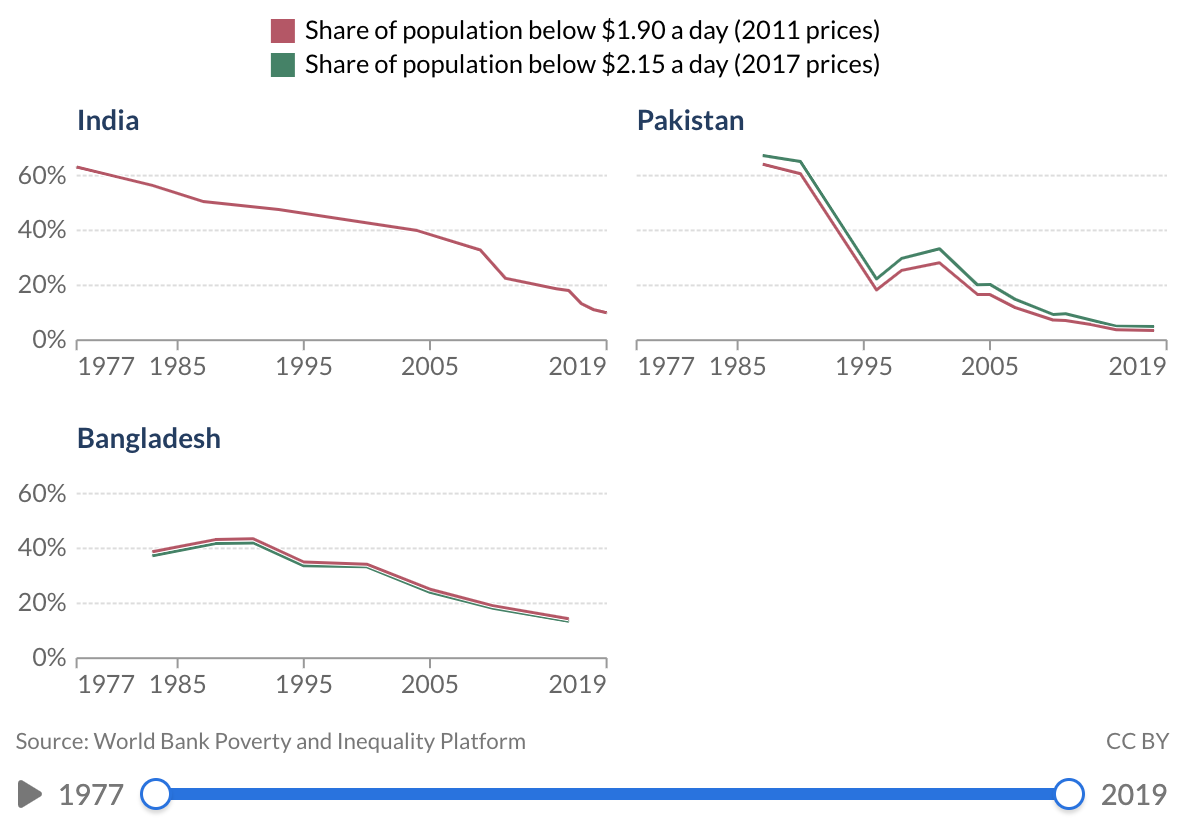
Income Poverty in Bangladesh, India and Pakistan. Source: Our World in Data


The UNDP poverty report shows that the income poverty (people living on $1.90 or less per day) in Pakistan is 3.6% while it is 22.5% in India and 14.3% in Bangladesh. In terms of the population vulnerable to multidimensional poverty, Pakistan (12.9%) does better than Bangladesh (18.2%) and India (18.7%)  However, Pakistan fares worse than India and Bangladesh in multiple dimensions of poverty. The headline multidimensional poverty (MPI) figure for Pakistan (0.198) is worse than for Bangladesh (0.104) and India (0.069). This is primarily due to the education and health deficits in Pakistan. Adults with fewer than 6 years of schooling are considered multidimensionally poor by OPHI/UNDP.  Income poverty is not included in the MPI calculations. The data used by OHP/UNDP for MPI calculation is from years 2017/18 for Pakistan and from years 2019/2021 for India. 

Multidimensional Poverty in South Asia. Source: UNDP

The Indian government's reported multidimensional poverty rate of 25.01% is much higher than the OPHI/UNDP estimate of 16.4%. NITI Ayog report released in November 2021 says: "India’s national MPI identifies 25.01 percent of the population as multidimensionally poor".
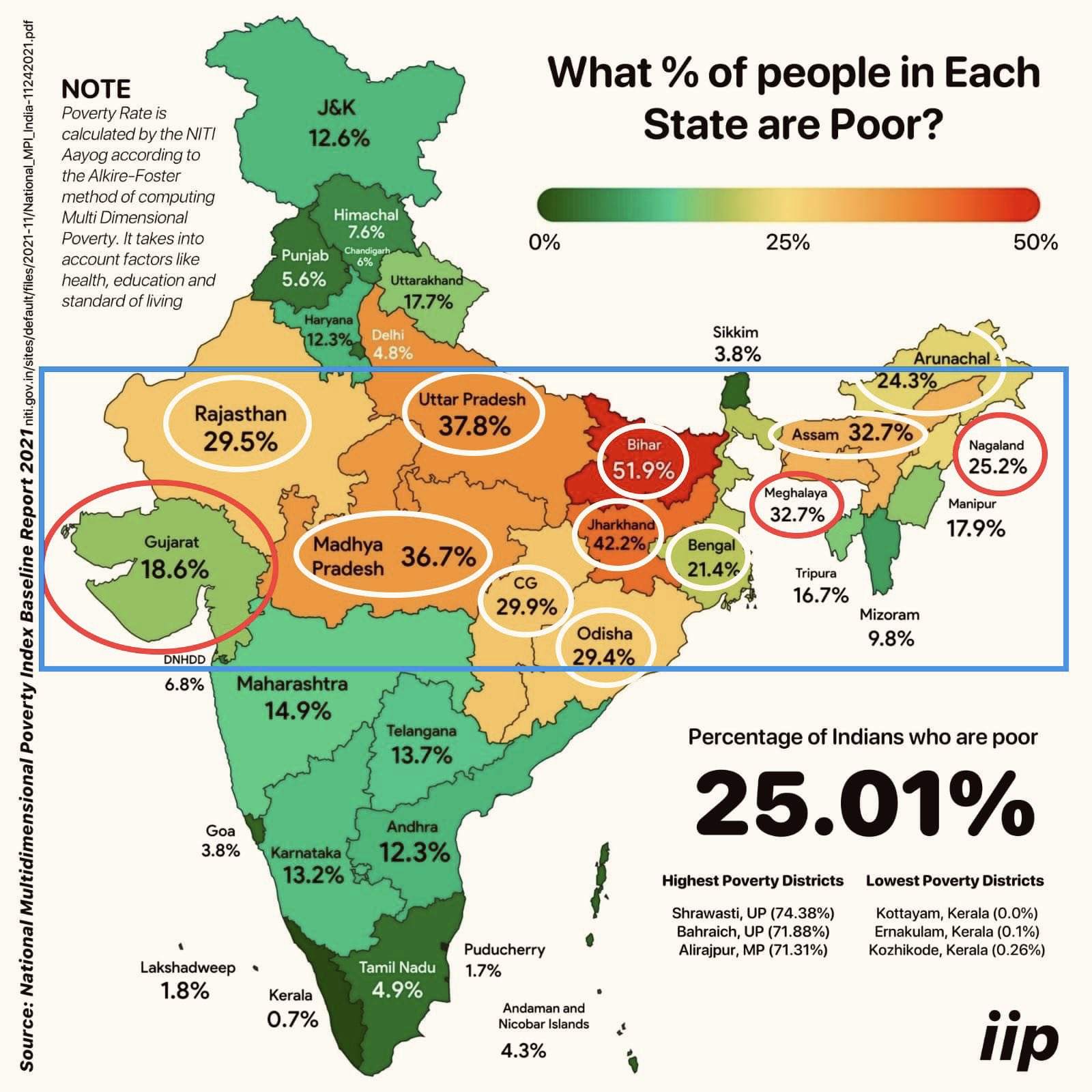
Multidimensional Poverty in India. Source: NITI Ayog via IIP

Earlier last year,  Global Hunger Index 2022 reported that  India ranks 107th for hunger among 121 nations. The nation fares worse than all of its South Asian neighbors except for war-torn Afghanistan ranked 109, according to the the report. Sri Lanka ranks 64, Nepal 81, Bangladesh 84 and Pakistan 99. India and Pakistan have levels of hunger that are considered serious. Both have slipped on the hunger charts from 2021 when India was ranked 101 and Pakistan 92. Seventeen countries, including Bosnia, China, Kuwait, Turkey and UAE, are collectively ranked between 1 and 17 for having a score of less than five.

Here's a video of Javed Akhtar's interview with Chetan Bhagat at ABP's "Ideas of India Summit 2023".  Please watch from 4:19 to 6:00 minutes. 

https://www.youtube.com/live/pZ5e81ysKGQ?feature=share


Related Links:


Haq's Musings

South Asia Investor Review

Pakistan Among World's Largest Food Producers

Pakistan Floods 2022

Food in Pakistan 2nd Cheapest in the World

India in Crisis: Unemployment and Hunger Persist After COVID

India Rising, Pakistan Collapsing

Record Number of Indians Seeking Asylum in US

Vast Majority of Pakistanis Support Imran Khan's Handling of Covid19 Crisis

Incomes of Poorest Pakistanis Growing Faster Than Their Richest Counterparts

Pakistanis Consuming More Calories, Fruits & Vegetables Per Capita 

How Grim is Pakistan's Social Sector Progress?

Pakistan Fares Marginally Better Than India On Disease Burdens

COVID Lockdown Decimates India's Middle Class

Pakistan Child Health Indicators

Pakistan's Balance of Payments Crisis

How Has India Built Large Forex Reserves Despite Perennial Trade Deficits

Riaz Haq's Youtube Channel

Sunday, November 10, 2019

Skills Gap in South Asia: Indian and Pakistani Youth Lack 21st Century Skills

Only 18% of Pakistanis and 19% of Indians under the age of 24 have the skills required for 21st century jobs, according to a United Nations and Business Coalition for Education study. It's the percentage of all school age children on track to complete secondary AND reach the learning benchmarks spelled out  by National Achievement Test (NAT) 2016 for Pakistan  and NCERT 2017 for India.

South Asian economies have experienced some of the fastest growth rates in the world. They are driven by young and growing populations in the region. Sustaining growth will become increasingly difficult unless significant investments are made to prepare South Asian youth for 21st century jobs.

Today, South Asia is home to the largest number of young people of any global region, with almost half of its population of 1.9 billion below the age of 24, according to data produced by the Global Business Coalition for Education (GBC-Education), the Education Commission, and UNICEF.

Youth unemployment remains high (at 9.8% in 2018) because of changing labor market demands and over — or under — qualification of job candidates, according to the report.


In most South Asian countries, the projected proportion of children and youth completing secondary education and learning basic secondary skills is expected to more than double by 2030. Still, on current trends, fewer than half of the region’s projected 400 million primary and secondary school-age children in 2030 are estimated to be on track to complete secondary education and attain basic workforce skills.


Current efforts underway to fill the skills gap in the biggest South Asian economies of India, Pakistan and Bangladesh are grossly insufficient. Only 47% of Indian, 40% of Pakistani and 55% of Bangladeshi youths will have the skills required by 2030.

These estimates were generated based on a 2019 update of the Education Commission’s original 2016 projections model for the Learning Generation report. Most recent national learning assessment data used for each country as follows: BCSE 2015 for Bhutan, GCE O Levels 2016 for Sri Lanka, LASI 2015 for Bangladesh, NAT 2016 for Pakistan, NCERT 2017 for India, Nepali country assessment 2017 for Nepal, O Level Exam 2016 for Maldives. Afghanistan is not included due to lack of recent learning assessment data at the secondary level.

Expectations of huge demographic dividends in South Asia will not be met unless policy makers significantly increase focus and investments to rapidly up-skill their youthful populations.

Related Links:

Haq's Musings

South Asia Investor Review

Pakistan NUTech to prepare 21st Century Workforce

Pakistan's Expected Demographic Dividend

10 Pakistan Universities Among Top 300 in Asia

Pakistan's Growing Human Capital

History of Literacy in Pakistan

Education Attainment in South Asia

Dr. Ata ur Rehman Defends HEC Reforms

Biotech and Genomics in Pakistan

Business Education in Pakistan

Armed Drones Outrage and Inspire Young Pakistanis

Tuesday, February 20, 2018

How Can Pakistan Reduce High Rates of Infant Mortality?

Of every 1,000 babies born in Pakistan, 45.6 die before the end of their first month – 1 in 22, the highest infant mortality rate in the world, according to a United Nations Children's Fund report titled "Every Child Alive: The urgent need to end newborn deaths".   Pakistan’s newborn mortality rate has declined by less than one quarter, from 60 in 2000 to 46 in 2016, according to UNICEF.

Highest Contributors to Newborn Deaths Source: UNICEF
Worst Countries:

Of the 2.6 million newborn dying each year worldwide, India tops with 24% share followed by Pakistan with 10%. Ten countries, Bangladesh, Ethiopia, Guinea-Bissau, India, Indonesia, Malawi, Mali, Nigeria, Pakistan and Tanzania account for more than half of the world’s newborn deaths, according to the report.  Four of these 10 countries are in South Asia while the rest are in sub-Saharan Africa.

The percentage of mothers in Pakistan who gave birth in a health facility increased from 21 per cent to 48 per cent between 2001 and 2013, and the proportion of women giving birth with a skilled attendant more than doubled, from 23 per cent to 55 per cent over the same period. But despite these remarkable increases, largely the result of rapid urbanization and the proliferation of private sector providers not subject to satisfactory oversight, Pakistan’s very high newborn mortality rate fell by less than one quarter, from 60 in 2000 to 46 in 2016, according to UNICEF.

The report says that more than 80 per cent of newborn deaths can be prevented "with access to well-trained midwives, along with proven solutions like clean water, disinfectants, breastfeeding within the first hour, skin-to-skin contact and good nutrition."

Community-Based Health Care:

How can Pakistan increase the number of childbirths in the presence of skilled attendants? The best option appears to be a skilled midwives program along the lines of the Lady Health Workers (LHW) program that is considered effective in delivering health education and care to women in remote villages.

“It (LHW) is one of the best community-based health systems in the world,” said Dr. Donald Thea, a Boston University researcher, talking about Pakistan's Lady Health Workers Program. Thea is one of the authors of a recent Lancet study on child pneumonia treatment in Pakistan. He talked with the New York Times about the study.

Published in British medical journal "The Lancet", the study followed 1,857 children who were treated at home with oral amoxicillin for five days and 1,354 children in a control group who were given standard care: one dose of oral cotrimoxazole and instructions to go to the nearest hospital or clinic. The home-treated group had only a 9 percent treatment-failure rate, while the control group children failed to improve 18 percent of the time.

Community Midwives: 

In response to the low levels of skilled birth attendance in rural Pakistan, the government has introduced a new cadre of community midwives (CMWs).

In 2008, Pakistan extended community-based health system with the introduction of an 18-month training program for community midwives. Then, in 2014, United Nations Population Fund – together with the Department of Health and Sindh Province’s Maternal, Newborn and Child Health program – launched a pilot effort to supplement the midwifery courses with hands-on training. Midwifery coaches visited the midwives’ clinics, offering guidance and mentorship, according to UNFPA. So far, over 300 midwives have benefitted from the coaching and mentorship program.

The Sindh UNFPA model needs to be scaled up across the country with the help of the federal and provincial governments in Pakistan. 

Summary:

Pakistan is the riskiest country for newborns. Of every 1,000 babies born in Pakistan, 45.6 die before the end of their first month – 1 in 22, the highest infant mortality rate in the world, according to a United Nations Children's Fund report titled "Every Child Alive: The urgent need to end newborn deaths".   Pakistan’s newborn mortality rate has declined by less than one quarter, from 60 in 2000 to 46 in 2016, according to UNICEF. The country's progress in reducing infant mortality rates has been very slow. There is an urgent need to improve the situation by by scaling up community-based midwife programs nation-wide.

Related Links:

Haq's Musings

Pakistan Lady Health Workers "Best in the World"

Premature Death Rates in Pakistan

Hardware (Infrastructure) Prioritized Over Software (Education/Health) in Pakistan

Disease Burdens in Pakistan

Human Development in Pakistan

Riaz Haq's Youtube Channel


Thursday, October 6, 2011

India Leads the World in Open Defecation

India's rivers have been turned into open sewers by 638 million Indians without access to toilets, according to rural development minister Jairam Ramesh. He was reacting a UNICEF report that says Indians make up 58% of the world population which still practices open defection, and the sense of public hygiene in India is the worst in South Asia and the world.


India(638m) is followed by Indonesia (58m), China (50m), Ethiopia (49m), Pakistan (48m), Nigeria (33m) and Sudan (17m). In terms of percentage of each country's population resorting to the unhygienic practice, Ethiopia tops the list with 60%, followed by India 54%, Nepal 50%, Pakistan 28%, Indonesia 26%, and China 4%.

18 percent of urban India still defecates in open while the percentage of rural India is as high as 69 percent of the population. It is the key reason why India carries among the highest infectious disease burdens in the world.

The number of open defecators in rural India alone is more than twice those in the whole of sub-Saharan Africa, according to a report by DFID, the UK's Department for International Development.

The World Bank has estimated that open defecation costs India $54 billion per year or $48 per head. This is more than the Government of India’s entire budget for health.

The UNICEF report says that with only four more years to go until 2015, a major leap in efforts and investments in sanitation is needed to reach the targets of Millennium Development Goals.

After the embarrassing headlines, it appears that Minister Ramesh is ready to step up the efforts to improve sanitation. He is quoted by Times of India as saying that "we are going to focus now on `nirmal gram abhiyan' -- today 25,000 nirmal grams are a tiny fraction of 6 lakh villages. These nirmal grams are in Maharashtra and Haryana. Maharashtra is a success of social movements while Haryana an example of determined state government action."


Here's a video report on open defecation in Mumbai, India:

https://youtu.be/pUNm_A1z2BM


Here's a video clip of Indian environment minister Jairam Ramesh saying "if there was a Nobel Prize for dirt and filth, India would win it hands down":


Related Links:

Haq's Musings

Fixing Sanitation Crisis in India

Food, Clothing and Shelter in India and Pakistan

Heavy Disease Burdens in South Asia

Peepli Live Destroys Indian Myths

India After 63 Years of Independence

Poverty Across India 2011

India and Pakistan Contrasted