Showing posts with label Pandemic. Show all posts

Friday, June 10, 2022

Economic Survey: Pakistanis Consuming More Calories, Fruits and Vegetables

Pakistanis are eating more and healthier foods, according to the Economic Survey of Pakistan 2021-22. Per capita average daily calorie intake in Pakistan has jumped to 2,735 calories in FY 2021-22 from 2,457 calories in 2019-20. The biggest contributor to it is the per capita consumption of fresh fruits and vegetables which soared from 53.6 Kg to 68.3 Kg, less than half of the 144 Kg (400 grams/day) recommended by the World Health Organization. Healthy food helps cut disease burdens and reduces demand on the healthcare system. Under former Prime Minister Imran Khan's leadership, Pakistan succeeded in achieving these nutritional improvements in spite of surging global food prices amid the Covid19 pandemic. 
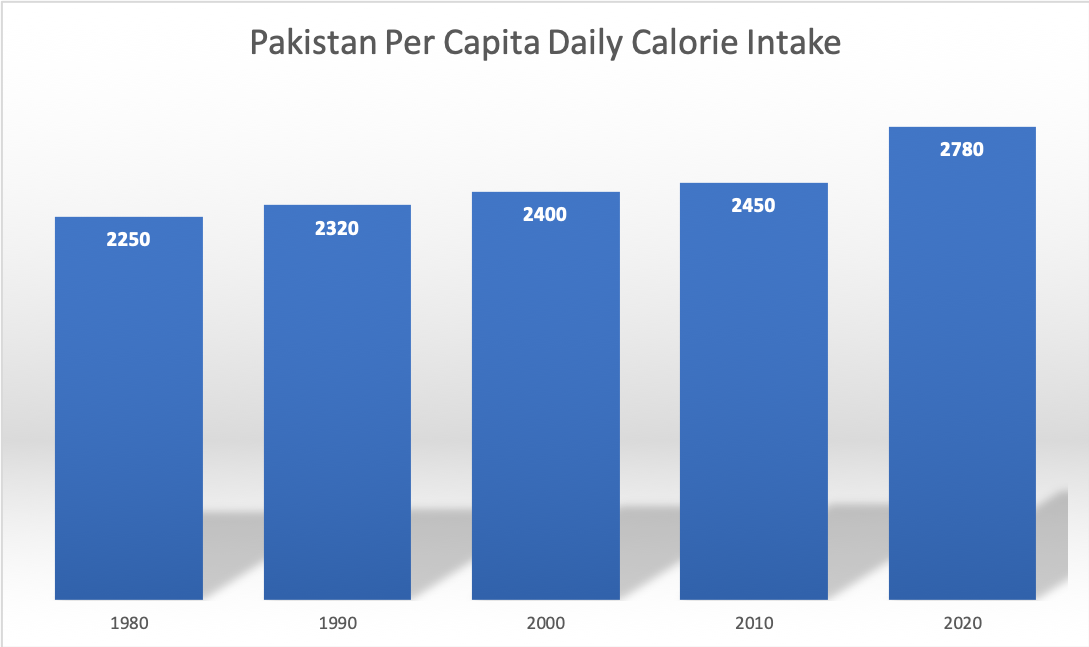
Pakistan Per Capita Daily Calorie Consumption. Source: Economic Surveys of Pakistan


The trend of higher per capita daily calorie consumption has continued since the 1950s. It has risen from about 2,078 in 1949-50 to 2,400 in 2001-02 and 2735 in 2021-22. The per capita per day protein intake in grams increased from 63 to 67 to about 75 during these years. Health experts recommend that women consume at least 1,200 calories a day, and men consume at least 1,500 calories a day, says Harvard Health Publishing.  The global average has increased from 2360 kcal/person/day in the mid-1960s to 2900 kcal/person/day currently, according to the Food and Agricultural Organization (FAO). The USDA (United States Department of Agriculture) estimates that most women need 1,600 to 2,400 calories, while the majority of men need 2,000 to 3,000 calories each day to maintain a healthy weight. Global Hunger Index defines food deprivation, or undernourishment, as consumption of fewer than 1,800 calories per day.

Share of Overweight or Obese Adults. Source: Our World in Data

The share of overweight or obese adults in Pakistan's population is estimated by the World Health Organization at 28.4%. It is 20% in Bangladesh, 19.7% in India, 32.3% in China, 61.6% in Iran and 68% in the United States.   

Major Food Items Consumed in Pakistan. Source: Economic Survey of Pakistan 2021-22

The latest edition of the Economic Survey of Pakistan estimates that per capita calories come from the annual per capita consumption of  164.7 Kg of cereals, 7.3 Kg of pulses (daal), 28.3 Kg of sugar, 168.8 liters of milk, 22.5 Kg of meat, 2.9 Kg of fish, 8.1 dozen eggs, 14.5 Kg of ghee (cooking oil) and 68.3 Kg of fruits and vegetables.  Pakistan's economy grew 5.97% and agriculture outputs increased a record 4.4% in FY 2021-22, according to the Economic Survey. The 4.4% growth in agriculture has boosted consumption and supported Pakistan's rural economy.  

Pakistan Growth Indicators. Source: Economic Survey 2021-22

The minimum recommended food basket in Pakistan is made up of basic food items (cereals, pulses, fruits, vegetables, meat, milk, edible oils and sugar) to provide 2150 kcal and 60gram protein/day per capita. 

The state of Pakistan's social sector is not as dire as the headlines suggest. There are good reasons for optimism. Key indicators show that nutrition and health in Pakistan are improving but such improvements need to be accelerated. 

Related Links:

Monday, February 14, 2022

COVID19: Has Pakistan Proved Experts Forecasts Wrong?

The United States Centers for Disease Control (CDC) have recently assessed American travelers' risk of COVID19 infection in Pakistan being among the lowest in the world. The Economist magazine has ranked Pakistan second in the world for return to the normalcy of pre-pandemic life. These assessments stand in sharp contrast to Pakistan's low ranking for pandemic preparedness by the Global Health Index (GHI). GHS has also continued to rank India higher than its neighbors in spite of Prime Minister Narendra Modi's disastrous handling of the COVID19 outbreak in India that saw people gasping for breath and dying on the streets of major Indian cities.  The health experts at GHS seem to be totally out of touch with reality. They are the epitome of the  "ivory tower" academia. 


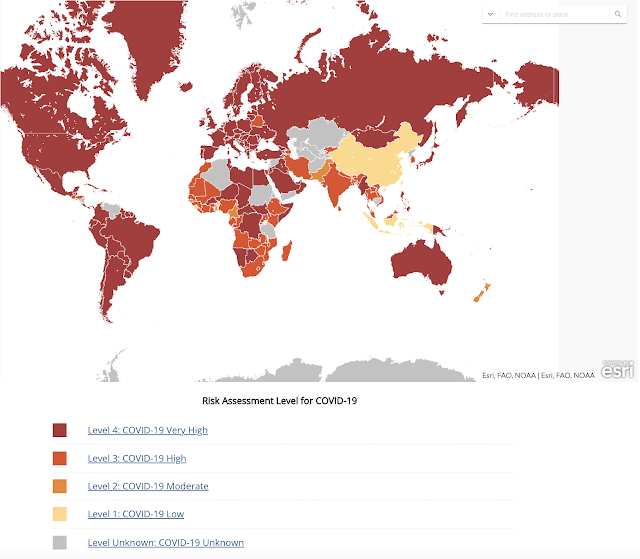
US CDC Travel Risk Map. Source: CDC

US CDC on Pakistan:

In its latest global travel advisory, the US Centers for Disease Control and Prevention (CDC) has placed Pakistan at level-2, a level assigned to just 5 countries in the world. 

The agency has placed India at level-3, which includes countries where the chances of catching Covid-19 are high.  Most of the world, including North America and Europe, are placed in level 4 by the CDC. 

Economist Magazine Normalcy Index. Source: Economist


Economist Magazine Normalcy Index:

The Economist magazine has its own ranked list of countries for return to pre-pandemic life. In its latest issue, the magazine says that "Activity is back at normal levels in just two of the countries we track: Colombia and Pakistan". 

The Economist ranks Pakistan second in the world with a score of 106.6, just behind the first-ranked Egypt with a score of 107.4.

Pandemic Preparedness Map. Source: Global Health Security

Global Health Index:

Global Health Security(GHS) Index measures the capacities of 195 countries to prepare for epidemics and pandemics.  GHS has been publishing its rankings and maps since 2020 that continue to show that North America and Western Europe as the best prepared for pandemics. 

GHS has also continued to rank India higher than its neighbors in spite of Prime Minister Narendra Modi's disastrous handling of the COVID19  in India outbreak that saw people gasping for breath and dying on the streets of major Indian cities.  The health experts at GHS seem to be totally out of touch with reality. They are the epitome of the  "ivory tower" academia. 

Related Links:

Haq's Musings

South Asia Investor Review

COVID19 in Pakistan: Test Positivity Rate and Deaths Declining

Fareed Zakaria Never Misses Any Opportunity to Bash Pakistan

Pakistan's Economist Normalcy Index

Lynchistan: India is the Lynching Capital of the World

73 Year After Independence, Caste-Ridden India Dominated By Brahmins

Modi's Disastrous Handling of COVID19 Pandemic

Is Pakistan's Response to COVID19 Flawed?

Pakistan's Computer Services Exports Jump 26% Amid COVID19 Lockdown

Coronavirus, Lives and Livelihoods in Pakistan

Vast Majority of Pakistanis Support Imran Khan's Handling of Covid19 Crisis

Pakistani-American Woman Featured in Netflix Documentary "Pandemic"

Coronavirus Antibodies Testing in Pakistan

Can Pakistan Effectively Respond to Coronavirus Outbreak? 

How Grim is Pakistan's Social Sector Progress?

Pakistan Fares Marginally Better Than India On Disease Burdens

Trump Picks Muslim-American to Lead Vaccine Effort

Democracy vs Dictatorship in Pakistan

Pakistan Child Health Indicators

Pakistan's Balance of Payments Crisis

Panama Leaks in Pakistan

Conspiracy Theories About Pakistan Elections"

PTI Triumphs Over Corrupt Dynastic Political Parties

Strikingly Similar Narratives of Donald Trump and Nawaz Sharif

Nawaz Sharif's Report Card

Riaz Haq's Youtube Channel


Sunday, July 4, 2021

Economist Normalcy Index: Pakistan Among Best Performing Countries For Handling COVID19

With a score of 84.4, Pakistan ranks third among 50 countries tracked by the Economist magazine for return to pre-pandemic life. Pakistan's neighbor India has a score of 46.5, ranking it near the bottom in 48th position.  China (score 72.9) is 19th, United States (72.8) 20th, United Arab Emirates (68.9) 27th and United Kingdom (62.5) 36th. The global average for return to pre-pandemic activity is 66.6 on a scale of 0 to 100. 

Top Performing Countries For Return to Pre-Pandemic Activity Level. Source: Economist

Economist's Global Normalcy Index:

The Economist magazine is tracking 50 countries for return to pre-pandemic activity level. Here is how it  explains it:

"The global normalcy index plummeted in March 2020 as many countries imposed draconian restrictions on their citizens. It fell to just 35 in April 2020, before improving gradually over the following months. Today it stands at 66, suggesting that the world has travelled roughly half of the way back to pre-pandemic life. Some indicators, such as traffic congestion and time spent outside, have recovered faster than others, particularly sports attendance and flights. The global average masks a lot of variation across countries. Click on the drop-down box to explore how behavior has changed in each one". 


Best Performing Countries:

The top 10 best performing countries or territories on the Economist Normalcy Index are Hong Kong (96.3/100), New Zealand (87.8), Pakistan (84,4), Nigeria (84.1), Ukraine (83.6), Romania (82.1), Denmark (81.3), Egypt (81.2), Israel (80.4) and Mexico (80.2). The global average for return to pre-pandemic activity is 66.6 on a scale of 0 to 100. 

 Worst Performing Countries For Return to Pre-Pandemic Activity Level. Source: Economist


Worst Performing Countries:

The worst performing countries from the bottom are Malaysia (score 27.3/100) at number 50, Taiwan (43.7) at 49, India (46.5) at 48, Chile (51.1) at 47, Vietnam (51.3) at 46, Argentina (52.9) at 45, Philippines (55.5) at 44, Singapore (55.5) at 43, Peru (56.1) at 42, Thailand (57.8) at 41 and Indonesia (58.3) at 40. 

COVID Test Positivity Rate in Pakistan. Source: Our World in Data 


COVID Positivity Rate:

Timely actions by Pakistan National Command Operations Center (NCOC) have helped control the third COVID19 wave in the country. With nearly 50,000 daily tests, the positivity rate has dropped to around 2% in the most recent week.  This has been accomplished in spite of the fact that the vaccination rate in Pakistan is still quite low. 

Normalcy Index vs Vaccination Rates. Source: Economist

Summary:

The Economist magazine normalcy index has ranked Pakistan among the top 5 countries for return to pre-pandemic activity level.The latest COVID positivity rate is just over 2% in spite of the fact that the vaccination rates are still very low. With a score of 84.4, Pakistan ranks third among 50 countries tracked by the Economist magazine for return to pre-pandemic life. Pakistan's neighbor India has a score of 46.5, ranking it near the bottom in 48th position.  China (score 72.9) is 19th, United States (72.8) 20th, United Arab Emirates (68.9) 27th and United Kingdom (62.5) 36th The global average for return to pre-pandemic activity is 66.6 on a scale of 0 to 100.

Related Links:

Haq's Musings

South Asia Investor Review

COVID19 in Pakistan: Test Positivity Rate and Deaths Declining

Fareed Zakaria Never Misses Any Opportunity to Bash Pakistan

Retired Justice Markanday Katju on Modi's India

Lynchistan: India is the Lynching Capital of the World

73 Year After Independence, Caste-Ridden India Dominated By Brahmins

Pakistan's Pharma Industry Among World's Fastest Growing

Is Pakistan's Response to COVID19 Flawed?

Pakistan's Computer Services Exports Jump 26% Amid COVID19 Lockdown

Coronavirus, Lives and Livelihoods in Pakistan

Vast Majority of Pakistanis Support Imran Khan's Handling of Covid19 Crisis

Pakistani-American Woman Featured in Netflix Documentary "Pandemic"

Coronavirus Antibodies Testing in Pakistan

Can Pakistan Effectively Respond to Coronavirus Outbreak? 

How Grim is Pakistan's Social Sector Progress?

Pakistan Fares Marginally Better Than India On Disease Burdens

Trump Picks Muslim-American to Lead Vaccine Effort

Democracy vs Dictatorship in Pakistan

Pakistan Child Health Indicators

Pakistan's Balance of Payments Crisis

Panama Leaks in Pakistan

Conspiracy Theories About Pakistan Elections"

PTI Triumphs Over Corrupt Dynastic Political Parties

Strikingly Similar Narratives of Donald Trump and Nawaz Sharif

Nawaz Sharif's Report Card

Riaz Haq's Youtube Channel


Thursday, April 29, 2021

Pre-COVID Fiction: India Wins US-China War Imagined For 2034

In a recently published fiction imagined for 2034 by former top US Admiral James Stavridis and Elliot Ackerman, China and the United States go to war that ends in India's victory. The authors portray Indians as heroes whose statesmen-ship de-escalates World War III, negotiates peace and helps India emerge as the new global superpower. Patel, the Indian uncle of the Indian-American deputy national security advisor Sandeep Chowdhury tells him, "America’s hubris has finally gotten the better of its greatness." The authors imagine the United Nations headquarters moves from New York to Mumbai after the war. Had this book been written after watching thousands of Indian victims of COVID19 gasping for breath and dying daily on the streets of New Delhi, I think Ackerman and Stavridis would have conceived  and developed a completely different plot line for their novel.  

2034 Book Cover


Elliot Ackerman and James Stavridis, authors of "2034: A Novel of the Next World War", imagine a series of incidents in South China Sea and the Persian Gulf. These incidents trigger cyber warfare, global internet outages and the use of tactical nuclear weapons fired from warplanes and warships. The military conflict results in millions of deaths in the cities of San Diego and Shanghai. India intervenes at this point by attacking and destroying Chinese and American fighter planes and ships to stop the war. 

The end of active fighting is followed by New Delhi Peace Accords arranged by the Indian government. The United Nations headquarters is moved from New York to Mumbai. At one point in the conflict, the authors have Patel lecture his nephew Sandeep Chowdhury, the US deputy national security advisor: 

"America’s hubris has finally gotten the better of its greatness. You’ve squandered your blood and treasure to what end? For freedom of navigation in the South China Sea? For the sovereignty of Taiwan? Isn’t the world large enough for your government and Beijing’s? Perhaps you’ll win this war. But for what? To be like the British after the Second World War, your empire dismantled, your society in retreat? And millions of dead on both sides?"

Rising Positivity Rates of COVID19 Tests in South Asia. Source: Our World in Data

Some reviewers of the book have speculated that China may want to take Taiwan by force for one particular technology company, the Taiwan Semiconductor Manufacturing Company (TSMC) which is currently the world's most advanced semiconductor technology company. Semiconductor components underlie all cutting edge applications from artificial intelligence (AI) and smartphones to self-driving cars and advanced military equipment.

The possibility of war between China and the United States can not be dismissed. However, the book's portrayal of India's emergence as a global superpower is pure fantasy.  Had this book been written after watching thousands of Indian victims of COVID19 gasping for breath and dying daily on the streets of New Delhi, Ackerman and Stavridis would have conceived  and developed a completely different plot line for their novel.  

Related Links:

Haq's Musings

South Asia Investor Review

India Tops World Hunger Charts

Is India Superpoor or Superpower?

Rape as a Political Weapon Used By Hindutva

Hindu Nationalism Inspired By Nazism, Fascism

Rise of Islamophobia After Sept 11, 2001 Terrorist Attacks

700,000 Indian Soldiers Versus 7 Million Kashmiris

Modi's Kashmir Blunder and India-Pakistan Nuclear Conflict

Is India a Paper Elephant? 

Howdy Modi Rally Exposes Indian-Americans to Charges of Hypocrisy

Modi's Extended Lockdown in Indian Occupied Kashmir

Hinduization of India

Brievik's Hindutva Rhetoric

Indian Textbooks

India's RAW's Successes in Pakistan

Riaz Haq Youtube Channel

VPOS Youtube Channel

Tuesday, February 16, 2021

Pakistani-American Doctor Fired For Giving Away Expiring COVID19 Vaccine

Dr. Hasan Gokal, Pakistani-American medical director of Harris County COVID Response Team, has been charged with stealing COVID19 Moderna vaccine and fired from his job, according to media reports.  Dr. Gokal's "crime" is to give away unused coronavirus vaccine doses that would have expired and lost if not used within hours. A Texas judge has dismissed charges against him. 

Dr. Hasan Gokal

Each vial of Moderna vaccine has 10 doses. Once it is punctured, the vaccine expires within 6 hours. After administering COVID19 vaccine to all the front-line healthcare workers who showed up for their appointment, Gokal gave the remaining expiring doses of the vaccine to acquaintances and strangers, including a bed-bound woman in her 90s, a woman in her 80s with dementia, several men and women in their 60s and 70s with health issues, and a mother with a child on a ventilator, according to New York Times. After midnight and just minutes before the vial would expire, the final person called and said he wouldn’t make it. Gokal turned to his wife, who has a pulmonary disease that causes shortness of breath, and gave her the last dose.

Even after dismissal of charges against him, Dr. Gokal still doesn’t have a job and instead volunteers at a nonprofit health clinic. Now his lawyer is pursuing a wrongful termination lawsuit, according to ABC Channel13. “An apology by Harris County Public Health and the Harris County District Attorney’s Office towards Dr. Gokal and his family will not be enough,” Paul Doyle, Gokal’s lawyer, told the news outlet.

Dr. Gokal is among thousands of Pakistani-American doctors who have been at the forefront of saving lives in the middle of the devastating COVID19 pandemic that has taken over 400,000 American lives so far. Among them is Dr. Syra Madad, Pakistani-American head of New York City’s Health and Hospitals System-wide Special Pathogens Program, who is featured in a 6-part Netflix documentary series "Pandemic: How to Prevent an Outbreak".

Pakistani-American doctors are the 3rd largest among foreign-educated doctors in America. Among the notable names of Pakistani-American doctors engaged in the fight against Covid-19 are: Dr. Saud Anwar in Connecticut, Dr. Gul Zaidi in New York and Dr. Umair Shah in Texas. Their work has received positive media coverage in recent weeks.

Dr. Saud Anwar, a Connecticut pulmonologist and state senator, came up with a ventilator splitter to deal with the shortages of life-saving equipment. Dr. Gul Zaidi, an acute-care pulmonologist in Long Island, was featured in a CBS 60 Minutes segment on how the doctors are dealing with unprecedented demands to save lives. Dr. Umair Shah was interviewed about his work by ABC TV affiliate in Houston, Texas.

Related Links:

Haq's Musings

South Asia Investor Review

Ex US Treasury Sec Praises Pakistan's COVID Response

Pakistani-American Health Expert Featured in Netflix Documentary "Pandemic"

Pakistan is the 3rd Largest Source of Foreign Doctors in America

Van Jones on "Geniuses from Pakistan"

Obama Honors Pakistani-American Doctor With Top Technology Medal

Hindus and Muslim Well-educated in America But Least Educated Worldwide

What's Driving Islamophobia in America?

Pakistani-Americans Largest Foreign-Born Muslim Group in Silicon Valley

The Trump Phenomenon

Islamophobia in America

Silicon Valley Pakistani-Americans

Pakistani-American Leads Silicon Valley's Top Incubator

Silicon Valley Pakistanis Enabling 2nd Machine Revolution

Karachi-born Triple Oscar Winning Graphics Artist

Pakistani-American Ashar Aziz's Fire-eye Goes Public

Two Pakistani-American Silicon Valley Techs Among Top 5 VC Deals

Pakistani-American's Game-Changing Vision 


Monday, August 10, 2020

Pakistan Independence Day 2020: National Resilience Amid Deadly COVID19 Pandemic

On Pakistan's 73rd Independence Anniversary, the people of the South Asian nation have demonstrated their resilience yet again. They have defied all foreign and domestic doomsayers, including media, activists and think tanks of all varieties. Pakistan has successfully fought off the deadly COVID19 virus and begun to bounce back economically. Moody's rating agency has raised Pakistan's economic outlook from "under review for downgrade" to "stable". Pakistan's Planning Minister Asad Umar is talking of a "V-shaped recovery". Large Scale Manufacturing (LSM) is recovering. Monthly cement sales have rebounded to the pre-pandemic level, fertilizers sales are setting records, fuel sales have increased, tax collection is up,  exports are rising and the Karachi stock market is booming again. Prime Minister Imran Khan and Army Chief General Qamar Javed Bajwa have been on the same page in tackling the health and economic crises faced by Pakistan. Contrary to the critics of Pakistan's civil-military ties,  Khan-Bajwa cooperation has been one of the keys to the country's success in dealing with the twin crises.

Coronavirus Pandemic:

Foreign and domestic media, activists and think tanks lived up to their reputation when it comes to the coverage of coronavirus pandemic in Pakistan. They all made dire predictions of imminent collapse of the state and society. That has been the case in the past when Pakistan faced terrorist threats and natural disasters.  As in the past, they all turned out to be wrong. Pakistan successfully tacked the pandemic and brought it under control. This success has drawn praise from the likes of Bill Gates known for his global health activism and philanthropy. Speaking on CNN Global Public Square, Gates said:

"Pakistan had a pretty bad peak in Karachi but those numbers have come down and now they look like Europe. India is still sadly in growth phase as is South America...in Africa South Africa is top...in the rest of Africa we've been funding a lot of testing because it's a bit opaque..what goes on in the lungs..you are more exposed to indoor and outdoor particulates even at younger ages you can get disease compared to let's say a rich country"

CNN Screenshot of Pakistan's COVID19 Progress

Civil-Military Relations:

Attacking Pakistani military and describing Pakistani civilian leadership as "puppets" has been one of the favorite hobby horses of foreign and domestic media, activists and think tanks. It seems that they would like nothing better perpetual conflict between the two power centers. So far, these critics have miserably failed in igniting the civil-military conflict in Pakistan.

Prime Minister Imran Khan and Army Chief General Javed Bajwa have been on the same page in tackling health and economic crises faced by Pakistan. This has been one of the keys to country's success in dealing with the twin crises.

Pakistan Stock Market Best Performing in Asia. Source: Bloomberg

Large Scale Manufacturing:

In spite of COVID19 pandemic, Large Scale Manufacturing (LSM) went up 16.81% in June 2020 from May 2020, but still down 7.74% from June, 2019.  LSM  declined 10.17% in fiscal 2020 from fiscal 2019.

Pakistan Manufacturing Output. Source: Bloomberg


Cement Sales:

Cement is a basic building material. Its sales are seen as a very important economic indicator of development activity. The cement sales jumped 37.75% from 3.512 million tons in July 2019 to 4.838 million tons in July 2020, the first month the new fiscal year 2020-21.


Pakistan Cement Sales. Source: Bloomberg


According to the data released by Pakistan's cement industry group APCMA, the local uptake of cement in July 2020 increased by 32.67% to 3.953 million tons from 2.979 million tons in July 2019 while exports rose 66.14% to 0.885 million tons, up from 0.533 million tons in same month last year.

Fertilizer Sales:

Sales of urea, a barometer of agriculture activity, have surged 83% to 1.18 million tons in June 2020 from a year ago.  The surge came after a decline 7% YoY to 2.6 million tonnes in the first half of CY20, partly due to COVID19 related lockdown in the country.

Export Performance:

As the COVID19 pandemic eased in Pakistan, the country's exports bounced up to $1.998 billion in July 2020 against $1.889 billion in the same month of the last fiscal year 2019, up 5.8% in dollar terms year-over-year. The imports stood at $3.54 billion in July 2020 against $3.696 billion in the same month of 2019, recording a decline of 4.2 percent. The overall trade balance reduced by negative 14.7% as it stood at $1.542 billion in July 2020 compared with $1.8 billion in same month of 2019.

Pakistan is trying to address various impediments to growing exports. “More than half of Pakistani exporters struggle with domestic and foreign regulatory barriers,” said Invisible Barriers to Trade – Pakistan 2020: Business Perspectives. The report was prepared in collaboration with the World Bank Group’s country office in Pakistan. There's significant upside to exports if Pakistani government and exporters can join hands to address these "invisible barriers to trade".

Naya Pakistan Housing:

Inn spite of the pandemic, Pakistani Prime Minister Imran Khan announced a new housing construction incentives package that includes down payment assistance and expansion of home loans portfolios by commercial banks at discounted rates for affordable housing for the poor.

Shariah compliant financing is also included in it. Pakistan’s mortgage finance to GDP ratio is just 0.25%, among the lowest in the world, according to the World Bank. The average for South Asia 3.4%.  New housing drives a large number of sectors of the economy from banking and building materials to construction and manufacturing of furniture and home appliances. These incentives are designed to stimulate the economy, boost employment and deal with the growing shortage of affordable housing in the country.


CPEC Gains Momentum:

The work on China-Pakistan Economic Corridor (CPEC) has gained momentum in spite of the pandemic that has slowed many sectors of the country's economy.

Pakistan has begun construction on major dam projects worth $11 billion. Diamer Bhasha dam will store 6.4 million acre-feet (MAF) of water and generate 4,500 MW of electricity. Azad Pattan hydro-electric project will produce 700 MW of electricity.

Financing for the $6.8 billion ML-1 railway project has been agreed. It will be the first major upgrade of the train track since Pakistan's independence in 1947. This project will upgrade Pakistan’s existing 2,655km railway tracks to allow trains to move up to 165km/h – twice as fast as their current speed.

Nine special economic zones (SEZs), including Rashakai in Khyber-Pakhtunkhwa, Allama Iqbal in Punjab and Dhabeji in Sindh province, have been launched. Some 1,000 acres of land had been procured for Rashakai SEZ, the groundbreaking of Allama Iqbal SEZ in Faisalabad had been done and tenders opened for Dhabeji SEZ, which would be built on 3,000 acres of land.

Pakistan's Human Development: 

One of the biggest areas of concern is Pakistan's laggard performance in human development. This requires closer civil-military cooperation to deliver better education and health care to improve the country's competitiveness in the world.

There's reason for optimism, however. Key indicators show that education and health care in Pakistan are improving but such improvements are slower than in other countries in South Asia region. Pakistan's human development ranking plunged to 150 in 2018, down from 149 in 2017. It is worse than Bangladesh at 136, India at 130 and Nepal at 149. The decade of democracy under Pakistan People's Party and Pakistan Muslim League (Nawaz) has produced the slowest annual human development growth rate in the last 30 years. The fastest growth in Pakistan human development was seen in 2000-2010, a decade dominated by President Musharraf's rule, according to the latest Human Development Report 2018. One of the biggest challenges facing the PTI government led by Prime Minister Imran Khan is to significantly accelerate human development rates in Pakistan.

Summary:

Pakistanis have defied all foreign and domestic doomsayers, including media, activists and think tanks of all varieties. Pakistan has successfully fought off the deadly COVID19 virus and begun to bounce back economically. Moody's rating agency has raised Pakistan's economic outlook from "under review for downgrade" to "stable". Pakistan's Planning Minister Asad Umar is talking of a "V-shaped recovery". Monthly cement sales have rebounded to pre-pandemic level, fuel sales have increased, tax collection is up,  exports are rising and the Karachi stock market is booming again. Prime Minister Imran Khan and Army Chief General Javed Bajwa have been on the same page in tackling the health and economic crises faced by Pakistan. Contrary to the critics of Pakistan's civil-military ties,  Khan-Bajwa cooperation has been one of the keys to the country's success in dealing with the twin crises.

Here's a brief video clip of Bill Gates' remarks on CNN:

https://youtu.be/NWTkfhiwsG4


Related Links:

Haq's Musings

South Asia Investor Review

COVID19 in Pakistan: Test Positivity Rate and Deaths Declining

Pakistan's Pharma Industry Among World's Fastest Growing

Is Pakistan's Response to COVID19 Flawed?

Pakistan's Computer Services Exports Jump 26% Amid COVID19 Lockdown

Coronavirus, Lives and Livelihoods in Pakistan

Vast Majority of Pakistanis Support Imran Khan's Handling of Covid19 Crisis

Pakistani-American Woman Featured in Netflix Documentary "Pandemic"

Coronavirus Antibodies Testing in Pakistan

Can Pakistan Effectively Respond to Coronavirus Outbreak? 

How Grim is Pakistan's Social Sector Progress?

Pakistan Fares Marginally Better Than India On Disease Burdens

Trump Picks Muslim-American to Lead Vaccine Effort

Democracy vs Dictatorship in Pakistan

Pakistan Child Health Indicators

Pakistan's Balance of Payments Crisis

Panama Leaks in Pakistan

Conspiracy Theories About Pakistan Elections"

PTI Triumphs Over Corrupt Dynastic Political Parties

Strikingly Similar Narratives of Donald Trump and Nawaz Sharif

Nawaz Sharif's Report Card

Riaz Haq's Youtube Channel

Monday, June 29, 2020

Are American and Pakistani Responses to COVID19 Pandemic Flawed?

Did the pandemic surveillance system fail in early detection of the Coronavirus in US and Pakistan? What are the problems in this system? What needs to be done to correct the problems?

Positive Test Rate Declines to 1 in 6.36 (15.7%) From Peak of 1 in 4.47 (22.3%) on June 4, 2020

How are Prime Minister Imran Khan of Pakistan and President Donald Trump of the United States handling the COVID19 pandemic? Are both their responses fundamentally flawed? Are absolute total lockdowns as recommended by the World Health Organization necessary in Pakistan? Can Pakistan handle the economic and human consequences of extended total lockdown?

Pakistan COVID19 Weekly Death Decline to 577 Now From Peak of 869 Last Week

Weekly COVID19 deaths in Pakistan have declined to 577 this week from 869 last week. To put it perspective, about 4,000 Pakistanis died everyday from various causes before the current pandemic.

The number of people testing positive in Pakistan has declined to 1 in 6.36 (15.7%) from the peak of 1 in 4.47 (22.3%) on June 4, 2020.

What does the coronavirus data show in terms of coronavirus cases and fatality rates in the US and Pakistan? Is the positivity rate the right gauge of the true extent of the spread of the virus? Is antibodies testing data a better indicator of it? Why is the COVID19 death rate in Pakistan among the lowest in the world? Is it grossly understated?

Despardes with Faraz Darvesh host discusses these questions with Pakistani-American epidemiologist Dr. Rashid Chotani and analyst Riaz Haq (www.riazhaq.com):


https://youtu.be/_fJk6GH_-GE


Related Links:

Haq's Musings

South Asia Investor Review

Can India Afford to Boycott China?

Has Modi Succeeded in Isolating Pakistan?

Did GOP's Dogwhistle Politics Produce Trump?

Coronavirus, Lives and Livelihoods in Pakistan

Vast Majority of Pakistanis Support Imran Khan's Handling of Covid19 Crisis

Pakistani-American Woman Featured in Netflix Documentary "Pandemic"

Coronavirus Antibodies Testing in Pakistan

Can Pakistan Effectively Respond to Coronavirus Outbreak? 

How Grim is Pakistan's Social Sector Progress?

Pakistan Fares Marginally Better Than India On Disease Burdens

Modi's Kashmir Blunder

Democracy vs Dictatorship in Pakistan

Pakistan Child Health Indicators

Pakistan's Balance of Payments Crisis

Panama Leaks in Pakistan

Conspiracy Theories About Pakistan Elections"

PTI Triumphs Over Corrupt Dynastic Political Parties

Strikingly Similar Narratives of Donald Trump and Nawaz Sharif

Nawaz Sharif's Report Card

Riaz Haq's Youtube Channel

Friday, May 15, 2020

Pakistan: Coronavirus, Lives and Livelihoods

Coronavirus infection rates and deaths in Pakistan are among the lowest in the world while the continuing lockdown is causing enormous damage to the nation's economy and livelihoods, according to government data. Health ministry data shows that fewer than a thousand lives have been lost to the disease in the country since the start of COVID19 infections more than two months ago. Meanwhile, millions of people in manufacturing, retail and the unorganized sectors are unemployed or underemployed. All of this is happening during Ramzan and Eid periods that account for bulk of retail sales in the majority Muslim country of 220 million. Pakistanis do not necessarily face the same level of risk from coronavirus as people living in America and Europe do.


Age Distribution of Covid Cases/Deaths in Pakistan. Source: covid.gov.pk


Age Factor in Covid19 Mortality:


Over 40% of all coronavirus deaths in Europe and America have occurred among the elderly living in nursing homes. Pakistanis age 60+ account for 19% of cases but 58% of deaths. Like US and Europe, older people are much more likely to die from coronavirus in Pakistan.  But average life expectancy in Pakistan is just 67 years and the median age in the country is only 22 years. The explanations offered for low death rates in South Asia include younger populations, more sunshine, higher temperature and humidity, universal BCG vaccinations etc. Yale researchers have argued in a recently published paper to consider universal mask adoption and increased hygiene measures as an alternative to complete lockdown.


March 2020 Manufacturing Data. Source: Pakistan Bureau of Statistics

Pakistan Manufacturing Data:

The March figures released by Pakistan Bureau Statistics confirm a precipitous drop of 22.95% in large scale manufacturing. This reflects halt in production in just the last one week of March 2020. April 2020 figures are almost certain to be a lot worse due to complete halt in production amid lockdown. It's spelling disaster for millions of employees and households linked to these industries. Government handouts can not replace household incomes generated from these industries.

While food production held up well in March, manufacturing of durables like air-conditioners, refrigerators, and deep freezers have plummeted. For example, production of refrigerators fell 34% from 86,107 in March 2019 to 56,449 in March 2020.  Number of television sets produced in March 2020 declined 34% to 19,790 from 30,788 in the same month last year.

Comparison of Confirmed Cases in Selected Countries. Source: Our World in Data

Coronavirus Infections and Deaths:

As of May 16, Pakistan has 38,755 cases and 834 deaths. These figures are among the lowest in the world. There are many theories explaining why Pakistan and the rest of South Asia have fared much better than America and Europe. To put it in perspective, there were 31 coronavirus related deaths in Pakistan where 4,000 people die on a regular day.  Any major change in daily death rates in recent weeks would not go unnoticed. While it is true that the testing rates in South Asia are low compared to America and Europe, the percentages of people testing positive and fatality rates in South Asia are also low. The explanations offered for low coronavirus infection and death rates in South Asia include more sunshine, higher temperature and humidity, younger demographics, universal BCG vaccinations etc.

Comparison of Coronavirus Deaths in Selected Countries. Source: Our World in Data

Pakistan COVID19 Death Rate Among World's Lowest 


Social Distancing Cost-Benefit Analysis:

In a recently published paper tiled "The Benefits and Costs of Social Distancing in Rich and PoorCountries", Yale researchers support universal mask adoption and increased hygiene measures as a alternatives to social distancing and complete lockdown.

Zachary Barnett-Howell and Ahmed Mushfiq Mobarak of Yale University argue that "social distancing policies are estimated to be less effective in poor countries with younger populations less susceptible to COVID-19, and more limited healthcare systems, which were overwhelmed before the pandemic". Here's an excerpt of the Yale paper:

"Poorer people are less willing to make...economic sacrifices. They place relatively greater value on their livelihood concerns compared to contracting COVID-19. Not only are the epidemiological and economic benefits of social distancing much smaller in poorer countries, such policies may exact a heavy toll on the poorest and most vulnerable. Workers in the informal sector lack the resources and social protections to isolate themselves and sacrifice economic opportunities until the virus passes. By limiting their ability to earn a living, social distancing can lead to an increase in hunger, deprivation, and related mortality and morbidity. Rather than a blanket adoption of social distancing measures, we advocate for the exploration of alternative harm-reduction strategies, including universal mask adoption and increased hygiene measures."

Summary:

While coronavirus infections and death rates in Pakistan are among the lowest, the nation's economy and livelihoods are in serious jeopardy. With or without coronavirus pandemic, we take risks everyday when we leave our homes to go to work or school, theaters or playground, or shopping. Risks we face range from street crimes and road accidents to lightening strikes. We need to make similar assessments of risks from diseases which vary from place to place. Pakistanis do not necessarily face the same level of risk from coronavirus as people living in America and Europe do. The explanations offered for low coronavirus infection and death rates in South Asia include more sunshine, higher temperature and humidity, younger demographics, universal BCG vaccinations etc. There is a need to weigh the risk of catching coronavirus against the loss of livelihoods in places like Pakistan.  Yale researchers have argued in a recently published paper to consider universal mask adoption and increased hygiene measures as an alternative to complete lockdown.

Related Links:

Haq's Musings

South Asia Investor Review

Vast Majority of Pakistanis Support Imran Khan's Handling of Covid19 Crisis

Pakistani-American Woman Featured in Netflix Documentary "Pandemic"

Can Pakistan Respond Effectively to Coronavirus Pandemic?

Can Pakistan Effectively Respond to Coronavirus Outbreak? 

How Grim is Pakistan's Social Sector Progress?

Pakistan Fares Marginally Better Than India On Disease Burdens

Can Imran Khan Lead Pakistan to the Next Level?

Democracy vs Dictatorship in Pakistan

Pakistan Child Health Indicators

Pakistan's Balance of Payments Crisis

Panama Leaks in Pakistan

Conspiracy Theories About Pakistan Elections"

PTI Triumphs Over Corrupt Dynastic Political Parties

Strikingly Similar Narratives of Donald Trump and Nawaz Sharif

Nawaz Sharif's Report Card

Riaz Haq's Youtube Channel

Monday, March 23, 2020

Pakistani-American Woman Featured in Netflix Documentary "Pandemic"

Dr. Syra Madad, Pakistani-American head of New York City’s Health and Hospitals System-wide Special Pathogens Program, is featured in a 6-part Netflix documentary series "Pandemic: How to Prevent an Outbreak". She had warned of a deadly pandemic in December, 2019, just days before China reported to the World Health Organization that it was treating dozens of patients for a novel virus of unknown origin.  We now know it as coronavirus or Covid-19. The series debuted in January 2020, but recent events have pushed it into Netflix’s “Top 10 in the U.S. Today.”

Dr. Madad says the novel coronavirus is "about 10 times more virulent than seasonal flu". “Whether it is somebody you come into contact with or touching door handles or something that’s a high touch surface,” she says. “We want to make sure we are applying everyday measures.”

Both COVID-19 coronavirus and the flu can be transmitted through water droplets in coughs or sneezes. However, tiny particles of COVID-19 may linger longer in the air even after the infected person leaves the room. It can also linger on different types of surfaces: up to one day on cardboard, and up to three days on wood and stainless steel, according to experts who have studied COVID-19.
Dr. Syra Madad

The cast of “Pandemic” includes government officials such as Dr. Dennis Carroll, director of the Emerging Threats Unit of USAID, to physicians in locations as far-flung as Oklahoma and India. It also features San Francisco researchers looking for a universal flu vaccine.

The series opens with a US government official standing in a field north of Pittsburgh, Pennsylvania, last fall beside a mass grave dating back to the 1918 Spanish flu pandemic that killed 50-100 million people. It then moves to a scene showing Dr. Syra Madad leading a simulation exercise of New York City's response to a future hypothetical outbreak.

Dr. Syra Madad, 34, is a devout Muslim. The Netflix series shows her praying at her home in Long Island, New York. She says, "I live and breathe being a Muslim. It shapes my daily life. I don't drink I don't eat meat that's not halal.....I do no harm and I help others".

Dr. Madad takes breaks to say her prayers at the Islamic Center of New York University. Before entering the prayer room, Madad stops to perform wudu, and washes her hands, mouth and face as well as her feet, according to a Washington Post report.

Dr. Syra Madad Speaking at NIH, Islamabad, Pakistan

The last time she visited Pakistan was in August 2018. She took time out to speak at the National Institute of Health, Islamabad, on Emergency Preparedness and Response to Public Health Emergencies, like Ebola and CCHF outbreaks.

On December 27th 2019, Dr. Syra Madad co-wrote a Washington Post op ed with Ronald A. Klain, former White House Ebola response coordinator in Obama Administration, warning lawmakers that a vital federal program to fight deadly pandemics was set to expire in May of 2020 and urged Congress to renew funding for the system that helps keep Americans safe from a sudden epidemic. “Failure to act would be penny-wise but pound-foolish,” it read. “The day will come when a dangerous pathogen will arrive in the United States once again.”  A few days later, the government in Wuhan, China, reported to the World Health Organization that it was treating dozens of patients for a novel virus of unknown origin. We now know it as coronavirus or Covid-19. It has caused a deadly pandemic that is raging around the world with devastating consequences.

Related Links:

Haq's Musings

South Asia Investor Review

Pakistani Woman Engineer Wins Grace Hopper Award

Working Women Bring About Silent Revolution in Pakistan

Status of Women in Pakistan

Pakistan's Sadia Zahidi Leads WEF Gender Parity Program

Can Pakistan Effectively Respond to Coronavirus Pandemic?

Pakistani Diaspora Thriving in America

Gender Gap Worst in South Asia

Status of Women in India

Female Literacy Lags in South Asia

Land For Landless Women

Are Women Better Off in Pakistan Today?

Growing Insurgency in Swat

Religious Leaders Respond to Domestic Violence

Fighting Agents of Intolerance

A Woman Speaker: Another Token or Real Change

A Tale of Tribal Terror

Riaz Haq's Youtube Channel