Showing posts with label GCC. Show all posts

Saturday, September 27, 2025

Pak-Saudi Joint Defense: Is Pakistan A Major Power or Bit Player in the Middle East?

The recently signed “Strategic Mutual Defense Agreement” between Saudi Arabia and Pakistan states that “any aggression against either country will be considered an aggression against both”. It is being seen by some geopolitical analysts as the beginning of an "Islamic NATO". Others, such as Indian-American analyst Shadanand Dhume, have dismissed Pakistan as no more than a "bit player" in the Middle East. Where does the truth lie? 

Pakistan PM Shahbaz Sharif(L) with Saudi Crown Prince MBS

Is Pakistan really capable of defending Saudi Arabia and other Arab Gulf nations against external aggression such as the recent Israeli attack on Qatar? Can Pakistan provide a nuclear umbrella to deter aggression against its friends in the Middle East? Or is it too weak economically and unstable politically to provide security guarantees to the GCC (Gulf Cooperation Council) nations like Qatar, Saudi Arabia and the United Arab Emirates?  Let's try and understand the context which has brought about this bilateral security arrangement between Pakistan and Saudi Arabia. 

The oil-rich Gulf Arab nations have long relied on the West for their security. But, on September 9, 2025, when Israel launched an airstrike on a residential compound in Doha, Qatar, the U.S. and its western allies did nothing to defend the Qataris. It’s notable that this attack occurred on a U.S. ally which hosts the largest American military base in the region. The fact that the United States did nothing to stop this Israeli aggression has shaken the confidence of the G.C.C. nations in the willingness of the United States to defend them, particularly from any Israeli attacks. Israel has attacked almost every country in the Middle East, including Iran, Lebanon, Syria and Yemen in the last 12 months.  Israel has gone rogue. It is carrying out a genocide in Gaza with impunity. It is being aided and abetted by the West in its crimes against humanity. It appears to have the license from the United States to do so. 

Given these realities, who can the Gulf Arabs turn to for security?  Which Muslim nation has Saudi Arabia had the closest military ties with for decades?  Which country with nuclear weapons is most likely to deter attacks on the Saudis from nuclear-armed adversaries like Israel? Who else but nuclear-armed Pakistan!  

 Oval Office Photo: L to R: VP JD Vance, President Trump, PM Sharif, FM Munir & Sec of State Rubio

There has been no official US reaction to the Pakistani-Saudi Strategic Mutual Defense Agreement so far. However, judging from the recent cordial meeting of the Pakistani Prime Minister Shahbaz Sharif and Army Chief Field Marshal Asim Munir with President Trump at the White House, it appears that Team Trump does not object to it. 

In recent years, Pakistan has emerged as a credible military power in terms of both conventional and nuclear capabilities. The Pakistani military's strong performance was recognized in May this year as it responded to what India called its "Operation Sindoor".  The country has developed a range of short and medium-range missiles capable of carrying both conventional and nuclear warheads. Its longest range missile Shaheen 3 can hit deep inside India and Israel. Last year, the Biden administration imposed sanctions against Pakistan after accusing it of developing intercontinental ballistic missiles (ICBMs) capable of reaching the US mainland. 

In January this year at an Islamabad event,  Ambassador Munir Akram articulated potential rationales for developing a missile of increased range, according to the US Congressional Research Service. A missile exceeding the Shaheen-III range may be necessary to reach Indian missiles deployed on bases in the Indian Ocean located "well beyond" the Shaheen-III range, he said, adding that India has sought to establish access to such bases. Akram also posited that Pakistan may need to develop an indigenous space launch vehicle or an anti-satellite weapon; ballistic missile programs can aid the development of such platforms.

Biden Administration Accused Pakistan of Developing Intercontinental Ballistic Missiles

Yes, Pakistan does have a weak economy. But that is primarily because of significant underinvestment over decades. That’s where the oil-rich Gulf Arab nations can help. They have been investing trillions of dollars in the West in the hope of getting security from them. They have huge sovereign investment funds which can invest in Pakistan. Even if they invest a fraction of what they have invested in the U.S., the positive effects on Pakistan’s economy will be immense. 

As to Pakistan’s political instability, it can be managed by a hybrid system of government where the politicians and the generals reach an understanding to benefit both as well as the country. It will also serve Saudi interests to use its considerable influence in Pakistan to bring political and economic stability to the country. 

Given today's geopolitical realities, Pakistan is the best choice for Saudi Arabia and other Gulf nations to deter aggression from Israel and other aggressors in the region.  Gulf Arab nations have generally welcomed the Strategic Mutual Defense Agreement (SMDA) between Saudi Arabia and Pakistan, viewing it as a move that strengthens regional security amid concerns about US commitments. Iran's President Masoud Pezeshkian has also welcomed it, describing it as "a beginning for a comprehensive regional security system". In a speech to the United Nations General Assembly, he said: “Iran welcomes the defensive pact between the two brotherly Muslim countries, the Kingdom of Saudi Arabia and the Islamic Republic of Pakistan, as a beginning for a comprehensive regional security system with the cooperation of the Muslim states of West Asia in the political security and defense domains”.  

Related Links:

Haq's Musings

South Asia Investor Review

Pakistan Downs India's French Rafale Jets in a Major Aerial Battle

Has Modi Succeeded Diplomatically or Militarily Against Pakistan After Pahalgam?

Has Pakistan Destroyed India's S-400 ADS?

Indian Military Begins to Accept its Losses to Pakistan in "Operation Sindoor"

Has Modi Succeeded Militarily or Diplomatically in Isolating Pakistan After "Operation Sindoor"?

West's Technological Edge in Geopolitical Competition

Modi's India: A Paper Elephant?

Pahalgam Attack: Why is the Indian Media Not Asking Hard Questions?

Ukraine's Lesson For Pakistan: Never Give Up Nukes!

Pakistan Economy Nears Trillion Dollars

Pakistan's Sea-Based Second Strike Capability

Riaz Haq Youtube Channel

VPOS Youtube Channel

Tuesday, June 7, 2022

Islamophobia: Can Modi's India Afford to Alienate the Entire Arab Muslim Middle East?

Last week, two official spokespersons of India's ruling BJP party insulted Prophet Muhammad (PBUH) on an Indian television channel known for promoting Islamophobia. Mohammad Zubair, an Indian Muslim journalist, tweeted a video clip of the TimesNow primetime show featuring BJP's official spokeswoman Nupur Sharma attacking the Prophet (SAW) revered by more than a billion Muslims around the world. As the video clip went viral, a long a growing list of Muslim countries has officially protested to the Indian government. The UAE, Oman, Indonesia, Malaysia, Iraq, the Maldives, Jordan, Libya, Bahrain and Pakistan have now joined Kuwait, Iran and Qatar, calling Indian ambassadors to register their protest, and Saudi Arabia has issued a strongly worded statement. "The Ministry of Foreign Affairs expressed its condemnation and denunciation of the statements made by the spokeswoman of the BJP,"  the Saudi statement said.

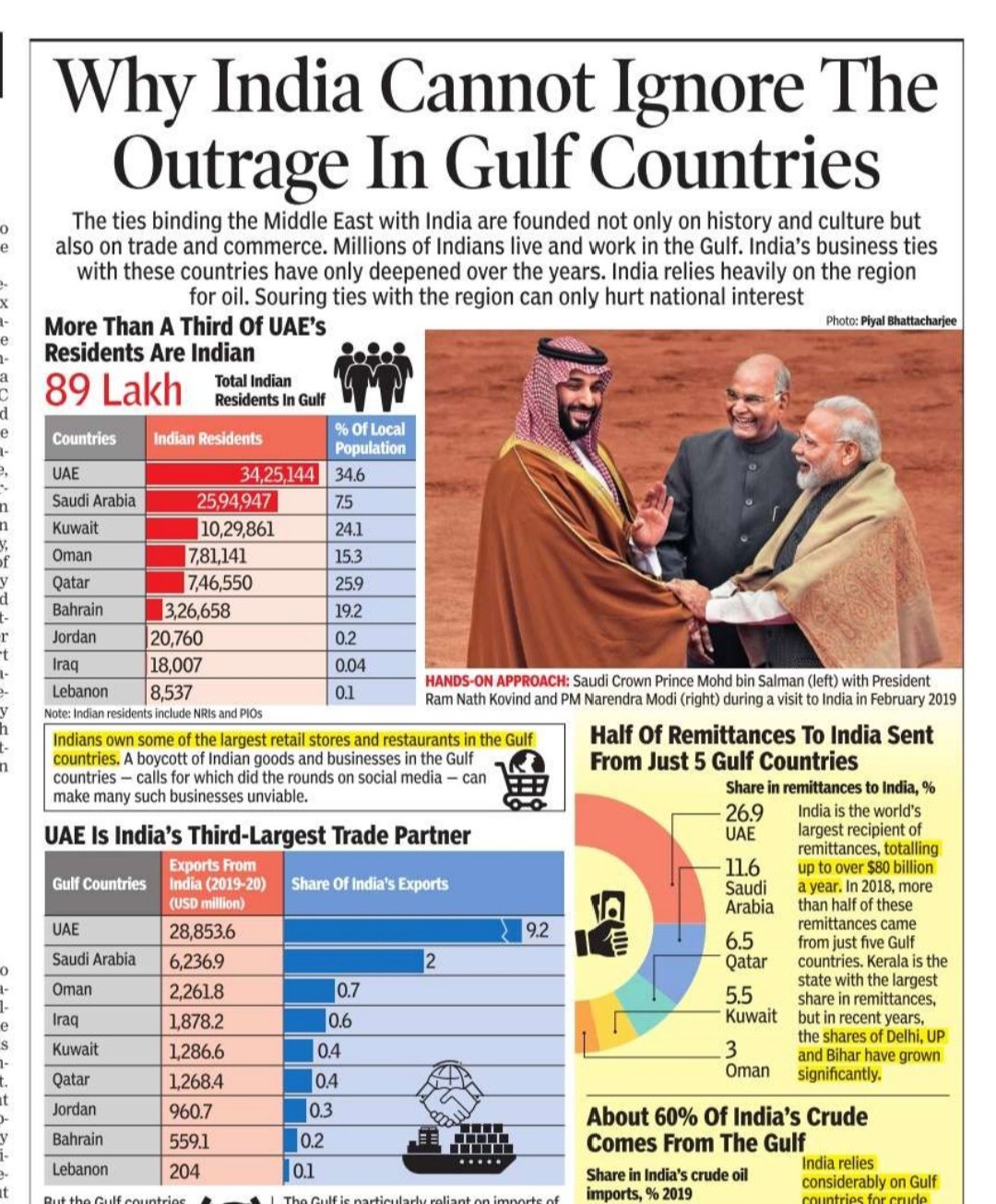
India's Ties to the GCC Nations. Source: Advaid


The BJP's entire domestic politics is built on the hatred of Islam and Muslims. At the same time, Prime Minister Narendra Modi who many hold primarily responsible for promoting Islamophobia in India, wants to have strong economic ties with the Arab Muslim Gulf states. This latest crisis has exposed the built-in contradictions in the BJP's domestic and international agenda.  Indian analyst Aakar Patel calls the ruling BJP party "a party of bigots". Here is his analysis of the situation:

"The (Modi) government has not bulldozed properties of Muslims for resisting rioting; it has conducted civic acts related to unauthorized construction. India is not targeting its Muslims through CAA-NRC pincer; it is only showing solidarity with non-Muslims from neighboring nations. Allowing mobs to prevent congregational prayers in designated spaces is really to ensure traffic flows smoothly. There can not be many who are innocent of what is going on. Certainly, there are none among the votaries of Hindutva. The problem is having democratized violence against Muslims across the country, and having been electorally rewarded for this, Modi must consider what it means for India. He has been given a taste of that this week, and as the sequence of events shows, he has not found it appealing. Trouble on this front will return unless Hindutva retreats and returns India to its normative secular state its Constitution prescribes. This is not going to happen under Modi, of course. The next best thing is to backpedal Hindutva a bit and calibrate Hindutva to a level where it pleases its constituency but doesn't offend the world. This will not be easy as we are about to find out". 


It is important to note that nearly 9 million Indians work in the Arab Gulf nations, 60% India's crude oil comes from the Middle East and the UAE is India'a third largest trading partner. Half of all remittances to India ( nearly $40 billion) come from just 5 Gulf nations of the GCC. 

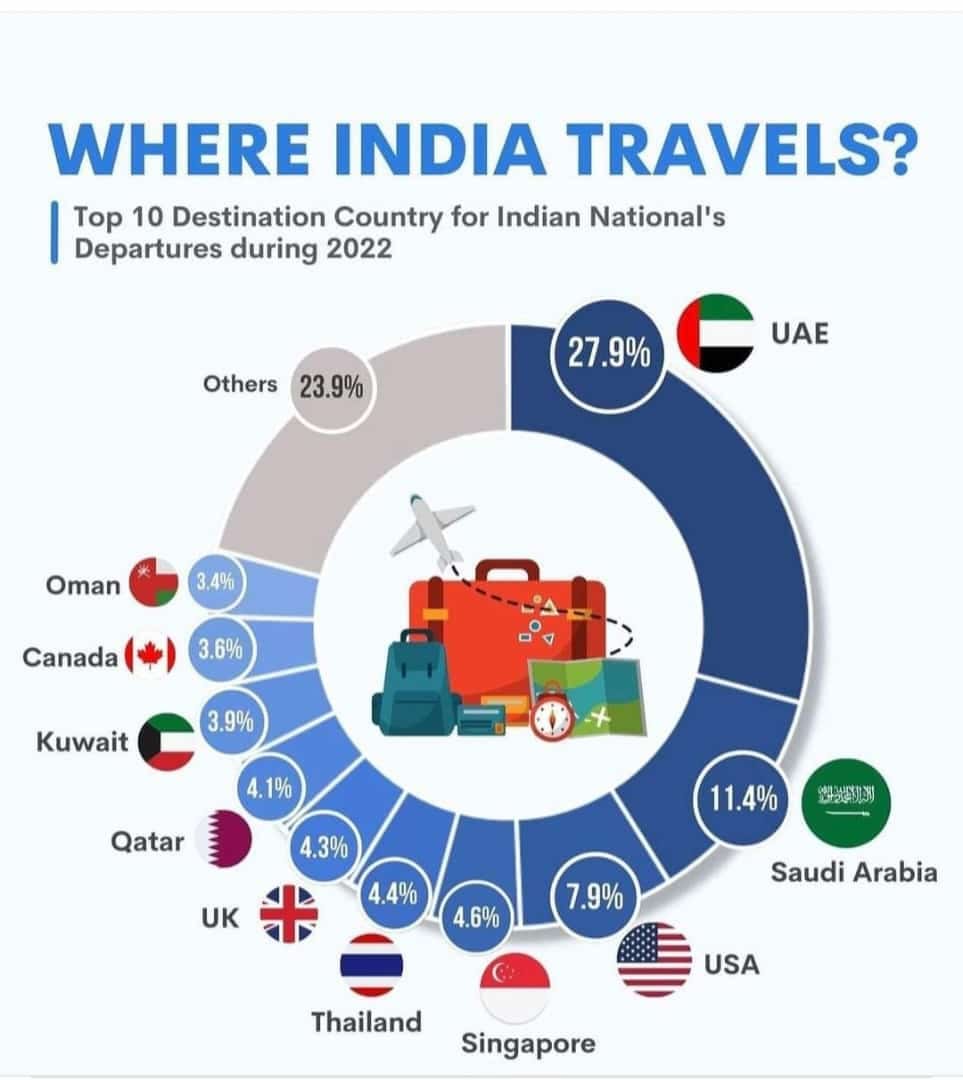
The Hindu Nationalists led by Prime Minister Modi are particularly hostile toward Muslims but also other Abrahamic faiths and the West. American journalist Walter Russell Mead described it in a recent Wall Street Journal Op Ed as follows: "Many BJP supporters want the Indian government to defend India’s Hindu civilization and culture from Islam, Christianity and Western secular liberalism. This form of Hindu nationalism leads to controversial policy initiatives". The fact that the United Arab Emirates has joined to protest is particularly significant. The Arab Muslim UAE, a grouping of  seven Arab Muslim kingdoms, has now become the number one destination for education and employment of people from Hindu India, according to the government data from the two countries. 

India is now ruled by the right-wing Hindu BJP party headed by Prime Minister Narendra Modi whose entire politics is based on extreme hatred of Islam and Muslims. In 2020, Emirati Princess Sheikha Hend bint Faisal al-Qasimi strongly criticized Islamophobia in India. She also expressed solidarity and sympathies with Indian Muslims and Kashmiris.

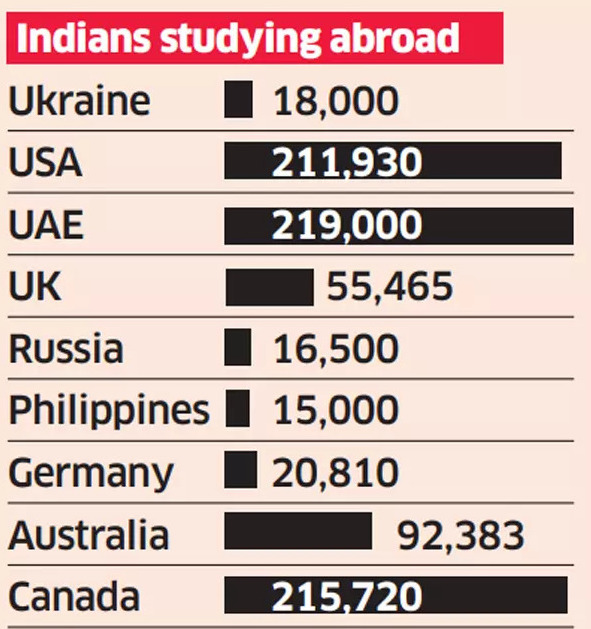
Indians Students Abroad. Source: Economic Times

Over 1.2 million Indian students are now studying overseas, twice more than a decade ago. The UAE has 219,000 Indian students, Canada 215,720, the US 211,930, Australia 92,383, Saudi Arabia 80,800, Britain 55,465, and Oman 43,600, according to the data from India's Ministry of External Affairs. 


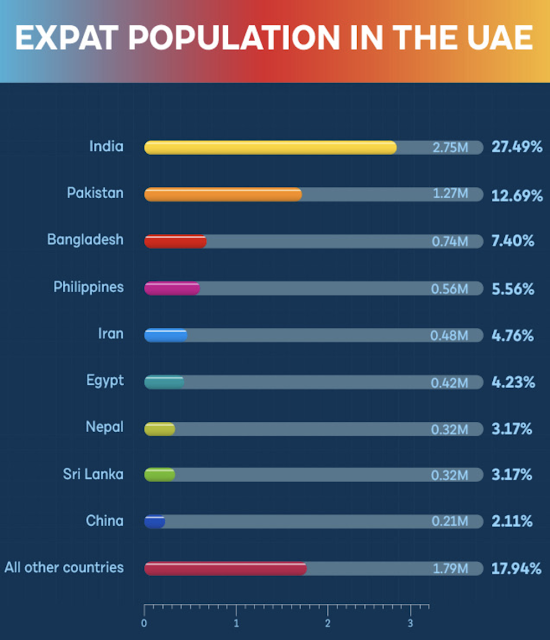
UAE Expat Population. Source: Global Media Insight

In addition to students, there are millions of foreigners working in the UAE. Currently, the Indian population in UAE is the highest with 2.75 million, followed by Pakistanis with 1.27 million. The UAE has around 0.75 million Bangladeshi nationals, 0.56 million Filipinos, and 0.48 million Iranians. There are also people from Egypt (0.42 million), Nepal (0.32 million), Sri Lanka ( 0.32 million), China (0.21 million) and the rest of the world (1.79million).

Last year, India received $43 billion in remittances from the UAE. Total worker remittances to India reached $87 billion last fiscal year, making it the world's largest recipient of these remittances. 

The United States was the second largest destination for Indian students. China maintained its top position among the leading places of origin for international students, with 35% of all international students in the 2020-21 school year hailing from the country, according to the data released by the United States government.  The second most common place of origin was India (18%), followed by South Korea (4%) and Canada (3%). Some of these countries also experienced the largest year-over-year declines in the number of students who enrolled at US institutions. The largest such percentage decreases occurred in South Korea (-21%), China (-15%) and India (-13%).

Related Links:

Sunday, January 12, 2020

Are Pakistani Leaders Slaves of Arab Royals?

Are Pakistani leaders slaves of Arab Royals? Or simply doing what is in Pakistan's best interest?

Prime Minister Imran Khan Driving Prince Mohammad Bin Salman in Islamabad

Why did Imran Khan not attend the Kuala Lumpur Islamic Summit that was organized by Malaysian Prime Minister Mahathir Mohammad and attended by Turkish President Erdogan and Iranian President Hasan Rouhani? Why did he yield to Saudi pressure to skip it?

What are Pakistan's key economic and security interests in Gulf Cooperation Countries (GCC)? Is labor Pakistan's biggest export earning over $20 billion a year? What is the biggest export market for Pakistan's labor? What would happen if Pakistan joined Malaysia and Turkey in creating a new Muslim bloc competing with the Arab-led Organization of Islamic Countries (OIC)? Will OIC try to live up to Pakistan's expectation of a tougher stance against India's Modi vis a vis Indian Occupied Kashmir and Indian Muslims?

Who makes Pakistan's foreign and security policies? How influential is Pakistani military in making these policies? Is Imran Khan free to pursue whatever policies he personally prefers? Would any other Prime Minister have pursued a different policy with GCC nations?

ALKS host Faraz Darvesh discusses these questions with Sabahat Ashraf (ifaqeer) and Riaz Haq (www.riazhaq.com).


https://youtu.be/ylEor2XPblQ


Related Links:

Haq's Musings

South Asia Investor Review

Soleimani Was the Hardest of the Hardliner

Confessions of an Economic Hitman

Putin Challenges American Exceptionalism

Remittances to Pakistan Up 21X Since Year 2000

Modi's Kashmir Blunder

Godfather Metaphor for Uncle Sam

Seeing Bin Laden's Death in Wider Perspective

Destructive Power of Drone Swarm on Saudi Oil Installation

US Dominates List of World's Top Universities

Indian RAW Agent Kulbhushan Jhadav Used Chabahar

Iran-Saudi Conflict

Pakistan's Nuclear Program

Iran Nuclear Deal

1971 India-Pakistan War

Chabahar vs Gwadar Ports

Did America Contribute to the Rise of ISIS?

Riaz Haq's YouTube Channel

PakAlumni Social Network