 |
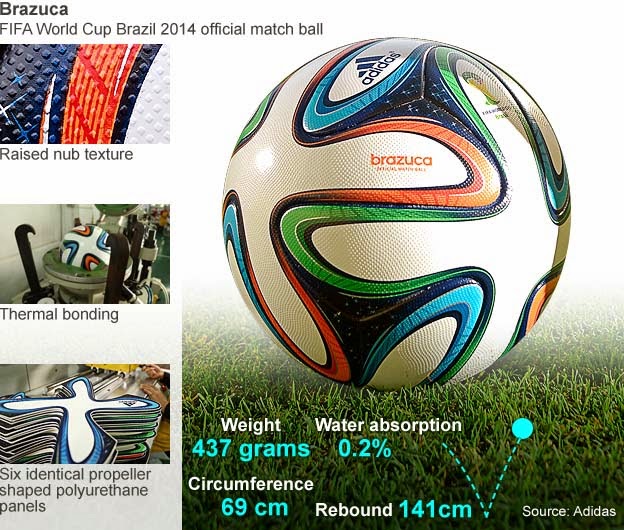
| Brazuca Ball Source: BBC |
Pakistan has not only earned the honor of manufacturing the ball that will be used in FIFA 2014 matches but also outdone both India and China in supplying tens of millions of footballs to European nations that place bulk orders for promotional purposes, according to India's Economic Times.
The Brazuca design is an improvement on the Jabulani ball used in 2010 World Cup in South Africa. Jabulani was too smooth with shallow seams, a problem that has been fixed in the Brazuca by adding raise nub texture and creating deeper seams making its flight more predictable.
The 2010 Jabulani ball had eight panels. The 2006 ball had 14. Before that, the balls were made of 32 internally-stitched panels. By decreasing the number of panels, they decreased the seams, creating a smoother surface. This smoother surface allows it to travel at higher speeds before it started knuckling. Knuckling is when the ball wobbles in the air, following an unpredictable flight path. It's a tool for strikers, a menace for goalkeepers. Researchers at the Center for Sports Engineering Research at Sheffield Hallam University in the UK measured the seams of the Jabulani and the Brazuca, and found that the Jabulani's seams are about .48 mm deep compared to 1.56 mm for the Brazuca. The seams on the Brazuca stretch to 327 cm, compared to 203 cm on the Jabulani.
The Brazuca ball went through a range of scientific tests to assure that it would complement the players' skills on the field, rather than adding a skill set all its own. "We do extensive flight path analysis and the results have shown constant and predictable paths, with deviations hardly recognizable," Matthias Mecking told the BBC. Mecking is Adidas's football director. "We've come full circle," NASA Ames Research Center scientist Ravi Mehta told the CBS News. "It's back to knuckling at about 30mph." He was not involved in the design but has tested the ball. Another important factor, he says, is the amount of friction between the ball and the player's boot. Dr Mehta explained that when a relatively smooth ball with seams flies through the air without much spin, the air close to the surface is affected by the seams, producing an asymmetric flow. This asymmetry creates forces that can suddenly knock the ball, causing volatile swoops.
Those who are familiar with the cricket ball know that seams and rough surfaces play a crucial role in how the bowler can make it swing in flight, a technique pioneered by Pakistan's Waqar Younis. Knuckle ball technique used by some Baseball pitchers is similar. The use of seams and roughness of the ball are tools for the bowler or pitcher but a menace for the batsman or batter at the other end.
Here's a video about Sialkot factory manufacturing Brazuca:
Adidas Brazuca being made in Pakistan by Lahorevideos
Related Links:
Haq's Musings
Johnson-Ali Model of Success in Olympics
Commonwealth Games 2010
Geo Sports Ban
IPL Mixes Business, Sports and Entertainment
Pak Cricket Needs Top Batting Coach and Sports Psychologist

