Oil consumption in Pakistan jumped 19% to 20.8 million tons in 2021, a strong indication of the country's economic recovery from the COVID-impacted 2020. In addition to oil, Pakistanis also consumed nearly 4 billion cubic foot of natural gas every day. Energy is fundamental to the functioning of any economy.
 |
| Pakistan Oil Consumption. Source: Arif Habib |
Pakistan's furnace oil consumption has been declining for several years as power producers continued to switch fuel to liquified natural gas (LNG) in recent years. However, the sudden jump in LNG prices forced them to use more furnace oil in year 2021 than in 2020. There was also a big jump in diesel (HSD) and petrol (MS) with a rise in number of vehicles on the nation's roads.
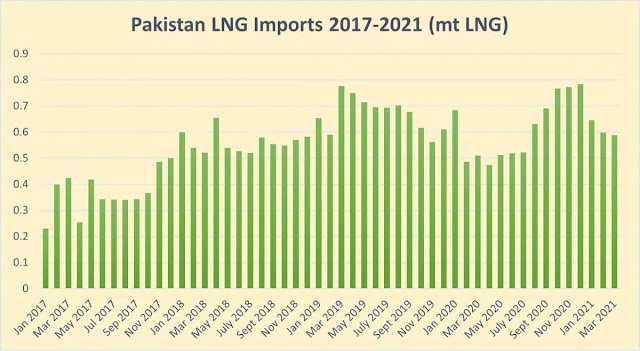 |
| Pakistan LNG Imports 2017-2021 in million tons |
 |
| Pakistan Natural Gas Consumption in Billion Cubic Feet Per Day |
“Year 2021 proved to be remarkable for the automobile sector as there was a volumetric sales growth of 90% on a year-on-year basis to 210,048 units compared to 110,540 units in 2020,” said Arif Habib Limited analyst Arsalan Hanif.
 |
| Pakistan Auto Sales. Source: Arif Habib |
Motorcycle sales in the first 9 months of CY 2-21 were 1.4 million units, up 37.5% vs the 2020 and 13.0% vs the 2019. Atlas Honda dominated the motorcycle market with sales up 52.2%. Soaring cement consumption, rising auto sales and double digit increase in energy consumption in Pakistan in 2021 confirm that Pakistan's recovery from the COVID-induced slump is well underway.
Barring any adverse impact of the Omicron variant of the COVID 19 virus, Pakistan's GDP is likely to grow at least 5% in the current fiscal year ending in June, 2022. The country's average economic growth of 5% a year has been faster than the global average since the 1960s. However, it has been slower than that of its peers in East Asia. It has essentially been constrained by Pakistan's recurring balance of payment (BOP) crises as explained by Thirlwall's Law. Pakistan has been forced to seek IMF bailouts 14 times in the last 70 years to deal with its BOP crises. This has happened in spite of the fact that remittances from overseas Pakistanis have grown 30X since 2000. Every time Pakistan has faced a balance of payments crisis, the result has been massive currency devaluation, high inflation and slower growth for a period of multiple years. This is exactly what Pakistan's current government led by Prime Minister Imran Khan is dealing with right now. This pain is the result of years of flat exports, soaring imports and excessive debt taken on during former Prime Minister Nawaz Sharif's PMLN government from 2013 to 2018. The best way for Pakistan to accelerate its growth beyond 5% is to boost its exports by investing in export-oriented industries, and by incentivizing higher savings and investments.
Related Links:

