Respected American South Asia expert Stephen Cohen of Washington's Brookings Institution recently told his audience: "Not a few Indian generals and strategists have told me that if only America would strip Pakistan of its nuclear weapons then the Indian army could destroy the Pakistan army and the whole thing would be over."
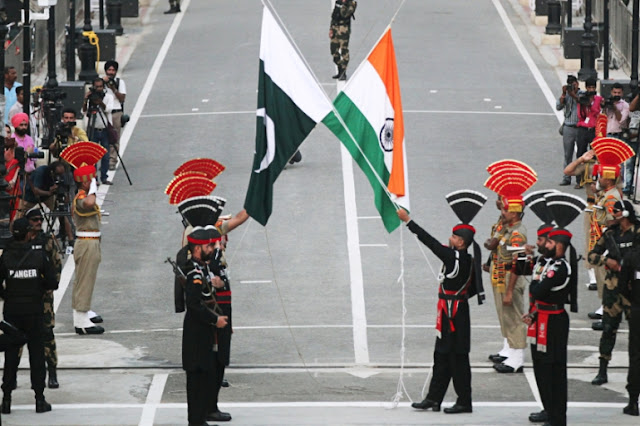 |
| India-Pakistan Border Crossing |
These remarks sharply contrast with the volumes being written in the West, particularly in the United States, about Pakistan's "obsession" with India. Pakistan is being incessantly lectured by the Western leaders and media to stop worrying about the security threat from India and focus exclusively on its western frontiers and the Taliban. These positions are often echoed by some of the liberal media editorials and commentators in Pakistan as well, in spite of substantial evidence to the contrary.
The American admonitions to Pakistan about India's "benign" intentions are now turning into absolute demands. Preposterous conditions by various interest groups and
Indian lobbyists in Washington are being added to the draft version of the "Aid Pakistan bill" that is expected to come up for debate in US Congress soon.
According to Pakistan's
Dawn newspaper, the first major condition for aid requires Pakistan to undertake not to support any person or group involved in activities meant to hurt India and to allow US investigators access to individuals suspected of engaging in nuclear proliferation if it wants to qualify for a threefold increase in US economic assistance. This is probably just one of many conditions that Pakistanis will see as an insult to and assault on the nation's sovereignty.
With Pakistan's vociferous protests and angry responses to the US campaign against its military and intelligence service's genuine concerns about the Indian threat, there are a few US respected analysts, including Christine Fair, Laura Rozen and Stephen Cohen, who are beginning to look for and discover evidence of India's hostile actions and intentions vis-a-vis Pakistan.
Here's what
Christine Fair of Rand Corporation thinks about Indian involvement in destabilizing Pakistan via its growing presence and influence in Afghanistan:
I think it would be a mistake to completely disregard Pakistan's regional perceptions due to doubts about Indian competence in executing covert operations. That misses the point entirely. And I think it is unfair to dismiss the notion that Pakistan's apprehensions about Afghanistan stem in part from its security competition with India. Having visited the Indian mission in Zahedan, Iran, I can assure you they are not issuing visas as the main activity! Moreover, India has run operations from its mission in Mazar (through which it supported the Northern Alliance) and is likely doing so from the other consulates it has reopened in Jalalabad and Qandahar along the border. Indian officials have told me privately that they are pumping money into Baluchistan. Kabul has encouraged India to engage in provocative activities such as using the Border Roads Organization to build sensitive parts of the Ring Road and use the Indo-Tibetan police force for security. It is also building schools on a sensitive part of the border in Kunar--across from Bajaur. Kabul's motivations for encouraging these activities are as obvious as India's interest in engaging in them. Even if by some act of miraculous diplomacy the territorial issues were to be resolved, Pakistan would remain an insecure state. Given the realities of the subcontinent (e.g., India's rise and its more effective foreign relations with all of Pakistan's near and far neighbors), these fears are bound to grow, not lessen. This suggests that without some means of compelling Pakistan to abandon its reliance upon militancy, it will become ever more interested in using it -- and the militants will likely continue to proliferate beyond Pakistan's control.
The former (American) intelligence official strongly supported the regional approach to Afghanistan suggested by US special representative to Afghanistan and Pakistan Richard Holbrooke. "Afghanistan is a classic power vacuum," the former official said. "Neighbors see it as point of instability to guarantee their own stability or an opportunity to score points."
While the U.S. media has frequently reported on Pakistani ties to jihadi elements launching attacks in Afghanistan, it has less often mentioned that India supports insurgent forces attacking Pakistan, the former intelligence official said. "The Indians are up to their necks in supporting the Taliban against the Pakistani government in Afghanistan and Pakistan," the former (US) intelligence official who served in both countries said. "The same anti-Pakistani forces in Afghanistan also shooting at American soldiers are getting support from India. India should close its diplomatic establishments in Afghanistan and get the Christ out of there."
"None of this is ever one-sided," he added. "That is why it was so devastating and we were so let down" when India got taken out of Holbrooke's official brief.
Here is an excerpt from respected South Asia expert Stephen Cohen's recent remarks in Canada:
India is groping now for a national identity that would allow it to approach Pakistan with confidence, but there is no consensus on how to mesh India’s identity with that of Pakistan’s. Indians do not know whether they want to play cricket and trade with Pakistan, or whether they want to destroy it. There is still no consensus on talking with Pakistan: sometimes the government and its spokesman claim that they do not want to deal with the generals, but when the generals are out of the limelight, they complain that the civilians are too weak to conclude a deal. The default option seems to be that Pakistan is now someone else’s problem--in this case the United States’. Not a few Indian generals and strategists have told me that if only America would strip Pakistan of its nuclear weapons then the Indian army could destroy the Pakistan army and the whole thing would be over. This of course is both silly and dangerous—and could lead to a catastrophic misjudgment when the fifth India-Pakistan crisis does come. We were close to one last year, I have no doubt that the people who tried to trigger a new India-Pakistan war will try again.
President David Malone, and Ladies and Gentlemen, I am honored to be invited to speak in this series on India. My approach will certainly be different from that of M.S. Swaminathan and Amartya Sen—both of whose work I came to know in 1993 when I spent a wonderful year in the Ford Foundation’s New Delhi office. My hope is that it offers an equally valid way of looking at India’s “emergence” or “rise,” and that what I have to say is relevant to our shared interest in seeing a more prosperous, equitable, and democratic India.
India’s Revolutions
India is a revolutionary power in many ways. India is not only undergoing several domestic revolutions—that of its economy, its caste system, and its federal structure, but also in how it sees its place in the world. India’s revolutions are different than those of China, and comparisons must be made very carefully. I can save some of you a lot of trouble by letting you know that much of the literature on “Chindia,” exemplified by two books I saw in Chennai last December—The Dragon and the Elephant and The Elephant and the Dragon, is with a few exceptions, mostly useless.
The end of the Cold War forced India to reconsider how it configured its relations with major states, notably America. It is still a free-rider to the extent that, without being a member of any American-organized alliance, it benefits from the stability provided by these alliances. At best, Indians describe their relationship with the US as a “natural alliance,” a content-less term. India has an interest in a stable international order, but it has so far been only a bit player when it comes to global order issues.
With the end of bipolarism the long-held dream of becoming one of the world’s four or five centers of power and authority seemed to move closer, but other than run of the mill peacekeeping operations under UN auspices—just like Bangladesh—it shows few signs of playing a larger role. Perhaps maintaining its own integrity is enough for the time being, but the chronic conflict with Pakistan is another reason why India remains confined to its region.
India’s dispute with Pakistan is one of the reasons why the reforms sought by Amartya Sen, M.S. Swaminathan, and such eminent businessmen as Nandan Nilekani will be slow in coming. Ironically, this is not because of Pakistan’s strengths, but because of its weaknesses. Let me develop this idea further.
Globalization and its Discontented Victims
The cold war masked a process that was just as corrosive to many states as the US-Soviet rivalry. Pakistan got the worst of both worlds: its cold war ties retarded its political development, they allowed for the perpetuation of a military and strategic rivalry with the much larger India, and gave it false comfort in the belief that its cold war allies would help them in time of crisis.
However, often hidden by the rhetoric of the cold war, another process was moving forward. This was variously termed “non-military security,” or ‘human security,” labels that were invented to compete with the cold war paradigm of “hard” or “real” security, that is, the security of states themselves.
There was a widespread belief, promulgated by the foundations and some governments, that states were themselves the threat -- that too strong states repressed their citizens, and that human rights groups and NGOs could, and should, fill in where the state was repressive. There was also a belief that too much attention had been given to the security of states, not enough to their citizens. The state was the problem, non-state forces, backed by international watchdogs, were the answer.
I think this was a misdiagnosis—states that were too weak were also a problem, and over the last ten years we have seen the further weakening of many new states, and some old ones, such as Nepal and Afghanistan, states that have been unable to adapt to the accelerating process of what we call globalization, defined as the increasingly rapid movement of ideas, people, and goods around the world at an unprecedented rate. The three technologies at the heart of this latest spell of globalization were the transistor, the wide-bodied jet, and the container ship. They enabled revolutionary applications such as the cell phone, satellite communications, and (a mixed blessing, indeed), global finance networks.
Of course, the world has always been globalizing, people, ideas and goods have been in motion since prehistoric times. Four hundred years ago globalization entered its modern era with the invention of navigational aids and new forms of military organization that allowed the exploration and conquest of the world by a few Western states and later Japan. Two hundred years ago globalization hit the middle classes, and allowed ice from Walden Pond to cool drinks in the clubs of Madras, Bombay, and Calcutta, and as Henry David Thoreau wrote, would mix with the holy waters of the Ganges. A hundred years ago steam technology and international mail service enabled my grandfathers to hopscotch around the world until they settled in the United States—one of them, incidentally, made a stop in Canada.
India had the resources and the infrastructure to take advantage of the most recent surge of globalization. It has become a global player in the software industry, a major center for advanced research (often funded by others, not necessarily in response to critical Indian needs, such as agriculture), a cultural superpower, and an efficient processor of services. As Thomas Friedman and others have noted, India (and China) have lifted the largest number of people in history out of poverty—yet India still has half of the world’s poor.
Misreading the World
Indian leaders misread the end of the Cold War. They correctly saw that they had to re-balance Indian strategic policy—after all the chief international supporter, the Soviet Union, had disappeared. Leading Indian strategists argued early on that some accommodation with the United States was necessary. Now, just about every party, except a few on the Left, agree with this shift.
However, there was a slow and inadequate response to the unleashing of new forces set free by the decline of communist and left ideology. We forget that the Cold War was not just a struggle between major states—the so-called superpowers—but a struggle between ideas on how the world would be organized. Young people are almost always idealistic, and a generation ago usually rallied to a leftist, pro-Soviet, or even pro-China cause.
The end of the cold war, plus China’s conversion to market economics and a cynical single party state pretty much removed the appeal of left ideas as far as the young, the backbone of any revolutionary movement that opposed injustice, even if Maoism without Mao lingers on in South Asia.
By the early 1990’s it was easy to predict that ethnic identity movements and religion would replace communism as the Polar Star of the young, the disenfranchised, and the angry.[3] As a state, India is familiar with ethnicity and identity: it is an important element in India’s relations with all of its neighbors. A short list would include Tibetans, Kashmiris, Bengalis, Sikhs, Sindhis, Nepali speakers, Mohajirs, and Tamils. Indeed, every one of India’s neighbors has a major overlap with it in terms of ethnic identity movements.
New Delhi early on learned how to manage ethnic movements, using force when necessary, then accommodation. In the words of an Indian police official, “we hit them over the head with a hammer, then we teach them to play the piano.” It works, in the same way that the Romans kept peace in their far-flung multi-ethnic empire. It also works as an instrument of foreign policy, and a number of South Asian states, including India, have used ethnic separatist movements to keep a rival off-balance. India (backed by the US) did this for a while with the Tibetans of China, it certainly did this in Sri Lanka, supporting Tamils, with tragic and unanticipated consequences, and its most significant use of ethno/linguistic discontent was its support of East Bengali separatist against Pakistan. There is ample evidence that India uses its presence in Afghanistan to not only balance radical Islamists there, but to undercut Pakistani efforts.
Of course, Pakistan had long fished in troubled Indian waters. Even today it officially draws a distinction between Kashmir and India proper. China actively supported Naga separatists and other irredentists for many years.
Two, three, four, or five wrongs not only do not make a right, but they create a morally muddied situation. If everyone is to blame, no one is to blame. The alphabet agencies—ISI, RAW, and so forth—are often the chosen instrument of state policy when there is a conventional (and now a nuclear) balance of power, and the diplomatic route seems barren.
Frankly, this would not matter very much in the larger scheme of things, especially with an India that is acquiring real economic power. In the case of India’s other major Asian rival, China, they have a long border dispute, they have supported separatist and irredentist groups in each other’s territory for years, they are economic rivals, and they are nuclear weapons states—yet they have moved to a level of accommodation and understanding that seems impossible in the case of India and Pakistan. China is expected to soon become India’s largest trade partner, whereas Indian trade with Pakistan (except via the smuggling route), is negligible.
The India-Pakistan Conundrum
There are many reasons why India and Pakistan are seemingly incompatible, despite their shared history and geographical space. Let me present an explanation, and then note how other trends impinge upon an already-dangerous situation.
Structurally, the India-Pakistan relationship is toxic. It is a classic case of what I call a “paired minority conflict.” In these situations both sides see themselves as vulnerable, threatened, encircled, and at risk. They have a “minority” or “small power” complex, which also means that conventional morality does not apply to them. Sri Lanka and the Middle East are the other two outstanding cases of a “paired minority conflict.” All three are self-contained, internally powered conflict machines.
It is easy to see why Pakistanis have a classic small power complex: they are indeed smaller than India, increasingly less capable, their friends are fickle, and when from time to time Indian politicians and officials concede that Pakistan is a legitimate country, Pakistanis feel even more insecure.
But why India? There is a powerful and emerging Indian identity, one that transcends regional differences, a continental-sized economy, and the plaudits of the world, now including the United States. India also has a world-class popular culture and its political parties are constantly redefining and refining a new Indian identity. But the fact remains that until very recently the self-identity of India’s elite was that they were citizens of a loser state? Those who were able to do so left it for more promised lands, to America’s benefit and that of Canada. This is changing rapidly, just as there is new thinking in Pakistan about India, but the core antagonisms still drive the overall relationship, hampering efforts to develop trade, people-to-people, and economic and institutional ties of a level that exists, say, between Taiwan and China.
In their quest for an identity, some Indians tried to replicate Pakistan’s failure by manufacturing a “Hindu” Indian identity—the so-called Hindutva movement. But there is no all-Indian Hindu identity—India is riven by caste and linguistic differences, and Aishwarya Rai and Sachin Tendulkar are more relevant rallying points for more Indians than any Hindu caste or sect, let alone the Sanskritized Hindi that is officially promulgated.
India is groping now for a national identity that would allow it to approach Pakistan with confidence, but there is no consensus on how to mesh India’s identity with that of Pakistan’s. Indians do not know whether they want to play cricket and trade with Pakistan, or whether they want to destroy it. There is still no consensus on talking with Pakistan: sometimes the government and its spokesman claim that they do not want to deal with the generals, but when the generals are out of the limelight, they complain that the civilians are too weak to conclude a deal. The default option seems to be that Pakistan is now someone else’s problem--in this case the United States’. Not a few Indian generals and strategists have told me that if only America would strip Pakistan of its nuclear weapons then the Indian army could destroy the Pakistan army and the whole thing would be over. This of course is both silly and dangerous—and could lead to a catastrophic misjudgment when the fifth India-Pakistan crisis does come. We were close to one last year, I have no doubt that the people who tried to trigger a new India-Pakistan war will try again.
The structural contradictions in the relationship explain much of the problem. Put in terms of raw politics, India’s political parties do not make this a central issue in governance. In Pakistan there is not much support in the Establishment (or ruling oligarchy, to use the proper Aristotelian label) for an end to South Asia’s cold (and sometimes hot) war.
As the years pass, India and Pakistan have traded places in being insecure and vulnerable: like two sides of a teeter-totter, when either side is down it fears that any concessions will lead down a slippery slope, when it is up, it expects the weaker side to bow. India is presently “up,” but there is no serious consideration of a deal that would bring to fruition the process begun by Atal Behari Vajpayee in the 1990s. Interestingly, it has been the BJP that seems to be more willing to redefine Pakistan in such a way that India could live at peace with it. Both Jaswant Singh and L.K. Advani have talked of “Jinnah’s Pakistan.”
Let me list a few other factors that reinforce this paired-minority complex:
* There are groups on both sides that try to disrupt the process when it seems to be reaching a positive conclusion. Some of the bureaucracies and covert agencies on each side need the conflict for their own self interest—the two armies, in particular, would have very little to do (except, perhaps to fight separatists and terrorist groups) if the international border were normalized. On the right, when Jaswant and Advani appeared soft on Pakistan they were roundly berated by the Hindutva hard-liners.
* The introduction of nuclear weapons in the arsenals of India and Pakistan have not promoted peace—although they may have made all-out war virtually impossible.
* The presence of bureaucratic pathologies should be noted, in particular the Pakistan army’s narrow vision, the Indian Ministry of External Affairs’ absence of vision.
* The so-called track II dialogues, are more often than not a way of avoiding serious strategic dialogue between Indians and Pakistanis. They often involve those people who were responsible for past bad decisions, yet the same people who ten years ago were eager to do nothing now preach the importance of dialogue and further meetings—conference building measure. As one Indian journalist properly observed during one of these marathon talk-fests, both governments should consider extending the age of retirement by five or ten years since so many of yesterday’s hawks had morphed into today’s doves.
* There is also an absence of imaginative strategic thinking in India—most officials and politicians seem to follow the advice of P.V. Narasimha Rao, who said that inaction is always preferable, that time will fix most problems.
Prime Minister Rao may have been right in some matters, but I don’t think this is the case with India’s chief strategic and foreign policy problem, one that penetrates to the core of Indian politics—the crumbling state of Pakistan. I won’t go into details, but all of the long term indicators for Pakistan are very negative: economic growth, population, demographic trends, sectarianism, governmental coherence, rising discontent among non-Punjabis, and an increase in sectarian extremism within the Punjab itself.
There is one positive trend: for the first time all of the major, relevant powers of the world are concerned about Pakistan. China, the EU and NATO states, America, and others understand that their Pakistan problem is not simply one of containing terrorism, but the integrity of the Pakistani state.
I think that Indians sense this, but the moment for action was five or six years ago. Here, Washington and New Delhi failed each other as they were falling over each other in an attempt to complete an agreement on civil nuclear energy. I supported the deal, but it certainly distracted the United States from what was happening before its eyes. “De-hyphenation” was an Indian objective, and it was successful in the short term—but it contributed to American disinterest in internal developments in Pakistan just as these were becoming pathological.
Exactly six years ago I published a book on Pakistan, and the last sentence concluded: “Before writing Pakistan off as the hopelessly failed state that its critics believe it to be, Washington may have one last opportunity to ensure that this troubled state will not become America’s biggest foreign policy problem in the last half of this decade.” Just before that the 2000 CIA “Global Trends” report, looking ahead to 2015, suggested that “Pakistan will not recover easily from decades of political and economic mismanagement. . . . Nascent democratic reforms will produce little change . . . . and domestic decline would benefit Islamic political activists, who may significantly increase their role in national politics and alter the makeup and cohesion of the military. . . . In a climate of continuing domestic turmoil, the central government’s control probably will be reduced to the Punjabi heartland and the economic hub of Karachi.” Most recently, the Australian/American strategist David Kilcullen, predicted that Pakistan might collapse in six months.
Is it too late? It might be, but politics is an empirical science, not a theoretical one, and there has to be one last comprehensive effort to answer the question of Pakistan’s viability.
As for India, it is both part of the problem and part of the solution, but I know that if it does not act in a positive and creative fashion its hopes of becoming a comprehensively great power cannot be achieved. There may be some gratification in seeing your major enemy and rival go up in flames, but not if your house catches fire.
What to Do?
Let me conclude with a small “to do” list, addressed mostly to India but also to outsiders who want to be of help:
* Kashmir is both the cause and effect of this paired-minority complex, it can’t be “solved” because there is no solution as long as present mind-sets prevail. Read the superb new study by Ambassador Howard Schaeffer of America’s many failed attempts coming out shortly from the Brookings press, and instead, look for ways that turn Kashmir into a non-zero sum problem. My suggestion would be to address, more broadly, the looming environmental and water issue, of which Kashmir is an important component. This affects India, China, Nepal, and Bangladesh, this is properly dealt with on a regional basis. Kashmir, as such, is not “ripe” for resolution, but parts of the problem are.
* Regional trade is another area where India and Pakistan need an excuse to do only what is in their self-interest. In this case there is the problem of the big fish-little fish: Pakistan is big fish as far as Afghanistan is concerned, but a little fish when it comes to India. India of course is the whale as far as Nepal, Sri Lanka and Bangladesh. India stands to gain a lot by giving up a little, a mind set that is common in the business community but not among the bureaucrats.
* Nuclear proliferation provides us with anotherff opportunity, and if missed, all parties will suffer. India tirelessly avoids the issue by pious accusations in the direction of Pakistan on how not to be a responsible nuclear weapons state. All that India needs to do is to rediscover the Rajiv Gandhi action plan, which not only called for global disarmament—a politically safe thing to with the Bush administration gone—but Rajiv also addressed, if briefly, the prospect of movement at the regional level. This now means China, India and Pakistan, and it should not take more than ten minutes to figure out how many nuclear weapons would preserve deterrence stability for India. Given that India was rewarded with an incredibly generous agreement by the Bush administration, India should do more than simply reiterate its own excellent record. Such a region-wide agreement might include better verification and assurances regarding national protection of weapons and fissile material; it is not that Indian practices are bad (although there is little evidence that they are good), it is that India’s vulnerability to a nuclear weapon from Pakistan is self-evident. It is astonishing that the same Indian officials and “formers” who decry Pakistan as a rogue state and the epicenter of terrorism, seem perfectly happy with Pakistan’s control over a growing nuclear arsenal.
* Finally, India needs to engage in introspection about he full range of military power that it wields. India is certainly Asia’s third great state, but the book I am now completing will argue that its strategic weight and its military power have been misjudged. Just because a state has done well in one or two areas does not necessarily mean that it will do well in all of them. There are no more than a handful of political and administrative officials who really understand the use of force and the instruments of military power. India cannot remove key threats by force, yet it maintains a huge army and an equally large paramilitary force that are strategically dysfunctional. It sometimes behaves like a timid state for good reason—yet it wants its neighbors to be in awe of its power. No big state will ever be beloved by its smaller neighbors, but India has failed to capitalize, especially in the case of Pakistan, on its real assets—these are its great cultural and economic power, not its army or its nuclear weapons.
To summarize, India is the dominant power in South Asia, but it is the putative leader of the least-integrated region of the world; its neighbors all struggle, and at least one of them, Pakistan, defines itself in anti-Indian terms. While India must concentrate upon its domestic reforms and restructuring, this process must be accompanied by fresh thinking about India’s regional relations, and the role that outside powers can play in helping these to become more normal.
The agenda I have outlined is already too long, and the problems that India faces in its relationship with Pakistan are very great. I remain optimistic that India will change -- it has done so at astonishing speed in many spheres—and somehow convert an enemy into a partner. India may have to give a little, but it has a lot to gain. The rest of us can stand by, offer suggestions where asked. However, we must also be prepared for strategic failure—another serious crisis with Pakistan, the further fragmentation of that state, or the expansion of the radical Islamist agenda to India itself. I am no Cassandra, but prudence suggests that we not just hope for the best, hope is not a policy.
In my view, Pakistan faces two existential threats, not one. Clearly, the Al Qaeda and Taliban threat is in the news right now much more than the Indian threat.
Any nation that has faced Indian intelligence's covert war followed by an outright invasion to divide it can not be told to ignore that threat. The kind of rhetoric that emanated from India post-Mumbai can not be ignored either, particularly when both nations have a nuclear standoff, the kind of stand off the Americans had with the Soviets. In fact, the situation is much worse than US-Soviet standoff because there is no geographic separation.
My assessment is that "the Taliban" is not one organized monolith with a clear set of unified goals and single chain of command. There are many disparate groups operating under the label of "the Taliban". My guess is that some of these groups have probably also been infiltrated by foreign intelligence agencies like RAW and Khad that want to wage covert war in Pakistan to destabilize it.
Related Links:


