Showing posts with label Construction. Show all posts

Tuesday, March 29, 2022

Pakistan Prime Minister Imran Khan Demonstrated Effectiveness as Crisis Leader

Prime Minister Imran Khan has effectively led Pakistan through multiple crises in the last 4 years. Khan inherited dangerously low forex reserves in 2018 which are now at  $23 billion, near the highest level in the nation's history. The COVID pandemic that hampered Pakistan's recovery has been handled well with the fully vaccinated rate for the eligible population at more than 75%. Not only has Khan deftly navigated his nation through these crises but his government has also revived the country's economy and grown exports by 26%.  Domestic savings rate recovered to nearly 17% after plunging to a low of 12% in 2018.  The year 2021 was a banner year for Pakistan's technology startups that raised over $350 million in funding, more than the amount raised in the previous 5 years. Manufacturing and construction industries are enjoying a boom last seen during the Musharraf years in 2000-2007. 

Pakistan has pursued an independent foreign policy under the PTI government. The nation has maintained friendly ties with all great powers, including China, Russia and the United States, as well the Islamic world. At a recent OIC foreign ministers' summit in Islamabad, Chinese foreign minister Wang Yi attended and endorsed OIC's support for the movement for “right to self-determination” in Jammu and Kashmir.

Historic Inflation Rates in India & Pakistan. Source: World Bank


Rising prices of food and fuel are still a major issue for the people of Pakistan and the rest of the world. Recent geopolitical crisis with the Russian invasion of Ukraine has only served to accelerate global inflation. It presents a serious challenge to the governments in Pakistan and elsewhere in the world. 

Pakistan's opposition parties have recently come together to try to topple Prime Minister Imran Khan's government. These opposition parties have little in common other than their hunger for power. If they succeed, the country will plunge into yet another period of instability and uncertainty that will reverse progress made in the last few years to stabilize the country's economy. 

Pakistan's Exports:

Pakistan's exports of goods and services have jumped 26% to $25 billion in the first 8 months of the current fiscal year, up from $20 billion in the same period last year. A key reason for recurring balance of payments crises and IMF bailouts has been the lack of growth in Pakistan's exports. 

Pakistan Exports in First 8 Months (July 21-Feb 22) in FY 22. Source: Razzak Dawood


The 26% export growth is particularly welcome after several years of stagnation seen during the PML N government of Prime Minister Nawaz Sharif. 

Job Creation: 

Pakistan’s economy created 5.5 million jobs during the past three years –on an average 1.84 million jobs a year, which is far higher than yearly average of creation of new jobs during the 2008-18 decade, according to the Labor Force Survey (LFS) published by the Pakistan Bureau of Statistics (PBS). 

Pakistan Employment By Sectors. Source: Pakistan Bureau of Statistics

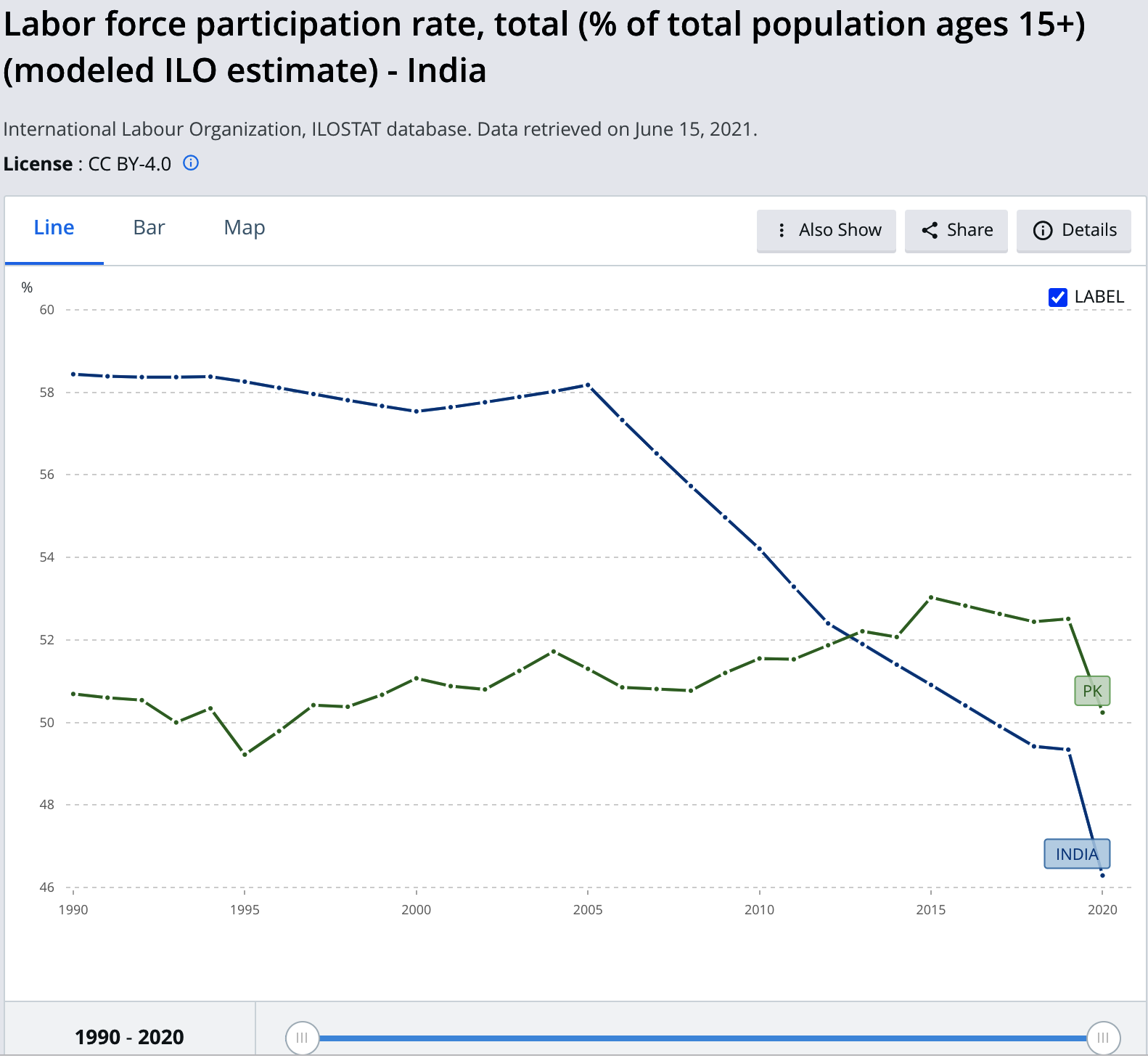
For the first time in recorded history, the labor force participation rate in Pakistan is now higher than in India, according to the ILO/World Bank estimates.


Labor Participation Rates in India and Pakistan. Source: World Bank/ILO


Unemployment rate in Pakistan is just 4.3% in spite of COVID19 pandemic. Jobless rate in India is 8%, much higher than in Pakistan. 

Unemployment Rate in India and Pakistan. Source: ILO/World Bank


Savings Rate:

Pakistan's domestic savings rate recovered to nearly 17% after plunging to a low of 12% in 2018. Savings are extremely important for increased investment to spur GDP growth in any country, including Pakistan.

Pakistan Savings Rate. Source: Global Economy

IMF Bailout:

Pakistan's forex reserves were running dangerously low forcing the country to seek a $6 billion IMF bailout in 2018 to avoid default.  The total reserves now exceed $22 billion.

Reko Diq Mining Deal Revival: 

Prime Minister Imran Khan's government recently resolved an $11 billion in damages that the country faced for improperly canceling a huge copper-gold mining deal in Balochistan.  

Reko Diq is the world's 4th largest undeveloped copper-gold porphyry deposit with over 14 million tons of copper and 21 million ounces of gold. The project was abandoned in 2011 after a Pakistan Supreme Court bench headed by former Chief Justice Iftikhar Chaudhry canceled the mining license granted to Tethyan Copper Company (TCC), a joint venture between Canada's Barrick Gold and Antofagasta Minerals of Chile. TCC challenged the cancellation in the International Centre for Settlement of Investment Dispute (ICSID). On July 12, 2019, the ICSID Tribunal awarded TCC $5.894 billion plus interest of  $700,000 per day in damages against Pakistan. As of 1 March 2022, the award stood at $6.5 billion. The new agreement between Barrick Gold Corporation  and the governments of Pakistan and Balochistan does away with this award. It also increases the share of the project owned by Pakistan from 25% to 50%, brings in $10 billion investment, the largest single investment in the country, and creates 8,000 jobs. Reko Diq is part of the Tethyan metallogenic belt (TMB) that extends from the Balkans in Europe to Pakistan including Serbo-Macedonian, Anatolian, Takab, Kerman and Chagai metallogenic belts. It is believed to be rich in copper and gold deposits.

Manufacturing and Construction Boom: 

Large scale manufacturing grew by 8.2% in February 2022,  after posting 7.6% growth during July-Jan FY22.  

QIM Index 2019-22. Source: APP

Pakistan Large Scale Manufacturing Index. Source: Mettis Global

The LSMI Quantum Index Number (QIM) hit an all-time high of 136.2 points in January, 2022. It averaged 120 points during July-January (2021-22), up from 111.5 points during July-January (2020-21), showing growth of 7.6%, according to latest PBS data.

Cement shipments in Pakistan. Source: All Pakistan Cement Manufacturers Association


Pakistan cement production has increased by double digits to respond to demand for housing and infrastructure construction on Prime Minister Imran Khan's watch. 

Technology Boom:

The year 2021 was a banner year for technology startups in Pakistan.  There was a 437% jump in investments in the startups, raising a total of $352 million across 72 deals in 2021, according to Aljazeera

Pakistan Startup Investments. Source: Aljazeera

Pakistan technology exports have soared 30% to $1.7 billion in the first 8 months of the current fiscal year, according to the State Bank of Pakistan

Expansion of Social Safety Net:

Pakistan's PTI government has built South Asia’s first digital National Socio-Economic Registry (NSER) as a part of its ambitious effort to build a basic social safety net. The Ehsaas (also known as BISP- Benazir Income Support)) program's socio-economic registry includes household information by  geography, age, income, education, health, disability, employment, energy consumption, land and livestock holdings etc. Ehsaas Programs include both Unconditional Cash Transfers (UCT) and Conditional Cash Transfers (CCT). Unconditional Cash Transfers are made only to people living in extreme poverty or distress. Conditional Cash Transfers like Waseela-e-Taleem and Nashonuma  are given for education and nutrition respectively.  In addition, there are feeding centers (langars) for the hungry and shelters (panahgahs) for the homeless. 

OIC Foreign Ministers in Islamabad:

Recent conference of Islamic countries foreign ministers hosted by Pakistan in Islamabad was attended by 56 nations. Chinese foreign minister Wang Yi attended as a special guest. Here's an excerpt of the Islamabad Declaration issued at the conclusion of the two-day conference:

“We declare that the final settlement of the Jammu and Kashmir dispute in accordance with UN Security Council resolutions is indispensable for durable peace in South Asia. We reiterate our call on India to: a) reverse its unilateral and illegal measures instituted since 5th August 2019; b) cease its oppression and human rights violations against the Kashmiris in IIOJK; c) halt and reverse attempts to alter the demographic structure and to redraw electoral constituencies in IIOJK; and d) take concrete and meaningful steps for full implementation of the UN Security Council resolutions on Jammu and Kashmir,”

Response to Indian hostility:

Prime Minister Imran Khan's government won praise for its handling of India's aggression with unprovoked air strikes in Balakot in February 2019. Pakistan responded with "Operation Swift Retort", shot down two Indian fighter jets and captured an Indian Air Force pilot. But Khan's government avoided further escalation of the incident. Similarly, Pakistan responded calmly to the "accidental firing" of Indian Brahmos cruise missile into Pakistan that could have easily escalated into a full-scale war between two nuclear-armed neighbors. 

No-Confidence Vote:

Pakistan's opposition parties have recently come together to try to topple Prime Minister Imran Khan's government. These opposition parties have little in common other than their hunger for power. If they succeed, the country will plunge into yet another period of instability and uncertainty that will reverse progress made in the last few years to stabilize the country's economy. 

Saturday, February 27, 2021

Construction and Manufacturing Driving Double-Digit Growth in Pakistan Cement and Steel Production

Pakistan steel production grew by 13.3% in 2020,  the second fastest among the top 40 steel producing countries, according to data published by the World Steel Association. At the same time, Pakistan Bureau of Statistics revealed that the nation's steel imports rose by 18% year-over-year. The demand for steel was driven by construction and manufacturing sectors which are leading Pakistan's economic recovery. 

World Steel Production. Source: World Steel Association

Pakistan steel-makers produced 3.7 million tons of steel in 2020, up 13.2% from 3.2 million tons in 2019. Neighboring India saw 10.6% decline in steel production in the same period. Global steel production declined 0.9% in 2020. Pakistan also imported $2.1 billion worth of iron, steel and scrap in the first 7 months (July 2020- January 2021) of the current fiscal year.  It's a jump of 18% from the same period in prior fiscal year.  Pakistan steel industry reached peak production of 5 million tons in 2017 before declining to 4.7 million tons in 2018 and 3.3 million tons in 2019. 

Construction boom helped Pakistan grow its domestic cement consumption by 17% in the first 7 months (July 2020-January 2021) of the current fiscal year. Domestic cement sales rose to 27.65 million tons in this period, while exports grew by 10.23% to 5.71million tons from 5.186 million tons in the same period last year.  The total cement sales (local and exports) were 33.36 million tons,  up 15.77% over the corresponding period of the last fiscal year.  

Related Links: 

Haq's Musings

South Asia Investor Review

Pakistan to Become World's 6th Largest Cement Producer By 2030

Naya Pakistan Housing Program

Pakistan's Response to COVID19 Pandemic

Pakistan Tech Exports

Pakistan Digital Economy Surged 69% Amid Covid19 Pandemic

Soaring Food Prices Hurting Pakistanis

Najam Sethi on Desperation in PDM Ranks

India's Firehose of Falsehoods Against Pakistan

Pakistan Launches Defense AI Program

Riaz Haq's Youtube Channel

PakAlumni Social Network

Sunday, February 21, 2021

Imran Khan Government's Midterm Review: Economy and Foreign Policy

Imran Khan's government has completed about half of its 5-year term it won in 2018. What are its accomplishments? Where has it failed in terms of economy and foreign policy. 

Economy:

Imran Khan inherited a serious balance of payments crisis cased by flat exports and record high imports in 2013-2018 period under Pakistan Muslim League (Nawaz) government. while the PTI government was still dealing with it, the country and the world were hit by COVID19 pandemic that devastated the global economy. 

Pakistan's Trade July2020-Jan2021. Source: Arif Habib


The 2019 International Monetary Fund's bailout required the PTI government to significantly devalue the Pakistani rupee to make exports competitive, and to raise interest rates to slow down imports. These actions triggered inflation, particularly food inflation, as energy and fertilizer prices rose. 

Export Growth in South Asia. Source: Wall Street Journal

The global COVID19 pandemic hit Pakistan and the world while the PTI government was still trying to stabilize the economy. The global economy slowed down as a result of lockdowns imposed around the world to slow the spread of the novel coronavirus. It impacted South Asian economies but Pakistan was thankfully spared the worst of it. 
Pakistan Vehicle Sales 1H FY20-21. Source: Arif Habib


Now Pakistani economy is finally stabilizing and a strong recovery is underway. The recovery is led particularly by the construction and manufacturing sector as evident from double digit increases in cement consumption and large scale manufacturing growth. 

Cement Sales in Pakistan. Source: Bloomberg


Foreign Policy:

One of Pakistan's key foreign policy successes is the US-Taliban Peace Deal. But now there is uncertainty surrounding it with the inauguration of President Joseph Biden. Biden's election and the growing rivalry between US and rising China have changed the calculus in South Asia and the Middle East regions, impacting Pakistan. Former President Trump's erratic behavior has also contributed to it. 

Based on Biden's record as Obama's vice president, it is expected that the new US president will continue to support a stable Pakistan. A suggestion that has been made by former State Department officials Shumaila Chaudhry and Vali Nasr is for the US to take advantage of Pakistan's free trade deal with China by setting up value-added re-export units in the country. 

Please watch this discussion with Faraz Darvesh as host and Dr. Owais Saleem, Sabahat Ashraf and Riaz Haq as panelists:

https://youtu.be/Cse9j72H1cU


Related Links:


How "Illiterate" Are Pakistan's "Illiterate" Cell Phone Users?


Monday, July 27, 2020

Naya Pakistan: Low-Cost Home Loans and Construction Subsidies to Boost Economy

Pakistani Prime Minister Imran Khan has recently announced a new housing construction incentives package that includes down payment assistance and expansion of home loans portfolios by commercial banks at discounted rates for affordable housing for the poor. Shariah compliant financing is also included in it. Pakistan’s mortgage finance to GDP ratio is just 0.25%, among the lowest in the world, according to the World Bank. The average for South Asia 3.4%.  New housing drives a large number of sectors of the economy from banking and building materials to construction and manufacturing of furniture and home appliances. These incentives are designed to stimulate the economy, boost employment and deal with the growing shortage of affordable housing in the country.


Naya Pakistan Housing:

Pakistan government's Naya Pakistan housing program offers Rs. 33 billion in direct subsidies for down payments for the first 100,000 applicants, according to media reports. In addition, the commercial banks are required to allocate 5% of their portfolio amounting to Rs330 billion for construction activities under this program. Pakistan’s mortgage finance to GDP ratio is just 0.25%, among the lowest in the world, according to the World Bank. A person earning Rs30,000 to Rs100,000 can build a house on a 5-marla lot with the mortgage financing at 5% and that of 10-marla at 7%.

Importance of Housing:

New Housing Starts are considered a reliable economic indicator in any country that collects routine economic data. Housing sector drives a large number of other sectors of the economy from banking and building materials to construction and manufacturing of furniture and home appliances.

These sectors, in turn, create jobs, improve people's living standards and widen the tax base. In the United States, for example, homes are the biggest contributors to net worth of Americans. Home equity loans allow people to take out loans for other purposes, including education, business startups and home improvements.  Hence, the governments' interest in pursuing pro-housing policies that ensure secure property rights, set aside land for housing and require banks to offer low-cost home loans.

Secure Property Rights:

Secure property rights are a pre-requisite for a thriving housing sector. Hernando de Soto Polar, Peruvian economist known for his work on the informal economy and on the importance of business and property rights, told Reuters back in 2016 that “(T)here is no such thing as an investment without property rights that are negotiable and transferable”.

In the United States, the world’s largest economy, the most important source of funds for new businesses is a mortgage on the entrepreneur’s house, de Soto wrote in his book “The Mystery of Capital”. He says that secure property rights for world's poor could unlock trillions in 'dead capital'.

Unfortunately, Pakistan's land title system is among the most corrupt in the country. A patwari, the title for the official keeping land records, is among the most resourceful government officials in much of Pakistan.  Patwaris have a well-deserved reputation for corruption. Legally protected and enforced property rights are the key source of the developed world’s prosperity, and the lack thereof is the reason why many nations remain mired in poverty, de Soto has argued.

Housing Finance:

Construction loans and mortgages at reasonable rates are essential for people to afford to build and own houses. Policies promoting discount loans and mortgages are the cornerstone of housing policies in the developed world.

Typical Low Cost Home. Source: Dawn 
In the United States, government-backed mortgage giants like FNMA (Federal National Mortgage Association) and Freddie Mac (Federal Home Loan Mortgage Corp) deploy vast resources to buy mortgages and ensure liquidity in the mortgage market. When lenders make loans for housing based on FNMA or Freddie Mac rules, they are confident they can sell in a highly liquid mortgage market.

Other developed countries also support mortgage financing in similar ways to make housing affordable.  Pakistan’s mortgage finance to Gross Domestic Product ratio is just 0.25%, among the lowest in the world.  The average for South Asia 3.4%. It's much higher in developed nations. It is over 65% in the United States, 40% in France and 20% in Italy.

Mortgage Debt to GDP Ratios in Developed Nation. Source: Urban Institute


Land at Discount Rates:

Land is a significant part of the cost of housing, particularly in or around big cities where land is highly appreciated. The government can help reduce this cost by offering land at discount for affordable housing.  There are news reports that Pakistan government has identified tracts of land to offer it to builders at discount rates for affordable housing.


Summary:

Naya Pakistan housing program offers Rs. 33 billion in direct subsidies for down payments for the first 100,000 applicants and requires the commercial banks to allocate 5% of their portfolio amounting to Rs330 billion for construction activities. Shariah compliant financing is also included in it.  It will boost Pakistan’s mortgage finance to GDP ratio which is only 0.25%, among the lowest in the world, and lower than 3.4% for South Asia. New housing drives a large number of sectors of the economy from banking and building materials to construction and manufacturing of furniture and home appliances. These incentives are designed to stimulate the economy, boost employment and deal with the growing shortage of affordable housing in the country.


Related Links:


Sunday, February 3, 2019

Fitch: Pakistan Construction Industry to Grow 8.9% Yearly Over Next 5 Years

Fitch Solutions, a global company focused on credit, economic, and political research, says in its latest report that the China-Pakistan Economic Corridor (CPEC) will drive Pakistan's construction industry in the next decade, as the risks associated with CPEC projects recede. Fitch forecasts that the real annual growth rate of Pakistan's construction industry will average 8.9% over the next 5 years. "We will adjust our forecasts to account for possible positive ripple effects across the economy, including the construction industry, in the event an IMF bailout is secured", the report adds.


Fitch Solutions' report titled "Industry Trend Analysis - CPEC to Remain a Primary Driver of Pakistan's Construction Industry" says: "We expect debt concerns surrounding CPEC projects to ease after financial details are released. In addition, we believe political risks associated with CPEC projects have diminished since the 2018 Pakistani general election. These factors will reduce overall risk profile of CPEC projects."

The Fitch report acknowledges the completion of eleven CPEC projects termed "early harvest". It says that despite major media and political scrutiny regarding CPEC, this progress on projects highlights Beijing’s improving track record in project execution and its commitment to infrastructure development in Pakistan. As a result of CPEC progress, a total of 3,240MW of capacity has been added to the country’s national grid, constituting over 11% of total installed capacity in Pakistan. Also highlighted in the report is the 392 kilometer Multan to Sukkur section of the Peshawar-Karachi motorway, a key CPEC project which is over 80% complete and is slated to finish by August this year.

Fitch believes political risks associated with CPEC projects have diminished. "Previously, we noted that the transition in power from Pakistan Muslim League (Nawaz) to Pakistan Tehreek-e-Insaf (PTI) posed a downside risk to the Pakistani construction industry as new Prime Minister Imran Khan pledged to review Chinese-backed projects, which could potentially have led to project delays and cancellations. However, the political situation in Pakistan has since stabilized and Prime Minister Imran Khan has demonstrated willingness to cooperate with China on multiple issues including CPEC. As such, we are in the view that downside risks stemming from political uncertainty are diminishing, and bilateral projects spearheaded by CPEC, will receive a boost in terms of policy implementation and project continuity," maintained the report.

In another recent report, Fitch's competitor Moody's has acknowledged that rermittances from Pakistan diaspora rose by 10% year on year to $10.71 billion in the first half of fiscal 2019, while goods imports slowed sharply to around 3% year on year as non-energy imports contracted.

Moody's expects "the current-account deficit to narrow to 4.7% of GDP in fiscal 2019 and to 4.2% in fiscal 2020 from 6.1% in fiscal 2018, it will remain sizable and wider than in 2013-16, driving Pakistan’s external financing needs. The government has secured $12 billion in financing from Saudi Arabia and the United Arab Emirates – in each case amounting to $6 billion and divided equally between deposits and deferred oil payments – which is likely to largely cover the country’s net financing needs for fiscal 2019".

Construction industry is a major driver of economies. The sector creates new jobs, builds housing and infrastructure, drives economic growth, and provides solutions to address social, climate and energy challenges, according to the World Economic Forum. The construction industry has important linkages with other sectors such as cement, steel, energy, furniture, household appliances, etc.  The construction industry's impact on GDP and economic development goes well beyond the direct contribution of construction activities.

Related Links:

Saturday, March 3, 2018

Pakistan is the World's Fastest Growing Steel Producer

Steel production in Pakistan jumped 39.3% to 5 million tons last year, according to World Steel Association. Earlier, Pakistan steel industry ramped up its output from 2.9 million tons in 2015 to 3.6 million tons in 2016.

While Pakistan's steel production growth is the world's fastest,  its relatively small steel production volume of 5 million tons ranks it 28th in the world. Other nations seeing strong growth in steel production are Iran (up 21.4%), Vietnam ( 31.9%) and Egypt (35%).   Iran ranks 13th with 21.7 million tons; Vietnam ranks 19th with 10.3 million tons; Egypt ranks 23rd with 6.8 million tons produced in 2017.

Some of the key names ramping up production capacity in Pakistan are Aisha Steel Mill (ASM),  Amreli Steels and Agha Steel Industries.

ASM, an Arif Habib Group company, is planning to expand capacity to a total of 700,000 tons a year from its current capacity of 220,000 tons.

Amreli Steels Limited, country’s leading steelmaker has announced plans to increase its annual production capacity of reinforcement bars to 750,000 tons a year within the next two years.


World Steel Production. Source: WorldSteel Association

The biggest drivers of soaring steel demand in Pakistan are rapidly growing large scale manufacturing and construction sectors.

Car sales shot up  23% while motorcycle sales soared by 20% in January 2018, according to industry data.

The cement sales, a good proxy for construction sector, rose 14.3% in the first 7 months of fiscal 2017-18.

World Steel Trade. Source: WorldSteel Association

Pakistan is the third fastest growing economy among the top 25 economies in terms of purchasing power parity.  Pakistan's economic growth is continuing to accelerate amid rising rising investments led by China-Pakistan Economic Corridor related infrastructure and energy related projects.  The IMF sees Pakistan economy growing at 5.6% while the World Bank forecasts it to grow by 5.5% in current fiscal year 2017-18 ending in June 2018, a full percentage point faster than the 4.5% average GDP growth for Emerging and Developing Economies (EMDEs) that include Argentina, Brazil, China, India, Nigeria and Russia among others. However, Pakistan economic growth continues to lag growth forecast for regional economies of India and Bangladesh. The report also calls attention to the expanding current account gap as a matter of concern that must be taken seriously by the government to avoid yet another return to the International Monetary Fund (IMF).

Related Links:

Haq's Musings

CPEC is Transforming Least Developed Parts of Pakistan

Per Capita Income in "Failed State" of  Pakistan Rose 22% in 5 Years

Credit Suisse Wealth Report 2017

Pakistan Translates GDP Growth to Citizens' Well-being

Rising Motorcycle Sales in Pakistan

Depth of Deprivation in India

Chicken vs Daal in Pakistan

China Pakistan Economic Corridor

Saturday, November 18, 2017

Pakistan Per Capita Cement Consumption Hit New High of 170 Kg in 2016

Pakistan's domestic cement consumption reached 35 million tons in 2016, up from 30 million tons in 2015, according to a report published by Global Cement.  Using the latest census population of 207 million, it works out to about 170 Kg per person consumption. The increase is driven by a combination of CPEC-related infrastructure projects as well as commercial and housing construction.


Pakistan Cement Sales. Source: Global Cement

While domestic demand for cement is continuing its upward trend, the exports have suffered a major decline. In 2009, the exports hit a high of over 11 million tons, constituting 34% of all cement dispatches at the time. Since then, they have fallen to below 6 million tons or 14% of all sales.

Pakistan cement industry is booming. There is some disagreement about where the biggest demand is coming from.  The CEO of Thatta Cement says it is 60% infrastructure and 40% housing but others say it is 70% housing and 30% infrastructure.

Pakistan's 11 cement manufacturers are investing a combined $2.25 billion to add new production capacity of 30 million tons a year by 2019, according to a media report attributed to the State Bank of Pakistan.

The year 2017 is also proving to be yet another boom year for cement industry. Cement sales have soared by 15% year-on-year to 10.3 million tons in the first quarter of fiscal year 2017-18 that ended in September 2017, up from 9 million tons in the same period in 2016.

Pakistan is among the world’s fastest-growing construction markets. A BMI report published earlier in 2017 forecasts an average 12 percent growth annually for the next five years.  Cement capacity utilization increased to 88 percent in the 10 months through April, the highest in 11 years, according to Bloomberg.

Beyond the construction industry boom, Pakistan's large scale manufacturing (LSM) sector is also soaring by double digits. Both of these sectors are important drivers for job growth in the country.

Although production was driven mostly by strong domestic demand, the exports in July-Sept 2018 also increased nearly 11% over the same period last year.

Among the notable sub-sectors driving strong LSM growth in July-August 2017 are: Tractors 115%,  motorcycles 28.3%, deep freezers 16.2%, air-conditioners 26.8%, electric-fans 22.4%, electric motors 17.3% and electric meters 18.3%, and switchgear 20.8%.

Significant improvement in the country's security situation is helping restore confidence of investors, businesses and consumers who are pushing economic growth in Pakistan to new highs. The fast pace of execution of China-Pakistan Economic Corridor (CPEC) related projects is at least partly responsible for it.

Related Links:


Sunday, February 15, 2015

Record Cement Sales Raise Hopes of Pakistan Economic Recovery

Domestic cement sales are up 9% year-over-year for the first 7 months of Pakistan's Fiscal 2014-15, according to media reports.  Overall, cement industry reports cement shipment of over 20 million tons in 7 months, a 6% annual increase with rising domestic demand offsetting falling exports due to weakness abroad.

Market capitalization of  Pakistani cement companies has jumped 70% last year, about 3 times more than the KSE-100 market index which rose 27% in 2014. This is the third consecutive year that cement companies have outperformed the broader market. Investors in Pakistan's cement sector have seen 600% rise in the last three years.

It appears that construction  sector is getting a boost from falling inflation and declining interest rates with a big drop in world oil prices. Domestic sales of 2.5 million tons a month translate to about 160 Kg per capita consumption of cement, the highest level in Pakistan's history.


Pakistan saw its domestic cement consumption double from about 11 million tons in 2003 to 22 million tons in 2008 on President Musharraf's watch. It remained essentially flat from 2009 through 2011 before rising to a new high of 24 million tons in 2012. With expected GDP annual growth to average 4.5-5.5 per cent over the next 3 years, local cement sales could rise by 9 per cent on average annually to reach 34 million tons per year by 2017 and exports to 8 million tons per year.

Cement sales and building activity indicators are an important sign of the strength or weakness of the broader economy, due to construction's important role in the economic sector. If individuals and businesses are willing to invest in new construction, it is a sign that the economy is doing well or poised to recover. If they aren't, the economy may be weak or headed for trouble. Construction is a very labor-intensive activity which creates many new jobs. Higher employment drives consumer spending which further stimulates the national economy.

In addition to rising demand for housing and new commercial real-estate, major infrastructure and energy projects related to the China-Pakistan Industrial Corridor are expected to significantly boost domestic cement consumption and create millions of new jobs over the next several years.

Related Links:

Haq's Musings

State Bank: Pakistan's Actual GDP Higher Than Official Figures

Investors Bullish on Pakistan Cement Sector

Pakistan Ranks in the Middle For Infrastructure and Logistics

China-Pakistan Industrial Corridor

India Fudging GDP to Claim Faster Growth Than China?

India-Pakistan Economic Comparison 2014


Tuesday, February 5, 2013

Pakistani Construction Boom Continues in 2013

Domestic cement consumption surged 10.10% in Pakistan in January 2013, according to All Pakistan Cement Manufacturers Association. On top of 8% increase in Fiscal Year 2011-12, it jumped another 8% for the first seven months of Fiscal Year 2012-13.

Cement production is an important barometer of national economic activity,  according to a research report compiled by a Credit Suisse analyst.  Last year, CS analyst Farhan Rizvi said in his report that "higher PSDP (Public Sector Development Program) spending has led to a resurgence in domestic cement demand in FY12 (+8%) and with increased PSDP allocation for FY13 (+19%) and General Elections due in 2013, domestic demand is likely to remain robust over the next six-nine months".

Ongoing public sector projects include new large and small dams, irrigation canals, power plants, highways, rapid transit systems, flyovers, airports, seaports, etc. Most of these were already in the pipeline when the PPP government assumed control in 2008. Recent pre-election increases in PSDP funding allowed work to resume on these projects in 2011-12.

 In addition to public sector infrastructure projects, there is a lot of privately funded real estate development activity visible in all major cities of the country.

Ocean Tower Karachi
Among the high-profile new construction projects completed this month is Ocean Tower in Karachi. At 393 feet high with 30 floors, it is now the tallest building in Pakistan. Ocean Tower has a shopping mall, food courts, corporate offices, a business club, car-parking area and 4 cinemas.

The Centaurus Islamabad
The Centaurus, at 361 feet, is another new project in Islamabad completed this month. It consists of three towers---office tower, residential tower and a 5-star hotel. The three will be linked by a shopping mall.

Big real estate developers like Bahria Town and Habib Construction are developing both commercial and housing projects in Islamabad, Karachi and Lahore. Other cities like Faisalabad, Hyderabad, Larkana, Multan, Mirpur, Peshawar and Quetta are also seeing new housing communities, golf courses, hotels, office complexes, restaurants, shopping malls, etc.

Per capita cement consumption in Pakistan was only 70 Kg in 2003. It has more than doubled in the last decade.  With back-to-back increases in domestic cement demand, per capita consumption has now risen to 154 Kg which is still below average for Asia. But the rising demand is a good sign of economic recovery since 2009 when the GDP growth hit a low of 1.7%.

Centaurus Mall Opening Day


Credit Suisse is bullish on Pakistan's cement sector in particular and Pakistani shares in general.

CS analyst Farhan Rizvi has initiated coverage with "an OVERWEIGHT stance, as we believe compelling valuations, improving domestic demand outlook, better pricing power and easing cost pressures make the sector an attractive investment proposition. Despite better growth prospects (3-year CAGR of 17% over FY12-15E) and improving margins, the sector trades at an attractive FY13E EV/EBITDA of 3.8x, 49% discount to the historical average multiple of 7.4x. Moreover, FY13E EV/tonne of US$74 is approximately 29% discount to historical average EV/tonne of US$104 and 50% discount to the region".

A New Housing Construction Project in Rawalpindi


Another CS analyst Farrukh Khan, based in Credit Suisse’ Asia Pacific headquarters in Singapore,says in his research report that “liquidity in 2012 has been concentrated in stocks offering positive earnings surprises (e.g., United Bank, Lucky Cement, DG Khan Cement and Bank Alfalah), enabling them to be strong outperformers. With further improvements in liquidity, we expect a broad-based price discovery to take hold in attractively valued oil and fertilizer stocks as well.”

 A string of strong earnings announcements by Karachi Stock Exchange listed companies and the Central Bank's 1.5% rate cut have already helped Karachi's KSE-100 index surge nearly 50% (37% in US $ terms) in 2012 to top all Asian market indices. It was followed by Bangkok's SET index which advanced 36%. It also easily beat India's Sensex index which was the top performer among BRICs with 25.19% annual gain.

Related Links:

 Haq's Musings

Pakistan's GDP Grossly Underestimated, Shares Highly Undervalued

Investment Analysts Bullish on Pakistan

Precise Estimates of Pakistan's Informal Economy

Comparing Pakistan and Bangladesh in 2012

Pak Consumer Boom  Fuels Underground Economy

Rural Consumption Boom in Pakistan

Pakistan's Tax Evasion Fosters Aid Dependence

Poll Finds Pakistanis Happier Than Neighbors

Pakistan's Rural Economy Booming

Pakistan Car Sales Up 61%

Resilient Pakistan Defies Doomsayers

Land For Landless Women in Pakistan

Pakistan's Circular Debt and Load-shedding

Tuesday, December 15, 2009

Housing Construction and Economic Growth in Pakistan

Housing construction is one of the largest sectors of most major economies in the world. In the United States, for example, housing is a significant contributor to the American economy, providing millions of Americans with jobs and generating hundreds of billions of dollars of economic output each year. It is also an important source of wealth building. Beyond economic measures, homeownership and adequate rental housing also contributes to society.

The construction and sale of new homes make direct contribution to GDP, based on the value of the housing built. However, the sales of existing homes do not enter into the calculation of the nation’s domestic output, just as a used car sales do not get entered because the transaction does not represent a new production. However, purchases related to the transaction of existing home sale do get included in the GDP. For example, all payments for services rendered, such as real estate agent commissions, home inspection, attorney, and loan origination fees, are included.

Currently, Pakistan has a serious housing crisis and needs about 7 million additional housing units now, according to the data presented at the World Bank Regional Conference on Housing last year.

According to BMI research, the country’s real estate sector continues to be dominated by the two major issues of a chronic shortage of housing against a backdrop of rapid urbanization and rising population and the impact of security factors on the risk appetite of investors and developers.


The first of these factors remains as intractable as ever, with the most recent estimates identifying shortfall of 7.9mn houses. By contrast, the current government is committed to building just 1 million houses. Other estimates paint a similar picture with the Punjab province, with a population of 82 million, said to be facing a shortage of 5 million houses. By some accounts, nationally there is an incremental demand for 700,000 units a year against the annual construction of just 150,000 units.

As to the second factor, the major projects currently moving forward are being executed by risk-tolerant developers from regions such as the Gulf Cooperation Council(GCC) and government or government-linked landowners in Pakistan. This has significantly reduced the scope to provide housing at the level required to supply the backlog. Recently, however, there are reports that Malaysian developers are coming to Pakistan, according to Malaysian news agency Bernama in August 2009. The Malaysian developers are negotiating to build some 500,000 low-cost houses annually in various parts of Pakistan.

The recent Dubai debt crisis will likely hurt some Pakistani workers in the Gulf region. However, the flip side of Dubai troubles is that many of these Gulf developers will look at Pakistan where real estate investments have always been winners, regardless of the political or economic environment. The supply has continued to lag demand for housing, retail and office properties.

The Gulf and Malaysian investments in housing can potentially help resuscitate Pakistan's currently moribund economy by creating millions of new jobs directly and indirectly. Construction is one of the most labor intensive economic activity requiring large numbers of workers, creating hundreds of thousands of jobs. And when the buyers move in, they will demand all kinds of products and services to furnish their homes, thereby creating further employment opportunities. All of this is offers a great recipe for reigniting economic growth and renewed prosperity in Pakistan.

A new wave of housing construction offers an opportunity to the PPP leadership to live up to at least one of their election promises included in their "roti, kapda and makaan" platform. Looking back at the history of the political platforms that have succeeded, what comes to mind is the name of President Franklin Roosevelt and his "New Deal" , as well as the successive US Presidents' policies on "The American Dream" of home ownership for all. These policies helped reduce poverty and enhanced education and housing for a large number of people in the US. New housing construction can also help reduce poverty in Pakistan.

Related Links:

Food, Clothing and Shelter in India, Pakistan

Pakistan Real Estate Report Q4 2009

Dubai Debt Crisis

Food, Clothing and Shelter For All

What Does Pakistani Democracy Deliver?

Urbanization in Pakistan Highest in South Asia

Housing: Global and Local Perspectives

Uncle Sam Saves Fannie and Freddie

Pakistan Attracts FDI Despite Security Concerns

Witness a Failed State: Try Pakistan's M2

Doing Business Rankings of Countries

Post-911 Economic Boom in Pakistan