Riaz Haq writes this data-driven blog to provide information, express his opinions and make comments on many topics. Subjects include personal activities, education, South Asia, South Asian community, regional and international affairs and US politics to financial markets. For investors interested in South Asia, Riaz has another blog called South Asia Investor at http://www.southasiainvestor.com and a YouTube video channel https://www.youtube.com/channel/UCkrIDyFbC9N9evXYb9cA_gQ
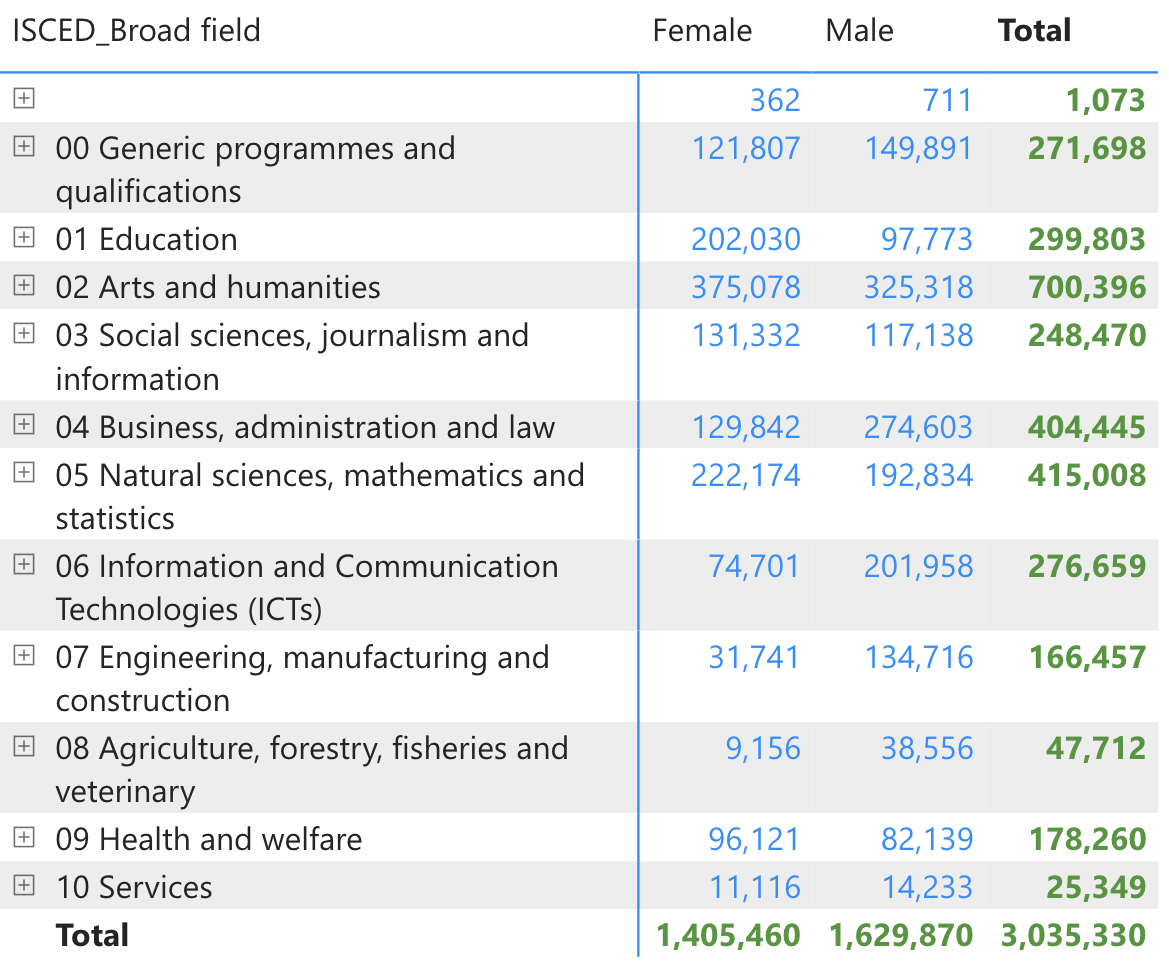
Over a million students, about a third of total 3 million students (1.4 million women, 1.6 million men) enrolled in Pakistani universities and degree colleges, are currently studying science, technology, engineering and mathematics (STEM Education), according to data released by the country's Higher Education Commission (HEC). Of these students, 415,008 are studying natural sciences and mathematics, 276,659 are in information and communication technologies (ICT), 178,260 are in health sciences and 166,457 are in engineering. Pakistan produced 157,102 STEM graduates last year, putting it among the world's top dozen or so countries. About 43,000 of these graduates are in information technology (IT).
Nearly half a million Pakistani women are currently enrolled in science, technology, engineering and mathematics courses at universities, accounting for nearly 46% of all STEM students in higher education institutions in the country.
Clockwise From Top Left: Nergis Mavalvala, Maria Abrar, Maheen Adamson, Tasneem Zehra Husain, Sundas Khalid, Asifa Akhtar
Acceptance rate in Pakistani universities and degree colleges was just 13.5% last year. Only 541,043 students were accepted from 4,085,185 students who applied. The country produced 471,306 university graduates in 2020-21. Of these, 157,102 were in STEM fields, including 43,000 graduates in information technology (IT).
In absolute terms, Pakistan probably ranks among the top dozen or so nations producing university graduates in STEM and IT fields. However, the country lags significantly behind its lower middle income peers in terms of percentage of students enrolled in universities. Only 12% of young people in the 18-25 age group are currently enrolled in higher education institutions. This is about half of the 25% average for South Asia. The data from the World Bank shows that the higher education enrollment rate was extremely low in Pakistan until 2000 when late President Musharraf decided to significantly boost investment in building universities and hire faculty to rapidly increase access to higher education in the country.
As Pakistan struggles with multiple serious crises, these young men and women now studying in the nation's universities and colleges offer hope for its bright future. In fact, the vast majority of Pakistanis feel that they have better lives than their parents did, and they think their children will have even better lives than theirs, according to a Gallup International Poll of 64 countries conducted from August to October last year. The poll asked two questions: 1) Do you feel your life is better, worse or roughly similar to that of your parents? and 2) Do you think your children will have a better, worse or roughly the same life as you? The answers to these questions reveal that Pakistanis are among the top 5 most positive nations among 64 countries polled by Gallup International. Anecdotal evidence in terms of packed shopping malls and restaurants in Pakistan's major cities confirms it. Such positivity augurs well for Pakistan's prospects of successfully dealing with the current crises. It will drive the nation's recovery.
When Gmail completes your sentences or Netflix offers you recommendations for movies to watch, do you wonder where it all came from? Do you know how airplanes fly or autonomous vehicles drive on auto-pilot? What algorithms are used to make it happen? Who made these possible? Where did the word "algorithm" come from? Have you heard of Mohammad ibn Musa al-Khwarizmi?
Al-Khwarizmi:
The word algorithm comes from Muhammad al-Khwarizmi, the name of a Muslim mathematician and scientist who developed the concept of algorithms. He was appointed the head of the House of Wisdom (Darul Hikma) in Baghdad in 820 AD. He is also credited with the invention of Algebra (hisab al-jabr). Darul Hikma, also known as the Grand Library of Baghdad, was a major public academy and intellectual center in Baghdad during the Abbasid rule.
The House of Wisdom was founded by Caliph Haroon al-Rashid in the late 8th century that later turned into a public academy during the reign of Al-Ma'moon. It was destroyed by the Mongols in the Siege of Baghdad in 1258, leaving very little archaeological evidence.
AI Algorithms:
An algorithm is a step-by-step procedure developed for accomplishing specific tasks. In artificial intelligence (AI), algorithms help accomplish tasks that used to require human judgment —such as flying airplanes, driving vehicles, composing emails and making recommendations for books and movies. High-powered computers help execute these algorithms at high speeds.
Social media platforms like Facebook and Google have long used AI algorithms relying on user profile data to help advertisers target potential customers. Now, under tremendous pressure from governments and civil society, the companies operating social media platforms are attempting to use AI algorithms for censoring hate speech.
Such algorithms are designed to be self-learning. They are trained by feeding lots data and examples selected by humans to help their ability to make judgements. Success rate of these algorithms improves with more data over time.
Artificial Intelligence Applications
Muslim Contributions to Math and Science:
A recent Twitter poll by Texas-based American journalist Wes Trueblood III asked the question: “Should schools in America be forced to teach Arabic numerals as a part of their curriculum?” He was shocked to see that 90% of respondents said "No". It was obvious that they did not know the fact that Arabic numerals are already taught in American schools because all mathematics today is based on Arabic numerals. And without mathematics, there can be no STEM (Science, Technology, Engineering and Mathematics).
Most people today are unaware of how much the Islamic civilization has contributed to mathematics, science and technology. Dick Teresi, author of 'Lost Discoveries', says it is partly attributable to the reluctance of the western scientists to acknowledge the work of Muslim scientists. The claim of Muslims as being mere "conduits" of knowledge has been rejected by Dick Teresi. Says Teresi, "Clearly, the Arabs served as a conduit, but the math laid on the doorstep of Renaissance Europe cannot be attributed solely to ancient Greece. It incorporates the accomplishments of Sumer, Babylonia, Egypt, India, China and the far reaches of the Medieval Islamic world.
Teresi describes the work done by Copernicus. Nasir al-Din al-Tusi, a Persian Muslim astronomer and mathematician, developed at least one of Copernicus's theorems, now called The Tusi Couple, three hundred years before Copernicus. Copernicus used the theorem without offering any proof or giving credit to al-Tusi. This was pointed out by Kepler, who looked at Copernicus's work before he developed his own elliptical orbits idea.
A second theorem found in Copernican system, called Urdi lemma, was developed by another Muslim scientist Mu'ayyad al-Din al-Urdi, in 1250. Again, Copernicus neither offered proof nor gave credit to al-Urdi. Columbia University's George Saliba believes Copernicus didn't credit him because Muslims were not popular in 16th century Europe, not unlike the situation today.
Tipler completely ignores the great contribution of another giant of science from the Islamic world, Ibn Haitham (Alhazen), who developed the "Scientific Method". Alhazen is also considered the father of modern optics. The ancient Greeks thought our eyes emitted rays, like a laser, which enabled us to see. The first person to explain that light enters the eye, rather than leaving it, was Ibn al-Haitham. He invented the first pin-hole camera after noticing the way light came through a hole in window shutters. The smaller the hole, the better the picture, he worked out, and set up the first Camera Obscura (from the Arab word qamara for a dark or private room). He is also credited with being the first man to shift physics from a philosophical activity to an experimental one.
The fountain pen was invented for the Sultan of Egypt in 953 after he demanded a pen which would not stain his hands or clothes. It held ink in a reservoir and, as with modern pens, fed ink to the nib by a combination of gravity and capillary action.
The algebra as we know today came from the Muslim world. Al Khwarizmi wrote the first book on algebra. The term "algebra" was first used by him. Al Khwarizmi was born about 790 in Baghdad, Iraq, and died about 850.
The word for "Algebra" comes from the Arabic word for "al-jabr" which means "restoration of balance" in both sides of an equation. Algebra was based on previous work from Greeks, Alexandrians in Egypt, and Hindus who had preserved the work from ancient Egyptians and Babylonians.
In the ninth century, al-Khwarizmi wrote one of the first Arabic algebras with both proofs and examples. Because of his work, he is called "the Father of Algebra." Al-Khwarizmi was a Persian born in the eighth century. He converted (changed) Babylonian and Hindu numerals into a workable system that almost anyone could use. He gave the name to his math as "al-jabr" which we know as "algebra".
A Latin translation of al-Khwarizmi's book on algebra appeared in Europe in the 12th century. In the early 13th century the new algebra appeared in the writings of the famous Italian mathematician, Leonardo Fibonacci. So, algebra was brought into Europe from ancient Babylon, Egypt and India by the Arabs and then into Italy.
In his 1864 book "The History of the Intellectual Development of Europe", English-born American scientist J.W. Draper wrote that “I have to deplore the systematic manner in which the literature of Europe has contrived to put out of sight our scientific obligations to the Mohammedans. Surely they can not be much longer hidden. Injustice founded on religious rancor and national conceit cannot be perpetuated forever".
University of Al Quaraouiyine:
University of Al Quaraouiyine (also spelled al karaouine) was founded by Fatima Al Fihri in 859 CE in Fez, Morocco. It is believed to be the world's oldest continuously operating university.
Al-Fihri, born in Kairouan (Qayrawan) in what is now Tunisia, was a well-educated daughter of a wealthy merchant. Her family migrated to Fez where she started the world's oldest continuously operating university named after her place of birth.
The University started as a madrassa affiliated with a mosque. It had the basic infrastructure and systems associated with modern universities. It had a formal curriculum, administered examinations and awarded degrees. It became part of the foundation of the glory days of the Islamic Civilization.
The University currently has staff and faculty of over 1000 and it has over 8000 students enrolled. The list of its most distinguished alumni includes Ibn Khaldun, widely regarded as the forerunner of the modern disciplines of historiography, sociology, economics, and demography. Other notable alumni are Jewish philosopher Maimonides, Muslim philosopher Ibn Rushd (Averroes) and Muslim geographer Mohammad Al-Idrisi.
The world's second oldest continuously operating university is Al Azhar in Cairo, Egypt established in 970 CE.
Universities in Europe:
University of Bologna, the oldest university in Europe, was established in 1088 CE, more than two centuries after University of Al Quaraouiyine was founded by Fatima Al-Fihri in Fez, Morocco.
Then came Oxford University in 1096, Salamanca University in 1134, Paris University in 1160 and Cambridge University in 1209.
Brigham Young University (BYU) history professor Glenn Cooper has traced the concept of receiving a degree to Islam and is associated with completing a set curriculum. The ceremonial cap and gown used in graduation ceremonies is also a legacy of Islamic tradition.
Rise and Fall of Islamic Civilization:
Where did star names like Ain ( عين), Betelgeuse (إبط الجوزاء ) and Cursa ( الكرسي) come from? Who named Californium and Berkelium elements of the periodic table? Famous American scientist Dr.Neil deGrasse Tyson answered these and other questions in some recent video presentations.
Neil deGrasse Tyson is an American astrophysicist, cosmologist, author, and science communicator, according to Wikipedia. Since 1996, he has been the Frederick P. Rose Director of the Hayden Planetarium at the Rose Center for Earth and Space in New York City.
What Dr. Tyson describes as "naming rights" simply means that those who discover new things get to name them. Californians got the naming rights to some of the elements of the periodic table while the Arabs got to name vast majority of the stars in the Cosmos. In modern western astronomy, most of the accepted star names are Arabic, a few are Greek and some are of unknown origin.
The lesson Dr. Tyson draws from the rise and fall of Muslims is as follows: Islamic civilization remained dominant in sciences and mathematics as long as Muslims practiced Ijtihad to ask questions and find answers to questions. What led to their decline was Taqlid, the unquestioning faith in Revelation.
Dr. Tyson credits the great Muslim philosopher Alhazen (Abū ʿAlī al-Ḥasan ibn al-Ḥasan ibn al-Haytham 965-1040 AD) with inventing the modern scientific method. Alhazen questioned everything, especially the things everyone took for granted, says Dr. Tyson. Alhazen's work was lavishly funded by the Muslim Caliphs. All of it changed when Imam Al Ghazali, or Algazel, a highly influential Islamic scholar of his time, succeeded in persuading Muslims to accept Taqlid that triggered rapid decline of the Islamic world.
Dr. Tyson has used the example of the great Islamic Civilization's decline to warn Americans against repeating it. He has particularly targeted those in America who denounce Darwin's theory of evolution or reject the validity of climate science.
World Changing Inventions/Discoveries:
While the concept of universities has had the biggest impact on the world, there are several other innovations and-or discoveries by Muslims that have changed the world. A short list includes coffee, Algebra, marching band and camera. Here is a video about the top 5 Muslim inventions that changed the world:
.jpeg)


