Showing posts sorted by relevance for query Musharraf human capital. Sort by date Show all posts

Wednesday, September 26, 2018

Pakistan Lags in Human Capital Development

Pakistan's human capital has doubled from three years of learning in 1990 to six years of learning in 2016, according to a human capital study of 195 countries recently published in the journal The Lancet.  However, Pakistan still ranks a poor 164th in the first-ever scientific study ranking countries for their levels of human capital. India has also more than doubled its human capital from 3 years to 7 years but Bangladesh stands out by tripling its human capital from two years to six years of learning since 1990.  In 2016, the Lancet study shows that 44 countries achieved more than 20 years of expected human capital while 68 countries had expected human capital of less than 10 years. Bangladesh, India and Pakistan have less than 10 years of learning, putting them in the category of low human capital countries. Learning is based on average student scores on internationally comparable tests.

What is Human Capital?

Dictionary defines human capital as "the collective skills, knowledge, or other intangible assets of individuals that can be used to create economic value for the individuals, their employers, or their community".

The Lancet study says it "provides a new measure of expected human capital for 195 countries, consisting of four components: educational attainment, learning, health, and survival, based on a systematic analysis of all available data. This measure, in units of health, education, and learning-adjusted expected years lived between age 20 and 64 years, is estimated each year from 1990 to 2016 and can be updated annually."  Learning is based on average student scores on internationally comparable tests.

Human Capital Growth in South Asia. Source: The Lancet
South Asia's Low Human Capital:

Both Pakistan and India have seen their human capital double from three years of learning in 1990 to six years of learning in 2016 but both still rank low with significantly less than 10 years of learning,  according to a human capital study of 195 countries recently published in the journal The Lancet.

In fact, the entire South Asia region continues to rank low in terms of human capital. Among South Asian nations, Sri Lanka ranks the highest at 102 (13 years), Maldives 116 (12 years), Bhutan 133 (9 years),  Nepal 156 (7 years),  India 158 (7 years),  Bangladesh 161 (6 years), Pakistan 164 (6 years) and Afghanistan 188 (4 years). Countries with less than 10 years of learning are considered having "low human capital" by the authors of the study.

In 2016, the Lancet study shows that 44 countries achieved more than 20 years of expected human capital while 68 countries had expected human capital of less than 10 years. Bangladesh, India and Pakistan have less than 10 years of learning, putting them in the category of low human capital countries.


Change in Global Human Capital Maps. Top 1990, Bottom 2016. Source: Lancet

Global Human Capital Rankings:

Finland tops the human capital charts with 28.4 years of learning, United States ranks 27th with 23 years of learning and Turkey and China rank 43rd and 44th respectively, each with 20 years of learning. The countries with the least human capital are those in sub-Saharan Africa. Mali ranks 191st (3 years), Burkina Faso 192nd (3 years), Chad 193rd (2 years), South Sudan 194th (2 years) and Niger (2 years)  at the very bottom ranked 195th.

Conducted by the Institute for Health Metrics and Evaluation (IHME) at the University of Washington in collaboration with University of California, Los Angeles (UCLA), the study on the measurement of human capital has been published in the journal The Lancet.

Impact of Human Capital on Economic Growth:

The Lancet report says that "human capital is characterized as the aggregate levels of education, training, skills, and health in a population, affecting the rate at which technologies can be developed, adopted, and employed to increase productivity".

Growth in human capital is associated with faster economic growth. The top quartile of countries in terms of absolute change in human capital from 1990 to 2016 had a median annualized growth in gross domestic product of 2·60% (IQR 1·85–3·69) compared with 1·45% (0·18–2·19) for countries in the bottom quartile, according to the Lancet report.

Human Development in Pakistan: 

In addition to the human capital report by The Lancet, UNDP’s Human Development Index (HDI) is another indicator of human progress that combines information on people’s health, education and income. The latest Human Development Report (HDR) shows Pakistan's HDI ranking sank to a new low of 150 in 2018.

Pakistan's Human Development Growth Rate By Decades. Source: HDR 2018

Pakistan saw average annual HDI (Human Development Index) growth rate of 1.08% in 1990-2000, 1.57% in 2000-2010 and 0.95% in 2010-2017, according to Human Development Indices and Indicators 2018 Statistical Update.  The fastest growth in Pakistan human development was seen in 2000-2010, a decade dominated by President Musharraf's rule, according to the latest Human Development Report 2018.

The Human Development Index (HDI) is a composite index focusing on three basic dimensions of human development: the ability to lead a long and healthy life, measured by life expectancy at birth; the ability to acquire knowledge, measured by mean years of schooling and expected years of schooling; and the ability to achieve a decent standard of living, measured by gross national income per capita.

Not only has Pakistan's economy slowed since 2008 but its progress in education sector has seen a dramatic slowdown. Data shows that Pakistan's literacy and enrollment rates are not rising in spite of significantly increased education spending over the last several years. Education budgets at federal and provincial levels have seen double digit increase of 17.5% a year on average since 2010. And yet, school enrollment and literacy rate have remained essentially flat during this period.  This lack of progress in education stands in sharp contrast to the significant improvements in outcomes seen from increase education spending during Musharraf years in 2001-2008. Why is it?

Is the money not being spent honestly and wisely? Is the education budget being used by the ruling politicians to create teacher jobs solely for political patronage? Are the teachers not showing up for work? Is the money being siphoned off by bureaucrats and politicians by hiring "ghost teachers" in "ghost schools"? Let's try and examine the data and the causes of lack of tangible results from education spending.

Pakistan Education Budget:

The total money budgeted for education by the governments at the federal and provincial levels has increased from Rs. 304 billion in 2010-11 to Rs. 790 billion in 2016-17,  representing an average of 17.5% increase per year since 2010.


Education and Literacy Rates:

Pakistan's net primary enrollment rose from 42% in 2001-2002 to 57% in 2008-9 during Musharraf years. It has been essentially flat at 57% since 2009 under PPP and PML(N) governments.

Source: Economic Survey of Pakistan 2015-16

Similarly, the literacy rate for Pakistan 10 years or older rose from 45% in 2001-2002 to 56% in 2007-2008 during Musharraf years. It has increased just 4% to 60% since 2009-2010 under PPP and PML(N) governments.

Source: Economic Survey of Pakistan 2015-16

Four Levels of Development:

The extensive data compilation and research by Professor Hans Rosling of Sweden has shown that the binary categorization of nations into developed and developing is no longer useful. Instead, he has proposed using 4 levels of development based on health and wealth indicators, a proposal that has now been accepted by the United Nations and the World Bank. Here's how Rosling and the United Nations define these 4 levels:

1. Level 1: One billion people live on level 1. This is what we think of as extreme poverty. If you’re on level 1, you survive on less than $2 a day and get around by walking barefoot. Your food is cooked over an open fire, and you spend most of your day traveling to fetch water. At night, you and your children sleep on a dirt floor.

2. Level 2: Three billion people live on level 2, between $2 and $8 a day. Level 2 means that you can buy shoes and maybe a bike, so it doesn’t take so long to get water. Your kids go to school instead of working all day. Dinner is made over a gas stove, and your family sleeps on mattresses instead of the floor.

Level 3: Two billion people live on level 3, between $8 and $32 a day. You have running water and a fridge in your home. You can also afford a motorbike to make getting around easier. Some of your kids start (and even finish) high school.

Level 4: One billion people live on level 4. If you spend more than $32 a day, you’re on level 4. You have at least a high school education and can probably afford to buy a car and take a vacation once in a while.

Imran Khan's Ambitious Agenda:

Imran Khan laid out his agenda in his first speech to the nation after taking the office of the prime minister.  It was more like a fireside chat in which he spoke directly to the people to explain his priorities that emphasize education,  health care and human development. These are the keys to leading Pakistan from level 2 to level 3. In order to pursue his priorities, Mr. Khan needs to first address the more urgent economic crisis which he acknowledged. Pakistan needs to deal with excessive public debt and pay for the necessary imports to move forward.  He must also deal with financial corruption and mismanagement to free up the resources for his ambitious agenda of economic and human development of the nation.

Mr. Khan will almost certainly face stiff opposition from the status quo forces which stand to lose from the changes he seeks. They will fight to preserve their patronage networks and their power and privilege. They will try to bring down his coalition government with all they have got. They might even threaten his personal safety and security.

Democracy and Development:

Professor Hans Rosling has compiled extensive socioeconomic data and done serious research to understand how nations develop. He has shared his work in "Factfulness" that he co-wrote with his son Ola Rosling and daughter Anna Rosling Ronnlund. Here's an except on democracy and development from Factfulness:

"This is risky but I am going to argue it anyway. I strongly believe that liberal democracy is the best way to run a country. People like me, who believe this, are often tempted to argue that democracy leads to, or its even a requirement for, other good things, like peace, social progress, health improvement, and economic growth. But here's the thing, and it is hard to accept: the evidence does not support this stance.

Most countries that make great economic and social progress are not democracies. South Korea moved from Level 1 to Level 3 faster than any other country had ever done (without finding oil), all the time as a military dictatorship. Of the ten countries with the fastest economic growth, nine of them score low on democracy.

Anyone who claims that democracy is a necessity for economic growth and health improvements will risk getting contradicted by reality. It's better to argue for democracy as a goal in itself instead of as a superior means to other goals we like."

Summary:

Pakistan's human capital has doubled from three years of learning in 1990 to six years of learning in 2016, according to a human capital study of 195 countries recently published in the journal The Lancet.  However, Pakistan still ranks a poor 164th in the first-ever scientific study ranking countries for their levels of human capital. India has also doubled its human capital from 3 years to 6 years but Bangladesh stands out by tripling its human capital from two years to six years of learning since 1990.  Learning is based on average student scores on internationally comparable tests.

Pakistan saw average annual HDI (Human Development Index) growth rate of 1.08% in 1990-2000, 1.57% in 2000-2010 and 0.95% in 2010-2017, according to Human Development Indices and Indicators 2018 Statistical Update.  The fastest growth in Pakistan human development was seen in 2000-2010, a decade dominated by President Musharraf's rule, according to the latest Human Development Report 2018. Pakistan's newly elected Prime Minister Mr. Imran Khan has laid out an ambitious agenda that could accelerate Pakistan's human development progress to take his country from level 2 to level 3 of socioeconomic development. It is achievable but the odds are against him because he faces stiff opposition from the status quo forces. The powerful dynastic duopoly of PPP and PMLN still dominates Pakistan's Senate whose support will be required for major reforms. The research by Professor Hans Rosling shows: "Of the ten countries with the fastest economic growth, nine of them score low on democracy." It's also supported by Pakistan's economic history where pace of development has consistently been faster under military governments than during civilian democratic rule. Can Prime Minister Imran Khan's leadership change the course of history and deliver faster human progress under democratic rule? Let's wait and see.

Sunday, January 19, 2014

Musharraf Accelerated Financial and Human Capital Growth in Pakistan

Pakistan experienced rapid economic and human capital growth in years 2000 to 2008 on President Pervez Musharraf's watch. Savings, investments and exports hit new records and the rate of increase in human development reached new highs not seen before or since this period.

Savings and Investments:

Domestic savings rate reached 18% of the GDP and foreign direct investment (FDI) hit a record level of $5.4 billion in 2007-8. This combination of domestic and foreign investments nearly tripled the size of the economy from $60 billion in 1999 to $170 billion in 2007, according to IMF. Exports nearly tripled from about $7 billion in 1999-2000 to $22 billion in 2007-2008, adding millions of more jobs. Pakistan was lifted from a poor, low-income country with per capita income of just $500 in 1999 to a middle-income country with per capita income exceeding $1000 in 2007.

Pakistan Per Capita Income 1960-2012. Source: World Bank 


The PPP government summed up General Musharraf's accomplishments well when it signed a 2008 Memorandum of Understanding with the International Monetary Fund which said:

"Pakistan's economy witnessed a major economic transformation in the last decade. The country's real GDP increased from $60 billion to $170 billion, with per capita income rising from under $500 to over $1000 during 2000-07". It further acknowledged that "the volume of international trade increased from $20 billion to nearly $60 billion. The improved macroeconomic performance enabled Pakistan to re-enter the international capital markets in the mid-2000s. Large capital inflows financed the current account deficit and contributed to an increase in gross official reserves to $14.3 billion at end-June 2007. Buoyant output growth, low inflation, and the government's social policies contributed to a reduction in poverty and improvement in many social indicators". (see MEFP, November 20, 2008, Para 1)

Human Capital Development: 

In addition to the economic revival, Musharraf focused on social sector as well. Pakistan's HDI grew an average rate of 2.7% per year under President Musharraf from 2000 to 2007, and then its pace slowed to 0.7% per year in 2008 to 2012 under elected politicians, according to the 2013 Human Development Report titled “The Rise of the South: Human Progress in a Diverse World”.


Primary Enrollment Source: Economic Survey of Pakistan

Youth Literacy Rate Source: Economic Survey of Pakistan

Overall, Pakistan's human development score rose by 18.9% during Musharraf years and increased just 3.4% under elected leadership since 2008. The news on the human development front got even worse in the last three years, with HDI growth slowing down as low as 0.59% — a paltry average annual increase of under 0.20 per cent. Going further back to the  decade of 1990s when the civilian leadership of the country alternated between PML (N) and PPP,  the increase in Pakistan's HDI was 9.3% from 1990 to 2000, less than half of the HDI gain of 18.9% on Musharraf's watch from 2000 to 2007.

R&D Spending Jumped 7-fold as % of GDP 1999-2007 Source: World Bank

Acceleration of HDI growth during Musharraf years was not an accident.  Not only did Musharraf's policies accelerate economic growth, helped create 13 million new jobs, cut poverty in half and halved the country's total debt burden in the period from 2000 to 2007, his government also ensured significant investment and focus on education and health care. The annual budget for higher education increased from only Rs 500 million in 2000 to Rs 28 billion in 2008, to lay the foundations of the development of a strong knowledge economy, according to former education minister Dr. Ata ur Rehman. Student enrollment in universities increased from 270,000 to 900,000 and the number of universities and degree awarding institutions increased from 57 in 2000 to 137 by 2008. Government R&D spending jumped from 0.1% of GDP in 1999 to 0.7% of GDP in 2007. In 2011, a Pakistani government commission on education found that public funding for education has been cut from 2.5% of GDP in 2007 to just 1.5% - less than the annual subsidy given to the various PSUs including Pakistan Steel and PIA, both of which  continue to sustain huge losses due to patronage-based hiring.

Pakistan's High-Tech Exports Tripled as % of Manufactured Exports. Source: World Bank


To see a discussion of the above subject and the current situation, please watch the following video:

http://vimeo.com/84504051


Civil-military Stand-Off on Musharraf Trial; Musharraf Govt's Performance Record from WBT TV on Vimeo.

Related Links:

Haq's Musings

Musharraf Earned Legitimacy By Good Governance

Musharraf Wants to Face Trial; Military Opposed to it

Saving Pakistan's Education

Political Patronage Trumps Public Policy in Pakistan

Dr. Ata-ur-Rehman Defends Pakistan's Higher Education Reforms

Twelve Years Since Musharraf's Coup

Musharraf's Legacy

Pakistan's Economic Performance 2008-2010

Role of Politics in Pakistan Economy

India and Pakistan Compared in 2011

Musharraf's Coup Revived Pakistan's Economy

What If Musharraf Had Said No?

Human Development in Musharraf Years

Monday, June 2, 2014

Pakistan GDP Grew Just 4.1% in 2013-14: Is it Another Lost Decade?

Meager 4.1% GDP growth reported by Pakistan for 2013-14 caps sixth consecutive year of disappointing economic performance under "democratic" governments in the country. This slow growth brings back bitter memories of the last lost decade of 1990s when economic growth plummeted to between 3% and 4%, poverty rose to 33%, inflation was in double digits and the foreign debt mounted to nearly the entire GDP of Pakistan as the governments of Benazir Bhutto (PPP) and Nawaz Sharif (PMLN) played musical chairs.

Pakistan GDP Growth Rates Since 1993. Source: World Bank


Economy in 1990s:

Before the current Prime Minister Nawaz Sharif was ousted by General Pervez Musharraf  in 1999, Pakistan's two main political parties had presided over a decade of corruption and mismanagement. In 1999 Pakistan’s economy was the slowest in South Asia while its total public debt as percentage of GDP was the highest in the region– 99.3 percent of its GDP and 629 percent of its revenue receipts, compared to Sri Lanka (91.1% and 528.3% respectively in 1998) and India (47.2% and 384.9% respectively in 1998). Internal Debt of Pakistan in 1999 was 45.6 per cent of GDP and 289.1 per cent of its revenue receipts, as compared to Sri Lanka (45.7% and 264.8% respectively in 1998) and India (44.0% and 358.4% respectively in 1998).

Musharraf Era:

Under President Musharraf's leadership, Pakistan became one of the four fastest growing economies in the Asian region during 2000-07 with its growth averaging over 6 per cent per year for most of this period. As a result of strong economic growth, Pakistan succeeded in reducing poverty by one-half, creating almost 13 million jobs, halving the country's debt burden, raising foreign exchange reserves to a comfortable position and propping the country's exchange rate, restoring investors' confidence and most importantly, taking Pakistan out of the IMF Program.

The above facts were acknowledged by the PPP government in a Memorandum of Economic and Financial Policies (MEFP) for 2008/09-2009/10, while signing agreement with the IMF on November 20, 2008. The document clearly (but grudgingly) acknowledged that "Pakistan's economy witnessed a major economic transformation in the last decade. The country's real GDP increased from $60 billion to $170 billion, with per capita income rising from under $500 to over $1000 during 2000-07" elevating Pakistan from low-income to middle-income country.


IMF MOU of 2008 further acknowledged that Pakistan's "volume of international trade increased from $20 billion to nearly $60 billion. The improved macroeconomic performance enabled Pakistan to re-enter the international capital markets in the mid-2000s. Large capital inflows financed the current account deficit and contributed to an increase in gross official reserves to $14.3 billion at end-June 2007. Buoyant output growth, low inflation, and the government's social policies contributed to a reduction in poverty and improvement in many social indicators". (see MEFP, November 20, 2008, Para 1)


Pakistan experienced rapid economic and human capital growth in years 2000 to 2008 on President Pervez Musharraf's watch. Savings, investments and exports hit new records and the rate of increase in human development reached new highs not seen before or since this period.

Exports as Percentage of GDP in South Asia. Source: World Bank

Savings and Investments:

Domestic savings rate reached 18% of the GDP and foreign direct investment (FDI) hit a record level of $5.4 billion in 2007-8. This combination of domestic and foreign investments nearly tripled the size of the economy from $60 billion in 1999 to $170 billion in 2007, according to IMF. Exports nearly tripled from about $7 billion in 1999-2000 to $22 billion in 2007-2008, adding millions of more jobs. Pakistan was lifted from a poor, low-income country with per capita income of just $500 in 1999 to a middle-income country with per capita income exceeding $1000 in 2007.

Pakistan Per Capita Income 1960-2012. Source: World Bank 


The PPP government summed up General Musharraf's accomplishments well when it signed a 2008 Memorandum of Understanding with the International Monetary Fund which said:

"Pakistan's economy witnessed a major economic transformation in the last decade. The country's real GDP increased from $60 billion to $170 billion, with per capita income rising from under $500 to over $1000 during 2000-07" to elevate Pakistan from low-income to middle-income group. It further acknowledged that "the volume of international trade increased from $20 billion to nearly $60 billion. The improved macroeconomic performance enabled Pakistan to re-enter the international capital markets in the mid-2000s. Large capital inflows financed the current account deficit and contributed to an increase in gross official reserves to $14.3 billion at end-June 2007. Buoyant output growth, low inflation, and the government's social policies contributed to a reduction in poverty and improvement in many social indicators". (see MEFP, November 20, 2008, Para 1)

Human Capital Development: 

In addition to the economic revival, Musharraf focused on social sector as well. Pakistan's HDI grew an average rate of 2.7% per year under President Musharraf from 2000 to 2007, and then its pace slowed to 0.7% per year in 2008 to 2012 under elected politicians, according to the 2013 Human Development Report titled “The Rise of the South: Human Progress in a Diverse World”.


Overall, Pakistan's human development score rose by 18.9% during Musharraf years and increased just 3.4% under elected leadership since 2008. The news on the human development front got even worse in the last three years, with HDI growth slowing down as low as 0.59% — a paltry average annual increase of under 0.20 per cent. Going further back to the  decade of 1990s when the civilian leadership of the country alternated between PML (N) and PPP,  the increase in Pakistan's HDI was 9.3% from 1990 to 2000, less than half of the HDI gain of 18.9% on Musharraf's watch from 2000 to 2007.

R&D Spending Jumped 7-fold as % of GDP 1999-2007 Source: World Bank

Acceleration of HDI growth during Musharraf years was not an accident.  Not only did Musharraf's policies attracted significant new domestic and foreign investments to accelerate economic growth, they also helped create 13 million new jobs, cut poverty in half and halved the country's total debt burden in the period from 2000 to 2007, his government also ensured significant investment and focus on education and health care. The annual budget for higher education increased from only Rs 500 million in 2000 to Rs 28 billion in 2008, to lay the foundations of the development of a strong knowledge economy, according to former education minister Dr. Ata ur Rehman.

Student enrollment in universities increased from 270,000 to 900,000 and the number of universities and degree awarding institutions increased from 57 in 2000 to 137 by 2008. Government R&D spending jumped from 0.1% of GDP in 1999 to 0.7% of GDP in 2007. In 2011, a Pakistani government commission on education found that public funding for education has been cut from 2.5% of GDP in 2007 to just 1.5% - less than the annual subsidy given to the various PSUs including Pakistan Steel and PIA, both of which  continue to sustain huge losses due to patronage-based hiring.

To see a discussion of the above subject and the current situation, please watch the following video:

http://vimeo.com/84504051


Civil-military Stand-Off on Musharraf Trial; Musharraf Govt's Performance Record from WBT TV on Vimeo.

Related Links:

Haq's Musings

Musharraf Earned Legitimacy By Good Governance

Musharraf Wants to Face Trial; Military Opposed to it

Saving Pakistan's Education

Political Patronage Trumps Public Policy in Pakistan

Dr. Ata-ur-Rehman Defends Pakistan's Higher Education Reforms

Twelve Years Since Musharraf's Coup

Musharraf's Legacy

Pakistan's Economic Performance 2008-2010

Role of Politics in Pakistan Economy

India and Pakistan Compared in 2011

Musharraf's Coup Revived Pakistan's Economy

What If Musharraf Had Said No?

Human Development in Musharraf Years


Tuesday, February 7, 2023

Remembering Pervez Musharraf (1943-2023): A True Patriot Who Made Pakistan Stronger

President Pervez Musharraf of Pakistan passed away this week. May his soul rest in peace. Amen. He was a true patriot who honestly served his country to the best of his ability. He strengthened his country's economy, society and military. Per capita incomes of Pakistanis doubled on his watch, lifting the country from a low-income to a middle-income country. His government liberalized media and telecommunications, leading to rapid growth in both industries.  President Musharraf dramatically accelerated his people's human development by investing heavily in education and healthcare. After what has transpired in recent years, most Pakistanis will remember his time in office as a golden age for the country. 

President Pervez Musharraf 1943-2023


Higher education reform backed by huge increases in spending led to a large increase in college and university enrollment and graduation rates. He halved Pakistan's debt burden and doubled exports during his 8 years in office. Pakistan built up credible nuclear deterrence by ensuring development of a variety of nuclear-capable missiles of various ranges. Pakistan developed the JF-17, its first indigenous fighter jet aircraft with China, and the Pakistan Air Force started deploying it during the Musharraf years.  He negotiated the upgrade of PAF F-16s and acquisition of dozens of new F-16s. 

Pakistan Debt and Fiscal Deficit Trend 2000-2020

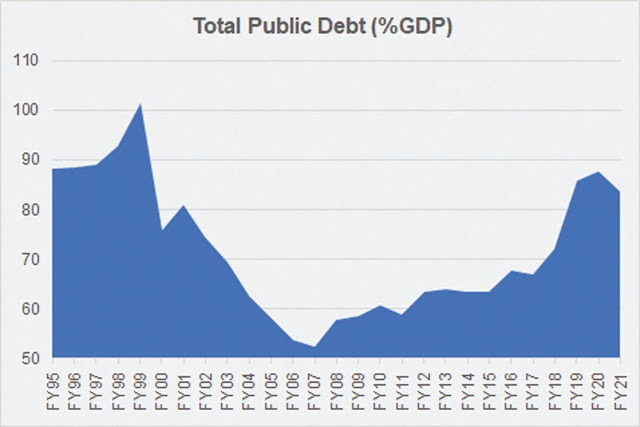
In 1999, President Pervez Musharraf inherited a massive debt of 100% of GDP run up by the Pakistan Peoples Party and the Pakistan Muslim League (Nawaz) governments in the 1990s. Musharraf's policies not only revived the bankrupt economy but also brought down debt to 52% of GDP by 2007. 

Pakistan Debt to GDP 1995-2021. Source: IMF


PPP Government's 2008 Letter to IMF:

In a letter to the International Monetary Fund in 2008, the PPP government hailed Musharraf's economic record without mentioning his name in the following words:

"Pakistan's economy witnessed a major economic transformation in the last decade (2000-2008). The country's real GDP increased from $60 billion to $170 billion, with per capita income rising from under $500 to over $1000 during 2000-07.....the volume of international trade increased from $20 billion to nearly $60 billion. The improved macroeconomic performance enabled Pakistan to re-enter the international capital markets in the mid-2000s. Large capital inflows financed the current account deficit and contributed to an increase in gross official reserves to $14.3 billion at end-June 2007. Buoyant output growth, low inflation, and the government's social policies contributed to a reduction in poverty and improvement in many social indicators". (see MEFP, November 20, 2008, Para 1).

Pakistan Manufacturing Value Added 2000-2021. Source: World Bank


Savings and Investments:

Domestic savings rate reached 18% of the GDP and foreign direct investment (FDI) hit a record level of $5.4 billion in 2007-8. This combination of domestic and foreign investments nearly tripled the size of the economy from $60 billion in 1999 to $170 billion in 2007, according to IMF. Exports nearly tripled from about $7 billion in 1999-2000 to $22 billion in 2007-2008, adding millions of more jobs. Pakistan was lifted from a poor, low-income country with per capita income of just $500 in 1999 to a middle-income country with per capita income exceeding $1000 in 2007.

FDI in the Musharraf years came in many sectors, ranging from telecommunications to manufacturing.
Several mobile phone and Internet service operators built networks worth billions of dollars. Without this telecom infrastructure, there would be no tech industry, no freelancers and no fast-growing tech exports today.

New cement plants met growing demand that more than doubled cement consumption, FMCG (fast moving consumer goods) sector took off to meet demand from growing middle class and production of cars and motorcycles jumped. 


Human Capital Development: 

In addition to the economic revival, Musharraf focused on the social sector as well. Pakistan's Human Development Index (HDI) score grew an average rate of 2.7% per year under President Musharraf from 2000 to 2007, and then its pace slowed to 0.7% per year in 2008 to 2012 under elected politicians, according to the 2013 Human Development Report titled “The Rise of the South: Human Progress in a Diverse World”.


Primary Enrollment Source: Economic Survey of Pakistan

Youth Literacy Rate Source: Economic Survey of Pakistan


Pakistan University Enrollment Jumped in Musharraf Years. Source: World Bank


Overall, Pakistan's human development score rose by 18.9% during the Musharraf years and increased just 3.4% under elected leadership since 2008. The news on the human development front got even worse in the last three years, with HDI growth slowing down as low as 0.59% — a paltry average annual increase of under 0.20 per cent. Going further back to the  decade of 1990s when the civilian leadership of the country alternated between PML (N) and PPP,  the increase in Pakistan's HDI was 9.3% from 1990 to 2000, less than half of the HDI gain of 18.9% on Musharraf's watch from 2000 to 2007.

R&D Spending Jumped 7-fold as % of GDP 1999-2007 Source: World Bank

Acceleration of HDI growth during the Musharraf years was not an accident.  Not only did Musharraf's policies accelerate economic growth, helped create 13 million new jobs, cut poverty in half and halved the country's total debt burden in the period from 2000 to 2007, his government also ensured significant investment and focus on education and health care. The annual budget for higher education increased from only Rs 500 million in 2000 to Rs 28 billion in 2008, to lay the foundations of the development of a strong knowledge economy, according to former education minister Dr. Ata ur Rehman. Student enrollment in universities increased from 270,000 to 900,000 and the number of universities and degree awarding institutions increased from 57 in 2000 to 137 by 2008. Government R&D spending jumped from 0.1% of GDP in 1999 to 0.7% of GDP in 2007. In 2011, a Pakistani government commission on education found that public funding for education has been cut from 2.5% of GDP in 2007 to just 1.5% - less than the annual subsidy given to the various PSUs including Pakistan Steel and PIA, both of which  continue to sustain huge losses due to patronage-based hiring.

Pakistan's High-Tech Exports Tripled as % of Manufactured Exports. Source: World Bank

Pakistan textile exports more than doubled from $5.2 billion to more than $11 billion during the Musharraf years. Exports soared 19.43% in 2001, 20% in 2004, 24.5% in 2005 and 11.23% in 2006, all on President Musharraf's watch, according to "The Rise and Fall of Pakistan's Textile Industry: An Analytical View" published by Javed Memon, Abdul Aziz and Muhammad Qayyum.     


Pakistan Textile Exports Growth. Source: Javed Memon

Pakistan experienced rapid economic and human capital growth in the years 2000 to 2008 on President Pervez Musharraf's watch. Savings, investments and exports hit new records and the rate of increase in human development reached new highs not seen before or since this period.  Without this human capital, there would be no tech industry, no freelancers and no fast-growing tech exports today.

Employment Growth in South Asia. Source: World Bank

Pakistan's employment growth was the highest in the South Asia region in 2000-2010, followed by Nepal, Bangladesh, India, and Sri Lanka in that order, according to a World Bank report titled "More and Better Jobs in South Asia".

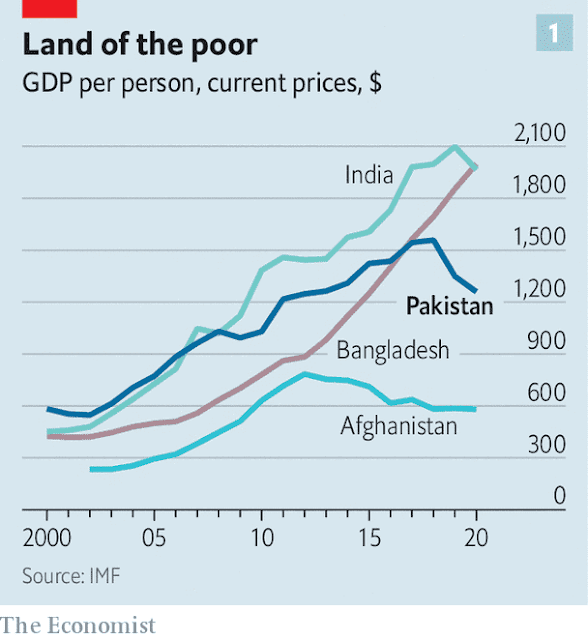
Comparing Per Capita GDP Trajectory in South Asia. Source: The Economist

Until 2010, Bangladesh was a laggard in the South Asia region. Its per capita income was about half of Pakistan's. Now Bangladesh's per capita GDP is higher than both India's and Pakistan's. What changed? The biggest change is Bangladeshi leader Shaikh Hasina's decision to stifle the unruly Opposition and the media to bring political and economic stability to the South Asian nation of 160 million people. It has eliminated a constant sense of crisis and assured investors and businesses of continuity of government policies. With development taking precedence over democracy, Shaikh Hasina followed the example of Asian Tigers  by focusing on export-led economic growth of her country. She incentivized the export-oriented garment industry and invested in human development. Bangladesh now outperforms India and Pakistan in a whole range of socioeconomic indicators: exports, economic growth, infant mortality rate, primary school enrollment, fertility rate and life expectancy.    

Related Links:


Monday, January 24, 2022

Pakistan Cut Public Debt in Half On Musharraf's Watch in 1999-2008

In 1999, President Pervez Musharraf inherited a massive debt of over 100% of GDP run up by the Pakistan Peoples Party and the Pakistan Muslim League (Nawaz) governments in 1990s. Musharraf's policies not only revived the bankrupt economy but also brought down debt to 52% of GDP by 2007. 

Pakistan Debt to GDP 1995-2021. Source: IMF


PPP Government's 2008 Letter to IMF:

In a letter to the International Monetary Fund in 2008, the PPP government hailed Musharraf's economic record without mentioning his name in the following words:

"Pakistan's economy witnessed a major economic transformation in the last decade (2000-2008). The country's real GDP increased from $60 billion to $170 billion, with per capita income rising from under $500 to over $1000 during 2000-07.....the volume of international trade increased from $20 billion to nearly $60 billion. The improved macroeconomic performance enabled Pakistan to re-enter the international capital markets in the mid-2000s. Large capital inflows financed the current account deficit and contributed to an increase in gross official reserves to $14.3 billion at end-June 2007. Buoyant output growth, low inflation, and the government's social policies contributed to a reduction in poverty and improvement in many social indicators". (see MEFP, November 20, 2008, Para 1).

Savings and Investments:

Domestic savings rate reached 18% of the GDP and foreign direct investment (FDI) hit a record level of $5.4 billion in 2007-8. This combination of domestic and foreign investments nearly tripled the size of the economy from $60 billion in 1999 to $170 billion in 2007, according to IMF. Exports nearly tripled from about $7 billion in 1999-2000 to $22 billion in 2007-2008, adding millions of more jobs. Pakistan was lifted from a poor, low-income country with per capita income of just $500 in 1999 to a middle-income country with per capita income exceeding $1000 in 2007.

FDI in Musharraf years came in many sectors, ranging from telecommunications to manufacturing.
Several mobile phone and Internet service operators built networks worth billions of dollars. Without this telecom infrastructure, there would be no tech industry, no freelancers and no fast-growing tech exports today.

New cement plants met growing demand that more than doubled cement consumption, FMCG (fast moving consumer goods) sector took off to meet demand from growing middle class and production of cars and motorcycles jumped. 


Human Capital Development: 

In addition to the economic revival, Musharraf focused on the social sector as well. Pakistan's Human Development Index (HDI) score grew an average rate of 2.7% per year under President Musharraf from 2000 to 2007, and then its pace slowed to 0.7% per year in 2008 to 2012 under elected politicians, according to the 2013 Human Development Report titled “The Rise of the South: Human Progress in a Diverse World”.


Primary Enrollment Source: Economic Survey of Pakistan

Youth Literacy Rate Source: Economic Survey of Pakistan

Overall, Pakistan's human development score rose by 18.9% during the Musharraf years and increased just 3.4% under elected leadership since 2008. The news on the human development front got even worse in the last three years, with HDI growth slowing down as low as 0.59% — a paltry average annual increase of under 0.20 per cent. Going further back to the  decade of 1990s when the civilian leadership of the country alternated between PML (N) and PPP,  the increase in Pakistan's HDI was 9.3% from 1990 to 2000, less than half of the HDI gain of 18.9% on Musharraf's watch from 2000 to 2007.

R&D Spending Jumped 7-fold as % of GDP 1999-2007 Source: World Bank

Acceleration of HDI growth during Musharraf years was not an accident.  Not only did Musharraf's policies accelerate economic growth, helped create 13 million new jobs, cut poverty in half and halved the country's total debt burden in the period from 2000 to 2007, his government also ensured significant investment and focus on education and health care. The annual budget for higher education increased from only Rs 500 million in 2000 to Rs 28 billion in 2008, to lay the foundations of the development of a strong knowledge economy, according to former education minister Dr. Ata ur Rehman. Student enrollment in universities increased from 270,000 to 900,000 and the number of universities and degree awarding institutions increased from 57 in 2000 to 137 by 2008. Government R&D spending jumped from 0.1% of GDP in 1999 to 0.7% of GDP in 2007. In 2011, a Pakistani government commission on education found that public funding for education has been cut from 2.5% of GDP in 2007 to just 1.5% - less than the annual subsidy given to the various PSUs including Pakistan Steel and PIA, both of which  continue to sustain huge losses due to patronage-based hiring.

Pakistan's High-Tech Exports Tripled as % of Manufactured Exports. Source: World Bank

Pakistan textile exports more than doubled from $5.2 billion to more than $11 billion during the Musharraf years. Exports soared 19.43% in 2001, 20% in 2004, 24.5% in 2005 and 11.23% in 2006, all on President Musharraf's watch, according to "The Rise and Fall of Pakistan's Textile Industry: An Analytical View" published by Javed Memon, Abdul Aziz and Muhammad Qayyum.     


Pakistan Textile Exports Growth. Source: Javed Memon

Pakistan experienced rapid economic and human capital growth in years 2000 to 2008 on President Pervez Musharraf's watch. Savings, investments and exports hit new records and the rate of increase in human development reached new highs not seen before or since this period.  Without this human capital, there would be no tech industry, no freelancers and no fast-growing tech exports today.

Employment Growth in South Asia. Source: World Bank

Pakistan's employment growth was the highest in South Asia region in 2000-2010, followed by Nepal, Bangladesh, India, and Sri Lanka in that order, according to a World Bank report titled "More and Better Jobs in South Asia".

Comparing Per Capita GDP Trajectory in South Asia. Source: The Economist

Until 2010, Bangladesh was a laggard in South Asia region. Its per capita income was about half of Pakistan's. Now Bangladesh's per capita GDP is higher than both India's and Pakistan's. What changed? The biggest change is Bangladeshi leader Shaikh Hasina's decision to stifle the unruly Opposition and the media to bring political and economic stability to the South Asian nation of 160 million people. It has eliminated a constant sense of crisis and assured investors and businesses of continuity of government policies. With development taking precedence over democracy, Shaikh Hasina followed the example of Asian Tigers  by focusing on export-led economic growth of her country. She incentivized the export-oriented garment industry and invested in human development. Bangladesh now outperforms India and Pakistan in a whole range of socioeconomic indicators: exports, economic growth, infant mortality rate, primary school enrollment, fertility rate and life expectancy.    

Related Links: