Showing posts with label colonialism. Show all posts

Thursday, December 21, 2023

Bibi to Biden: "You Carpet Bombed Germany. You Dropped the Atom Bomb. A Lot of Civilians Died"

At a recent Democratic fundraiser organized by the Israel lobby in the United States, President Joseph R. Biden shared some details of the conversations he has had with Israeli Prime Minister Benjamin "Bibi" Netanyahu about protecting civilians in Gaza. Justifying Israel's genocidal war on Gaza, Netanyahu told Biden: “You carpet-bombed Germany. You dropped the atom bomb. A lot of civilians died”. Netanyahu is “a good friend, but I think he has to change, and… This (extremist coalition) government in Israel is making it very difficult for him to move,” Biden told the attendees at the campaign fundraiser in Washington hosted by former AIPAC board chair Lee Rosenberg.  Last month, Biden used the word “indiscriminate” to describe Israel’s bombing campaign in Gaza, according to a report in the Times of Israel. 

President Biden and Prime Minister Netanyahu

The Israel Lobby:

American Israeli Political Action Committee (AIPAC), also known as the Israel lobby, is considered the most powerful lobby in Washington D.C. The lobby has showered its friendly politicians with money from Jewish donors. It has also ensured the defeat of those politicians who dared to speak out against Israeli policies in the Middle East. As one former Democratic senator, Ernest Hollings, put it on leaving office, ‘you can’t have an Israeli policy other than what AIPAC gives you around here.’ Or as Ariel Sharon once told an American audience, ‘when people ask me how they can help Israel, I tell them: “Help AIPAC.”’

President Jimmy Carter who helped broker peace between Israel and Egypt knows the Israel lobby well. He told Amy Goodman of "Democracy Now" many years ago: "I think it’s accurate to say that not a single member of Congress with whom I’m familiar would possibly speak out and call for Israel to withdraw to their legal boundaries or to publicize the plight of the Palestinians or even to call publicly and repeatedly for good faith peace talks.....  And I would say that if any member of Congress did speak out, as I’ve just described, they would probably not be back in the Congress the next term ". 

Biden-Netanyahu Conversations: 

President Biden recalled how during one of their many conversations since October 7, Netanyahu sought to justify the deaths of civilians in Gaza by recalling how many died in the US response to the Japanese bombing of Pearl Harbor, according to the Times of Israel. 

“You carpet-bombed Germany. You dropped the atom bomb. A lot of civilians died,” Biden quoted Netanyahu as having said. “They not only want to have retribution — which they should — for what Hamas did, but against all Palestinians… They don’t want anything to (do) with the Palestinians,” Biden said, reiterating the US stance that Hamas does not represent all Palestinians and that not all of Gaza should suffer because of the October 7 attack by Hamas on Israel. 

It should be noted that the reason Netanyahu sounds American is because he was raised and educated in the United States. He is essentially an American who was born in Tel Aviv, raised in Philadelphia, and then returned to Israel after finishing higher education at MIT and Harvard. 

The US and Israel: 

While acknowledging the US role in killing large number of civilians during WW II, Biden pointed out to Netanyahu that the conventions and laws agreed to by the international community after the war were designed to stop the kind of excesses Netanyahu mentioned, such as the carpet bombing of Germany and the dropping of the atomic bombs on civilian populations in Japanese cities of Hiroshima and Nagasaki. 

“I said, ‘Yeah, that’s why all these institutions were set up after World War II to see to it that it didn’t happen again,'” Biden said he told Netanyahu.  Biden also advised Netanyahu not to repeat the mistakes the US made in response to the terrorist attacks in New York in 2001. “Don’t make the same mistakes we made [after] 9/11. There was no reason why we had to be in a war in Afghanistan [after] 9/11. There was no reason why we had to do some of the things we did,” Biden said.

While Biden's response makes sense, it is hard not to see the parallels between the  United States and Israel. Both of them are settler colonial societies built on genocide of the native populations and their replacement by Europeans.  This process was endorsed by top British politicians like Winston Churchill.  

This process of Israel's creation was endorsed by top British politicians like Winston Churchill.   “I do not admit that the dog in the manger has the final right to the manger,” former British Prime Minister Winston Churchill told the Peel Commission in 1937, “even though he may have lain there for a very long time.” He denied that “a great wrong has been done to the Red Indians of America, or the Black people of Australia,” by their replacement with “a higher grade race.”

Related Links:


Haq's Musings

South Asia Investor Review

Modi and Netanyahu: Two Sides of the Same Coin

Israel's Gaza Attack is Criminal, Not Defensive

Pictorial Review of Israel's Young Gaza Victims

American College Campuses Rise Up Against Israel's Genocidal War on Gaza

Israeli Settler Colonialism

Islamophobia Driving US Policy in Middle East and South Asia?

Israeli Scholars Offer Insights into Zionist Psyche

Total, Extended Lockdown in Indian Occupied Kashmir

What is India Hiding From UN Human Rights Team?

Indian JNU Professor on Illegal Indian Occupation of Kashmir, Manipur, Nagaland

Riaz Haq Youtube Channel

PakAlumni: Pakistani Alumni Social Network


Saturday, September 10, 2022

The Reign of Queen Elizabeth II Saw the Sun Set on the British Empire

Queen Elizabeth II (1926-2022) died this week. The sun set on the British Empire during her reign that began in 1952. The dismantling of the empire had already started with the independence of India and Pakistan in 1947 before she ascended to the throne. It continued in the 1950s and 60s with dozens of nations in Asia and Africa declaring their independence. British colonialism was soon replaced by western neocolonialism led by the United States. Black and brown people continue to suffer from the scourge of racism in a world dominated by white Europeans. Corrupt ruling elites with colonized minds ensure that true decolonization does not occur in the former British colonies. They treat their own people with the same disdain as did their former colonial bosses. The struggle for true independence continues. 

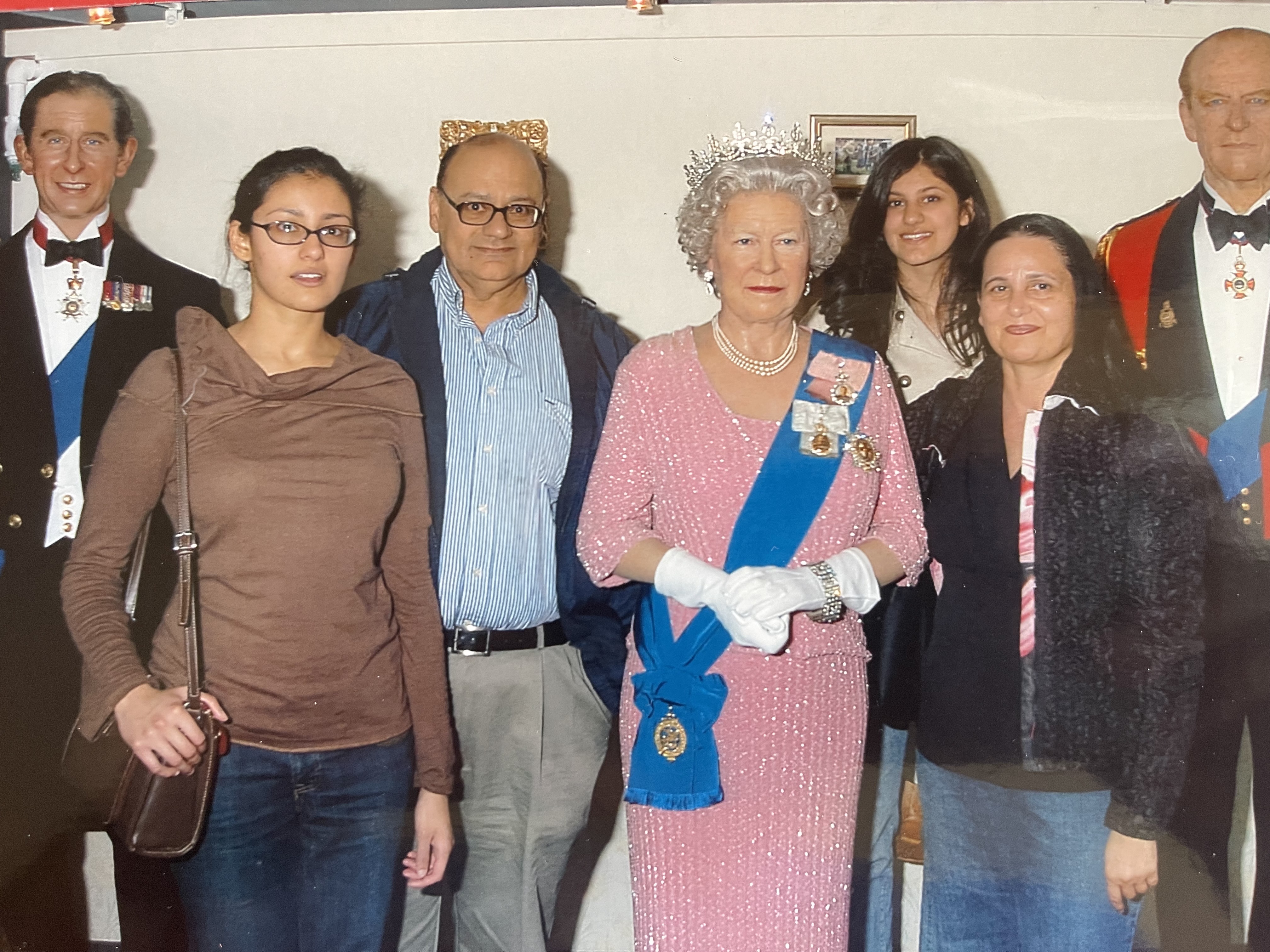
Haq Family With British Royal Family at Madame Tussauds in London

Economic Extraction:

When the British arrived in Mughal India, the country's share of the world GDP was 25%, about the same as the US share of the world GDP today. By 1947, the undivided India's share of world GDP ($4 trillion in 1990 Geary-Khamis dollars) had shrunk to about 6% (India: $216 billion, Pakistan: $24 billion). As of 2010, South Asia's contribution to world GDP further shrank to about 4%, according to British Economist Angus Maddison. 

Divide and Rule Policy: 

Colonial-era British historians deliberately distorted the history of Indian Muslim rule to vilify Muslim rulers as part of the British policy to divide and conquer India, says American history professor Audrey Truschke, in her book "Aurangzeb: The Life and Legacy of India's Most Controversial King". These misrepresentations of Muslim rule made during the British Raj appear to have been accepted as fact not just by Islamophobic Hindu Nationalists but also by at least some of the secular Hindus in India and Muslim intellectuals in present day Pakistan, says the author.  Aurangzeb was neither a saint nor a villain; he was a man of his time who should be judged by the norms of his times and compared with his contemporaries, the author adds. Hindutva today is among the worst legacies of the British Raj. 

Legacy of Major Conflicts:

Major conflicts in South Asia and the Middle East are a legacy of the final days of British rule. Among these are Kashmir and Palestine. 

Kashmir today is seen as a major flashpoint for a nuclear war between India and Pakistan. The rise of Hindutva, also a legacy of the British Raj, has increased the risk of such a devastating conflict. Vast majority of Indians, including those who oppose Prime Minister Narendra Modi, believe that nuclear war is "winnable", according to the results of a Stimson Center poll released recently. They want their country to build a bigger nuclear arsenal than China and Pakistan combined.  Responding to the clamor for more nukes,  Indian Prime Minister Narendra Modi said in 2019 that Indian nuclear weapons were not kept as mere showpieces.  

Colonized Minds:

Pakistan achieved independence from British colonial rule 75 years ago. However, the minds of most of Pakistan's elites remain colonized to this day.  This seems to be particularly true of the nation's western-educated "liberals" who dominate much of the intellectual discourse in the country. They continue to look at their fellow countrymen through the eyes of the Orientalists who served as tools for western colonization of Asia, Middle East and Africa. The work of these "native" Orientalists available in their books, op ed columns and other publications reflects their utter contempt for Pakistan and Pakistanis. Their colonized minds uncritically accept all things western. They often seem to think that the Pakistanis can do nothing right while the West can do no wrong. Far from being constructive, these colonized minds promote lack of confidence in the ability of their fellow "natives" to solve their own problems and contribute to hopelessness. The way out of it is to encourage more inquiry based learning and critical thinking.

Summary:

Queen Elizabeth's passing represents the end of an era that saw the sun set on the British Empire. Among the legacies of the British rule are racism and slavery that continue to be manifested in the new era of western neocolonialism. Major conflicts created by colonial powers in South Asia and the Middle East continue to threaten world peace. Former colonies continue to be ruled by corrupt elites with colonized minds who treat their own people with utter contempt. Their struggle for true independence continues. 

Here's an interesting discussion of the legacy of the British Raj in India as seen by writer-diplomat Shashi Tharoor:


https://www.youtube.com/watch?v=dN2Owcwq6_M


Related Links:

Haq's Musings

Pakistan Day: Freeing the Colonized Minds

Hindutva: Legacy of the British Raj

Vast Majority of Indians Believe Nuclear War is Winnable

Modi Faces Full-Blown Homegrown Insurgency in Kashmir

Pakistan's Rising College Enrollment Rates

Pakistan Beat BRICs in Highly Cited Research Papers

Launch of "Eating Grass: Pakistan's Nuclear Program"

Upwardly Mobile Pakistan

Riaz Haq's YouTube Channel

Pakistani Social Networl

Monday, August 13, 2018

Pakistan Day: Will "Naya Pakistan" Be Truly Free?

Pakistan's Independence Day celebrations this year coincide with a momentous change in leadership.  It has been brought about by the triumph of the insurgent Pakistan Tehreek e Insaf (PTI) over Pakistan Muslim League Nawaz (PMLN) and Pakistan Peoples Party (PPP), both regarded as dynastic political parties.  PMLN and PPP are each controlled by a family.  Pakistan's Prime Minister Elect Imran Khan is part of a generation that he says "grew up at a time when colonial hang up was at its peak."  How will the acknowledgement of this upbringing affect Imran Khan's leadership of "Naya Pakistan"? Let's examine the answers to this question.

Colonial Era Education: 

Imran Khan attended Aitchison College, an elite school established in Lahore by South Asia's colonial rulers to produce faithful civil servants during the British Raj. He then went on to graduate from Oxford University in England. Here's an excerpt of what he wrote in an article published by the Arab News on January 14, 2002:

"My generation grew up at a time when colonial hang up was at its peak. Our older generation had been slaves and had a huge inferiority complex of the British. The school I went to was similar to all elite schools in Pakistan. Despite gaining independent, they were, and still are, producing replicas of public schoolboys rather than Pakistanis.

I read Shakespeare, which was fine, but no Allama Iqbal — the national poet of Pakistan. The class on Islamic studies was not taken seriously, and when I left school I was considered among the elite of the country because I could speak English and wore Western clothes.

Despite periodically shouting ‘Pakistan Zindabad’ in school functions, I considered my own culture backward and religion outdated. Among our group if any one talked about religion, prayed or kept a beard he was immediately branded a Mullah.

Because of the power of the Western media, our heroes were Western movie stars or pop stars. When I went to Oxford already burdened with this hang up, things didn’t get any easier. At Oxford, not just Islam, but all religions were considered anachronism."

Colonized Minds: 

It is refreshing to see Imran Khan's acknowledgement that Pakistan's elite schools are "producing replicas of public schoolboys rather than Pakistanis".  Pakistan achieved independence from the British colonial rule 70 years ago. However, the minds of most of Pakistan's elites remain colonized to this day.  This seems to be particularly true of the nation's western-educated "liberals" who dominate much of the intellectual discourse in the country. They continue to look at their fellow countrymen through the eyes of the Orientalists who served as tools for western colonization of Asia, Middle East and Africa. The work of these "native" Orientalists available in their books, op ed columns and other publications reflects their utter contempt for Pakistan and Pakistanis. Their colonized minds uncritically accept all things western. They often seem to think that the Pakistanis can do nothing right while the West can do no wrong. Far from being constructive, these colonized minds promote lack of confidence in the ability of their fellow "natives" to solve their own problems and contribute to hopelessness. The way out of it is to encourage more inquiry based learning and critical thinking.

Orientalism As Tool of Colonialism:

Dr. Edward Said (1935-2003), Palestine-born Columbia University professor and the author of "Orientalism",  described it as the ethnocentric study of non-Europeans by Europeans.  Dr. Said wrote that the Orientalists see the people of Asia, Africa and the Middle East as “gullible” and “devoid of energy and initiative.” European colonization led to the decline and destruction of the prosperity of every nation they ruled. India is a prime example of it. India was the world's largest economy producing over a quarter of the world's GDP when the British arrived. At the end of the British Raj, India's contribution was reduced to less than 2% of the world GDP.

Education to Colonize Minds:

In his "Prison Notebooks", Antonio Gramsci, an Italian Marxist theorist and politician, says that a class can exercise its power not merely by the use of force but by an institutionalized system of moral and intellectual leadership that promotes certain ideas and beliefs favorable to it.  For Gramsci "cultural hegemony" is maintained through the consent of the dominated class which assures the intellectual and material supremacy of the dominant class.

In "Masks of Conquest", author Gauri Viswanathan says that the British curriculum was introduced in India to "mask" the economic exploitation of the colonized. Its main purpose was to colonize the minds of the natives to sustain colonial rule.

Cambridge Curriculum in Pakistan:

The colonial discourse of the superiority of English language and western education continues with a system of elite schools that uses Cambridge curriculum in Pakistan.

Over 270,000 Pakistani students from elite schools participated in Cambridge O-level and A-level International (CIE) exams in 2016, an increase of seven per cent over the prior year.

Cambridge IGCSE exams is also growing in popularity in Pakistan, with enrollment increasing by 16% from 10,364 in 2014-15 to 12,019 in 2015-16. Globally there has been 10% growth in entries across all Cambridge qualifications in 2016, including 11% growth in entries for Cambridge International A Levels and 8 per cent for Cambridge IGCSE, according to Express Tribune newspaper.

The United Kingdom remains the top source of international education for Pakistanis.  46,640 students, the largest number of Pakistani students receiving international education anywhere, are doing so at Pakistani universities in joint degree programs established with British universities, according to UK Council for International Student Affairs.

At the higher education level, the number of students enrolled in British-Pakistani joint degree programs in Pakistan (46,640) makes it the fourth largest effort behind Malaysia (78,850), China (64,560) and Singapore (49,970).

Teach Critical Thinking:

Pakistani educators need to see the western colonial influences and their detrimental effects on the minds of youngsters. They need to improve learning by helping students learn to think for themselves critically. Such reforms will require students to ask more questions and to find answers for themselves through their own research rather than taking the words of their textbook authors and teachers as the ultimate truth.

Summary: 

It is refreshing to see Imran Khan's acknowledgement that Pakistan's elite schools are "producing replicas of public schoolboys rather than Pakistanis". The minds of most of Pakistan's elite remain colonized 70 years after the British rule of Pakistan ended in 1947. They uncritically accept all things western. A quick scan of Pakistan's English media shows the disdain the nation's western educated elites have for their fellow countryman.  Far from being constructive, they promote lack of confidence in their fellow "natives" ability to solve their own problems and contribute to hopelessness.   Their colonized minds uncritically accept all things western. They often seem to think that the Pakistanis can do nothing right while the West can do no wrong. Unless these colonized minds are freed, it will be difficult for the people of Pakistan to believe in themselves, have the confidence in their capabilities and develop the national pride to lay the foundation of a bright future. The best way to help free these colonized minds is through curriculum reform that helps build real critical thinking.

Here's an interesting discussion of the legacy of the British Raj in India as seen by writer-diplomat Shashi Tharoor:

https://www.youtube.com/watch?v=dN2Owcwq6_M


Related Links:

Haq's Musings

PTI's Triumph Over Dynastic Political Parties

How Can Pakistan Avoid Recurring BoP Crises?

Alam vs Hoodbhoy

Inquiry Based Learning

Dr. Ata ur Rehman Defends Higher Education Reform

Pakistan's Rising College Enrollment Rates

Pakistan Beat BRICs in Highly Cited Research Papers

Launch of "Eating Grass: Pakistan's Nuclear Program"

Upwardly Mobile Pakistan

Impact of Industrial Revolution

Hindutva: Legacy of British Raj


Thursday, October 19, 2017

Pakistani Academia's Growing Interest in Decolonizing Minds

There is increasing recognition in Pakistan and other nations colonized in the past by the West of the need to "decolonize knowledge" and to deal with the entrenched "injustices inherited" from colonial masters. Language is being recognized as a "library of ideas" essential for creation and transmission of knowledge in former colonies.

Habib University Conference:

Habib University, Pakistan's leading liberal arts institution of higher learning, is leading the way forward with "Postcolonial Higher Education Conference (PHEC)", an annual conference held each year at the university's Karachi campus since 2014. The conference attracts scholars from around the world.


This year’s PHEC's theme was “Inheritance of Injustice” to highlight the results of historical injustices seen today in many facets across the world, from economic and ecological to geo-political, according to a report in Newsline Magazine.  The conference featured top global academics from South Asia, Africa, the US and the UK.

The keynote at this year's conference was delivered by Dr. Mwangi wa Githinji professor of economics at the University of Massachusetts at Amherst.

Dr. Githinji discussed how “inherited economic, social, language and ecological structures have transmitted colonial injustice into the present.”

He suggested that “development still is understood in a deficit model based on dualities with the aim to move countries to be more like the ‘modern’ and ‘industrialized’ world” and called for education systems to also break out of their post-colonial inheritance to indigenizing systems in which “language is a library of ideas and telling a story allows us to create our own histories.”

Answering questions at the conference Professor Githinji said “liberal arts and sciences education allows us to become knowledge creators rather than just consumers. Part of this process requires a rethinking of our history, even before colonialization. Telling of a story is the creation of a memory.”

South African scholar Dr. Suren Pillay of the University of the Western Cape who also attended the conference said that the “intellectuals must struggle to decolonize knowledge, by not taking progress and civilization at face value, but by telling more multiple and messy stories that co-constitute the story of the modern state.”

Education to Colonize Minds:

Dr. Edward Said (1935-2003), Palestine-born Columbia University professor and the author of "Orientalism",  described it as the ethnocentric study of non-Europeans by Europeans.  Dr. Said wrote that the Orientalists see the people of Asia, Africa and the Middle East as “gullible” and “devoid of energy and initiative.” European colonization led to the decline and destruction of the prosperity of every nation they ruled. India is a prime example of it. India was the world's largest economy producing over a quarter of the world's GDP when the British arrived. At the end of the British Raj, India's contribution was reduced to less than 2% of the world GDP.

In his "Prison Notebooks", Antonio Gramsci, an Italian Marxist theorist and politician, says that a class can exercise its power not merely by the use of force but by an institutionalized system of moral and intellectual leadership that promotes certain ideas and beliefs favorable to it.  For Gramsci "cultural hegemony" is maintained through the consent of the dominated class which assures the intellectual and material supremacy of the dominant class.

In "Masks of Conquest", author Gauri Viswanathan says that the British curriculum was introduced in India to "mask" the economic exploitation of the colonized. Its main purpose was to colonize the minds of the natives to sustain colonial rule.

Kenyan writer Ngugi wa Thiong’o in his book "Decolonizing the Mind" talks about the "culture of apemanship and parrotry" among the natives trained by their colonial masters to maintain control of their former colonies in Africa. He argues that "the freedom for western finance capital and for the vast transnational monopolies under its umbrella to continue stealing from the countries and people of Latin America, Africa, Asia and Polynesia is today protected by conventional and nuclear weapons".

Cambridge Curriculum in Pakistan:

The colonial discourse of the superiority of English language and western education continues with a system of elite schools that uses Cambridge curriculum in Pakistan.

Over 270,000 Pakistani students from elite schools participated in Cambridge O-level and A-level International (CIE) exams in 2016, an increase of seven per cent over the prior year.

Cambridge IGCSE exams is also growing in popularity in Pakistan, with enrollment increasing by 16% from 10,364 in 2014-15 to 12,019 in 2015-16. Globally there has been 10% growth in entries across all Cambridge qualifications in 2016, including 11% growth in entries for Cambridge International A Levels and 8 per cent for Cambridge IGCSE, according to Express Tribune newspaper.

The United Kingdom remains the top source of international education for Pakistanis.  46,640 students, the largest number of Pakistani students receiving international education anywhere, are doing so at Pakistani universities in joint degree programs established with British universities, according to UK Council for International Student Affairs.

At the higher education level, the number of students enrolled in British-Pakistani joint degree programs in Pakistan (46,640) makes it the fourth largest effort behind Malaysia (78,850), China (64,560) and Singapore (49,970).

Teach Critical Thinking:

Pakistani educators and policy makers need to see the western colonial influences and their detrimental effects on the minds of youngsters. They need to promote liberal arts education and to do serious research to create knowledge. They need to improve learning by helping students learn to think for themselves critically. Such reforms will require students to ask more questions and to find answers for themselves through their own research rather than taking the words of their textbook authors and teachers as the ultimate truth.

Summary: 

There is increasing recognition in Pakistan and other nations colonized in the past by the West of the need to "decolonize knowledge" and to deal with the entrenched "injustices inherited" from the colonial masters.  Part of this post-colonial conversation is to stop being uncritical consumers of knowledge and narratives produced by the West and to encourage creation of local knowledge in the former colonies. This is a positive welcome trend toward real decolonization in Asia and Africa that I hope gathers serious momentum with more liberal arts centers of learning like the Karachi-based Habib University in the near future.

Here's an interesting discussion of the legacy of the British Raj in India as seen by writer-diplomat Shashi Tharoor:

https://www.youtube.com/watch?v=dN2Owcwq6_M


Related Links:

Haq's Musings

Pakistan Day: Freeing the Colonized Minds

Alam vs Hoodbhoy

Inquiry Based Learning

Dr. Ata ur Rehman Defends Higher Education Reform

Pakistan's Rising College Enrollment Rates

Pakistan Beat BRICs in Highly Cited Research Papers

Launch of "Eating Grass: Pakistan's Nuclear Program"

Upwardly Mobile Pakistan

Impact of Industrial Revolution

Hindutva: Legacy of British Raj