Showing posts with label Blinken. Show all posts

Thursday, September 29, 2022

US-Pakistan F-16 Deal: Indian EAM Jaishankar Throws a Tantrum

“You’re not fooling anybody by saying these things," said Indian External Affairs Minister Subramanian Jaishankar to his American hosts in Washington. He was lashing out at the United States for the State Department's explanation for the $450 million F-16 "sustainment" package sale to Pakistan. Earlier,  the US Defense Security Cooperation Agency (DSCA) said in an announcement: 

“This proposed sale ($450 million F-16 package) will support the foreign policy and national security objectives of the United States by allowing Pakistan to retain interoperability with US and partner forces in ongoing counter-terrorism efforts and in preparation for future contingency operations.” The US State Department spokesman Ned Price talked about "shared values" and "shared interests" of his country with both India and Pakistan. He also recommended that "these two neighbors have relations with one another that are as constructive as can be possible".   
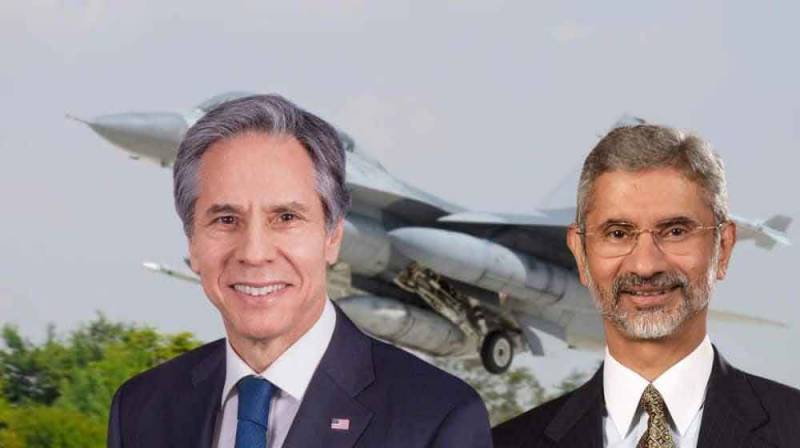
US Secretary of State Tony Blinken (L), Indian External Affairs Minister S. Jaishankar

Responding to Jaishankar's outburst, the US State Department spokesman Ned Price said, “We don’t view our relationship with Pakistan, and … our relationship with India as in relation to one another. These are both partners of ours with different points of emphasis in each. We look at both as partners, because we do have in many cases shared values. We do have in many cases shared interests. And the relationship we have with India stands on its own. The relationship we have with Pakistan stands on its own. We also want to do everything we can to see to it that these neighbors have relations with one another that are as constructive as can be possible. And so that’s another point of emphasis.”

President Joe Biden & First Lady Jill with Pakistani Prime Minister Shahbaz Sharif at the UN HQ

Indian Prime Minister Narendra Modi recently attended a summit meeting of the China-Russia sponsored Shanghai Cooperation Organization (SCO) held in Samarkand, Uzbekistan. India is a full member of this alliance which has been created to counter the US dominance in Asia. At the same time, New Delhi has also joined QUAD, a group of 4 nations (Australia, India, Japan and US) formed by the United States  to counter China's rise. Simultaneous membership of these two competing alliances is raising serious questions about Prime Minister Narendra Modi's real intentions and trustworthiness. It appears that there is an Indian policy shift from "non-alignment" to "all-alignment".

Writing an Op Ed for The Indian Express about Jaishankar's fit of anger, Indian journalist Nirupama Subramanian put it in the following words: “As Delhi demonstrates “strategic autonomy” to engage with every side — Quad one week, and Russia and China the next at the Shanghai Cooperation Organization (SCO) in Samarkand — and work around Western sanctions to buy oil from Russia, and keep friends in all camps, it may have to come to terms that others in world play the same game.”

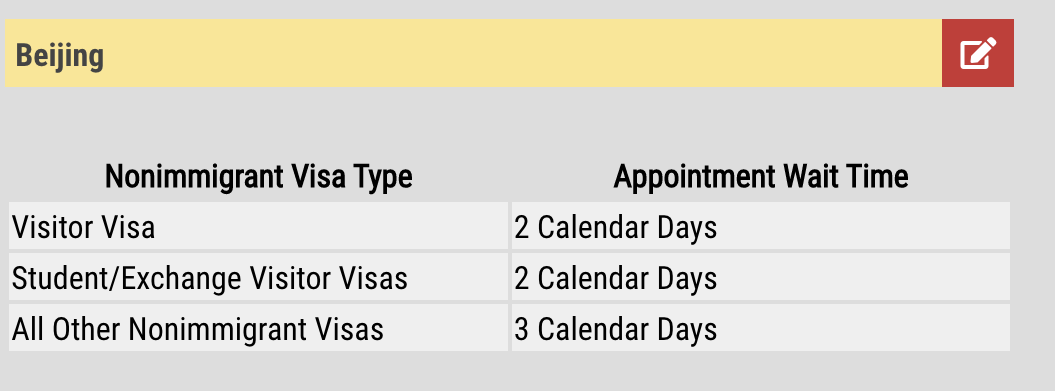
US Visa Appointment Wait Time. Source: US State Department

Jaishankar also raised the issue of long appointment wait times for Indians seeking visas to come to the United States. "In India, there are families unable to meet; students waiting for a long time. So it is a serious problem. But, I'm confident that, with the sincerity Secretary Blinken showed, they would address this, and with any support that we can provide, we hope things will improve," he said.  Secretary Anthony Blinken said in response, "We had constraints from COVID about the number of people we could have in our embassies at any one time etc. We are now building back very determined really from that surging resources. We have a plan when it comes to India to address the backlog of visas that have built up. I think you'll see that play out in the coming months."

US Visa Appointment Wait Time. Source: US State Department

Currently, the waiting period for Indian applicants in  New Delhi is 444 calendar days for student/exchange visitor visas, 758 calendar days for visitor visas and 354 calendar days for all other non-immigrant visas. 

The appointment waiting period for Pakistani applicants in Islamabad is one calendar day for student/exchange visitor visas, 450 calendar days for visitor and one calendar day for all other non-immigrant visas.  For the Chinese applicants in Beijing it is two calendar days for student/exchange visitor and students visas and three calendar days for all other non-immigrant visas. 

Thursday, September 16, 2021

Karachi-Born US Senator Van Hollen Stands Up For Pakistan During Afghanistan Hearing

Maryland Democrat Chis Van Hollen, a key US senator who was born in Karachi, said it was the Trump administration that asked Pakistan to release the top three Taliban leaders for US-Taliban peace talks in Doha Qatar. He was speaking at a recent US Senate hearing on the fall of Kabul to the Taliban and the chaotic US withdrawal that followed the Afghan Army collapse

Senator Chris Van Hollen


Senator Chris Van Hollen was born in 1959 in Karachi where his father was serving as a foreign service officer at the US Embassy in Karachi, Pakistan. His father later served as Deputy Assistant Secretary of State for Near Eastern Affairs (1969–1972) and US Ambassador to Sri Lanka and the Maldives (1972–1976). His mother worked for the CIA as chief of the intelligence bureau for South Asia.

“Is it not the fact that the Trump administration asked the Pakistani government to release three top Taliban commanders as part of that (peace) process?” Senator Van Hollen asked. Targeting the Trump administration, Van Hollen continued, “And so, we pick a date. We say to the Taliban you can attack Afghan forces and then we say, now let’s negotiate the future of Afghanistan. Isn’t the way it was set up when you walked in?” “That’s essentially, yes," Blinken replied.   

Referring to allegations of Pakistan's complicity in promoting chaos in Afghanistan, Senator Van Hollen said, “I think a number of those countries, at least Pakistan — like India, like the others — have an interest in preventing chaos and civil war in Afghanistan".

Here's the exchange between Van Hollen and Blinken at the Afghanistan hearing on Capitol Hill:

 Van Hollen: “Is it not the fact that the Trump administration asked the Pakistani government to release three top Taliban commanders as part of that process?” 

Blinken: “That’s correct".

Van Hollen: “And one of them is now number two in the Taliban government, Baradar, right?”

Blinken: “That’s correct.” 

Van Hollen: “He is the person everybody saw in those photos in Kabul, right?” 

Mr Blinken: “That’s correct.” 

Van Hollen: “And there was another senior commander, and they began the discussions in Doha.” 

Blinken: “That’s right.” 

Van Hollen: “They (US negotiators) did not include the Afghan government, did they?” 

Blinken: “That’s right, correct.” 

Van Hollen: “And they in fact essentially ordered, pressured, the Afghan government to release 5,000 Taliban prisoners, right?” 

Blinken: “That’s correct.” 

Van Hollen: “Many of those fighters are involved in the attack on Kabul today, right?” 

Blinken: “Yes.” 

Van Hollen: “Now, let’s see what the negotiation was: the US will leave by a certain date in May this year, right?” 

Blinken: “Correct.” 

Van Hollen: “You can’t attack American forces, but you can attack the Afghan forces with impunity, right?” 

Blinken: “That’s correct.” 

Van Hollen: “And so, we pick a date. We say to the Taliban you can attack Taliban forces and then we say, now let’s negotiate the future of Afghanistan. Isn’t the way it was set up when you walked in?”

Blinken: “That’s essentially, yes.” . 


British Defense Forces Chief General Sir Nick Carter is another western leader who has defended Pakistan recently. Responding to the familiar charge of "safe havens" for Taliban in Pakistan, General Nick Carter told BBC's Yalda Hakim that Pakistanis have hosted millions of Afghan refugees for many years and "they end up with all sorts of people". "We would be very worried if they heartlessly kicked out" the Afghans from Pakistan. He said that Pakistan's Army Chief General Bajwa genuinely wants to see a peaceful and stable Afghanistan. 

Carter Malkasian, former advisor to US Joint Chiefs Chairman General Dunford, has also recently talked about how Afghan governments have scapegoated Pakistan for their own failures. He said: "Let’s take Pakistan, for example. Pakistan is a powerful factor here. But on the battlefield, if 200 Afghan police and army are confronted with 50 Taliban or less than that, and those government forces retreat, that doesn’t have a lot to do with Pakistan. That has to do with something else". 

In another discussion,  Malkasian explained the rapid advance of the Taliban and the collapse of the Afghan government led by President Ashraf Ghani. Here's what he said:

Over time, aware of the government’s vulnerable position, Afghan leaders turned to an outside source to galvanize the population: Pakistan. Razziq, President Hamid Karzai and later President Ashraf Ghani used Pakistan as an outside threat to unite Afghans behind them. They refused to characterize the Taliban as anything but a creation of Islamabad. Razziq relentlessly claimed to be fighting a foreign Pakistani invasion. Yet Pakistan could never fully out-inspire occupation.  

Many westerners, including politicians, generals, analysts and journalists, are angry with Pakistan for the stinging US defeat in Afghanistan. They are trying to scapegoat Pakistan for the West's failed policies. Some want to punish Pakistan. However, many of them also recognize the importance of Pakistan in dealing with the aftermath of the Afghan fiasco. American analyst Michael Kugelman recently tweeted about America's use of Pakistani airspace (ALOCS) for "over-the-horizon" counter-terrorism ops in Afghanistan, underlining Pakistan's importance to the United States.  

US Analyst Michael Kugelman on American Reliance on Pakistan

A recent piece in Politico summed up US reliance on Pakistan as follows :

"The Biden administration has been unusually circumspect about revealing its contacts and discussions with Pakistan. While Pakistan’s actions often appear at odds with the United States, it nonetheless is a nation with links to the Afghan Taliban whose cooperation on fighting terrorism can be helpful. It’s also a nuclear-armed country American officials would prefer not to lose entirely to Chinese influence".