Showing posts with label Covid19. Show all posts

Friday, June 10, 2022

Economic Survey: Pakistanis Consuming More Calories, Fruits and Vegetables

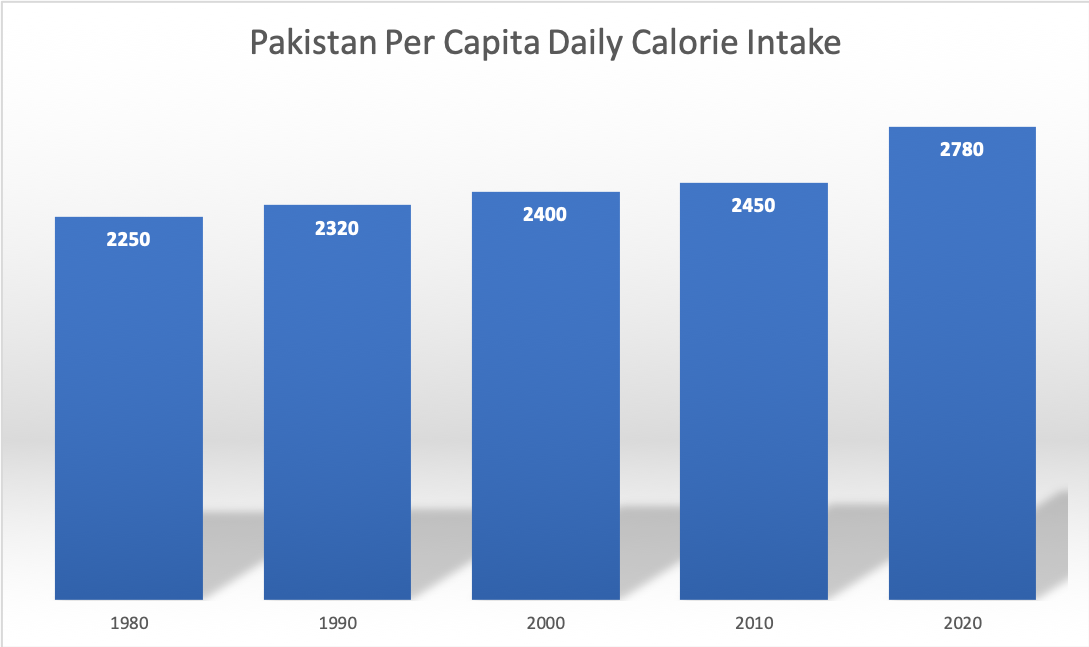
Pakistanis are eating more and healthier foods, according to the Economic Survey of Pakistan 2021-22. Per capita average daily calorie intake in Pakistan has jumped to 2,735 calories in FY 2021-22 from 2,457 calories in 2019-20. The biggest contributor to it is the per capita consumption of fresh fruits and vegetables which soared from 53.6 Kg to 68.3 Kg, less than half of the 144 Kg (400 grams/day) recommended by the World Health Organization. Healthy food helps cut disease burdens and reduces demand on the healthcare system. Under former Prime Minister Imran Khan's leadership, Pakistan succeeded in achieving these nutritional improvements in spite of surging global food prices amid the Covid19 pandemic

Pakistan Per Capita Daily Calorie Consumption. Source: Economic Surveys of Pakistan


The trend of higher per capita daily calorie consumption has continued since the 1950s. It has risen from about 2,078 in 1949-50 to 2,400 in 2001-02 and 2735 in 2021-22. The per capita per day protein intake in grams increased from 63 to 67 to about 75 during these years. Health experts recommend that women consume at least 1,200 calories a day, and men consume at least 1,500 calories a day, says Harvard Health Publishing.  The global average has increased from 2360 kcal/person/day in the mid-1960s to 2900 kcal/person/day currently, according to the Food and Agricultural Organization (FAO). The USDA (United States Department of Agriculture) estimates that most women need 1,600 to 2,400 calories, while the majority of men need 2,000 to 3,000 calories each day to maintain a healthy weight. Global Hunger Index defines food deprivation, or undernourishment, as consumption of fewer than 1,800 calories per day.

Share of Overweight or Obese Adults. Source: Our World in Data

The share of overweight or obese adults in Pakistan's population is estimated by the World Health Organization at 28.4%. It is 20% in Bangladesh, 19.7% in India, 32.3% in China, 61.6% in Iran and 68% in the United States.   

Major Food Items Consumed in Pakistan. Source: Economic Survey of Pakistan 2021-22

The latest edition of the Economic Survey of Pakistan estimates that per capita calories come from the annual per capita consumption of  164.7 Kg of cereals, 7.3 Kg of pulses (daal), 28.3 Kg of sugar, 168.8 liters of milk, 22.5 Kg of meat, 2.9 Kg of fish, 8.1 dozen eggs, 14.5 Kg of ghee (cooking oil) and 68.3 Kg of fruits and vegetables.  Pakistan's economy grew 5.97% and agriculture outputs increased a record 4.4% in FY 2021-22, according to the Economic Survey. The 4.4% growth in agriculture has boosted consumption and supported Pakistan's rural economy.  

Pakistan Growth Indicators. Source: Economic Survey 2021-22

The minimum recommended food basket in Pakistan is made up of basic food items (cereals, pulses, fruits, vegetables, meat, milk, edible oils and sugar) to provide 2150 kcal and 60gram protein/day per capita. 

The state of Pakistan's social sector is not as dire as the headlines suggest. There are good reasons for optimism. Key indicators show that nutrition and health in Pakistan are improving but such improvements need to be accelerated. 

Related Links:

Wednesday, May 11, 2022

WHO: India's 4.7 Million Excess Deaths Account For Nearly One-Third of the Global COVID Death Toll

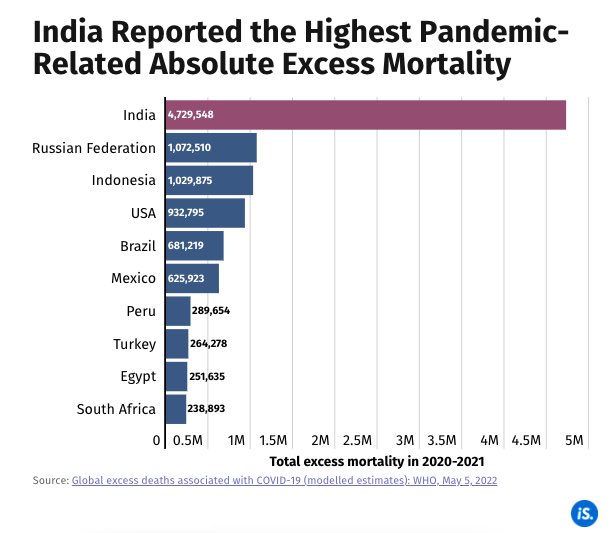
The World Health Organization estimates that India had 4.730 million COVID19-related  deaths in 2020-21, nearly a third of 15 million global excess deaths attributed to the pandemic. India is followed by Russia with 1.073 million deaths and Indonesia with 1.03 million deaths. The United States with 933,795 deaths and Brazil with 681,219 deaths round out the top 5 countries that suffered the heaviest losses of life believed to be related to the pandemic. Mexico (625,923 deaths), Peru (289,654 deaths), Turkey (264,279 deaths) Egypt (251,635 deaths) and South Africa (238,893 deaths) are ranked number 6 through 10 in the world for excess deaths in 2020-21 period. Although Pakistan too had 8 times the official figure, it still does not figure in WHO's top 10 list for total number of COVID deaths. 

Total Excess Deaths Recorded During the COVID-19 Pandemic in 2020-21. Source: WHO

Excess deaths measure how many more people died than expected compared with previous years. Although it is difficult to say with certainty how many of these deaths were due to Covid, they can be considered a measure of the scale and toll of the pandemic, according to the BBC. 

Although the government of Prime Minister Narendra Modi disputes the WHO estimates, the scenes of desperation and death all over India, including the streets of major cities during the pandemic, offer significant anecdotal evidence to support the WHO claim. Although Pakistan too had 8 times the official figure, it still does not figure in WHO's top 10 list for total number of COVID deaths. 

List of Countries with excess deaths during COVID19 pandemic. Source: WHO

Prime Minister Modi's mishandling of the COVID19 pandemic has left a lasting effect on India's economy. Akhil Bharatiya Pratinidhi Sabha (ABPS), the top decision-making body of India's Hindu right-wing RSS (Rashtriya Swayamsevak Sangh), says that “the young generation is suffering from unemployment and the pandemic has made things even grim... We cannot turn a blind eye to unemployment. It is a crisis and it needs to be addressed.” The RSS was apparently reacting to the falling labor participation rate in India relative to Pakistan and the global averages. The RSS leadership wants the government of Prime Minister Narendra Modi to focus on helping small and medium sized enterprises (SMEs) to create jobs.  RSS likes Modi government's ‘Make in India’ initiative “but it needs to be sharpened even more and get more investment.” The resolution is titled, ‘The need to promote work opportunities to make Bharat self-reliant’. The solution offered by ABPS resolution: Take agro-based local initiatives to promote rural areas and create jobs, according to Ram Madhav, a member of the RSS executive committee. 

Falling Employment in India. Source: CMIE


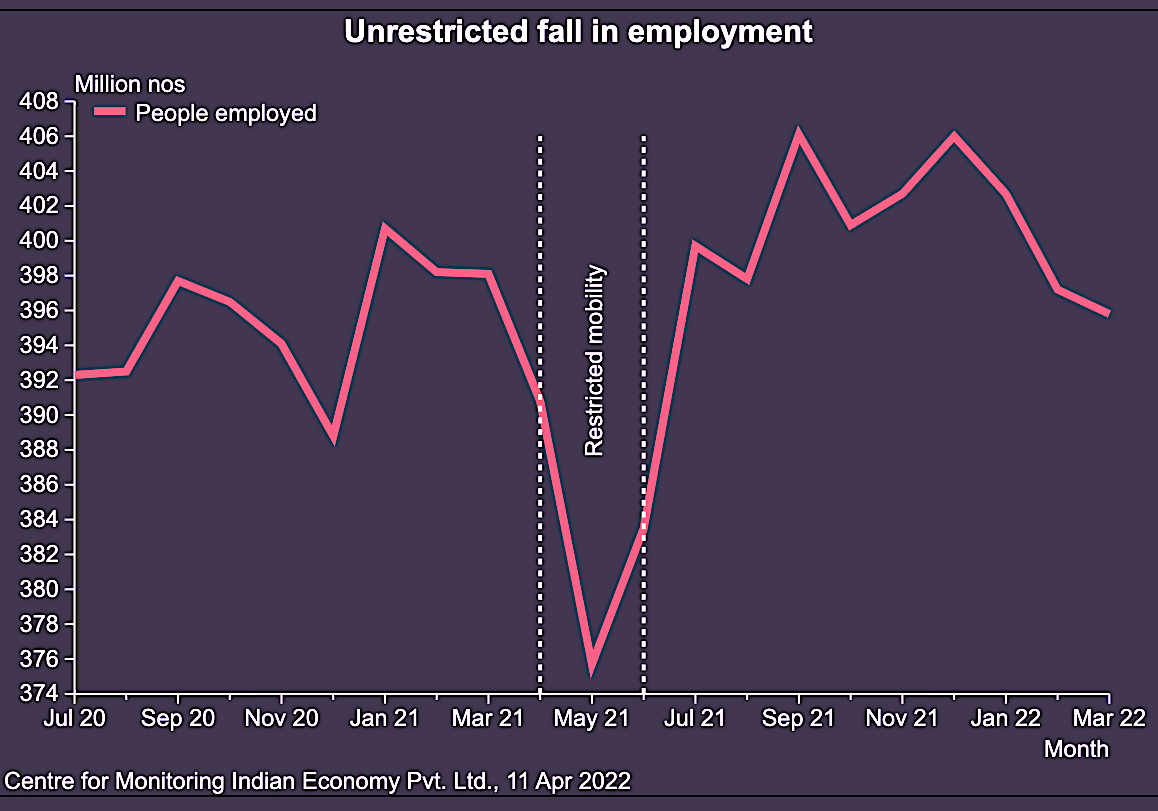
India's labor participation rate (LPR) fell to 39.5% in March 2022, as reported by the Center for Monitoring Indian Economy (CMIE). It dropped below the 39.9% participation rate recorded in February. It is also lower than during the second wave of Covid-19 in April-June 2021. The lowest the labor participation rate had fallen to in the second wave was in June 2021 when it fell to 39.6%. The average LPR during April-June 2021 was 40%. March 2022, with no Covid-19 wave and with much lesser restrictions on mobility, has reported a worse LPR of 39.5%.

Labor Participation Rates in India and Pakistan. Source: ILO/World Bank

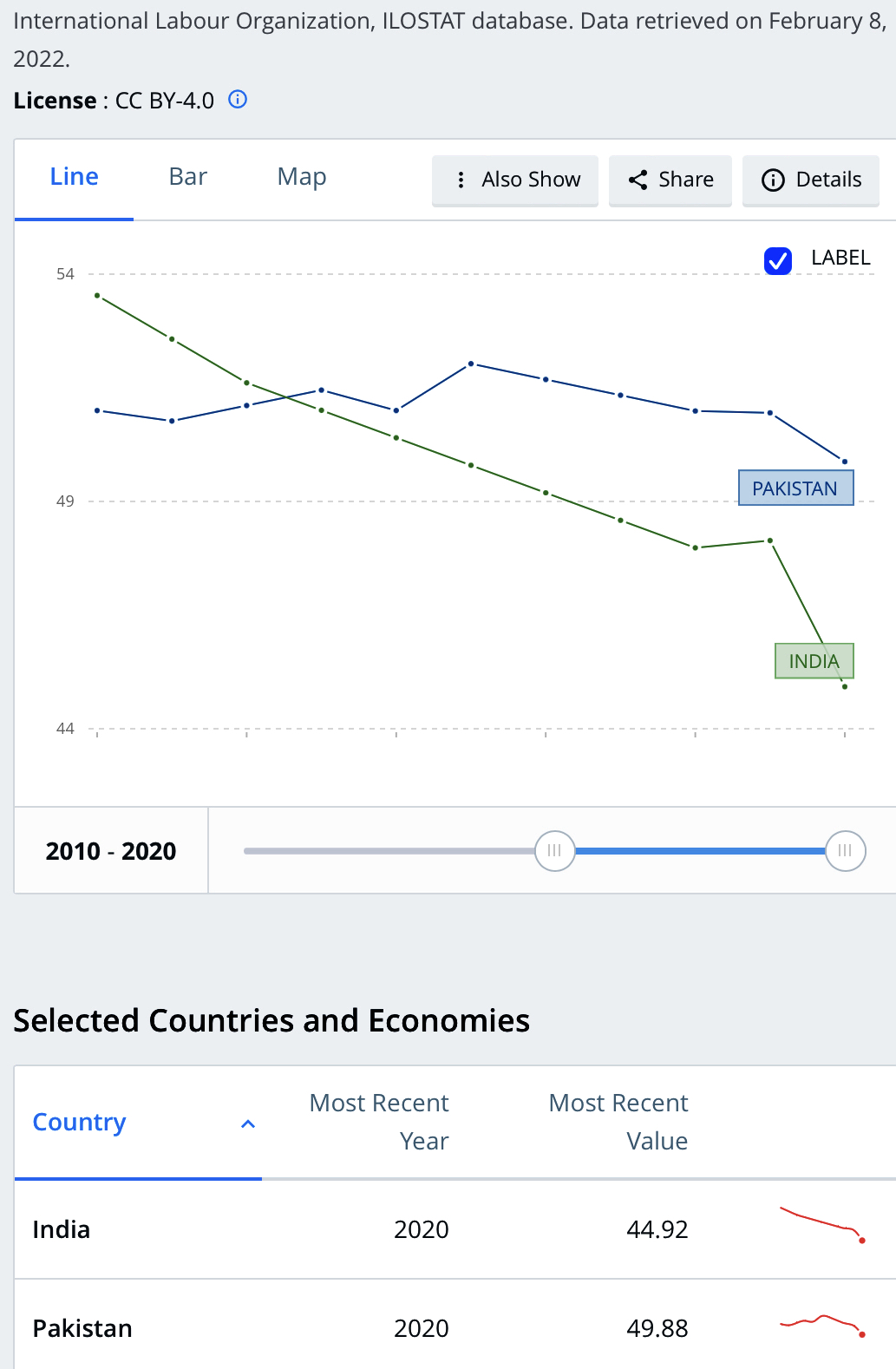
In spite of the headline GDP growth figures highlighted by the Indian and world media, the fact is that it has been jobless growth. The labor participation rate (LPR) in India has been falling for more than a decade. The LPR in India has been below Pakistan's for several years, according to the International Labor Organization (ILO). 

Indian Employment Trends By Sector. Source: CMIE Via Business Standard

Construction and manufacturing sectors in India have been shedding jobs while the number of people working in agriculture has been rising, according to CMIE. Job losses have caused a hunger crisis in India which now ranks 94th among 107 nations ranked by World Hunger Index in 2020. Other South Asians have fared better: Pakistan (88), Nepal (73), Bangladesh (75), Sri Lanka (64) and Myanmar (78) – and only Afghanistan has fared worse at 99th place. The COVID19 pandemic has worsened India's hunger and malnutrition. Tens of thousands of Indian children were forced to go to sleep on an empty stomach as the daily wage workers lost their livelihood and Prime Minister Narendra Modi imposed one of the strictest lockdowns in the South Asian nationPakistan's former Prime Minister Imran Khan opted for "smart lockdown" that reduced the impact on daily wage earners. China, the place where COVID19 virus first emerged, is among 17 countries with the lowest level of hunger. 


Related Links:

Haq's Musings

South Asia Investor Review

Pakistan Among World's Largest Food Producers

Naya Pakistan Housing Program

Food in Pakistan 2nd Cheapest in the World

Indian Economy Grew Just 0.2% Annually in Last Two Years

Pakistan to Become World's 6th Largest Cement Producer by 2030

Pakistan Reduced Poverty & Grew Economy During COVID Pandemic

Pakistan's Computer Services Exports Jump 26% Amid COVID19 Lockdown

Coronavirus, Lives and Livelihoods in Pakistan

Vast Majority of Pakistanis Support Imran Khan's Handling of Covid19 Crisis

Pakistani-American Woman Featured in Netflix Documentary "Pandemic"

Incomes of Poorest Pakistanis Growing Faster Than Their Richest Counterparts

Can Pakistan Effectively Respond to Coronavirus Outbreak? 

How Grim is Pakistan's Social Sector Progress?

Pakistan Fares Marginally Better Than India On Disease Burdens

Trump Picks Muslim-American to Lead Vaccine Effort

COVID Lockdown Decimates India's Middle Class

Pakistan Child Health Indicators

Pakistan's Balance of Payments Crisis

How Has India Built Large Forex Reserves Despite Perennial Trade Deficits

Conspiracy Theories About Pakistan Elections"

PTI Triumphs Over Corrupt Dynastic Political Parties

Strikingly Similar Narratives of Donald Trump and Nawaz Sharif

Nawaz Sharif's Report Card

Riaz Haq's Youtube Channel

Tuesday, February 22, 2022

COVID19 Impact: Declining Enrollment of Pakistani Students in US, China

Pakistan, the world's sixth most populous nation, ranked 18th in the number of students studying in the United States. Pakistani students enrolled in the US fell by 5.8% to 7,475 in 2020-21, significantly less than the 15% drop in international student enrollment. However, number of Pakistanis studying in the US in 2020-21 was even less than students from much smaller nations like Nepal which ranked 12th. Overall, COVID19 travel restrictions brought down the total number of foreign students enrolled in American educational institutions dropped to less than one million in 2020-21, the lowest figure since 2015-16.  

Pakistani Students in the US. Source: OpenDoors

China maintained its top position among the leading places of origin for international students, with 35% of all international students in the 2020-21 school year hailing from the country, according to the data released by the United States government.  The second most common place of origin was India (18%), followed by South Korea (4%) and Canada (3%). Some of these countries also experienced the largest year-over-year declines in the number of students who enrolled at US institutions. The largest such percentage decreases occurred in South Korea (-21%), China (-15%) and India (-13%).

Foreign Students Studying in US. Source: OpenDoors

The number of students in China, the top destination for Pakistani students, was also heavily impacted by COVID travel bans. Some 28,000 Pakistani students are affected by China’s tough border closures and are studying from home. Studying in China has only been possible for South Korean students who were granted an exemption in July 2020, according to reports.  

Pakistani Students in the US. Source: OpenDoors

During his recent visit to Beijing, Prime Minister Imran Khan brought up the issues faced by Pakistani students in resuming education in China. A joint statement issued by Chinese and Pakistani sides mentioned it thus: "Pakistan side highlighted that China has become a popular education destination. While ensuring safety against COVID-19, China will arrange for Pakistani students to return to China and resume classes in a prudent manner". 


Monday, February 14, 2022

COVID19: Has Pakistan Proved Experts Forecasts Wrong?

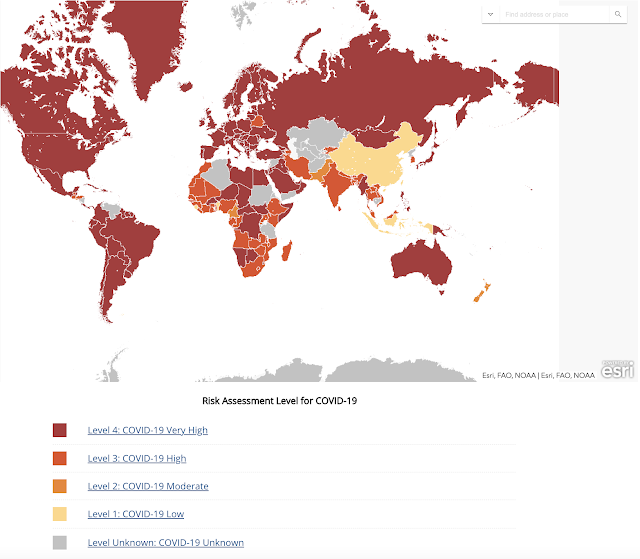
The United States Centers for Disease Control (CDC) have recently assessed American travelers' risk of COVID19 infection in Pakistan being among the lowest in the world. The Economist magazine has ranked Pakistan second in the world for return to the normalcy of pre-pandemic life. These assessments stand in sharp contrast to Pakistan's low ranking for pandemic preparedness by the Global Health Index (GHI). GHS has also continued to rank India higher than its neighbors in spite of Prime Minister Narendra Modi's disastrous handling of the COVID19 outbreak in India that saw people gasping for breath and dying on the streets of major Indian cities.  The health experts at GHS seem to be totally out of touch with reality. They are the epitome of the  "ivory tower" academia. 


US CDC Travel Risk Map. Source: CDC

US CDC on Pakistan:

In its latest global travel advisory, the US Centers for Disease Control and Prevention (CDC) has placed Pakistan at level-2, a level assigned to just 5 countries in the world. 

The agency has placed India at level-3, which includes countries where the chances of catching Covid-19 are high.  Most of the world, including North America and Europe, are placed in level 4 by the CDC. 

Economist Magazine Normalcy Index. Source: Economist


Economist Magazine Normalcy Index:

The Economist magazine has its own ranked list of countries for return to pre-pandemic life. In its latest issue, the magazine says that "Activity is back at normal levels in just two of the countries we track: Colombia and Pakistan". 

The Economist ranks Pakistan second in the world with a score of 106.6, just behind the first-ranked Egypt with a score of 107.4.

Pandemic Preparedness Map. Source: Global Health Security

Global Health Index:

Global Health Security(GHS) Index measures the capacities of 195 countries to prepare for epidemics and pandemics.  GHS has been publishing its rankings and maps since 2020 that continue to show that North America and Western Europe as the best prepared for pandemics. 

GHS has also continued to rank India higher than its neighbors in spite of Prime Minister Narendra Modi's disastrous handling of the COVID19  in India outbreak that saw people gasping for breath and dying on the streets of major Indian cities.  The health experts at GHS seem to be totally out of touch with reality. They are the epitome of the  "ivory tower" academia. 

Related Links:

Haq's Musings

South Asia Investor Review

COVID19 in Pakistan: Test Positivity Rate and Deaths Declining

Fareed Zakaria Never Misses Any Opportunity to Bash Pakistan

Pakistan's Economist Normalcy Index

Lynchistan: India is the Lynching Capital of the World

73 Year After Independence, Caste-Ridden India Dominated By Brahmins

Modi's Disastrous Handling of COVID19 Pandemic

Is Pakistan's Response to COVID19 Flawed?

Pakistan's Computer Services Exports Jump 26% Amid COVID19 Lockdown

Coronavirus, Lives and Livelihoods in Pakistan

Vast Majority of Pakistanis Support Imran Khan's Handling of Covid19 Crisis

Pakistani-American Woman Featured in Netflix Documentary "Pandemic"

Coronavirus Antibodies Testing in Pakistan

Can Pakistan Effectively Respond to Coronavirus Outbreak? 

How Grim is Pakistan's Social Sector Progress?

Pakistan Fares Marginally Better Than India On Disease Burdens

Trump Picks Muslim-American to Lead Vaccine Effort

Democracy vs Dictatorship in Pakistan

Pakistan Child Health Indicators

Pakistan's Balance of Payments Crisis

Panama Leaks in Pakistan

Conspiracy Theories About Pakistan Elections"

PTI Triumphs Over Corrupt Dynastic Political Parties

Strikingly Similar Narratives of Donald Trump and Nawaz Sharif

Nawaz Sharif's Report Card

Riaz Haq's Youtube Channel


Monday, November 8, 2021

Global Food Security Index 2021: Food in Pakistan More Affordable Than India, Bangladesh, Nepal

Food is more affordable in Pakistan than in Bangladesh and India, according to the Global Food Security Index 2021. Earlier in 2021, Global Hunger Index report also ranked Pakistan better than India. Numbeo Grocery Index reports that the food prices in Pakistan are the second cheapest in the world. 


Global Food Security Index 2021. Source: Economist


Global Food Security:

Pakistan (with 52.6 points) has scored better than  Bangladesh (48.8), Nepal (48.3) and India (50.2 points) in terms of food affordability.  Sri Lanka scored higher with 62.9 points in this category on the GFS Index 2021,  according to a global report released by Economist Impact and Corteva Agriscience recently. 

Ireland, Australia, the UK, Finland, Switzerland, the Netherlands, Canada, Japan, France and the US shared the top rank with the overall GFS scores in the range of 77.8 and 80 points on the index. 

In overall food security, Pakistan ranked 75th with a score of 54.7, ahead of Sri Lanka (77), Nepal (79) and Bangladesh (84), but behind India ranked 71st with a score of 57.2 points on the GFS Index 2021 ranking 113 countries.

Pakistan improved its GFS score by 9 points (to 54.7 in 2021 from 45.7 in 2012) while India’s score improved only by 2.7 points to 57.2 in 2021 from 54.5 in 2012.  Nepal improved by 7 points (to 53.7 points in 2021 from 46.7 points in 2012) and Bangladesh by 4.7 points (to 49.1 in 2021 from 44.4 points in 2012). China’s score improved by 9.6 points to 71.3 in 2021 from 61.7 in 2012, the report said. “The GFSI looks beyond hunger to identify the underlying factors affecting food insecurity around the world,” said Tim Glenn, Executive Vice-President and Chief Commercial Officer, Corteva Agriscience.

The cost of living in Pakistan is the world's lowest despite recent inflationary trends, according to the Cost of Living Index for mid-2021 as published by Numbeo.  Numbeo Grocery Index reports that the food prices in Pakistan are the second cheapest in the world. 

History of Inflation in Pakistan. Source: Statista


Global Hunger Index:

Global Hunger Index 2021 report has ranked Pakistan 92nd, ahead of India ranked 101st among 116 countries.  Pakistan's other South Asian  neighbors are ranked better: Nepal (76), Bangladesh (76), Myanmar (71). 

Hunger Trends in South Asia. Source: Global Hunger Index 

Pakistan has been reducing hunger at a faster rate than India but slower than other South Asian neighbors like Bangladesh and Nepal. It is notable that Pakistan's minimum monthly wage of US$491 in terms of purchasing power parity is among the highest in developing nations in Asia Pacific, including Bangladesh, India, China and Vietnam, according to the International Labor Organization

Monthly Minimum Wages Comparison. Source: ILO


COVID-Induced Inflation: 

Global supply-chain disruptions and economic recovery from COVID19 pandemic have driven up prices of all commodities, including food and fuel, worldwide. 


Summary: 

Food and fuel prices in Pakistan are among the lowest in the world. However, everyone is feeling the pinch of rising global prices. It is particularly painful for people in developing countries like Pakistan. These prices are beyond the control of any one national government. What governments like Pakistan can and should do is to protect the poorest and most vulnerable people in their countries. Prime Minister Imran Khan's plan to deliver targeted food subsidies worth $700 million should help reduce the pain. This $700 million package of targeted subsidies is in addition to more than a billion dollars distributed to the indigent families under the Ehsaas program.  

Related Links:

Haq's Musings

South Asia Investor Review

Pakistan Among World's Largest Food Producers

Naya Pakistan Housing Program

Food in Pakistan 2nd Cheapest in the World

Pakistan's Pharma Industry Among World's Fastest Growing

Pakistan to Become World's 6th Largest Cement Producer by 2030

Pakistan's 2012 GDP Estimated at $401 Billion

Pakistan's Computer Services Exports Jump 26% Amid COVID19 Lockdown

Coronavirus, Lives and Livelihoods in Pakistan

Vast Majority of Pakistanis Support Imran Khan's Handling of Covid19 Crisis

Pakistani-American Woman Featured in Netflix Documentary "Pandemic"

Incomes of Poorest Pakistanis Growing Faster Than Their Richest Counterparts

Can Pakistan Effectively Respond to Coronavirus Outbreak? 

How Grim is Pakistan's Social Sector Progress?

Pakistan Fares Marginally Better Than India On Disease Burdens

Trump Picks Muslim-American to Lead Vaccine Effort

Democracy vs Dictatorship in Pakistan

Pakistan Child Health Indicators

Pakistan's Balance of Payments Crisis

Panama Leaks in Pakistan

Conspiracy Theories About Pakistan Elections"

PTI Triumphs Over Corrupt Dynastic Political Parties

Strikingly Similar Narratives of Donald Trump and Nawaz Sharif

Nawaz Sharif's Report Card

Riaz Haq's Youtube Channel

PakAlumni Social Network

Saturday, August 21, 2021

Has Pakistan Achieved Herd Immunity Against COVID19?

How widespread are coronavirus infections and vaccinations in Pakistan? Has Pakistan achieved herd immunity or close to achieving it?  The latest IHME (Institute for Health Metrics and Evaluation) report on Pakistan (dated August 19, 2021) claims that "about 81% of the population have been infected, and about 65% are immune to the Delta variant". It says that the "cases and deaths are declining in Pakistan, but the situation remains fragile".      

The report defines two types of coronavirus variants: escape and non-escape. The escape variants include Beta (B.1.351), Gamma (P.1) and Delta (India) variants while non-escape variants are the original ancestral virus and Alpha (UK) variant.  The report projects Pakistan reaching 75% to 90% immunity to various COVID19 variants through a combination of infections and vaccinations by the end of 2021. 

Immunity to COVID Variants in Pakistan. Source: IHME

The IHME August 19 COVID19 results briefing on Pakistan also warns: "If mobility increases and mask wearing declines as cases are declining (people let down their guard), cases could surge again".  Here is the summary of the IHME report:

"Cases and deaths are declining in Pakistan, but the situation remains fragile. We estimate that about 81% of the population have been infected, and about 65% are immune to the Delta variant (accounting for cross-variant protection). If mobility increases and mask wearing declines as cases are declining (people let down their guard), cases could surge again."

If the IHME modeling of COVID19 in Pakistan is correct, it raises hope that Pakistan is nearing an end to the current pandemic that has badly hurt its people and its economy. Achieving this goal will require that Pakistanis continue to implement the following 5 strategies recommended by IHME. 

1) Increase vaccination through outreach and perhaps vaccine mandates from employers and making it easy to get vaccinated; 

2) Reduce the risk of major transmission if schools are to open through appropriate use of mitigation measures including universal masking, sufficient distancing of students, and periodic testing of all students; 

3) Support hospital systems that will be under severe stress in the next 4–6 weeks; 

4) Implement mask mandates in states or communities with major surges in hospitalization; and 

5) Maintain surveillance on breakthrough infection by type of vaccine and time since vaccination – as well as adequate testing for vaccinated and unvaccinated – in order to accurately track the evolution of the epidemic".

Related Links:

Haq's Musings

South Asia Investor Review

COVID19 in Pakistan: Test Positivity Rate and Deaths Declining

Fareed Zakaria Never Misses Any Opportunity to Bash Pakistan

Pakistan COVID19 Normalcy Index

Lynchistan: India is the Lynching Capital of the World

73 Year After Independence, Caste-Ridden India Dominated By Brahmins

Pakistan's Pharma Industry Among World's Fastest Growing

Is Pakistan's Response to COVID19 Flawed?

Pakistan's Computer Services Exports Jump 26% Amid COVID19 Lockdown

Coronavirus, Lives and Livelihoods in Pakistan

Vast Majority of Pakistanis Support Imran Khan's Handling of Covid19 Crisis

Pakistani-American Woman Featured in Netflix Documentary "Pandemic"

Coronavirus Antibodies Testing in Pakistan

Can Pakistan Effectively Respond to Coronavirus Outbreak? 

How Grim is Pakistan's Social Sector Progress?

Pakistan Fares Marginally Better Than India On Disease Burdens

Trump Picks Muslim-American to Lead Vaccine Effort

Democracy vs Dictatorship in Pakistan

Pakistan Child Health Indicators

Pakistan's Balance of Payments Crisis

Panama Leaks in Pakistan

Conspiracy Theories About Pakistan Elections"

PTI Triumphs Over Corrupt Dynastic Political Parties

Strikingly Similar Narratives of Donald Trump and Nawaz Sharif

Nawaz Sharif's Report Card

Riaz Haq's Youtube Channel


Thursday, July 29, 2021

Racial Slurs Hurled at Pakistani-American Doctor in a Public Hearing in St. Louis, Missouri

St. Louis County Health Director Dr. Faisal Khan, a Pakistani American, was subjected to racial abuse at a St. Louis County Council meeting, according to multiple media reports. He apparently got caught up in the middle of a fierce, angry debate on new mask mandates amid surging infections attributed to the Delta variant of the COVID19 virus that originated in India. The anti-mask crowd is particularly strong in Republican states that voted for former President Donald J. Trump.  

Dr. Faisal Khan


Dr. Khan was subjected to racial slurs and physically assaulted after defending a new mask mandate to combat COVID-19.  In response to the abuse, he raised his middle finger at a crowd gathered at a St. Louis County Council meeting, according to a Wednesday letter obtained by the St. Louis Post-Dispatch. “After being physically assaulted, called racial slurs and surrounded by an angry mob, I expressed my displeasure by using my middle finger toward an individual who had physically threatened me and called me racist slurs,” Khan wrote to Councilwoman Rita Heard Days who led the meeting.

“You asked us to stay home,” Rita Heard Days, the council chairwoman, told the director of the county’s public health department before voting to lift the mask mandate. “You asked us to put on masks. You asked us to stay six feet apart,” she said. “We have followed your orders, and yet we are still in a predicament. So something is not working.”  In an apparent reference to the rapid spread of the highly transmissible delta variant in the United States, Dr. Faisal Khan told her that the virus has changed.

While testifying, Dr. Khan said members of the crowd mocked his accent. As he left, Khan said he was shoulder-bumped, then surrounded by a crowd and called a racial slur. He also called out Councilman Tim Fitch for what Khan described as a xenophobic dog-whistle in asking Khan about his credentials. “Dr. Khan, we certainly have heard of your background before, but most here have not,” Fitch said during the meeting. “Can you tell us why you’re called Dr. Khan? Are you a physician in the United States?”

Dr. Faisal Khan is among thousands of Pakistani-American doctors who have been at the forefront of saving lives in the middle of the devastating COVID19 pandemic that has taken over half a million American lives so far. Among them is Dr. Syra MadadPakistani-American head of New York City’s Health and Hospitals System-wide Special Pathogens Program, who is featured in a 6-part Netflix documentary series "Pandemic: How to Prevent an Outbreak".
Pakistani-American doctors are the 3rd largest among foreign-educated doctors in America. Among the notable names of Pakistani-American doctors engaged in the fight against Covid-19 are: Dr. Saud Anwar in Connecticut, Dr. Gul Zaidi in New York and Dr. Umair Shah in Texas. Their work has received positive media coverage in recent weeks.

Dr. Saud Anwar, a Connecticut pulmonologist and state senator, came up with a ventilator splitter to deal with the shortages of life-saving equipment. Dr. Gul Zaidi, an acute-care pulmonologist in Long Island, was featured in a CBS 60 Minutes segment on how the doctors are dealing with unprecedented demands to save lives. Dr. Umair Shah was interviewed about his work by ABC TV affiliate in Houston, Texas.

Related Links:

Haq's Musings

South Asia Investor Review

Ex US Treasury Sec Praises Pakistan's COVID Response

Pakistani-American Health Expert Featured in Netflix Documentary "Pandemic"

Pakistan is the 3rd Largest Source of Foreign Doctors in America

Van Jones on "Geniuses from Pakistan"

Obama Honors Pakistani-American Doctor With Top Technology Medal

Hindus and Muslim Well-educated in America But Least Educated Worldwide

What's Driving Islamophobia in America?

Pakistani-Americans Largest Foreign-Born Muslim Group in Silicon Valley

The Trump Phenomenon

Islamophobia in America

Silicon Valley Pakistani-Americans

Pakistani-American Leads Silicon Valley's Top Incubator

Silicon Valley Pakistanis Enabling 2nd Machine Revolution

Karachi-born Triple Oscar Winning Graphics Artist

Pakistani-American Ashar Aziz's Fire-eye Goes Public

Two Pakistani-American Silicon Valley Techs Among Top 5 VC Deals

Pakistani-American's Game-Changing Vision 


Sunday, July 4, 2021

Economist Normalcy Index: Pakistan Among Best Performing Countries For Handling COVID19

With a score of 84.4, Pakistan ranks third among 50 countries tracked by the Economist magazine for return to pre-pandemic life. Pakistan's neighbor India has a score of 46.5, ranking it near the bottom in 48th position.  China (score 72.9) is 19th, United States (72.8) 20th, United Arab Emirates (68.9) 27th and United Kingdom (62.5) 36th. The global average for return to pre-pandemic activity is 66.6 on a scale of 0 to 100. 

Top Performing Countries For Return to Pre-Pandemic Activity Level. Source: Economist

Economist's Global Normalcy Index:

The Economist magazine is tracking 50 countries for return to pre-pandemic activity level. Here is how it  explains it:

"The global normalcy index plummeted in March 2020 as many countries imposed draconian restrictions on their citizens. It fell to just 35 in April 2020, before improving gradually over the following months. Today it stands at 66, suggesting that the world has travelled roughly half of the way back to pre-pandemic life. Some indicators, such as traffic congestion and time spent outside, have recovered faster than others, particularly sports attendance and flights. The global average masks a lot of variation across countries. Click on the drop-down box to explore how behavior has changed in each one". 


Best Performing Countries:

The top 10 best performing countries or territories on the Economist Normalcy Index are Hong Kong (96.3/100), New Zealand (87.8), Pakistan (84,4), Nigeria (84.1), Ukraine (83.6), Romania (82.1), Denmark (81.3), Egypt (81.2), Israel (80.4) and Mexico (80.2). The global average for return to pre-pandemic activity is 66.6 on a scale of 0 to 100. 

 Worst Performing Countries For Return to Pre-Pandemic Activity Level. Source: Economist


Worst Performing Countries:

The worst performing countries from the bottom are Malaysia (score 27.3/100) at number 50, Taiwan (43.7) at 49, India (46.5) at 48, Chile (51.1) at 47, Vietnam (51.3) at 46, Argentina (52.9) at 45, Philippines (55.5) at 44, Singapore (55.5) at 43, Peru (56.1) at 42, Thailand (57.8) at 41 and Indonesia (58.3) at 40. 

COVID Test Positivity Rate in Pakistan. Source: Our World in Data 


COVID Positivity Rate:

Timely actions by Pakistan National Command Operations Center (NCOC) have helped control the third COVID19 wave in the country. With nearly 50,000 daily tests, the positivity rate has dropped to around 2% in the most recent week.  This has been accomplished in spite of the fact that the vaccination rate in Pakistan is still quite low. 

Normalcy Index vs Vaccination Rates. Source: Economist

Summary:

The Economist magazine normalcy index has ranked Pakistan among the top 5 countries for return to pre-pandemic activity level.The latest COVID positivity rate is just over 2% in spite of the fact that the vaccination rates are still very low. With a score of 84.4, Pakistan ranks third among 50 countries tracked by the Economist magazine for return to pre-pandemic life. Pakistan's neighbor India has a score of 46.5, ranking it near the bottom in 48th position.  China (score 72.9) is 19th, United States (72.8) 20th, United Arab Emirates (68.9) 27th and United Kingdom (62.5) 36th The global average for return to pre-pandemic activity is 66.6 on a scale of 0 to 100.

Related Links:

Haq's Musings

South Asia Investor Review

COVID19 in Pakistan: Test Positivity Rate and Deaths Declining

Fareed Zakaria Never Misses Any Opportunity to Bash Pakistan

Retired Justice Markanday Katju on Modi's India

Lynchistan: India is the Lynching Capital of the World

73 Year After Independence, Caste-Ridden India Dominated By Brahmins

Pakistan's Pharma Industry Among World's Fastest Growing

Is Pakistan's Response to COVID19 Flawed?

Pakistan's Computer Services Exports Jump 26% Amid COVID19 Lockdown

Coronavirus, Lives and Livelihoods in Pakistan

Vast Majority of Pakistanis Support Imran Khan's Handling of Covid19 Crisis

Pakistani-American Woman Featured in Netflix Documentary "Pandemic"

Coronavirus Antibodies Testing in Pakistan

Can Pakistan Effectively Respond to Coronavirus Outbreak? 

How Grim is Pakistan's Social Sector Progress?

Pakistan Fares Marginally Better Than India On Disease Burdens

Trump Picks Muslim-American to Lead Vaccine Effort

Democracy vs Dictatorship in Pakistan

Pakistan Child Health Indicators

Pakistan's Balance of Payments Crisis

Panama Leaks in Pakistan

Conspiracy Theories About Pakistan Elections"

PTI Triumphs Over Corrupt Dynastic Political Parties

Strikingly Similar Narratives of Donald Trump and Nawaz Sharif

Nawaz Sharif's Report Card

Riaz Haq's Youtube Channel


Monday, June 28, 2021

The Biden Bounce: US Student Visa Applications From Pakistan Jump 37% in 2021

Student visa applications from Pakistan have jumped 37% this year. Overall, the number of international student applicants has increased by about 9% this year from last year, according to data from the Common App, as of January 22, 2021. Most of the top “sending” countries are showing increases, with the notable exception of China, the leading source of international students. But that decrease has been more than offset by substantial increases from countries like India, Canada, Nigeria, Pakistan, the United Kingdom, and Brazil, according to a report in Forbes magazine.

Pakistani F-1 Students in the United States. Source: Open Door


Although applications from China are down by 18% from last year, that loss is more than offset by large increases in applicants from several other countries; including India (+28%), Canada (+22%), Nigeria (+12%), Pakistan (+37%), the United Kingdom (+23%), and Brazil (+41%), according to Forbes. American colleges and universities have welcomed the trend. 43% of educational institutions are reporting an increase in their international student applications for the 2021-2022 academic year. 

The bounce is being attributed to declining COVID cases and the anticipation of the Biden Administration's liberal visa policy. President Joseph R. Biden has signaled his welcoming attitude toward foreign arrivals by signing a number of executive orders ranging from the revocation of Trump's "Muslim ban" to reinstatement of DACA protection.  

In the last pre-COVID academic year 2018-19, nearly 2,000 new F-1 students arrived in the United States from Pakistan, making it the 25th largest sending country. In the same academic year, China was the top sending country with nearly 100,000 new students enrolling in American universities. India was second with about 43,000 students. 

There were 7,939 Pakistani students studying on F-1 visa in the United States, ranking the country as the 22nd among countries sending students to the United States. China topped with nearly 370,000 international students in the United States while India was second with just over 200,000 students. 

Earlier in 2021,  representatives from 13 top US universities visited Pakistan and met thousands of Pakistani students at college fairs in Islamabad, Lahore, and Karachi as part of EducationUSA’s 16th South Asia Tour.  They shared valuable information about their institutions’ academic programs, campus life, financial aid options, and application procedures, according to the US Embassy in Pakistan.  

Since 2005, Pakistan’s Fulbright Program is the world’s largest in terms of financial contribution from the U.S. Government. The Government of Pakistan, through the Higher Education Commission (HEC), has also provided generous support. Every year approximately 100 Pakistanis begin master’s programs, and another 50 begin PhD studies on Fulbright scholarships at leading U.S. universities. 

Wednesday, June 2, 2021

India's Covid Crisis Decimates Country's Middle Class

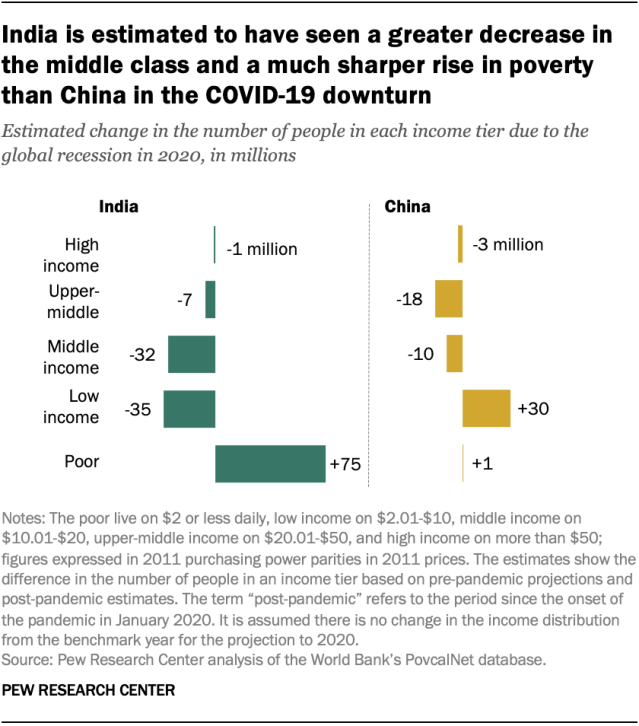
Indian economy shrank 7.3% in fiscal year 1920-21, its worst performance since independence in 1947. Nearly 230 million middle class Indians have slipped below the poverty line, constituting a 15 to 20% increase in poverty since Covid-19 struck last year, according to Pew Research. Middle class consumption has been a key driver of economic growth in India. Erosion of the middle class will likely have a significant long-term impact on the country's economy. “India, at the end of the day, is a consumption story,” says Tanvee Gupta Jain, UBS chief India economist, according to Financial Times. “If you never recovered from the 2020 wave and then you go into the 2021 wave, then it’s a concern.”  

India's Economic Performance Since Independence. Source: Bloomberg


Mainstream Indian media have long been afraid to cover the incompetence and failures of Prime Minister Modi's government. But this is finally changing with the COVID pandemic hitting India's newsrooms. Dozens of Indian reporters and their family members have died after being infected with coronavirus. 

Middle Class Decline in India, China. Source: Pew Research

The disastrous turn in the situation on the ground couple with the change in media coverage have brought focus on Modi government's failed policies in handling the deepening health crisis and its devastating impact. The images of large numbers of people gasping for breath and dying on the streets for lack of oxygen have shocked the world. The covid crisis has exposed the hollowness of India's super-power delusions fed by the country's western boosters who see it as a counterweight to China. An example of such western propaganda is a recent novel by retired US Admiral Janes Stavirides. 

Increase in Debt-to-GDP Ratio During Pandemic. Source: Business Standard

Prime Minister Modi's government has taken on significant debt to cope with the crisis of covid pandemic. As a result, India's debt-to-gp has increased 17% to 89.3%, the third highest among emerging economies. By contrast, Pakistan's debt-to-gdp has risen by a mere 1.6% to 87.2% during the pandemic, according to figures released by the IMF.  

Modi's Hindutva Rate of Growth in India


The authors of "2034: A Novel of the Next World War" portray Indians as heroes whose statesmen-ship de-escalates World War III, negotiates peace and helps India emerge as the new global superpower. Patel, the Indian uncle character of the Indian-American deputy national security advisor Sandeep Chowdhury tells him, "America’s hubris has finally gotten the better of its greatness." The authors imagine the United Nations headquarters moves from New York to Mumbai after the war. Had this book been written after watching thousands of Indian victims of COVID19 gasping for breath and dying daily on the streets of New Delhi, I think Ackerman and Stavridis would have conceived  and developed a completely different plot line for their novel.  

Related Links:

Haq's Musings

South Asia Investor Review

India Tops World Hunger Charts

Is India Superpoor or Superpower?

Rape as a Political Weapon Used By Hindutva

Hindu Nationalism Inspired By Nazism, Fascism

Rise of Islamophobia After Sept 11, 2001 Terrorist Attacks

700,000 Indian Soldiers Versus 7 Million Kashmiris

Modi's Kashmir Blunder and India-Pakistan Nuclear Conflict

Is India a Paper Elephant? 

Howdy Modi Rally Exposes Indian-Americans to Charges of Hypocrisy

Modi's Extended Lockdown in Indian Occupied Kashmir

Hinduization of India

Brievik's Hindutva Rhetoric

Indian Textbooks

India's RAW's Successes in Pakistan

Riaz Haq Youtube Channel

VPOS Youtube Channel