Saturday, November 24, 2018

Top Asia Investment Strategist Chris Wood Sees Strong Economy in Pakistan

Speaking at a recent Delhi investment conference, Managing Director and Chief Strategist Christopher Wood of CLSA (formerly known as Credit Lyonnais Securities Asia) surprised everyone, by saying that he loves the Pakistan stock market more than any other in Asia, according to Indian media reports. Wood, based in Hong Kong, has been named as the "best strategist" in Asia several times by magazines such as Asiamoney and Institutional Investor.

Christopher Wood of CLSA in New Delhi, India
Strong Recovery:

After recently visiting Pakistan for the first time,Wood wrote that Pakistan faces some short-term issues  but its "economy can recover quickly from its latest crisis once the current hole in the balance of payments is plugged, as is likely to be the case by a combination of China and IMF funding, combined with some extra support provided by Saudi Arabia".

Exports as Percentage of GDP. Source: CLSA
Wood explained that "minimal (private sector) debt points to a strong recovery". He said "it was interesting to learn of the resilience of the country’s private sector with debt concentrated very much at the government level". "Pakistan is well positioned to to benefit from the US-China trade war", he added. A similar conclusion has recently been reached by Tokyo-based Nomura Securities. Pakistan exports are currently just 8.2% of GDP, among the lowest in Asia.

Pakistan's Private Debt. Source: CLSA

Low Private Debt:

Wood wrote: "Consumer loans and SME loans accounted for only 12% of total bank loans (PKR498 billion and PKR422 billion respectively) at the end of 2Q18, while the loan-to-deposit ratio of the banking system is only 53%, down from 75% in 2008 (see following chart). Meanwhile, 69% of bank loans are to the corporate sector. But it is not leveraged, with corporate debt totaling only 16% of GDP."

Source: Grizzle.com

Stock Market Valuations:

Wood finds Pakistan stock market particularly attractive because of its significantly low valuation relative to its Asian peers. Wood wrote: "The attractive point is low valuations and high dividend yields. The market is on 6.9x forecast calendar 2019 earnings based on a universe of 47 stocks and a 2019 forecast dividend yield of 8.2%."

CLSA Recommended Weightings

Summary:


Top investment strategist Christopher Wood of CLSA sees strong recovery of Pakistan economy once the short-term balance of payments crisis is overcome.  Wood attributes it to "minimal (private sector) debt". He says "it was interesting to learn of the resilience of the country’s private sector with debt concentrated very much at the government level". "Pakistan is well positioned to benefit from the US-China trade war", he added. A similar conclusion has recently been reached by Tokyo-based Nomura Securities. Pakistan exports are currently just 8.2% of GDP, among the lowest in Asia.

Related Links:


Wednesday, November 21, 2018

Pakistan Among Top 3 Likely Beneficiaries of US-China Trade War

Nomura Securities strategists believe Malaysia, Japan and Pakistan are expected to be the top 3 beneficiaries of import substitution triggered by US-China trade war escalation. Nomura's analysis is based on detailed study of 7,705 items which will be subject to tariffs and counter tariffs by US and China if the stand-off continues. Nomura developed two indices as part of its research on the subject: NISI (Nomura Import Substitution Index) and NPRI (Nomura Production Relocation Index).

Source: Nomura Securities

The two economic rivals have announced a series of tit-for-tat tariffs on imports in recent months with US set to increase tariffs to 25% on a range of Chinese products in January, unless the two sides reach a trade deal.

Nomura research shows the US list affects 3,477 products imported by US from China valued at $270 billion. Product categories affected are in electrical equipment, appliances and components (29%), machinery and mechanical appliances (22.7%) and furniture and related products (11.9%). China’s tariff list covers 4,228 US products with a combined value of $110 billion, and consists of food, beverage and tobacco, and vehicles.

Malaysia will benefit most, in particular from its exports of “electronic integrated circuits, liquefied natural gas and communication apparatus”. “Vehicles with only spark-ignition internal combustion reciprocating piston engines” will help Japan, according to the analysis, while Pakistan’s cotton yarn exports could rise.

If the trade war between the world's top two economies continues for years, there will also be production relocation of industrial units from China to other countries in the region. The biggest likely beneficiaries of it will be Vietnam, Malaysia, Singapore and India. Pakistan is least likely to benefit from it.

New opportunities are likely to open up for several Asian nations, including Pakistan, to increase industrial production and grow exports if the US-China trade war escalates.

Will the US-China trade conflict escalate? Is Pakistan capable of seizing the opportunity to expand its exports? Will Pakistan's recurring balance of payments crises end?  Will Pakistan manage to avoid repeated IMF bailouts? Only time will tell.

Related Links:


Monday, November 19, 2018

Pakistani Author-Journalist Raza Rumi in Silicon Valley

Pakistani author-journalist Raza Ahmad Rumi recently visited San Francisco Bay Area as part of his book tour to promote his latest book "Being Pakistani: Society, Culture and The Arts". Raza had three speaking engagements in the Bay Area: (1) At the World Affairs Council in San Francisco on Wednesday November 14, 2018, (2) Institute of South Asia Studies at University of California at Berkeley on Thursday November 15, 2018, and (3) Pakistani-American Community Center in Silicon Valley, CA on Friday November 16, 2018.


The Silicon Valley event with Raza Rumi was organized by Talk4Pak.com, a media platform to connect Pakistani-Americans with Pakistan, at the Pakistani-American Community Center (PACC) in Milpitas, CA.


Raza was introduced by Riaz Haq at the PACC. Raza is a alumnus of London School of Economics. He has passed Pakistan Civil Service exam and served in senior positions in Pakistan government. He has also worked as a consultant at the Manila-based Asian Development Bank (ADB). He is currently  the editor of Lahore-based Daily Times. He lives in Ithaca, New York and teaches at Cornell University. His books include Delhi by Heart: Impressions of a Pakistani Traveller, The Fractious Path: Pakistan’s Democratic Transition and Identity and Faith and Conflict. His most recent collection of essays Being Pakistani: Society, Culture and The Arts was published in 2018 by Harper Collins.


In his presentation at the PACC, Raza Rumi challenged the prevailing one-dimensional narrative of Pakistan that wrongly focuses on extremism and terrorism. He acknowledged that Pakistan does have a serious problem of extremism and terrorism. But these problems also exist elsewhere, including in America where we have seen the rise of white supremacists' violence in recent years. He said part of his motivation in writing Being Pakistani is to highlight Pakistan's other dimensions including, for example, its ancient civilization that is thousands of years old as well its long Sufi traditions of tolerance and inclusiveness.

He mentioned the great ancient cities of Mehrgarh in Balochistan, Moenjodaro in Sindh and Harappa in Punjab. Raza emphasized in the areas that now make up Pakistan as a great center of learning with Taxila University, believed to be the world's first university, located close to the twin cities of Rawalpindi-Islamabad. He also mentioned Gandhara Civilization where Buddhism flourished in what is now Khyber PakhtunKhwa (KPK) province of Pakistan. Rumi sees Pakistanis as inheritors of these great civilizations.


Rumi talked of the poetry of Bulleh Shah and the work of miniaturist artist Shazia Sikander whose art is displayed at top museums across America and the wildly popular Coke Studio that offers a beautiful fusion of the traditional and the modern poetry and music. Raza said that it was "ironically" during General Musharraf's regime that the deregulation of media, telecom revolution and proliferation of news and entertainment channels allowed Pakistani arts and culture to flourish.

Rumi said that there are threats to mass media and free expression but there is also pushback by many who wish to preserve freedom. He said that Pakistan's progress is not linear but it is definitely making progress toward a democratic middle-class nation.  There is a growing middle class in Pakistan and the country recently saw peaceful elections and power transfer for the third time in the last decade. The process is far from perfect but the overall trends are positive.

Here's a video  recording of the event:

https://youtu.be/OJr2Jk6SNsg


Related Links:

Haq's Musings

Pakistan's Other Story

Pakistan Elections 2018

Pakistan Middle Class Growth

Coke Studio: Music Drives Coke Sales in Pakistan

Malaysia's Ex-PM Mahathir Stirs up Hadith Controversy

Riaz Haq's Sermon on Interfaith Relations

Misaq e Madina Inspired Quaid e Azam's Vision of Pluralist Pakistan

Riaz Haq's Ramadan Sermon

Alam vs Hoodbhoy: Clash of Ideas in Islam

Talk4Pak Youtube Channel

Riaz Haq's Youtube Channel

Thursday, November 15, 2018

Pakistan's Insatiable Appetite For Energy

Pakistan's consumption of oil and gas has rapidly grown over the last 5 years, an indication of the nation's accelerating economic growth. Pakistan is among the fastest growing LNG markets, according to Shell 2017 LNG report.

Pakistan Oil Consumption in Barrels Per Day. Source: CEIC.com

Oil consumption in Pakistan has shot up about 50% from 400,000 barrels per day in 2012 to nearly 600,000 barrels per day in 2017. During the same period, Pakistan's gas consumption has risen from 3.5 billion cubic feet per day to nearly 4 billion cubic feet per day, according to British Petroleum data.

Pakistan is among the fastest growing LNG markets, according to Shell 2017 LNG report.  The country has suffered a crippling energy shortage in recent years as demand has risen sharply to over 6 billion cubic feet per day,  far outstripping the domestic production of about 4 billion cubic feet per day. Recent LNG imports are beginning to make a dent in Pakistan's ongoing energy crisis and helping to boost economic growth. Current global oversupply and low LNG prices are helping customers get better terms on contracts.

Pakistan Gas Consumption in Billions of Cubic Feet Per Day. Source: CEIC.com

Since the middle of the 18th century, the Industrial Revolution has transformed the world. Energy has become the life-blood of modern economies. Energy-hungry machines are now doing more and more of the work at much higher levels of productivity than humans and animals who did it in pre-industrial era.

Every modern, industrial society in history has gone through a 20-year period where there were extremely large investments in the energy sector, and availability of ample electricity made the transition from a privilege of an urban elite to something every family would have. It seems that Pakistan is beginning to recognize it. If Pakistan wishes to join the industrialized world, it will have to continue to do this by having a comprehensive energy policy and making large investments in the power sector. Failure to do so would condemn Pakistanis to a life of poverty and backwardness.

Pakistan is heavily dependent on energy imports to drive its economy. These energy imports put severe strain on the country's balance of payments and forces it to repeatedly seek IMF bailouts.

Pakistan needs to develop export orientation for its economy and invest more in its export-oriented industries to earn the hard currencies it needs for essential imports including oil and gas. At the same time, Pakistan is stepping up its domestic oil and gas exploration efforts.  American energy giant Exxon-Mobil has joined the offshore oil and gas exploration efforts started by Oil and Gas Development Corporation (OGDC), Pakistan Petroleum Limited (PPL) and Italian energy giant ENI.

Related Links:

Haq's Musings

South Asia Investor Review

Pakistan Oil and Gas Exploration

US EIA Estimates of Oil and Gas in Pakistan

Pakistan Among Fastest Growing LNG Markets

Methane Hydrate Release After Balochistan Quake

Thar Coal Development

Why Blackouts and Bailouts in Energy-Rich Pakistan?

Riaz Haq's Youtube Channel

Monday, November 12, 2018

Pakistan's Scientific Output Doubles in 5 Years

Pakistan's quality-adjusted scientific output (Weighted Functional Count) as reported in Nature Index has doubled from 18.03 in 2013 to 37.28 in 2017. Pakistan's global ranking has improved from 53 in 2013 to 40 in 2017. In the same period, India's WFC has increased from 850.97 in 2013 to 935.44 in 2017. India's global ranking has improved from 13 in 2013 to 11 in 2017.

Top 10 Pakistan Institutions in Scientific Output. Source: Nature Index
Pakistan's Global Ranking:

Pakistan ranks 40 among 161 countries for quality adjusted scientific output for year 2017 as reported by Nature Index 2018.  Pakistan ranks 40 with quality-adjusted scientific output of 37.28. India ranks 11 with 935. Malaysia ranks 61 with 6.73 and Indonesia ranks 63 with 6.41. Bangladesh ranks 100 with 0.81. Sri Lanka ranks 84 with 1.36. US leads with almost 15,800, followed by China's 7,500, Germany 3,800, UK 3,100 and Japan 2,700.

Nature Index:

The Nature Index is a database of author affiliation information collated from research articles published in an independently selected group of 82 high-quality science journals. The database is compiled by Nature Research. The Nature Index provides a close to real-time proxy of high-quality research output and collaboration at the institutional, national and regional level.

The Nature Index includes primary research articles published in a group of high-quality science journals. The journals included in the Nature Index are selected by a panel of active scientists, independently of Nature Research. The selection process reflects researchers’ perceptions of journal quality, rather than using quantitative measures such as Impact Factor. It is intended that the list of journals amounts to a reasonably consensual upper echelon of journals in the natural sciences and includes both multidisciplinary journals and some of the most highly selective journals within the main disciplines of the natural sciences. The journals included in the Nature Index represent less than 1% of the journals covering natural sciences in the Web of Science (Clarivate Analytics) but account for close to 30% of total citations to natural science journals.

Pakistan vs BRICS:

In a report titled "Pakistan: Another BRIC in the Wall", author Lulian Herciu says that Pakistan’s scientific productivity has quadrupled, from approximately 2,000 articles per year in 2006 to more than 9,000 articles in 2015. During this time, the number of Highly Cited Papers featuring Pakistan-based authors increased tenfold, from 9 articles in 2006 to 98 in 2015.

Top Asian Universities:

British ranking agency Quacquarelli Symonds (QS) has recently ranked 23 Pakistani universities among the top 500 Asian universities for 2019, up from 16 in 2018.  Other South Asian universities figuring in the QS top universities report are 75 from India, 6 from Bangladesh and 4 from Sri Lanka.

In terms of the number of universities ranking in Asia's top 500, Pakistan with its 23 universities ranks second in South Asia and 7th among 17 Asian nations topped by China with 112, Japan 89, India 75, South Korea 57, Taiwan 36, Malaysia 26, Pakistan 23, Indonesia 22, Thailand 19, Philippines 8, Hong Kong 7, Vietnam 7, Bangladesh 6, Sri Lanka 4, Singapore 3, Macao 2 and Brunei 2.

Summary:

Pakistan's quality-adjusted scientific output (WFC) as reported in Nature Index has doubled from 18.03 in 2013 to 37.28 in 2017. Pakistan's global ranking has improved from 53 in 2013 to 40 in 2017.  Pakistan ranks 40 with quality-adjusted scientific output of 37.28. India ranks 11 with 935. Malaysia ranks 61 with 6.73 and Indonesia ranks 63 with 6.41. Bangladesh ranks 100 with 0.81. Sri Lanka ranks 84 with 1.36.  In a report titled "Pakistan: Another BRIC in the Wall", author Lulian Herciu says that Pakistan’s scientific productivity has quadrupled, from approximately 2,000 articles per year in 2006 to more than 9,000 articles in 2015. During this time, the number of Highly Cited Papers featuring Pakistan-based authors increased tenfold, from 9 articles in 2006 to 98 in 2015.   British ranking agency Quacquarelli Symonds (QS) has recently ranked 23 Pakistani universities among the top 500 Asian universities for 2019, up from 16 in 2018.

Related Links:

Haq's Musings

South Asia Investor Review

Pakistan Hi-Tech Exports Exceed A Billion US Dollars in 2018 

Pakistan Becomes CERN Member

Pakistani Scientists at CERN

Rising College Enrollment in Pakistan

Pakistani Universities Listed Among Asia's Top 500 Jump From 16 to 23 in One Year

Genomics and Biotech Research in Pakistan

Human Capital Growth in Pakistan

Educational Attainment in Pakistan

Pakistan Human Development in Musharraf Years

Thursday, November 8, 2018

Pakistan Consumer Confidence Index Reached All-Time High in Q2/2018

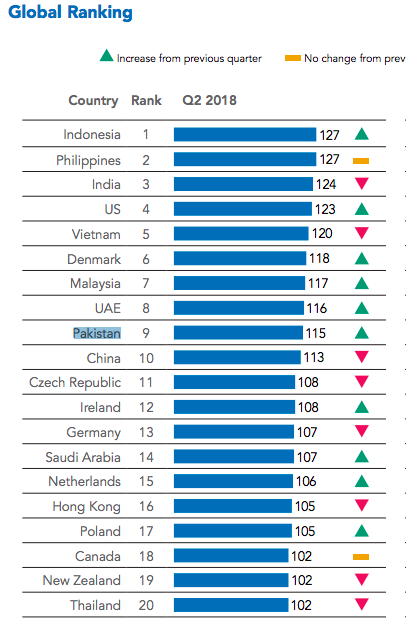
Pakistan consumer confidence index reached an all-time high of 115 in Q2/2018, up 8 points from 107 in Q1/2018, according to latest The Conference Board Global Consumer Confidence Survey (TCB-Global). Pakistan now ranks 9th in the world. Pakistan's neighbor India's consumer confidence was measured at 124, down 6 points from prior quarter. India ranks 3rd in the world.

Global Consumer Confidence Ranking. Source:  Nielsen


Here's an excerpt of the TCB-Global report on Pakistan:

"In Pakistan, consumer confidence has reached an all-time high of 115, following an 8-point increase. Consumers in Pakistan are increasingly optimistic about job prospects and their personal financial situation. However, it is uncertain whether the high level of confidence can be sustained in the future. Pakistan’s new government is likely to approach IMF for assistance to address the country’s worsening external balance, which might lead to significant fiscal and monetary tightening. This, along with rising consumer prices, will pose major challenges to consumer confidence post-election."

The survey indicates that Pakistan's domestic economy remains strong in spite of the rising concerns about balance of payments. The new Pakistani government headed by PTI leader Imran Khan is reporting some successes in alleviating these concerns with help from Islamabad's friends in Beijing and Riyadh. Saudi Arabia has already pledged $6 billion in cash and deferred oil payments. Since returning from a trip to Beijing, Pakistan's Finance Minister Asad Umar has said "Pakistan's immediate balance of payment crisis is over".  It's highly likely that Pakistan will seek yet another IMF bailout with conditions that will force spending cuts and cause economy to slow down this year. This will hurt consumer confidence.

Related Links:


Wednesday, November 7, 2018

Study: Indian Muslims Worse Off Than Untouchables and Falling Further

A recent Dartmouth study by three researchers has reported that "Muslims (in India) now have considerably worse upward mobility (29) today than both Scheduled Castes (37.4–37.8) and Scheduled Tribes (32.5–32.7). The comparable figure for African Americans is 34."

The research paper titled "Intergenerational Mobility in India: Estimates from New Methods and Administrative Data" says that "higher caste groups (in India) have experienced constant and high upward mobility over time, a result that contradicts a popular notion that it is increasingly difficult for higher caste Hindus to get ahead".

Dartmouth researchers' analysis focuses on two mobility measures: (i) the expected outcome of a child born into the bottom half of the parent outcome distribution (upward interval mobility, henceforth referred to as upward mobility); and (ii) the expected outcome of a child born into the top half of the parent distribution (downward interval mobility).

Indian Muslims at Bottom in Social Mobility. Source: Dartmouth College


Panel A  in the above figure presents bounds on trends in upward interval mobility, or the average rank among sons born to fathers in the bottom half of the father education distribution. Panel B presents bounds on trends in downward interval mobility, or the average education rank among sons born to fathers in the top half of the father education distribution. Panel C presents bounds on trends in the proportion of sons completing primary school, conditional on being born to a father in the bottom half of the education distribution. Panel D presents bounds on trends in the proportion of sons attaining a high school degree, conditional on being born to a father in the bottom half of the education distribution.

The Dartmouth paper by Sam Asher, Paul Novosad and Charlie Rafkin confirms what an Indian government commission headed by Justice Rajendar Sachar found back in 2006 by saying that "Muslim disadvantage has been widely noted, including by the well-publicized federal Sachar Report (2006)".  Here's an excerpt of the paper:

"India’s Muslims constitute a similar population share as the Scheduled Castes and Scheduled Tribes (14% for Muslims vs. 16.6% for SCs and 14% for STs). Muslims have worse socioeconomic outcomes than the general population (Sachar Committee Report, 2006). While Muslim disadvantage has been widely noted, including by the well-publicized federal Sachar Report (2006), there are few policies in place to protect them and there has not been an effective political mobilization in their interest. Muslims have also been frequent targets of discrimination and even violence."

The discrimination and violence against Muslims that the paper refers to has only gotten worse since the election of Hindu Nationalist leader Narendra Modi to India's highest office in India in 2014.

Earlier this year, an 8-year-old Muslim girl Asifa Bano was locked in a Hindu temple, drugged, gang-raped for several days and then bludgeoned to death in Indian occupied Kashmir, according to a report in a leading American newspaper.

Gang Rape Victim: 8-Year-Old Asifa Bano
Support of Rapists: 

The horror of a Muslim child's rape and murder was made even worse when the ruling BJP-affiliated right-wing Hindu lawyers marched in defense of her attackers. Prime Minister Narendra Modi reluctantly condemned the crime after waiting for several days. His belated acknowledgment came in response to international outrage.

Is this just another rape in India? Did the child's Muslim faith make her a target? Has Islamophobia gone mainstream in India?  To answer these questions, let us put some context to what is happening in Modi's India.

India saw about 39,000 rape cases reported in 2016, a 12% jump over the prior year, according to Indian crime statistics.  Children were reported as victims in 42% of the cases.

It is hard to say how many of the rape victims were Muslim.  What is known, however, is the exhortation by iconic Hindutva leaders to rape of Muslim women.  Vinayak Damodar Savarkar, one of the founders of right-wing RSS who Prime Minister Modi describes as "worthy of worship", is among them. After getting elected to the highest office in India, Modi paid tribute to Savarkar by laying flowers at his portrait that hangs in India's Parliament.

VD Savarkar, in one of his books titled Six Glorious Epochs of Indian History, elaborates on why raping of Muslim women is not only justified but encouraged.

Savarkar has used revisionist Hindutva history to exhort his followers to rape Muslim women as payback for historic wrongs he believes were committed by Muslim conquerers of India. “Once they are haunted with this dreadful apprehension that the Muslim women too, stand in the same predicament in case the Hindus win, the future Muslim conquerors will never dare to think of such molestation of Hindu women,” he writes.

Hindutva Revisionist History: 

American history professor Audrey Truschke, in her recently published book "Aurangzeb: The Life and Legacy of India's Most Controversial King" has argued that colonial-era British historians deliberately distorted the history of Indian Muslim rule to vilify Muslim rulers as part of the British policy to divide and conquer India.  These misrepresentations of Muslim rule made during the British Raj appear to have been accepted as fact not just by Islamophobic Hindu Nationalists but also by at least some of the secular Hindus in India and Muslim intellectuals in present day Pakistan, says the author.  Aurangzeb was neither a saint nor a villain; he was a man of his time who should be judged by the norms of his times and compared with his contemporaries, the author adds.

Truschke says the original history of the Mughal rule was written in Persian. However, it is the English translation of the original work that are often used to distort it. Here's what she says about it in her book:

"The bulk of Mughal histories are written in Persian, the official administrative language of the Mughal empire but a foreign tongue in India today. Out of necessity and ease, many historians disregard the original Persian text and rely instead on English translations. This approach narrows the the library of materials drastically, and many translations of the Mughal texts are of questionable quality, brimming with mistranslations and abridgments. Some of these changes conveniently served the agendas of the translators, especially colonial-era translations that tend to show Indo--Muslim kings at their worst so that the British would seem virtuous by comparison (foremost here is Elliot and Dowson's History of India as Told by Its Own Historians). Such materials are great for learning about British colonialism, but they present an inaccurate picture of Mughal India."

Modi's Record: 

In 2002 when Narendra Modi was chief minister of the Indian state of Gujarat, hundreds of young Muslim girls were sexually assaulted, tortured and killed.  These rapes were condoned by the ruling BJP, whose refusal to intervene lead to the rape and killing of thousands and displacement of 200,000 Muslims.

Since his election to India's top elected office, Modi has elevated fellow right-wing Hindu extremists to positions of power in India. Yogi Adiyanath, known for his highly inflammatory anti-Muslim rhetoric, was hand-picked in 2016 by Modi to head India's most populous state of Uttar Pradesh.

Adiyanath's supporters brag about digging up Muslim women from their graves and raping them. In a video uploaded in 2014,  he said, “If [Muslims] take one Hindu girl, we’ll take 100 Muslim girls. If they kill one Hindu, we’ll kill 100 Muslims.”

Yogi wants to "install statues of Goddess Gauri, Ganesh and Nandi in every mosque”.  Before his election, he said, “If one Hindu is killed, we won’t go to the police, we’ll kill 10 Muslims”.  He endorsed the beef lynching of Indian Muslim Mohammad Akhlaque and demanded that the victim's family be charged with cow slaughter.

Madhav S. Golwalkar, considered among the founders of the Hindu Nationalist movement in India, saw Islam and Muslims as enemies. He said: “Ever since that evil day, when Moslems first landed in Hindusthan, right up to the present moment, the Hindu Nation has been gallantly fighting to shake off the despoilers".

In his book We, MS Golwalkar wrote the following in praise of what Nazi leader Adolf Hitler did to Jews as a model for what Hindus should do to Muslims in India: "To keep up the purity of the Race and its culture, Germany shocked the world by her purging the country of the Semitic races -- the Jews. Race pride at its highest has been manifested here. Germany has also shown how well-nigh impossible it is for races and cultures, having differences going to the root, to be assimilated into one united whole, a good lesson for us in Hindusthan to learn and profit by."

Social Hostility Against Minorities in South Asia. Source: Bloomberg

Rise of Hindu Nationalists: 

The situation for India's minorities, particularly Muslims, has become a lot worse in the last two years with Hindu mobs raping and lynching Muslims with impunity. The 2016 election of anti-Muslim radical Hindu priest Yogi Adiyanath as Chief Minister of Uttar Pradesh, India's most populous state, is seen as a clear signal from Mr. Modi that his anti-Muslim policies will continue.

Mohammad Akhlaq is believed to be the first victim of Hindu lynch mobs claiming to be protecting the cow. He was accused of consuming beef. For more than a week Prime Minister Narendra Modi remained silent over the incident and even after he spoke about it, he did not condemn it outright. The ruling BJP officials even tried to explain it as the result of the genuine anger of the Hindus over the slaughtering of a cow.

Pew Research Report:

A Pew Research report from data collected in 2015, about a year after Modi rose to power, found that the level of hostility against religious minorities is "very high". In fact, it said India scores 9 for social hostilities against religious minorities on a scale of 0-10.   Other countries in "very high" category for social hostilities include Nigeria, Iraq and Syria. Pakistan's score on this scale is 7 while Bangladesh is 5.5.

Pew Research Report on Religious Freedom

History of Anti-Muslim Riots in India:

Paul Richard Brass, professor emeritus of political science and international relations at the Henry M. Jackson School of International Studies, University of Washington, has spent many years researching communal riots in India. He has debunked all the action-reaction theories promoted by Hindu Nationalists like Modi. He believes these are not spontaneous but planned and staged as "a grisly form of dramatic production" by well-known perpetrators from the Sangh Parivar of which Prime Minister Modi has been a member since his youth.

Here's an excerpt of Professor Brass's work:

"Events labelled “Hindu-Muslim riots” have been recurring features in India for three-quarters of a century or more. In northern and western India, especially, there are numerous cities and town in which riots have become endemic. In such places, riots have, in effect, become a grisly form of dramatic production in which there are three phases: preparation/rehearsal, activation/enactment, and explanation/interpretation. In these sites of endemic riot production, preparation and rehearsal are continuous activities. Activation or enactment of a large-scale riot takes place under particular circumstances, most notably in a context of intense political mobilization or electoral competition in which riots are precipitated as a device to consolidate the support of ethnic, religious, or other culturally marked groups by emphasizing the need for solidarity in face of the rival communal group. The third phase follows after the violence in a broader struggle to control the explanation or interpretation of the causes of the violence. In this phase, many other elements in society become involved, including journalists, politicians, social scientists, and public opinion generally. At first, multiple narratives vie for primacy in controlling the explanation of violence. On the one hand, the predominant social forces attempt to insert an explanatory narrative into the prevailing discourse of order, while others seek to establish a new consensual hegemony that upsets existing power relations, that is, those which accept the violence as spontaneous, religious, mass-based, unpredictable, and impossible to prevent or control fully. This third phase is also marked by a process of blame displacement in which social scientists themselves become implicated, a process that fails to isolate effectively those most responsible for the production of violence, and instead diffuses blame widely, blurring responsibility, and thereby contributing to the perpetuation of violent productions in future, as well as the order that sustains them."

"In India, all this takes place within a discourse of Hindu-Muslim hostility that denies the deliberate and purposive character of the violence by attributing it to the spontaneous reactions of ordinary Hindus and Muslims, locked in a web of mutual antagonisms said to have a long history. In the meantime, in post-Independence India, what are labelled Hindu-Muslim riots have more often than not been turned into pogroms and massacres of Muslims, in which few Hindus are killed. In fact, in sites of endemic rioting, there exist what I have called “institutionalized riot systems,” in which the organizations of militant Hindu nationalism are deeply implicated. Further, in these sites, persons can be identified, who play specific roles in the preparation, enactment, and explanation of riots after the fact. Especially important are what I call the “fire tenders,” who keep Hindu-Muslim tensions alive through various inflammatory and inciting acts; “conversion specialists,” who lead and address mobs of potential rioters and give a signal to indicate if and when violence should commence; criminals and the poorest elements in society, recruited and rewarded for enacting the violence; and politicians and the vernacular media who, during the violence, and in its aftermath, draw attention away from the perpetrators of the violence by attributing it to the actions."

Summary:

A recent Dartmouth study by three researchers has reported that "Muslims (in India) now have considerably worse upward mobility (29) today than both Scheduled Castes (37.4–37.8) and Scheduled Tribes (32.5–32.7). The comparable figure for African Americans is 34."  The Darthmouth paper adds that " (Indian) Muslims have also been frequent targets of discrimination and even violence."

India is seeing a spate of gang rapes and lynchings of Muslims by Hindu mobs who have been emboldened by the rise of anti-Muslim Hindu Nationalist leader Narendra Modi since his 2014 election to the highest office in India.  In their writings, iconic Hindutva leaders like Savarkar have encouraged rape of Muslim women. The elevation of radical Hindu Yogi Adiyanath to the top job in Uttar Pradesh by Mr. Modi has further alarmed India's Muslim minority. University of Washington's Professor Emeritus Paul Brass, who has documented the history of anti-Muslim violence in India,  describes it as "a grisly form of dramatic production" by well-known perpetrators from the Sangh Parivar of which Prime Minister Modi has been a member since his youth. Pew Research report on religious violence confirms India's status as a country with "very high" levels of social hostilities against religious minorities.  There appears to be no relief in sight for them at least in the foreseeable future.

Related Links:

Haq's Musings

Islamophobia Goes Mainstream

700,000 Indian Troops vs 10 Million Kashmiris

Muslim Lynchings in Modi's India

Yogi Adiyanath as UP CM

Hindu Nationalists Admire Hitler

Hinduization of India Under Modi

Muslim Victims of Gujarat 2002

India's Superpower Delusions: Modi's Flawed Policies

Saturday, November 3, 2018

How Does US Centcom See Saudi Arabia?

Popular Muslim American comedian Hasan Minhaj has come across a troubling US Central Command document that describes Saudis as having "Negro blood" in their ancestry. Minhaj recently talked about it in his Netflix Series "Patriot Act".

The welcome booklet for US military personnel joining a US mission to train Saudi troops in the Kingdom of Saudi Arabia (KSA) as recently as June 2018 read as follows: “The population of [Saudi Arabia] is mainly composed of descendants of indigenous tribes that have inhabited the peninsula since prehistoric times with some later mixture of Negro blood from slaves imported from Africa."

Here's what Minhaj said in Netflix's Patriot Act:

"Suddenly, America's marriage of convenience with Saudi Arabia is starting to feel outdated. How outdated? Our military has been working in Saudi Arabia for decades. And if you are sent on a training mission in Saudi Arabia, this is the official military document you get. It describes the Saudi people as indigenous tribes with some later mixture of Negro blood from slaves imported from Africa. Oh, America, even in boring technical manuals, you still somehow managed to be racist.This [expletive] is still on the Internet, you guys. But Hasan, you know, it was probably written a while ago. Really? It was updated June 2018. But Hasan, these things are like an iTunes user agreement. It's probably at the bottom. Oh, no. It's Chapter 1, Page 5. OK, but is Negro still a bad word - dictionary.com, offensive".

Minhaj's highlighting of the offensive language resulted in prompt removal it from the Centcom website. “We regret that inappropriate material was posted to our website without a more fulsome review and apologize to anyone who took offense,” said CENTCOM spokesman Capt. Bill Urban in a statement, per military newspaper Stars and Stripes. “We removed the document as soon as we were notified of the content, and it was returned to the originating office for revision.”

Related Links:


Haq's Musings


South Asia Investor Review

Does US Share Responsibility For ISIS?

Riaz Haq's Youtube Channel

Did the West Sow the Seeds of ISIS?

General Petraeus Debunks Allegations of Duplicity Against Pakistan

Unintended Consequences of Charlie Wilson's War

Jihadis Growing After Afghan and Iraq Wars

US Invasion of Iraq

Global Power Shift After Industrial Revolution

Seeing Bin Laden's Death in Wider Perspective

Straight Talk by Gates on Pakistan

What If Musharraf Had Said No to US After 911? 

Who Are the Haqqanis?

Creation of the State of Israel

Monday, October 29, 2018

Standard Chartered Bank: Pakistan Among Most Upwardly Mobile Emerging Nations

Pakistan is among the most upwardly mobile nations in the world, according to a new Standard Chartered Bank study titled "Climbing the Prosperity Ladder".

The Standard Chartered study looks into social mobility, financial proficiency and digital savviness among 11,000 emerging affluent consumers in China, Hong Kong, India, Indonesia, Kenya, Malaysia, Nigeria, Pakistan, Singapore, South Korea and the UAE. 34% of Pakistani respondents said their incomes have increased by more than 50% over the last 5 years while 44% said they have seen 10% or more income growth in the last year.

Socially Mobile Income Growth. Source: Standard Chartered Bank

China, India and Pakistan:

Standard Chartered study talks about the "fast-growing economies of China, India and Pakistan are providing abundant opportunities for scaling the social pyramid".  Here's an excerpt of the Standard Chartered report:

The fast-growing economies of China, India and Pakistan are providing abundant opportunities for scaling the social pyramid. Leading the way, in both China and India 67% of the emerging affluent are experiencing positive social mobility, while Pakistan is not far behind with 64%. Of the emerging affluent in these countries, India and Pakistan both have more than one in 10 (11%) that are experiencing supercharged social mobility, versus 7% in China. Strong earnings progression is fueling impressive rates of social mobility in all three countries. Many of the socially mobile have benefitted from a salary increase of 50% or more in the last five years – 34% in Pakistan, followed by 30% in India and 26% in China. This gap could widen, with India and Pakistan more optimistic about their future salaries than their Chinese counterparts. Almost half of the socially mobile in Pakistan (48%) and India (46%) predict another earnings increase of 50% or more in the next five years, whereas less than three in 10 (29%) expect the same in China. While the emerging affluent in China are more cautious about salary growth than their counterparts in fast-growing Pakistan and India, workplace remuneration is just one side of the social mobility equation. Education has been considered crucial to improving social standing in China for a long time, but the generational shift towards university access among the socially mobile is larger than any other market: more than nine in 10 have attended university (91%), compared to 34% of their fathers and 29% of their mothers.

Education Mobility:

Upwardly mobile Pakistanis have seen a significant increase in education levels. 89% of them have college degrees compared to 66% of fathers and 49% of mothers who did.

Socially Mobile Education Levels. Source: Standard Chartered Bank 

Gender Balance:

In terms of gender parity, 51% of socially supercharged in Pakistan are men and 49% are women.

Socially Mobile Gender Differences. Source: Standard Chartered

Intergenerational Mobility:

Are they better off than their parents? The answer is a resounding Yes for 79% of Pakistanis who feel better off than their parents.

Inter-generational Mobility. Source: Standard Chartered
Saving For Education:

Upwardly mobile Pakistanis see the value of education for their children. 18% of them say saving for their children's education is a top priority.

Saving For Education. Source: Standard Chartered

Summary:


Standard Chartered Bank study finds that Pakistan is among the most upwardly mobile nations in terms of income and education. 79% of Pakistanis feel they are better off than their parents.  34% of socially mobile Pakistani respondents say their incomes have increased by more than 50% over the last 5 years while 44% say they have seen 10% or more income growth in the last year. 89% of them have college degrees compared to 66% of fathers and 49% of mothers who did.

Related Links:


Sunday, October 28, 2018

Pakistani Universities Listed Among Asia's Top 500 Jump From 16 to 23 in One Year

British ranking agency Quacquarelli Symonds (QS) has ranked 23 Pakistani universities among the top 500 Asian universities for 2019, up from 16 in 2018.  Other South Asian universities figuring in the QS top universities report are 75 from India, 6 from Bangladesh and 4 from Sri Lanka.

Top 500 Asian Universities. Source: QS University Rankings 2019
South Asia Ranking:

In terms of the number of universities ranking in Asia's top 500, Pakistan with its 23 universities ranks second in South Asia and 7th among 17 Asian nations topped by China with 112, Japan 89, India 75, South Korea 57, Taiwan 36, Malaysia 26, Pakistan 23, Indonesia 22, Thailand 19, Philippines 8, Hong Kong 7, Vietnam 7, Bangladesh 6, Sri Lanka 4, Singapore 3, Macao 2 and Brunei 2.

National University of Singapore ranked number one in Asia followed by University of Hong Kong and Nanyang Technological University in Singapore. Tsinghua University and Peking University—both from China—round off the top five list in Asia.

Pakistani Universities Ranked Among QS Asia Top 500. Source: QS Top Universities 2019

Pakistan's Top Universities: 

National University of Sciences and Technology (NUST) is the top ranked university in Pakistan in QS Asia University Rankings 2019. NUST has moved up from 91st to 87th position. The second ranked university in Pakistan is Lahore University of Management Sciences (LUMS) at 95th position in the Asian ranking. These are the only two Pakistani universities ranked among the top 100 in the QS Asia University Rankings 2019. By contrast, India has 8 universities ranked among Asia's top 100.  My alma mater NED University of Engineering and Technology is ranked 15th among Pakistan's 23 universities included in Asia's top 500 for 2019.

Top 15 Asian Nations Publishing Research. Source: SCIMAGO

Pakistan has emerged as the country with the highest percentage of Highly Cited Papers compared with the BRIC countries (Brazil, Russia, India and China) in the last 10 years, according to Thomson Reuters. Pakistan has doe so despite the fact that its "R&D environment faced substantial economic challenges".

Source: Thomson Reuters
Pakistani Researchers Citations: 

In a report titled "Pakistan: Another BRIC in the Wall", author Lulian Herciu says that Pakistan’s scientific productivity has quadrupled, from approximately 2,000 articles per year in 2006 to more than 9,000 articles in 2015. During this time, the number of Highly Cited Papers featuring Pakistan-based authors increased tenfold, from 9 articles in 2006 to 98 in 2015.

Source: Thomson Reuters
The author asserts that his report provides comparisons between Pakistan and BRIC nations taking a look at productivity and leveraging contextual indicators. His analysis points to the fact that Pakistan can be benchmarked with emerging and dynamic countries such as those in the BRIC (Brazil, Russia, India and China) group.

The Thomson Reuters report has found that, in 2012, "Pakistan's normalized Citation Impact was higher than that of all of the BRIC nations".

CERN Membership:

In 2014, Pakistan became the first Asian country and only the third in the world after Turkey and Serbia to be honored with CERN's associate membership. The status of associate member is a step before full membership. As an associate member, Pakistan  is entitled to attend open and restricted sessions of the organization.

College and University Enrollment:

There are over 3 million students enrolled in grades 13 through 16 in Pakistan's 1,086 degree colleges and 161 universities, according to Pakistan Higher Education Commission report for 2013-14.  The 3 million enrollment is 15% of the 20 million Pakistanis in the eligible age group of 18-24 years.  In addition, there are over 255,000 Pakistanis enrolled in vocational training schools, according to Technical Education and Vocational Training Authority (TEVTA).

Graduation Day at NED Engineering University For 1300 Graduates in 2013
Pakistani universities have been producing over half a million graduates, including over 10,000 IT graduates, every year since 2010, according to HEC data. The number of university graduates in Pakistan increased from 380,773 in 2005-6 to 493,993 in 2008-09. This figure is growing with rising enrollment and contributing to Pakistan's growing human capital.

Source: UNESCO's Global Education Digest 2009


Higher education in Pakistan has come a long way since its independence in 1947 when there was only one university, the University of Punjab. By 1997, the number of universities had risen to 35, of which 3 were federally administered and 22 were under the provincial governments, with a combined enrollment of 71,819 students. A big spending boost by President Pervez Musharraf helped establish 51 new universities and awarding institutions during 2002-2008. This helped triple university enrollment from 135,000 in 2003 to about 400,000 in 2008, according to Dr. Ata ur Rehman who led the charge for expanding higher education during Musharraf years. There are 161 universities with 1.5 million students enrolled in Pakistan as of 2014.

R&D Investment: 

Rise of research and publications at Pakistani universities began during Musharraf years when the annual budget for higher education increased from only Rs 500 million in 2000 to Rs 28 billion in 2008, to lay the foundations of the development of a strong knowledge economy, according to former education minister Dr. Ata ur Rehman. Student enrollment in universities increased from 270,000 to 900,000 and the number of universities and degree awarding institutions increased from 57 in 2000 to 137 by 2008. Government R&D spending jumped seven-fold as percentage of GDP from 0.1% of GDP in 1999 to 0.7% of GDP in 2007. It has since declined as percentage of GDP.

Summary:

British ranking agency Quacquarelli Symonds (QS) has ranked 23 Pakistani universities among the top 500 Asian universities for 2019, up from 16 in 2018.  Other South Asian universities figuring in the QS top universities report are 75 from India, 6 from Bangladesh and 4 from Sri Lanka. Pakistani scientists and researchers are continuing to produced highly cited research in spite of serious economic and security challenges. Enrollment in higher education is rising and giving a boost to academic research. With better policy focus and more investment in higher education, Pakistan  can make an even greater impact with its young demographics.

Related Links:

Haq's Musings

South Asia Investor Review

Pakistan Becomes CERN Member

Pakistani Scientists at CERN

Rising College Enrollment in Pakistan

10 Pakistani Universities Among Asia's Top 300

Genomics and Biotech Research in Pakistan

Human Capital Growth in Pakistan

Educational Attainment in Pakistan

Pakistan Human Development in Musharraf Years